

Sample Category Title
US 30-Year Yield Hits 19-Year High — Oil Is Only Part of the Story
TL;DR: The US 30-year Treasury yield has climbed above 5.31%, its highest in 19 years, alongside oil's push through $90 — but fading Fed hike expectations and softer inflation data suggest structural forces like fiscal deficits and Fed credibility uncertainty are carrying the move as much as oil is.
Oil Above $90 Makes an Easy Explanation — Maybe Too Easy
US 30-year Treasury yield has climbed above 5.31%, highest level in 19 years, while 10-year yield sits around 4.73%. Brent has simultaneously pushed through $90 as US-Iran tensions intensify. Put those charts side by side and conclusion looks obvious: oil is driving another inflation scare, and bond investors are responding.
That story is not wrong. It is simply incomplete.
Treasury yields have repeatedly followed crude during Iran-related swings this year. They rose during oil spikes in July and again in early August, then retreated when crude plunged on hopes of de-escalation. Higher oil raises inflation expectations, and investors demand more yield from long-duration bonds to compensate.
But this time 30-year yield has reached a 19-year high while recent CPI and PPI readings have softened and markets have been aggressively cutting Fed hike expectations. September hike probability has fallen dramatically, yet long end keeps selling off. If oil were whole story, those counterweights should be doing more.
Oil May Be Triggering the Move, but Term Premium Is Carrying It
Energy still matters. Year-ahead inflation expectations have stayed above 4% for five straight months, so households have not fully bought into a benign inflation story. With Brent back above $90 and Hormuz shipping heavily disrupted, bond investors have legitimate reason to protect themselves against another energy-driven inflation impulse.
What oil explains best is timing. Each new escalation gives investors another reason to sell duration.
What it does not explain as well is level. Why should 30-year Treasury require its highest yield since 2007 when markets simultaneously think Fed needs substantially less tightening than feared only weeks ago?
Answer may be that long-end yields are increasingly pricing risks that Fed funds rate cannot solve quickly: huge government borrowing requirements, uncertainty about inflation-control framework and growing competition for investor capital.
Washington’s Deficit Does Not Disappear if Iran De-Escalates
Fiscal backdrop is most obvious structural candidate. The CBO recently raised its annual deficit estimate to $2.1 trillion, roughly $200 billion above earlier projection. Greater deficits mean greater financing needs, and greater financing needs mean more Treasury securities that investors must absorb.
For long end, mechanism is simple: if supply keeps increasing faster than natural demand, price has to fall until yield becomes attractive enough to clear market.
Unlike Brent, this pressure is persistent. US-Iran de-escalation can remove an oil premium within days. It cannot remove hundreds of billions of dollars of government borrowing requirements. That is why worsening fiscal profile can keep long yields elevated even after individual inflation scares fade.
It also changes how investors should interpret future bond rallies. Softer data may still pull 30-year yield lower, but if fiscal term premium has risen structurally, those declines may increasingly struggle to return yields to old ranges.
Fewer Fed Hikes Can Actually Mean Higher Long Yields
More unusual part of story comes from Fed Chair Kevin Warsh.
Warsh has resisted conventional forward guidance, leaving investors with less certainty about Fed reaction function. That matters because long bonds are not priced only on next meeting. Investors are making judgments about inflation and monetary policy over decades. Less clarity means more risk, and more risk means higher term premium.
This produces a counterintuitive possibility. When Warsh suggests rate hikes may not be preferred way to fight inflation, markets can price fewer hikes in near term but more inflation uncertainty in long term. Front-end rates fall, while 30-year yields rise.
That may be exactly why current bond move looks so strange. Markets are no longer expecting a long sequence of Fed hikes, but that does not necessarily mean investors have become more confident about inflation control.
If Fed were simply becoming less hawkish because inflation is clearly defeated, long end should welcome it. If Fed is becoming less predictable while inflation risks from oil, tariffs and repeated supply shocks persist, long-end investors may instead demand a larger buffer.
Wednesday’s Fed Minutes Could Help Separate Those Stories
This makes upcoming FOMC minutes more useful than headline 9–3 vote alone.
Markets already know three policymakers dissented in favor of tighter policy. More important question is how majority viewed repeated supply shocks and whether hold reflected confidence that inflation would fade or concern that labor market could no longer absorb aggressive tightening.
Minutes also predate softer July CPI, PPI and retail sales releases, so they should not be treated as current Fed forecast. Their value is in revealing reaction function: what risks policymakers were trying to insure against and what evidence they would need before changing course.
For 30-year bonds, clarity itself could matter. If minutes suggest Fed has a coherent threshold for responding to inflation, some credibility premium could ease. If they reinforce impression of a highly uncertain framework, long-end yields may stay stubbornly high even as September hike odds remain low.
AI Boom Is Also Competing for Same Pool of Money
Government is not only borrower asking markets to absorb more duration.
AI infrastructure buildout has generated a large wave of corporate issuance as technology companies finance data centers, power infrastructure and related capital expenditure. That supply gives institutional investors more alternatives to long-dated Treasurys.
This factor receives less attention because it does not produce a clean daily headline like Brent or CPI. But bond markets ultimately clear through supply and demand. Heavy Treasury issuance and unusually strong corporate borrowing arriving at same time increase competition for long-term capital.
Again, it is probably not the reason 30-year yield reached 5.31%. But together with fiscal deficits and greater uncertainty over Fed reaction function, it helps explain why long yields may be experiencing something more persistent than a temporary oil shock.
Watch What Happens When Oil Falls
Best test may come not when Brent rises again, but when it eventually falls.
If Iran tensions ease and crude drops back below $90 while 30-year yield retreats sharply, oil explanation gains credibility. Inflation premium was driving much of move and bond market can normalize as energy threat recedes.
If Brent falls and long yield barely follows, conclusion changes. Bond market would be signaling that structural pressures—fiscal supply, Fed credibility and competition for capital—have taken over.
That would have much broader implications than another Iran-driven volatility episode. Persistently high long yields feed directly into mortgage rates, corporate financing costs, equity valuations and financial conditions even if Fed itself stops hiking.
ActionForex's Technical View on the 30-Year Yield: 5.39 Could Tell Us Whether Something Bigger Is Changing
Chart is arriving at perfect place to test that thesis.
30-year yield is approaching 5.35 medium-term channel ceiling, while 5.39 marks 100% projection of 4.63 to 5.20 from 4.82. That cluster is a natural place for current advance to stall. Consolidation there would fit interpretation that latest surge partly reflects another round of oil and geopolitical repricing.
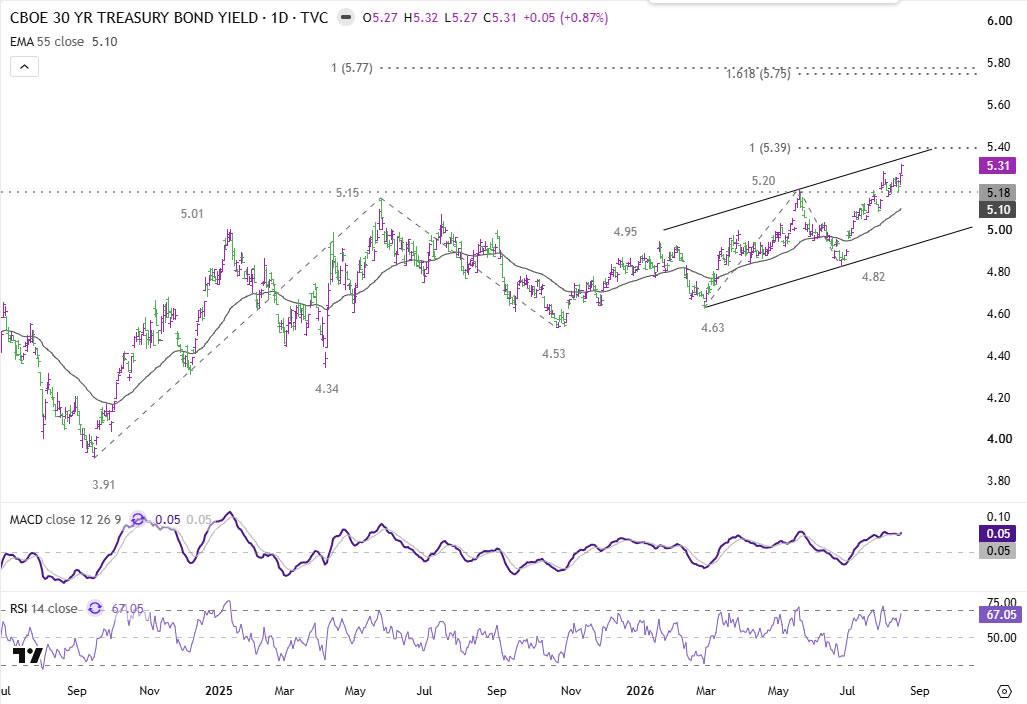
A decisive break through 5.35–5.39, however, would be much harder to dismiss. It would signal buyers are still demanding greater compensation even at yields already near two-decade highs. That could trigger acceleration toward 5.75, 161.8% projection target, and strengthen argument that something structural is changing underneath Treasury market.
On downside, break of 5.18 would indicate short-term top and shift focus back to 55-day EMA around 5.10, with scope for deeper correction.
Oil helped push 30-year yield toward this test. What happens at 5.35–5.39—and what happens when oil eventually retreats—will tell us whether Brent was driving Treasury selloff, or merely exposing a much bigger problem.
Key Takeaways
- The 30-year Treasury yield hit 5.31%, a 19-year high, even as September Fed hike odds fell sharply and inflation data softened — a mismatch oil alone doesn't fully explain.
- The CBO's raised $2.1 trillion deficit estimate points to a persistent, structural source of Treasury supply pressure that oil de-escalation can't remove.
- Warsh's minimal forward guidance can paradoxically push front-end rates down while long-end yields rise, since less policy clarity raises long-term uncertainty premium.
- Heavy AI-related corporate bond issuance is competing with Treasury supply for the same pool of long-duration capital, adding a less visible but real structural pressure.
- 5.35-5.39 is the key resistance cluster; a break opens 5.75, while a break of 5.18 support would point to a short-term top and correction toward 5.10.
Australia Westpac Consumer Sentiment Rebounds After RBA Hold, but Pessimism Persists
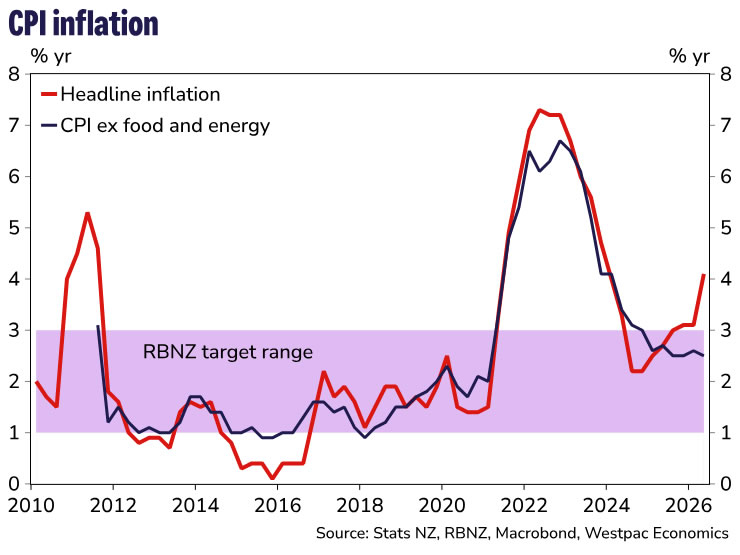
Australian consumer sentiment improved in August, with Westpac–Melbourne Institute Consumer Sentiment Index rising 83.9 to 88.9, a 6.0% monthly gain. Improvement was concentrated among mortgage holders and emerged almost entirely after RBA’s August 11 decision to keep rates unchanged. Current financial assessments led rebound, with family finances versus a year ago jumping 71.1 to 80.0, while time to buy a dwelling rose 85.4 to 95.7. Even so, headline index remains below neutral 100 and 9.7% weaker than a year earlier.
Forward-looking measures were less convincing. Family finances over next 12 months edged up 96.5 to 98.2, while expectations for economic conditions over next year rose 78.3 to 82.8. Unemployment Expectations Index deteriorated 129.9 to 135.7, moving above its long-run average, while House Price Expectations fell 118.0 to 110.8. Consumers also continue to anticipate tighter borrowing conditions: 59% expect mortgage rates to rise further, although RBA hold reduced uncertainty and lifted share expecting rates to stay unchanged or fall.
For RBA, survey shows August hold provided immediate relief without restoring confidence. Household pessimism, rising unemployment concerns and relatively subdued forward expectations suggest three hikes this year are still working through economy. Westpac argues Board is unlikely to have enough new evidence by September 28–29 meeting to conclude upside inflation risks have materialised, particularly with only one monthly inflation print ahead and labor market easing more than RBA had previously forecast. That keeps September tilted toward another hold even as Board retains explicit option to hike again.
Data Summary
| Component | Current | Previous | Trend |
|---|---|---|---|
| Consumer Sentiment Index | 88.9 | 83.9 | Improved 6.0% m/m |
| Family finances vs a year ago | 80.0 | 71.1 | Strong improvement |
| Family finances next 12 months | 98.2 | 96.5 | Modest improvement |
| Economic conditions next 12 months | 82.8 | 78.3 | Improved |
| Economic conditions next 5 years | 89.8 | 87.1 | Improved |
| Time to buy a major household item | 93.8 | 86.8 | Improved strongly |
| Time to buy a dwelling | 95.7 | 85.4 | Improved strongly |
| Unemployment Expectations Index | 135.7 | 129.9 | Job concerns increased |
| House Price Expectations Index | 110.8 | 118.0 | Weakened |
| Interest Rate Expectations Index | 158.8 | 162.6 | Eased slightly |
Key Takeaways
- Australian consumer sentiment rebounded 6.0% in August, with headline index rising from 83.9 to 88.9.
- Improvement was concentrated among mortgage holders and emerged almost entirely after RBA’s August 11 hold decision.
- Despite rebound, sentiment remains firmly pessimistic, below neutral 100 and 9.7% lower than a year ago.
- Current financial conditions improved more sharply than forward-looking expectations, suggesting consumers felt immediate relief without becoming substantially more confident about outlook.
- Family finances versus a year ago jumped from 71.1 to 80.0, while time to buy a dwelling rose from 85.4 to 95.7.
- Labor-market anxiety increased, with Unemployment Expectations Index rising from 129.9 to 135.7, above its long-run average.
- House Price Expectations Index fell from 118.0 to 110.8, pointing to weaker housing-market confidence.
- 59% of respondents still expect mortgage rates to rise further, although RBA hold reduced uncertainty and increased share expecting rates to stay unchanged or decline.
- Survey supports case for RBA patience in September: households are responding to restrictive policy, while rising unemployment concerns argue against assuming economy can absorb another hike easily.
Brent Crude Oil Wave Analysis
Brent crude oil: ⬆️ Buy
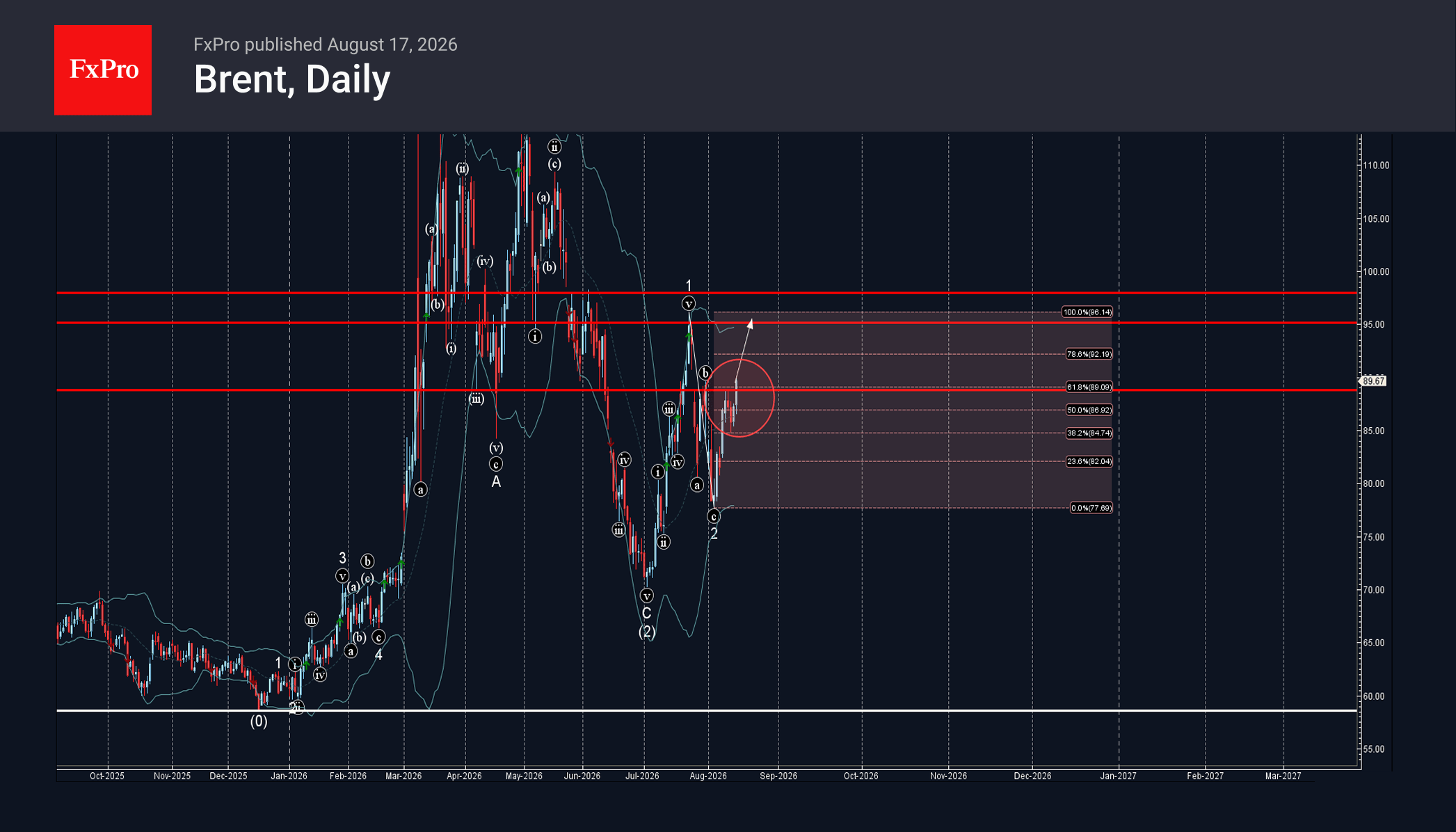
– Brent broke resistance zone
– Likely to rise to resistance level 95.00
Brent crude oil today broke the resistance zone between the resistance level 88.80 (top of the previous minor correction b) and the 61.8% Fibonacci correction of the downward ABC correction 2.
The breakout of this resistance zone is likely to accelerate the active short-term impulse wave 3 from the start of August.
Brent crude oil can be expected to rise further to the next resistance level 95.00 – which stopped the previous impulse wave 1 in July.
Bitcoin Wave Analysis
Bitcoin: ⬆️ Buy
– Bitcoin reversed from support zone
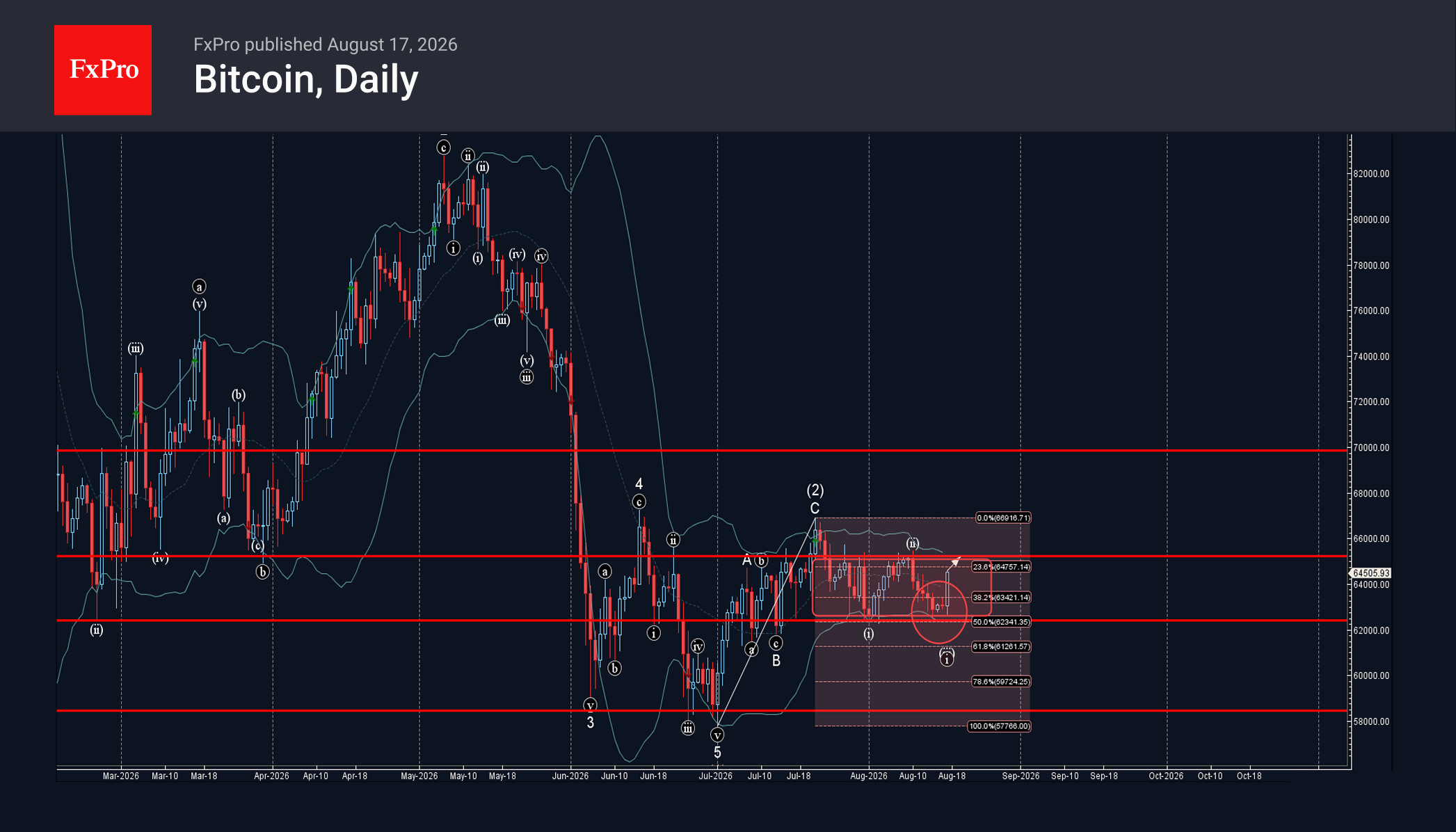
– Likely to rise to resistance level 65225.00
Bitcoin cryptocurrency recently reversed from the support zone between the support level 62420.00 (lower border of the sideways price range), lower daily Bollinger Band and the 50% Fibonacci correction of the upward impulse from July.
The upward reversal from this support zone stopped the earlier short-term impulse wave iii from the top of this sideways price range.
Given the improved sentiment across the crypto markets, Bitcoin cryptocurrency can be expected to rise further to the next resistance level 65225.00 – upper border of the active price range.
Eco Data 8/18/26
| GMT | Ccy | Events | Act | Cons | Prev | Rev |
|---|---|---|---|---|---|---|
| 00:30 | AUD | Westpac Consumer Confidence Aug | 6.00% | 4.10% | ||
| 06:00 | GBP | Claimant Count Change Jul | -11.0K | 16.5K | 6.7K | |
| 06:00 | GBP | ILO Unemployment Rate (3M) Jun | 4.90% | 4.80% | 4.90% | |
| 06:00 | GBP | Average Earnings Excluding Bonus 3M/Y Jun | 3.50% | 3.40% | 3.40% | |
| 06:00 | GBP | Average Earnings Including Bonus 3M/Y Jun | 4.10% | 4.10% | 4.30% | |
| 09:00 | EUR | Germany ZEW Economic Sentiment Aug | 34.2 | 30.1 | 26.3 | |
| 09:00 | EUR | Germany ZEW Current Situation Aug | -61.1 | -68.8 | -77.6 | |
| 09:00 | EUR | Eurozone ZEW Economic Sentiment Aug | 31.4 | 25 | 23.4 | |
| 12:30 | USD | Building Permits Jul | 1.44M | 1.37M | 1.37M | |
| 12:30 | USD | Housing Starts Jul | 1.24M | 1.34M | 1.43M | 1.42M |
| 12:30 | USD | Import Price Index M/M Jul | -0.40% | 0.40% | 0.30% | -0.30% |
| 13:15 | USD | Industrial Production M/M Jul | 0.20% | 0.30% | 0.10% | 0.30% |
| 13:15 | USD | Capacity Utilization Jul | 76.30% | 76.30% | 76.10% | 76.20% |
| 14:00 | USD | Pending Home Sales M/M Jul | -2.30% | 1.50% | -5.40% | -4.80% |
| 00:30 | AUD |
| Westpac Consumer Confidence Aug | |
| Actual | 6.00% |
| Consensus | |
| Previous | 4.10% |
| 06:00 | GBP |
| Claimant Count Change Jul | |
| Actual | -11.0K |
| Consensus | 16.5K |
| Previous | 6.7K |
| 06:00 | GBP |
| ILO Unemployment Rate (3M) Jun | |
| Actual | 4.90% |
| Consensus | 4.80% |
| Previous | 4.90% |
| 06:00 | GBP |
| Average Earnings Excluding Bonus 3M/Y Jun | |
| Actual | 3.50% |
| Consensus | 3.40% |
| Previous | 3.40% |
| 06:00 | GBP |
| Average Earnings Including Bonus 3M/Y Jun | |
| Actual | 4.10% |
| Consensus | 4.10% |
| Previous | 4.30% |
| 09:00 | EUR |
| Germany ZEW Economic Sentiment Aug | |
| Actual | 34.2 |
| Consensus | 30.1 |
| Previous | 26.3 |
| 09:00 | EUR |
| Germany ZEW Current Situation Aug | |
| Actual | -61.1 |
| Consensus | -68.8 |
| Previous | -77.6 |
| 09:00 | EUR |
| Eurozone ZEW Economic Sentiment Aug | |
| Actual | 31.4 |
| Consensus | 25 |
| Previous | 23.4 |
| 12:30 | USD |
| Building Permits Jul | |
| Actual | 1.44M |
| Consensus | 1.37M |
| Previous | 1.37M |
| 12:30 | USD |
| Housing Starts Jul | |
| Actual | 1.24M |
| Consensus | 1.34M |
| Previous | 1.43M |
| Revised | 1.42M |
| 12:30 | USD |
| Import Price Index M/M Jul | |
| Actual | -0.40% |
| Consensus | 0.40% |
| Previous | 0.30% |
| Revised | -0.30% |
| 13:15 | USD |
| Industrial Production M/M Jul | |
| Actual | 0.20% |
| Consensus | 0.30% |
| Previous | 0.10% |
| Revised | 0.30% |
| 13:15 | USD |
| Capacity Utilization Jul | |
| Actual | 76.30% |
| Consensus | 76.30% |
| Previous | 76.10% |
| Revised | 76.20% |
| 14:00 | USD |
| Pending Home Sales M/M Jul | |
| Actual | -2.30% |
| Consensus | 1.50% |
| Previous | -5.40% |
| Revised | -4.80% |
Dollar Index Breaks Key Supports
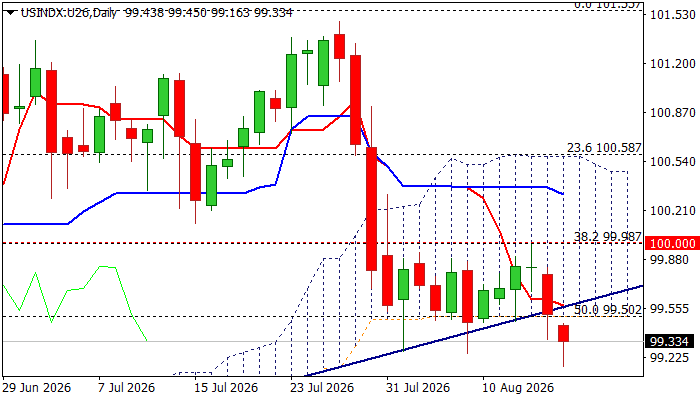
The dollar index hit the lowest levels in two months on Monday, following eventual break of key 99.50 support zone (daily Ichimoku cloud base / trendline support) which recently resisted several attacks.
The dollar is in red for the second consecutive day, deflated by growing bets that the US central bank will keep interest rates unchanged in September, after key economic indicators showed further weakening of the labor sector and inflation eased in July.
Fresh weakness also violated the floor of the range (99.25/99.95) that extends into third week, with sustained break here to confirm bearish signals and (break of cloud base / trendline) and generate fresh signal of bearish continuation of the fall from 101.48.
Daily technical studies are almost in full bearish setup that supports near-term action for acceleration towards next target at 99.00 (200DMA / Fibo 61.8% of 97.44/101.55), guarding 98.67 (May 29 trough) and 98.41 (Fibo 76.4%).
Broken cloud base reverts to solid resistance which should cap upticks and keep fresh bears in play.
Res: 99.50; 100.00; 100.16; 100.31
Sup: 99.16; 99.00; 98.67; 98.41
Will the S&P 500 Stay at the Top?
- Impressive corporate results have propelled the S&P 500 to record highs.
- The US stock market may be entering a ‘Goldilocks’ phase.
The S&P 500 has retreated from its record highs amid concerns about a cooling US economy. Until now, its resilience, coupled with impressive corporate results, had enabled the stock market to scale new heights. However, falling employment and retail sales, deteriorating consumer sentiment and slowing inflation point to weaker demand.
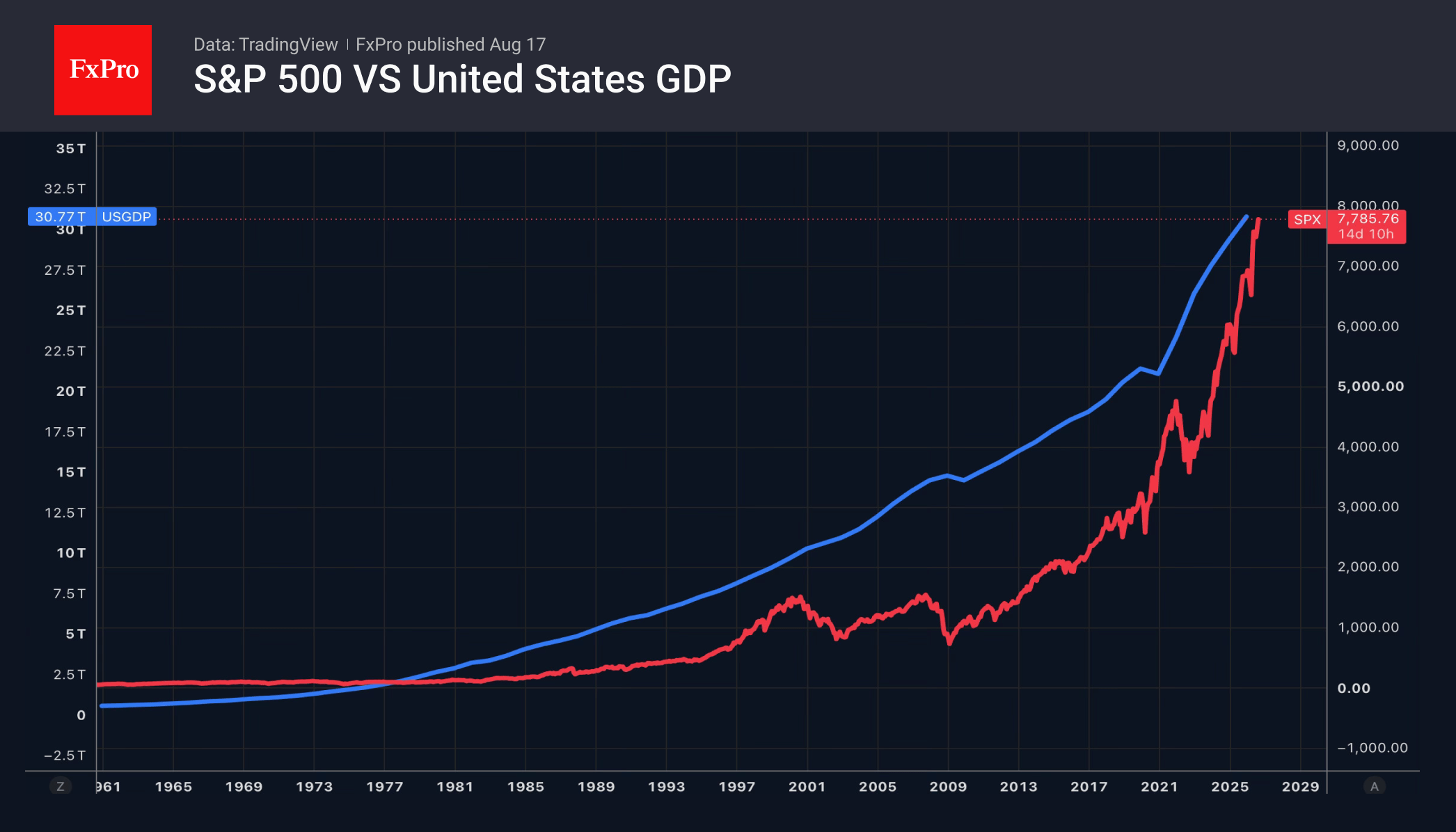
In the second quarter, profits at tech giants rose by 31%, exceeding the already optimistic forecast of 23%. The former figure is a record, while the latter is among the best outside post-recession recoveries. These gains have been achieved through increased productivity, as more companies adopt AI. Around 90% of listed companies have reported their financial results, and the S&P 500 is currently on track for its best half-year earnings-per-share performance since 2021.
Corporate earnings growth is outpacing that of the broad stock market index, leading to a fall in the forward P/E ratio from 26 at the start of the year to 22. The decline in the financial multiple suggests that there is no bubble to speak of. Fundamental valuations make the S&P 500 an attractive buy. Unsurprisingly, Wall Street’s consensus forecast for the broad stock index at the end of 2026 has been raised to 7,894. Experts believe it will rise by at least a further 1%. At the same time, analysts have raised their earnings-per-share forecasts from 15% in January to 27%.
Such figures have not been seen outside of recovery periods following downturns. The instances in which the S&P 500 has posted double-digit growth at the end of each of four consecutive years can be counted on the fingers of one hand. Signs of a slowdown in the US economy are a warning; however, if GDP growth falls only slightly, a so-called Goldilocks scenario will emerge – a combination of a slow but still strong economy and a Federal Reserve reluctant to raise interest rates.
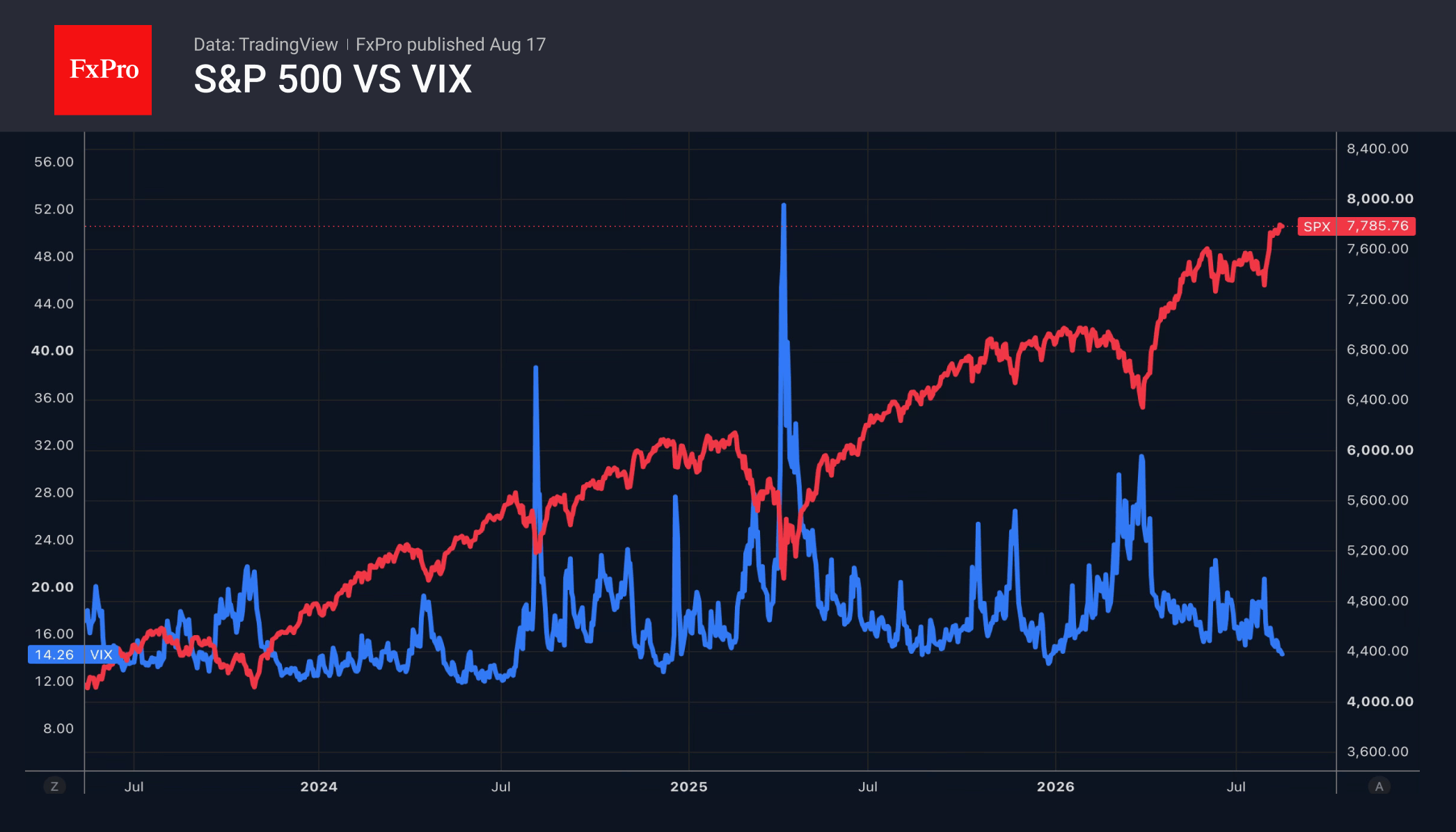
The VIX’s fall to its lowest level since late December signals that greed is dominating the equity market. At the same time, derivatives are pricing in modest daily gains for the S&P 500 through to the end of August, not exceeding 0.8%. The key events are NVIDIA’s corporate earnings report and the Jackson Hole Economic Symposium.
The FxPro Analyst Team
Sunset Market Commentary
Markets
Moves in core bonds continue to point at bear steepening pressures. The 30-yr in the US turned a 2 bps loss into a 2 bps gain for the day, keeping the tenor near the year-to-date highs, which in turn are the highest levels since 2007. Changes in the other parts of the curve are negligible. Similar dynamics are playing out in Europe. Both the 30-yr European swap and German bund yield are trading close to or at new 15-year peaks. The front end of the curve remains more or less locked with money markets continuing to entertain the idea of one more ECB rate hike in the short run and an additional move later (currently discounted for Q1 2027). The stalemate in US-Iran talks is a supporting factor in a daily perspective, alongside the structural upward pressures coming from public finance risk premia. There are renewed skirmishes in Lebanon, more strikes on vessels in the Hormuz Strait and US president Trump threatening to bomb Oman as well if it "gets in the way". His verbal attack comes after reports that Oman and Iran are negotiating a deal without the US on how the Hormuz Strait should be managed. A senior Iranian official meanwhile told Reuters that the country shifted from a defensive posture to a "fully offensive" one and warned of a regional escalation if diplomacy fails. Oil prices nudge slightly higher but remain below the $90 threshold. European stock markets remained positive for much of the session but began grinding lower when the first US dealers arrived. Wall Street trades slightly lower with the Nasdaq "outperforming" on blockbuster revenue growth by Claude-owner Anthropic.
The US dollar starts the new week the way it ended the previous one, on the backfoot. EUR/USD extended gains beyond 1.16 and tested the 38.2% recovery on the 2026 decline at 1.1614. Failure to break through resulted in some minor return action lower, back towards the big figure. The trade-weighted dollar index dipped to the weakest levels since mid-June and is currently changing hands around 99.42. USD/JPY steadies around 159.3. Sterling is showing similar muted market moves with EUR/GBP copy-pasting last week by treading water near 0.855. GBP/USD does show some action, inspired by dollar weakness. Cable moves to a three-month high of 1.356.
News & Views
Canadian July inflation figures printed slightly above consensus. Headline inflation accelerated by 0.5% M/M (vs 0.4% expected) with the Y/Y-figure hitting 3% (up from 2.8%) for only the second time since December 2023. In July, goods prices increased by 0.3% while services costs increased by 0.7%. On a yearly basis, prices for gasoline grew at a faster rate in July (+25.7%) compared with June (+20.5%). Prices for travel tours rose also at a faster pace in July (+15.2% Y/Y) compared with June (+6.8%). Contributing to higher prices were more expensive hotels and flights to US destination cities, coinciding with the hosting of World Cup matches. Core inflation gauges showed stickiness as well with the Bank of Canada's preferred trimmed mean gauge stabilizing at an upwardly revised 1.9% Y/Y. The front end of the Canadian yield curve underperforms following the inflation numbers with the 2-yr yield gaining around 3 bps. The market-implied probability of a December BoC rate hike rises from around 55% last Friday to currently 73%. The Loonie gradually extends its recent good run (higher commodity prices) against a lackluster US dollar with USD/CAD trading at 1.3850 for the first time since early June.
First Q3 Chinese economic data disappointed, pointing to a continued slowdown in growth momentum. Disruptions caused by extreme weather added to the effect of fiscal austerity. Recall that Q2 2026 GDP growth came in at 4.3% Y/Y, below the government's official 4.5%-5% target range. Domestic demand provided the biggest miss with retail sales growth slowing from 1% Y/Y to 0.6% Y/Y and from 1.3% YtD Y/Y to 1.2%. The investment recession deepens with fixed asset investment growth falling by 6.7% YtD YoY from -5.7% in June. Industrial production growth failed to offset these developments, growing by 4.5% Y/Y (from 5.3%) and by 5.3% YtD Y/Y (from 5.4%). There's a big divergence between ongoing strength in the AI sector (advanced manufacturing) and weakness in most of the rest of the Chinese economy.
Canadian Inflation Heated Up in July
- Headline CPI inflation ticked up slightly further than markets were expecting to 3.0% year-on-year (y/y) in July, from 2.8% in June, thanks to high gasoline prices. That was one tick higher than markets were anticipating.
- Prices at the pump rose 25.7% y/y in July, compared with 20.5% in June. Price pressures at grocery stores cooled further, with prices for food purchased from stores up 3.1% in July, down from 3.9% y/y in June.
- Shelter inflation cooled further in July to 1.3% y/y from 1.5% y/y in June. Homeowners' replacement costs are down 2.1% versus a year ago, which Statistics Canada cites as the main category exerting downward pressure on Canadian inflation.
- Services inflation ran hotter at 2.5% y/y, driven by higher travel-related costs. The effects of the World Cup showed up in prices for travel tours, which were up 15.2% y/y on more expensive flights and hotels in U.S. cities hosting World Cup games. Higher jet fuels costs are also contributing to increased airfares which were up 12% y/y in July, relative to 9.6% in June.
- The Bank of Canada's preferred core inflation metrics (median and trim) averaged 2.0% in July versus 1.9% in June.
Key Implications
- Inflation ticked up slightly in July due to due to higher prices at the pump and higher travel-related costs due to the World Cup. Core inflation remained bang on the Bank of Canada's 2% target. We expect the Bank of Canada's (BoC) core inflation measures to drift a little bit above 2% in the coming months on some pass through of higher energy costs to other prices in the economy.
- Short-term Government of Canada bond yields are up slightly on the higher inflation read, but given the travel impact on inflation should fade in the coming months, we aren't too concerned that core inflation running slightly above 2% should spook the BoC into raising interest rates. The BoC has noted that Canada continues to deal with the confidence shock of on-again-off-again tariff threats from the U.S., which given there is no deal as yet to avert the 50% tariffs set to come into effect on August 19th, remains a clear downside risk to Canada's economy.
The Yen: Has the Trend Finally Been Broken?
- Currency interventions spooked speculators trading USDJPY.
- The likelihood of a Fed rate hike in 2026 continues to fall.
The US dollar fell back to a two-month low after a sudden 0.6% decline in US retail sales in July, versus an expected 0.1% rise. This unwelcome surprise, coupled with a decline in the University of Michigan’s consumer sentiment index, has reduced the likelihood of the Fed tightening monetary policy in September to 31%, and by the end of the year to 64%.
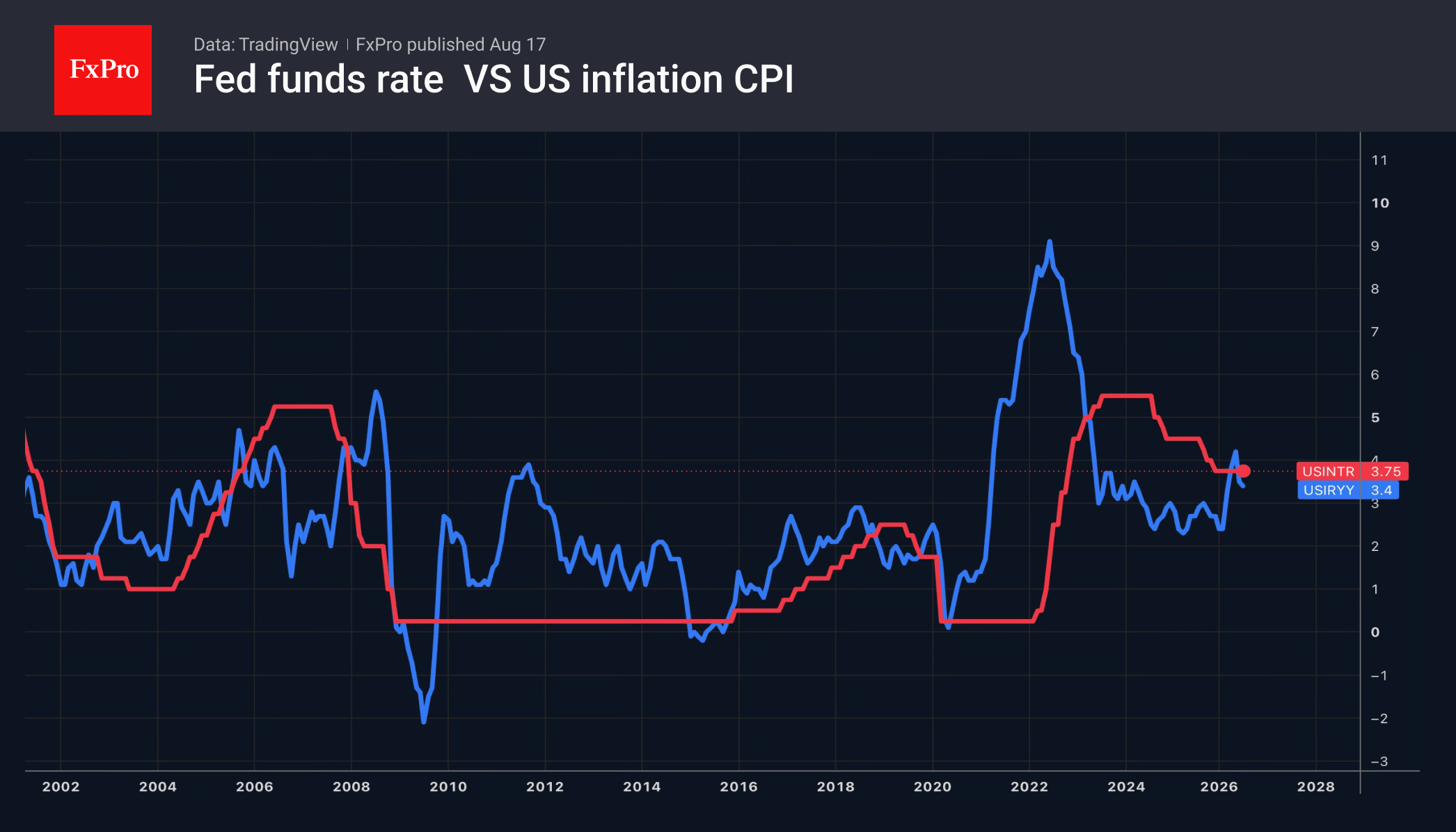
Goldman Sachs believes these figures are still overestimated. A federal funds rate hike in September is highly unlikely against a backdrop of slowing inflation, falling employment and declining retail sales. Looking ahead, the bank believes that consumer price inflation will continue to fall without any intervention from the Fed.
The only factor that might disrupt the disinflationary process is if Brent breaks out of the $80–90 per barrel trading range. Moreover, Israel’s attacks on Lebanon heighten the risks of such a scenario due to the potential escalation of the conflict in the Middle East. However, if Brent fails to break out of its consolidation range, the chances of a slowdown in US inflation will increase. This would cause the Fed to lag behind other central banks in tightening monetary policy and would weaken the dollar.
The decline in the US dollar has allowed USDJPY bears to push prices away from the key round 160, thereby reducing the risk of further currency interventions by the US and Japan. Since the previous intervention, hedge funds have halved their short positions in the yen.
Speculators appear less confident in the continuation of the USDJPY rally than they were in May–July. They have finally taken on board that Sanae Takaichi’s government will not stand in the way of monetary tightening, and that the BoJ may raise rates as early as September. The probability of such an outcome has risen to 80 per cent. The futures market is fully convinced that monetary tightening will take place in October.
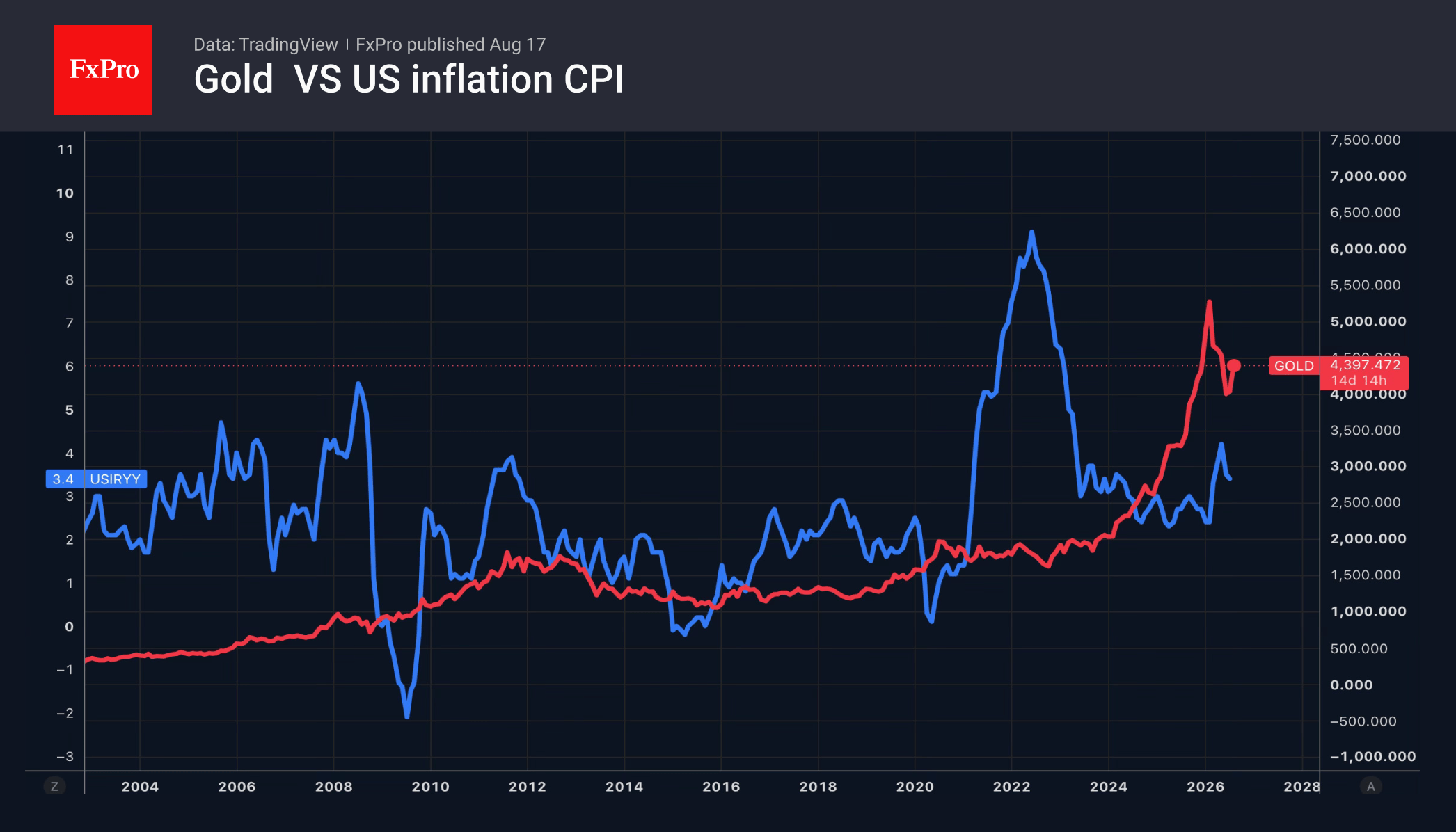
Disappointing US retail sales figures have helped gold climb back above $4,400 per ounce. For the precious metal, there is little difference between a recession and stagflation. In either case, it is poised to continue its rally. If US GDP growth continues to fall, it will not matter how inflation behaves. The bulls will be able to capitalise on its dynamics.
The FxPro Analyst Team