Sample Category Title
Australia Annual Wage Growth Slows to 3.2% as Private-Sector Pay Moderates
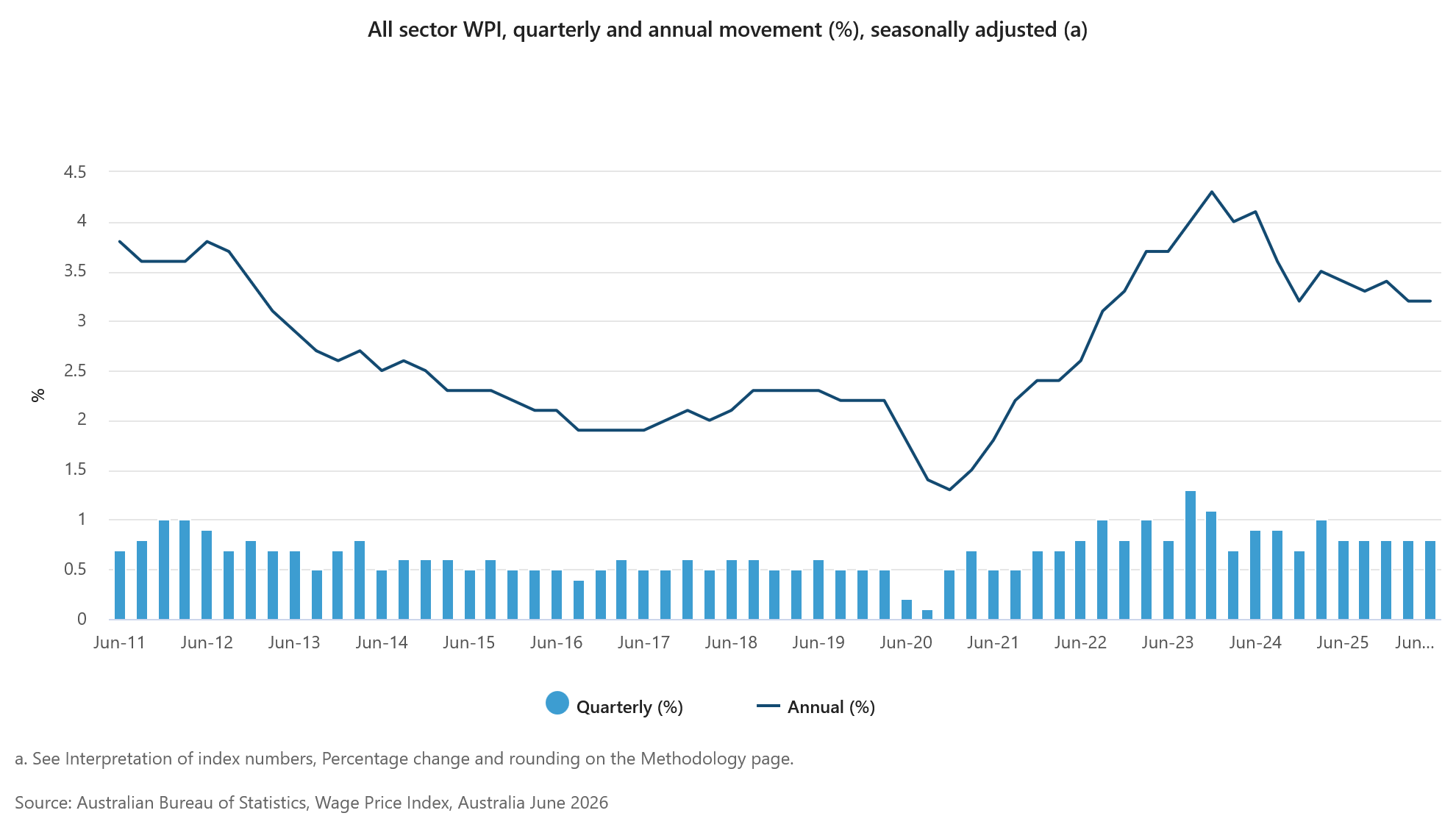
Australia’s wage growth held steady on a quarterly basis but continued to cool over the year, offering some reassurance that labor-cost pressures are not reaccelerating. Wage Price Index rose 0.8% q/q in Q2, matching expectations and extending the same quarterly pace for a fifth consecutive quarter. Annual wage growth slowed from 3.4% a year earlier to 3.2%, remaining well below the 4.3% peak reached in late 2023.
Moderation was clearer in private sector. Private wages rose 0.7% q/q, while annual growth eased from 3.2% in Q1 to 3.1%, and from 3.4% in Q2 2025. Public-sector wages were firmer at 0.9% q/q and 3.4% y/y, with annual growth unchanged from Q1 but down from 3.7% a year earlier. Public-sector pay has now outpaced private-sector growth for six consecutive quarters, driven in Q2 by state government public-service increases and scheduled Commonwealth agreement rises.
The distribution of wage increases also points toward gradual cooling. 79% of jobs recorded wage rises of less than 4% over the past year, up from 75% a year earlier and highest share since Q2 2022. ABS said decline in larger pay rises has contributed to slower overall wage growth. In original terms, Public administration and safety recorded a 1.1% quarterly increase, while Health care and social assistance rose 0.5%.
For RBA, report does not eliminate inflation concerns, but it offers little evidence that wages are becoming a fresh source of upside pressure. Board has deliberately kept another rate hike on table if inflation risks materialize, yet slowing annual wage growth and softer private-sector pay reduce urgency from labor-cost side. With public-sector wages still comparatively firm, RBA is unlikely to dismiss wage pressures entirely, but upcoming inflation and employment data should carry greater weight in determining whether retained tightening bias needs to be used.
Data Summary
| Indicator | Actual | Expected | Previous |
|---|---|---|---|
| Wage Price Index q/q | 0.8% | 0.8% | 0.8% |
| Wage Price Index y/y | 3.2% | — | 3.3% |
| Private Sector Wages q/q | 0.7% | — | 0.8% |
| Private Sector Wages y/y | 3.1% | — | 3.2% |
| Public Sector Wages q/q | 0.9% | — | 0.8% |
| Public Sector Wages y/y | 3.4% | — | 3.4% |
| Jobs with wage rises below 4% | 79% | — | 75%* |
| Public Administration & Safety q/q | 1.1% | — | — |
| Health Care & Social Assistance q/q | 0.5% | — | — |
*Compared with Q2 2025.
Key Takeaways
- Australia Wage Price Index rose 0.8% q/q for a fifth consecutive quarter, matching expectations.
- Annual wage growth eased to 3.2%, down from 3.4% a year earlier and well below late-2023 peak of 4.3%.
- Private-sector wages softened further, with annual growth easing from 3.2% to 3.1%.
- Public-sector wages remained firmer at 3.4% y/y, outpacing private-sector growth for a sixth straight quarter.
- State government wage rises and scheduled Commonwealth pay increases were key supports to public-sector growth.
- 79% of jobs recorded wage rises below 4%, up from 75% a year earlier, showing larger pay increases are becoming less common.
- For RBA, data do not point to renewed wage acceleration. That reduces urgency for another hike from labor-cost side, even as Board keeps tightening option open if broader inflation risks strengthen.
Wti Crude Oil Charges Higher with Fed Minutes Set to Test Bulls
Key Highlights
- WTI Crude Oil started a fresh increase above the $84.00 zone.
- A bullish trend line is forming with support at $83.50 on the 4-hour chart of XTI/USD.
- Gold prices struggled to clear the $4,450 resistance.
- GBP/USD managed to remain stable above 1.3500 after the UK’s employment report.
WTI Crude Oil Price Technical Analysis
WTI Crude Oil prices formed a base above $80.50 against the US Dollar. The price started a fresh increase and traded above the $82.50 resistance.
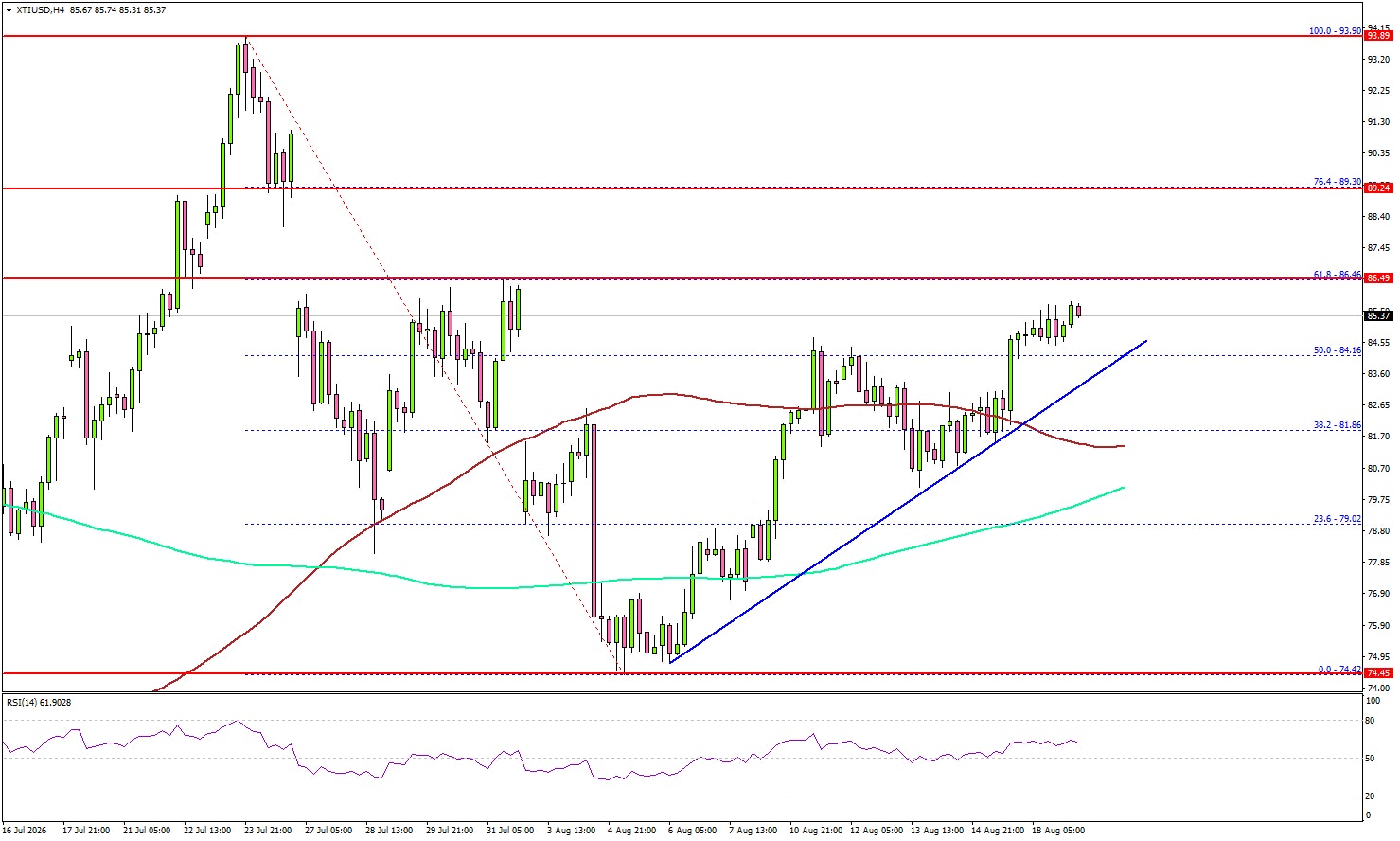
Looking at the 4-hour chart of XTI/USD, the price settled above the $84.00 level, the 100 simple moving average (red, 4-hour), and the 200 simple moving average (green, 4-hour). There was a clear move above the 50% Fib retracement level of the downward move from the $93.90 swing high to the $74.42 low.
On the upside, the price could face resistance at $86.50 and the 61.8% Fib retracement level. The next resistance might be $87.80. A close above $87.80 could send Oil prices toward $89.30.
If there is a pullback, the price might find support at $84.00. The first major support could be near the $83.50 zone. There is also a bullish trend line forming with support at $83.50. The next support might be $82.20. The main support might be $81.20 and the 100 simple moving average (red, 4-hour).
A close below $81.20 might even push the price toward $80.00 and the 200 simple moving average (green, 4-hour). Any more losses could open the door for a push below $76.50.
Looking at Gold, the price started a decent increase, but it must settle above $4,450 to continue higher in the near term.
Economic Releases to Watch Today
- ECB President Lagarde’s speech.
- FOMC Minutes.
Hormuz Crisis Turns Stagflationary as Silver Starts to Crack
TL;DR: The Hormuz crisis is shifting from an oil-and-bond story to a broader risk-off one, with equities weakening, Copper breaking lower, and Silver losing its rebound structure — a sign its industrial-demand exposure is becoming a liability rather than an advantage.
Silver Is Starting to Feel the Other Side of the Oil Shock
For several days, the Hormuz crisis was primarily an oil-and-bond story. Brent climbed, inflation fears returned, and global yields pushed higher. Now the second half of the trade is beginning to appear: equities are weakening, Copper has broken lower, and Silver is starting to lose its rebound structure.
That shift comes as the US-Iran confrontation moves beyond simple diplomatic stalemate. The June 17 ceasefire framework expired August 17 without renewal, but the formal deadline mattered less than the deterioration that followed. Another tanker was struck in the Strait of Hormuz, Tehran laid out sweeping conditions for reopening the waterway, and Washington hardened its own rhetoric. More importantly, US Special Envoy for Peace Jared Kushner indicated Iran is unwilling to compromise on US demands, suggesting current talks are failing to narrow differences rather than merely moving slowly.
Brent has responded by extending its advance toward $92, with WTI around $85. But Silver's reaction increasingly shows why this is no longer just a commodity-supply story.
Higher Oil Is Lifting Yields — and Starting to Hurt Growth Assets
The bond market has taken the escalation seriously. The US 30-year yield has reached approximately 5.33%, its highest in 19 years, while the 10-year is hovering around 4.72–4.75%. Germany's 10-year Bund has surged to around 3.27%, its highest level since 2011.
That global move gives the current shock a stagflationary character. Hormuz disruption threatens higher oil and freight costs, which keep inflation expectations elevated and reduce room for central banks to ease policy. But the resulting rise in yields also tightens financial conditions and weighs on valuations and demand.
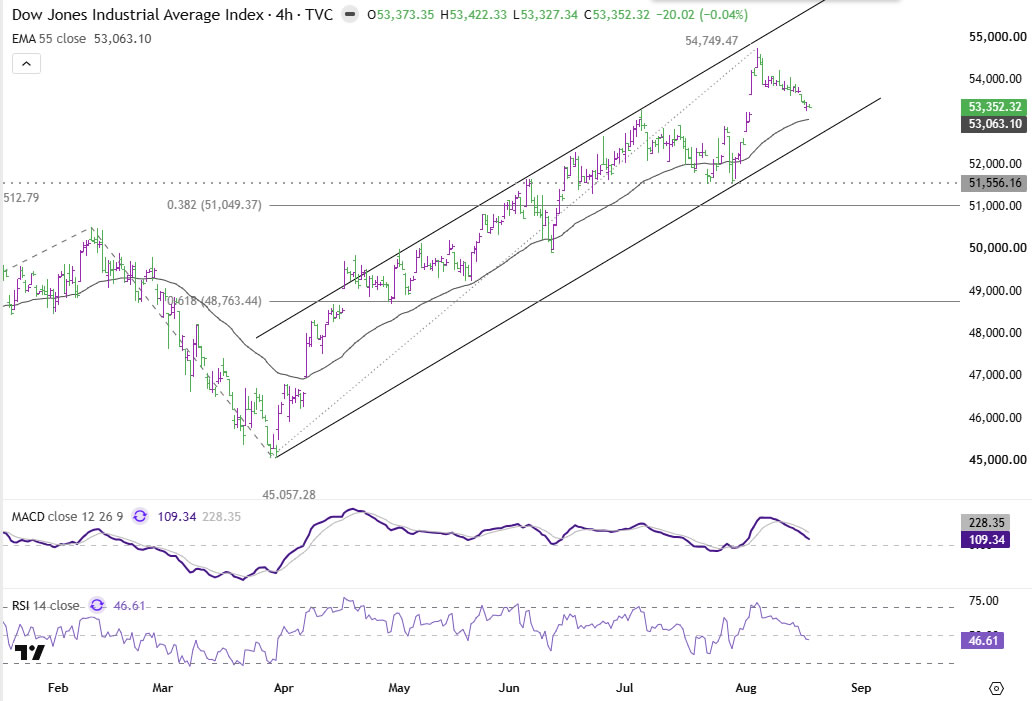
Equities are beginning to show that pressure and have closed down for multiple sessions. The Dow slipped -0.22% overnight, the S&P 500 fell -0.69%, and the Nasdaq lost -1.33%. The Nasdaq's larger decline is especially consistent with higher-yield pressure.
For Silver, this matters because it sits between two worlds. Gold can still benefit from monetary uncertainty and inflation concerns. Silver shares some of that support, but it also depends much more heavily on industrial demand and risk appetite. The current environment is turning that dual identity into a disadvantage.
Copper Is Giving Silver Bulls a Warning
Copper offers one of the clearest cross-checks. The metal surged to a record 6.9247 in early August on structural supply-deficit optimism, but has since reversed to a two-week low. Price has fallen below the 55 4H EMA near 6.66, broken rising trend support, and slipped through the roughly 6.565 retracement area.
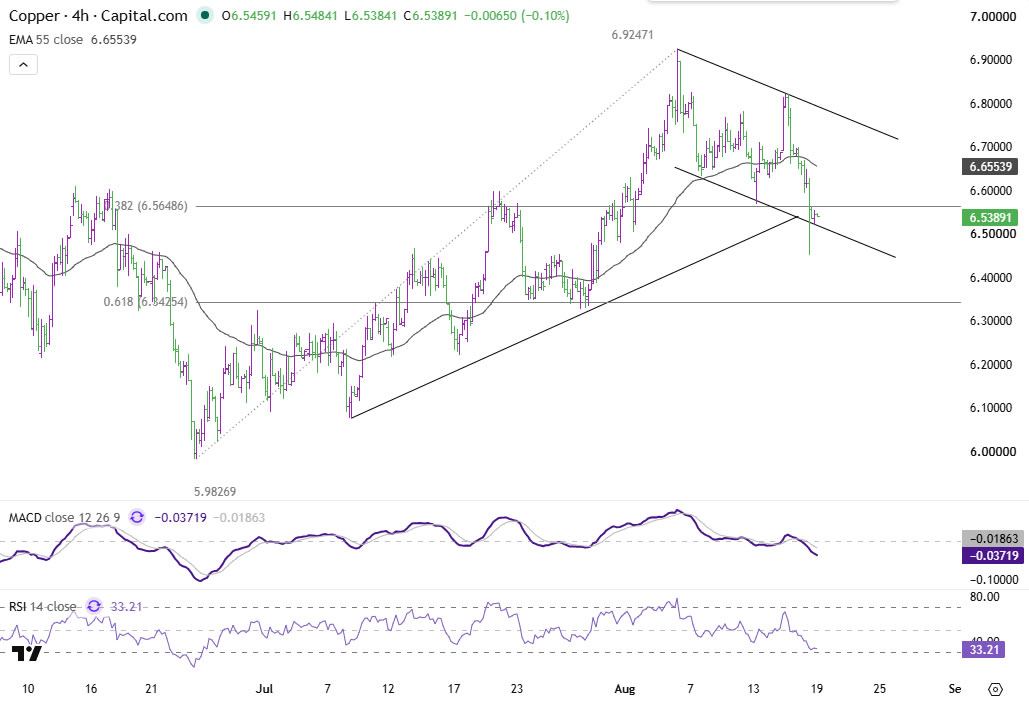
RSI around 33 shows momentum has weakened sharply. Some profit-taking after an all-time high is natural, but timing matters — Copper's selloff is accelerating just as stocks retreat and bond yields climb. That's exactly what Silver bulls don't want to see. Copper has much less monetary support than Gold, so its weakness is a cleaner signal that investors are beginning to worry about the demand consequences of higher energy costs and tighter financial conditions.
If Copper keeps falling while Brent stays elevated, Silver's industrial component becomes an increasingly important drag.
Gold Is Starting to Win the Metals Trade
The Gold/Silver ratio is already reflecting that divergence. The correction from roughly 72.55 appears to have completed at 66.23, with the ratio now rebounding sharply toward 69.40. A firm break above 69.40 would confirm another leg higher and point to further Silver underperformance relative to Gold.
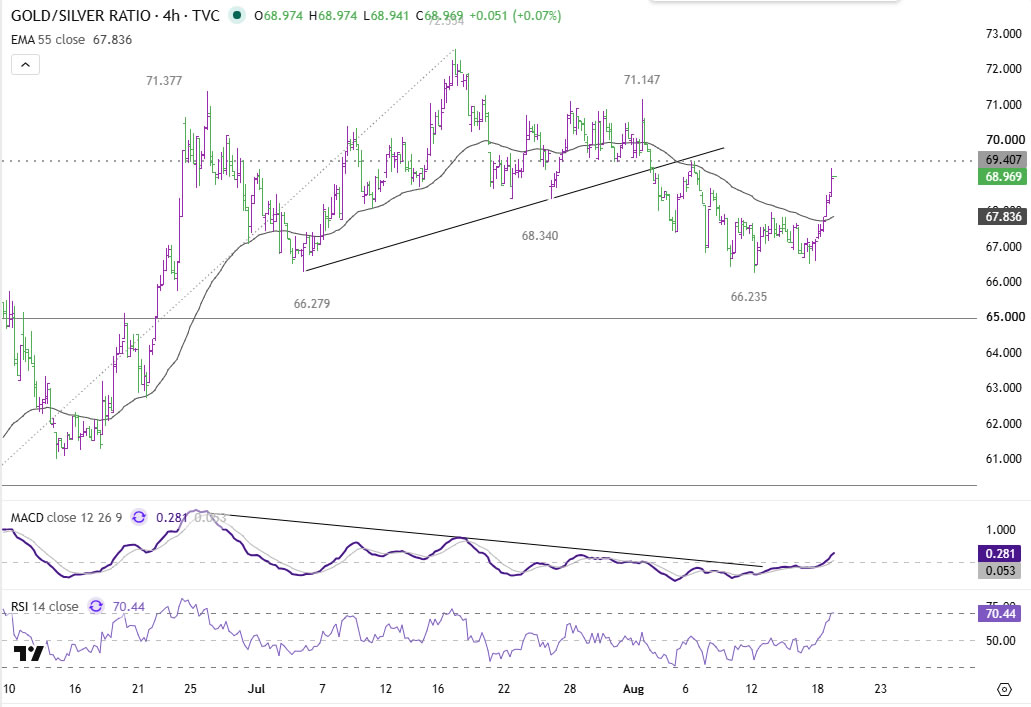
That would fit the current macro mechanism almost perfectly. Both metals face high yields, but Gold retains a cleaner monetary bid from policy uncertainty and geopolitical risk. Silver faces those same yields while also absorbing deteriorating industrial sentiment. So if the ratio breaks 69.40 at the same time Copper extends its decline, the market would be delivering two independent confirmations that Silver's problem is becoming more than a simple short-term pullback.
ActionForex's Technical View on Silver
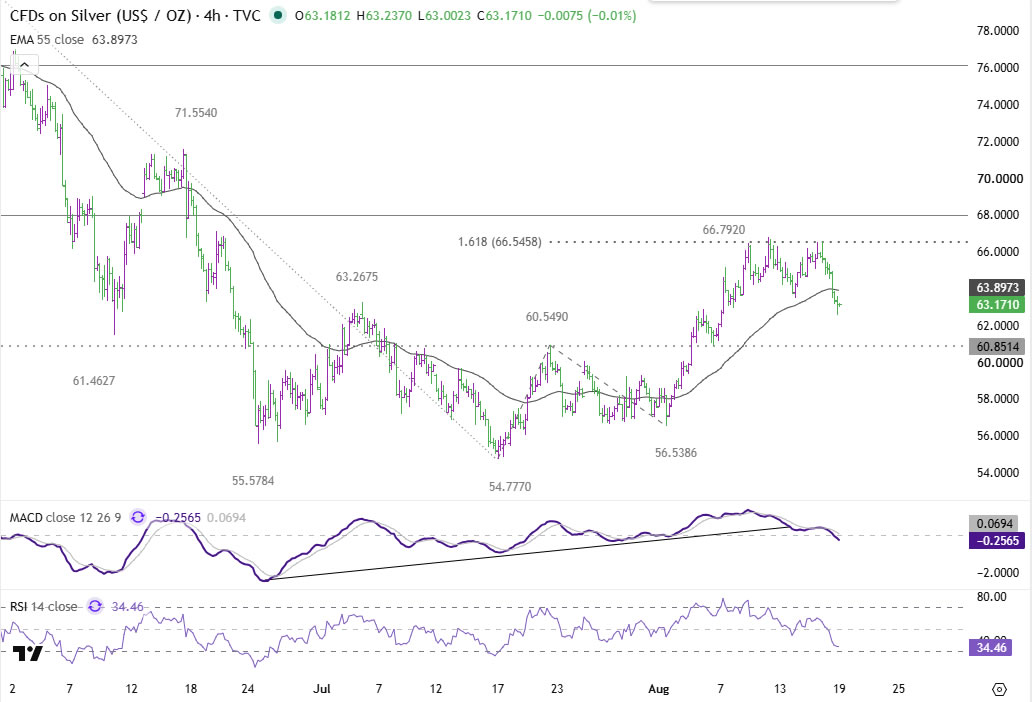
Silver's 4H structure has already weakened materially. The rebound from 54.77 extended to 66.79, but price has since broken firmly below the 55 4H EMA around 63.90. The 4H MACD has also broken its rising trendline, signaling a loss of momentum that supported the recovery. This raises the risk that the move from 54.77 was only a three-wave corrective rebound that ended at 66.79.
The bigger picture supports that interpretation. The recovery was rejected below 67.99, the 38.2% retracement of the larger 89.36–54.77 decline. Silver has also fallen through the 55-day EMA near 63.71, leaving the medium-term bearish structure intact unless price can regain that area quickly. In other words, the rebound repaired momentum but never cleared the level required to demonstrate the larger downtrend had ended.
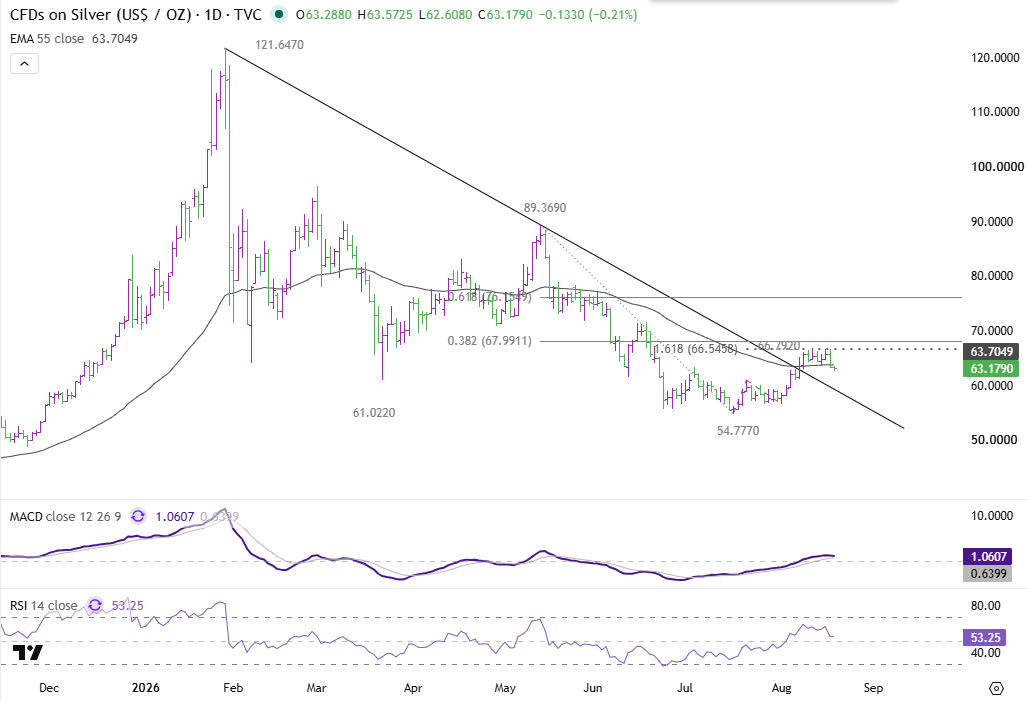
The immediate focus now shifts lower. The first important downside zone is 60.92, resistance turned support. A firm break there would substantially strengthen the view that 66.79 marked completion of the rebound, with a deeper fall then seen back to the 54.77–56.53 support zone. For bulls, the first task is recovering 63.70–63.90, where the daily and 4H moving averages converge — even that would only stabilize the near-term structure. A more meaningful invalidation requires a sustained recovery through 66.79, which would put the 67.99 retracement resistance back into play.
That gives traders a straightforward map:
- Below 63.70–63.90: downside pressure dominates.
- Break below 60.92: the corrective-top case gains confirmation.
- Below 54.77: the larger bearish trend resumes.
- Above 66.79: the bearish rebound-completion thesis weakens materially.
Key Takeaways
- The Hormuz crisis is broadening from an oil-and-bond story into a risk-off one, with equities, Copper, and now Silver all showing pressure.
- Rising global yields (US 30-year at 5.33%, German Bund at 3.27%) give the current shock a stagflationary character that's starting to weigh on growth assets.
- Copper's reversal from a record high to a two-week low offers a cleaner read on deteriorating demand sentiment than Gold, since it carries less monetary support.
- The Gold/Silver ratio rebounding toward 69.40 signals Silver is starting to underperform Gold as its industrial-demand exposure turns into a liability.
- 60.92 is the key level to watch: a break would confirm Silver's rebound from 54.77 topped at 66.79, opening a deeper fall toward the 54.77-56.53 zone.
New Zealand Input PPI Rises 2.9% in Q2, Output Prices Up 1.6%
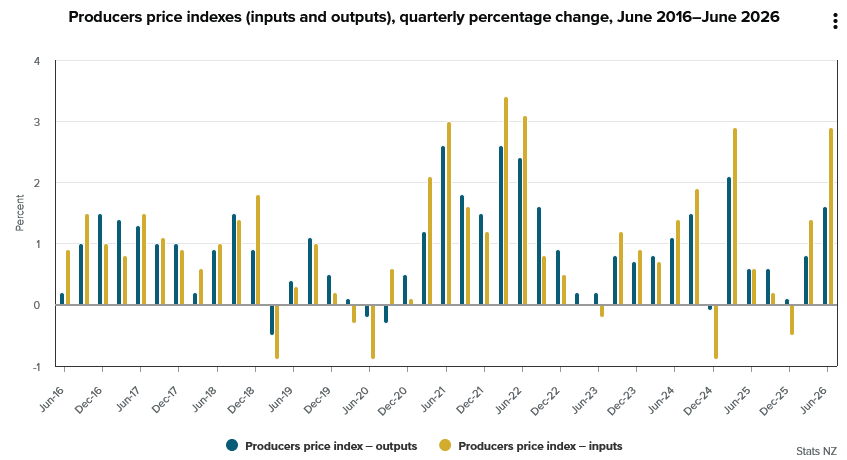
New Zealand producer price pressures accelerated sharply in Q2, with input PPI rising 2.9% q/q from 1.4% in Q1, more than double 1.3% consensus. Output PPI also strengthened, rising 1.6% from 0.8%, twice 0.8% expected. Stats NZ said producers faced higher costs for inputs including fuel, power and raw materials.
The gap between input and output prices was particularly notable. Producers’ costs rose almost twice as fast as prices received for their goods and services, pointing to potential pressure on margins if firms are unable to pass those increases through. Consumer prices rose 1.5% q/q over the same period, slightly below output PPI and well below input-cost growth.
Cost pressures were broader across the economy. Farm Expenses Price Index rose 3.8% q/q, while Capital Goods Price Index increased 1.8%. Overall, Q2 data show a clear reacceleration in upstream inflation, with key question now whether businesses continue absorbing higher costs or increasingly pass them into final prices.
Data Summary
| Indicator | Actual | Expected | Previous |
|---|---|---|---|
| PPI Input q/q | 2.9% | 1.3% | 1.4% |
| PPI Output q/q | 1.6% | 0.8% | 0.8% |
| CPI q/q | 1.5% | — | 0.9% |
Key Takeaways
- New Zealand producer cost pressures accelerated sharply in Q2, with PPI Input rising from 1.4% to 2.9% q/q, more than double 1.3% consensus.
- PPI Output increased from 0.8% to 1.6%, also twice 0.8% expected.
- Input costs rose substantially faster than output prices, suggesting businesses either absorbed part of increase through margins or still have costs to pass through.
- Stats NZ highlighted higher fuel, power and raw-material prices as important contributors to input-cost increase.
- Producer input inflation at 2.9% was nearly twice Q2 CPI increase of 1.5%, highlighting strength of upstream cost pressures.
- Broader cost measures were also firm, with Farm Expenses Price Index up 3.8% and Capital Goods Price Index up 1.8%.
- Overall, Q2 data show a clear reacceleration in production costs, with future inflation impact depending on how much businesses pass through to customers.
Eco Data 8/19/26
| GMT | Ccy | Events | Act | Cons | Prev | Rev |
|---|---|---|---|---|---|---|
| 22:45 | NZD | PPI Input Q/Q Q2 | 2.90% | 1.30% | 1.40% | |
| 22:45 | NZD | PPI Output Q/Q Q2 | 1.60% | 0.80% | 0.80% | |
| 23:50 | JPY | Machinery Orders M/M Jun | 9.70% | 7.80% | -12.40% | |
| 01:30 | AUD | Wage Price Index Q/Q Q2 | 0.80% | 0.80% | 0.80% | |
| 06:00 | GBP | CPI M/M Jul | 0.30% | 0.30% | 0.10% | |
| 06:00 | GBP | CPI Y/Y Jul | 2.90% | 2.90% | 2.60% | |
| 06:00 | GBP | Core CPI Y/Y Jul | 2.60% | 2.50% | 2.60% | |
| 06:00 | GBP | RPI M/M Jul | 0.60% | 0.30% | ||
| 06:00 | GBP | RPI Y/Y Jul | 3.20% | 3.00% | ||
| 06:00 | GBP | PPI Input M/M Jul | -1.70% | 0.00% | -2.00% | 1.90% |
| 06:00 | GBP | PPI Input Y/Y Jul | 4.90% | 6.60% | 7.30% | 7.40% |
| 06:00 | GBP | PPI Output M/M Jul | 0.20% | 0.20% | 0.00% | 0.10% |
| 06:00 | GBP | PPI Output Y/Y Jul | 3.10% | 3.20% | 3.50% | |
| 06:00 | GBP | PPI Core Output M/M Jul | 0.60% | 0.50% | ||
| 06:00 | GBP | PPI Core Output Y/Y Jul | 2.80% | 2.60% | ||
| 08:00 | EUR | Eurozone Current Account (EUR) Jun | 35.1B | 26.8B | 25.1B | 25.8B |
| 09:00 | EUR | Eurozone CPI Y/Y Jul F | 2.90% | 2.90% | 2.90% | |
| 09:00 | EUR | Eurozone Core CPI Y/Y Jul F | 2.50% | 2.50% | 2.50% | |
| 14:30 | USD | Crude Oil Inventories (Aug 14) | 4.4M | 0.2M | 17.4M | |
| 18:00 | USD | FOMC Minutes |
| 22:45 | NZD |
| PPI Input Q/Q Q2 | |
| Actual | 2.90% |
| Consensus | 1.30% |
| Previous | 1.40% |
| 22:45 | NZD |
| PPI Output Q/Q Q2 | |
| Actual | 1.60% |
| Consensus | 0.80% |
| Previous | 0.80% |
| 23:50 | JPY |
| Machinery Orders M/M Jun | |
| Actual | 9.70% |
| Consensus | 7.80% |
| Previous | -12.40% |
| 01:30 | AUD |
| Wage Price Index Q/Q Q2 | |
| Actual | 0.80% |
| Consensus | 0.80% |
| Previous | 0.80% |
| 06:00 | GBP |
| CPI M/M Jul | |
| Actual | 0.30% |
| Consensus | 0.30% |
| Previous | 0.10% |
| 06:00 | GBP |
| CPI Y/Y Jul | |
| Actual | 2.90% |
| Consensus | 2.90% |
| Previous | 2.60% |
| 06:00 | GBP |
| Core CPI Y/Y Jul | |
| Actual | 2.60% |
| Consensus | 2.50% |
| Previous | 2.60% |
| 06:00 | GBP |
| RPI M/M Jul | |
| Actual | 0.60% |
| Consensus | |
| Previous | 0.30% |
| 06:00 | GBP |
| RPI Y/Y Jul | |
| Actual | 3.20% |
| Consensus | |
| Previous | 3.00% |
| 06:00 | GBP |
| PPI Input M/M Jul | |
| Actual | -1.70% |
| Consensus | 0.00% |
| Previous | -2.00% |
| Revised | 1.90% |
| 06:00 | GBP |
| PPI Input Y/Y Jul | |
| Actual | 4.90% |
| Consensus | 6.60% |
| Previous | 7.30% |
| Revised | 7.40% |
| 06:00 | GBP |
| PPI Output M/M Jul | |
| Actual | 0.20% |
| Consensus | 0.20% |
| Previous | 0.00% |
| Revised | 0.10% |
| 06:00 | GBP |
| PPI Output Y/Y Jul | |
| Actual | 3.10% |
| Consensus | 3.20% |
| Previous | 3.50% |
| 06:00 | GBP |
| PPI Core Output M/M Jul | |
| Actual | 0.60% |
| Consensus | |
| Previous | 0.50% |
| 06:00 | GBP |
| PPI Core Output Y/Y Jul | |
| Actual | 2.80% |
| Consensus | |
| Previous | 2.60% |
| 08:00 | EUR |
| Eurozone Current Account (EUR) Jun | |
| Actual | 35.1B |
| Consensus | 26.8B |
| Previous | 25.1B |
| Revised | 25.8B |
| 09:00 | EUR |
| Eurozone CPI Y/Y Jul F | |
| Actual | 2.90% |
| Consensus | 2.90% |
| Previous | 2.90% |
| 09:00 | EUR |
| Eurozone Core CPI Y/Y Jul F | |
| Actual | 2.50% |
| Consensus | 2.50% |
| Previous | 2.50% |
| 14:30 | USD |
| Crude Oil Inventories (Aug 14) | |
| Actual | 4.4M |
| Consensus | 0.2M |
| Previous | 17.4M |
| 18:00 | USD |
| FOMC Minutes | |
| Actual | |
| Consensus | |
| Previous | |
Sunset Market Commentary
Markets
ECB chief economist Lane was the first today to voice some views on monetary policy since the July meeting. He steered clear from offering specifics, but said the ECB would do what's needed to tame inflation that's expected to hover around 3% (2.9% currently) for the rest of this year. Much of course depends on the Middle East situation. Lane, however, is already seeing inflation drivers for next year: food (amongst others related to the El Niño weather event). His comments didn't really trigger a market reaction with money market bets continuing to be well in the 90%+ for a September hike. We do see some bear flattening in the European curve today but that's in a reaction to yesterday's intraday oil price rise (Brent currently at $91.3, slightly changed) which took place beyond European trading hours. Net daily changes for German bund yields vary between 2.9 for the 30-yr and 5.3 bps at the front. The country by the way tapped 4bn in a 30-yr syndicated sale at the highest rate in 15 years as risk premia keep pushing up the long end of the curves, in Germany and elsewhere. Japanese 30-yr and 40-yr yields jumped another 7 and 8.7 bps respectively today and are closing in rapidly on the May record highs. The 10-yr yield already hit a new 3-decade high today. At 2.96% this tenor is now just shy of the 3% that the Japanese government has assumed in the budget. US rates add another 1.5-2 bps, undisturbed by a mixed bag of economic data that included sub-par import/export price data, industrial production & a NY service business gauge but a strong weekly ADP employment increase. Housing data was inconclusive (strong permits, weakish housing starts). Yet it's enough for the likes of the 30-yr to be on track for another "highest since" 2007 (on a closing basis). In the UK, that same 30-yr maturity (5.83%) is drawing attention for grinding closer towards the psychologically important 6% barrier, a level last seen in 1998. Stock markets are increasingly looking vulnerable in the face of this relentless core bond yield increase, particularly because it's at least as much driven by the real component as by the inflation expectations part. European stocks shed 0.5%, tech on Wall Street underperforms with the Nasdaq losing 1%. Covering the stoic currency markets adds little value today.
News & Views
In less than 12 hours, the US might impose 50% tariffs against approximately $20bn worth of Canadian goods (5% of total shipments to the US last year) under Section 338 of the Tariff Act of 1930 ("discriminatory treatment of American products"). The US administration cited several trade practices as irritants, resulting in the tariff deadline. They included provincial bans on US alcohol sales, disputes over dairy quota allocation and broader retaliatory tariff measures against US products. The US especially wants to see the latter scrapped. Automotive sector tariffs have emerged as another major sticking point, with Canada pushing to reduce the tariff rate on autos to 10% or expand an exemption for US-made parts in vehicles. Last-minute negotiations are going on today.
Bank of Finland governor and ECB governing council member Olli Rehn argues not to ditch forward guidance as a policy tool in a manner the Fed under Warsh did. In an op-ed published in the Financial Times, he pointed out the US economy is fundamentally different on one key variable: the neutral rate. He said current estimates put the euro area's neutral rate at 2% (0% real rate +2% inflation) while that climbs into the 3%-4% area for the US. That means the Fed has more room to cut rates before encountering the lower bound level, where further reductions are ineffective or even counter-productive. The ECB has less, Rehn says, meaning forward guidance retains value when monetary policy ever gets constrained again. Rehn does warn that the recent experience, in particular following the pandemic, has shown the dangers of taking the tool too far. Earlier guidance that linked interest rate raises to the end of QE had forced the ECB into larger rate increases than it had signalled initially.
Brent Breaks $90 — Now US 10-Year at 4.75% Holds the Bigger Market Test
Why oil's break above $90 is spilling into global bond yields, and why that's flipping the usual risk-off currency playbook
Why it matters: A sustained break of 4.75% on the 10-year would signal the oil shock is spreading into global financial conditions broadly, not just energy prices, potentially forcing a wider repricing across equities, currencies and rate-sensitive assets. It's already flipping the usual playbook: Aussie and Dollar lead while traditional havens Franc and Yen lag, because markets are trading this as an inflation and rates story rather than a conventional risk-off event.
Hormuz Shock Moves Beyond Oil
Middle East tensions continued to dominate headlines Tuesday as expiry of the 60-day US-Iran ceasefire framework left no clear diplomatic path forward. Brent pushed decisively above $90, while harder rhetoric from Washington and Tehran reinforced uncertainty over whether the current standoff will escalate further. More importantly for broader markets, the oil shock is not confined to energy: global bond yields are rising sharply as investors reassess inflation risk and how long monetary policy may need to stay restrictive.
Iranian parliament speaker Mohammad Bagher Ghalibaf said the Strait of Hormuz would remain closed until Tehran's demands were met, including lifting the US blockade, releasing frozen assets, ending the oil embargo and stopping military threats and operations. A senior Iranian official separately said Tehran was shifting toward a "fully offensive" posture after diplomatic efforts stalled. On the US side, President Donald Trump again insisted Iran must abandon any nuclear-weapons capability while escalating rhetoric over control of Hormuz. Military confrontation has nevertheless stayed relatively contained for now, although UKMTO reported another vessel was struck by an unknown projectile in the Strait, causing engine-room damage and a crew casualty.
Tuesday's Escalation Points
- Ghalibaf: Strait stays closed until US blockade lifted, frozen assets released, oil embargo ended and military threats stopped.
- Senior Iranian official: Tehran shifting toward a "fully offensive" posture.
- Trump: reiterated Iran must abandon any nuclear-weapons capability, escalated rhetoric over control of Hormuz.
- UKMTO: another vessel struck by an unknown projectile in the Strait, engine-room damage and a crew casualty.
Brent Has Broken Its Threshold — Bonds May Be Next
Bond markets are increasingly treating prolonged Hormuz disruption as an inflation problem rather than simply a geopolitical headline. US 30-year Treasury yield has reached its highest level in nearly two decades, while Germany's 10-year Bund yield has climbed to its highest since 2011. Higher energy and freight costs threaten to keep inflation pressure elevated even if recent headline data have softened, strengthening the case for restrictive rates to persist longer than markets previously hoped.
That puts the US 10-year yield around 4.75% at the center of the next market test. Brent has already cleared its previous $90 barrier; a sustained break of 4.75% by the 10-year yield would suggest the oil shock is spreading more deeply into global financial conditions. Such a move could force broader repricing across equities, currencies and other rate-sensitive assets, especially if investors start treating higher yields as something more persistent than another temporary reaction to Middle East headlines.
Aussie Leads as Risk-Off Playbook Flips
Currency performance shows why this is not a conventional geopolitical risk-off episode. Aussie is the strongest major currency so far, followed by Dollar and Euro, while Swiss Franc is weakest, Kiwi second weakest and Yen third. Loonie and Sterling sit in the middle.
Normally, escalating geopolitical risk might be expected to favor Franc and Yen. This time, the inflation and rates channel is dominating. Rising global yields make low-yielding currencies less attractive, while higher energy prices increase the possibility that central banks with existing tightening biases will need to stay restrictive for longer. That combination helps explain why traditional haven currencies are lagging even as Middle East risk intensifies.
Typical Risk-Off Playbook vs. Today's Pattern
| Typical Geopolitical Risk-Off | Today's Pattern | |
|---|---|---|
| Expected leaders | Swiss Franc, Yen (safe havens) | Aussie strongest, Dollar second |
| Expected laggards | Higher-yielding currencies | Swiss Franc weakest, Yen third weakest |
| Dominant mechanism | Flight to safety | Inflation and rates channel: rising global yields make low-yielders less attractive |
Brent Above $90 Gives RBA Hawkish Bias Fresh Relevance
AUD's outperformance is particularly notable. RBA deliberately kept the door open to further tightening earlier this month, saying the cash rate could rise again if upside inflation risks materialise. Officials subsequently reinforced that conditional hawkishness, making renewed oil pressure directly relevant to Australian rate expectations.
Markets may therefore be rebuilding some probability of another RBA hike as Brent pushes higher, adding a domestic policy tailwind to AUD's already strong technical and regional-risk backdrop. That does not mean another hike is now assured. Upcoming Australian jobs data and next week's CPI still matter. But $90-plus oil raises precisely the kind of inflation uncertainty RBA said could justify additional action, giving Aussie another reason to outperform.
Dollar Gets Yield Support, but No Full Reversal Yet
Dollar is the second-strongest major currency, helped by rising Treasury yields and a modest return of Fed tightening risk. Probability of a September hold has slipped toward 63%, suggesting markets are putting some chance of near-term action back into the curve as oil and inflation risks rebuild.
Yet the greenback has not generated a decisive reversal after its recent broad selloff. That suggests the current adjustment in Fed expectations is still relatively limited. Long-end yields may also be rising partly because of term-premium and inflation-risk concerns rather than a straightforward shift toward significantly more Fed hikes. For Dollar, a sustained 10-year break above 4.75% accompanied by a larger change in September pricing would provide much stronger evidence that the rates shock is becoming a genuine support rather than merely slowing the recent decline.
CAD Strength Shows Up More Clearly Against Low Yielders
Canadian Dollar is only around the middle of the daily ranking, but that understates oil's support because Dollar itself is benefiting from higher US yields. CAD strength is showing more clearly against low-yielding currencies, particularly Yen, where Brent's terms-of-trade support for Canada combines with widening global yield differentials against Japan.
That distinction matters when reading current FX moves. USD/CAD can obscure Canadian strength when both currencies receive support from the same global shock through different channels. Crosses such as CAD/JPY provide a cleaner expression of the oil effect: higher crude benefits Canada directly while higher global yields simultaneously squeeze Yen.
4.75% Could Decide Whether Oil Shock Becomes a Market-Wide Repricing
The near-term question is not simply whether Brent can stay above $90. Oil has already crossed that threshold. More important is whether higher energy prices now push global yields through levels capable of tightening financial conditions materially.
If US 10-year yield fails around 4.75% and Brent settles after the current geopolitical repricing, broader market impact could stay contained. But a sustained break above 4.75%, especially alongside further oil gains, would signal that the Hormuz crisis is moving from an energy shock into a global rates shock. That would strengthen higher-yielding currencies, increase pressure on Yen and Franc, and force markets to reconsider how quickly central banks can step away from tightening policy.
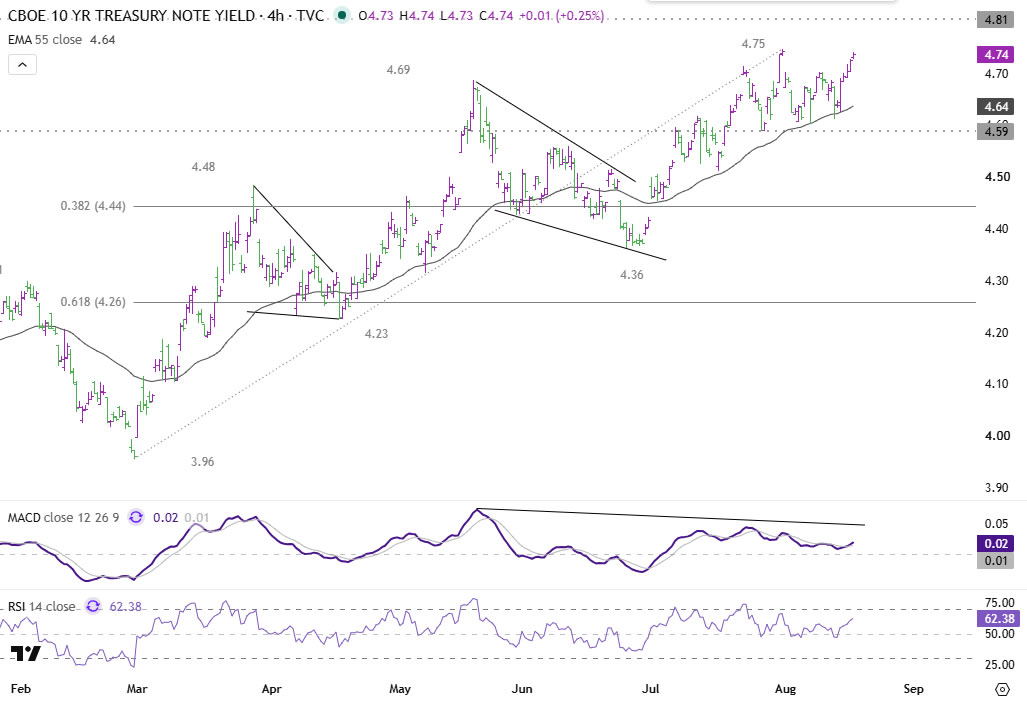
For now, rhetoric is escalating faster than military conflict. That leaves markets balancing two possibilities: the current standoff persists with Brent holding around $90, or fresh escalation pushes oil and yields into another leg higher. Brent has already given its answer. The Treasury market is next.
Related Coverage
Oil & Yields Deep Dive
- Read why CAD/JPY is benefiting from a rare double tailwind, oil supporting Canadian Dollar's terms of trade while the same shock squeezes Yen through higher global yields, and why a break of 117.50 could open 120.86: Oil Shock Is Working Twice for CAD/JPY — Can It Reach 120?.
- See why US 30-year yield's climb above 5.31%, a 19-year high, is only partly about oil, with fiscal deficits and Fed uncertainty also pushing long-end yields higher: US 30-Year Yield Hits 19-Year High — Oil Is Only Part of the Story.
Global Data Deep Dives
- Read why Germany's ZEW sentiment jumped to 34.2 in August, with the Current Situation Index improving sharply and sector expectations strengthening broadly: Germany ZEW Sentiment Strengthens to 34.2 as Current Conditions Improve.
- See why UK payroll employment fell another 13K in July even as regular earnings growth edged up to 3.5%: UK Payroll Employment Falls as Unemployment Holds at 4.9%.
- Read why Australian consumer sentiment's rebound to 88.9 after the RBA hold still leaves confidence fragile amid rising unemployment concerns: Australia Westpac Consumer Sentiment Rebounds After RBA Hold, but Pessimism Persists.
Frequently Asked Questions
Q: Why is oil breaking $90 being treated as a bond market story, not just an energy story?
A: Because bond markets are already reacting. US 30-year Treasury yield has hit its highest level in nearly two decades, and Germany's 10-year Bund yield has climbed to its highest since 2011, as investors treat prolonged Hormuz disruption as an inflation problem that could keep monetary policy restrictive for longer, not just a geopolitical headline. That's why US 10-year yield near 4.75% is now framed as the bigger test than Brent's move above $90.
Q: Why are Franc and Yen lagging despite escalating geopolitical risk?
A: Because the inflation and rates channel is dominating over the usual flight-to-safety pattern. Rising global yields make low-yielding currencies like Franc and Yen less attractive, while higher energy prices raise the chance that central banks with existing tightening biases stay restrictive for longer. That's letting Aussie and Dollar, both benefiting from that rates channel, lead instead of the traditional havens.
Q: What would confirm the oil shock is becoming a broader market repricing?
A: A sustained break of US 10-year yield above 4.75%, especially alongside further oil gains, would signal the Hormuz crisis is moving from an energy shock into a global rates shock. That would likely strengthen higher-yielding currencies further, increase pressure on Yen and Franc, and force markets to reconsider how quickly central banks can step away from tightening policy. If 4.75% fails to break and Brent settles, the broader impact could stay contained instead.
Key Takeaways
- Brent decisively broke above $90: The move came as the 60-day US-Iran ceasefire framework expired with no clear diplomatic path forward.
- The shock has spread beyond energy into bonds: US 30-year yield hit its highest level in nearly two decades, and Germany's 10-year Bund yield reached its highest since 2011.
- US 10-year yield near 4.75% is the next key test: A sustained break would signal the oil shock is becoming a genuine financial-conditions shock rather than just a headline reaction.
- Currency performance flipped the usual risk-off playbook: Aussie and Dollar led while Franc and Yen lagged, because markets are trading inflation and rates risk rather than seeking traditional havens.
- AUD's strength is compounded by oil reviving RBA hawkish relevance: Though upcoming Australian jobs data and next week's CPI still matter before another hike is assured.
- CAD's oil-driven strength shows most clearly against Yen: USD/CAD understates it since Dollar is also benefiting from the same yield shock, making CAD/JPY a cleaner read.
What to Watch Next
US 10-year yield's ability to sustain a break above 4.75% is the key test for whether this becomes a broader market repricing, alongside whether Brent extends its gains or settles around $90. On the geopolitical side, watch for genuine military escalation in the Strait of Hormuz versus continued rhetoric-only standoff, since rhetoric has so far outpaced actual conflict.
FOMC Minutes, Canadian Inflation Data, and USD/CAD Technical Analysis
Key takeaways
- FOMC Policy: Markets await the August 19 minutes for clarity on whether the Fed will prioritize cooling labor market momentum or persistent inflation risks.
- Canada CPI: Headline inflation accelerated to 3.0% on energy costs, while core inflation remained steady. The BoC is expected to hold rates at 2.25% on September 2.
- USD/CAD Technicals: Price action is testing a critical support confluence (long-term SMA200, monthly S2, weekly S1) with the RSI indicating oversold conditions at 29.24.
FOMC meeting minutes
Market participants are looking ahead to the publication of the July FOMC meeting minutes on Wednesday, August 19, seeking insight into the central bank’s debate on future interest rate moves following its 9–3 decision to keep the benchmark target range at 3.50%–3.75%. Although these discussions occurred before the August 7 non-farm payrolls (NFP) report, analysts will examine the text to determine whether persistent inflation risks or cooling labor market momentum—underscored by slowing hiring and an unexpected drop of 23,000 jobs in July—will play a larger role in shaping the Fed’s decision at the September meeting.
Market expectations for the federal reserve policy rates
Source: CME Group - CME Fedwatch tool, conditional meetings probabilities. Past performance is not indicative of future results
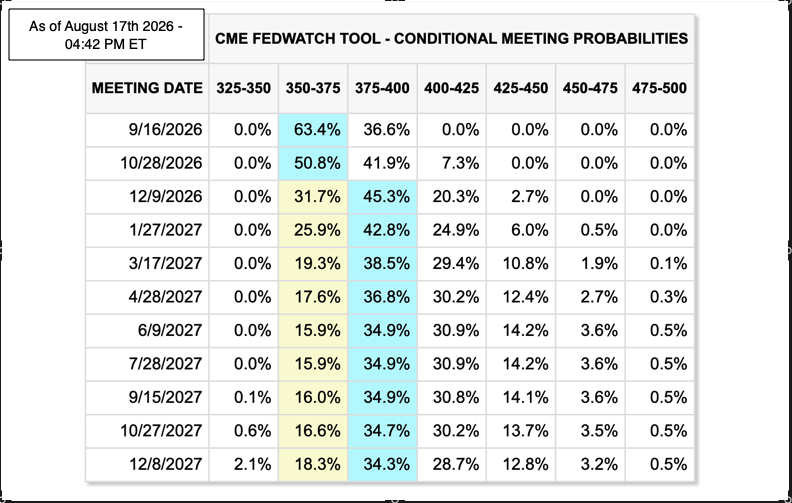
As of August 17th, 2026, market expectations for Federal Reserve policy rates reflect a shift toward a higher-for-longer regime driven by persistent inflation concerns and economic resilience. According to the CME FedWatch Tool, traders are pricing in conditional meeting probabilities that favor maintaining or slightly adjusting the benchmark interest rate target range. For the September 16, 2026, meeting, the market indicates a 63.4% probability that the target rate will settle in the 350–375 basis points (3.50%–3.75%) range, with a 36.6% probability that it will settle in the 375–400 basis points range. Moving toward the end of the year, the highest probability shifts slightly upward to the 375–400 basis points range, coming in at 45.3% for the December 9, 2026, meeting (with a 31.7% chance remaining at 350–375 bps and 20.3% at 400–425 bps). Looking further out into 2027, the central tendency of market expectations remains firmly anchored around the 375–400 bps target rate—holding probabilities near 35% to 43% through late 2027—suggesting that market participants foresee limited monetary easing and expect interest rates to remain relatively steady rather than returning to lower levels.
Canada consumer price index (CPI)
Source: Bloomberg Finance L.P. - Canada CPI - All items, weighted median and trimmed mean
Past performance is not indicative of future results.
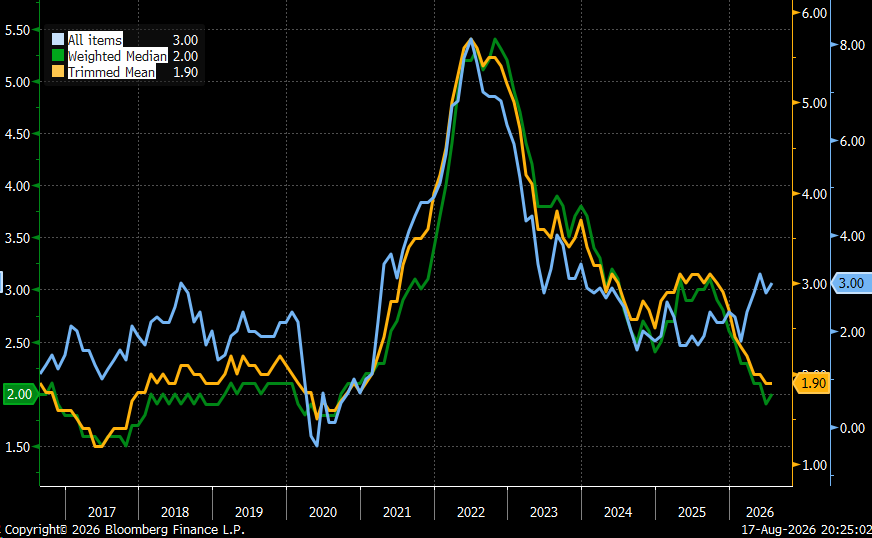
Canada’s Consumer Price Index (CPI) report, released by Statistics Canada, showed that while the headline inflation accelerated to 3.0% year-over-year in July, up from 2.8% in June, the Bank of Canada’s preferred core inflation metrics remained largely muted, suggesting that the headline increase was driven by volatile factors rather than broad-based price pressures. Specifically, the CPI-Median rose slightly to 2.0% from 1.9%, while the CPI-Trim held steady at 1.9%, both filtering out extreme price volatility to provide a clearer view of underlying trends.
The jump in headline inflation to 3.0% reduces the immediate likelihood of a rate cut or a hike at the Bank of Canada’s (BoC) upcoming September 2nd meeting. With Canada’s unemployment rate sitting around 6.5%, raising interest rates in a cooling labor market to combat oil shocks may risk over-tightening. According to the Montreal Exchange, BoC is expected to keep the interest rate at its current level of 2.25%.
USD/CAD daily chart technical analysis
Source: Tradingview.com - USD/CAD daily chart. Past performance is not indicative of future results.
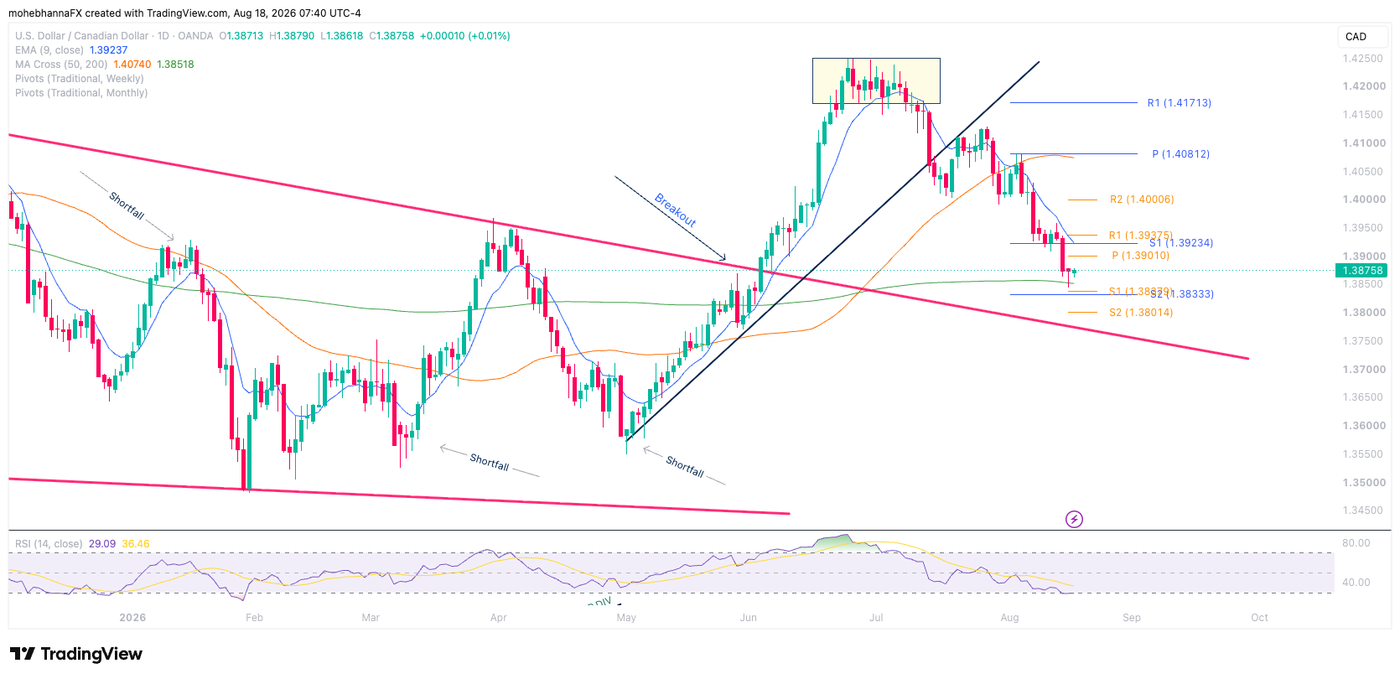
- Following a breakout below an ascending channel in early 2025, the USD/CAD price action traded within a narrowing formation, as marked by the red lines on the chart.
- Price action continued to find support and resistance along the formation’s lower and upper boundaries throughout its duration till June 2026.
- In May 2026, price action began a sharp trend, as marked by the black line on the chart. In June 2026, the price broke above the upper boundary of the narrowing price action, reaching a high of 1.4240. However, in July, it broke below the trend and completed a pullback to its extension, followed by a steep decline that pierced multiple critical support levels.
- The break took the price below the monthly PP of 1.4081, the monthly S1 of 1.3923, the weekly PP of 1.3901, the fast EMA9, and the intermediate SMA 50.
- Currently, price action is attempting to hold above a key technical support confluence formed by the long-term SMA, the monthly S2 at 1.3833, and the weekly S1 at 1.3837.
- A secondary support level sits below, defined by the extension of the aforementioned formation’s upper red border line.
- The 14-period RSI moves in tandem with price action, sitting in oversold territory at 29.24.
EUR/USD Daily Outlook
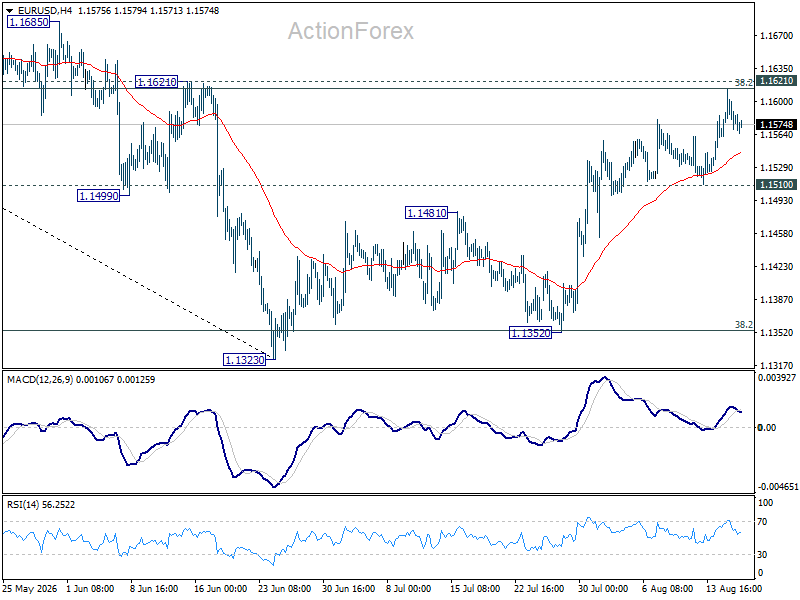
Intraday bias in EUR/USD stays on the upside at this point. Decisive break of 1.1621 cluster resistance (38.2% retracement of 1.2081 to 1.1323 at 1.1613) will solidify the case that fall from 1.2081 has completed as a three wave correction at 1.1323. Further rally would then be seen to 61.8% retracement at 1.1791. For now, further rally will remain in favor as long as 1.1510 support holds, in case of retreat.
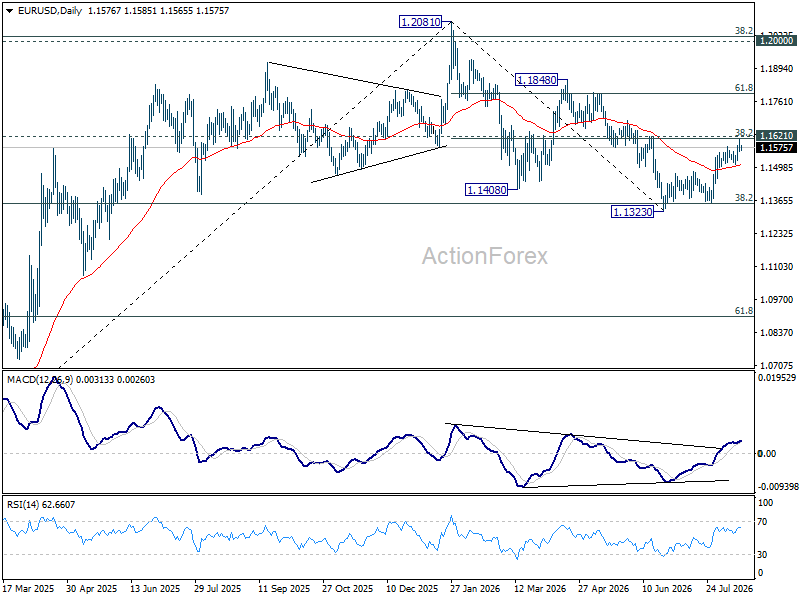
In the bigger picture, focus is staying on 38.2% retracement of 1.0176 to 1.2081 at 1.1353. Decisive break there will revive the case of medium term bearish trend reversal after rejection by 1.2 key cluster resistance level. Further fall should be seen to 61.8% retracement at 1.0904. Nevertheless, strong rebound from 1.1353, followed by break of 1.1621 resistance, will retain medium term bullishness.
USD/JPY Daily Outlook
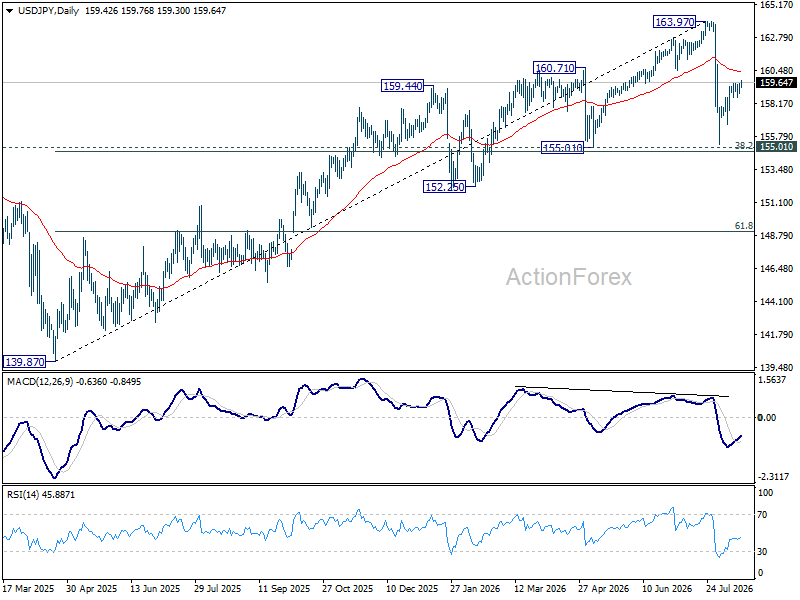
Intraday bias in USD/JPY is back on the upside as rebound from 155.22 resumed. Strong resistance could emerge from 159.59 to 160.62 zone (50% and 61.8% retracement of 163.97 to 155.22) to limit upside. On the downside, firm break of 158.58 will turn bias back to the downside for deeper pullback. However, firm break of 159.59 will pave the way back to retest 163.97 high.
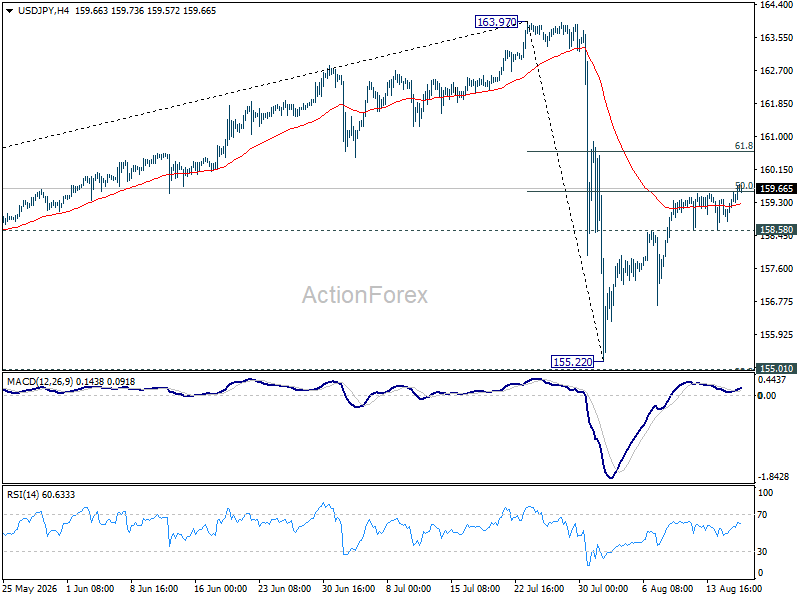
In the bigger picture, as long as 155.01 cluster support (38.2% retracement of 139.87 to 163.97 at 154.76) holds, the larger up trend is still expected to continue through 163.97 after current correction completes. However, firm break of 155.01 will raise the chance that USD/JPY is already in a larger scale correction, and open up deeper fall back to 139.87 (2025 low) in the medium term.