Sample Category Title
Fed Had More Hawks Than the 9–3 Vote Suggested — But July Is Already Stale
Minutes of Federal Reserve’s July 28–29 meeting showed a more hawkish policy debate than 9–3 decision to hold rates at 3.50–3.75% might suggest. While three members formally voted for a 25bp hike, minutes said “several participants favored an increase of 25 basis points”, while “many participants assessed that policy tightening would likely be necessary if inflation did not decline.” Some also questioned whether financial conditions were sufficiently restrictive to return inflation to 2%. Taken together, discussion suggests concern about persistent inflation extended well beyond simple tally of three dissenting votes, even if minutes do not establish that additional members would have voted for an immediate hike.
Inflation debate centered increasingly on risk that repeated shocks keep delaying disinflation. Most participants still expected inflation to step down over rest of year as tariff and earlier energy effects faded, but officials judged risks were “skewed to the upside.” Several warned that “successive supply shocks have repeatedly delayed the expected return of inflation to 2 percent,” while renewed Middle East conflict was seen as capable of extending supply-chain problems and lifting prices again. AI was emerging as another complication: some officials saw investment boom already boosting aggregate demand and prices, even as eventual productivity gains could increase supply and lower costs later.
Stable labor market gave hawks room to emphasize price stability. Participants judged labor demand and supply to be broadly balanced, unemployment close to longer-run estimates and economic activity still expanding at a solid pace. A few officials favoring a July hike argued that acting then could “help forestall the need for a steeper and potentially more costly sequence of tightening moves at a later stage.” That effectively captures insurance-hike argument: tighten modestly before inflation becomes entrenched rather than risk a larger adjustment later.
But minutes describe Fed’s assessment at end of July, making their hawkish message less straightforward for markets today. Subsequent softer employment, inflation, retail-sales and producer-price readings have altered information set substantially. July record is therefore more useful as a guide to Fed’s reaction function than as a direct September signal: failure of inflation to fall would revive tightening pressure, while clearer weakening in labor demand and consumption gives hold camp more reason to wait. Minutes reveal how easily tightening debate could return, but whether July hawks still command same urgency depends on data that arrived after meeting.
Key Takeaways
- July FOMC minutes showed broader hawkish concern than 9–3 vote alone suggested. Three members formally dissented for a 25bp hike, while “several participants” favored raising rates and “many” saw further tightening as likely if inflation failed to decline.
- Some officials questioned whether financial conditions were restrictive enough to bring inflation sustainably back to 2%.
- Hawkish argument included an “insurance hike” logic: acting sooner could reduce risk of needing a steeper and more costly tightening sequence later.
- Fed remained concerned that successive supply shocks were repeatedly delaying return of inflation to target, with Middle East tensions adding fresh upside risk.
- AI investment was becoming part of inflation debate, with some officials seeing stronger aggregate demand and price pressure before longer-term productivity gains arrive.
- Labor market was still viewed as broadly stable in July, giving hawks more room to prioritize inflation.
- But minutes are already partly stale. Softer jobs, CPI, retail-sales and PPI data released since meeting have weakened immediate case for tightening.
- Best interpretation is hawkish reaction function, outdated economic snapshot: minutes show what could revive hike debate, not necessarily what Fed would do today.
FOMC Minutes Show Fed Trying to Communicate Less Without Saying Less
- The Federal Open Market Committee (FOMC) held the federal funds rate at a target range of 3.50% to 3.75% at its July meeting, with three dissents in favor of a 25-basis-point rate increase.
- The minutes reinforce that the Fed’s communication strategy has shifted under Chair Warsh. The Committee appears intent on reducing explicit forward guidance and putting more weight on realized data, while still emphasizing that inflation remains above target and price stability remains non-negotiable.
- On inflation, participants continued to see upside risks as material. Supply shocks, including energy-related pressures tied to the Middle East conflict, were seen as a risk to the return to 2%, leaving officials unwilling to treat the inflation shock as temporary or fully contained.
- The minutes show the meeting should not be received as a one-sided case for imminent tightening. Participants still saw growth as solid and the labor market as broadly balanced but also acknowledged elevated uncertainty and downside risks to activity, giving the majority reason to wait for more confirmation before moving rates higher.
- Three members, Beth Hammack, Neel Kashkari, and Lorie Logan, dissented from the majority, preferring a 25-basis-point hike because they judged that still-elevated inflation and upside risks to the inflation outlook warranted an immediate increase.
Key Implications
- The main takeaway is communication: the Fed is trying to reduce explicit forward guidance, but doing so raises the burden on officials to explain their reaction function and assessment of the economy clearly as the inflation-growth tradeoff evolves.
- The minutes should also be read with an important timing caveat. The July meeting took place before the July CPI and retail sales reports, which materially reduced the near-term case for additional tightening. These minutes are best read less as a live signal of imminent hikes and more as evidence that the Fed was struggling with a real inflation-growth tradeoff before the latest data softened the tightening argument.
(FED) Minutes of the Federal Open Market Committee
July 28–29, 2026
A joint meeting of the Federal Open Market Committee and the Board of Governors of the Federal Reserve System was held in the offices of the Board of Governors on Tuesday, July 28, 2026, at 10:00 a.m. and continued on Wednesday, July 29, 2026, at 9:00 a.m.1
Developments in Financial Markets and Open Market Operations
The manager began by noting that, against a backdrop of solid economic data, developments over the intermeeting period were influenced by the conflict in the Middle East. Oil prices ended the period higher following the escalation of tensions in the Middle East. Across asset classes, inflation compensation moved little in response to higher oil prices, nominal rates rose largely on expectations of higher policy rates, equities were somewhat lower, and the dollar edged up modestly.
Near-term inflation compensation declined notably after the June FOMC meeting and moved up only marginally thereafter despite the sharp increase in oil prices. Market outreach and written responses to the Open Market Desk Survey of Market Expectations (Desk survey) indicated that this decline after the June FOMC meeting was attributable in part to investors' perceptions of the Committee's strong resolve to deliver price stability, as reflected in the June FOMC statement and press conference. Longer-term inflation compensation remained stable and consistent with the Committee's 2 percent longer-run inflation objective.
Nominal Treasury yields rose 25 to 30 basis points, driven by corresponding increases in real interest rates. Market pricing and outreach indicated that, while investors expected no action at the July FOMC meeting as a base case, the market priced in about a one-in-three chance of an increase in the target range for the federal funds rate. At longer horizons, the market was fully pricing in a 25 basis point hike by the September meeting and another one by the end of the first quarter of next year. The median respondent to the Desk survey, by contrast, expected no change in the policy rate this year or the next but expected a rate cut in early 2028.
Turning to equity and credit markets, the manager noted that the S&P 500 was down marginally over the intermeeting period. Since the start of the year, equity prices for the artificial intelligence (AI) related infrastructure sector had outperformed those for both the S&P 500 and hyperscaler firms, though appreciation of even those firms had stalled over the intermeeting period. Credit spreads for hyperscaler firms widened further relative to those for investment-grade bond issuers. In the private credit sector, recent data confirmed that redemption requests to business development companies continued to increase in the second quarter.
Reviewing international developments, the manager remarked that market-implied policy rates through the end of 2026 increased more for the U.S. than for advanced foreign economies (AFEs) over the intermeeting period. At the same time, the relatively resilient U.S. growth outlook supported continued foreign inflows into domestic assets, particularly U.S. equities. Consistent with the widening interest rate gap and heavy equity inflows, the dollar continued to appreciate.
The manager observed that money markets remained generally stable. Repurchase agreement (repo) rates again went through a brief period of softness earlier in the period and temporarily dragged the effective federal funds rate (EFFR) down 1 basis point. Repo rates recovered quickly, the EFFR returned to its earlier level, and money market rates generally ended the period little changed, on net, and close to the interest rate on reserve balances.
The manager noted that the level of reserves in the system appeared to remain within a range consistent with an ample supply. With reserve management purchases continuing, the Desk forecast was for reserves to remain within that range in coming months.
By unanimous vote, the Committee ratified the Desk's domestic transactions over the intermeeting period. There were no intervention operations in foreign currencies for the System's account during the intermeeting period.
Staff Review of the Economic Situation
The information available at the time of the meeting indicated that inflation remained elevated. Labor market conditions remained stable, and real gross domestic product (GDP) continued to expand.
Total consumer price inflation—as measured by the 12-month change in the price index for personal consumption expenditures (PCE)—was 4.1 percent in May. Core PCE price inflation, which excludes changes in consumer energy prices and many consumer food prices, was 3.4 percent. Both total and core inflation were higher than their levels from a year earlier, a development that the staff attributed to factors such as the effects of past tariff increases, higher energy and input costs stemming from the conflict in the Middle East, and the surge in demand related to the AI buildout. Core goods price inflation had moved up relative to a year earlier; the staff viewed this increase as being largely attributable to the effects of tariffs and AI-related price pressures. Core services price inflation had edged up over the past year, as an acceleration in core nonhousing services prices had offset a deceleration in prices for housing services. Based on data from the consumer and producer price indexes, the staff estimated that total PCE price inflation stepped down to 3.7 percent in June, led by a deceleration in consumer energy prices; core PCE price inflation was estimated to have edged down to 3.3 percent.
The unemployment rate was 4.2 percent in June and had changed little, on net, over the preceding two years. Nonfarm payroll employment growth slowed in June; average monthly job gains over the first half of the year, however, were well above 2025's average pace. The 12-month change in average hourly earnings was 3.5 percent in June, 0.4 percentage point lower than a year earlier.
Available indicators suggested that real GDP growth had slowed in the second quarter. However, real private domestic final purchases—which comprises PCE and private fixed investment and which often provides a better signal of underlying economic momentum than does real GDP—appeared to have picked up in the second quarter and to have been rising faster than GDP. Consumer spending had firmed, and the AI buildout continued to support business investment. Real exports and imports both expanded at a robust pace in the second quarter, with continued strength in high-tech trade. U.S. energy exports remained elevated amid disruptions to oil shipments in the Middle East. On balance, with imports growing faster than exports, net exports continued to subtract from GDP growth.
Growth abroad picked up in the second quarter, as foreign economies demonstrated resilience in the face of commodity price volatility and supply chain disruptions stemming from the conflict in the Middle East. Labor markets were generally stable, while manufacturing activity was solid, supported in part by strong global demand for high-tech goods related to the AI buildout.
Headline inflation was above targeted levels in many foreign economies, importantly reflecting increases in retail energy and food prices due to the conflict in the Middle East. Foreign central banks continued to assess the effects of the conflict on their economies, with most maintaining their policy rates over the intermeeting period.
Staff Review of the Financial Situation
Over the intermeeting period, both the market-implied expected path of the federal funds rate and nominal Treasury yields moved up somewhat, in part reflecting FOMC communications that were perceived as more restrictive than expected amid an economic outlook that was little changed. The market-implied policy rate path shifted moderately higher, as did option-implied probability distributions of short-term interest rates. Market-implied measures of interest rate volatility remained largely unchanged, on net. Nominal Treasury yields rose, driven by increases in real yields. Short-term inflation compensation declined notably, largely reflecting technical factors related to indexation lags and the passage of time. Market-based measures of longer-term inflation compensation and survey-based measures of inflation expectations remained well anchored.
Broad equity price indexes fell slightly, on net, but were still close to all-time highs. Strong expectations of corporate profit growth and investor risk sentiment continued to suggest that investors expect resilient economic activity. The VIX—a forward-looking measure of near-term equity market volatility—increased modestly, on net, and stood slightly above its historical median. Corporate bond spreads were little changed and remained very low by historical standards, reflecting investor perceptions of a solid corporate credit outlook and strong appetite for corporate securities.
Sovereign yields for AFEs increased, mostly in line with U.S. yields, whereas measures of inflation compensation were mixed. The broad dollar index increased modestly, with the dollar appreciating most against AFE currencies. Equity indexes in South Korea and Taiwan dropped notably, driven by concerns about semiconductor company valuations; equity indexes elsewhere were little changed overall.
Financing conditions in domestic credit markets remained generally accommodative for larger businesses and municipalities but were somewhat restrictive for many small businesses and households. Borrowing costs were little changed since the June FOMC meeting.
Credit continued to be generally available to most businesses, households, and municipalities. Bank lending kept expanding, and corporate bond and equity financing were strong, partly driven by the financing of AI-related investments. Nonetheless, investor concerns continued to weigh on lending in the private credit market, and credit continued to be somewhat restrictive for small businesses. For households, home-purchase mortgage activity remained depressed. Credit continued to be available for existing credit card holders but was tight for new applicants. Issuance of municipal bonds remained strong.
Banks' responses to the July Senior Loan Officer Opinion Survey on Bank Lending Practices indicated easier lending standards, on net, for the fourth consecutive quarter and stronger demand for credit for the fifth consecutive quarter. Special questions on the levels of bank lending standards indicated that overall standards were slightly below their historical median and had eased across loan types relative to July 2025. Lending standards had largely returned to their respective pre-pandemic levels, except for consumer loans. The levels of standards continued to be at the tighter end of the range since 2005 for all loan categories except commercial and industrial loans, for which standards were generally easier than their historical medians.
Credit performance remained solid in most markets. The 12-month trailing default rate on nonfinancial corporate bonds remained near the bottom tercile of its historical distribution, the default rate for leveraged loans decreased slightly, and defaults in the private credit market were little changed. The credit performance of loans to medium-sized and large businesses and municipalities also remained solid, and the credit performance of municipal bonds was strong. By contrast, the credit performance of small business loans and commercial mortgage-backed securities continued to be somewhat weak. Measures of credit performance of household debt were solid on balance.
The staff provided an updated assessment of the stability of the U.S. financial system and, on balance, continued to characterize the system's financial vulnerabilities as notable. The staff judged that asset valuation pressures were elevated. Equity valuations remained high despite some moderation from year-end, supported by AI enthusiasm and strong corporate profits. The equity premium—the forward earnings-to-price ratio adjusted for the level of long-term interest rates—was at a level that has only been lower in recent history during the dot-com bubble.
Vulnerabilities associated with nonfinancial business and household debt were characterized as moderate. The ability of publicly traded investment-grade firms to service their debt remained solid, but median interest coverage ratios for lower-quality business borrowers were at the lower end of their historical distribution. Household balance sheets remained strong.
Vulnerabilities associated with leverage in the financial sector were characterized as notable. Leverage at hedge funds remained near all-time highs across all strategies and was highly concentrated within the largest funds. In addition, life insurers' exposures to riskier and less liquid asset classes were at high levels, making some insurers susceptible to losses in the event of a broad deterioration in business credit quality. By contrast, dealer leverage remained low and bank regulatory capital ratios remained within the high post–Basel III range, although the fair value of some bank assets stayed well below the book value.
Vulnerabilities associated with funding risks were characterized as moderate. Overall runnable liabilities in short-term funding markets remained stable, while hedge funds' repo and prime brokerage borrowing rose to record levels.
Staff Economic Outlook
Total inflation was expected to decline over the second half of the year, as retail gasoline prices were forecast to move lower and as core inflation was projected to slow modestly. Inflation was expected to step down next year, as the effects of tariffs and the Middle East conflict wane, and to be about 2 percent in 2028. The staff's inflation forecast was similar to the one prepared for the June meeting.
Real GDP was projected to slightly outpace potential next year, supported by financial conditions and AI-related investment. The unemployment rate was expected to remain close to the staff's estimate of its longer-run rate this year and to edge lower next year, ending slightly below its longer-run rate in 2028. The staff's outlook for economic activity was a touch weaker than the one prepared for the June meeting, mostly in response to incoming data.
The staff continued to view the uncertainty around their projection as substantial in light of the uncertainty surrounding ongoing geopolitical developments and the potential economic effects of AI investment and adoption. On balance, risks to the forecasts for employment and real GDP growth were seen as skewed to the downside. Risks to the inflation forecast were seen as skewed to the upside, with the possibility that inflation would prove to be more persistent than the staff anticipated.
Participants' Views on Current Conditions and the Economic Outlook
Participants acknowledged that inflation remained elevated. They noted that estimates based on available data indicated that, on a 12-month basis, total PCE inflation moved down in June, largely reflecting a sharp drop in energy prices, and that core inflation edged down. Several participants noted that price increases over the past year were broad based, spanning various categories of goods and services. Some participants remarked that price increases remained elevated in core services excluding housing. Some participants noted that, even after excluding prices of items most directly affected by tariffs and energy prices, underlying inflation appeared to be elevated. Some participants observed that materials for data centers, such as chips and steel, had registered large price increases and that consumer items such as smartphones, computer equipment, software, and electricity had also been subject to price pressures.
Participants assessed that market- and survey-based indicators of medium- and longer-term inflation expectations remained at levels consistent with the Committee's 2 percent objective. Several participants remarked that survey-based measures of relatively short-term inflation expectations were higher than they were before the conflict in the Middle East.
Most participants anticipated that inflation would step down over the rest of the year as the effects of tariffs and earlier energy price increases wane, but many participants noted the possibility that inflation might be more persistently elevated. Several participants assessed that the pass-through of past increases in tariffs into the level of prices was now largely complete and that the effects of recently announced tariffs on measured inflation would likely be modest. A couple of participants reported that their business contacts had been largely absorbing elevated input costs by compressing their profit margins, but that continued conflict in the Middle East or new supply shocks could make it difficult for them to avoid raising prices charged to consumers. A couple of other participants noted, however, that some of their business contacts judged that consumers would resist further price increases.
Several participants assessed that the effects of the AI buildout on consumer prices had so far been limited to select categories. However, several other participants viewed investment in AI as already having broader effects on prices by pushing up aggregate demand or assessed that it would likely do so relatively soon. A few participants commented that it was still too early to know if AI-related developments would mainly lead to a shift in the relative prices of various goods and services or affect inflation more broadly and persistently. Some participants noted that productivity gains associated with adoption of AI would eventually reduce production costs and increase aggregate supply, a development that should put downward pressure on inflation, though there were a range of views on how long this effect would likely take to materialize.
Participants judged that their inflation outlooks were highly uncertain and that inflation risks were skewed to the upside. Many participants noted that the recent re-escalation of the conflict in the Middle East significantly clouded the inflation outlook. These participants remarked that a protracted conflict could prolong supply chain challenges and could put upward pressures on inflation. Many participants highlighted the possibility that, after several years of inflation above 2 percent, continued elevated inflation rates could begin to affect inflation expectations and wage- and price-setting decisions. Several participants remarked that successive supply shocks have repeatedly delayed the expected return of inflation to 2 percent in recent years, adding to concerns about persistently elevated inflation.
Participants assessed that labor market conditions were stable, with labor demand and supply in balance. They observed that the unemployment rate had remained relatively stable over the past year near most estimates of its longer-run level. Participants also noted that payroll employment gains had strengthened this year and appeared roughly consistent with recent labor force growth and that indicators such as layoffs, unemployment insurance claims, and hiring had remained low and stable. Some participants pointed out that patterns such as the broadening of payroll gains to sectors beyond health care and social assistance, as well as modest increases in job openings and related indicators suggest that the labor market had strengthened modestly. Several participants remarked that uncertainties associated with AI-related developments as well as current and anticipated productivity gains were keeping both hiring and firing low. Several participants observed that, in sectors connected to the ongoing AI buildout, there was strong demand for skilled workers—including electricians, machinists, and engineers—leading to notable increases in their wages. A few participants noted some lingering signs of softness in the labor market, including the low job-finding rate and the persistently elevated long-term unemployment rate. Some participants remarked that overall nominal wage growth was moderate and consistent with inflation moving toward 2 percent, but a few mentioned upside risks to wage growth going forward.
Participants generally expected labor market conditions to remain stable in the near term, with the unemployment rate staying close to current levels. Some participants viewed that the signs of modest strengthening in labor market conditions boded well for the outlook. A few participants assessed that AI-related developments appeared to have had a limited net effect on employment so far, with some workers being displaced and others benefiting from jobs created by the AI buildout. Several participants observed that fears about AI leading to widespread layoffs had not materialized to date. Participants recognized that significant uncertainty surrounded the potential effect of AI-related developments on the labor market.
Participants generally observed that economic activity had continued to expand at a solid pace, despite elevated uncertainty, supported by strong business investment and resilient consumer spending. Participants noted that the strength in business investment remained concentrated in AI-related expenditures. Several participants noted that financial conditions were supporting demand, and a few participants noted that other factors, such as less restrictive regulations, were also supporting business activity. Participants observed that consumer spending had strengthened recently. Some participants observed that stock market gains had provided support to consumer spending, particularly among higher-income households. Some participants noted, however, that low- and moderate-income households were under increasing strains, with inflation eroding their real disposable income.
Participants generally expected solid real GDP growth to continue in the near term and pointed to a few factors likely to support continued expansion, including ongoing AI-related investment and household spending. Participants acknowledged that, while the economy had demonstrated resilience to date, uncertainty surrounding the economic outlook remained elevated, partly due to the conflict in the Middle East. Several participants suggested that AI-related investments would likely increase the growth of productivity and of potential output in the coming years. These participants remarked, however, that considerable uncertainty remained regarding both the timing and magnitude of potential productivity gains. Several participants discussed, as a downside risk, the possibility that AI developments could disappoint, leading to a significant repricing of stocks, with consequent negative effects on consumer spending.
In their discussion of financial stability, some participants focused on vulnerabilities associated with the financing of the rapid buildout of AI-related infrastructure. These participants observed that high equity valuations of AI-linked firms reflected favorable assessments of the sector's long-term earnings outlook. They noted the risk that major downward revisions to those assessments might lead to a broad-based repricing of assets, generate tighter financial conditions, and create strains in financial institutions directly or indirectly exposed to the sector. A few participants highlighted the increased degree to which capital spending in the AI sector was being financed by borrowing, including credit provided by nonbank investors or regional banks. In commenting on the private credit sector, a couple of participants noted that activity had slowed recently and that developments in private credit warranted close monitoring. A couple of participants considered vulnerabilities associated with the business sector and noted that holders of corporate debt might face difficulties if firms were to experience financial stress on a large scale. A couple of participants observed that banks were a source of resilience in the financial system and emphasized that, for this situation to continue, banks needed to remain well capitalized. A couple of participants discussed ways in which episodes of price volatility in the market for U.S. Treasury securities could adversely affect the financial system or ways to reduce the likelihood of such events. A few participants stressed the importance of addressing cybersecurity risks associated with rapidly advancing AI-related technologies. A couple of participants considered an intermeeting incident involving a disruption to transaction settlements and noted that the Federal Reserve's ample-reserves regime had helped maintain the orderly functioning of money markets in the face of this disruption.
In their consideration of monetary policy at this meeting, most participants supported maintaining the current target range for the federal funds rate. Participants generally thought that the information that would accumulate in the intermeeting period could provide more clarity, and correspondingly reduce uncertainty, about the inflation outlook. Participants generally observed that economic activity had continued to expand at a solid pace and that labor market conditions appeared stable. Participants noted that inflation remained elevated relative to the Committee's 2 percent objective, in part reflecting price increases associated with supply shocks in certain sectors, including energy. Several participants favored an increase of 25 basis points in the target range at this meeting. These participants remarked that price pressures appeared broad based and judged that the Committee should adopt a more restrictive policy stance to meet its commitment to achieving its price-stability and maximum-employment goals on a sustained basis.
With regard to the outlook for monetary policy, participants reiterated that their interpretations of incoming information would be a key component of their deliberations. Many participants assessed that policy tightening would likely be necessary if inflation did not decline. Some participants commented that financial conditions might not currently be sufficiently restrictive to facilitate a return of inflation to 2 percent. Various participants suggested that financial conditions had tightened over the intermeeting period and that this development was partly a reflection of strong economic growth and market expectations that the Committee would adopt a more restrictive policy stance before long. A few of the participants who favored raising the target range for the federal funds rate at this meeting judged that doing so would likely help forestall the need for a steeper and potentially more costly sequence of tightening moves at a later stage.
Most participants commented on balance sheet policy. They noted that the findings of the task force on balance sheet policy would be a useful input into Committee deliberations and suggested that future FOMC meetings would provide an opportunity for a comprehensive discussion on the topic. Various participants pointed to particular issues that could be examined. Issues highlighted included considerations related to market functioning and financial stability, the influence of balance sheet policy on monetary and financial conditions, and the appropriate maturity composition of the Federal Reserve's holdings of Treasury securities. Several participants referred to earlier Committee discussions of these issues, and many participants reaffirmed that the primary means of adjusting the stance of monetary policy should be through changes in the target range for the federal funds rate.
Various participants noted that their overall assessments of the economy were little changed given the short interval between the June and July meetings. The Chairman observed that six scheduled meetings per year, held roughly every two months, would allow more information to accumulate between meetings than under current practice and provide policymakers and the staff more time to consider strategic monetary policy issues. The Chairman asked for input from the Committee on these issues, but no decisions regarding possible changes in the meeting schedule were made, and the Chairman indicated that any change in practice would not affect the schedule over the balance of 2026.
Committee Policy Actions
In support of the Committee's dual-mandate goals, nine members agreed to maintain the target range for the federal funds rate at 3-1/2 to 3-3/4 percent and also reaffirmed the FOMC's policy of maintaining ample reserves in the banking system. Members noted that the unemployment rate was largely unchanged and that solid growth in economic activity had continued, while inflation remained elevated relative to the Committee's 2 percent goal. In June, the Committee had underlined its continuing resolve to achieve its dual-mandate goals by indicating in its postmeeting statement that it "will deliver price stability." Almost all members agreed that it was appropriate to retain this language in July's postmeeting statement. Three members voted against the decision to maintain the target range for the federal funds rate, preferring an increase of 25 basis points in the target range at this meeting.
At the conclusion of the discussion, the Committee voted to direct the Federal Reserve Bank of New York, until instructed otherwise, to execute transactions in the System Open Market Account in accordance with the following domestic policy directive, for release at 2:00 p.m.:
"Effective July 30, 2026, the Federal Open Market Committee directs the Desk to:
- Undertake open market operations as necessary to maintain the federal funds rate in a target range of 3-1/2 to 3-3/4 percent.
- Conduct standing overnight repurchase agreement operations at a rate of 3.75 percent.
- Conduct standing overnight reverse repurchase agreement operations at an offering rate of 3.5 percent and with a per-counterparty limit of $160 billion per day.
- When appropriate, increase the System Open Market Account holdings of securities through purchases of Treasury bills and, if needed, other Treasury securities with remaining maturities of 3 years or less to maintain an ample level of reserves.
- Roll over at auction all principal payments from the Federal Reserve's holdings of Treasury securities. Reinvest all principal payments from the Federal Reserve's holdings of agency securities into Treasury bills."
The vote also encompassed approval of the statement below for release at 2:00 p.m.:
"The Federal Open Market Committee approved the following statement for release by a 9 – 3 vote:
The Committee decided to maintain the target range for the federal funds rate at 3-1/2 to 3-3/4 percent, in support of the Federal Reserve's dual mandate. The Committee is continuing its policy of maintaining ample reserves in the banking system.
Economic activity is expanding at a solid pace despite elevated uncertainty that owes, in part, to the conflict in the Middle East. Productivity growth and capital investment are strong. Job gains have kept pace with the workforce, and the unemployment rate has changed little.
Inflation remains elevated relative to the Committee's 2 percent goal, in part reflecting supply shocks that have driven price increases in certain sectors, including energy. The Committee will deliver price stability."
Voting for this action:Kevin Warsh, John C. Williams, Michael S. Barr, Michelle W. Bowman, Lisa D. Cook, Philip N. Jefferson, Anna Paulson, Jerome H. Powell, and Christopher J. Waller.
Voting against this action: Beth M. Hammack,Neel Kashkari, and Lorie K. Logan, who preferred to raise the target range for the federal funds rate by 1/4 percentage point at this meeting.
Consistent with the Committee's decision to leave the target range for the federal funds rate unchanged, the Board of Governors of the Federal Reserve System voted unanimously to maintain the interest rate paid on reserve balances at 3.65 percent, effective July 30, 2026. The Board of Governors of the Federal Reserve System voted unanimously to approve the establishment of the primary credit rate at the existing level of 3.75 percent.
It was agreed that the next meeting of the Committee would be held on Tuesday–Wednesday, September 15–16, 2026. The meeting adjourned at 10:50 a.m. on July 29, 2026.
Notation Vote
By notation vote completed on July 7, 2026, the Committee unanimously approved the minutes of the Committee meeting held on June 16–17, 2026.
Attendance
Kevin Warsh, Chairman
John C. Williams, Vice Chair
Michael S. Barr
Michelle W. Bowman
Lisa D. Cook
Beth M. Hammack
Philip N. Jefferson
Neel Kashkari
Lorie K. Logan
Anna Paulson
Jerome H. Powell
Christopher J. Waller
Thomas I. Barkin, Mary C. Daly, Austan D. Goolsbee, Sushmita Shukla, and Cheryl L. Venable, Alternate Members of the Committee
Susan M. Collins, Alberto G. Musalem, and Jeffrey R. Schmid, Presidents of the Federal Reserve Banks of Boston, St. Louis, and Kansas City, respectively
Joshua Gallin, Secretary
Matthew M. Luecke,2 Deputy Secretary
Michelle A. Smith, Assistant Secretary
Mark E. Van Der Weide, General Counsel
Richard Ostrander, Deputy General Counsel
Trevor A. Reeve, Economist
Stacey Tevlin, Economist
Beth Anne Wilson, Economist
Stephanie R. Aaronson, Brian M. Doyle, Michael T. Kiley, and Elizabeth Klee, Associate Economists
Roberto Perli, Manager, System Open Market Account
Julie Ann Remache, Deputy Manager, System Open Market Account
Jose Acosta, Principal System Engineer, Division of Information Technology, Board
Alyssa Arute,3 Assistant Director, Division of Reserve Bank Operations and Payment Systems, Board
Gadi Barlevy, Executive Vice President, Federal Reserve Bank of Chicago
William F. Bassett, Senior Associate Director, Division of Financial Stability, Board
Camille Bryan, Senior Project Manager, Division of Monetary Affairs, Board
Marco Cagetti, Assistant Director, Division of Research and Statistics, Board
Michele Cavallo, Special Adviser to the Board, Division of Board Members, Board
Andrew Cohen,4 Special Adviser to the Board, Division of Board Members, Board
Francisco Covas, Deputy Director, Division of Supervision and Regulation, Board
Stephanie E. Curcuru, Deputy Director, Division of International Finance, Board
Marnie Gillis DeBoer,3 Senior Associate Director, Division of Monetary Affairs, Board
Ryan A. Decker, Special Adviser to the Board, Division of Board Members, Board
Anthony M. Diercks, Principal Economist, Division of Monetary Affairs, Board
Wendy E. Dunn, Adviser, Division of Research and Statistics, Board
Adhiraj Dutt,5 Policy and Market Analysis Principal, Federal Reserve Bank of New York
Eric C. Engstrom, Special Adviser to the Chairman, Division of Board Members, Board
Laura J. Feiveson,6 Special Adviser to the Board, Division of Board Members, Board
Andrew Figura, Senior Associate Director, Division of Research and Statistics, Board
Etienne Gagnon, Senior Associate Director, Division of International Finance, Board
Jenn Gallagher, Assistant to the Board, Division of Board Members, Board
Joseph W. Gruber, Executive Vice President, Federal Reserve Bank of Kansas City
Daniel L. Heil, Special Adviser to the Chairman, Division of Board Members, Board
Valerie S. Hinojosa, Assistant Director, Division of Monetary Affairs, Board
Jane E. Ihrig, Special Adviser to the Board, Division of Board Members, Board
Don H. Kim, Senior Adviser, Division of Monetary Affairs, Board
Anna R. Kovner, Executive Vice President, Federal Reserve Bank of Richmond
Andreas Lehnert, Director, Division of Financial Stability, Board
Benjamin Lester, Vice President, Federal Reserve Bank of Philadelphia
Logan T. Lewis, Assistant Director, Division of International Finance, Board
Laura Lipscomb, Special Adviser to the Board, Division of Board Members, Board
Rachel Lu,5 Head of Financial Risk, Federal Reserve Bank of New York
Fernando M. Martin, Senior Economic Policy Advisor II, Federal Reserve Bank of St. Louis
John P. McConnell, Special Adviser to the Chairman, Division of Board Members, Board
Benjamin W. McDonough, Secretary of the Board, Office of the Secretary, Board
Brent H. Meyer, Vice President, Federal Reserve Bank of Atlanta
Kindra I. Morelock, Information Services Senior Analyst, Division of Monetary Affairs, Board, and Federal Reserve Bank of Chicago
Norman J. Morin, Associate Director, Division of Research and Statistics, Board
Edward Nelson, Senior Adviser, Division of Monetary Affairs, Board
David Newville, Director, Division of Consumer and Community Affairs, Board
Teodora Paligorova, Principal Economist, Division of Financial Stability, Board
Paolo A. Pesenti, Director of Monetary Policy Research, Federal Reserve Bank of New York
Brian Phillips,4 Special Counsel, Legal Division, Board; Special Adviser to the Board, Division of Board Members, Board
Eugenio P. Pinto,6 Special Adviser to the Board, Division of Board Members, Board
Odelle Quisumbing, Assistant to the Secretary, Office of the Secretary, Board
Nellisha D. Ramdass,7 Deputy Director, Division of Monetary Affairs, Board
Romina D. Ruprecht, Senior Economist, Division of Monetary Affairs, Board
Samantha Schwab, Special Adviser to the Chairman, Division of Board Members, Board
Zeynep Senyuz, Special Adviser to the Board, Division of Board Members, Board
Adam H. Shapiro, Vice President, Federal Reserve Bank of San Francisco
Andre F. Silva,5 Principal Economist, Division of Monetary Affairs, Board
Gustavo A. Suarez, Deputy Associate Director, Division of Research and Statistics, Board
Thomas D. Tallarini, Jr., Assistant Vice President, Federal Reserve Bank of Minneapolis
Jenny Tang, Vice President, Federal Reserve Bank of Boston
Yannick Timmer, Principal Economist, Division of Monetary Affairs, Board
Willem Van Zandweghe, Vice President, Federal Reserve Bank of Cleveland
Annette Vissing-Jørgensen, Senior Adviser, Division of Monetary Affairs, Board
Jeffrey D. Walker,3 Senior Associate Director, Division of Reserve Bank Operations and Payment Systems, Board
Randall A. Williams, Group Manager, Division of Monetary Affairs, Board
Donielle A. Winford,8 Senior Information Manager, Division of Monetary Affairs, Board
Paul Winfree, Special Adviser to the Chairman, Division of Board Members, Board
Emre Yoldas, Deputy Associate Director, Division of International Finance, Board
Rebecca Zarutskie, Senior Vice President, Federal Reserve Bank of Dallas
Filip Zikes, Special Adviser to the Board, Division of Board Members, Board
_______________________
Joshua Gallin
Secretary
1. The Federal Open Market Committee is referenced as the "FOMC" and the "Committee" in these minutes; the Board of Governors of the Federal Reserve System is referenced as the "Board" in these minutes. Return to text
2. Attended opening remarks for Tuesday's session only. Return to text
3. Attended through the discussion of developments in financial markets and open market operations. Return to text
4. Attended the discussion of economic developments and the outlook. Return to text
5. Attended through the discussion of the economic and financial situation. Return to text
6. Attended through the discussion of developments in financial markets and open market operations and from the discussion of the economic and financial situation through the end of the meeting. Return to text
7. Attended Tuesday's session only. Return to text
8. Attended Wednesday's session only. Return to text
Eco Data 8/20/26
| GMT | Ccy | Events | Act | Cons | Prev | Rev |
|---|---|---|---|---|---|---|
| 23:50 | JPY | Trade Balance (JPY) Jul | -0.69T | -0.44T | -0.88T | -0.93T |
| 01:00 | AUD | Consumer Inflation Expectations Aug | 4.90% | 4.70% | ||
| 01:00 | CNY | 1-Y Loan Prime Rate | 3.00% | 3.00% | 3.00% | |
| 01:00 | CNY | 5-Y Loan Prime Rate | 3.50% | 3.50% | 3.50% | |
| 01:30 | AUD | Employment Change Jul | -15.8K | 11.4K | 76.3K | 80.2K |
| 01:30 | AUD | Unemployment Rate Jul | 4.50% | 4.40% | 4.40% | |
| 06:00 | EUR | Germany PPI M/M Jul | 1.10% | 0.50% | -0.30% | |
| 06:00 | EUR | Germany PPI Y/Y Jul | 3.00% | 2.70% | 1.80% | |
| 12:30 | CAD | New Housing Price Index M/M Jul | -0.10% | 0.00% | -0.10% | |
| 12:30 | CAD | Industrial Product Price M/M Jul | 0.60% | -0.40% | -1.40% | |
| 12:30 | CAD | Raw Material Price Index Jul | -2.20% | -1.80% | -6.90% | |
| 12:30 | USD | Initial Jobless Claims (Aug 14) | 206K | 210K | 209K | 212K |
| 12:30 | USD | Philadelphia Fed Manufacturing Survey Aug | 47.4 | 24.3 | 41.4 | |
| 14:30 | USD | Natural Gas Storage (Aug 14) | 16B | 15B | 36B |
| 23:50 | JPY |
| Trade Balance (JPY) Jul | |
| Actual | -0.69T |
| Consensus | -0.44T |
| Previous | -0.88T |
| Revised | -0.93T |
| 01:00 | AUD |
| Consumer Inflation Expectations Aug | |
| Actual | 4.90% |
| Consensus | |
| Previous | 4.70% |
| 01:00 | CNY |
| 1-Y Loan Prime Rate | |
| Actual | 3.00% |
| Consensus | 3.00% |
| Previous | 3.00% |
| 01:00 | CNY |
| 5-Y Loan Prime Rate | |
| Actual | 3.50% |
| Consensus | 3.50% |
| Previous | 3.50% |
| 01:30 | AUD |
| Employment Change Jul | |
| Actual | -15.8K |
| Consensus | 11.4K |
| Previous | 76.3K |
| Revised | 80.2K |
| 01:30 | AUD |
| Unemployment Rate Jul | |
| Actual | 4.50% |
| Consensus | 4.40% |
| Previous | 4.40% |
| 06:00 | EUR |
| Germany PPI M/M Jul | |
| Actual | 1.10% |
| Consensus | 0.50% |
| Previous | -0.30% |
| 06:00 | EUR |
| Germany PPI Y/Y Jul | |
| Actual | 3.00% |
| Consensus | 2.70% |
| Previous | 1.80% |
| 12:30 | CAD |
| New Housing Price Index M/M Jul | |
| Actual | -0.10% |
| Consensus | 0.00% |
| Previous | -0.10% |
| 12:30 | CAD |
| Industrial Product Price M/M Jul | |
| Actual | 0.60% |
| Consensus | -0.40% |
| Previous | -1.40% |
| 12:30 | CAD |
| Raw Material Price Index Jul | |
| Actual | -2.20% |
| Consensus | -1.80% |
| Previous | -6.90% |
| 12:30 | USD |
| Initial Jobless Claims (Aug 14) | |
| Actual | 206K |
| Consensus | 210K |
| Previous | 209K |
| Revised | 212K |
| 12:30 | USD |
| Philadelphia Fed Manufacturing Survey Aug | |
| Actual | 47.4 |
| Consensus | 24.3 |
| Previous | 41.4 |
| 14:30 | USD |
| Natural Gas Storage (Aug 14) | |
| Actual | 16B |
| Consensus | 15B |
| Previous | 36B |
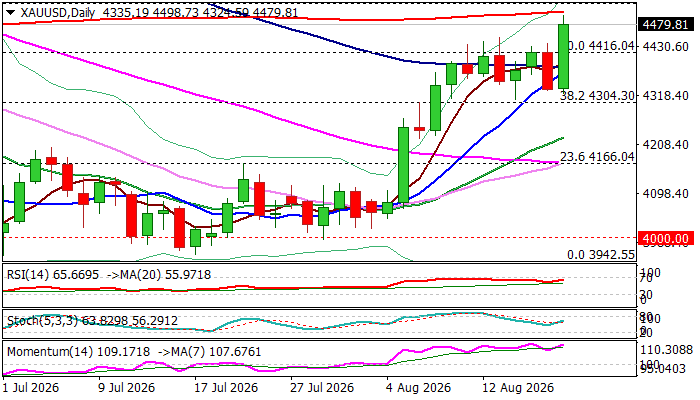
Gold Rises Over 3% on Weaker Dollar
Gold price surged over 3% on Wednesday, driven by sharp fall in the US dollar, on primarily dovish outlook for the Fed monetary policy action.
Fresh gains show strong attempts for eventual break above eight-day range, defined by $4310 floor, reinforced by daily Ichimoku cloud base ($4358) and range tops at $4440 zone, though several upticks failed to register daily close above Fibo barrier at $4416 (50% retracement of $4889/$3942 bear-leg).
Sustained break higher to generate signal of bullish continuation, with immediate targets at $4509 (200DMA) and $4527 (Fibo 61.8%), while stronger acceleration would focus $4600 (round-figure) and $4666 (Fibo 76.4%).
Daily studies firmed following multiple DMA bull-crosses, strong bullish momentum, while thick daily cloud underpins.
Broken barriers at $4440 (range top) and $4416 (50% retracement) revert to solid supports which should hold potential dips and keep fresh bullish structure intact.
Res: 4509; 4527; 4600; 4666
Sup: 4440; 4416; 4371; 4330
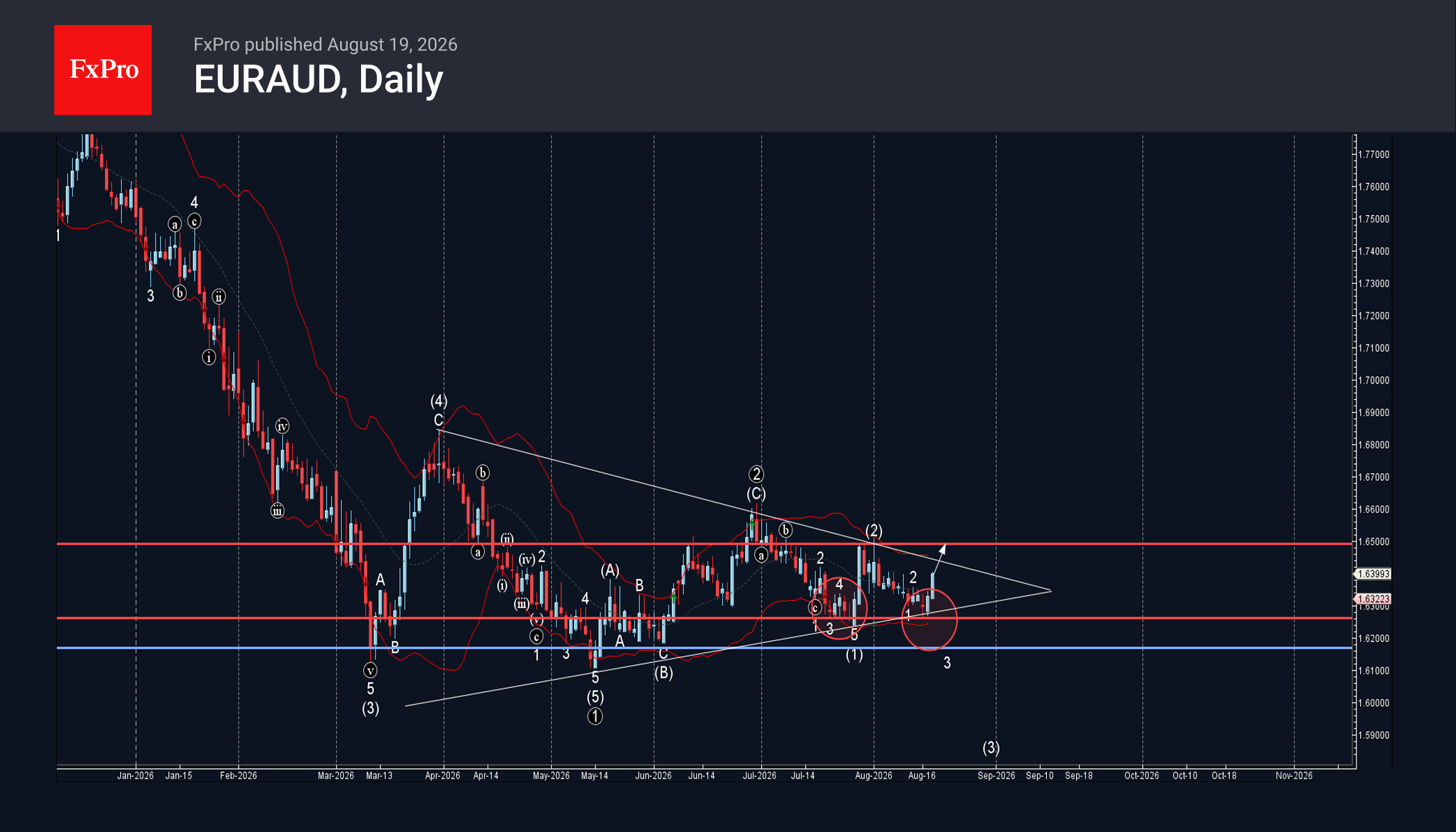
EURAUD Wave Analysis
EURAUD: ⬆️ Buy
– EURAUD reversed from support zone
– Likely to rise to resistance level 1.6500
EURAUD currency pair recently reversed up from the support zone between the support level 1.6260 (which has been reversing the price from July) and the support trendline of the daily Triangle from March.
This support zone was strengthened by the lower daily Bollinger Band – which helped form the daily Bullish Engulfing.
EURAUD currency pair can be expected to rise further to the next resistance level 1.6500, which reversed the previous correction (2) at the end of July.
Sunset Market Commentary
Markets
The US Treasury today announced that it is increasing, by at least double, the size of liquidity support buyback operations for longer-dated nominal coupon securities (10y to 20y and 20y to 30y). The current maximum size of $2bn per operation will be at least $4bn per operation, effective September 9 and in effect for the remainder of the current refunding quarter (through Nov 4). This will apply to 7 more buyback operations after which the Treasury will announce more on future sizes at the next Quarterly Refunding statement. "The increase in buyback operation sizes reflects Treasury's desire to provide greater liquidity support in longer-dated nominal sectors where there is consistent strong sponsorship from market participants, as evidenced by the significant volume of high-quality offers Treasury routinely receives in longer-dated buyback operations." The Treasury launched its buyback program in May 2024. It purchases off-the-run nominal coupon securities and TIPS from primary dealers, financed by simultaneously issuing new on-the-run securities. The goal is to retire illiquid older debt and replace it with more actively traded benchmarks, improving overall market depth. US Treasuries rallied at the long end of the US curve which bull flattens. Daily changes on the US yield curve range between -0.2 bps (2-yr) and -8 bps (30-yr). On FX markets, the announcement pushed EUR/USD beyond the 1.16 resistance area with EUR/USD currently trading at 1.1650 for the first time since early June. US equity markets opened stronger, gaining up to 0.5% (Nasdaq). While the higher volumes are clearly no game-changer, they signal that "big brother" (Treasury Secretary Bessent) is watching the long end of the curve. The end-of-July joint efforts with Japanese authorities to stem JPY-weakness were also partially inspired by worries about the long end of the curve. Bessent wanted to avoid the situation where Japan accelerated selling of US Treasury holdings to fund FX interventions. The US 30-yr yield moved above 5.3% for the first time since 2007 earlier this week. The US 10-yr yield flirted with 4.75% for the first time since January of last year. The US administration is focused on interest rates as election pledges to lower mortgage rates risk backfiring at upcoming US-midterm elections. Apart from the political aspect, elevated interest rates significantly weigh on the US budget deficit. According to the CBO, federal interest rate costs will hit 3.3% of GDP this year (and head to 4.6% of GDP in 2036) after averaging 2.1% over the past half-century. The forecast assumes a 4.1% 10-y bond yield.
The final July EMU CPI figure came in slightly higher than initially reported (2.95% Y/Y for headline and 2.47% Y/Y for core), following an upward revision of energy prices from 10% YoY to 10.3% YoY. Given the recent increase in oil prices, we have upgraded our August headline inflation nowcast from 3% to 3.2%, while the core inflation estimate remains around 2.4%.
News & Views
Poland's prime minister Tusk announced an overhaul to the country's income tax regime to ease the burden on middle-income earners today. The government will introduce a new 24% rate, sitting in between the existing 12% and 32% brackets. The threshold for the lowest rate will be lifted from the 2022 level of PLN 120 000 to PLN 130 000 with the 24% rate applicable to earnings between PLN 130 000 and PLN 150 000. Tusk said the changes will come into effect next year and would benefit around 3.5 mln Poles. A 3 ppts increase in the corporate income tax rate to 22% for companies with annual revenues exceeding €50 mln should fund the measure. Banks, which already pay elevated rates (30% this year) due to windfall-tax measures imposed earlier, are not affected by the overhaul.
Less than a month ahead of the Swedish general elections (September 13), the country's center-left opposition is holding a 10 percentage point lead over the right-wing coalition. The four left-leaning parties had a combined 53.9% backing, giving them an estimated 196 seats. This compares to the 43.9%, or 153 seats, the ruling coalition scored. Public broadcaster SVT, the survey-taker, said no government has ever bridged a gap this wide in such short time, making change all but certain. The Social Democrats maintained their position as the biggest party, garnering 30.5% support, up 0.2% ppts from the 2022 election result. That makes its leader, Magdalena Andersson, the most likely candidate to take over the baton from Sweden's right-wing Moderates' Ulf Kristersson as prime minister.
Dollar Slides on Treasury Buybacks — Can Fed Minutes Bring the Hawks Back?
What's happening: Dollar sold off broadly Wednesday after Treasury announced it will at least double its long-dated debt buyback operations, from $2bn to at least $4bn, starting September 9, pulling the 30-year Treasury yield back below 5.20% from above 5.33% earlier in the week and stripping away Dollar's recent yield support.
Why it matters: The buybacks address liquidity, not the structural fiscal deficit that drove yields toward two-decade highs, so whether 30-year yield stays contained is itself a test. Attention now shifts to Wednesday's July FOMC minutes, but the real question isn't the 9-3 vote itself, it's whether hawkish sympathy extends beyond the three official dissenters, and even that signal may already be stale given the data received since the July 30 meeting.
Treasury Buybacks Knock Away Dollar’s Yield Support
Dollar came under broad selling pressure in early US trading Wednesday as long-dated Treasury yields reversed sharply from this week’s multi-year highs. 30-year yield fell back below 5.20% after reaching above 5.33% earlier in week, near its highest level in two decades, stripping away an important source of recent support for greenback.
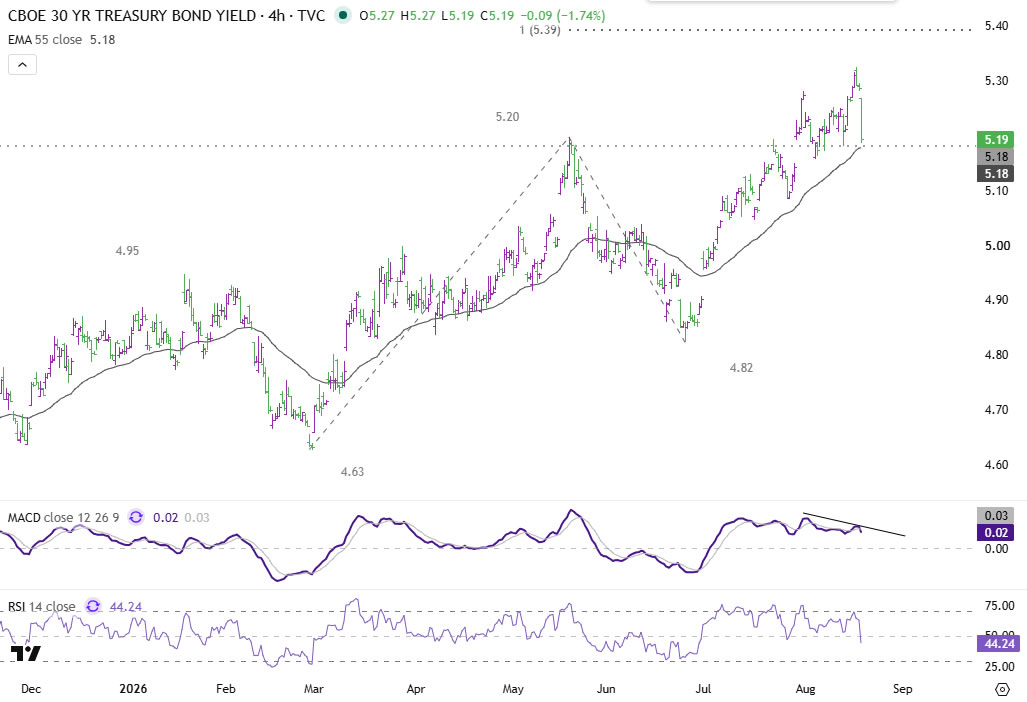
Trigger came from Treasury Department, which said it will at least double maximum size of its long-dated debt buyback operations from $2bn to at least $4bn, starting September 9 and running through November 4. Operations will target 10–20 year and 20–30 year sectors, precisely where selling pressure has been most intense since late June. Treasury said larger operations were intended to provide greater liquidity support in long-dated nominal securities, citing consistently strong participation from market counterparties.
Immediate market reaction is revealing because expanded buybacks do not begin for another three weeks. Investors nevertheless pushed long yields sharply lower as soon as future relief was announced. That suggests positioning in long end had become stretched enough that even prospect of greater Treasury absorption was sufficient to trigger substantial reversal.
Treasury's Buyback Expansion
- Size: at least doubled, from $2bn to at least $4bn maximum per operation.
- Start date: September 9, running through November 4.
- Target sectors: 10-20 year and 20-30 year, where selling pressure has been most intense since late June.
- Stated rationale: greater liquidity support in long-dated nominal securities, citing strong counterparty participation.
Buybacks Offer Relief, Not a Fiscal Reset
The announcement changes near-term dynamics in long end, but it should not be confused with a solution to structural pressures that drove yields toward two-decade highs.
Treasury buybacks can improve liquidity and absorb selected long-dated securities, easing pressure in parts of curve that have struggled to attract buyers. But they do not remove underlying fiscal deficit or eliminate government financing needs. Treasury still needs to fund those requirements elsewhere across maturity spectrum.
That distinction sets up an important test. If 30-year yield remains contained after Wednesday’s move despite elevated oil prices and continued fiscal concerns, expanded buybacks may have materially altered near-term supply and liquidity balance. If yields quickly rebound once announcement is absorbed, this week’s deeper pressures—fiscal deterioration, inflation risk and higher term premium—would still appear dominant.
For Dollar, immediate effect is simpler: lower long yields have removed much of support that briefly interrupted recent selloff.
Fed Minutes Need to Reveal More Than Three Hawks
Attention now shifts to July FOMC minutes, where market-moving question is not whether Committee was divided. Headline vote already showed that clearly.
Fed held rates by 9–3, with Hammack, Kashkari and Logan dissenting in favor of a hike—the first unified three-way hawkish dissent of its kind since 2016. What markets do not know is whether those three were truly isolated or merely only officials prepared to register formal dissent.
That distinction matters for assessing risk for the rest of the year. If minutes show several of nine hold voters were sympathetic to immediate tightening but preferred waiting for another round of data, headline vote would understate underlying hawkishness. A 9–3 decision backed by broad majority opposition to tightening sends a very different signal from a 9–3 where several hold votes were close calls.
For Dollar to recover meaningfully from Wednesday’s yield-driven selloff, minutes may need to reveal exactly that kind of broader hawkish sympathy rather than merely repeat arguments already associated with three dissenters.
Two Readings of the 9-3 Vote
| Narrow Reading | Broader Reading | |
|---|---|---|
| Hawkish support | Limited to the three dissenters, Hammack, Kashkari and Logan | Several hold voters privately sympathetic, preferred waiting for more data |
| Signal for Dollar | Fed's hawkish wing is genuinely isolated | Committee more hawkish beneath the surface than the vote count suggests |
| What would confirm it | Minutes largely repeat arguments already tied to the three dissenters | Minutes show "insurance hike" logic or supply-shock concern spreading to hold voters |
Watch the “Insurance Hike” and Supply-Shock Arguments
The reasoning behind dissent also matters.
Kashkari and Logan had framed tighter policy partly as an insurance strategy: modest action sooner could reduce risk that Fed eventually has to move much more aggressively. If that logic appears elsewhere in minutes among officials who ultimately voted hold, markets could conclude Committee is more willing to act pre-emptively than vote count suggests.
Supply-shock discussion will be another key area. Repeated shocks—from tariffs to Middle East energy disruption—raise question of whether inflation can continue being treated as temporary each time, particularly if those shocks begin affecting expectations or pricing behavior. AI-related investment and strong capital demand could also feature in discussion over how much spare capacity economy really has.
Labor market assessment is equally important. Hawkish case rested partly on argument that employment conditions were still resilient enough to tolerate tighter policy without excessive cost. Evidence that broader Committee was already concerned about weakening labor demand would work in opposite direction and make recent soft data even more significant.
But July Minutes Describe an Economy That No Longer Exists
There is one major limitation: minutes reflect Committee’s thinking as of July 30.
Since then, markets have received weaker employment data, softer CPI, subdued retail sales and flat PPI. Those releases have materially reduced expectations for September tightening and changed balance between inflation and growth risks.
That means minutes should not be treated as direct statement of what Fed would do today. Their value lies in revealing reaction function—what evidence hawks needed to see, how much labor-market weakness would make them hesitate, and whether officials voting hold were waiting for specific inflation triggers.
In that sense, most useful question is not whether July minutes look hawkish or dovish in isolation. It is whether thresholds described by policymakers have already been crossed by data released since meeting.
That also raises importance of Chair Warsh’s upcoming communication. His August 28 Jackson Hole keynote will incorporate information that July minutes could not, making it a potentially more relevant guide to current policy thinking.
FX Market Has One Clear Theme: Dollar Weakness
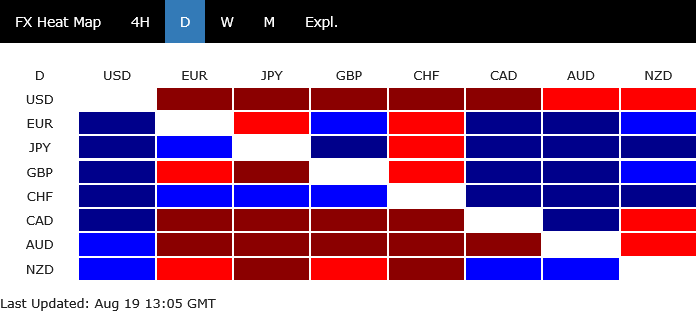
Broader currency ranking offers little evidence of a unified risk or commodity theme Wednesday. Dollar is weakest major currency, followed by Aussie and Loonie, while Swiss Franc leads, followed by Yen and Euro. Kiwi and Sterling sit closer to middle.
That mixed ranking makes it unnecessary to force a broader narrative. Clearest relationship is between Dollar and Treasury yields.
Related Coverage
Trade & Commodities Deep Dive
- Read why Trump's three-day pause on the planned 50% Canada tariff eases immediate pressure on CAD without resolving broader trade tensions: Trump Pauses Canada Tariff — Relief for CAD, but No Trade Reset Yet.
- See why Silver is cracking as the Hormuz crisis shifts from an inflation shock into a broader stagflation trade, with 60.92 now key support: Hormuz Crisis Turns Stagflationary as Silver Starts to Crack.
Global Inflation Deep Dives
- Read why Eurozone's finalized 2.9% CPI gives the ECB more than just an oil-driven headline to worry about, with core CPI firming to 2.5%: Eurozone CPI Finalized at 2.9% as Energy and Services Keep ECB on Guard.
- See why UK CPI's rise to 2.9% masks easing services inflation, with housing costs doing most of the work on the headline: UK CPI Rises to 2.9%, but Services Inflation Moves Lower.
Central Bank Commentary
- Read why RBA Deputy Governor Hauser sharpened the case for another hike if disinflation stalls, citing oil, AI demand and weak productivity: RBA's Hawkish Warning Gets Clearer: Disinflation Stalls, Rates Rise Again.
Asia-Pacific Data Deep Dives
- See why Australia's annual wage growth easing to 3.2% suggests wages are cooling gradually rather than becoming a fresh inflation threat: Australia Annual Wage Growth Slows to 3.2% as Private-Sector Pay Moderates.
- Read why New Zealand's Q2 input costs surging 2.9% against output prices up just 1.6% points to renewed pressure on business margins: New Zealand Input PPI Rises 2.9% in Q2, Output Prices Up 1.6%.
Frequently Asked Questions
Q: Why did Dollar fall on a buyback program that doesn't start for three weeks?
A: Because positioning in the long end of the Treasury curve had become stretched enough that even the prospect of greater future Treasury absorption was sufficient to trigger a substantial reversal. The 30-year yield fell from above 5.33% to below 5.20% on the announcement alone, and since Dollar had been drawing support from those elevated yields, the reversal immediately removed that support.
Q: Do Treasury buybacks fix the structural pressure that pushed yields to two-decade highs?
A: Not on their own. Buybacks improve liquidity and absorb selected long-dated securities, but they don't remove the underlying fiscal deficit or eliminate government financing needs, Treasury still has to fund those requirements elsewhere across the maturity spectrum. Whether 30-year yield stays contained despite elevated oil prices and fiscal concerns, or quickly rebounds once the announcement is absorbed, will show whether buybacks meaningfully altered the supply and liquidity balance or just delayed the pressure.
Q: What would July's Fed minutes need to show to bring Dollar bulls back?
A: More than repeating the known arguments of the three dissenters, Hammack, Kashkari and Logan. Dollar would need minutes showing several hold voters were sympathetic to immediate tightening, sharing the "insurance hike" logic or supply-shock concerns, which would suggest the Committee is more hawkish beneath the surface than the 9-3 vote implies. Even then, the minutes reflect the Fed's thinking as of July 30, before weaker jobs, softer CPI and flat PPI arrived, so Chair Warsh's August 28 Jackson Hole keynote may end up mattering more.
Key Takeaways
- Treasury will at least double long-dated buybacks, from $2bn to at least $4bn, starting September 9: The announcement pulled 30-year yield back below 5.20% from above 5.33% earlier in the week.
- The market reaction arrived three weeks early: Since the program doesn't start until September 9, the immediate yield reversal suggests long-end positioning had become stretched.
- Buybacks address liquidity, not the structural fiscal deficit: Whether 30-year yield stays contained once the announcement is absorbed is itself a test of whether this is durable relief or just a pause.
- The real question in Wednesday's Fed minutes isn't the 9-3 vote itself: It's whether hawkish sympathy extends beyond the three dissenters, Hammack, Kashkari and Logan, to hold voters who saw it as a close call.
- Minutes reflect thinking as of July 30, before a run of softer data: Weaker employment, softer CPI, subdued retail sales and flat PPI since then may have already crossed thresholds officials described, making Chair Warsh's August 28 Jackson Hole keynote a more current guide.
- FX ranking showed no unified theme beyond Dollar weakness: Franc led, Dollar was weakest, and the clearest relationship Wednesday was between Dollar and Treasury yields.
What to Watch Next
July FOMC minutes are the immediate test, specifically whether they reveal "insurance hike" logic or supply-shock concerns spreading beyond the three dissenters. Also watch whether 30-year yield stays contained below 5.20% as the buyback announcement is digested, and treat Chair Warsh's August 28 Jackson Hole keynote as a potentially more current read on Fed thinking than the minutes themselves.
EUR/USD Daily Outlook
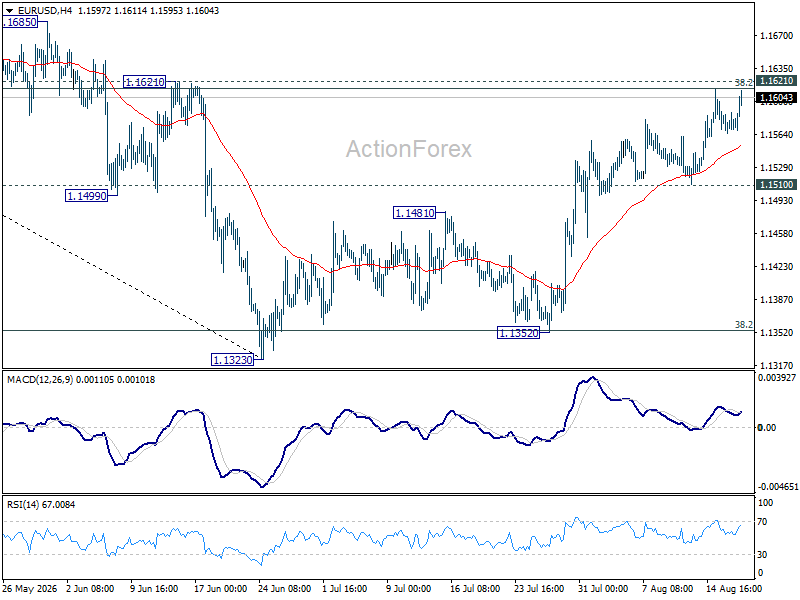
Further rise is in favor in EUR/USD with 1.1510 support intact. On the upside, decisive break of 1.1621 cluster resistance (38.2% retracement of 1.2081 to 1.1323 at 1.1613) will solidify the case that fall from 1.2081 has completed as a three wave correction at 1.1323. Further rally would then be seen to 61.8% retracement at 1.1791.
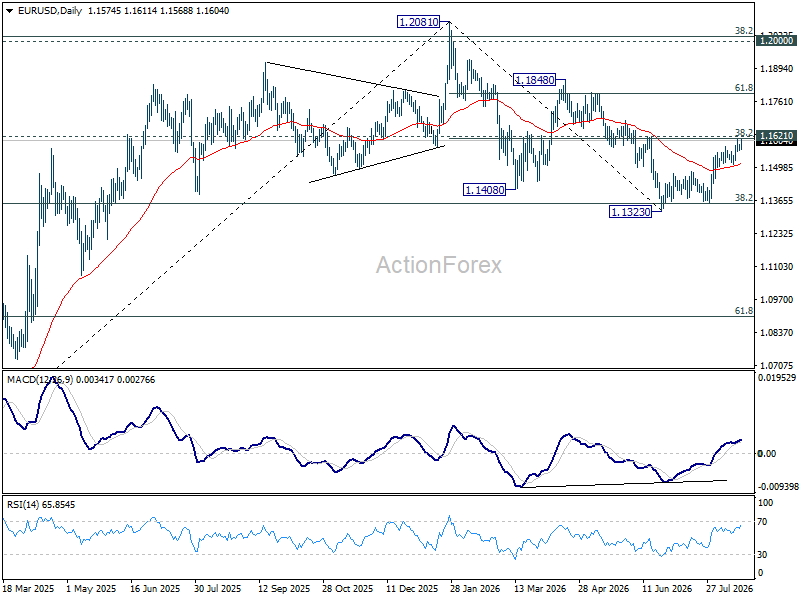
In the bigger picture, focus is staying on 38.2% retracement of 1.0176 to 1.2081 at 1.1353. Decisive break there will revive the case of medium term bearish trend reversal after rejection by 1.2 key cluster resistance level. Further fall should be seen to 61.8% retracement at 1.0904. Nevertheless, strong rebound from 1.1353, followed by break of 1.1621 resistance, will retain medium term bullishness.
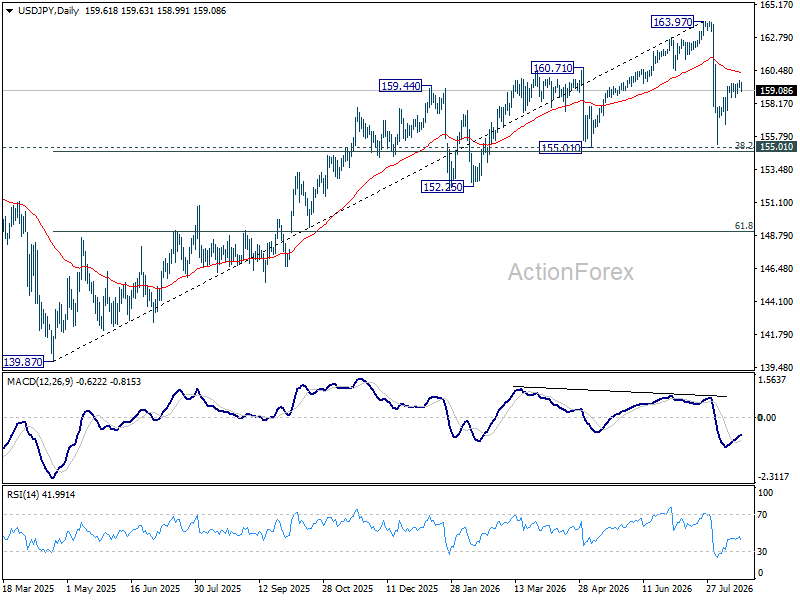
USD/JPY Daily Outlook
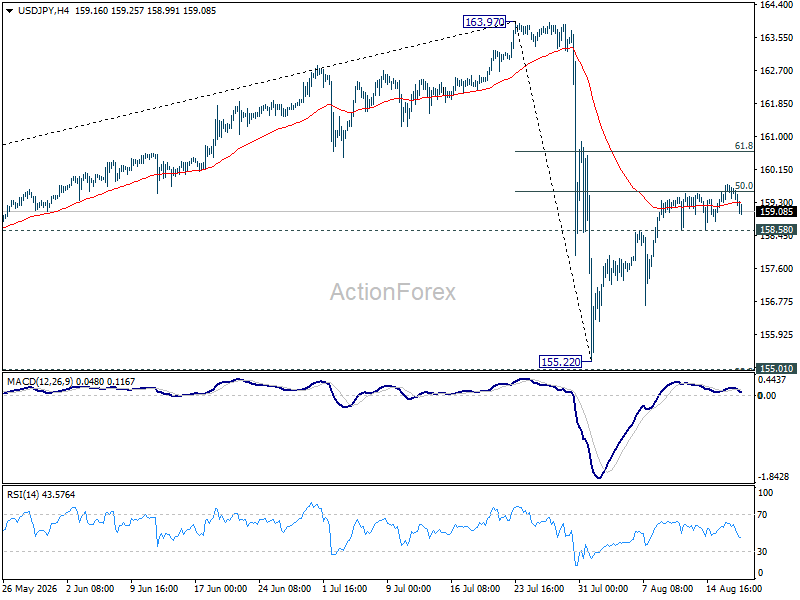
While further rise cannot be ruled out in USD/JPY, strong resistance could emerge from 159.59 to 160.62 zone (50% and 61.8% retracement of 163.97 to 155.22) to limit upside. On the downside, firm break of 158.58 will turn bias back to the downside for deeper pullback. However, firm break of 159.59 will pave the way back to retest 163.97 high.
In the bigger picture, as long as 155.01 cluster support (38.2% retracement of 139.87 to 163.97 at 154.76) holds, the larger up trend is still expected to continue through 163.97 after current correction completes. However, firm break of 155.01 will raise the chance that USD/JPY is already in a larger scale correction, and open up deeper fall back to 139.87 (2025 low) in the medium term.