

Sample Category Title
Brent Breaks $94, Global Yields Push Higher — but Dollar Refuses to Follow
What's happening: Brent crude broke above $94 and WTI through $87 today, both fresh highs since late July, after Trump threatened "TREMENDOUS Economic Consequences" against countries helping Iran evade sanctions. That oil breakout is dragging global bond yields higher again, US 10-year toward 4.70%, 30-year toward 5.24%, clawing back much of Wednesday's Treasury-buyback-driven decline, with German, UK and Canadian yields rising too.
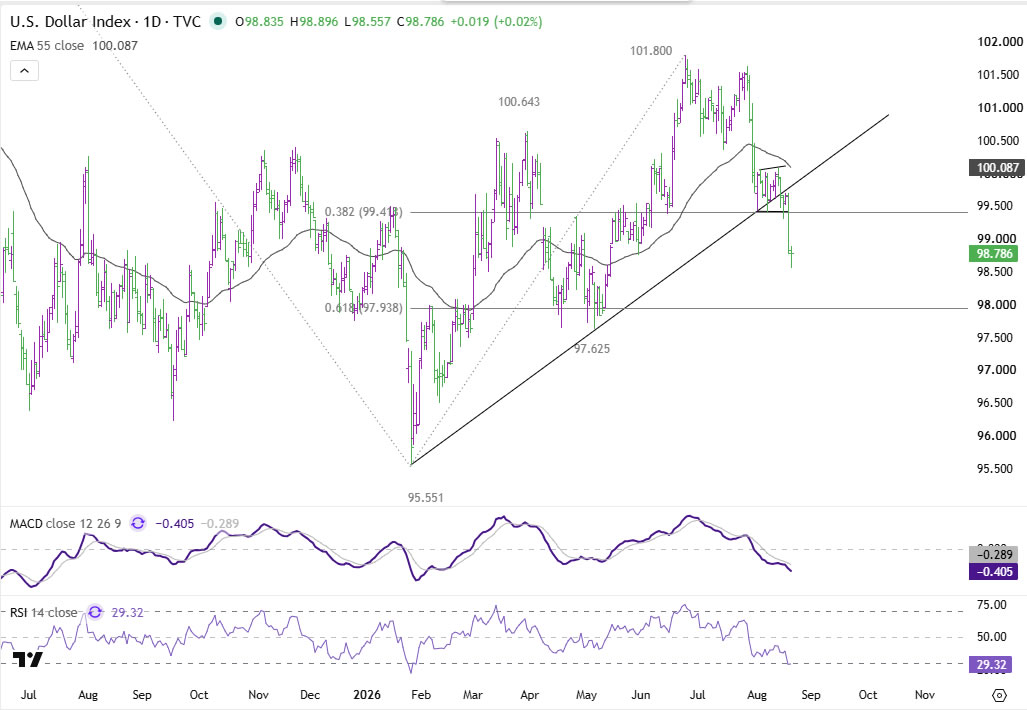
Why it matters: Under normal circumstances, US yields rebounding this much would restore some Dollar support, but DXY is broadly flat. That's because Thursday's yield increase is global, not uniquely American, limiting any relative US yield advantage, and DXY has already suffered a technical breakdown. Watch whether yields keep recovering while DXY stays below 100.08, Dollar's non-reaction becomes the real signal, versus a renewed global yield decline combined with DXY breaking 97.93, which would reinforce the bearish Dollar setup.
Oil Rally Accelerates as Trump Turns Up Economic Pressure on Iran
Brent crude accelerated above $94 today, while WTI pushed through $87, extending both benchmarks to their highest levels since late July. Move marks a fresh phase in oil rally rather than simple consolidation of earlier gains, as markets increasingly price prolonged disruption to Middle East energy supplies and diminishing prospects for a quick US-Iran settlement.
Latest escalation followed US President Donald Trump’s Wednesday warning of an “ECONOMIC D-DAY” against Iran. Trump threatened “TREMENDOUS Economic Consequences” for countries allowing their financial institutions, businesses, airports or government entities to provide Iran with an economic lifeline. Threat extended specifically to channels used to circumvent sanctions, including oil smuggling, swap lines, cash transfers, exchange houses, ship registries and front companies. UAE’s suspension of economic and financial ties with Iran added another layer of pressure.
Iran showed no sign of backing down. Foreign Minister Abbas Araghchi described Trump’s threat as “economic terrorism,” while Deputy Foreign Minister Kazem Gharibabadi argued Washington had turned toward economic warfare after its military campaign failed to achieve its objectives. With Strait of Hormuz disruption already constraining regional trade, increasingly aggressive economic confrontation raises risk that disruption lasts considerably longer than markets initially expected.
Trump's "Economic D-Day" Threat
- Target: countries allowing financial institutions, businesses, airports or government entities to give Iran an economic lifeline.
- Named channels: oil smuggling, swap lines, cash transfers, exchange houses, ship registries and front companies.
- UAE: suspended economic and financial ties with Iran, adding another layer of pressure.
- Iran's response: Araghchi called it "economic terrorism"; Gharibabadi said Washington turned to economic warfare after its military campaign fell short.
Brent $94 Adds Another Inflation Problem for Global Bonds
Oil breakout is now spilling back into bond markets. US 10-year Treasury yield rebounded toward 4.70% on Thursday, while 30-year climbed back toward 5.24%, clawing back a substantial portion of Wednesday’s Treasury-buyback-driven decline.
Importantly, move is not confined to US. German, UK and Canadian government yields are also higher. That breadth makes oil a plausible common contributor. A purely US technical reversal following Treasury buyback announcement would not naturally explain simultaneous selling across several major sovereign markets, whereas Brent above $94 raises headline inflation and inflation-expectation risks across energy-importing economies.
Still, oil should not be assigned all of blame. Thursday’s move is better viewed as combination of renewed global inflation concerns and fading relief from Wednesday’s Treasury announcement. Whether breakeven inflation rates begin rising alongside nominal yields will provide an important test of how much of latest bond selloff is actually being driven by oil.
Treasury Buybacks Provided Relief, Not a Fiscal Solution
Wednesday’s dramatic yield decline followed Treasury’s decision to at least double maximum size of long-dated buybacks, particularly in 20- and 30-year sectors. Markets immediately front-ran prospect of greater liquidity support even though enlarged operations do not begin until September 9.
But buybacks did not change underlying fiscal backdrop or broader Treasury financing requirements. J.P. Morgan argued that program “does nothing to address” structural forces driving yields, including unsustainable fiscal deficits and firmer inflation expectations. Standard Chartered’s Eric Robertsen similarly characterized intervention as an attempt to influence natural supply and demand rather than address underlying pressures.
Thursday’s rebound therefore carries an important message. Treasury announcement was powerful enough to trigger an immediate repricing of long-duration bonds, but market has yet to demonstrate that it can permanently suppress structural pressure on long yields. A return by 30-year yield toward this week’s 5.30–5.33% highs would reinforce view that buybacks changed short-term positioning more than long-term equilibrium.
Higher Treasury Yields Fail to Rescue Dollar
Dollar’s reaction is arguably more striking. DXY is broadly flat despite 10-year Treasury yield recovering toward 4.70% and 30-year returning above 5.20%. Under normal circumstances, such a rebound in US yields would be expected to restore at least some support to greenback.
One reason is that Thursday’s yield increase is global rather than uniquely American. German, UK and Canadian yields are rising alongside Treasuries, limiting improvement in relative US yield advantage. Oil itself also produces competing currency effects, supporting some commodity currencies while putting pressure on energy importers.
Oil, Bonds and Dollar Are Not Moving in Lockstep
Three distinct forces are now intersecting. Oil is responding directly to escalation in US-Iran economic confrontation and increasingly persistent disruption around Hormuz. Global bonds are responding both to renewed energy-driven inflation risks and structural pressures that Wednesday’s Treasury buyback announcement did not remove. Dollar, meanwhile, is failing to capitalize on higher US yields because those yields are rising alongside their global counterparts and DXY has already suffered an important technical breakdown.
That makes Dollar’s non-reaction one of most important signals to watch. If Treasury yields continue recovering while DXY remains below 100.08, it would suggest simply restoring higher nominal US yields is not sufficient to rebuild Dollar’s previous support. Conversely, a renewed fall in global yields combined with DXY breaking 97.93 would reinforce bearish Dollar setup. For now, Brent above $94 is again putting pressure on global rates—but unlike earlier phases of yield surge, greenback is refusing to follow.
US Data Deep Dive
- Read why falling initial jobless claims came alongside a rise in continuing claims and a higher four-week average: U.S. Jobless Claims Fall to 206K, but Continuing Claims Rise.
Asia-Pacific Data Deep Dives
- See why Japan's headline 23.2% export surge overstates the real story, with volumes up only 5.2% once weak Yen and higher prices are stripped out: Japan Exports Surge 23.2%, but Weak Yen and Oil Shock Distort the Headline.
- Read why Australia's -15.8K July jobs drop and unemployment rising to 4.5% give the RBA clearer evidence the labor market is cooling: Australia Jobs Fall -15.8K as Unemployment Hits 4.5%, Giving RBA More Evidence of Slowdown.
Fed Deep Dive
- See why July's Fed minutes revealed more hawkish concern than the 9-3 vote suggested, even as the data behind that meeting is already out of date: Fed Had More Hawks Than the 9-3 Vote Suggested — But July Is Already Stale.
Frequently Asked Questions
Q: Why is Dollar not rallying even though US Treasury yields are recovering?
A: Because Thursday's yield increase is happening globally, not just in the US. German, UK and Canadian yields are rising alongside Treasuries, so the US isn't gaining a relative yield advantage the way it normally would. DXY has also already suffered a technical breakdown, so a rebound in nominal yields alone isn't enough to restore Dollar's previous support.
Q: Why aren't Wednesday's Treasury buybacks fully explaining Thursday's bond selloff?
A: Because the buyback program addresses liquidity, not the structural fiscal deficit and inflation expectations actually driving yields toward two-decade highs, as J.P. Morgan and Standard Chartered both noted. Thursday's global scope, German, UK and Canadian yields all rising too, wouldn't be explained by a US-specific technical reversal, which points to Brent's break above $94 as a more plausible common driver.
Q: What would confirm oil is now driving the global bond selloff rather than something else?
A: Whether breakeven inflation rates start rising alongside nominal yields. If they do, it would support the idea that Brent above $94 is feeding directly into inflation expectations across energy-importing economies. For Dollar specifically, watch DXY against 100.08 and 97.93, staying below 100.08 while yields recover would show Dollar's disconnect from yields persisting, while a break of 97.93 alongside falling global yields would reinforce the bearish setup.
Key Takeaways
- Brent broke above $94 and WTI above $87 after Trump threatened "TREMENDOUS Economic Consequences" against countries helping Iran evade sanctions.
- The oil breakout is spilling into bonds globally, not just the US: German, UK and Canadian yields rose alongside Treasuries, arguing against a purely US-technical explanation.
- Wednesday's Treasury buyback relief didn't fix the structural backdrop: J.P. Morgan and Standard Chartered both said the program doesn't address the fiscal deficit and inflation expectations driving yields, and Thursday's rebound is clawing much of that relief back.
- Dollar failed to rally despite recovering US yields: DXY stayed broadly flat even as the 10-year moved toward 4.70% and the 30-year back above 5.20%.
- The disconnect comes from yields rising globally, not just in the US: That limits any relative US yield advantage, and DXY has already suffered a technical breakdown.
- Two levels frame what comes next: DXY staying below 100.08 while yields recover would confirm Dollar's disconnect from yields; a break of 97.93 alongside falling global yields would reinforce the bearish setup.
What to Watch Next
DXY's behavior relative to 100.08 and 97.93 is the clearest read on whether Dollar's disconnect from yields persists or reverses. Breakeven inflation rates will show how much of the bond selloff is genuinely oil-driven, and further escalation in Trump's economic pressure on Iran, along with the persistence of Hormuz disruption, remains the key upside risk for Brent.
U.S. Jobless Claims Fall to 206K, but Continuing Claims Rise
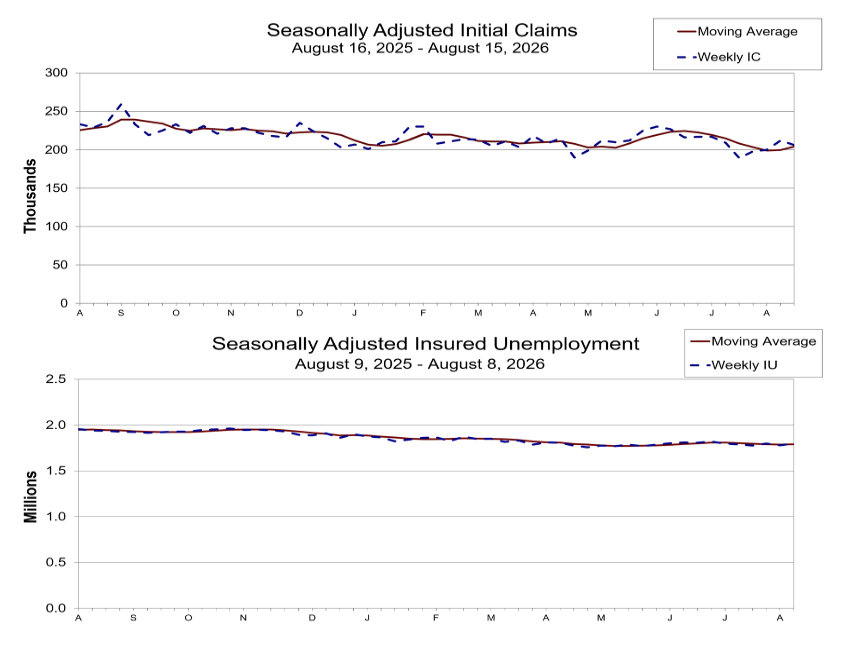
U.S. initial jobless claims fell 6,000 to 206,000 in the week ended August 15, below market expectations for 210,000 and pointing to continued stability in labor-market conditions. However, the previous week's figure was revised up to 212,000 from 209,000, meaning the latest decline partly reflects a higher starting point. The four-week moving average, which smooths weekly volatility, increased to 204,000 from a revised 199,750.
The broader picture is less reassuring than the headline decline suggests. Continuing claims rose 18,000 to 1.799 million in the week ended August 8, while the four-week average increased to 1.789 million. The insured unemployment rate was unchanged at 1.2%. Rising continuing claims indicate that workers who have lost jobs may be taking longer to return to employment, even as the flow of new claims remains relatively low.
Data Summary
| Indicator | Latest | Previous | Consensus |
|---|---|---|---|
| Initial Jobless Claims | 206K | 212K | 210K |
| 4-Week Moving Average | 204K | 199.75K | — |
| Continuing Claims | 1.799M | 1.781M | — |
| 4-Week Avg. Continuing Claims | 1.789M | 1.7865M | — |
| Insured Unemployment Rate | 1.2% | 1.2% | — |
Key Takeaways
- Initial claims fell to 206K, beating expectations for 210K and suggesting layoffs remain contained.
- Previous week's claims were revised higher to 212K, from 209K, reducing the strength of the latest decline.
- Four-week average rose to 204K, pointing to some softening in the underlying trend despite the weekly fall.
- Continuing claims increased 18K to 1.799M, suggesting unemployed workers are taking somewhat longer to find new jobs.
- Labor market is cooling gradually rather than deteriorating sharply. Low initial claims argue against an abrupt downturn, while rising continuing claims provide evidence of weaker labor-market momentum.
Full US jobless claims release here.
EURUSD – Bulls Take a Breather Ahead of Fresh Advance
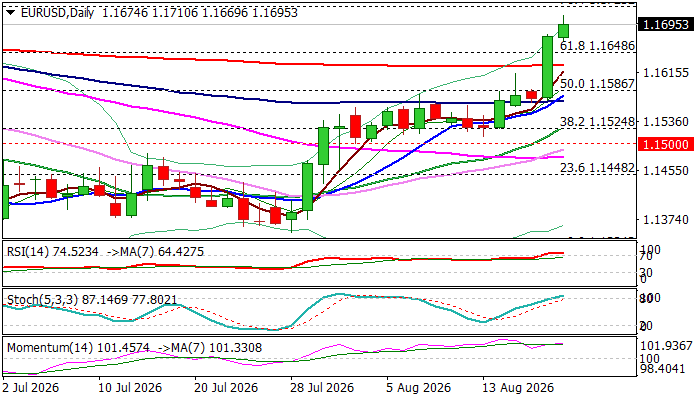
EURUSD extends steep ascend into second consecutive day and trading at three-month high on Thursday.
Bulls hold grip after Wednesday’s 0.85% advance (the biggest daily gain since March 19), after generating bullish signals on break above 200DMA (1.1628) and Fibo 61.8% of 1.1849/1.1324 (1.1648) and probe through round-figure barrier at 1.1700.
Dips on partial profit-taking are likely to be limited (ideally to be contained by broken Fibo 61.8% (1.1648) to keep bulls intact and provide better levels to re-enter bullish market for extension towards 1.1725 (Fibo 76.4%) and 1.1800 zone (early May lower platform).
Daily studies are firmly bullish but overbought that contributes to scenario of limited pullback ahead of fresh push higher.
Caution on dips below 200DMA that may weaken near-term structure.
Res: 1.1710; 1.1725; 1.1800; 1.1849
Sup: 1.1690; 1.1648; 1.1628; 1.1610
Japan 225 Analysis: Index Declines Amid Rising BoJ Rate Expectations
Selling pressure on the Japan 225 has intensified as markets increasingly anticipate a possible Bank of Japan rate hike in September. According to Reuters, policymakers are considering taking action at the 17–18 September meeting and may be open to tightening monetary policy at a faster pace than the current guidance of roughly two rate increases per year.
Market pricing points to a high probability of a September hike. At the same time, Japanese government bond yields have climbed to multi-year highs, reflecting growing expectations for tighter monetary policy alongside concerns over inflation and fiscal risks.
Technical Analysis of Japan 225
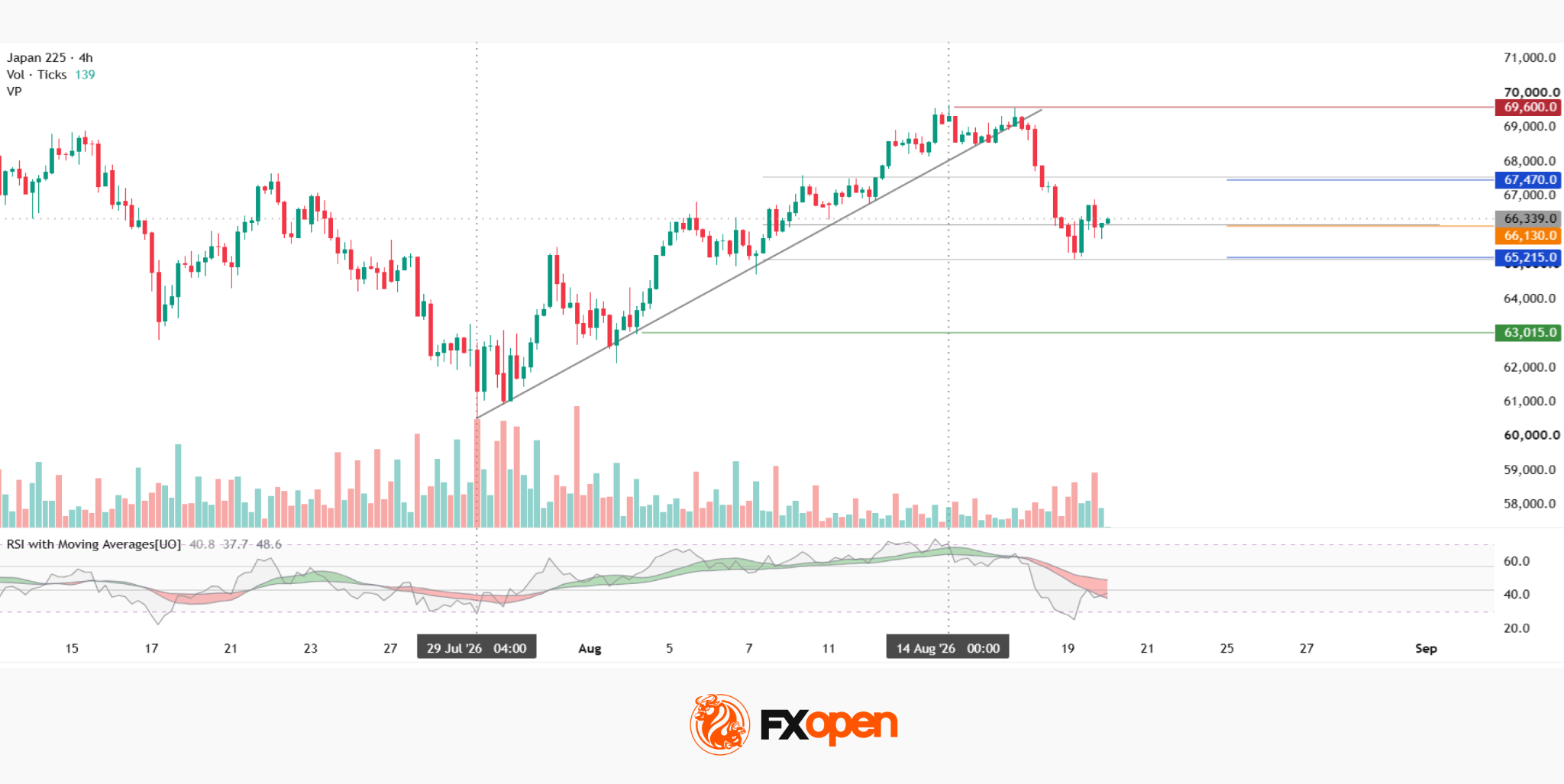
The H4 chart of the Japan 225 shows an upward trend that developed against a backdrop of declining vertical volume, with the index advancing from a local base formed in late July towards a peak of 69,600.
The trendline now appears to have been broken, with the move accompanied by a steady increase in trading volume. This suggests that the current decline is gaining more momentum than the preceding advance.
The index is currently trading around the Point of Control (POC) at 66,130, within the boundaries of the current market profile. The upper boundary is located at 67,470, while the lower boundary stands at 65,215.
If the breakdown extends and the price moves below the lower boundary of the profile, the next significant area of interest would be the 63,015 support zone, where the nearest concentration of market activity is located.
Conversely, if buyers regain control and successfully push the index back through the profile from below, the previous uptrend high at 69,600 would become the next major resistance level.
The RSI + MAs indicator currently shows readings of 39, 39 and 49. RSI has already entered oversold territory, while the fast moving average remains below the neutral zone and the slow moving average is positioned around its midpoint.
Key Takeaways
The fundamental backdrop remains mixed. Expectations of a Bank of Japan rate hike are weighing on the Japan 225, while weak domestic demand adds another source of uncertainty.
In the near term, the index is likely to remain sensitive to expectations surrounding the BoJ’s next policy decision, incoming inflation data, movements in the yen and changes in Japanese government bond yields. These factors could determine whether the current technical correction develops into a deeper decline or gives way to a renewed recovery.
Trade global index CFDs with zero commission and tight spreads (additional fees may apply). Open your FXOpen account now or learn more about trading index CFDs with FXOpen.
This article represents the opinion of the Companies operating under the FXOpen brand only. It is not to be construed as an offer, solicitation, or recommendation with respect to products and services provided by the Companies operating under the FXOpen brand, nor is it to be considered financial advice.
Trump Sparks Crypto Acceleration as Treasury Buybacks Add Fuel to Bitcoin and Ethereum
TL;DR: Bitcoin and Ethereum have surged over 14% and 22% this week, respectively, as falling real yields from the Treasury buyback shock combine with Trump's renewed crypto policy push — turning a macro rebound into a more powerful, crypto-specific acceleration.
Trump Changes the Character of the Crypto Rally
Something more important than another broad risk-on bounce is happening in crypto. Bitcoin has gained more than 14% this week and Ethereum roughly 22%, with Ethereum's outperformance particularly striking. The initial spark came from Treasury buybacks and the sharp fall in long-duration Treasury yields, but President Donald Trump's latest push has given crypto its own catalyst. That combination — lower real yields plus a renewed U.S. policy push — is turning a macro rebound into a more powerful crypto-specific acceleration.
Trump's Wednesday White House meeting with major crypto executives produced three developments that markets are now weighing. First was his backing for the CLARITY Act, which he called “very, very powerful structured legislation” and said could “open the door to the next wave of innovations and innovators.” He also called for “a fair version” of the bill. Coinbase CEO Brian Armstrong called it a “true bipartisan compromise.” Unlike general political support, this has a hard test ahead: the bill needs 60 Senate votes in a window next month. It is still only legislation, but White House pressure materially raises its importance for crypto markets.
From Regulation to Onchain Markets
Trump's second message was aimed at the rapidly growing onchain derivatives market. Referring to Hyperliquid, he said, “I understand Mike [Selig, CFTC Chair] is also working to bring [Hyperliquid] into the United States in a fully compliant and legal fashion.” HYPE immediately jumped roughly 20% over 24 hours.
The comment matters beyond Hyperliquid itself. CFTC Chair Mike Selig has already indicated that regulators are looking at ways for onchain perpetuals markets to operate in the U.S. Trump's support gives that effort an additional political dimension. It is not yet an approved regulatory framework, and traditional exchanges have raised concerns about offshore perpetual platforms, so there is still a significant policy fight ahead. But markets are clearly beginning to price the possibility that parts of crypto infrastructure currently operating outside the U.S. could eventually be brought into a formal domestic framework.
Bitcoin Buying Is the Wild Card
Trump also discussed the possibility of additional government Bitcoin purchases, but this part of the story needs more restraint. His actual wording was that a Bitcoin purchase “has been talked about”, while saying he would rely on Atkins and others for recommendations and would “certainly listen.” That is materially different from announcing a purchase program.
The U.S. already holds roughly 328,000 BTC through its Strategic Bitcoin Reserve, meaning any new buying would expand an existing framework rather than establish one. It is potentially important, but it is not yet a policy decision. For now, the CLARITY Act and the emerging regulatory pathway for onchain markets offer firmer catalysts.
Treasury Buybacks Are Adding the Macro Fuel
The macro backdrop is doing plenty of work underneath the political story. Treasury's surprise decision to at least double long-dated debt buybacks caused 30-year and 10-year yields to plunge as investors immediately priced the future reduction in long-duration supply. Operations do not begin until September 9, but the market moved well in advance.
For crypto, the transmission mechanism is straightforward. Falling real yields reduce the relative attraction of U.S. fixed-income assets and make non-yielding, higher-risk assets more attractive. The same real-yield move has supported gold and weakened the dollar. What makes crypto different this time is that Trump has supplied a second, sector-specific catalyst just as the macro environment has turned more supportive.
ActionForex's Technical View on Bitcoin
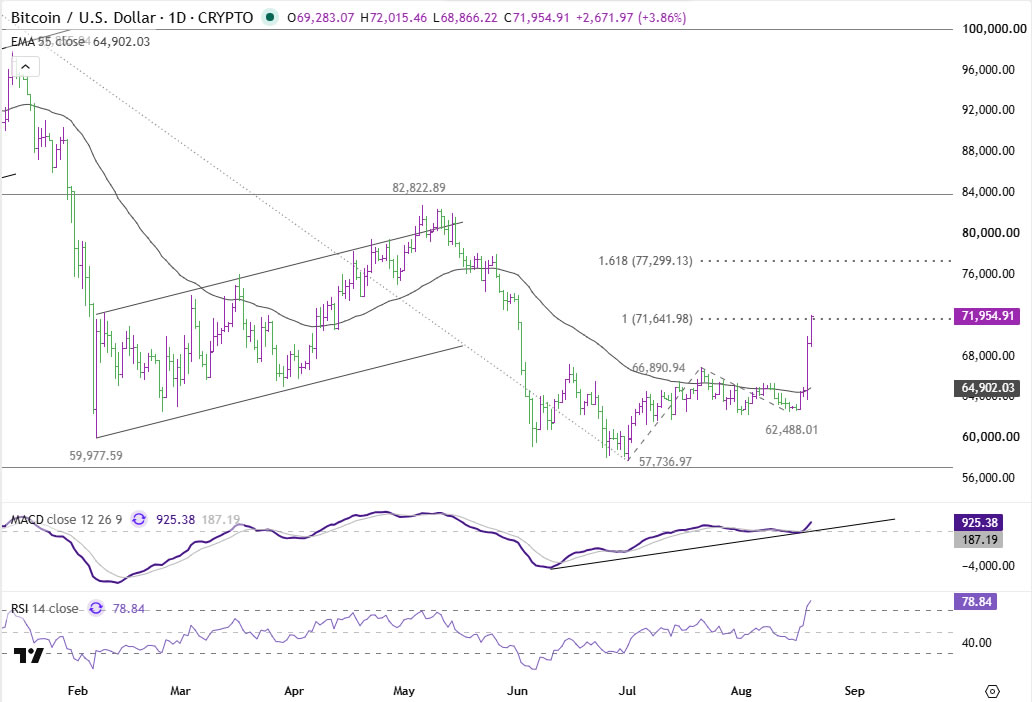
Bitcoin's charts now show genuine acceleration rather than simply a rebound from oversold conditions. The break above 66,890 resumed the rise from 57,736, while the move above the 55-day EMA strengthens the case that 57,736 is a medium-term bottom. Price is now testing 71,641, the 100% projection of the move from 57,736 to 66,890 measured from 62,488.
A decisive break above 71,641 would be the next major technical confirmation. It would imply that the rebound is becoming impulsive and expose 161.8% projection at 77,299 as the target.
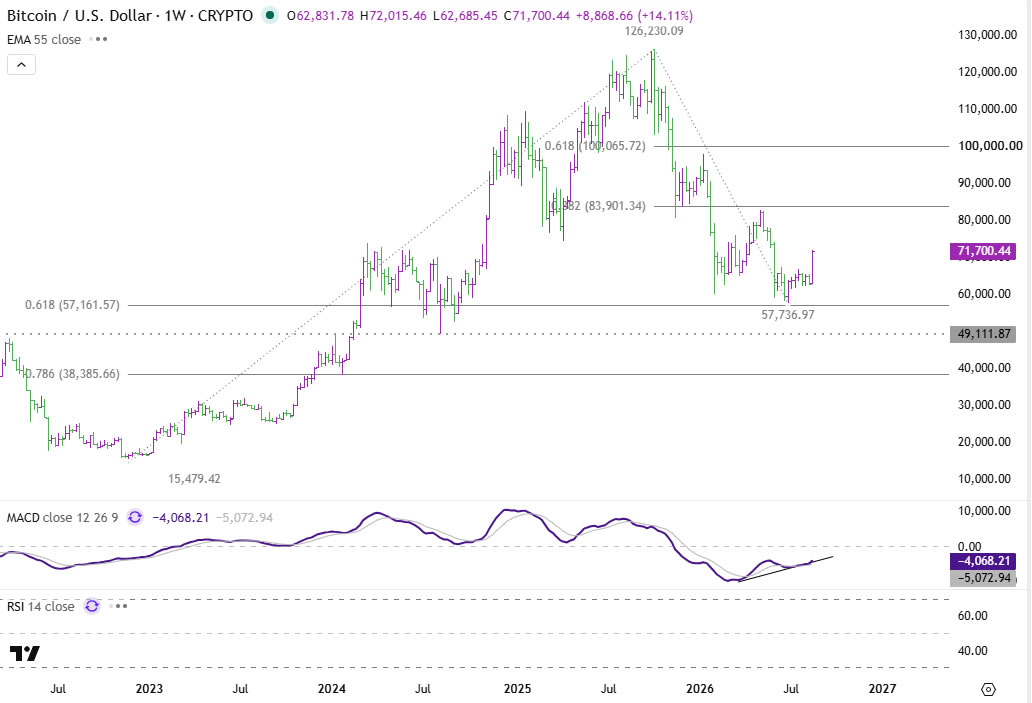
Zoom out to the weekly chart and the picture is more nuanced. Bullish divergence condition in W MACD supports that 57,736 is a medium term bottom. The next hurdle is 55 W EMA (now at 77,773). Clearing it would pave the way to 38.2% retracement of 126,230 to 57,736 at 83,901, even if the rise is part of a corrective pattern in the larger down trend from 126230.
ActionForex's Technical View on Ethereum
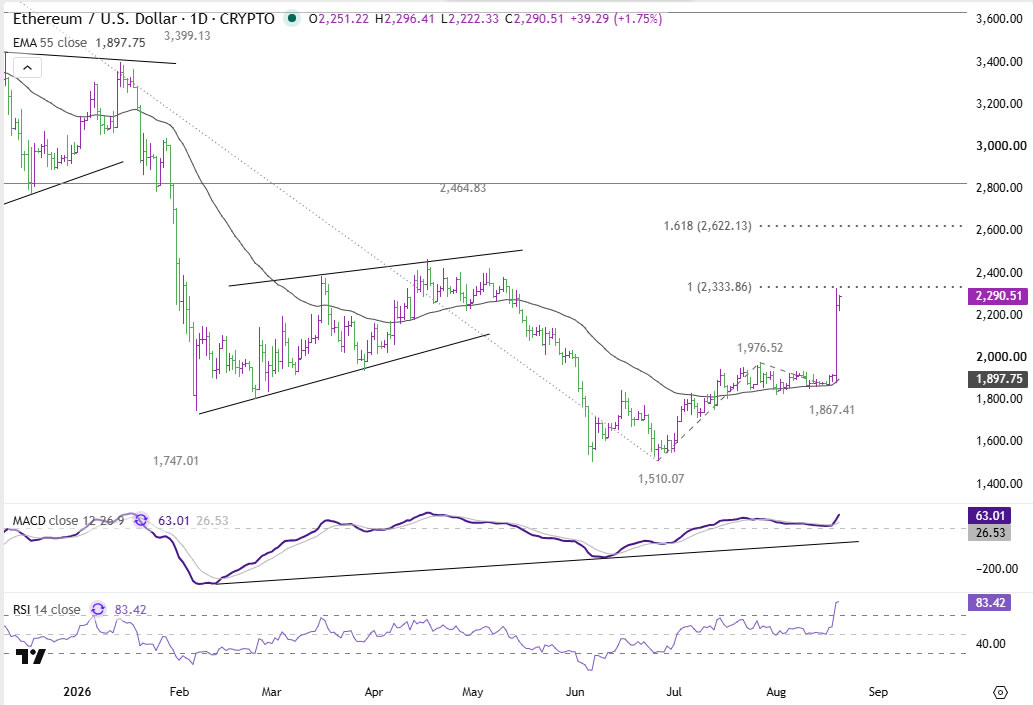
Ethereum is showing even stronger acceleration. The break above 1,976 has carried price toward 2,333, the 100% projection of the 1,510-to-1,976 advance measured from 1,867. A firm break above 2,333 would expose 161.% projeciton at 2,622 as the next target.
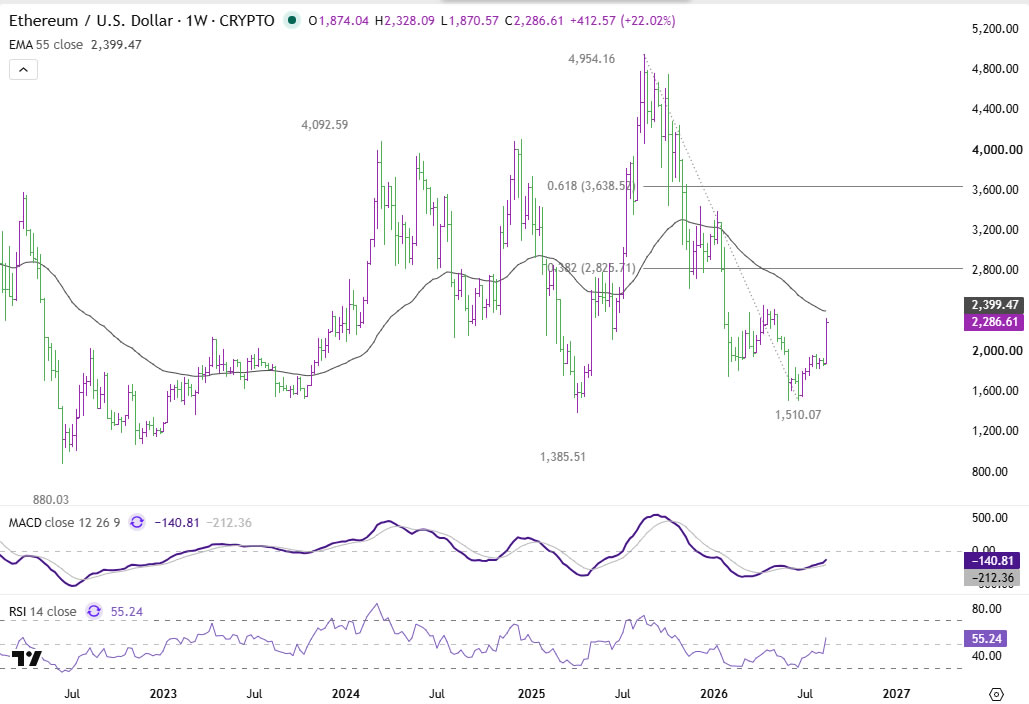
More importantly, Ethereum is approaching its weekly 55-week EMA near 2,399. Clearing that level would strengthen the medium-term recovery case and put 38.2% retracement of 4954 to 1510 at 2825 in view, even if it's just developing into a corrective pattern in the broader downtrend.
The Next Test Is the Pullback
There is a warning sign: both daily markets are stretched. Bitcoin's RSI is around 79 and Ethereum's above 83, so chasing the initial surge carries increasing technical risk. The next pullback may therefore tell more than another one-day jump.
If Bitcoin holds above 66,890 and Ethereum holds above 1,976 after a correction, the breakouts would look increasingly credible. If both fall back into their former ranges, the latest acceleration would look more like a policy-driven spike.
For now, however, the evidence points toward something stronger: Treasury buybacks have lowered the macro hurdle for risk assets, while Trump's renewed crypto push is giving Bitcoin and Ethereum a reason to outperform. The key question is no longer whether crypto is participating in the rally, but whether this combination is strong enough to turn the rebound into a sustained medium-term advance.
Key Takeaways
- Bitcoin gained over 14% and Ethereum roughly 22% this week, with the initial macro spark from Treasury buybacks amplified by Trump's crypto-specific policy push.
- Trump's CLARITY Act backing still needs 60 Senate votes next month, and his Bitcoin reserve comments remain exploratory, not a confirmed purchase program.
- CFTC Chair Mike Selig's comments on bringing platforms like Hyperliquid into a compliant US framework sent HYPE up roughly 20% in 24 hours.
- Falling real yields from the Treasury buyback shock are the same mechanism supporting Gold and weakening the Dollar, now extending into crypto.
- Both Bitcoin (RSI ~79) and Ethereum (RSI ~83) are technically stretched; holding above 66,890 and 1,976 respectively through the next pullback would confirm the breakouts are durable.
The Dollar Has Followed in the Yen’s Footsteps
- The US Treasury is defending bond yields.
- The dovish Fed is weakening the dollar.
The US dollar has plummeted to its lowest level since May following the Treasury’s decision to increase its long-term bond buybacks from $2 billion to $4 billion from 9 September. This has led to a fall in Treasury yields and is reminiscent of Japan’s currency intervention practices. The markets realised that a yield of 5.3% on 30-year bonds is a pain threshold for the Treasury, just as 164 on USDJPY is for Tokyo. The parallels do not end there.
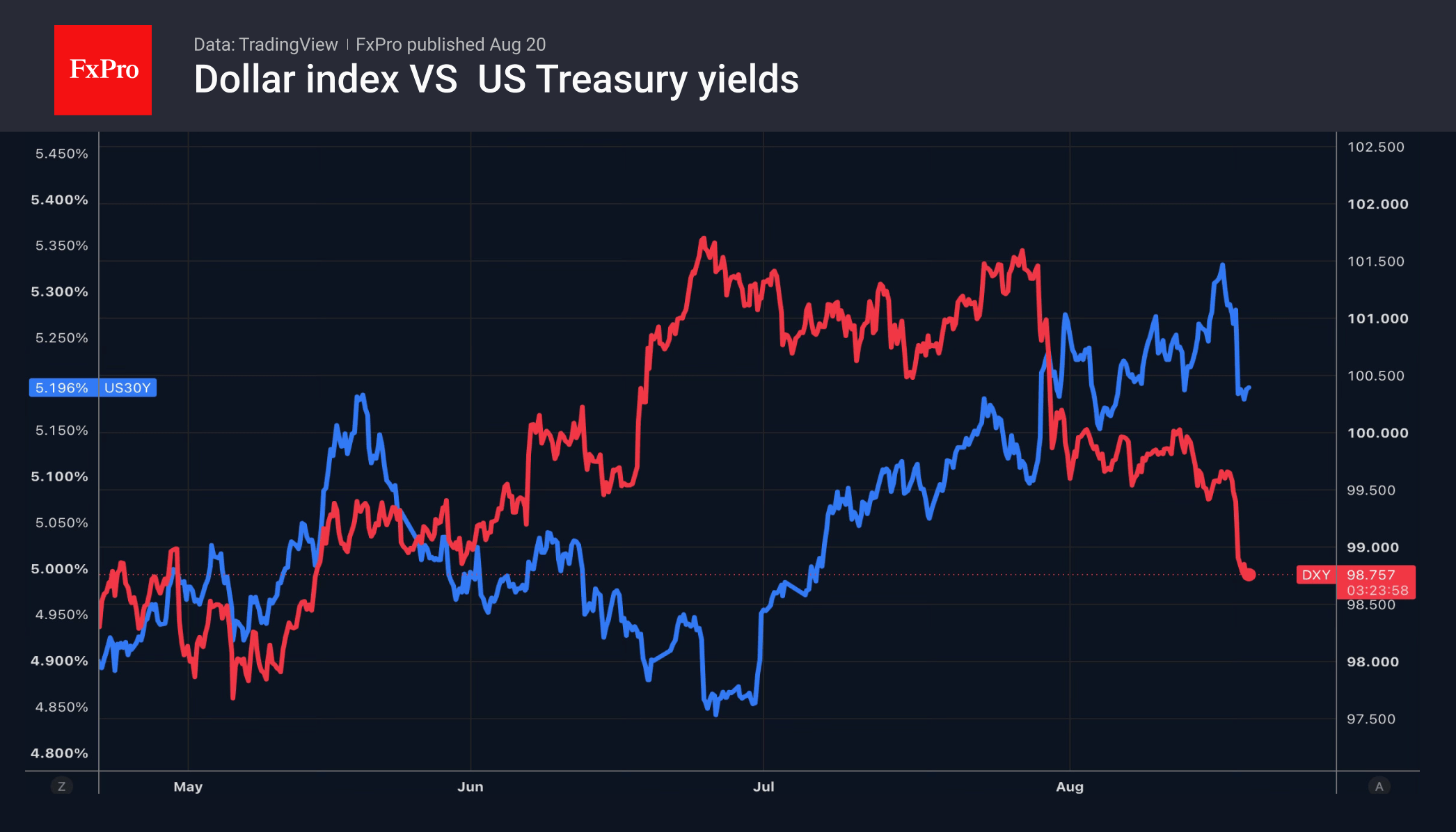
From a fundamental perspective, the US dollar’s fall against the yen is unjustified, as the wide interest rate differential between the Fed and the BoJ means the yen is being actively sold as a funding currency in carry trades. Tokyo is forced to seize the right moment and spend money to dampen the bulls’ enthusiasm for USDJPY. The US Treasury is also having to go against the fundamentals. The rally in Treasury yields is driven not only by fiscal stimulus and a widening budget deficit. Debt yields are also influenced by geopolitics and competition from artificial intelligence.
Hyperscalers are raising funds to finance AI-related projects by issuing corporate bonds. For example, the interest rates on Alphabet’s debt securities maturing in 2075 stand at around 6.8%. The appeal of such assets is drawing money away from the US debt market. Treasuries are being sold off, pushing up their yields.
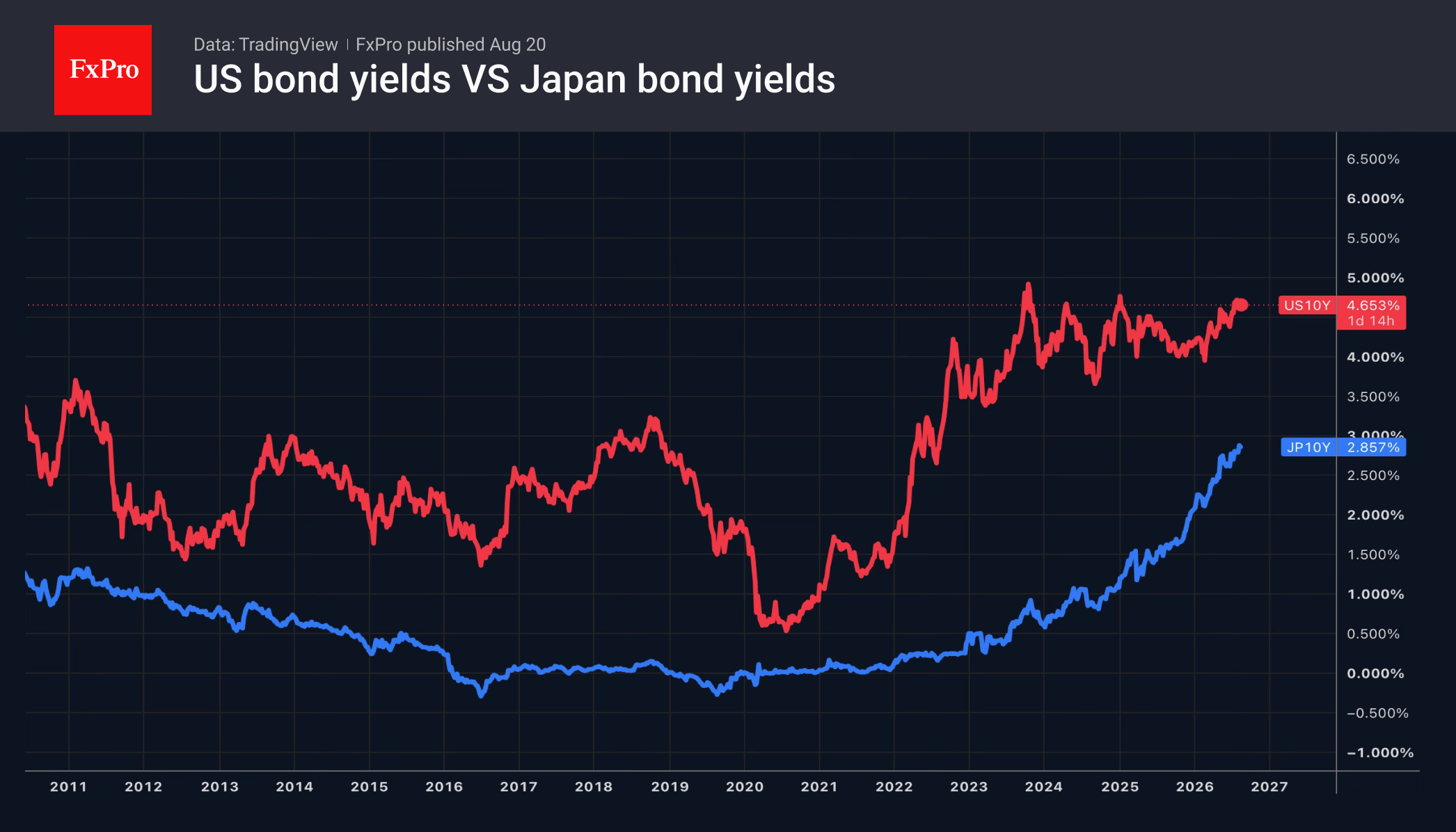
In the forex market, there is a view that, without support from the Bank of Japan, the gains made by bears on USDJPY through coordinated currency intervention cannot be sustained. In other words, the BoJ must accelerate its monetary tightening by raising the overnight rate every three months rather than every six months. Or signal its intention to raise it significantly above current levels, at least to 2.5%.
In the case of the Fed, there is a clear contradiction. The minutes of the July FOMC meeting showed that an increasing number of officials are prepared to vote in favour of tightening monetary policy. The document’s tone can be described as hawkish. Conversely, for the US dollar to weaken, the central bank must be reluctant to raise rates. At the same time, Citigroup believes that the main cost of the Treasury’s attempts to control bond yields is a weaker dollar.
The FxPro Analyst Team
Chart Alert: Gold Major Bullish Breakout as USD Debasement Narrative Takes Hold
Key takeaways
- Gold surges: XAU/USD jumped 4.35% on 19 August, its biggest one-day gain since February, lifting its August gain to 10.7%.
- USD debasement drives gold: Treasury bond buybacks have fuelled fiscal-dominance concerns, shifting focus from yields to US dollar purchasing-power risk.
- $4,405 is pivotal: Holding above $4,434/$4,405 keeps the bullish sequence intact, with a break above $4,504 exposing $4,580 and $4,640.
Gold (XAU/US) has been on a tear to the upside since the start of August 2026. The precious yellow metal has staged a 10% rally from the potential major swing low of $3,942, printed on 30 June 2026, to Tuesday, 18 August 2026’s closing level of $4,335.
On Wednesday, 19 August 2026, it added a daily gain of 4.35% to close at US$4,523, its largest single-day rally since February 2026.
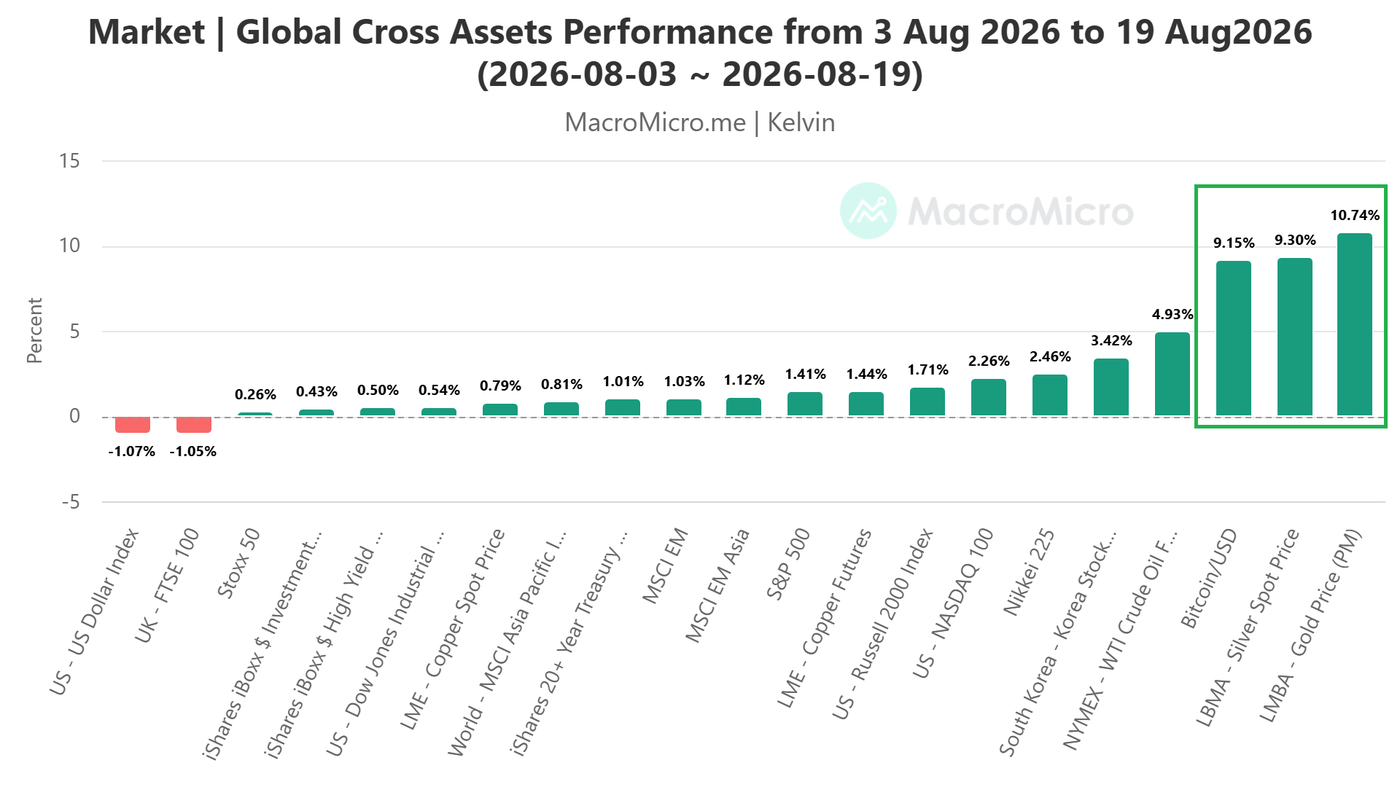
Overall, spot gold (quoted by the London Bullion Market Association) has now transitioned from a prior underperformer (in July 2026) to the top performer, month-to-date, as of 19 August 2026, with a stellar gain of 10.7% among major cross-asset classes, followed by spot silver (+9.3%), and Bitcoin/USD (+9.1%) (see Fig. 1).
Fig. 1: Month-to-date major cross assets performance as of 19 Aug 2026 (Source: MacroMicro). The information presented is historical information, and past performance is not indicative of future performance.
US Treasury buybacks, fiscal dominance & USD debasement
The rally in gold (XAU/USD), as reported by most media outlets, has been catalyzed by a sudden announcement of the US Treasury’s doubling of the buyback program for long-dated US Treasury bonds (10-year to 30-year) from $2 billon per operation to $4 billionb operation in a bid to rein in long-term borrowing costs as the 30-year US Treasury yield rocketed to a 19-year high of 5.31% at the start of this week.
Yesterday’s larger US Treasury bond buyback program sent the 30-year yield down by 10 basis points, closing at 5.19% (still an elevated level, a 19-year high) on Wednesday, 19 August 2026.
These media outlets’ reports connected the dots through the lens of interest rates: lower long-term US Treasury yields reduce the opportunity cost of holding gold, a non-income-bearing asset, which, in turn, triggered a positive feedback loop into gold.
On the contrary, the rally in gold (XAU/USD) since the end of June 2026 has come in the backdrop of a rising 30-year US Treasury yield (+44 bps) over the same period.
Thus, gold traders are not really pricing in a bullish movement triggered by the pure interest rate conduit, but rather through a currency purchasing power perspective; the US dollar debasement narrative.
Wednesday’s aggressive bullish price action in gold, which saw the US Dollar Index tumble to a three-month low, is being interpreted as a “panic intervention” by the US Treasury and as a sign of fiscal dominance, in which fiscal debt management takes precedence over monetary discipline.
When government bodies step in to cushion sovereign bond markets amid persistent deficit spending, market participants rapidly reprice the risk of long-term USD debasement. Non-yielding bullion directly benefits as a store of value, free from counterparty and inflation risk.
Let’s now unpack the latest short-term technicals of gold (XAU/USD).
Potential start of a new medium-term bullish impulsive up move sequence
Fig. 2: Gold (XAU/USD) long-term secular trend as of 20 Aug 2026 (Source: TradingView). The information presented is historical information, and past performance is not indicative of future performance.
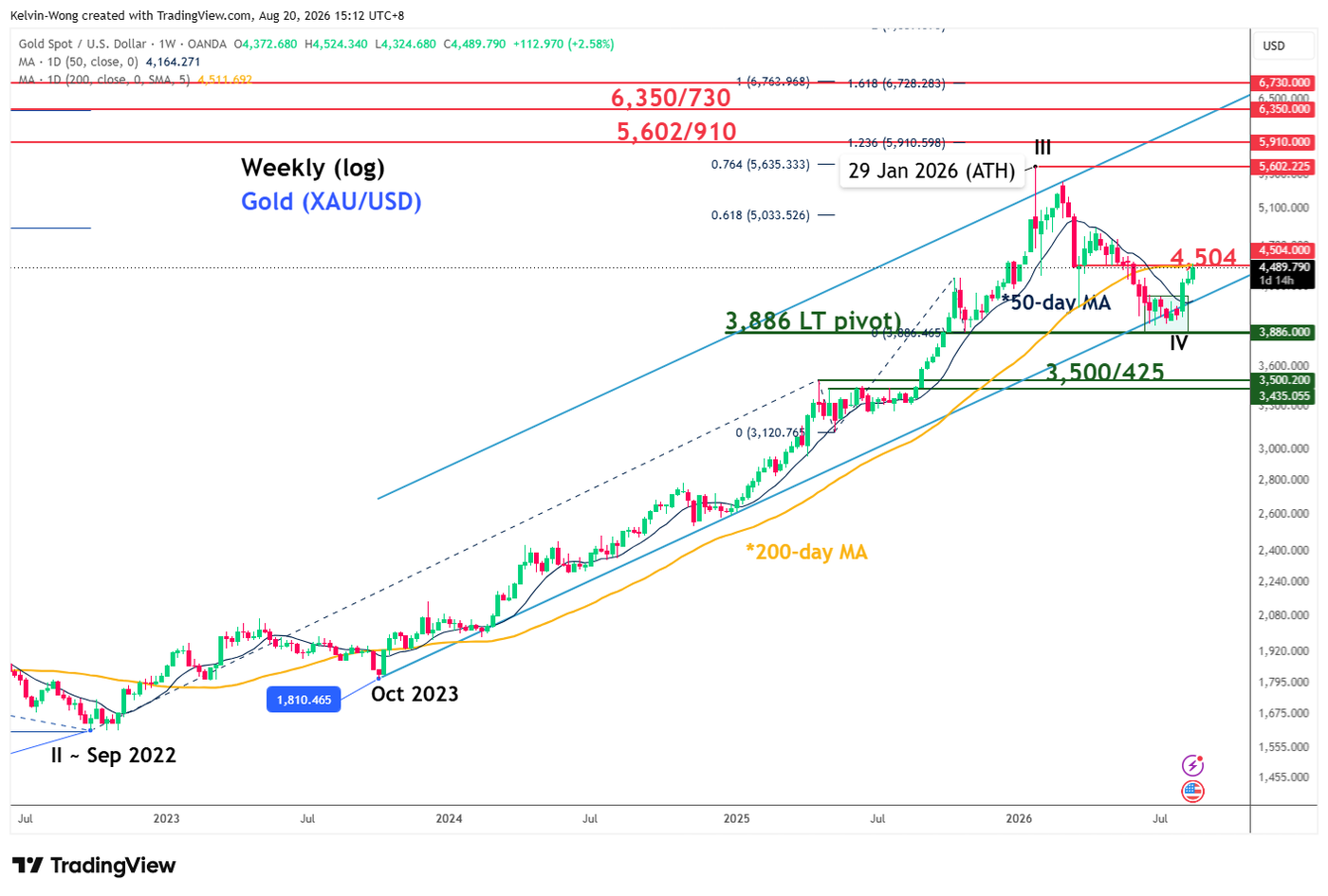
Fig. 3: Gold (XAU/USD) minor trend as of 20 Aug 2026 (Source: TradingView). The information presented is historical information, and past performance is not indicative of future performance.
The 6-month corrective decline of 30% from its current all-time intraday high of $5,602 on 29 January 2026 is likely to have ended on 29 January 2026 where its weekly price actions have staged a rebound from the lower boundary of a major ascending channel running from October 2023 low, cleared above the 50-day moving average with a weekly bullish reversal candlestick pattern follow-through on the week of 3 August 2026 (see Fig. 2).
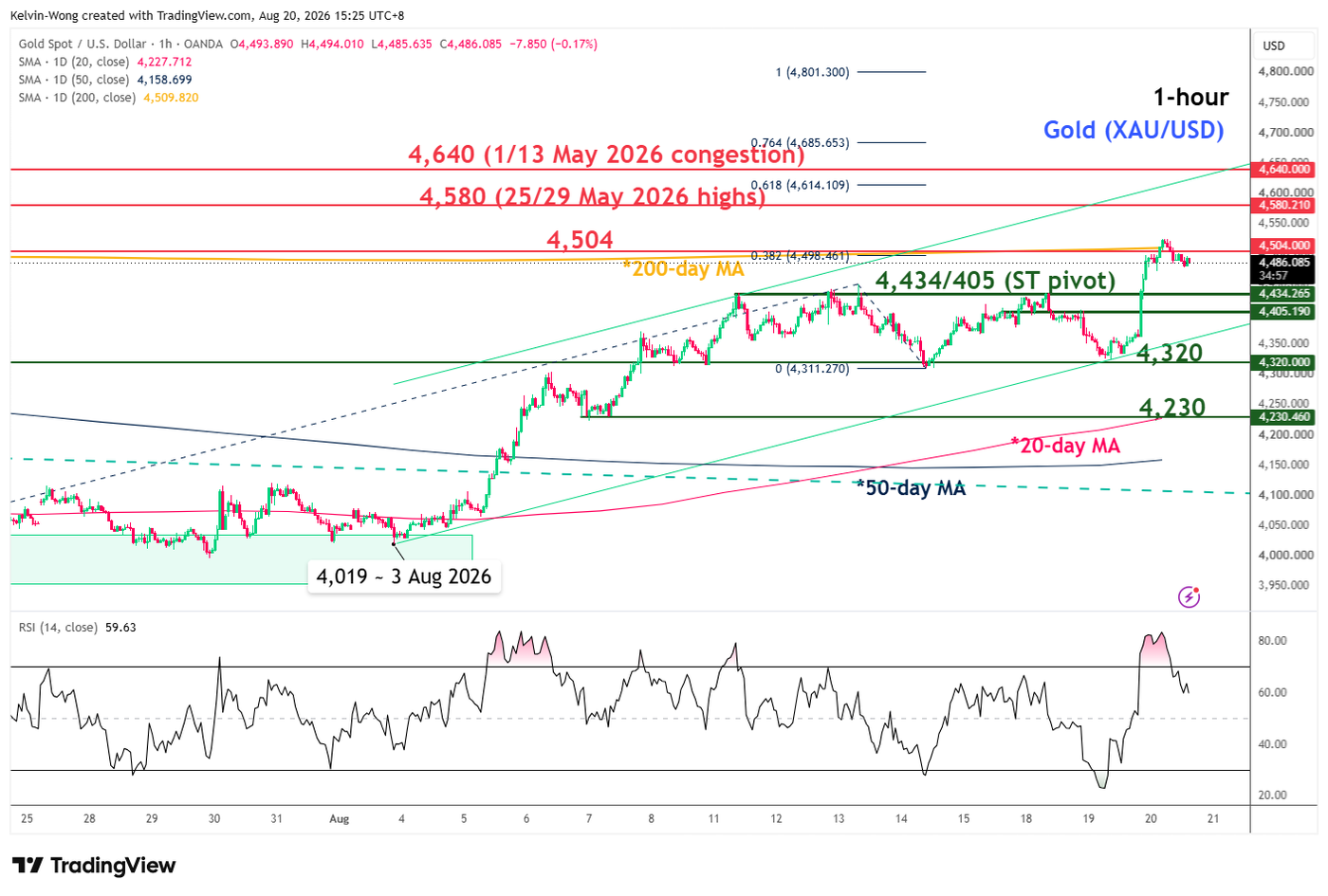
In the short to medium-term horizon, gold (XAU/USD) is now oscillating within an ascending channel in place since the 3 August 2026 low of $4,019.
Watch the $4,434/4,405 key short-term pivotal support to maintain the multi-day bullish impulsive up move sequence. A clearance above the $4,504 near-term resistance (also close to the key 200-day moving average) is likely to reinforce the bullish potential towards the next intermediate resistances at $4,580 and $4,640 in the first step (see Fig. 3).
On the other hand, failure to hold and an hourly close below $4,405 negates the bullish tone for another set of minor corrective pull-back towards the next intermediate support at $4,320 (also the lower boundary of the ascending channel).
GBP/USD at Three-Month High: Outlook Hinges on Economic Data
GBP/USD surged to 1.3613 on Wednesday, reaching a three-month high. Investors are digesting fresh UK inflation and labour market data.
Consumer inflation accelerated to 2.9% in July, up from 2.6% in June and in line with forecasts. Core inflation held steady at 2.6%. Following the release, markets slightly scaled back expectations of a Bank of England rate hike before year-end.
Earlier labour market data showed unemployment holding at 4.9%, above expectations, while the number of payrolled employees fell by 86,000 year-on-year. Meanwhile, growth in regular pay remained fairly stable at 3.5%.
Additional support for the pound is coming from a weaker dollar. Soft US economic data have led investors to reduce expectations of further Federal Reserve tightening. At the same time, elevated oil prices and uncertainty surrounding the US–Iran conflict continue to pose inflation risks for the UK.
Technical Analysis
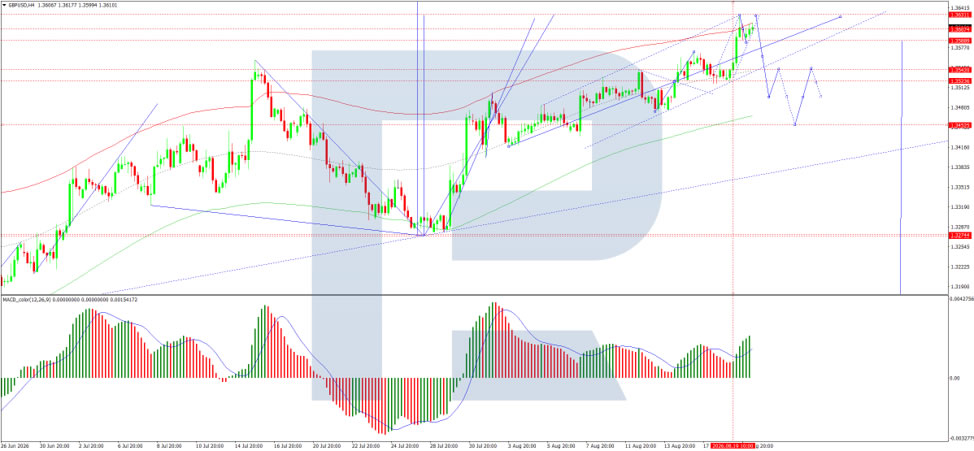
On the H4 GBP/USD chart, a wide consolidation range is forming around the 1.3523 level. The market has moved towards its upper boundary. A new compact consolidation range is expected to form below 1.3631. A downside breakout from this range would open the way for a move lower towards 1.3500. The MACD supports this scenario, with its signal line above zero and beginning to turn downwards.
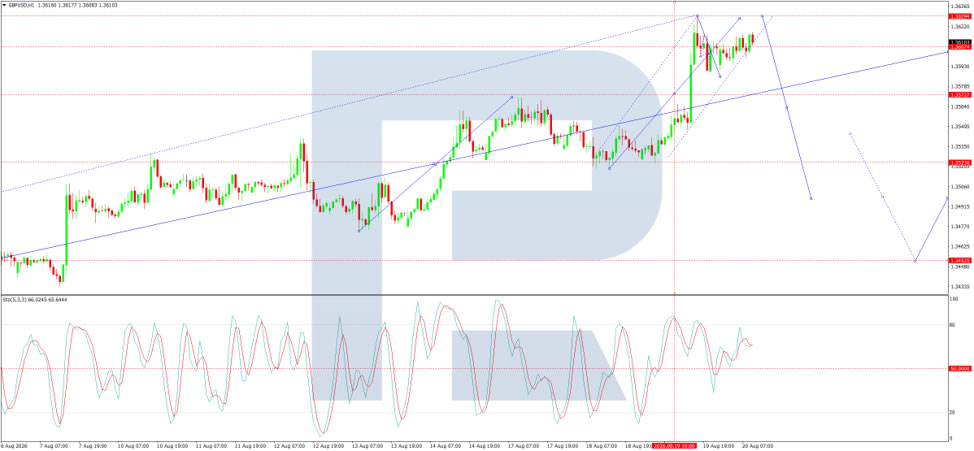
On the H1 chart, the market has formed a compact consolidation range around the 1.3607 level, currently extending between 1.3588 and 1.3618. A move lower towards 1.3572 is expected, followed by a move higher to 1.3600. The Stochastic oscillator confirms this scenario, with its signal line below 80 and trending downward towards 20, indicating short-term downside pressure.
Conclusion
GBP/USD has climbed to a three-month high, supported by a weaker dollar and UK economic data that largely met expectations. Inflation accelerated to 2.9% in July, while core inflation held steady, prompting markets to slightly lower BoE rate hike expectations. Labour market data showed unemployment above forecasts and a decline in payroll employment, though wage growth remained stable. The dollar remains under pressure from soft US data, which has reduced Fed tightening expectations. However, elevated oil prices and geopolitical uncertainty continue to pose inflation risks for the UK. Technically, the pair may see a short-term pullback towards 1.3572, with potential for a further decline to 1.3500. The near-term direction will depend on upcoming economic releases and central bank signals.
Disclaimer
Any forecasts contained herein are based on the author's particular opinion. This analysis may not be treated as trading advice. RoboForex bears no responsibility for trading results based on trading recommendations and reviews contained herein.
Dollar Under Pressure as Treasury Yields Fall: USD/JPY and USD/CAD Await Fresh Data
The US dollar has come under moderate pressure as long-term US Treasury yields have declined. Another factor has been the US Treasury Department’s decision to increase buyback operations for securities with maturities ranging from 10 to 30 years in an effort to support market liquidity. Against this backdrop, the 30-year Treasury yield fell by around 9 basis points to 5.19%.
The decline in yields has weakened one of the key sources of support for the dollar and has been particularly significant for USD/JPY, which remains highly sensitive to movements in the US bond market.
The recently released FOMC minutes provided a counterweight. The minutes revealed growing concerns among policymakers about inflation risks, with several officials favouring a rate hike as early as the July meeting. This kept the overall tone relatively hawkish. Although policymakers were divided over whether an immediate rate increase was necessary, inflation risks remain a central concern for the Federal Reserve, while future decisions will continue to depend on incoming economic data.
Today, markets will focus on a fresh batch of US economic figures. The Philadelphia Fed Manufacturing Index is expected to fall to 24.1 from 41.4, while initial jobless claims are forecast at 210,000. Weaker-than-expected figures could put additional pressure on the dollar, whereas resilient data may allow the currency to recover some of its recent losses.
For the Canadian dollar, commodity-price data will provide an additional catalyst. The Raw Materials Price Index (RMPI) is expected to decline by 1.8% following a 6.9% drop in the previous month, making the actual reading potentially important for the further direction of USD/CAD.
USD/JPY
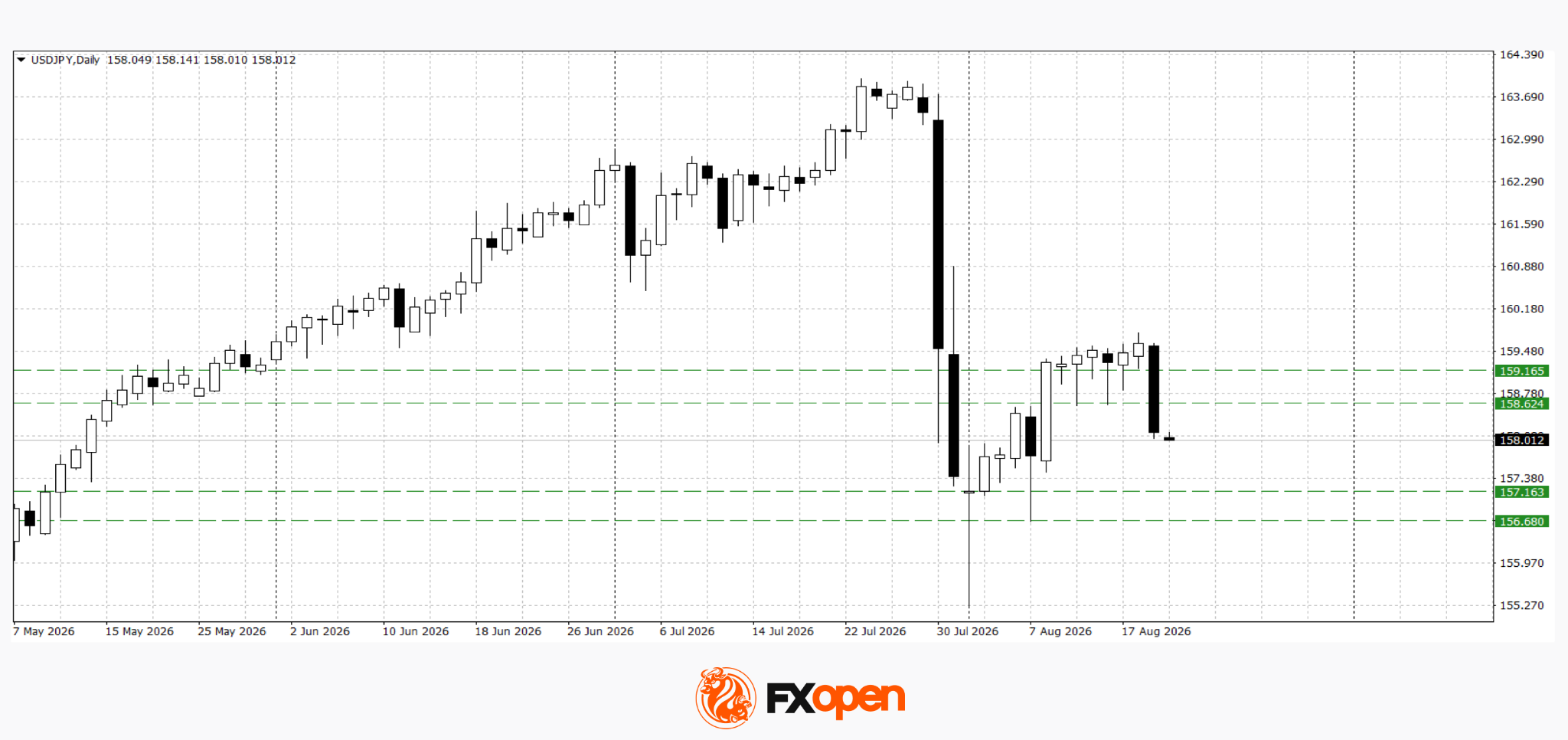
USD/JPY made several unsuccessful attempts to approach the key 160.00 resistance level before sharply retreating towards 158.00 as US Treasury yields declined.
If selling pressure on the dollar persists, the pair could move towards the 156.70–157.20 area. At the same time, a corrective rebound following yesterday’s decline could lift the pair towards 158.60–159.20.
Key events for USD/JPY:
- today at 15:30 (GMT+3): Philadelphia Fed Manufacturing Index;
- today at 15:30 (GMT+3): US initial jobless claims;
- tomorrow at 02:30 (GMT+3): Japan national core Consumer Price Index (CPI).
USD/CAD
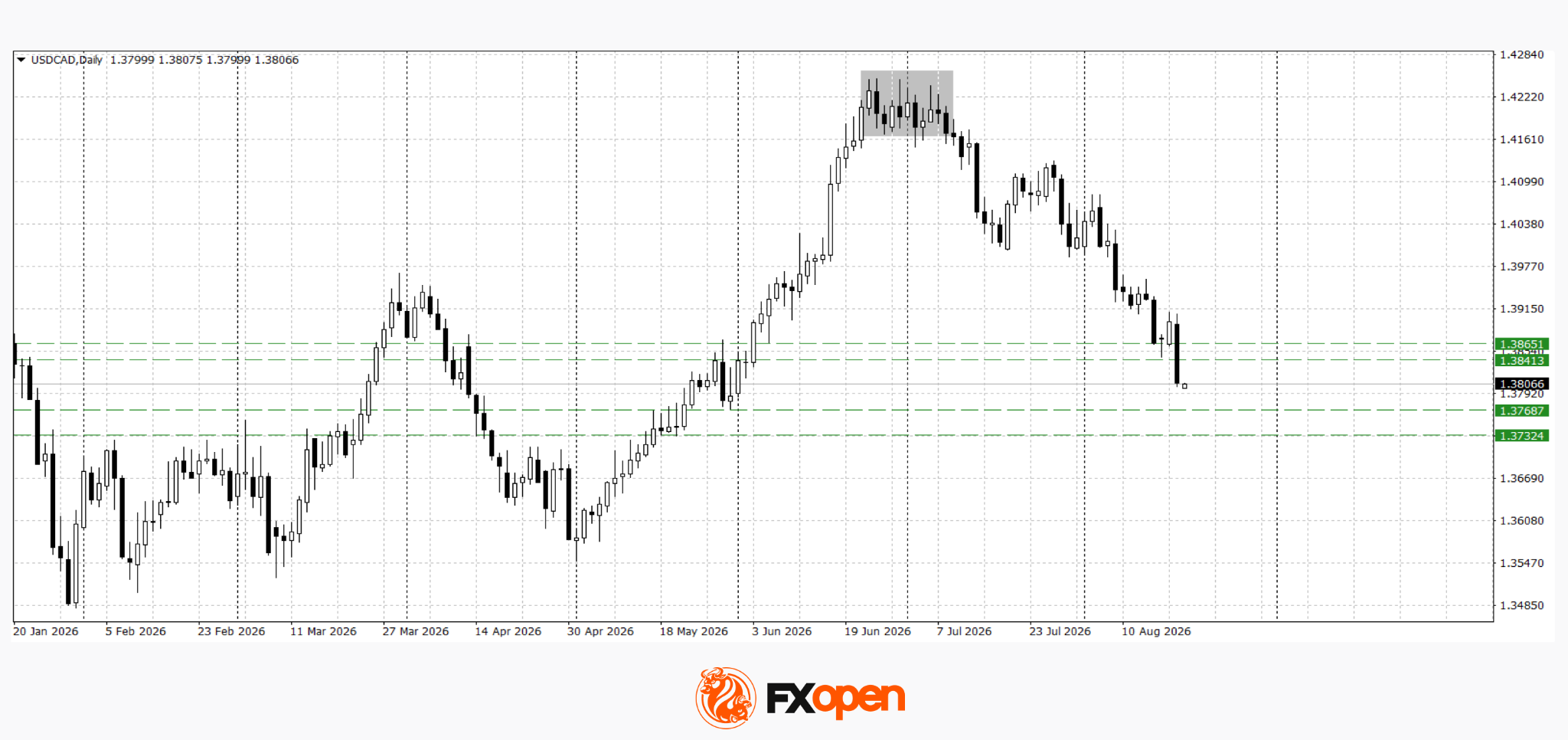
USD/CAD remains in a broader downtrend following the formation of a “tower” pattern in early July. Yesterday, sellers tested the important 1.3800 support level.
A sustained break below yesterday’s low could open the way towards 1.3730–1.3760. If 1.3800 continues to hold as support, however, the pair could stage a recovery towards 1.3840–1.3870.
Key events for USD/CAD:
- today at 15:30 (GMT+3): Canadian Raw Materials Price Index (RMPI);
- today at 17:00 (GMT+3): US Leading Economic Indicators;
- tomorrow at 15:30 (GMT+3): Canadian core retail sales.
Outlook
USD/JPY and USD/CAD remain caught between opposing fundamental forces. Falling Treasury yields are weighing on the dollar, while the relatively hawkish tone of the FOMC minutes is limiting the scope for a deeper decline.
The market’s attention is now turning to the latest US economic data. Weaker figures could extend the dollar’s correction and increase downside pressure on USD/JPY and USD/CAD, while stronger-than-expected releases could restore support for the US currency and trigger a recovery in both pairs.
Trade over 50 forex markets 24 hours a day with FXOpen. Take advantage of low commissions, deep liquidity, and spreads from 0.0 pips (additional fees may apply). Open your FXOpen account now or learn more about trading forex with FXOpen.
This article represents the opinion of the Companies operating under the FXOpen brand only. It is not to be construed as an offer, solicitation, or recommendation with respect to products and services provided by the Companies operating under the FXOpen brand, nor is it to be considered financial advice.
The Crypto Market Has Broken Out of Its Consolidation
Market Overview
The cryptocurrency market has risen by almost 8% over the past 24 hours to $2.37T, reaching its highest level since early June. The initial momentum came on the back of news that the US Treasury was supporting the debt market. This relatively small but timely move signalled that the government is monitoring the situation in the debt markets, spurring demand for risk assets. The rally was then fuelled by a wave of short-covering, following weeks of extremely narrow trading.
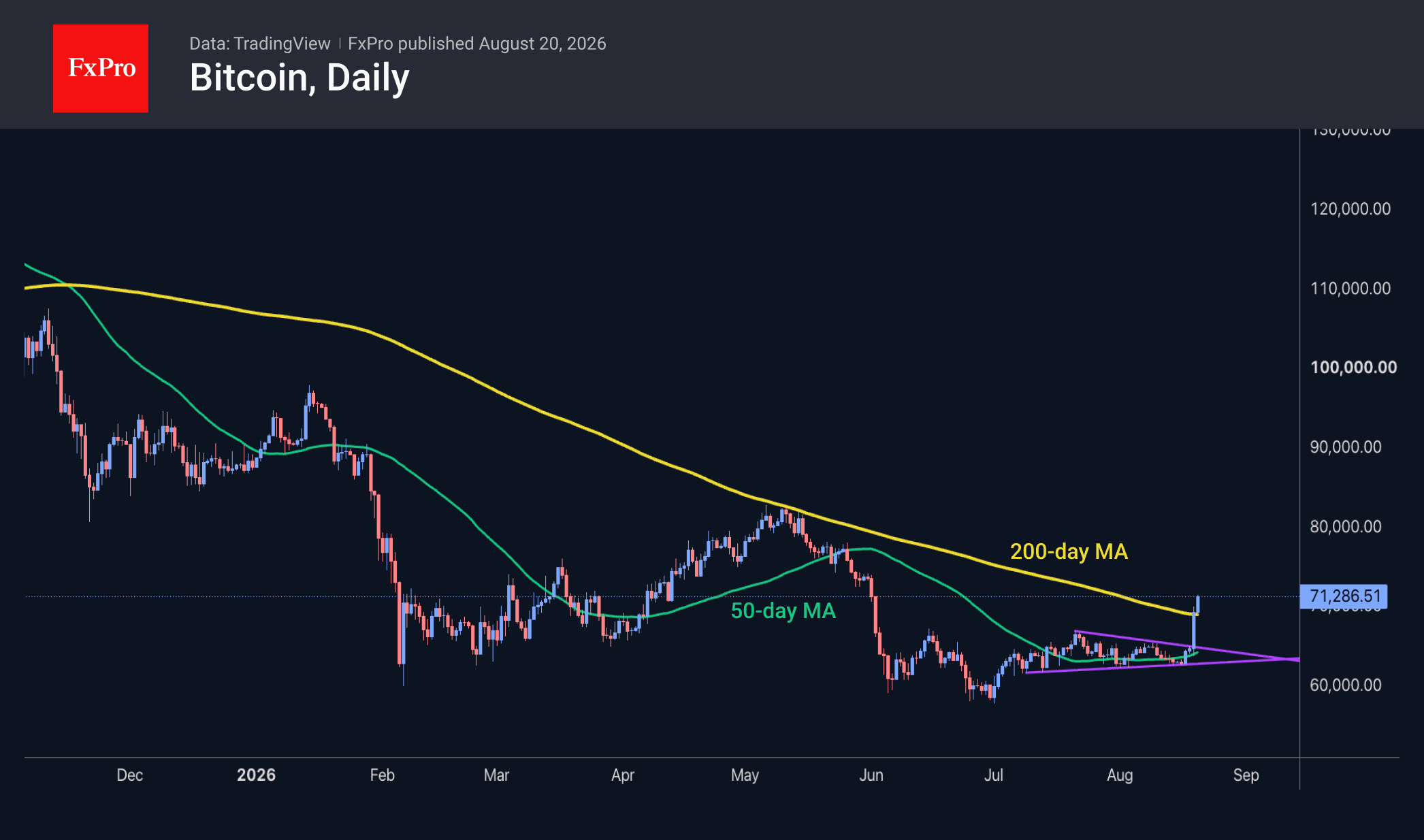
Bitcoin reached $70K, posting a 9% rally over 8 hours during the US trading session. As the new day began, the leading cryptocurrency retreated slightly to $69.6K. On Monday, BTC consolidated above the 50-day moving average, and by Wednesday, it had already tested the 200-day MA. As expected, the market’s long-compressed spring snapped back, catching those who had been range-trading and those who had been building short positions on the rise off guard. If Bitcoin does not quickly lose its recent gains, it will be a significant sign that a bull market has begun, much like in October 2023 or March 2020.
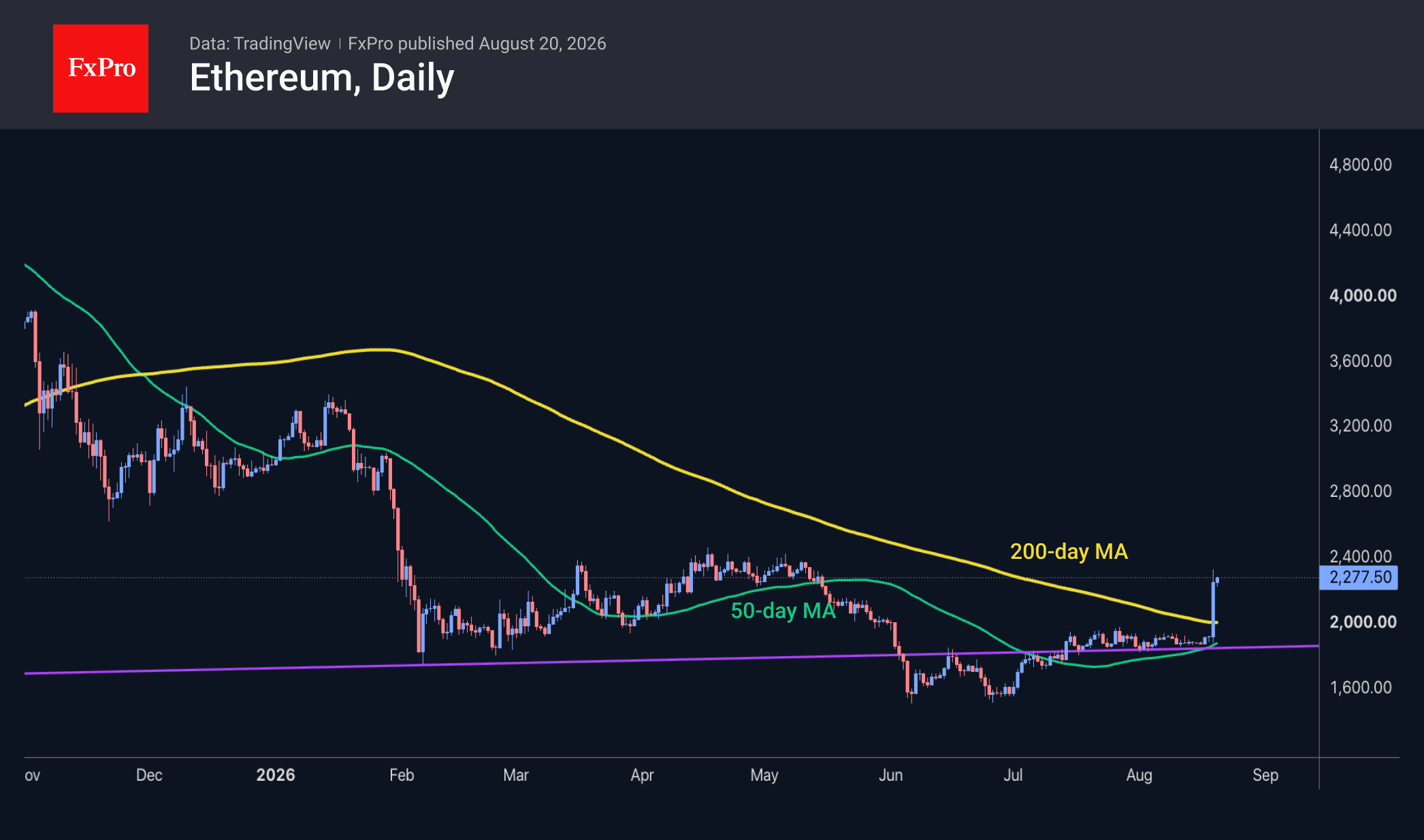
Ethereum recorded an even more impressive breakout, showing an 18% gain over 24 hours at its peak. Having risen to $2.25K, the second-largest cryptocurrency is trading near its April–May highs, having broken above its 200-day moving average and away from a long-term support line that has risen from around $1.75K to $1.9K over the past 8 months. The next significant level where the coin may face resistance to further gains appears to be the $2.5K–$2.8K range.
News Background
Bitcoin whales have resumed buying. According to CryptoQuant, over the past 60 days, large holders have acquired around 43,000 BTC, worth approximately $2.75 billion. Medium-sized holders have also begun actively buying the asset.
The leading cryptocurrency may be nearing the end of its bearish phase, as on-chain metrics show the first signs of a recovery in spot demand, CryptoQuant notes.
Two out of the three conditions necessary for a full-fledged recovery of BTC have already been met, according to Bitfinex Alpha. Expectations regarding the Fed’s interest rate have improved, and financial conditions remain relatively accommodative. However, there has not yet been a capital outflow from traditional markets into cryptocurrencies.
Bitcoin is showing signs of being in the late stages of a downtrend, but it is still too early to say that a bottom has been formed, according to VanEck’s assessment based on an analysis of 12 indicators.
BlackRock maintains a positive view on the role of Bitcoin in investment portfolios following a fall of more than 50% from its October high. Analysts attributed the sell-off to deleveraging and capital reallocation, rather than a fundamental change in the investment case for the leading cryptocurrency.
The US SEC has unveiled new rules for the crypto market. The draft, titled ‘Regulation Crypto Assets’, simplifies the raising of capital via tokens, circumventing the restrictions of securities legislation.
The FxPro Analyst Team