Sample Category Title
UK PMI Services Strengthen in August, but Manufacturing Momentum Fades
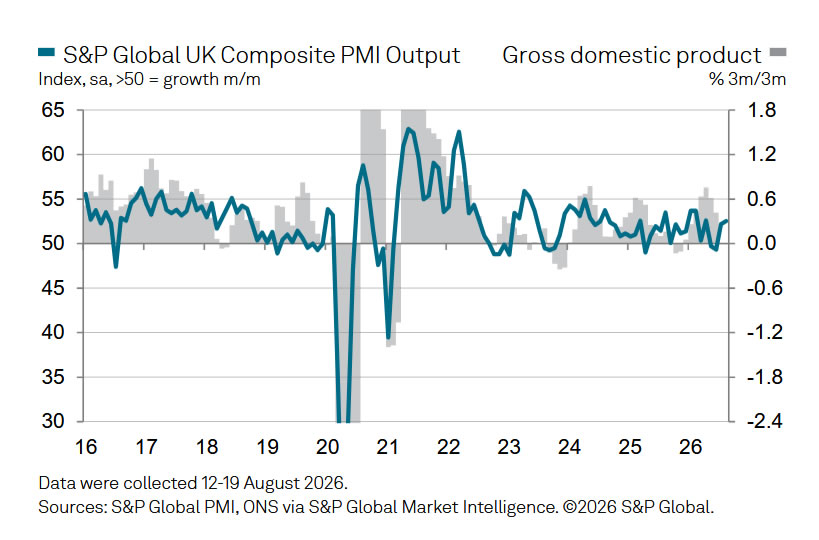
UK private-sector growth strengthened modestly in August, with PMI Composite Output rising from 52.2 to 52.5, a four-month high. PMI Services Business Activity improved from 52.1 to 52.8, reaching a six-month high and providing the main lift. Manufacturing moved the other way. PMI Manufacturing eased from 51.9 to 51.5, while PMI Manufacturing Output fell from 52.9 to 51.2, both five-month lows.
S&P Global said sunny weather and technology investment supported activity, while manufacturing lost some momentum as precautionary stock building faded. Business confidence improved to its strongest since Middle East war began, and job losses moderated. But cost pressures remained elevated, driven by energy prices, supply-chain disruption and high staffing costs. S&P Global estimated the survey was consistent with around 0.3% q/q GDP growth in Q3.
For BoE, August PMI points to resilient growth but an uncomfortable inflation backdrop. Stronger services activity reduces urgency to support economy, while persistent cost pressure argues against an early dovish turn. S&P Global said Bank is likely to retain a hawkish bias but stay cautious, holding off on further hikes until growth and inflation signals become clearer.
Data Summary
| Component | Current | Previous | Trend |
|---|---|---|---|
| PMI Composite Output | 52.5 | 52.2 | 4-month high |
| PMI Services Business Activity | 52.8 | 52.1 | 6-month high |
| PMI Manufacturing | 51.5 | 51.9 | 5-month low |
| PMI Manufacturing Output | 51.2 | 52.9 | 5-month low |
Key Takeaways
- UK PMI Composite Output rose from 52.2 to 52.5 in August, reaching a four-month high.
- PMI Services Business Activity strengthened from 52.1 to 52.8, a six-month high and main driver of faster overall growth.
- Manufacturing lost momentum. PMI Manufacturing fell from 51.9 to 51.5, while PMI Manufacturing Output dropped from 52.9 to 51.2.
- S&P Global said sunny weather and technology investment supported activity. Earlier precautionary stock building in manufacturing started to fade.
- Business confidence improved to its strongest level since Middle East war began, while job losses became less severe.
- Cost pressures remained high due to energy prices, Middle East-related supply disruption and staffing costs.
- Survey was consistent with around 0.3% q/q GDP growth in Q3.
- For BoE, resilient growth and elevated costs support a hawkish bias, but softer manufacturing and lingering uncertainty argue for patience before another hike.
Gold Wave Analysis
Gold : ⬆️ Buy
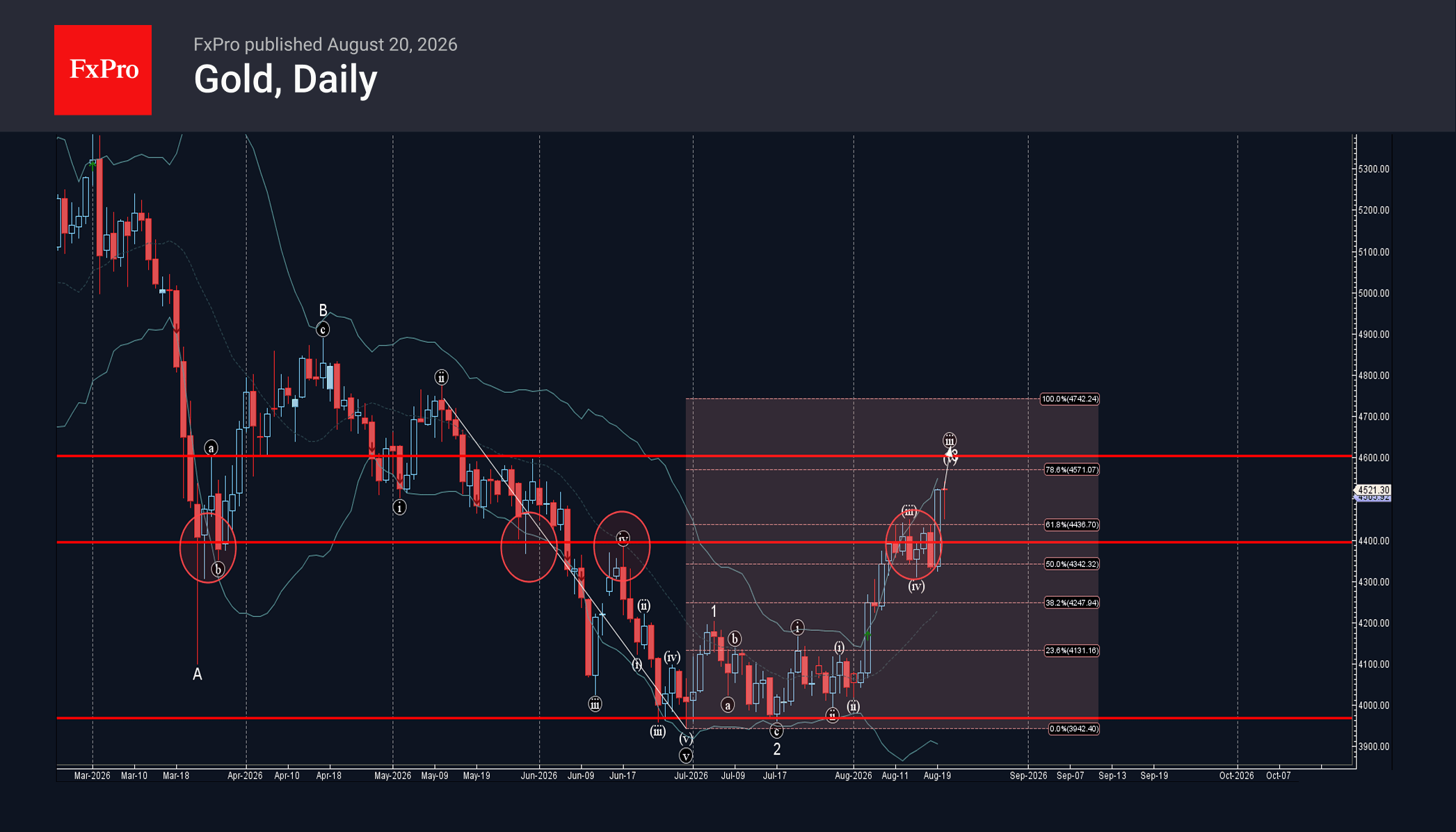
– Gold broke resistance level 4400.00
– Likely to rise to resistance level 4600.00
Gold recently broke the resistance level 4400.00 (former top of wave iv from June) intersecting with the 61.8% Fibonacci correction of the downward impulse from May.
The breakout of the resistance level 4400.00 accelerated the active minor impulse wave iii of the impulse wave 3 from July.
Gold can be expected to rise further to the next resistance level 4600.00, former minor pivot high from the end of May the target price for the completion of the active impulse wave iii.
Eurozone PMI Composite Hits Nine-Month High, Reinforces ECB Hawkish Bias
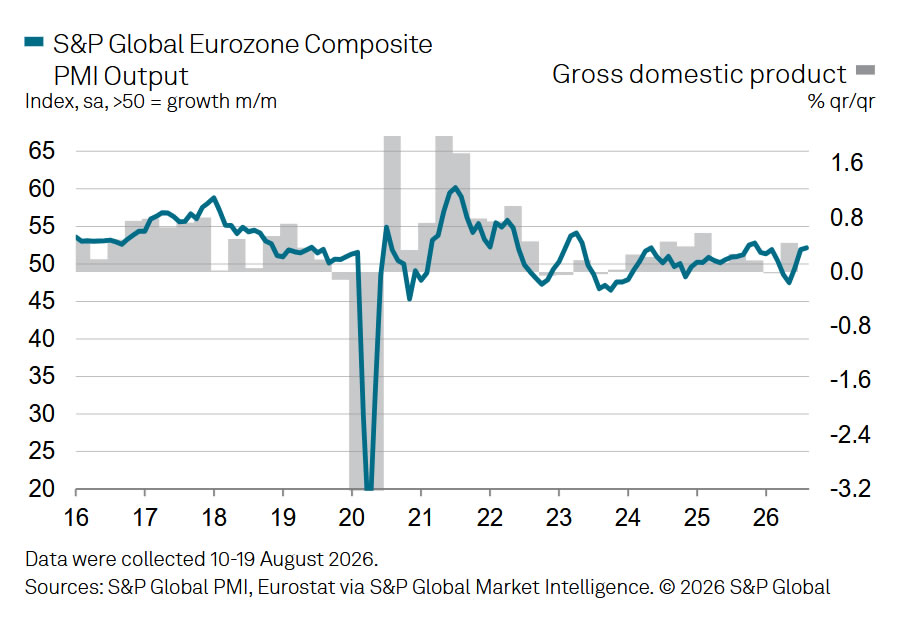
Eurozone private-sector growth strengthened slightly in August, with PMI Composite Output edging from 52.0 to 52.1, its highest in nine months. PMI Manufacturing rose more clearly from 51.9 to 52.8, while PMI Manufacturing Output increased from 52.9 to 53.4, marking its strongest expansion in four-and-a-half years. PMI Services Business Activity was unchanged at 51.7, keeping services in moderate expansion. S&P Global said the readings were consistent with roughly 0.3% q/q GDP growth in Q3.
Manufacturing was the standout, helped by precautionary inventory building amid Middle East supply disruptions and stronger demand for AI-related technology and defence equipment. Germany benefited particularly strongly: PMI Manufacturing rose from 52.2 to 54.1, while PMI Manufacturing Output jumped from 54.7 to 56.7, a 55-month high. But services remained weak, falling from 49.8 to 48.5. France showed a similar split in reverse form: PMI Manufacturing improved from 49.8 to 51.5, but PMI Services fell from 49.6 to 48.4, pulling PMI Composite Output down from 49.4 to 48.8.
Growth outside France and Germany was firmer, with tourism helping services activity across rest of region expand at its fastest pace in more than three years. There were also encouraging signs from employment, with companies returning to hiring for first time this year. Price pressures moved in a more favorable direction. Services selling-price inflation eased to joint-lowest pace this year, while goods-price inflation moderated further.
For ECB, August PMIs reinforce a relatively hawkish growth-inflation mix. Activity is expanding at a solid pace, manufacturing momentum is strengthening, and hiring has resumed. Easing selling-price pressures are welcome, but inflation remains elevated by historical standards. S&P Global concluded that a hawkish bias is likely to be maintained, with further near-term rate hikes still possible if stronger activity prevents inflation from cooling sufficiently.
Data Summary
| Component | Current | Previous | Trend |
|---|---|---|---|
| Eurozone PMI Composite Output | 52.1 | 52.0 | 9-month high |
| Eurozone PMI Services Business Activity | 51.7 | 51.7 | Growth unchanged |
| Eurozone PMI Manufacturing | 52.8 | 51.9 | 51-month high |
| Eurozone PMI Manufacturing Output | 53.4 | 52.9 | 54-month high |
| Germany PMI Composite Output | 51.0 | 51.3 | Growth eased |
| Germany PMI Services Business Activity | 48.5 | 49.8 | Deeper contraction |
| Germany PMI Manufacturing | 54.1 | 52.2 | 51-month high |
| Germany PMI Manufacturing Output | 56.7 | 54.7 | 55-month high |
| France PMI Composite Output | 48.8 | 49.4 | 2-month low |
| France PMI Services Business Activity | 48.4 | 49.6 | 2-month low |
| France PMI Manufacturing | 51.5 | 49.8 | Returned to expansion |
| France PMI Manufacturing Output | 50.7 | 48.5 | 4-month high |
Key Takeaways
- Eurozone PMI Composite Output edged from 52.0 to 52.1 in August, reaching a nine-month high and signaling continued solid private-sector expansion.
- Manufacturing was main driver. PMI Manufacturing rose from 51.9 to 52.8, while PMI Manufacturing Output climbed from 52.9 to 53.4, strongest in four-and-a-half years.
- PMI Services Business Activity held at 51.7, keeping services in expansion without further acceleration.
- S&P Global said survey was consistent with around 0.3% q/q GDP growth in Q3.
- Germany showed a sharp sector split. Manufacturing strengthened strongly, but services fell deeper into contraction at 48.5.
- France remained weak overall, with PMI Composite Output dropping to 48.8 and services at 48.4, even as manufacturing returned to expansion.
- Growth outside France and Germany was stronger, with tourism helping services activity reach its fastest pace in more than three years.
- Employment improved, with firms adding staff for first time this year.
- Price pressures eased, particularly in services selling prices, but inflation remained elevated by historical standards.
- For ECB, resilient growth, stronger manufacturing and renewed hiring reinforce a hawkish bias, even as softer selling-price inflation provides some relief.
XAG/USD Analysis: Triangle Breakout Attempt Amid US Treasury Buybacks
On 19 August, the US Treasury announced that it would double the volume of long-term government bond buybacks. The measure led to a noticeable decline in yields at the longer end of the curve and forms part of the Treasury’s broader efforts to contain pressure on long-term borrowing costs. These efforts include market interventions and calls for the Federal Reserve to expand the limits of the FIMA repo facility.
Lower Treasury yields improve the relative appeal of precious metals, which do not generate interest income, providing direct support for silver. Industrial demand is another important factor. Chinese imports of silver-containing ores rose 62.5% year-on-year in June amid expanding production of solar panels and power-grid equipment.
Technical Analysis of Silver
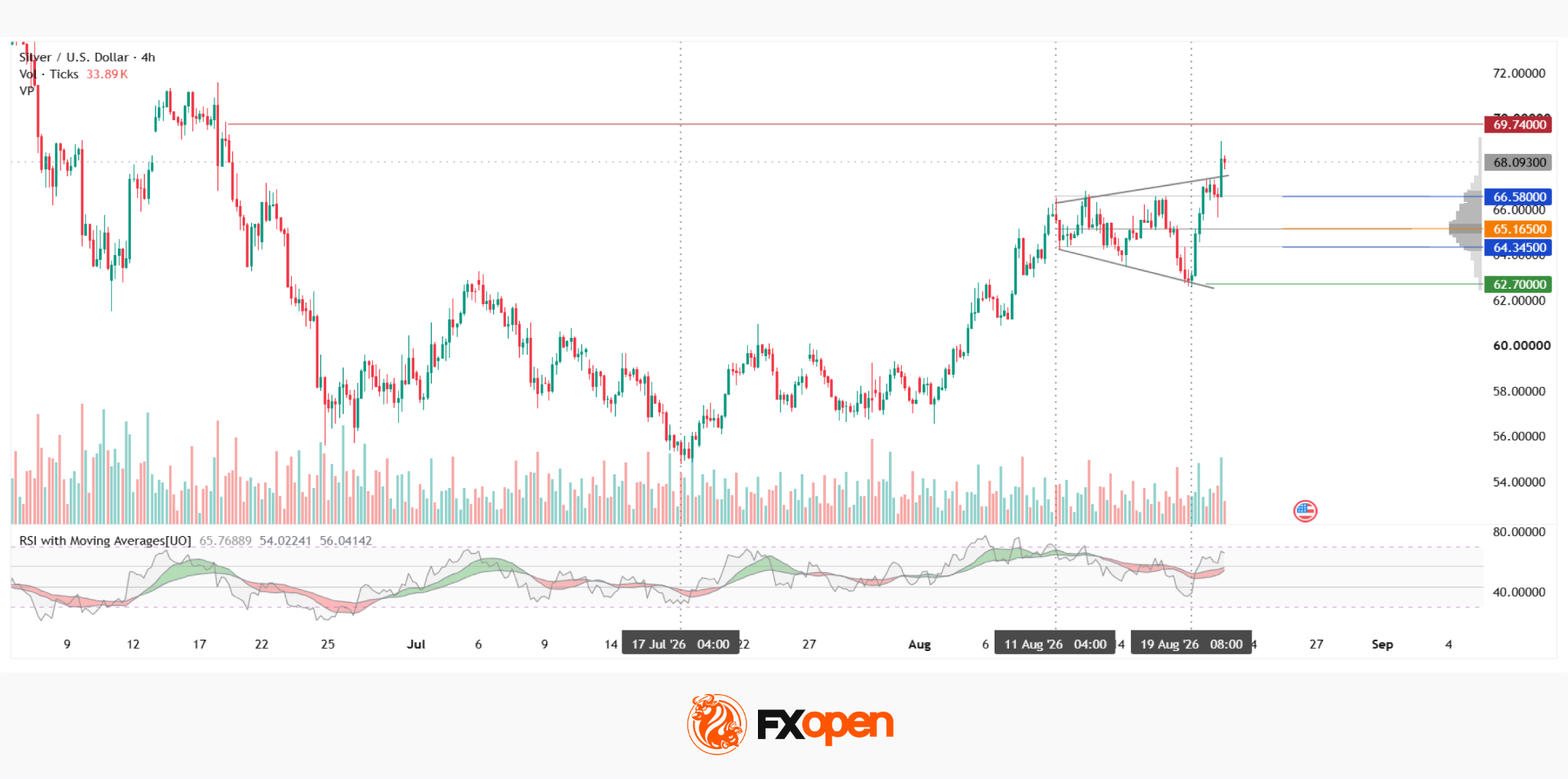
Since 17 July, XAG/USD has been moving within a pronounced uptrend on the four-hour chart. In the upper portion of this advance, a pattern resembling a broadening triangle emerged in mid-August. Unlike a conventional triangle, its boundaries widened rather than converged, reflecting increasing volatility during the consolidation phase.
On 20 August, the price broke above the formation and continued to hold above the current market profile. The breakout candle was accompanied by a noticeable increase in vertical volume compared with the preceding consolidation bars, adding some confirmation to the move.
Following the breakout, silver moved above the profile’s upper boundary at $66.58. If the bullish momentum persists, the next major upside reference is the red resistance level at $69.74.
A return inside the profile would shift attention to the cluster of two important levels: the Point of Control (POC) at $65.165 and the lower profile boundary at $64.345. Their proximity makes this area particularly important for the short-term outlook. If sellers push the price through this cluster, the next potential support could be found around the green level at $62.700.
The RSI + MAs indicator currently shows readings of 66, 56 and 56. The oscillator is trading above the neutral zone, while both moving averages remain below its upper boundary and are only beginning to approach a potential breakout.
Key Takeaways
The breakout above the broadening triangle on increased volume initially points towards further upside, but maintaining prices above the market profile will require additional confirmation.
The $66.58 level is therefore likely to remain important in the near term: holding above it would favour continuation towards $69.74, while a return below the profile could bring the 65.165–64.345 area back into focus.
The broader outlook will also remain sensitive to the direction of US Treasury yields. A continued decline in yields could provide further support for silver, while a renewed rise in long-term yields could limit the metal’s upside.
Start trading commodity CFDs with tight spreads (additional fees may apply). Open your trading account now or learn more about trading commodity CFDs with FXOpen.
This article represents the opinion of the Companies operating under the FXOpen brand only. It is not to be construed as an offer, solicitation, or recommendation with respect to products and services provided by the Companies operating under the FXOpen brand, nor is it to be considered financial advice.
Sunrise Market Commentary
Markets
The US Treasury curve bear steepened yesterday, with yields rising by 2.5 bps (2-yr) to 5.7 bps (30-yr). The move almost fully reversed the temporary relief by the US Treasury's announcement to upscale liquidity providing buyback operations at longer tenors. They immediately met with criticism both because of their limited scale and by exposing the US Treasury (Secretary) as being nervous about the absolute levels of long term yields. It's in markets' nature to eventually find out how big Bessent's resolve is. Yesterday, he tried to soothe worries by stressing that the administration had a big toolkit to get bond yields down. In his opinion, they don't trade in line with fundamentals with a quiet period in a thin market amplifying moves. He also touched on the heart of the matter, deteriorating public finances: "we are announcing probably at the end of this week, beginning of next week, an increased focus on fiscal consolidation." It didn't help for yesterday's intraday action that energy prices got a new boost as US President Trump prepares for economic D-Day against Iran. On Monday, Bessent is scheduled to detail specific measures of "the greatest coordinated economic isolation in the history of the world". The plan targets not only Iran but also its trading partners. Markets are again misinterpreting the situation according to Bessent, who says that economic pressure isn't necessarily bullish for crude. In the meantime, Brent crude did rally to the high $94/b area for the first time in a month. European gas prices (Dutch TTF) hit €65/MWh for the first time since mid-March. Low European gas storage levels are expected to keep prices elevated during injection season. German gas storage for example is 50% full (EU average of 61%), well below the 5-yr seasonal average of 76% this time of the year. It prompted the Economy Ministry to lower its November 1st official target of 70% to the range of 60% to 70%.
Yesterday's bond sell-off wasn't exclusive to the US. It also impacted other assets with risk sentiment on stock markets dwindling. Key US indices lost 0.9% to 1.3%. The Dow Jones underperformed after Walmart announced sales growth slowing to a 6-yr low. US assets suffer in general as markets return to some kind of debasement trade. EUR/USD moved above 1.17 for the first time since mid-May. Crypto markets are staging a comeback while the tables for gold are turning for the better as well. August global PMI surveys offer some distraction today, but they're probably unable to take the focus off dynamics at the long end of global yield curves and potential spill-over effects to risk sentiment.
News & Views
Japanese inflation in July quickened bang in line with expectations. The headline figure rose to 1.9% from 1.6% while the Bank of Japan's preferred underlying gauge (ex. fresh food) accelerated to 1.8% from 1.6%, the fastest pace since January. Bear in mind that government subsidies for electricity, gas and gasoline artificially subdue price pressures. Classic core CPI (ex. food and energy) rebounded to 1.9% from 1.7%. Other indicators, such as services inflation at 1.2% – slightly higher than in June – are also suggestive of the underlying momentum holding on. The Bank of Japan had said earlier that it expects CPI to rise "clearly above" the 2% target from the second half of this fiscal year (that runs through March 2027). With inflation having accelerated for a second month straight, the numbers today seem to back that. Japanese money markets slightly upped bets for a rate hike at the September meeting to 82% with pricing currently going as far as two more moves (to 1.75%) over 2027. The Japanese yen is unbothered by the print. USD/JPY steadies around yesterday's close near 159.
The Panama Canal authority said it will begin limiting daily slots from September 4 to 34 per day. A further reduction to 32 per day follows September 15. It is a direct effect of the water shortages caused by El Niño. Rainfall from May to August has been more than a third lower than the historical average. With this El Niño forecasted as being a severe one, the authority also warned about water availability during the upcoming dry season, which stretches from January through April. The decision comes after traffic through the canal is already surging because of a global rerouting of containers as the Hormuz Strait remains closed. Average auction prices for slots on the Canal have already more than doubled, raising shipping costs even further.
Flash PMIs to Test Growth Resilience
In focus today
- In the euro area, August flash PMIs and Q2 negotiated wage data are released. PMIs are expected to remain broadly unchanged from July, with services at 51.6 and manufacturing at 51.9. The economy has shown resilience to the energy shock and with German fiscal easing increasingly supporting growth, we expect this to carry into Q3. Negotiated wage growth is expected to ease slightly to 2.4% y/y, after 2.5% y/y in Q1, based on national data and the ECB's wage tracker.
- In the UK, the August flash PMIs will give the latest read on whether the resilience has continued. As in the euro area, the UK economy has proved more robust than expected during the summer.
- In the US, August flash PMIs are released. Activity continues to hold up well, with both indices expected to remain above the 50 level. Markets expect manufacturing to be unchanged at 53.9, while services are seen easing to 54.0 from 54.6 in July.
- In Sweden, focus turns to the July Labour Force Survey (LFS) unemployment figures. We expect unemployment to tick slightly lower from current levels, although the LFS has become increasingly volatile, particularly over the summer, making the release difficult to predict.
- In Denmark, the August consumer and business sentiment indicators are due. Consumer confidence edged down in July to -14.7 from -14.0, as lower willingness to buy and a weaker view of the current economic situation outweighed less pessimism about households' future finances. Business sentiment rose sharply in July to 105.4 from 101.0, driven mainly by higher confidence in retail and industry sectors.
Economic and market news
What happened overnight
In Japan, August flash PMIs and nationwide July inflation data were released overnight. The weak yen continues to support growth in Japan as new orders rise at the fastest pace in August. The manufacturing PMI edged higher to 55.1 from 54.7 in July and the service index increased to 52.3 from 51.2 in July. Inflation excluding fresh food increased to 1.8% in July from 1.6% in June in line with consensus, as energy subsidies are keeping it below the inflation target. The pressure for further tightening from the Bank of Japan is mounting to support the yen, but with domestic price pressures still modest, the decision is not straightforward.
What happened yesterday
In commodities, Brent crude traded above USD94.5/bbl yesterday, reaching its highest level since late July, after the US escalated its economic pressure on Iran. President Trump warned of severe consequences for countries maintaining financial or commercial ties with Tehran, while Treasury Secretary Scott Bessent said the US would impose the "toughest sanctions in history". Bessent also suggested that a stronger sanctions push could reduce the likelihood of a renewed large-scale military escalation and that oil markets are misinterpreting the message. Details of the US measures are expected on Monday.
In Sweden, the Riksbank kept its policy rate unchanged at 1.75%, once again underwhelming market expectations with their forward guidance. As this was a smaller meeting without new forecasts, focus was on the press release and verbal guidance, where the Riksbank reiterated that the probability of a rate increase later this year remains largely unchanged from June. The added guidance, referring to the higher inflation prints over summer, marks a tiny step in a more hawkish direction but also suggests that the Riksbank wants to wait for more data. As we see it, the likelihood of a hike already in September has decreased.
In the US, the Philly Fed manufacturing index surprised to the upside in August, rising to 47.4 from 41.4. However, new orders and shipments weakened from July, though both remained at relatively strong levels. Weekly initial jobless claims came in lower, although continuing claims edged higher, giving overall positive signals.
In Norway, Norges Bank's Q3 Expectations Survey sent a somewhat mixed signal. CEOs' 12-month inflation expectations rose to 4.2% from 4.1%, while 2-year expectations increased to 4.6% from 4.1%. This gives little support to Norges Bank's call for signs that inflation pressures are easing, although the survey was conducted before the low July inflation print. However, the details were softer. Inflation expectations among other participants edged lower, labour unions lowered wage expectations and employment expectations fell. All participants now expect lower wage growth than Norges Bank's forecast from the June MPR.
In Denmark, Q2 GDP growth came in at 0.3% q/q, somewhat below our expectation of 0.5%, after the very strong 1.5% in Q1. The y/y growth rate slowed to 4.6% but remains high by historical standards. Industrial production was again the main growth driver, although the composition shifted, with wind turbines appearing to take over from pharmaceuticals as the key driver, at least temporarily.
Equities: Equities continued to slide yesterday, with the S&P 500 down 0.9% and ~2% below last week's all-time high. The drivers behind the decline shifted, however. Health care was the worst-performing sector, giving back part of the strong rally seen in the previous session. Consumer-related sectors, including staples and discretionary, also underperformed markedly. Walmart came under pressure following weaker sales growth, its slowest in more than six years, combined with a softer Q3 outlook. Meanwhile, semiconductors rebounded slightly after a difficult week, while software performance moderated. Real estate was among the best-performing sectors. Overall, the market lacked a clear directional rotation, with neither cyclical versus defensive nor value versus growth dynamics dominating trading. US futures are little changed this morning.
FI and FX: US yields moved higher yesterday, reversing much of the initial effect after Bessent's announcement on Wednesday of increased buybacks from the US Treasury. EUR/USD has also moved back to below 1.17. We caution against overstating the impact of the buyback announcement, with US fiscal consolidation being a long way off. Yesterday's Riksbank announcement yet again underwhelmed market expectations, and with ECB seemingly set to deliver a rate hike in September, the policy rate gap will then widen to 75bp, which would likely increase the pressure on the SEK further. The focus today is on the flash PMI releases from Europe and the US.
UK Retail Sales Fall -0.5% in July, but Three-Month Trend Stays Positive
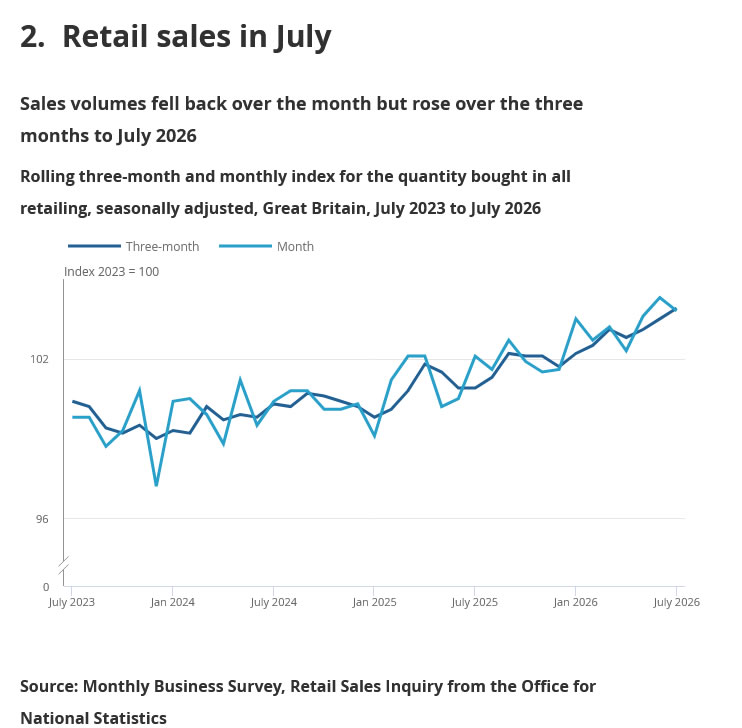
UK retail sales volumes fell -0.5% m/m in July, matching expectations, after June growth was revised down from 1.0% to 0.7%. May was revised slightly higher to 1.3%. On an annual basis, sales growth slowed from a revised 3.8% to 1.6%, missing expectations for 2.2%. Despite July’s setback, volumes were still up 1.1% in the three months to July compared with the previous three-month period.
Weakness was concentrated in non-food categories. Non-food store sales fell 1.3%, with clothing, household goods and department stores all softer. Retailers said earlier promotions had pulled some demand forward into June, while hot weather reduced footfall and weighed on demand for certain products. Non-store retailing also fell back after a promotion-heavy June, although volumes remained above May levels. Food stores provided some offset, helped by hot weather and World Cup-related demand for supermarket goods, alcoholic drinks and beverages.
Overall, July looks more like a payback after a strong June than a sharp deterioration in consumer spending. Sales volumes remained at their second-highest level since April 2022, while the positive three-month trend suggests underlying consumption is still holding up despite weaker monthly momentum.
Data Summary
| Indicator | Actual | Expected | Previous |
|---|---|---|---|
| Retail Sales m/m | -0.5% | -0.5% | +0.7% |
| Retail Sales y/y | +1.6% | +2.2% | +3.8% |
| Retail Sales, 3m/3m | +1.1% | — | — |
| Non-Food Store Sales m/m | -1.3% | — | — |
June monthly growth was revised from +1.0% to +0.7%. June annual growth was revised from +4.2% to +3.8%.
Key Takeaways
- UK retail sales volumes fell 0.5% m/m in July, matching expectations after June growth was revised down to 0.7%.
- Annual growth slowed from a revised 3.8% to 1.6%, missing expectations for 2.2%.
- Broader trend remained firmer than monthly headline. Sales volumes rose 1.1% over three months to July compared with previous three months.
- Non-food store volumes fell 1.3%, with weakness in clothing, household goods and department stores.
- Earlier promotions brought some spending forward into June, making July decline partly a timing effect rather than clear deterioration in demand.
- Hot weather also weighed on clothing footfall and some furniture demand.
- Food-store volumes rose, helped by hot weather and World Cup-related spending.
- Total retail volumes remained at their second-highest level since April 2022, supporting view that July was a pullback after strong May and June rather than start of a sharp consumer downturn.
Japan’s Data Is Strengthening as Australia’s Weakens. Why Is AUD/JPY Rising?
TL;DR: Japan's data is strengthening and Australia's is weakening, yet AUD/JPY keeps rising — because the cross is trading on the global yield backdrop and carry differential, not on either country's local fundamentals.
Domestic Data Point Clearly Lower for AUD/JPY
AUD/JPY has rebounded strongly even though this week's data from both sides of the cross argue for the opposite move. Japan delivered firmer inflation and stronger business activity. Australia produced a weak jobs report and softer PMIs. On domestic fundamentals alone, that combination should favor the Yen over the Aussie.
Japan's July core CPI rose from 1.6% to 1.8% y/y, while core-core CPI accelerated from 1.7% to 1.9% — a broadening that ActionForex covered in detail here, noting firmer services inflation and renewed energy pressure ahead of the BoJ's September meeting. August PMIs strengthened as well: PMI Manufacturing rose from 54.5 to 55.1, while PMI Services climbed from 51.2 to 52.3 — part of a broader acceleration where overseas demand posted its strongest growth in more than eight-and-a-half years, led by semiconductor and AI-related industries. Those readings reinforce expectations the BoJ could raise rates again at its September meeting.
Australia moved in the opposite direction. Employment fell -15.8K in July, against expectations for an increase, while unemployment rose from 4.4% to 4.5%. August PMI Composite Output then eased from 53.2 to 52.5, while PMI Services Business Activity fell from 53.6 to 52.9. PMI Manufacturing Output slipped from 50.3 to 49.7, moving back into contraction, even as manufacturing orders improved and cost pressures accelerated.
Global Yields Are Overriding Local Fundamentals
That AUD/JPY is rising anyway is the more important signal. The cross is currently trading less on Australian and Japanese data than on the global yield backdrop.
The Yen briefly benefited after the US Treasury's August 19 buyback announcement drove long-dated US yields sharply lower. That compressed yield differentials globally and temporarily reduced pressure on low-yield funding currencies. But the move didn't last — US yields rebounded quickly on Thursday, with the 10-year Treasury yield returning toward 4.70% and the 30-year yield moving back above 5.20%. Other major sovereign yields also rose. As carry conditions improved again, the Yen returned to underperformance.
That mechanism matters more for AUD/JPY than the latest local data. When global yields rise, the opportunity cost of holding a low-yielding currency such as the Yen increases. Carry demand then tends to favor currencies offering substantially higher policy rates, including the Aussie.
BoJ Hike Bets Are Rising, But the Carry Gap Is Still Wide
Japan's stronger CPI and PMI data still matter because they reinforce September BoJ hike expectations. But even another 25bp increase wouldn't transform the relative-rate picture.
The RBA cash rate stands at 4.35%, compared with the BoJ policy rate at 1.00% — a gap of roughly 335bp. A BoJ hike to 1.25% would narrow it to around 310bp, still a substantial spread.
That helps explain why the Yen can weaken even as BoJ normalization expectations strengthen. Markets may be becoming more confident that Japan will hike, but the expected adjustment is still small relative to the existing carry advantage. Australia's softer data could eventually narrow that gap from the other side if markets become convinced the RBA's tightening bias won't survive. But this week's releases haven't been enough to overpower the global yield move.
ActionForex's Technical View on AUD/JPY
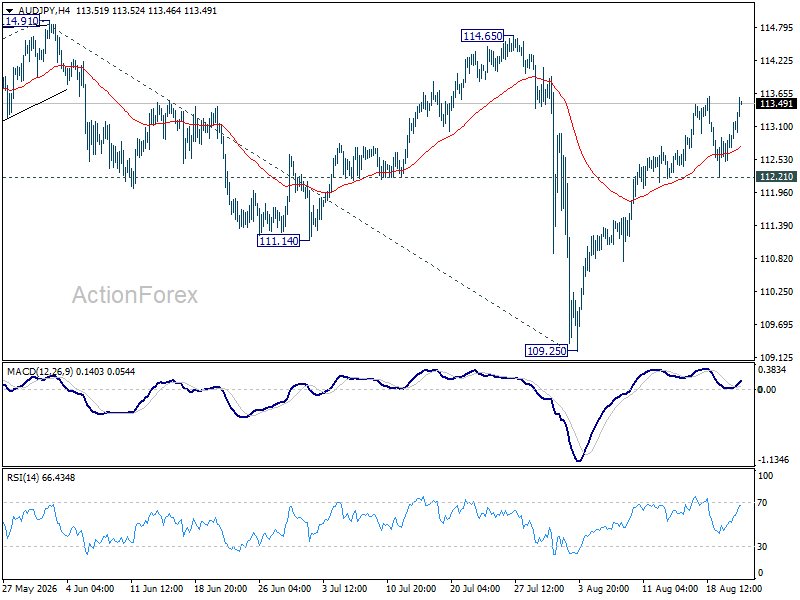
Technically, the current rebound supports the view that the correction from 114.91 completed with three waves down to 109.25. That decline held above 108.77, the bottom of wave four of a lesser degree. Support from the 55-day EMA also strengthens the bullish interpretation.
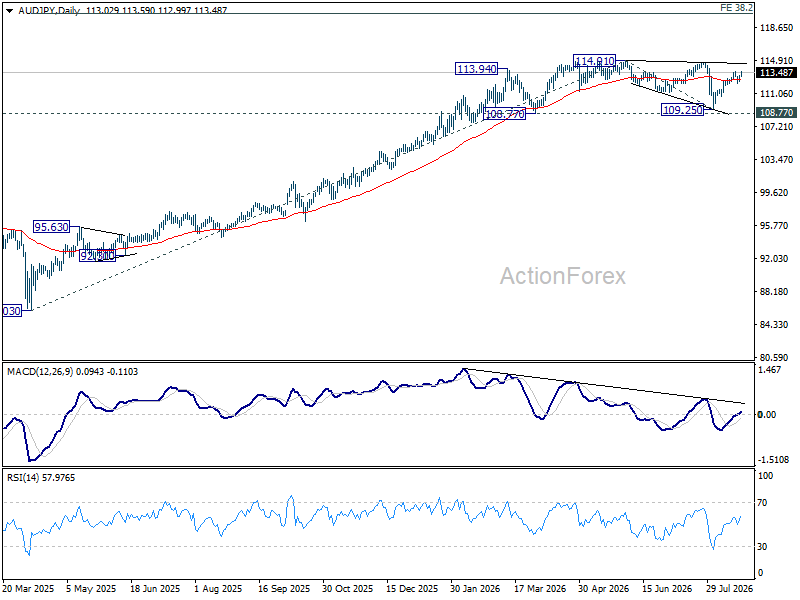
The near-term outlook stays bullish while 112.21 support holds. The next target is the 114.65–114.91 resistance zone.
A decisive break of 114.91 would be much more important. It would confirm resumption of the larger uptrend from 86.03, the 2025 low. The next upside target would then be the 38.2% projection of 86.03 to 114.91 from 109.25, at 120.28, putting the psychological 120 level directly into focus.
A move below 112.21 would delay the bullish case and suggest the correction from 114.91 is still unfolding, with another near-term decline possible before the broader uptrend resumes.
AUD/JPY Is Sending a Global, Not Domestic, Signal
The key takeaway isn't that Australian fundamentals suddenly improved or that Japanese data failed to matter. It's that both local stories are being overwhelmed by a larger market force. Japan is getting stronger. Australia is getting softer. Yet AUD/JPY is rising because global yields have reasserted the carry advantage over the Yen.
That makes the next move in US and global bond yields more important for this cross than another small change in local data. As long as carry pressure stays elevated and 112.21 holds, AUD/JPY can keep pressing toward 114.91 despite a domestic macro backdrop that, on paper, argues for the opposite.
Key Takeaways
- Japan's core-core CPI accelerated to 1.9% and PMIs strengthened broadly, while Australia's jobs report contracted and PMIs softened — a combination that should favor Yen, not Aussie.
- AUD/JPY's rise despite this divergence signals the cross is trading on global yields and carry conditions, not local fundamentals, right now.
- The RBA-BoJ rate gap stands at roughly 335bp; even a September BoJ hike to 1.25% would only narrow it to around 310bp, preserving a substantial carry advantage for AUD.
- US yields briefly fell on the Treasury buyback announcement but rebounded quickly, restoring carry pressure on the Yen within days.
- AUD/JPY holds a bullish bias above 112.21 support, targeting 114.65-114.91; a break above 114.91 would open a path toward 120.28.
Elliott Wave Outlook: Bitcoin (BTCUSD) Launches New Bullish Leg
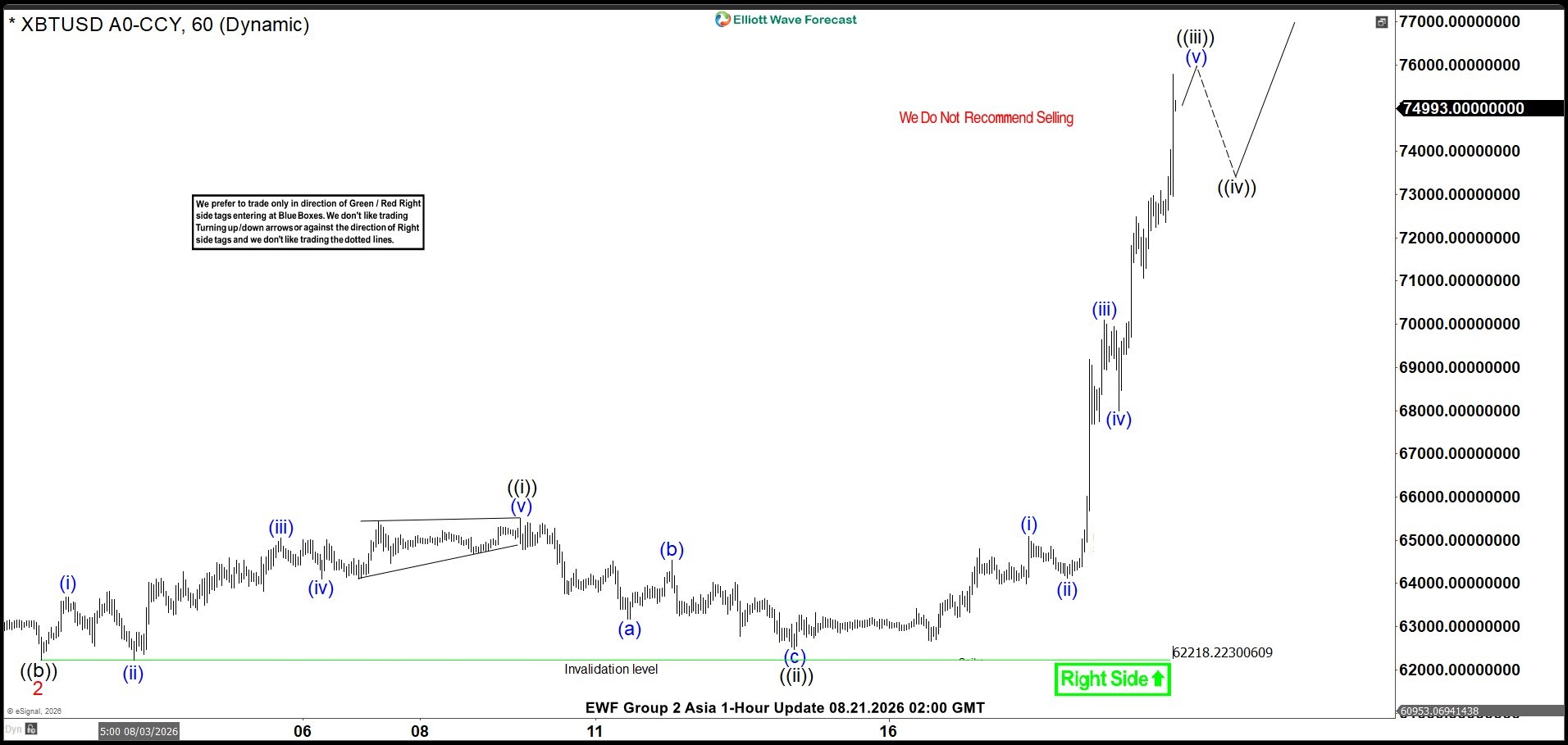
The short‑term Elliott Wave view in Bitcoin (BTCUSD) indicates that the cryptocurrency established a significant low on June 25, 2026. From that level, price action began to unfold with impulsive characteristics. The initial advance completed wave 1 at $66,990, followed by a corrective pullback in wave 2 that ended at $62,214.75. Momentum then shifted upward again, as reflected in the one‑hour chart. From wave 2, wave ((i)) concluded at $65,510, while the subsequent retracement in wave ((ii)) found support at $62,470.
The structure has continued to develop with internal subdivisions forming another impulse of lesser degree. From wave ((ii)), wave (i) terminated at $65,080, and the corrective phase in wave (ii) ended at $64,112.8. Bitcoin then extended higher in wave (iii), reaching $70,089, before a modest decline in wave (iv) concluded at $67,993.4. The market is now progressing toward completion of wave (v) within wave ((iii)). Once this final leg concludes, a corrective pullback in wave ((iv)) is anticipated before the broader rally resumes.
Near term, the critical pivot remains at $62,218.2. As long as this level holds, corrective phases are expected to find support within a three‑ or seven‑swing structure, setting the stage for further upside. The overall sequence suggests that Bitcoin retains bullish potential, with dips likely to attract buyers. This reinforces the view that the impulsive cycle from the June 25 low remains intact, and the market should continue to advance once the current corrective phase completes.
Bitcoin (BTCUSD) 60 Minute Elliott Wave Chart
BTCUSD Elliott Wave Video
https://www.youtube.com/watch?v=2y7frOetq64
Bitcoin Wave Analysis
Bitcoin: ⬆️ Buy
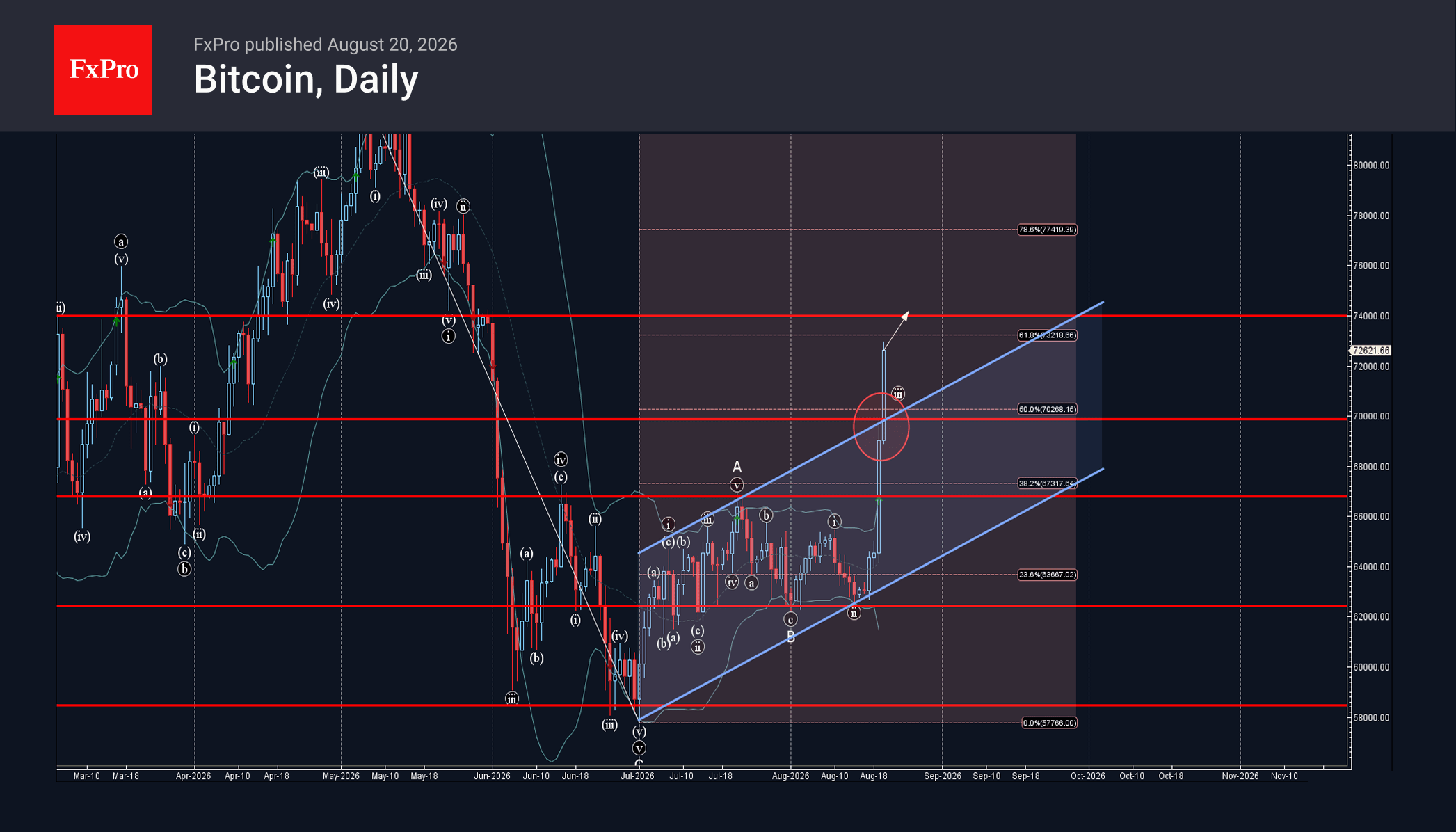
– Bitcoin broke round resistance level 70000.00
– Likely to rise to resistance level 74000.00
Bitcoin cryptocurrency recently broke the resistance zone between the round resistance level 70000.00 and the resistance trendline of the daily up channel from June.
The breakout of this resistance zone coincided with the breakout of the 50% Fibonacci correction of the sharp downward impulse from May.
Bitcoin cryptocurrency can be expected to rise further to the next resistance level 74000, former support from the end of May.