

Sample Category Title
GBP/USD Daily Outlook
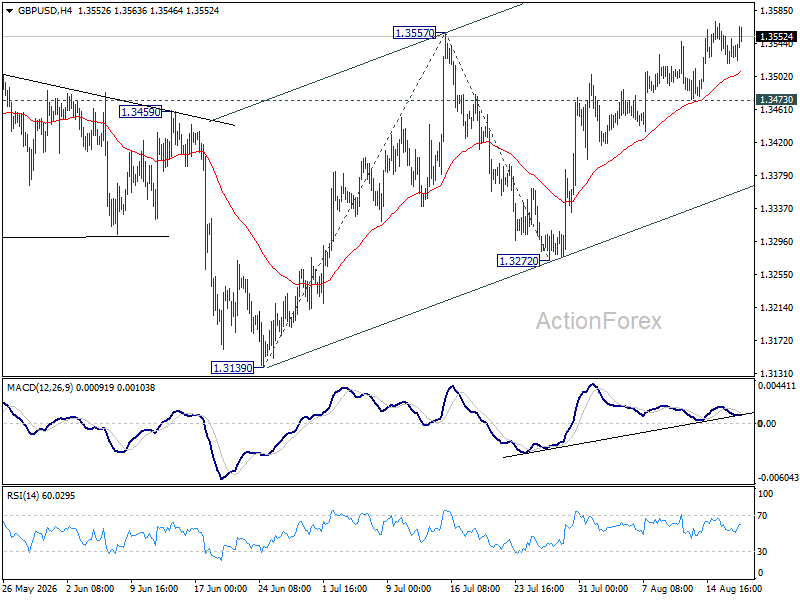
Intraday bias in GBP/USD stays mildly on the upside at this point. Rise from 1.3139 would target 100% projection of 1.3139 to 1.3557 from 1.3272 at 1.3690. However, firm break of 1.3473 will turn bias back to the downside for deeper pullback.
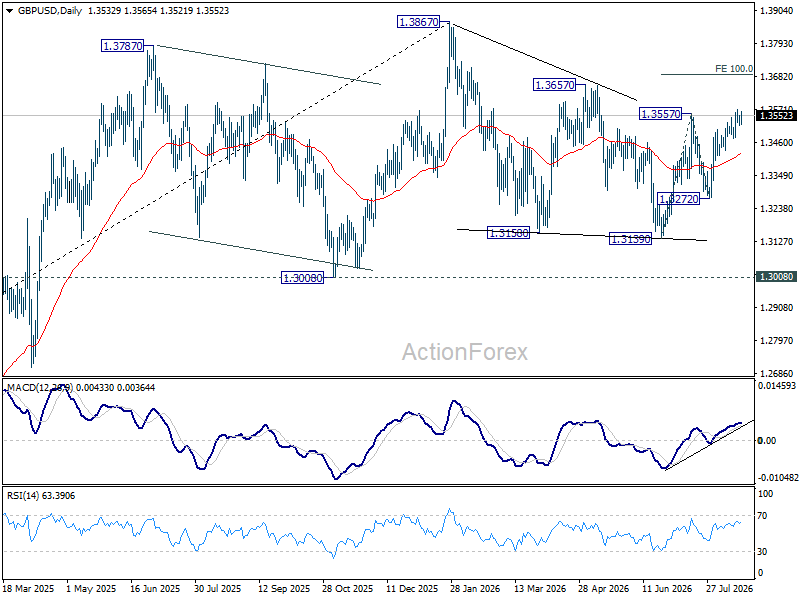
In the bigger picture, price actions from 1.3867 are a corrective pattern within the broader up trend from 1.0351 (2022 low). With 1.3008 support intact, medium term bullishness is maintained and break of 1.3867 is in favor for a later stage, towards 1.4248 key resistance (2021 high). However, firm break of 1.3008 will at least bring deeper fall to 38.2% retracement of 1.0351 to 1.3867 at 1.2524, with increased risk of bearish reversal.
USD/CHF Daily Outlook
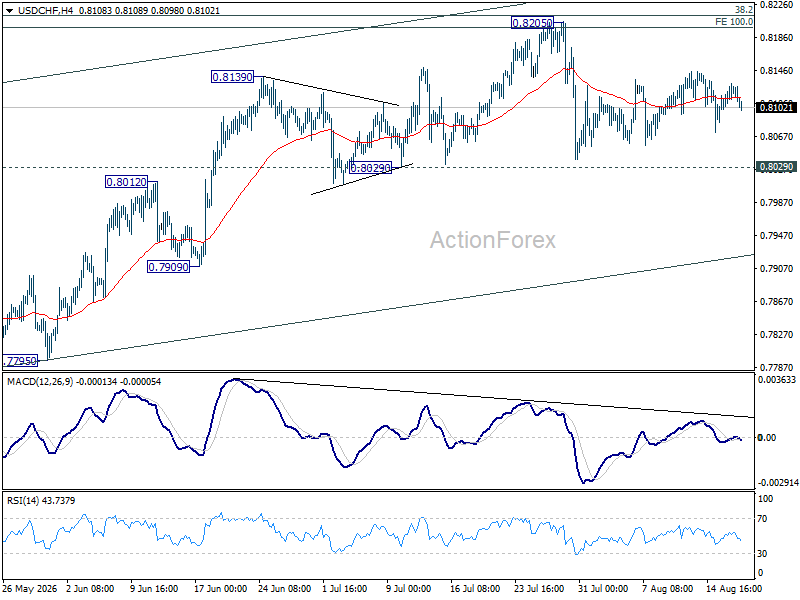
No change in USD/CHF's outlook as range trading continues. Intraday bias remains neutral. With 0.8029 support intact, further rally is expected. On the upside, firm break of 0.8205 will extend the rise from 0.7603 to 161.8% projection 0.7603 to 0.8041 from 0.7600 at 0.8469. However, decisive break of 0.8029 will bring deeper fall to channel support (now at 0.7921).
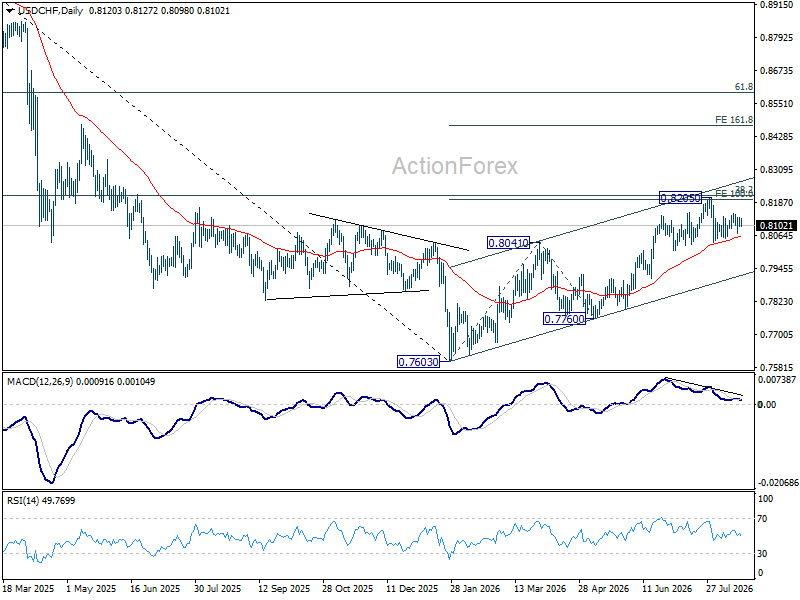
In the bigger picture, focus is now on 38.2% retracement of 0.9200 (2025 high) to 0.7603 at 0.8213. Decisive break will argue that USD/CHF is reversing the medium term trend, and turn focus to 0.8332 support turned resistance (2023 low) for confirmation. Nevertheless, rejection by 0.8213 will maintain medium term bearishness for another fall through 0.7603 at a later stage.
AUD/USD Daily Report
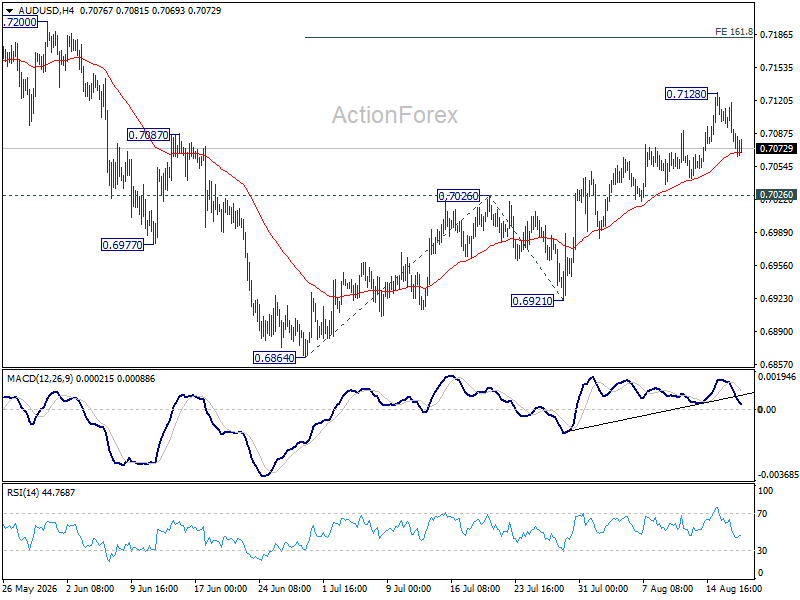
Intraday bias in AUD/USD is turned neutral with current retreat, and some consolidations would be seen first. Further rally is expected as long as 0.7026 resistance turned support holds. Above 0.7128 will extend the rise from 0.6864 to 161.8% projection of 0.6864 to 0.7026 from 0.6921 at 0.7183.
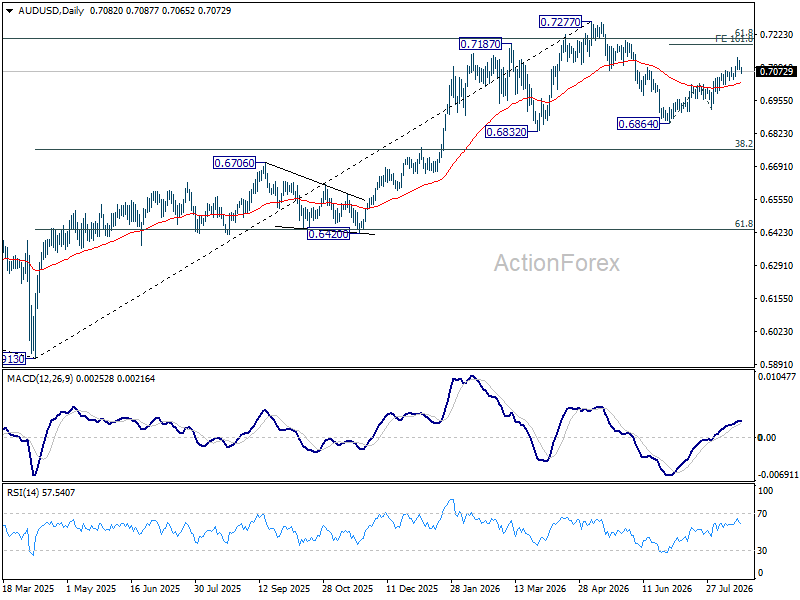
In the bigger picture, price action from 0.7277 medium term top is seen as developing into a correction to rise from 0.5913 only. While deeper decline cannot be ruled out, downside should be contained by 38.2% retracement of 0.5913 to 0.7277 at 0.6756 to bring rebound. Consolidations would continue below 0.7277 for a while, before an eventual upside breakout.
GBP/JPY Daily Outlook
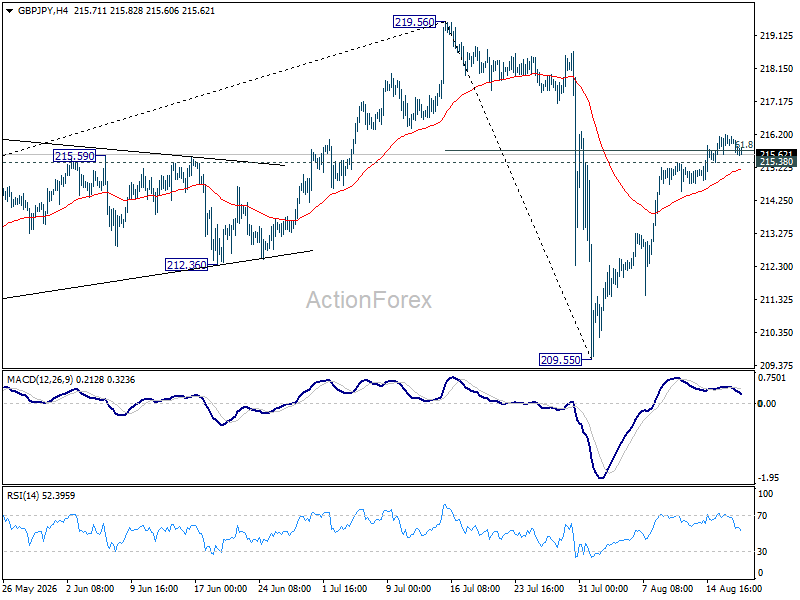
Intraday bias in GBP/JPY remains mildly on the upside for the moment. Sustained break of 61.8% retracement of 219.56 to 209.55 at 215.73 will pave the way to retest 219.56 high. On the downside, below 215.38 minor support will turn bias neutral again first.
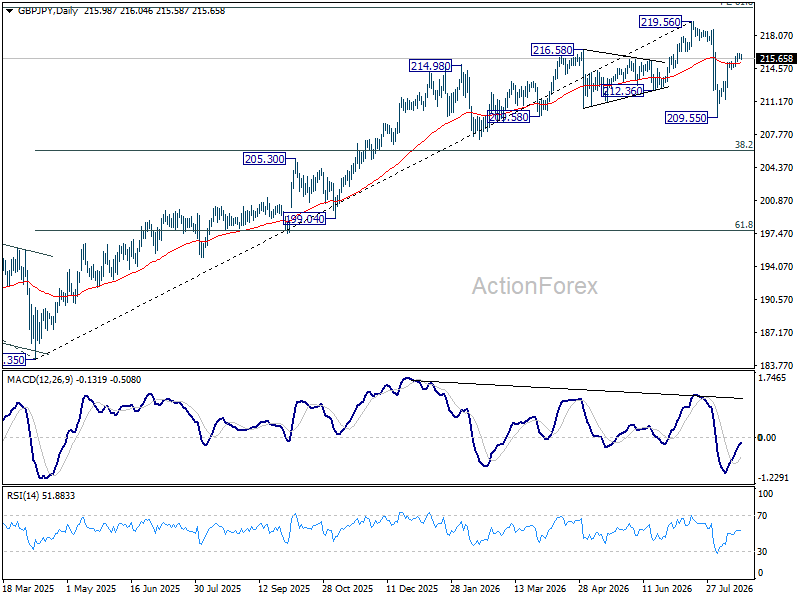
In the bigger picture, strong rebound above 55 W EMA (now at 208.91) keeps the up trend from 123.94 (2020 low) intact. Firm break of 209.55 should target 100% projection of 148.93 to 208.09 from 184.35 at 243.51. However, sustained break of 55 W EMA will argue that it's already in a medium term down trend to 184.35 support.
EUR/JPY Daily Outlook
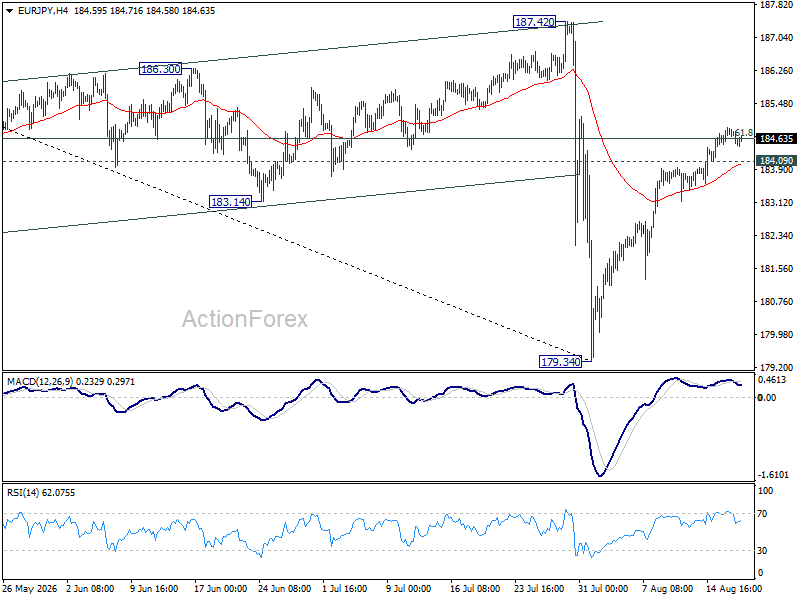
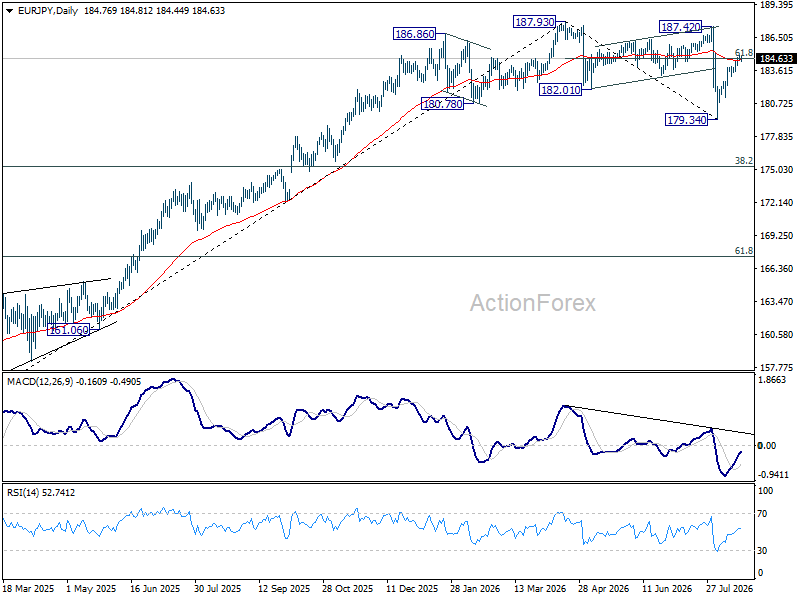
Intraday bias in EUR/JPY stays mildly on the upside at this point. Sustained trading above 61.8% retracement of 187.93 to 179.34 at 184.64 will pave the way to retest 187.93 high. On the downside, below 184.09 minor support will turn intraday bias neutral first.
In the bigger picture, strong rebound from rising 55 W EMA (now at 180.23) keeps the up trend from 114.42 (2020 low) intact. Break of 187.93 will target 78.6% projection of 124.37 (2022 low) to 175.41 (2025 high) from 154.77 at 194.88. However, sustained break of 55 W EMA will argue that it's already in a medium term down trend to 175.41 resistance turned support and below.
EUR/GBP Daily Outlook
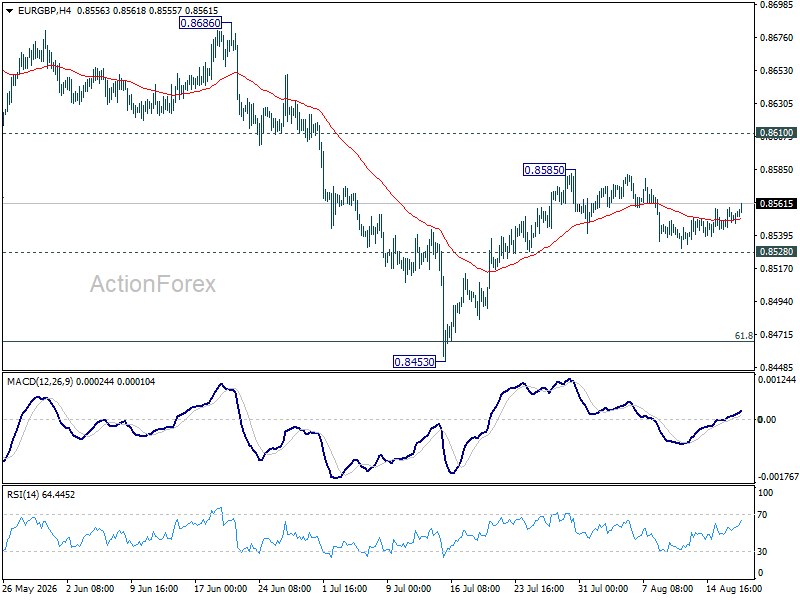
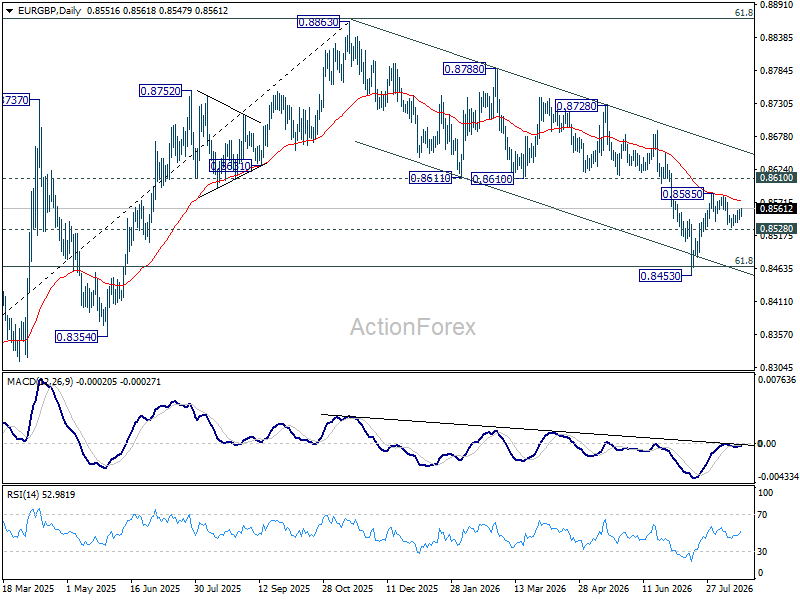
Intraday bias in EUR/GBP stays neutral at this point. While rebound from 0.9453 might extend, strong resistance should be seen from 0.8610 support turned resistance to limit upside. On the downside, break of 0.8528 support will argue that the corrective rebound from 0.8453 has completed, and turn bias back to the downside for retesting this low. However, firm break of 0.8610 will bring stronger rally to falling channel resistance (now at 0.8650).
In the bigger picture, rise from 0.8221 (2024 low) should have completed at 0.8863, just ahead of 38.2% retracement of 0.9267 (2025 high) to 0.8221 at 0.8867. Deeper fall would be seen back to 0.8221. For now, outlook will be neutral at best as long as 0.8610 support turned resistance hold.
EUR/AUD Daily Outlook
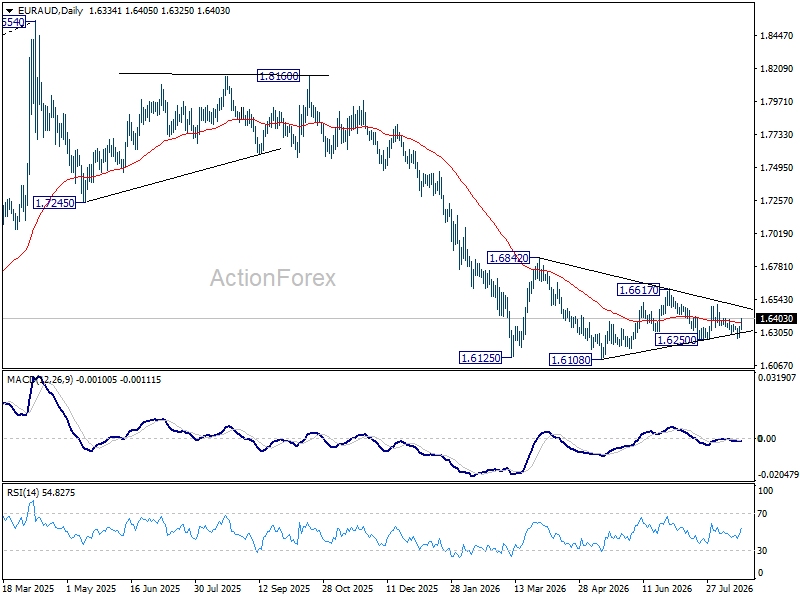
Intraday bias in EUR/AUD is back on the upside with break of 1.6358 minor resistance. Further rise should be seen to 1.6503 resistance first. Break there will target 1.6617. On the downside, below 1.6250 will target a retest on 1.6108 low. Overall, corrective pattern from 1.6108 (or 1.6125) is still extending.
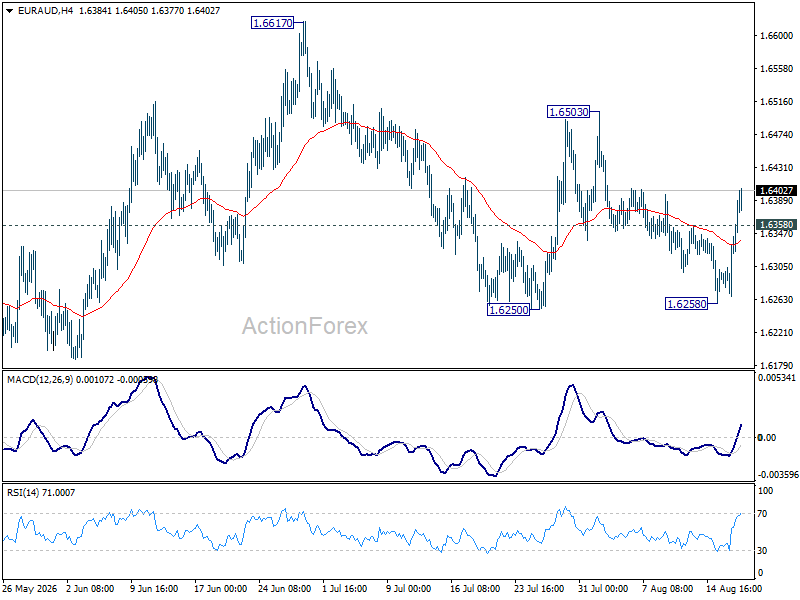
In the bigger picture, outlook will stay bearish as long as 1.6842 resistance holds. Fall from 1.8554 (2025 high) is expected to continue to 61.8% retracement of 1.4281 to 1.8554 at 1.5913. Decisive break there will pave the way back to 1.4281 (2022 low). However, firm break of 1.6842 should confirm medium term bottoming, and bring stronger rally.
EUR/CHF Daily Outlook
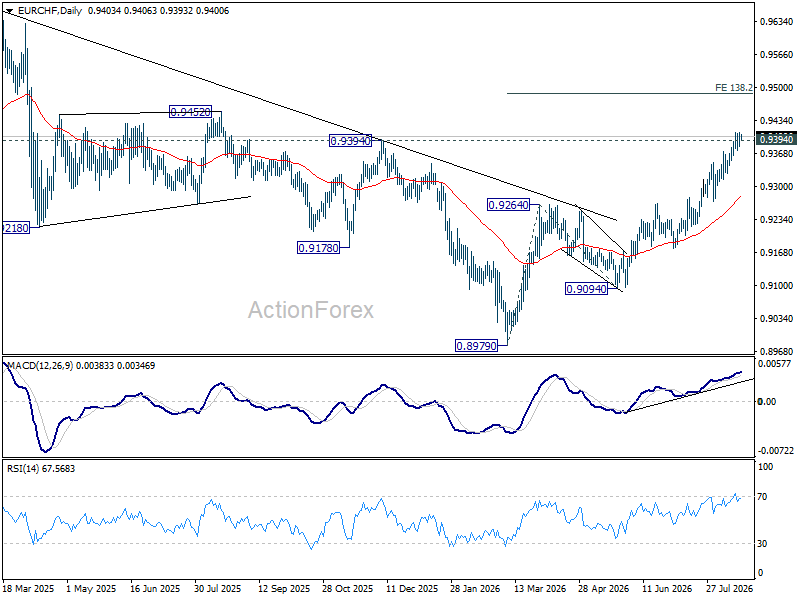
EUR/CHF is still bounded in consolidation below 0.9408 and intraday bias stays neutral. Further rally is expected as long as 0.9326 support holds. Above 0.9408 will extend larger rise to 138.2% projection of 0.8979 to 0.9264 from 0.9094 at 0.9488.
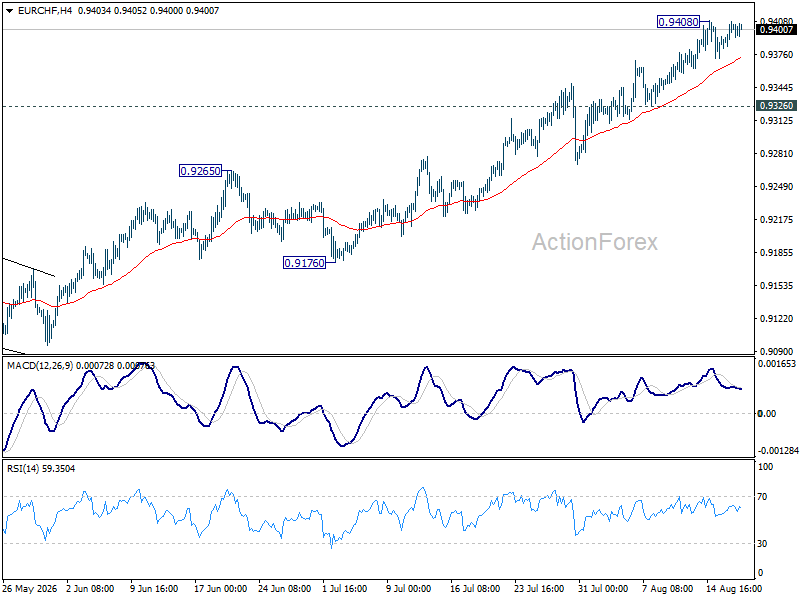
In the bigger picture, the break of 0.9394 resistance solidify the case that rise from 0.8979 medium term is at least reversing the fall from 0.9928 (2024 high), with prospect of developing into a medium term up trend. Further rally should be seen to 0.9660 resistance next. This will remain the favored case as long as 0.9264 resistance turned support holds, in case of pullbacks.
XAG/USD Analysis: Silver Surges on Jobs Data, Yields Threaten to End It
Silver has had one of its strongest months in years, but this week's price action shows just how fragile precious metals rallies can be when bond markets get nervous. The metal surged nearly 10% last week after July's Non-Farm Payrolls badly missed expectations, printing a loss of 23,000 jobs, prompting markets to price out any chance of a September Fed hike and reviving safe-haven demand.
That momentum reversed on Tuesday, however, with silver dropping toward $64 as global bond yields spiked to multi-year highs on mounting concerns over government spending and persistent inflationary pressures. Rising oil prices added to the unease, keeping inflation risks firmly in focus even as rate-hike expectations continue to fade.
Beneath the volatility, the structural picture remains supportive: silver continues to draw solid demand from the green energy transition, solar panels, electric vehicles, and AI data centre infrastructure, all keeping a floor under prices. All eyes now turn to the Fed's July meeting minutes and Chair Kevin Warsh's remarks at Jackson Hole, both expected to offer fresh clues on the path ahead for rates.
Technical Analysis of XAG/USD
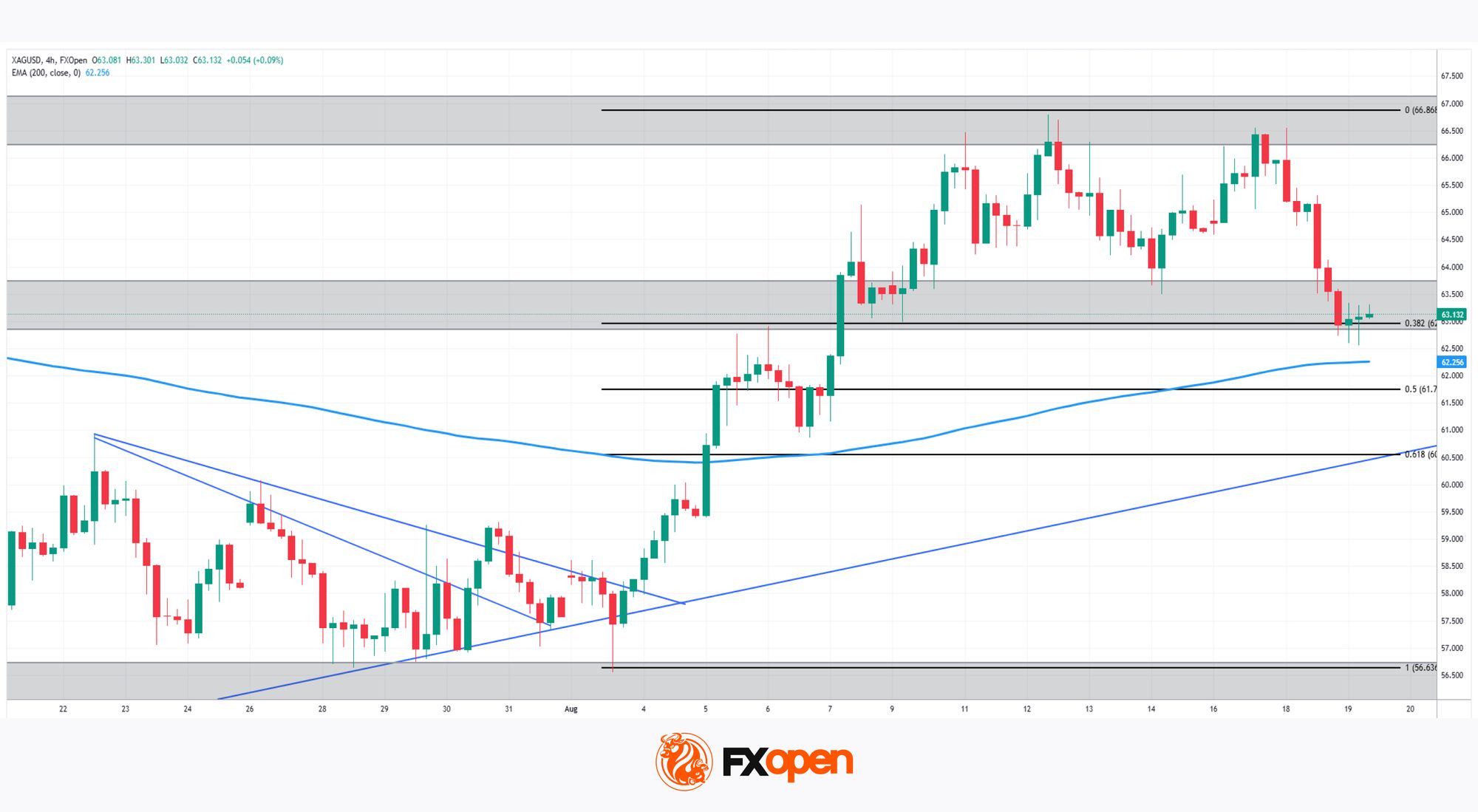
As XAG/USD chart shows, silver broke above its descending trendline from June's highs in early August, a genuine shift after weeks of decline, and has since been holding above the 0.382 Fibonacci retracement near 62.88, right where the 200-period EMA also sits nearby at 62.27. The broader recovery has been building on an ascending trendline off the mid-July lows.
Bullish Scenario
Should buyers defend this 0.382-EMA confluence and push higher, the path would open toward a retest of the 66.73 highs, the 0 Fibonacci level marking the origin of the entire decline. A confirmed break above that zone would signal the correction is fully over.
Bearish Scenario
Conversely, a break below the 0.382 retracement and the ascending trendline would expose the 0.5 level near 61.69, with a deeper slide risking a retest of the 0.618 retracement around 60.49, or even the triangle apex near 56.64 if selling pressure accelerates.
With price sitting right at the intersection of a reclaimed trendline, the 200-period EMA, and a key Fibonacci level, silver looks poised for a decisive move, will this recovery extend toward fresh monthly highs, or does the recent bond market turmoil drag the metal back into its prior range?
Start trading commodity CFDs with tight spreads (additional fees may apply). Open your trading account now or learn more about trading commodity CFDs with FXOpen.
This article represents the opinion of the Companies operating under the FXOpen brand only. It is not to be construed as an offer, solicitation, or recommendation with respect to products and services provided by the Companies operating under the FXOpen brand, nor is it to be considered financial advice.
Gold Has More to Offer
- The precious metal could rise in tandem with Treasury yields.
- The BoJ’s accelerated tightening will support the yen.
The new Fed Chair wants the markets to do the central bank’s job for him. If the number of supporters of his position increases, the chances of a rate hike in 2026 will fall, weakening the greenback. Recently, the US dollar has retreated amid concerns that the July FOMC meeting minutes will show that Kevin Warsh’s approach is working.
His passivity is one of the drivers behind the rally in long-term Treasury yields to their highest levels since 2007. Other reasons include concerns about the budget deficit, rising inflation due to the conflict in the Middle East, and the diversion of funds towards artificial intelligence. To finance AI-related expenditures, companies are issuing bonds, diverting capital from the Treasury market and raising Treasury yields.
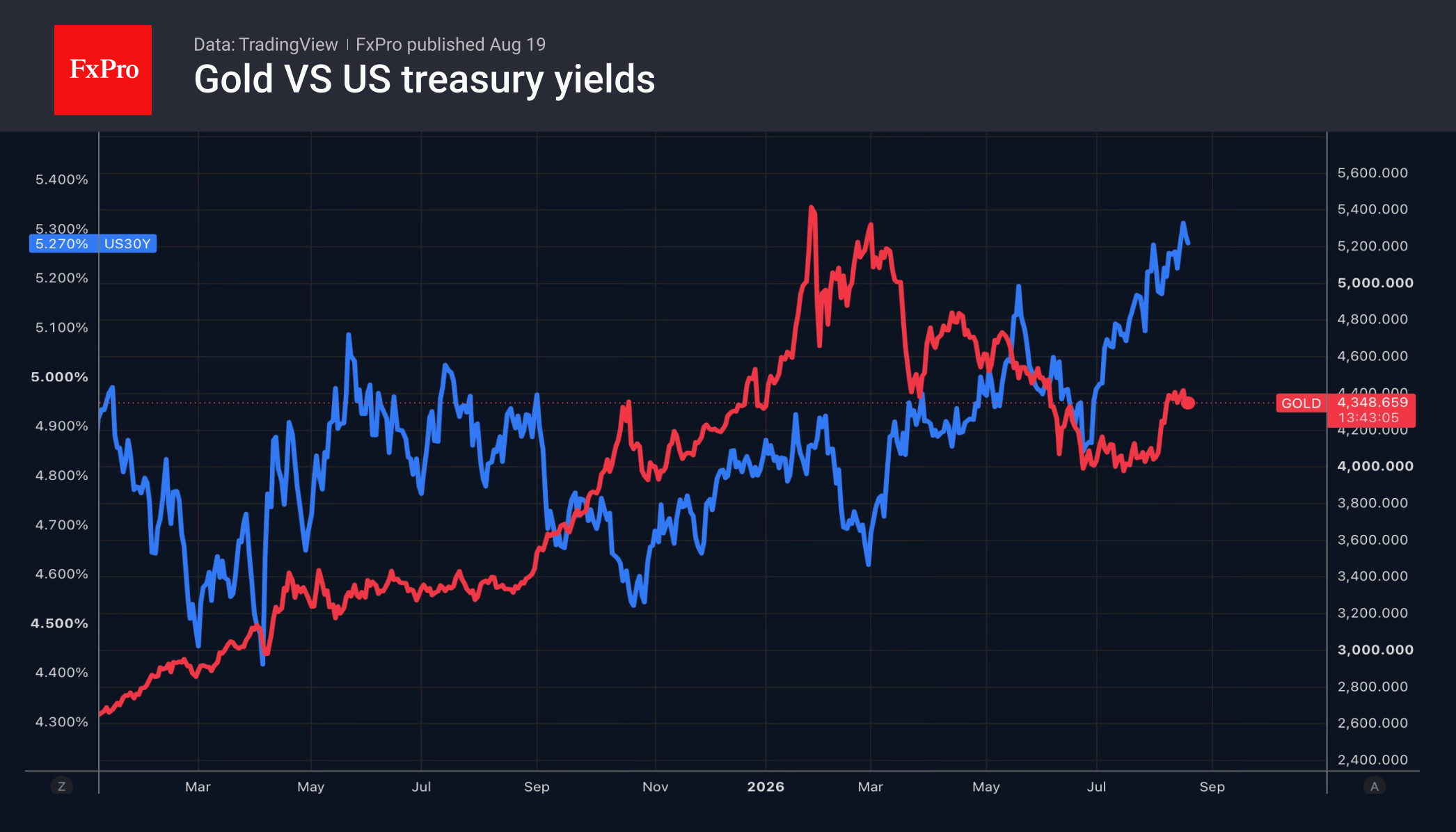
Surprisingly, rising interest rates on debt are not preventing gold from continuing its climb. Even though there are occasional slumps, such as the one seen on 18 August, which was the sharpest fall in nearly a month, investors believe that the rise in Treasury bond yields has more to do with selloffs driven by fears over the budget deficit than with hopes for the strength of the US economy. Indeed, the Congressional Budget Office forecasts that debt service costs will rise from an average of 2.1% of GDP over the past half-century to 3.3% in 2026 and 4.6% in 2036. Concerns about US financial stability are helping the metal to rise.
Additionally, according to a Bank of America survey, the proportion of investors who consider gold undervalued has risen to its highest level since March 2023.
Other currencies have capitalised on the weakness of the US dollar. The bulls failed to break through the resistance level at 159.5 on USDJPY, and the pair retreated. According to Mizuho Financial Group, the Bank of Japan will raise its overnight rate from 1% to 1.25% as early as September, and will then accelerate the cycle of monetary tightening, taking a new step every three months rather than every six. The main reason for this is that borrowing costs remain negative, whilst inflation stands at 1.6%.
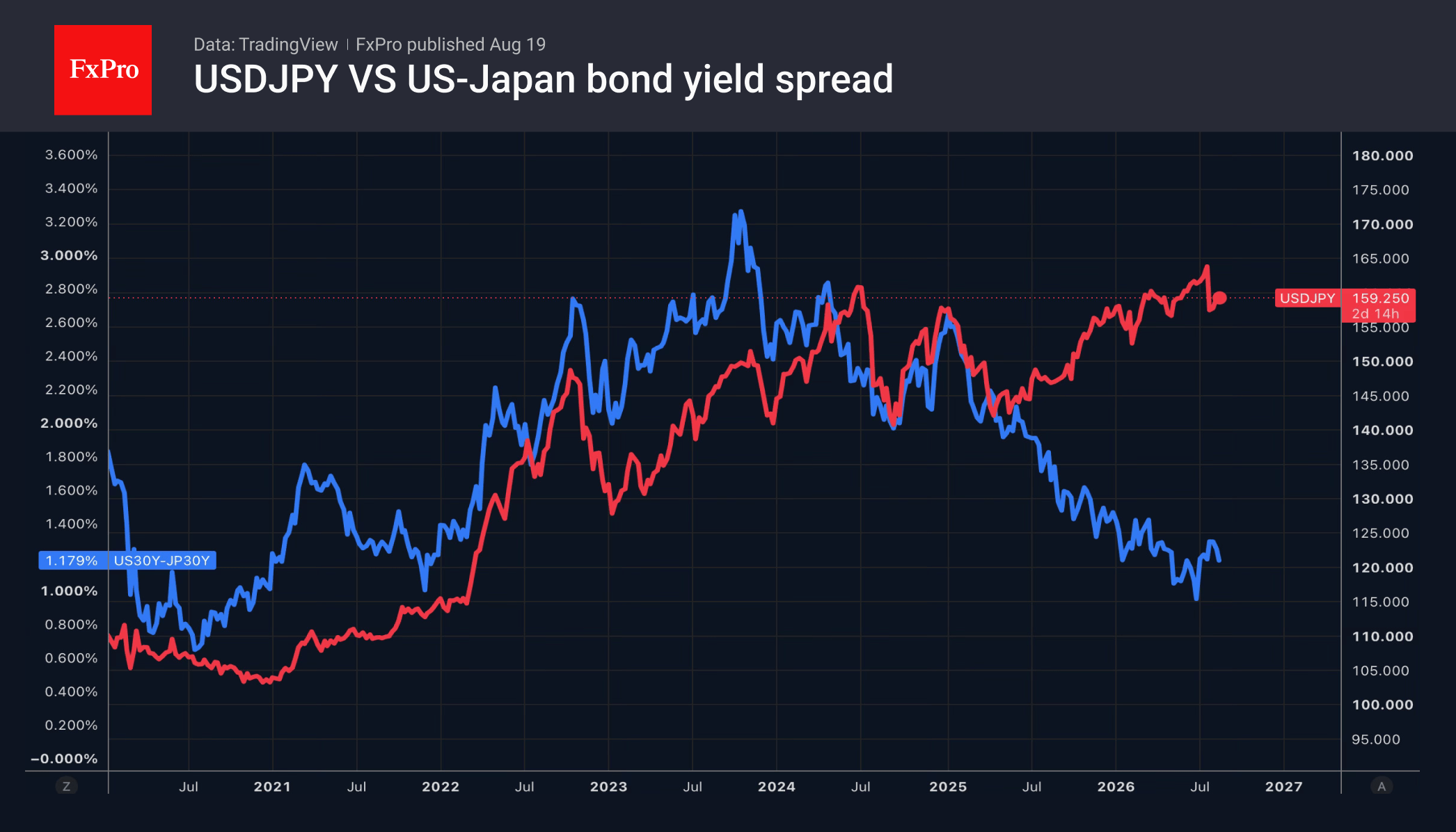
The yen is also being supported by the fact that yields on Japanese government bonds are rising faster than those on US bonds. They have reached their highest level since 1996. This is contributing to capital repatriation and a fall in the USDJPY exchange rate.
The FxPro Analyst Team