Sat, Apr 04, 2026 14:17 GMT
More

    Sample Category Title

    GBP/JPY Weekly Outlook

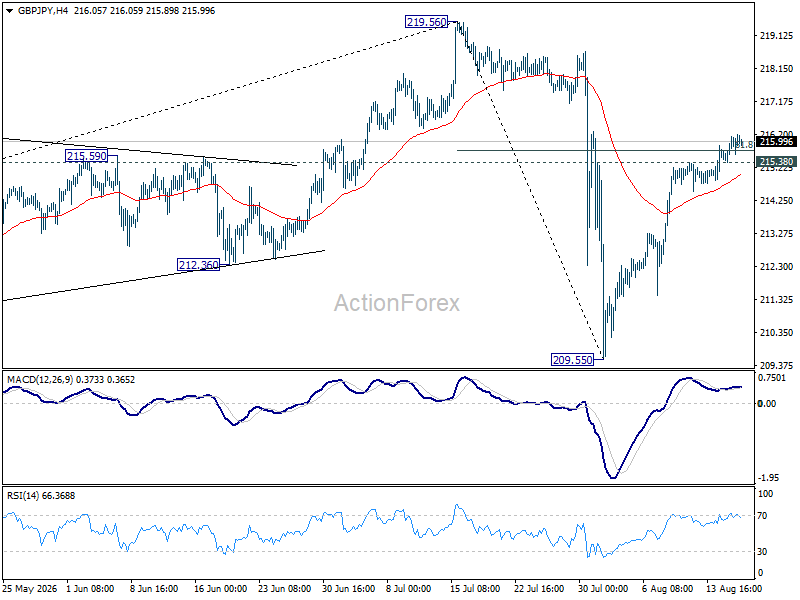
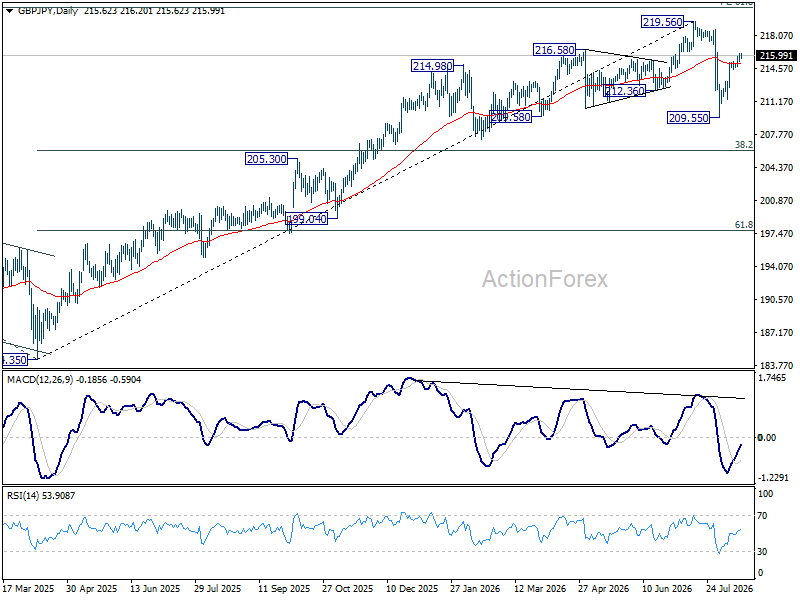
    GBP/JPY edged higher last week but failed to break through 213.28 resistance and retreated. Initial bias stays neutral this week first. On the upside, firm break of 213.28 will resume the rise from 207.20 to retest 214.98 high. However, break of 210.77 will bring deeper fall back to 209.15 support and below.

    In the bigger picture, up trend from 123.94 (2020 low) is still in progress. Firm break of 214.98 will target 61.8% projection of 148.93 (2022 low) to 208.09 (2024 high) from 184.35 at 220.90. This will remain the favored case as long as 55 W EMA (now at 203.13) holds, even in case of another deep pullback.

    In the long term picture, up trend from 116.83 (2011 low) is in progress. Next target is 251.09 (2007 high). This will remain the favored case as long as 55 M EMA (now at 184.92) holds.

    EUR/JPY Weekly Outlook

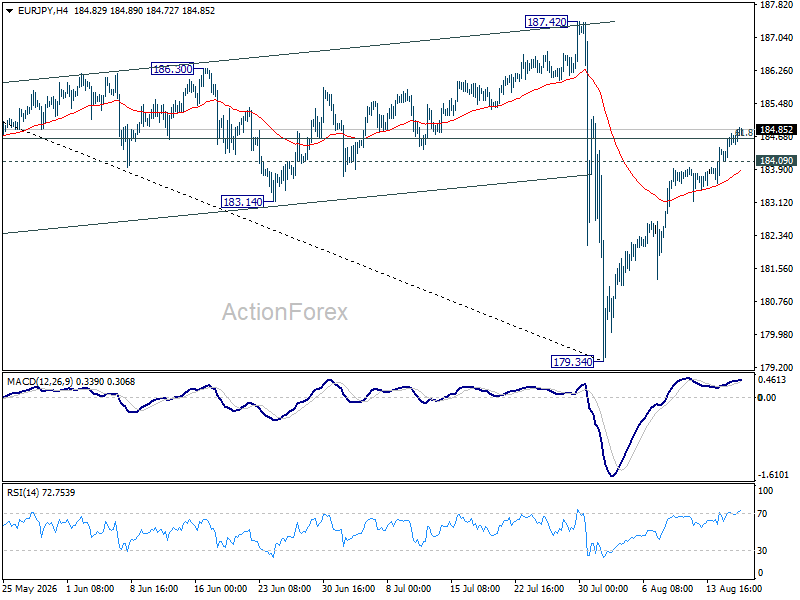
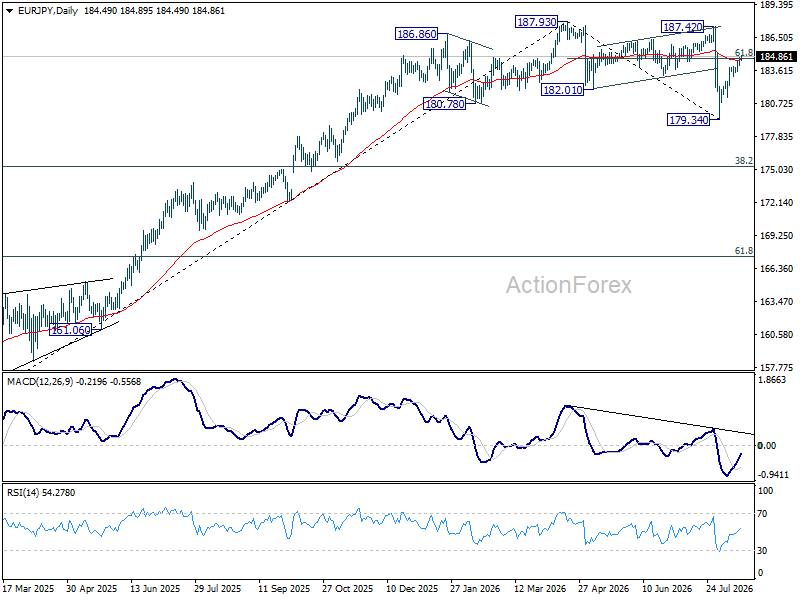
    EUR/JPY's rebound from 182.02 extended higher last week but retreated just ahead of 184.75 resistance. Initial bias remains neutral this week first. On the upside, break of 184.75 will resume the rise from 180.78 to retest 186.86 high. On the downside, however, below 183.17 minor support will turn bias back to the downside for 182.02 and below.

    In the bigger picture, a medium term top could be in place at 186.86 and some more consolidations would be seen. Nevertheless, as long as 55 W EMA (now at 175.93) holds, the larger up trend from 114.42 (2020 low) remains intact. Firm break of 186.86 will pave the way to 78.6% projection of 124.37 (2022 low) to 175.41 (2025 high) from 154.77 at 194.88 next.

    In the long term picture, up trend from 94.11 (2021 low) is in progress. Next target is 138.2% projection of 94.11 to 149.76 (2014 high) from 114.42 (2020 low) at 191.32. This will remain the favored case as long as 154.77 support holds.

    EUR/GBP Weekly Outlook

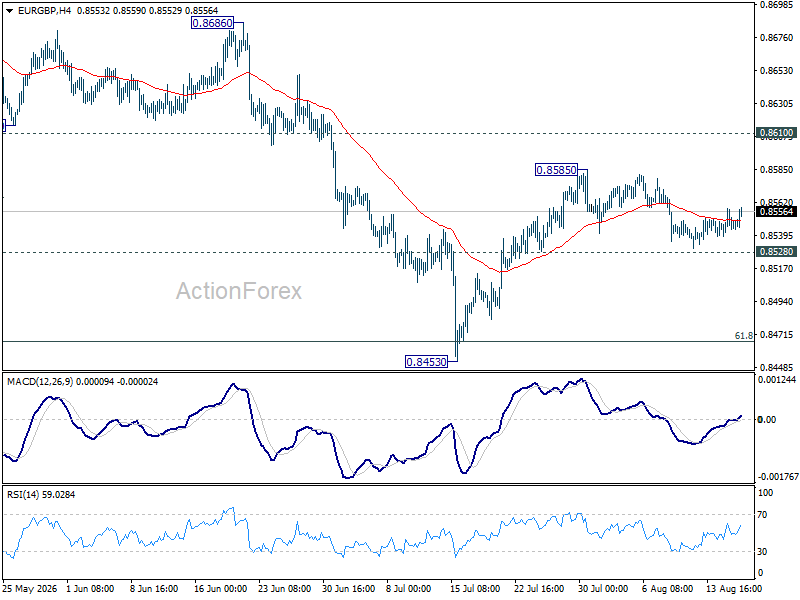
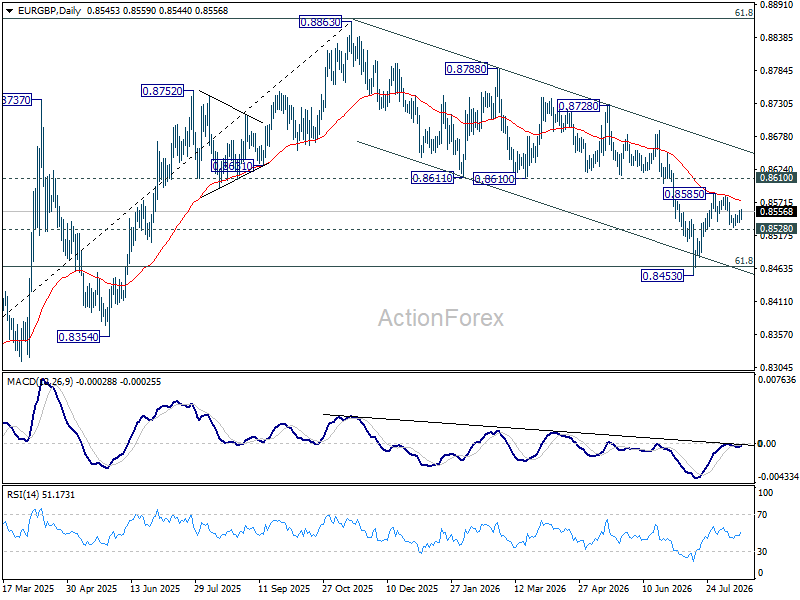
    EUR/GBP stayed in range trading above 0.8610 last week. Initial bias remains neutral this week first. On the upside, sustained break above 55 D EMA (now at 0.8680) will confirm short term bottoming, and bring stronger rebound back to 0.8788 resistance. However, rejection by 55 D EMA will set up another fall through 0.8611 to 100% projection of 0.8863 to 0.8611 from 0.8788 at 0.8536.

    In the bigger picture, current development revived the case that whole rise from 0.8221 (2024 low) has completed at 0.8863, after rejection by 61.8% retracement of 0.9267 (2022 high) to 0.8221 at 0.8867. Sustained trading below 38.2% retracement of 0.8821 to 0.8863 at 0.8618 will confirm this case, and bring deeper fall to 61.8% retracement at 0.8466 at least. For now, medium term outlook is neutral at best as long as 0.8863 resistance holds.

    In the long term picture, price action from 0.9499 (2020 high) is seen as part of the long term range pattern from 0.9799 (2008 high). Range trading should continue between 0.8201 and 0.9499, until there is clear signal of imminent breakout.

    EUR/AUD Weekly Outlook

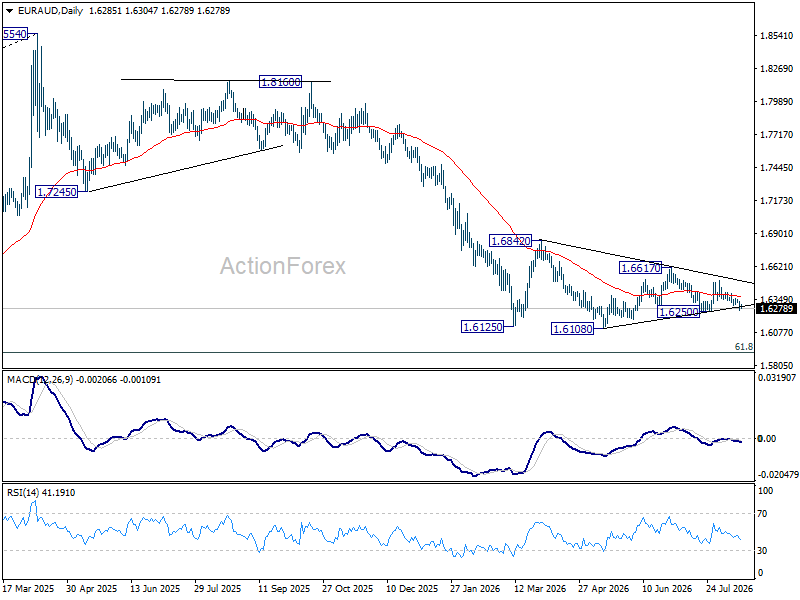
    EUR/AUD's extended rebound last week confirmed short term bottoming at 1.6125. Initial bias stays on the upside this week. Sustained break of 55 D EMA (now at 0.6756) will pave the way to 38.2% retracement of 1.8554 to 1.6125 at 1.7053. On the downside, below 1.6607 minor support will turn intraday bias neutral first.

    In the bigger picture, fall from 1.8554 medium term top is seen as reversing the whole up trend from 1.4281 (2022 low). Deeper decline should be seen to 61.8% retracement of 1.4281 to 1.8554 at 1.5913, which is slightly below 1.5963 structural support. Decisive break there will pave the way back to 1.4281. For now, risk will stay on the downside as long as 55 W EMA (now at 1.7226) holds, even in case of strong rebound.

    In the longer term picture, rise from 1.4281 is seen as the second leg of the pattern from 1.9799 (2020 high), which is part of the pattern from 2.1127 (2008 high). Current development argue that it has already completed at 1.8554. Sustained trading below 55 M EMA (now at 1.6592) will confirm this bearish case, and pave the way back towards 1.4281.

    EUR/CHF Weekly Outlook

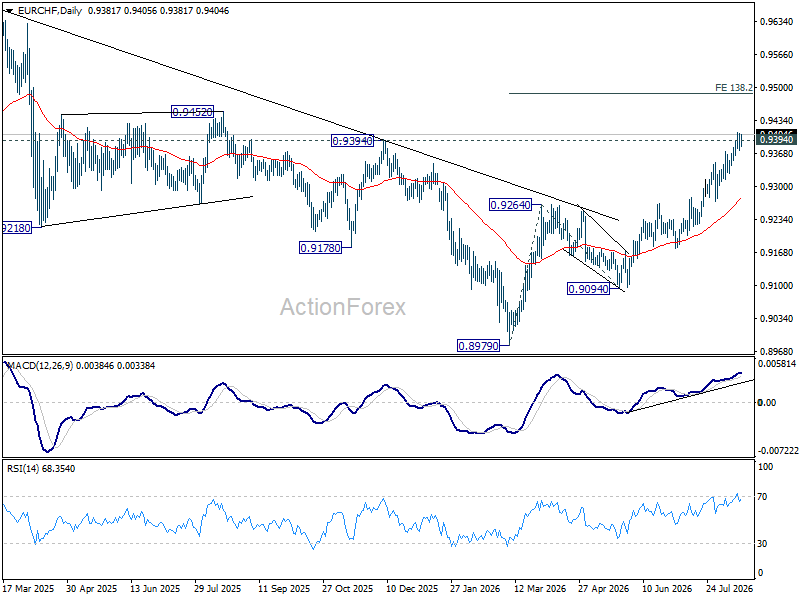
    EUR/CHF's rebound from 0.8979 short term bottom last week. Initial bias stays on the upside this week for 61.8% retracement of 0.9394 to 0.8979 at 0.9235 Sustained break there will pave the way to 0.9394 key resistance next. On the downside, below 0.9142 minor support will turn intraday bias neutral again first.
    In the bigger picture, as long as 55 W EMA (now at 0.9290) holds, the larger down trend from 0.9928 (2024 high) is still expected to continue through 0.8979 at a later stage. However, sustained break of 55 W EMA should confirm medium term bottoming, and bring stronger rise through 0.9394 resistance, even as a corrective move.

    In the long term picture, EUR/CHF is holding well inside long term falling trend channel. Down trend from 1.2004 (2018 high) is still in progress. Outlook will continue to stay bearish as long as falling 55 M EMA (now at 0.9711) holds.

    Markets Weekly Outlook – Middle East Uncertainty to Dominate Ahead of Jobs Report, Nasdaq 100 at 6-month Lows

    • Middle East uncertainty dominated the week, sending the Nasdaq into official correction territory (down >10%)
    • The US Dollar is eyeing its strongest monthly gain since July 2025
    • The week ahead is anchored by crucial US data, including the Non-Farm Payrolls/Jobs Report and Retail Sales, as well as Eurozone inflation figures.

    Another week dominated by the happenings in the Middle East. The uncertainty around whether or not a deal would materialize between the US, Israel and Iran kept markets on edge and hanging on the words of President Trump.

    Markets hovered between brief bouts of risk-on sentiment but the risk off environment dominated the majority of the time. As I write this, the US is waiting for troops to land in the Middle East with about 3,000 troops from the Army’s 82nd Airborne Division expected to land Friday.

    This was followed by a Wall Street Journal report later in the day that the Pentagon is ​looking at sending ‌up to 10,000 additional ​ground troops ​to the Middle East ⁠to ​give President Donald ​Trump more military options. This comes as President Trump ​weighs peace talks with ‌Tehran, ​citing ⁠Department of Defense ​officials with ​knowledge ⁠of the planning.

    Heading into the weekend, the S&P 500 and the Nasdaq retreated to six-month lows on Friday, as a sell-off in technology stocks weighed heavily on the broader market. While the Dow Jones Industrial Average remained relatively flat for the period, both the S&P 500 and the Nasdaq are now pacing toward their fifth consecutive week of losses.

    This downturn highlights a period of extreme uncertainty, evidenced by the CBOE Volatility Index (VIX) climbing 1.57 points to 29.01, a clear sign that investor anxiety is reaching a fever pitch.

    The Nasdaq’s recent performance officially confirms a move into correction territory, ending Thursday more than 10% below its record close. It follows in the footsteps of the Russell 2000, which was the first major index to signal a correction last week.

    Meanwhile, the commodities complex has faced its own share of volatility. After hitting a four-month low of $4,097.99 on Monday, spot gold staged a recovery to trade above $5,300/oz for much of the week. Despite this bounce, the precious metal remains under significant pressure as markets continue to price in a more hawkish outlook for interest rates.

    Source: Investing.com

    Silver and PGMs (platinum group metals) saw a reprieve on Friday, with spot silver gaining 4.4% to reach $71.01 per ounce, while platinum and palladium rose by 3% and 3.7%, respectively.

    In the energy sector, oil prices edged higher on Friday, though Brent crude is still eyeing its first weekly decline since early February.

    This comes amid shifting geopolitical headlines, President Trump indicated that talks with Iran were progressing, though he offered little in the way of specifics. The underlying supply crunch remains severe, however, as the conflict has sidelined roughly 11 million barrels per day. The International Energy Agency has characterized the current situation as a supply crisis more severe than the combined impact of the dual oil shocks of the 1970s.

    How did FX markets perform?

    The US Dollar is eyeing its strongest monthly gain since July 2025, fueled by safe-haven demand and rising expectations for a domestic rate hike. The Dollar Index (DXY) rose to 99.973 on Friday, up 2.4% for March.

    This strength has pushed the Yen toward the critical 160.00 level, a threshold widely seen as a trigger for potential BoJ intervention. Despite rising Japanese bond yields and hawkish signals from policymakers, the Yen remains pressured by Japan’s high sensitivity to energy import costs.

    Elsewhere, the Euro held steady at $1.1529, while Sterling marked its fourth straight decline to $1.3311.

    Risk-sensitive currencies also struggled; the Australian Dollar touched a two-month low of $0.6887, having shed 3% since the start of the conflict. This leaves the Aussie as the second-worst major performer this month, trailing only the Indian Rupee, which has dropped nearly 4%.

    Markets are currently focused on whether central banks will hike interest rates in April following energy price spikes caused by conflict in the Middle East. While markets are pricing in a high probability of hikes, I think this may be premature.

    The Week Ahead

    Here is the summary of key events for next week in the US, Eurozone (EU), and UK:

    United States

    Retail Sales (Wednesday): Expected to be lifted by strong auto sales, but there is concern that rising energy costs are becoming "demand-destructive," leaving consumers with less money for discretionary spending.

    Non-Farm Payrolls / Jobs Report (Friday): This is the marquee event. While a rebound to around +60,000 jobs is expected (following a weak February impacted by strikes and weather), the underlying trend is described as "low-hire, low-fire," with most sectors outside of government and healthcare actually losing workers over the past year.

    ISM Manufacturing Index: Likely to show strength as customers rush orders to get ahead of potential price hikes in manufactured goods.

    Eurozone (EU)

    Economic Sentiment (Monday): Sentiment is expected to drop significantly. Consumer confidence has already "taken a nosedive" due to the dual fears of geopolitical turmoil and higher prices.

    Inflation Data (Tuesday): Preliminary March readings are expected to show a sharp increase in headline inflation driven by surging petrol and diesel prices at the pump.

    Manufacturing vs. Services: Analysts will be looking at the European Commission's data to see how energy-intensive industries are holding up compared to the services sector, which has recently seen a drop in activity.

    United Kingdom (UK)

    BoE Decision Maker Panel (DMP) Survey: This survey of CFOs will be closely watched for wage expectations. While wage growth has been falling, "hawks" at the Bank of England are concerned that expectations remain higher than desired.

    Inflation Expectations: There is specific concern regarding consumer perceptions of inflation, which have spiked alongside petrol prices. This is noted as one of the few data points that might "panic" the Bank of England into a rate hike.

    Rate Hike Speculation: Despite market pricing of three hikes this year, ING notes reports that BoE Governor Bailey was "infuriated" by the hawkish repricing, suggesting the bank is further from hiking than investors believe.

    China

    PMI Data (Tuesday/Wednesday): The focus is on whether manufacturing returns to expansionary territory.

    Official NBS PMI (Tuesday): Expected to rise to 50.0 (up from 49.0 in February). This would be a significant milestone as the index has been in contraction for 10 of the last 11 months.

    Caixin (RatingDog) Manufacturing PMI (Wednesday): Expected to continue its trend of outperforming the official NBS indicator.

    Japan

    Tokyo CPI (Friday): Markets will closely watch inflation data for the capital. Both headline and core inflation are expected to remain stable in March, as rising gasoline prices are likely offset by government utility subsidies and steady food costs.

    Economic Activity Data: February figures for Industrial Production and Retail Sales are expected to decline, partially reversing the strong gains seen in January.

    For all market-moving economic releases and events, see the MarketPulse Economic Calendar. (click to enlarge)

    Chart of the Week - US Dollar Index (DXY)

    The US Dollar Index (DXY) is currently testing a critical juncture as it battles a confluence of technical resistance levels.

    After a sharp recovery from the January lows, price action has carved out an ascending channel, but the bullish momentum is now stalling near the 100.617 handle.

    While the index remains above its key SMAs (20, 50, and 200), a failure to break and hold above the psychological 100.00 level could trigger a retracement toward the 98.72 support zone.

    The RSI is currently hovering around 61, indicating that while bulls maintain control, the window for a sustained breakout is narrowing.

    Traders should watch for a decisive daily close above the channel for continuation, or a breakdown below 99.57 to confirm a short-term reversal.

    US Dollar Index (DXY) Chart, March 27, 2026

    Source:TradingView.Com (click to enlarge)

    The Weekly Bottom Line: The Fed Pauses, Inflation Persists

    Canadian Highlights

    • The outlook is now clouded by the Iran conflict, overshadowing signs of easing inflation.
    • Retail sales showed strong momentum early in the year, but higher energy prices are set to erode real spending in the coming months.
    • Core inflation was near target with excess capacity in the economy, giving the BoC some buffer as the energy shock hits.

    U.S. Highlights

    • Energy markets remain volatile as physical damage and data opacity deepen uncertainty around the Middle East conflict.
    • The Fed held rates steady, emphasizing caution as higher oil prices complicate the inflation outlook.
    • Softer housing data underscore growing sensitivity to higher yields and tighter financial conditions.

    Canada – What Might Have Been

    This week’s data releases and Bank of Canada (BoC) statement describe a world that could have been, with a domestic backdrop that showed signs of easing inflation. The war in Iran has upended that. With escalatory strikes on energy infrastructure this week, WTI oil prices are holding at $94 (as of the time of writing). All the focus is now on how big and persistent the energy shock will be – with the prospect of stagflation looming.

    It is unfortunate that households and businesses will face this new pinch, because this morning’s retail sales data sent some positive signals. Real volumes posted a solid gain in January, taking the three-month gain to 7.7% (annualized) and February’s preliminary estimate of the nominal figure showed another solid month could be expected. After a year of fits and starts, it looks like things were just starting to turn a corner. The expected surged in gasoline and energy prices in March will muddy the picture and likely eat into the real spending figures in the months ahead.

    On the path of future inflation, this week’s economic news came as a silver lining. First off, it looks like inflation is going to be starting this shock from a pretty good place. Measures of near-term core inflation all showed signs of softening price momentum. The main measures were all roughly in line with the 2% target rate on a three-month annualized basis (Chart 1). Moreover, this trend has been building for a while – the rate of annualized change over the past six months showed the average of the BoC’s measures (1.7%), CPIX (2.5%) and CPI excluding food and energy (2.1%) all roughly in line with target. The positive progress suggests that officials were well on track to meet the 2% target before the most recent shock. These subdued near-term price changes despite the disruptions to supply chains from tariffs suggest that the economy is operating with some excess capacity.

    Another major development happening in the background is the country’s population turning modestly lower in 2025 (Chart 2). On the surface, declining population should help to relieve pressure on housing markets and weigh on rental growth, putting further downward pressure on shelter inflation. However, it is also leading to some tightening in labour supply, limiting spare capacity. On balance, we don’t see labour demand improving much in the coming months, but tighter labour supply will help to offset some rise in the unemployment rate.

    A solid starting point for inflation and domestic excess capacity give the BoC some wiggle room to deal with the evolving energy shock. As a result, we see core measures of inflation moving only modestly higher in the coming months, before moderating into 2027. Absent a more meaningful softening in the economy, this is likely to keep the BoC on hold indefinitely.

    U.S. – The Fed Pauses, Inflation Persists

    Financial markets remained on edge this week as the conflict in the Middle East escalated, with uncertainty expanding into physical energy supply rather than just shipping disruptions. Reports of damage to key oil and LNG facilities in the Gulf, including infrastructure that could take months—if not longer—to repair, have injected a persistent risk premium into energy markets. Oil prices have swung sharply day‑to‑day and remain well above pre‑conflict levels (Chart 1). This dynamic remains consistent with the base case in our Quarterly Economic Forecast, but risks of even higher prices are growing. Higher gasoline prices hurt consumer spending and the prolonged uncertainty raises downside risks in energy‑importing regions. We flagged these concerns this week in our State Economic Forecast, especially for states with higher exposure to transportation, manufacturing, and energy‑intensive industries.

    Against this backdrop, the Federal Reserve held its policy rate steady this week, as expected, but the statement was cautious. Chairman Powell acknowledged the heightened uncertainty stemming from the Middle East conflict, and revised projections showed higher inflation relative to December. The Fed continues to signal just one rate cut this year, reflecting concern that higher energy prices could slow the disinflation process at a time when core inflation is already proving sticky. Market reaction reinforced inflation concerns, with fed funds futures beginning to price a non‑trivial risk that the next move in rates may not be lower (Chart 2). Our commentary noted that the Fed appears intent on preserving flexibility, particularly given the risk that a prolonged energy shock could push the economy toward an uncomfortable mix of slower growth and firmer inflation.

    Against this backdrop, markets continued to reprice risk this week in response to higher energy prices and a more cautious Federal Reserve. Equity markets struggled to find footing, while Treasury yields pushed higher as inflation risks moved back to the foreground. Incoming economic data offered a mixed picture. New home sales fell sharply in January, a reminder that interest‑rate‑sensitive sectors remain vulnerable to higher yields, though weather effects likely exaggerated the weakness. More broadly, the data flow reinforces that financial conditions are doing more of the near‑term adjustment work as the economy absorbs another external shock.

    Looking ahead to next week, attention will undoubtedly remain on developments in the Middle East. Beyond the headlines, investors will also be watching how Fed officials are responding to the evolving situation and also the University of Michigan Consumer Sentiment Survey, a widely followed gauge of household confidence and inflation expectations. With energy prices and volatility high, these data could offer early signs of whether the current shock is beginning to weigh more materially on sentiment—or inflation expectations—an outcome that would further complicate the policy backdrop.

    Summary 3/31 – 4/3

    Monday, Mar 30, 2026

    GMT Ccy Events Cons Prev
    23:50 JPY BoJ Summary of Opinions
    07:00 CHF KOF Leading Indicator Feb 100.6 104.2
    08:30 GBP Mortgage Approvals Feb 61K 60K
    08:30 GBP M4 Money Supply M/M Feb 0.10% -0.10%
    09:00 EUR Eurozone Economic Sentiment Indicator Mar 96.5 98.3
    09:00 EUR Eurozone Industrial Confidence Mar -9 -7.1
    09:00 EUR Eurozone Services Sentiment Mar 4 5
    09:00 EUR Eurozone Consumer Confidence Mar F -16.3 -16.3
    12:00 EUR Germany CPI M/M Mar P 0.90% 0.20%
    12:00 EUR Germany CPI Y/Y Mar P 2.70% 1.90%
    23:50 JPY
    BoJ Summary of Opinions
    Consensus
    Previous
    07:00 CHF
    KOF Leading Indicator Feb
    Consensus 100.6
    Previous 104.2
    08:30 GBP
    Mortgage Approvals Feb
    Consensus 61K
    Previous 60K
    08:30 GBP
    M4 Money Supply M/M Feb
    Consensus 0.10%
    Previous -0.10%
    09:00 EUR
    Eurozone Economic Sentiment Indicator Mar
    Consensus 96.5
    Previous 98.3
    09:00 EUR
    Eurozone Industrial Confidence Mar
    Consensus -9
    Previous -7.1
    09:00 EUR
    Eurozone Services Sentiment Mar
    Consensus 4
    Previous 5
    09:00 EUR
    Eurozone Consumer Confidence Mar F
    Consensus -16.3
    Previous -16.3
    12:00 EUR
    Germany CPI M/M Mar P
    Consensus 0.90%
    Previous 0.20%
    12:00 EUR
    Germany CPI Y/Y Mar P
    Consensus 2.70%
    Previous 1.90%

    Tuesday, Mar 31, 2026

    GMT Ccy Events Cons Prev
    23:01 GBP BRC Shop Price Index Y/Y Mar 1.20% 1.10%
    23:30 JPY Tokyo CPI Y/Y Mar 1.60%
    23:30 JPY Tokyo CPI Core Y/Y Mar 1.80% 1.80%
    23:30 JPY Tokyo CPI Core-Core Y/Y Mar 2.50%
    23:30 JPY Unemployment Rate Feb 2.70% 2.70%
    23:50 JPY Industrial Production M/M Feb P -2.10% 4.30%
    23:50 JPY Retail Trade Y/Y Feb 0.80% 1.80%
    00:00 NZD ANZ Business Confidence Mar 59.2
    00:00 NZD ANZ Activity Outlook Mar 52.6
    00:30 AUD RBA Minutes
    00:30 AUD Private Sector Credit M/M Feb 0.60% 0.50%
    01:30 CNY NBS Manufacturing PMI Mar 50.3 49
    01:30 CNY NBS Non-Manufacturing PMI Mar 49.9 49.5
    05:00 JPY Housing Starts Y/Y Feb -4.40% -0.40%
    06:00 EUR Germany Import Price M/M Feb 0.70% 1.10%
    06:00 EUR Germany Retail Sales M/M Feb 0.30% -0.90%
    06:00 GBP GDP Q/Q Q4 F 0.10% 0.10%
    06:00 GBP Current Account (GBP) Q4 -23.3B -12.1B
    07:55 EUR Germany Unemployment Change Feb 4K 1K
    07:55 EUR Germany Unemployment Rate Feb 6.30% 6.30%
    09:00 EUR Eurozone CPI Y/Y Mar P 2.50% 1.90%
    09:00 EUR Eurozone Core CPI Y/Y Mar P 2.40% 2.40%
    12:30 CAD GDP M/M Jan 0.10% 0.20%
    13:00 USD S&P/CS Composite-20 HPI Y/Y Jan 1.50% 1.40%
    13:00 USD Housing Price Index M/M Jan 0.10% 0.10%
    13:45 USD Chicago PMI Mar 55.6 57.7
    14:00 USD Consumer Confidence Mar 88.3 91.2
    23:01 GBP
    BRC Shop Price Index Y/Y Mar
    Consensus 1.20%
    Previous 1.10%
    23:30 JPY
    Tokyo CPI Y/Y Mar
    Consensus
    Previous 1.60%
    23:30 JPY
    Tokyo CPI Core Y/Y Mar
    Consensus 1.80%
    Previous 1.80%
    23:30 JPY
    Tokyo CPI Core-Core Y/Y Mar
    Consensus
    Previous 2.50%
    23:30 JPY
    Unemployment Rate Feb
    Consensus 2.70%
    Previous 2.70%
    23:50 JPY
    Industrial Production M/M Feb P
    Consensus -2.10%
    Previous 4.30%
    23:50 JPY
    Retail Trade Y/Y Feb
    Consensus 0.80%
    Previous 1.80%
    00:00 NZD
    ANZ Business Confidence Mar
    Consensus
    Previous 59.2
    00:00 NZD
    ANZ Activity Outlook Mar
    Consensus
    Previous 52.6
    00:30 AUD
    RBA Minutes
    Consensus
    Previous
    00:30 AUD
    Private Sector Credit M/M Feb
    Consensus 0.60%
    Previous 0.50%
    01:30 CNY
    NBS Manufacturing PMI Mar
    Consensus 50.3
    Previous 49
    01:30 CNY
    NBS Non-Manufacturing PMI Mar
    Consensus 49.9
    Previous 49.5
    05:00 JPY
    Housing Starts Y/Y Feb
    Consensus -4.40%
    Previous -0.40%
    06:00 EUR
    Germany Import Price M/M Feb
    Consensus 0.70%
    Previous 1.10%
    06:00 EUR
    Germany Retail Sales M/M Feb
    Consensus 0.30%
    Previous -0.90%
    06:00 GBP
    GDP Q/Q Q4 F
    Consensus 0.10%
    Previous 0.10%
    06:00 GBP
    Current Account (GBP) Q4
    Consensus -23.3B
    Previous -12.1B
    07:55 EUR
    Germany Unemployment Change Feb
    Consensus 4K
    Previous 1K
    07:55 EUR
    Germany Unemployment Rate Feb
    Consensus 6.30%
    Previous 6.30%
    09:00 EUR
    Eurozone CPI Y/Y Mar P
    Consensus 2.50%
    Previous 1.90%
    09:00 EUR
    Eurozone Core CPI Y/Y Mar P
    Consensus 2.40%
    Previous 2.40%
    12:30 CAD
    GDP M/M Jan
    Consensus 0.10%
    Previous 0.20%
    13:00 USD
    S&P/CS Composite-20 HPI Y/Y Jan
    Consensus 1.50%
    Previous 1.40%
    13:00 USD
    Housing Price Index M/M Jan
    Consensus 0.10%
    Previous 0.10%
    13:45 USD
    Chicago PMI Mar
    Consensus 55.6
    Previous 57.7
    14:00 USD
    Consumer Confidence Mar
    Consensus 88.3
    Previous 91.2

    Wednesday, Apr 1, 2026

    GMT Ccy Events Cons Prev
    23:50 JPY Tankan Large Manufacturing Index Q1 16 15
    23:50 JPY Tankan Non - Manufacturing Index Q1 33 34
    23:50 JPY Tankan Large All Industry Capex Q1 3.00% 12.60%
    00:30 AUD Building Permits M/M Feb 6.20% -7.20%
    00:30 JPY Manufacturing PMI Mar F 51.4 51.4
    01:45 CNY RatingDog Manufacturing PMI Mar 51.8 52.1
    06:30 CHF Real Retail Sales Y/Y Feb 0.90% -1.10%
    07:30 CHF Manufacturing PMI Mar 47.1 47.4
    07:50 EUR France Manufacturing PMI Mar F 50.2 50.2
    07:55 EUR Germany Manufacturing PMI Mar F 51.7 51.7
    08:00 EUR Eurozone Manufacturing PMI Mar F 51.4 51.4
    08:30 GBP Manufacturing PMI Mar F 51.4 51.4
    09:00 EUR Eurozone Unemployment Rate Feb 6.10% 6.10%
    12:15 USD ADP Employment Change Mar 42K 63K
    12:30 USD Retail Sales M/M Feb 0.40% -0.20%
    12:30 USD Retail Sales ex Autos M/M Feb 0.30% 0.00%
    13:30 CAD Manufacturing PMI Mar 51
    13:45 USD Manufacturing PMI Mar F 52.4 52.4
    14:00 USD ISM Manufacturing PMI Mar 52.3 52.4
    14:00 USD ISM Manufacturing Prices Paid Mar 72.5 70.5
    14:00 USD ISM Manufacturing Employment Index Mar 48.8
    14:00 USD Business Inventories Jan 0.20% 0.10%
    14:30 USD Crude Oil Inventories (Mar 27) 2.0M 6.9M
    23:50 JPY
    Tankan Large Manufacturing Index Q1
    Consensus 16
    Previous 15
    23:50 JPY
    Tankan Non - Manufacturing Index Q1
    Consensus 33
    Previous 34
    23:50 JPY
    Tankan Large All Industry Capex Q1
    Consensus 3.00%
    Previous 12.60%
    00:30 AUD
    Building Permits M/M Feb
    Consensus 6.20%
    Previous -7.20%
    00:30 JPY
    Manufacturing PMI Mar F
    Consensus 51.4
    Previous 51.4
    01:45 CNY
    RatingDog Manufacturing PMI Mar
    Consensus 51.8
    Previous 52.1
    06:30 CHF
    Real Retail Sales Y/Y Feb
    Consensus 0.90%
    Previous -1.10%
    07:30 CHF
    Manufacturing PMI Mar
    Consensus 47.1
    Previous 47.4
    07:50 EUR
    France Manufacturing PMI Mar F
    Consensus 50.2
    Previous 50.2
    07:55 EUR
    Germany Manufacturing PMI Mar F
    Consensus 51.7
    Previous 51.7
    08:00 EUR
    Eurozone Manufacturing PMI Mar F
    Consensus 51.4
    Previous 51.4
    08:30 GBP
    Manufacturing PMI Mar F
    Consensus 51.4
    Previous 51.4
    09:00 EUR
    Eurozone Unemployment Rate Feb
    Consensus 6.10%
    Previous 6.10%
    12:15 USD
    ADP Employment Change Mar
    Consensus 42K
    Previous 63K
    12:30 USD
    Retail Sales M/M Feb
    Consensus 0.40%
    Previous -0.20%
    12:30 USD
    Retail Sales ex Autos M/M Feb
    Consensus 0.30%
    Previous 0.00%
    13:30 CAD
    Manufacturing PMI Mar
    Consensus
    Previous 51
    13:45 USD
    Manufacturing PMI Mar F
    Consensus 52.4
    Previous 52.4
    14:00 USD
    ISM Manufacturing PMI Mar
    Consensus 52.3
    Previous 52.4
    14:00 USD
    ISM Manufacturing Prices Paid Mar
    Consensus 72.5
    Previous 70.5
    14:00 USD
    ISM Manufacturing Employment Index Mar
    Consensus
    Previous 48.8
    14:00 USD
    Business Inventories Jan
    Consensus 0.20%
    Previous 0.10%
    14:30 USD
    Crude Oil Inventories (Mar 27)
    Consensus 2.0M
    Previous 6.9M

    Thursday, Apr 2, 2026

    GMT Ccy Events Cons Prev
    23:50 JPY Monetary Base Y/Y Mar -10.40% -10.60%
    00:30 AUD Trade Balance (AUD) Feb 2.55B 2.63B
    06:30 CHF CPI M/M Mar 0.50% 0.60%
    06:30 CHF CPI Y/Y Mar 0.50% 0.10%
    12:30 USD Initial Jobless Claims (Mar 27) 215K 210K
    12:30 USD Trade Balance (USD) Feb -59.2B -54.5B
    12:30 CAD Trade Balance (CAD) Feb -1.8B -3.65B
    14:30 USD Natural Gas Storage (Mar 27) 38B -54B
    23:50 JPY
    Monetary Base Y/Y Mar
    Consensus -10.40%
    Previous -10.60%
    00:30 AUD
    Trade Balance (AUD) Feb
    Consensus 2.55B
    Previous 2.63B
    06:30 CHF
    CPI M/M Mar
    Consensus 0.50%
    Previous 0.60%
    06:30 CHF
    CPI Y/Y Mar
    Consensus 0.50%
    Previous 0.10%
    12:30 USD
    Initial Jobless Claims (Mar 27)
    Consensus 215K
    Previous 210K
    12:30 USD
    Trade Balance (USD) Feb
    Consensus -59.2B
    Previous -54.5B
    12:30 CAD
    Trade Balance (CAD) Feb
    Consensus -1.8B
    Previous -3.65B
    14:30 USD
    Natural Gas Storage (Mar 27)
    Consensus 38B
    Previous -54B

    Friday, Apr 3, 2026

    GMT Ccy Events Cons Prev
    00:30 JPY Services PMI Mar F 52.8 52.8
    01:45 CNY RatingDog Services PMI Mar 53.7 56.7
    12:30 USD Nonfarm Payrolls Mar 48K -92K
    12:30 USD Unemployment Rate Mar 4.40% 4.40%
    12:30 USD Average Hourly Earnings M/M Mar 0.30% 0.40%
    13:45 USD Services PMI Mar F 51.1 51.1
    00:30 JPY
    Services PMI Mar F
    Consensus 52.8
    Previous 52.8
    01:45 CNY
    RatingDog Services PMI Mar
    Consensus 53.7
    Previous 56.7
    12:30 USD
    Nonfarm Payrolls Mar
    Consensus 48K
    Previous -92K
    12:30 USD
    Unemployment Rate Mar
    Consensus 4.40%
    Previous 4.40%
    12:30 USD
    Average Hourly Earnings M/M Mar
    Consensus 0.30%
    Previous 0.40%
    13:45 USD
    Services PMI Mar F
    Consensus 51.1
    Previous 51.1

    Canadian GDP Growth Stalled in January But Expect a Partial February Rebound

    Canada’s gross domestic product for January on Tuesday, and February trade data on Thursday will provide more clues on the economy’s trajectory in early 2026.

    In line with Statistics Canada’s advance estimate, we expect GDP growth to have slowed to essentially flat in January after rising 0.2% in December.

    Weakness was concentrated in the auto sector, where production disruptions at Ontario plants drove manufacturing and wholesale sales down 3.9% and 1.5%, respectively. Early indicators, however, point to a partial rebound in February as disruptions unwound.

    Real estate agents and broker services also weakened, as unusually harsh weather dampened home resales in January. Strength in energy sectors offset these declines with Alberta’s non-conventional oil production and mining (excluding oil and gas) both rising modestly after contracting in December. Retail sales increased 1%, reflecting resilient household spending.

    February indicators point to partial rebound

    Spending resilience appears to have extended into February. Early indicators including our tracking of RBC card spending data , as well as Statistics Canada’s advance retail sales estimate (a 0.9% nominal increase) all point to improvement.

    Other advance industry estimates also showed recovery. Manufacturing sales rose 3.8% in nominal terms, according to Statistics Canada, driven by strength in transportation equipment and food product manufacturing. Wholesale sales increased 2.3%, lifted similarly by higher auto and parts sales. Housing-related activity likely remained soft in February as home resales remained soft.

    The Bank of Canada flagged downside risks to their 1.8% annualized GDP growth forecast for Q1 at the March meeting. After a weak January, improvements in activities in February and March as auto disruptions eased should still leave growth on balance in line with our forecast for a modest increase.

    For February’s international trade data, we expect a narrowing in Canada’s trade deficit from $3.6 billion to $1.8 billion driven by a partial rebound in auto exports and higher oil prices. The deficit should continue to narrow in March after the Middle East conflict drove oil prices sharply higher.

    We expect next week’s U.S. March payroll report to show a 50,000 increase in employment, partly driven by the end of the nurses’ strike. The unemployment rate is expected to remain steady at 4.4%, given subdued layoffs and stable initial jobless claims.

    Week Ahead – US Jobs Report Eyed as Iran War Wipes Out Fed Rate Cut Bets

    • Middle East conflict to remain primary driver amid peace efforts.
    • US payrolls report in focus as Fed rate cut hopes fade.
    • Other US data, including ISM PMIs, to shed further light on US economy.
    • Eurozone and Japanese inflation also on tap ahead of Easter break.

    Iran turmoil clouds outlook

    Despite contradictory reports, a quick resolution to the Iran war doesn’t appear to be on the near-term horizon, heightening the uncertainty over the global economic outlook. Most importantly, oil and gas prices remain elevated, even if they haven’t been scaling new highs lately.

    Thus, for central banks, the inflation threat has far from receded and the growing realisation of this is being reflected across all asset classes, with equities and bonds being sold off and the US dollar standing tall. The latter’s popularity coupled with gold’s unusual lack of safe-haven appeal indicates that investors have preferred to hold cash during this conflict.

    That’s not to say that there is no prospect of the US and Iran agreeing to hold face-to-face talks aimed at ending the hostilities. After all, President Trump’s repeated insistence that America is winning the war and that Tehran is desperate to make a deal suggests he is seeking a way out.

    With the US midterm elections approaching, it does not bode well for the Republican party for gasoline prices to be this high, as both the party’s and Trump’s popularity have plummeted since the start of the US-Israeli strikes.

    However, markets are becoming increasingly wary of the peace efforts, as Iran has repeatedly rejected the White House’s 15-point plan and especially as there are equally strong signals of an escalation, amid the buildup of US troops in the region.

    Nevertheless, any meaningful progress to begin ceasefire talks would boost risk appetite as well as divert more attention towards economic events.

    From rate cuts to rate hikes

    The highlight on the economic front will be the nonfarm payrolls in the United States. Most Fed policymakers continue to downplay the risks to the labour market while highlighting the inflation risks. Moreover, markets are now on board with the Fed’s hawkish stance. Investors have not only priced out any rate cuts for the foreseeable future, but they’ve also priced in around 18 basis points of rate increases by year-end.

    If the incoming data reinforces the view of a resilient economy and sticky inflation, then it won’t take much for a full 25-bps hike to be baked in.

    And there’s plenty of releases on the agenda that could shape those expectations, starting with the Chicago PMI and consumer confidence index for March, and the JOLTS job openings for February on Tuesday. February retail sales and the ISM manufacturing PMI for March will grab the spotlight on Wednesday, together with the ADP employment numbers. There will be more labour market indicators on Thursday with the Challenger Layoffs for March.

    Will there be a jobs bounce in March?

    But the main highlight as always will be Friday’s official NFP figures and the ISM services PMI. The US economy unexpectedly shed 92k jobs in February so the focus in the March data will not only be whether there was a rebound, but also if the prior month’s print will be revised higher.

    The consensus estimate for March is a gain of 48k, but the unemployment rate is forecast to have edged up from 4.4% to 4.5%.

    The ISM’s services activity gauge will be watched too, particularly the employment and prices paid components.

    Any signs that the US jobs market is not in as good a shape as the Fed currently thinks it is, could revive rate cut expectations, but probably only mildly, unless there’s a massive drop in payrolls for the second straight month. The US dollar is likely to take a knock in such a scenario. But stocks would be in greater danger if a worsening economic picture is only partially offset by a very modest boost to rate cut bets.

    Eurozone CPI eyed as ECB ponders rate hike

    Across the pond, there’s been an even sharper repricing for rate expectations. Both the European Central Bank and Bank of England are seen to be raising interest rates at least twice this year, probably three times. Europe is much more reliant on oil and gas imports from the Middle East, unlike the US, which is far less energy dependent, and so the ECB and BoE have little option but to contain the fallout from the energy price shock that the Iran crisis has unleashed.

    Revised estimates of Q4 GDP growth out of the UK on Tuesday are unlikely to have much bearing on BoE rate hike expectations as it’s now outdated, but the Eurozone’s flash inflation readings on the same day will be monitored quite closely.

    There was a small uptick in all Eurozone CPI measures in February, including the two core rates. A further acceleration in March could make policymakers more inclined to vote for a rate hike sooner rather than later.

    Investors see around a two-thirds probability of a 25-bps increase at the April meeting, but it’s unclear if a majority of Governing Council members are ready to back an early move. Still, if the March CPI numbers are hotter than expected, those odds would likely increase, lifting the euro somewhat.

    Can Tokyo CPI shift BoJ hike expectations?

    Interestingly, tightening expectations for the Bank of Japan have been less dramatic, despite the significant upside risk to Japanese inflation from the Iran conflict. Japan imports almost 90% of its oil from the Middle East and faces potential energy shortages if the blockage of the Strait of Hormuz doesn’t end soon.

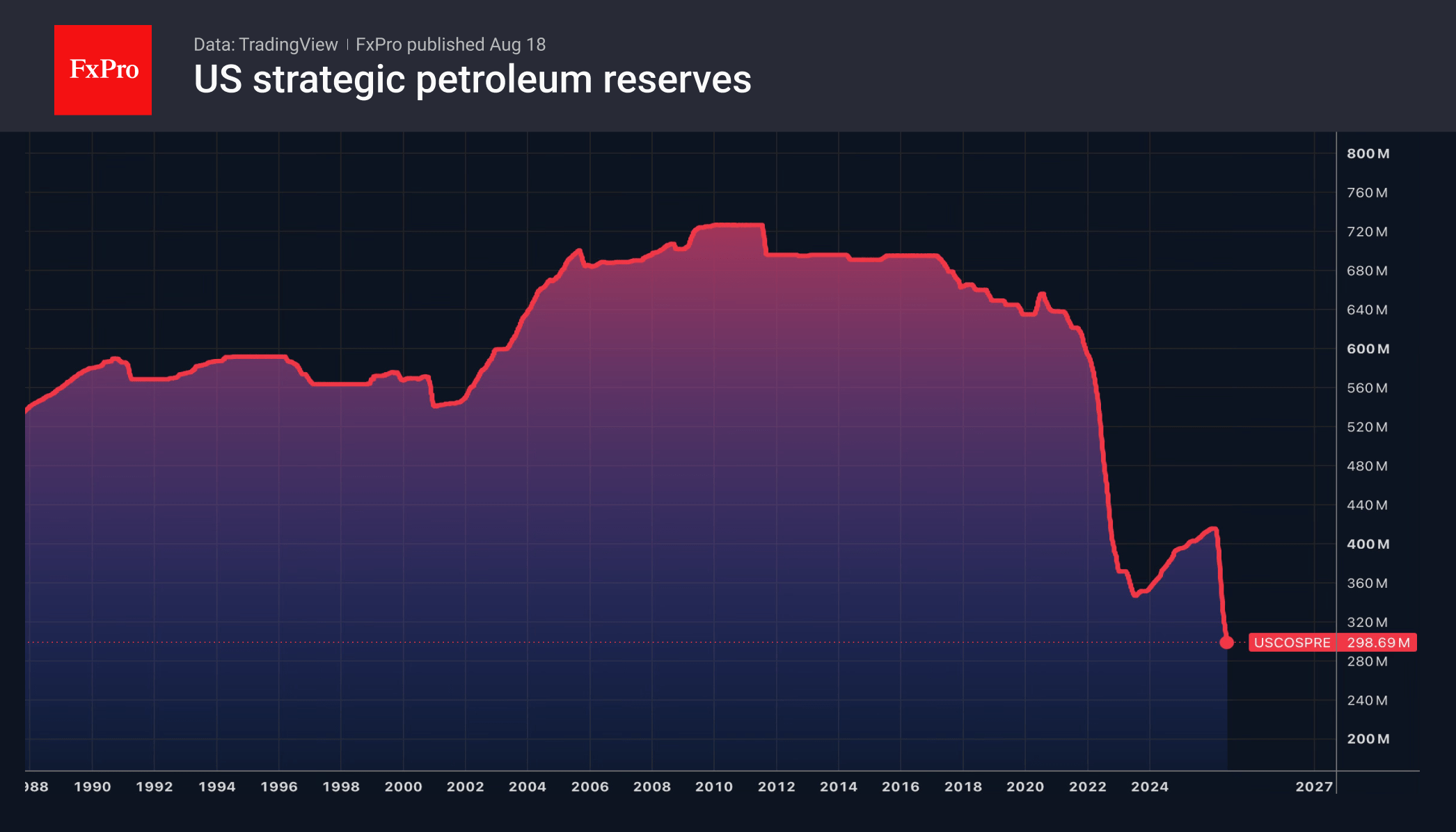
    The government has resorted to releasing some of its strategic oil reserves and there’s even reports it is thinking about buying Iranian oil in Chinese yuan, to evade US sanctions.

    For Japan, the jump in crude oil prices poses a dual risk to inflation – first directly via higher fuel costs and indirectly via the weaker yen, which itself is coming under pressure due to the strain of the oil crisis on the country’s current account balance.

    Yet, markets continue to price in just two 25-bps rate rises for 2026. Worries about the impact of higher energy costs on growth are likely dampening the more hawkish bets. But the Bank of Japan doesn’t seem too phased just yet, keeping the option of an April rate hike firmly on the table.

    If preliminary March CPI numbers for the Tokyo district out on Tuesday show inflation heading back above the BoJ’s 2.0% target, tightening odds for April could climb higher from around 62% currently, offering some support to the beleaguered yen, as it inches ever closer to the critical 160.00 intervention mark.

    Also out on Tuesday are industrial production and retail sales figures for February, followed by the BoJ’s quarterly Tankan business survey on Wednesday.