Sample Category Title
Dollar Selloff Builds, but Fed Minutes and Brent $90 Hold the Next Tests
Why the Dollar's slide has run out of fresh bad news to feed on, and what Wednesday's FOMC minutes and Brent's stalled rally at $90 will decide next
Why it matters: With no new bad news left to extend the move, the next leg depends on two specific tests: whether Wednesday's FOMC minutes reveal more hawkish sympathy beneath the 9-3 hold vote than the headline count suggests, and whether Brent can finally break above $90 despite a near-total collapse in Hormuz shipping traffic. Until one of those flips, Dollar bears keep the advantage.
Dollar Keeps Falling Even Without New Bad News
Dollar started the new week the same way it ended the last one, under broad selling pressure. This time there was no fresh US data shock to blame. Instead, markets continued working through the cumulative implications of weaker employment, softer retail spending and cooling inflation, all of which have steadily dismantled the case for aggressive Fed tightening. September hike odds have fallen from roughly 60% earlier this month to around 25–30%, while the rate path increasingly looks like limited fine-tuning rather than the beginning of another sustained hiking cycle.
The FX leaderboard makes the shift clear. Dollar sits at the bottom, followed by Yen and Loonie, while Aussie is strongest and showing signs of acceleration. Kiwi follows, then Swiss Franc, leaving Euro and Sterling in the middle.
Dollar weakness without a fresh catalyst suggests repricing still has momentum. But the next leg is unlikely to come from repeating what markets already know. Wednesday's FOMC minutes and Brent's continuing struggle with $90 now offer two clearer tests of whether the bearish Dollar narrative can extend.
Monday's FX Leaderboard
- Weakest: Dollar, followed by Yen and Loonie.
- Middle: Euro and Sterling.
- Strongest: Aussie, showing signs of acceleration, followed by Kiwi and Swiss Franc.
9-3 Vote May Not Tell the Whole Fed Story
Fed minutes matter more than usual because the post-meeting press conference revealed remarkably little about internal debate. The headline vote was 9-3 for a hold, but that does not necessarily mean only three policymakers were seriously considering a hike. Minutes can show whether some members of the majority were close calls, officials who agreed to wait but shared much of the dissenters' inflation concern.
That is especially important because Neel Kashkari and Lorie Logan framed their dissents around timing rather than a radically different destination. Their argument was essentially preventive: move modestly now to reduce the risk that the Fed eventually needs to tighten much more aggressively. If minutes show versions of that "insurance hike" logic appearing among hold voters, markets may discover the Committee was more hawkish beneath the surface than the 9-3 count suggests. If the majority instead focused heavily on emerging labor-market weakness, the case for renewed near-term tightening would look considerably thinner.
What Matters Is Fed's Reaction Function, Not a Stale Rate Call
Middle East inflation risk deserves particular attention. Neel Kashkari argued that repeated supply shocks, pandemic, Ukraine, tariffs and now Middle East conflict, could eventually prevent inflation from behaving like a series of temporary disturbances. If the broader Committee discussion shows similar concern over oil and Hormuz, it would establish a clearer threshold for when geopolitics starts influencing Fed policy directly.
Still, Wednesday's minutes describe a Fed meeting that happened before softer July CPI, PPI and retail sales data. Since then, September hike odds have fallen dramatically. That makes the minutes a poor guide to what the Committee would vote today. Their value instead lies in revealing why officials chose their positions and what data could make them switch. The market-moving question is not whether three dissenters were hawkish, that is already known, but whether the minutes identify specific triggers that recent data are already moving toward or away from.
Hormuz Is Already in Crisis — Oil Wants Something Worse
The US-Iran story presents a similar distinction between existing stress and genuinely new information. The formal 60-day truce deadline arrives this week, but the arrangement has already been largely non-functional for weeks. Oman continues talks with Tehran over reopening the Strait of Hormuz while the US keeps its blockade of Iranian ports in place, and Washington continues demanding that Iran abandon any path toward nuclear weapons.
Commercial traffic through Hormuz has collapsed. Only five cargo ships reportedly crossed on Saturday and none on Sunday, compared with 31 during the previous weekend. Yet Brent's Monday rebound has still left crude capped beneath $90. That tells markets something important: severe disruption alone is no longer enough. Much of the current standoff appears priced, and oil increasingly needs a fresh escalation, rather than merely persistence of the existing crisis, to generate another meaningful geopolitical premium.
Hormuz Traffic Collapse
- Saturday crossings: five cargo ships.
- Sunday crossings: none.
- Previous weekend: 31 crossings.
- Brent: rebounded Monday but remains capped beneath $90.
Two Ways Dollar Selloff Could Be Interrupted
That makes the near-term setup unusually clean. Dollar can continue weakening if FOMC minutes show narrow support for immediate tightening while Brent stays below $90. Both would reinforce the idea that the Fed faces only limited need for additional rate increases despite geopolitical uncertainty.
Risks run in the opposite direction. Minutes revealing that several hold voters sympathized with preventive tightening would make markets more sensitive to the next strong US data. A genuine escalation around Iran or Hormuz that finally pushes Brent through $90 could revive inflation expectations independently. Until one of those happens, however, Dollar bears retain the advantage: aggressive Fed tightening is being priced away, and geopolitical shock has yet to become large enough to reverse that process.
Related Coverage
Gold & Commodities Deep Dive
- Read why Gold's stall near 4,450 keeps its bullish structure intact, and why this week's US-Iran deadline and Brent's behavior around $90 could determine whether inflation risk rebuilds: Gold Stalls at 4,450 — What Will Break the Deadlock?.
Currency Deep Dive
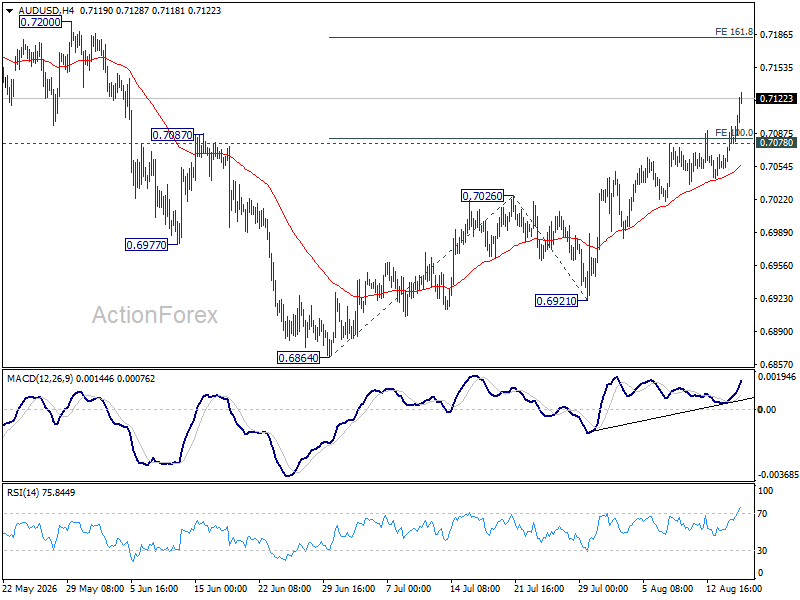
- See why AUD/USD's breakout above its near-term channel puts Thursday's Australia jobs report in focus as the first real test of whether the rally can extend toward 0.7183: AUD/USD Gets Its Breakout. Can Australia's Jobs Data Keep It Going?.
Global Data Deep Dives
- See why Canada's July CPI beat expectations at 3.0%, with BoC Trimmed and Common measures also accelerating more than forecast, making it hard to dismiss as temporary energy noise: Canada CPI Accelerates to 3% as Energy Shock Meets Firmer Core Inflation.
- Read why China's July data showed production holding up better than consumption and investment, reinforcing Beijing's own diagnosis of a supply-demand imbalance: China's Supply-Demand Divide Widens as Investment Slumps and Retail Sales Stall.
- See why New Zealand's services PSI held in expansion for a second month even as Employment stayed in contraction and 64% of respondent comments turned negative: NZ PSI Recovery Holds, but Employment Still Refuses to Follow.
Frequently Asked Questions
Q: Why is the Dollar still falling without any new negative catalyst?
A: Because markets are still digesting the cumulative case built over recent weeks, weaker employment, softer retail sales and cooling inflation, which has pushed September hike odds down from roughly 60% to around 25–30%. That repricing still has momentum, but a genuinely new leg lower requires new information rather than a repeat of what's already known, which is why Wednesday's FOMC minutes and Brent's behavior near $90 matter so much this week.
Q: Why do the Fed minutes matter more than the headline 9-3 vote?
A: Because the post-meeting press conference revealed little about internal debate, and a 9-3 hold doesn't necessarily mean only three officials were seriously considering a hike. Kashkari and Logan framed their dissents around timing, an "insurance hike" to prevent needing much more aggressive tightening later, rather than a fundamentally different view of where rates should end up. If minutes show hold voters sharing that logic, the Committee could look more hawkish beneath the surface than the headline count suggests.
Q: Why hasn't Brent broken above $90 despite Hormuz traffic nearly collapsing?
A: Because the severity of the existing crisis is already priced in. Only five cargo ships crossed the Strait on Saturday and none on Sunday, compared with 31 the previous weekend, yet Brent's Monday rebound still left crude capped beneath $90. That suggests oil now needs a fresh escalation, not just persistence of the current standoff, to generate another meaningful geopolitical premium.
Key Takeaways
- Dollar's selloff continued without a fresh catalyst: Markets are digesting cumulative Fed repricing, September hike odds have fallen from roughly 60% to around 25–30%.
- The 9-3 vote may understate hawkish sentiment: Kashkari and Logan's dissents were framed around timing, not destination, so minutes could reveal hold voters who shared similar "insurance hike" logic.
- Minutes describe a meeting held before the recent run of soft data: Their real value is revealing specific triggers for officials' positions, not a stale vote count from before July CPI, PPI and retail sales.
- Hormuz shipping has nearly collapsed, but Brent still can't clear $90: Five ships crossed Saturday, none Sunday, versus 31 the prior weekend, showing the existing crisis is largely priced in.
- Two scenarios determine the Dollar's next leg: Narrow hawkish support in the minutes plus Brent below $90 extends the selloff; broader hawkish sympathy or a genuine Hormuz escalation would interrupt it.
- FX leaderboard confirms the shift: Dollar weakest, followed by Yen and Loonie, while Aussie leads with signs of acceleration.
Canada CPI Accelerates to 3% as Energy Shock Meets Firmer Core Inflation
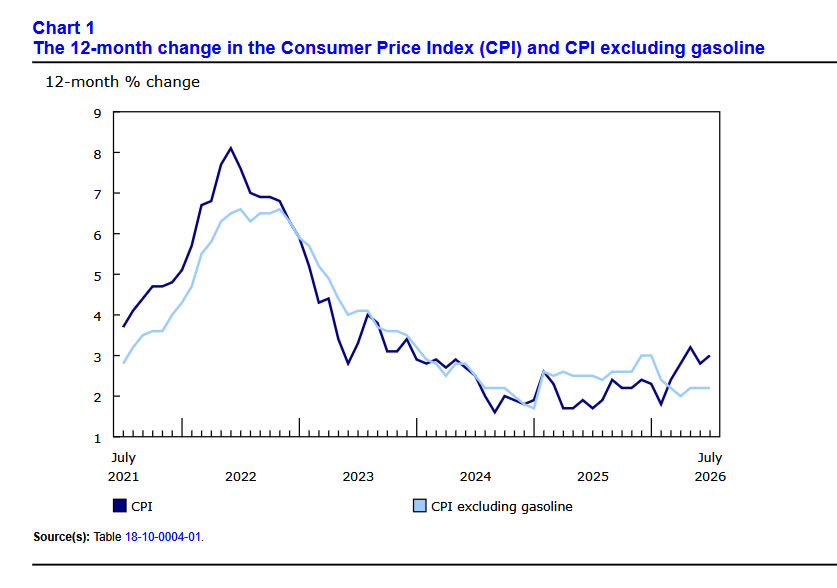
Canada inflation accelerated more than expected in July, with headline CPI rising from 2.8% to 3.0% y/y, above 2.9% consensus. Monthly CPI swung from -0.4% m/m to +0.5%, also stronger than 0.4% expected.
Gasoline was major driver, with annual price growth accelerating from 20.5% to 25.7% as Middle East conflict, Strait of Hormuz blockade and partial closure of Red Sea shipping routes pushed energy costs higher. Travel tours also contributed, while slower grocery inflation provided some offset.
Importantly, July report was not purely an energy story. CPI excluding gasoline held at 2.2% y/y for third consecutive month, while BoC core gauges all edged higher. Median CPI rose from 1.9% to 2.0%, matching expectations; Trimmed CPI increased from 1.8% to 1.9%, above 1.8% forecast; and Common CPI climbed from 2.6% to 2.7%, compared with 2.5% expected. That combination suggests underlying inflation pressure firmed even as gasoline accounted for much of headline acceleration.
Energy-driven headline inflation alone could potentially be looked through by the BoC, but simultaneous acceleration across core measures makes report harder to dismiss as temporary oil noise. Key question now is whether higher energy costs begin feeding more broadly into underlying prices, or whether softer domestic demand keeps second-round effects contained and allows BoC to maintain extended hold.
Data Summary
| Indicator | Actual | Expected | Previous |
|---|---|---|---|
| CPI y/y | 3.0% | 2.9% | 2.8% |
| CPI m/m | 0.5% | 0.4% | -0.4% |
| CPI ex-Gasoline y/y | 2.2% | — | 2.2% |
| CPI Median y/y | 2.0% | 2.0% | 1.9% |
| CPI Trimmed y/y | 1.9% | 1.8% | 1.8% |
| CPI Common y/y | 2.7% | 2.5% | 2.6% |
| Gasoline y/y | 25.7% | — | 20.5% |
Key Takeaways
- Canada headline CPI accelerated from 2.8% to 3.0% y/y, above 2.9% consensus, while monthly CPI rebounded from -0.4% to +0.5%.
- Gasoline was major driver, with annual price growth accelerating from 20.5% to 25.7% amid Middle East conflict, Strait of Hormuz blockade and partial closure of Red Sea shipping routes.
- Travel tours also contributed to faster headline inflation, while slower growth in grocery prices provided some offset.
- Inflation was not purely an energy story. CPI excluding gasoline held at 2.2% for third straight month.
- BoC’s core gauges all firmed: Median rose from 1.9% to 2.0%, Trimmed from 1.8% to 1.9%, and Common from 2.6% to 2.7%.
- Trimmed and Common CPI both exceeded expectations, making July report more hawkish than headline gasoline surge alone would suggest.
Crypto: Bears Remain in Control
Market Overview
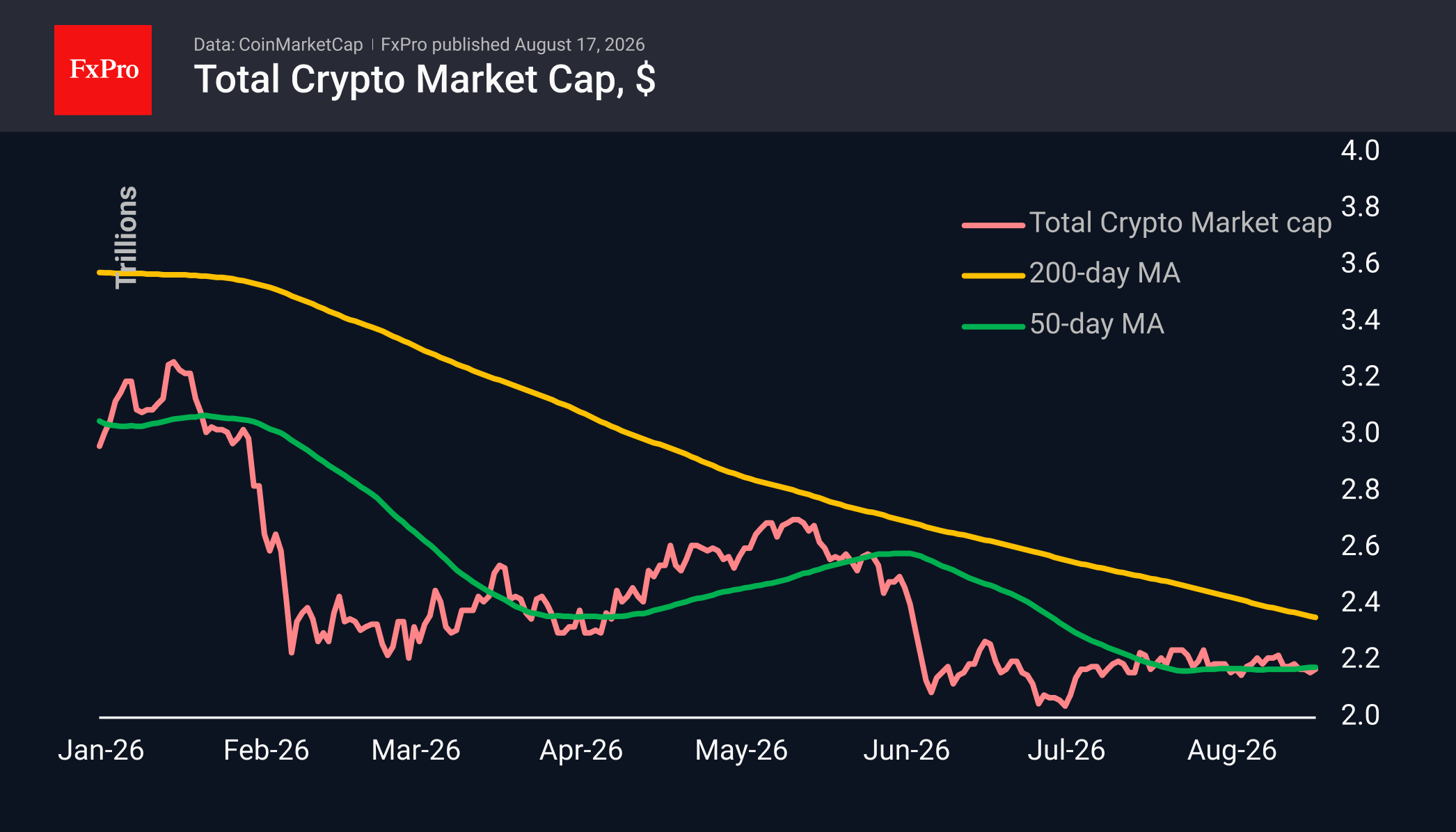
The crypto market has lost just over 2% compared to its level seven days ago. However, there were signs of a positive trend on Monday, as the market capitalisation rebounded from a local low of $2.16T to $2.18T. The market continues to hover around its 50-day moving average, consolidating within a very narrow range despite the weakening dollar and a rally in the equity market. Among the top cryptocurrencies over the past 24 hours, the top gainers were Zcash (+4.8%), Dash (+2.4%) and Near Protocol (+1%). Declines affected roughly twice as many coins, with the biggest losses seen in Cosmos (-3.8%), Aptos (-2.7%) and Filecoin (-2%).
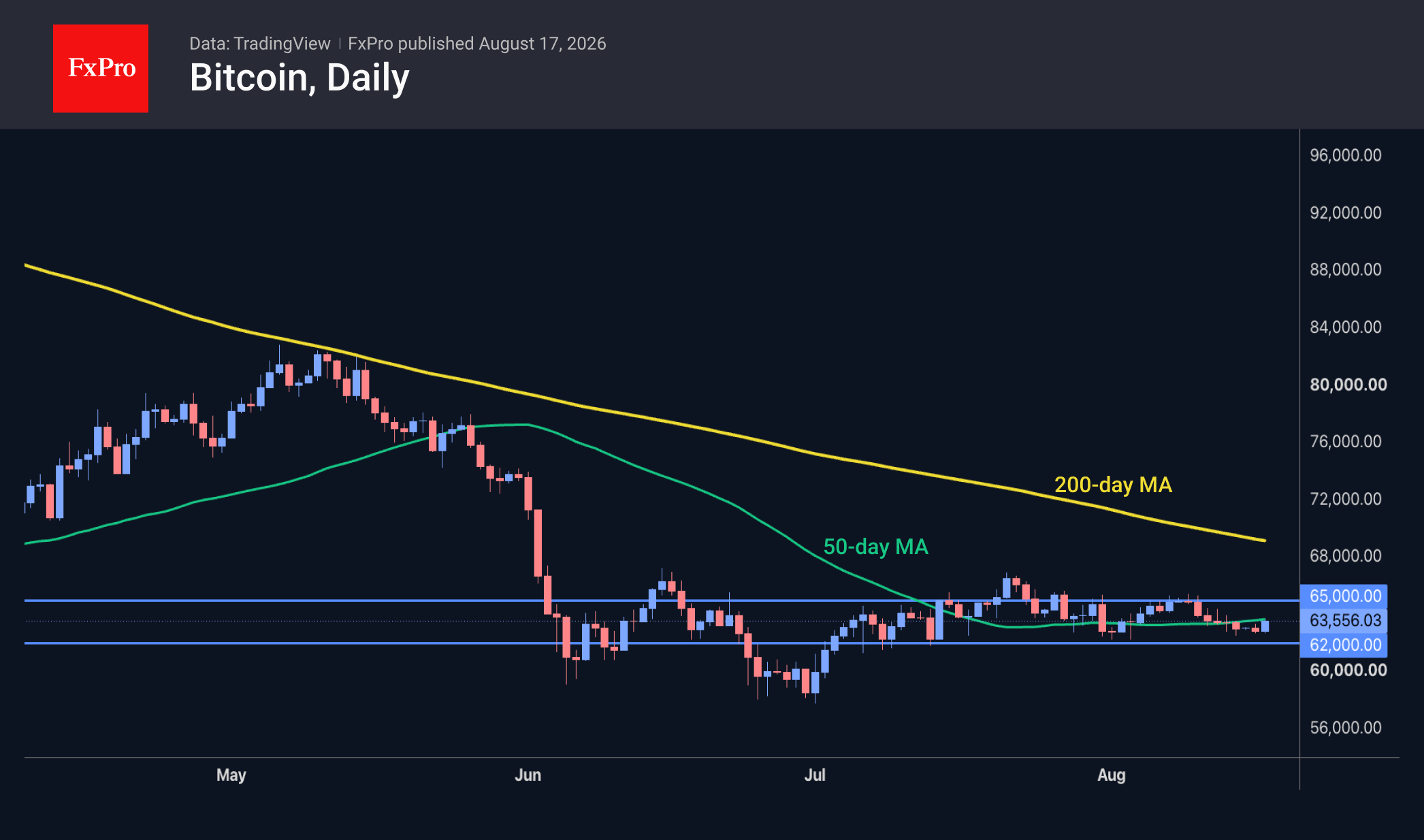
Bitcoin has been trading below its 50-day moving average for the fourth day in a row, after an earlier attempt to break above it, followed by a pullback to $63.3K. On weekly timeframes, the leading cryptocurrency remains below the 200-week MA. Thus, the bears are confirming their dominance in both the medium-term and ultra-long-term trends. It will only be possible to speak of a breakout from consolidation and expect increased volatility once the price breaks out of the $62–65K range.
News Background
Claims that the crypto market is dead or nearing its end are appearing with increasing frequency on social media. Santiment believes that this situation, against a backdrop of growing pessimism, may be attractive to long-term buyers.
The crypto market has entered the final phase of the bear cycle. According to estimates by DeFi Report, around 85 per cent of the cycle is already behind us, and how the situation develops from here will depend on global macroeconomic events.
Under a new methodology, the Bitcoin treasuries of Strategy and Metaplanet could be excluded from MSCI indices for holding non-operating assets. No decision has been made yet, and MSCI is gathering feedback until 30 September, promising to publish the results by 16 October. JPMorgan previously estimated a potential outflow from Strategy’s securities under such a scenario at $2.8 billion.
According to estimates from Miner Weekly, public Bitcoin miners have reduced their hash rate by 21 per cent over three quarters due to redeploying capacity to AI infrastructure. The current decline is attributed to a weak mining economy and competition for capital and electricity from the AI sector.
FG Nexus, which held 50,000 ETH, sold off its entire cryptocurrency holdings and wound up its Ethereum strategy less than a year after its launch. The total net loss from holding crypto assets reached $45.2 million. Income from staking amounted to just $144,000.
Hyperscale Data has reduced its Bitcoin reserves to approximately 275 BTC after selling around 685 BTC. The proceeds will be used to develop a data centre in Michigan, service debt and cover other expenses. The company will continue to mine Bitcoin and expects to build up its reserves over time.
The FxPro Analyst Team
EUR/USD Daily Outlook
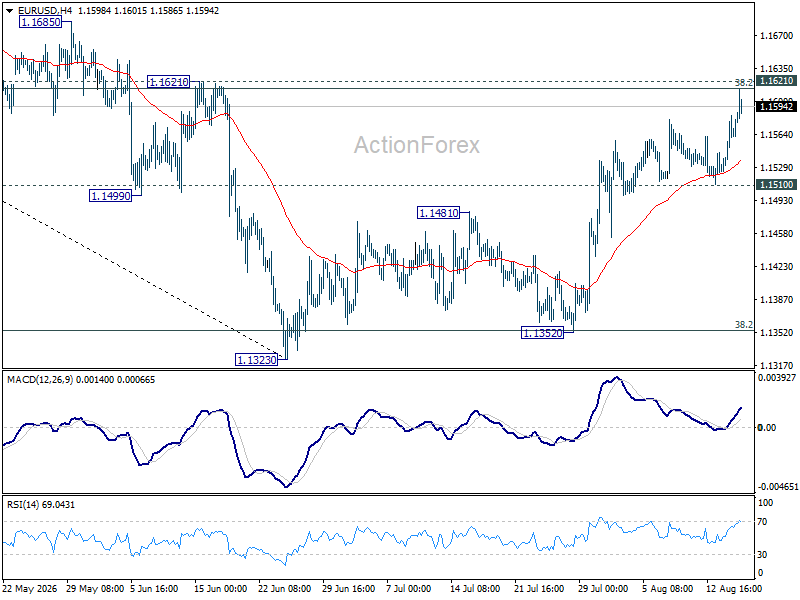
Intraday bias in EUR/USD remains on the upside as rise fro 1.1323 continues. Decisive break of 1.1621 cluster resistance (38.2% retracement of 1.2081 to 1.1323 at 1.1613) will solidify the case that fall from 1.2081 has completed as a three wave correction at 1.1323. Further rally would then be seen to 61.8% retracement at 1.1791. For now, further rally will remain in favor as long as 1.1510 support holds, in case of retreat.
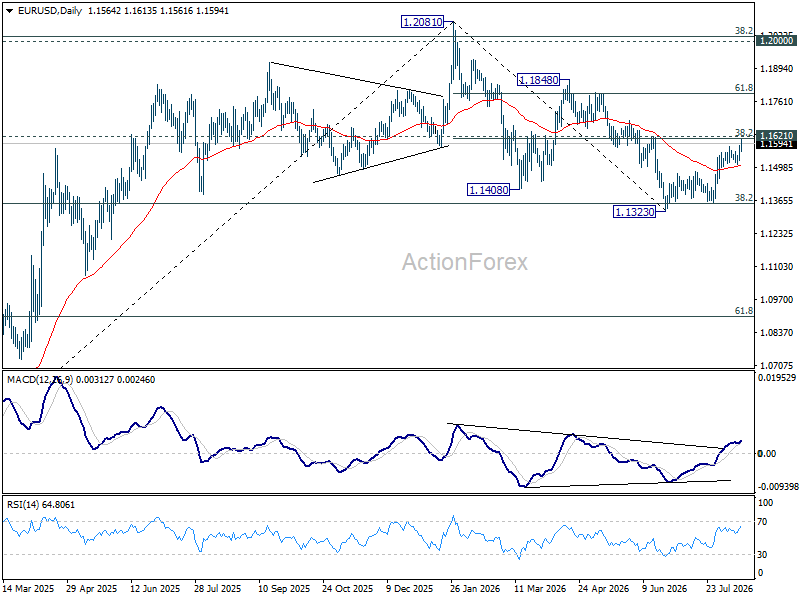
In the bigger picture, focus is staying on 38.2% retracement of 1.0176 to 1.2081 at 1.1353. Decisive break there will revive the case of medium term bearish trend reversal after rejection by 1.2 key cluster resistance level. Further fall should be seen to 61.8% retracement at 1.0904. Nevertheless, strong rebound from 1.1353, followed by break of 1.1621 resistance, will retain medium term bullishness.
USD/JPY Daily Outlook
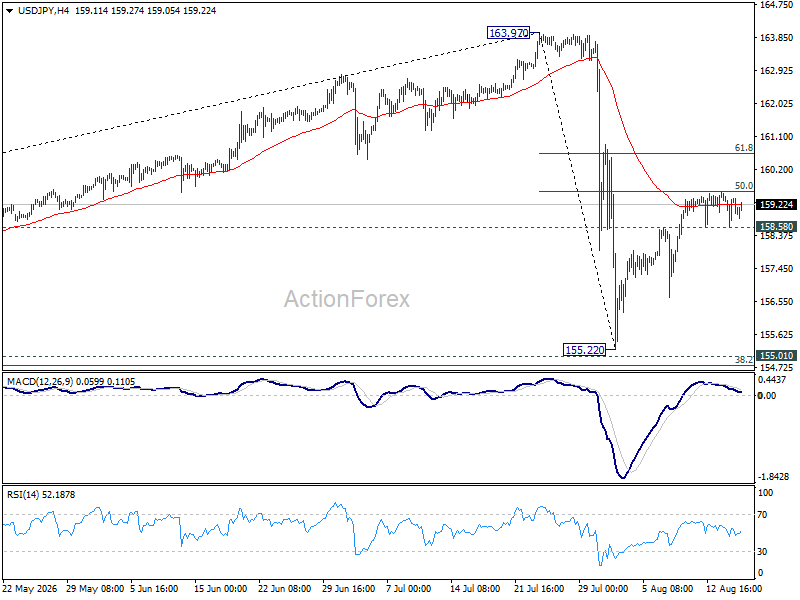
Intraday bias in USD/JPY remains neutral for the moment. While another rise might still be seen, strong resistance could emerge from 159.59 to 160.62 zone (50% and 61.8% retracement of 163.97 to 155.22) to limit upside. On the downside, firm break of 158.58 will turn bias back to the downside for deeper pullback.
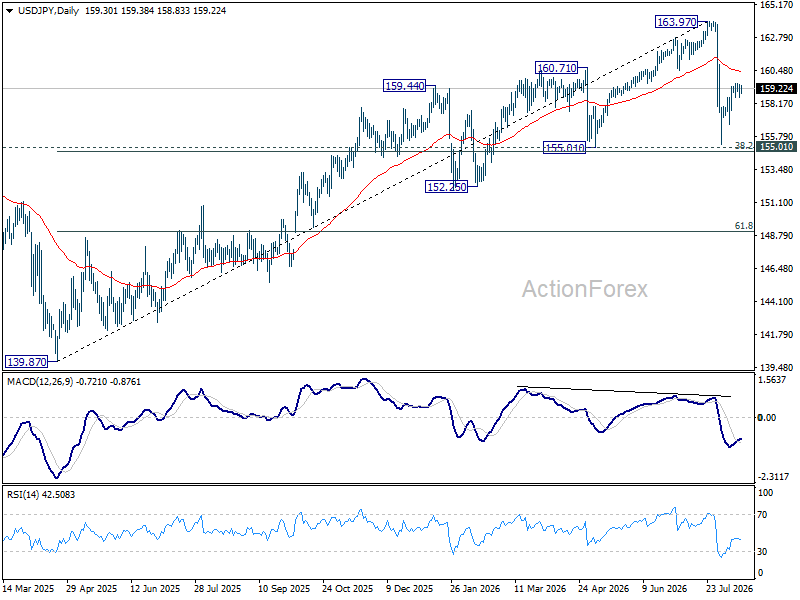
In the bigger picture, as long as 155.01 cluster support (38.2% retracement of 139.87 to 163.97 at 154.76) holds, the larger up trend is still expected to continue through 163.97 after current correction completes. However, firm break of 155.01 will raise the chance that USD/JPY is already in a larger scale correction, and open up deeper fall back to 139.87 (2025 low) in the medium term.
GBP/USD Daily Outlook
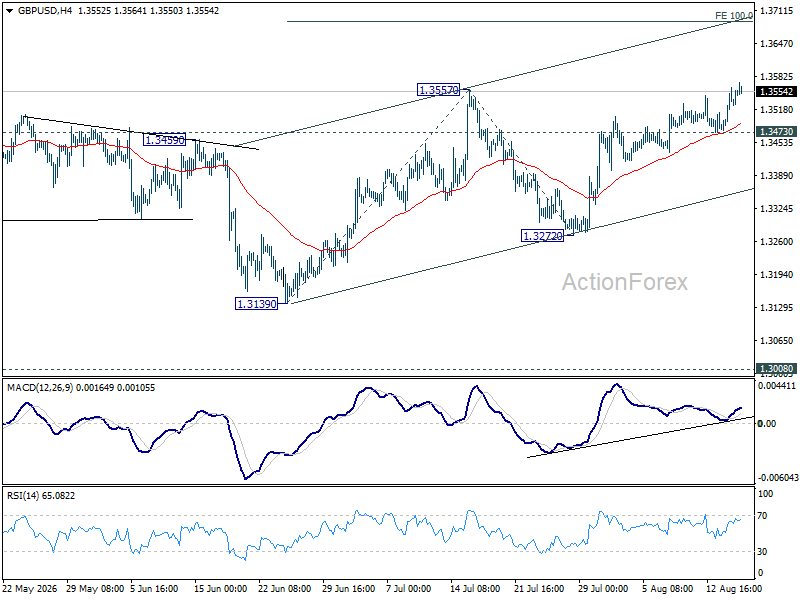
Intraday bias remains on the upside at this point. Decisive break of 1.3557 will extend the rise from 1.3139 to 100% projection of 1.3139 to 1.3557 from 1.3272 at 1.3690. On the downside, below 1.3473 minor support will turn intraday bias neutral again first.
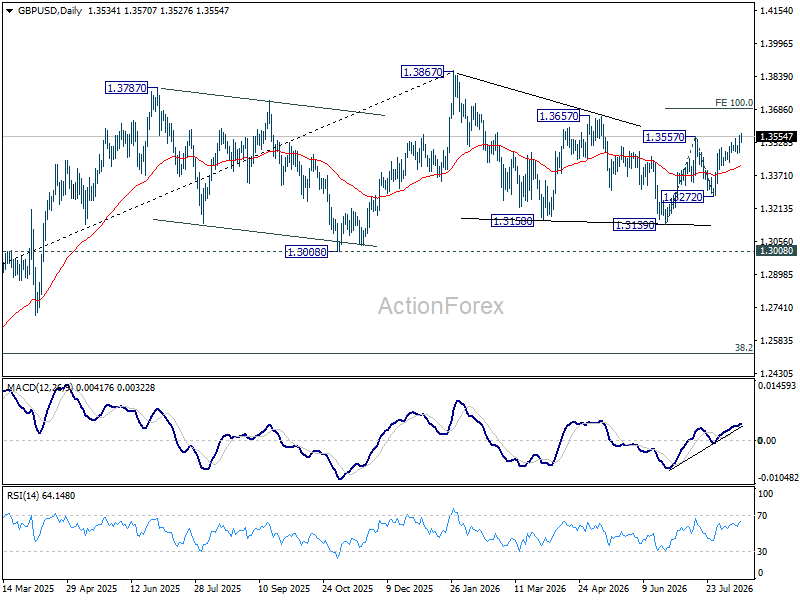
In the bigger picture, price actions from 1.3867 are a corrective pattern within the broader up trend from 1.0351 (2022 low). With 1.3008 support intact, medium term bullishness is maintained and break of 1.3867 is in favor for a later stage, towards 1.4248 key resistance (2021 high). However, firm break of 1.3008 will at least bring deeper fall to 38.2% retracement of 1.0351 to 1.3867 at 1.2524, with increased risk of bearish reversal.
USD/CHF Daily Outlook
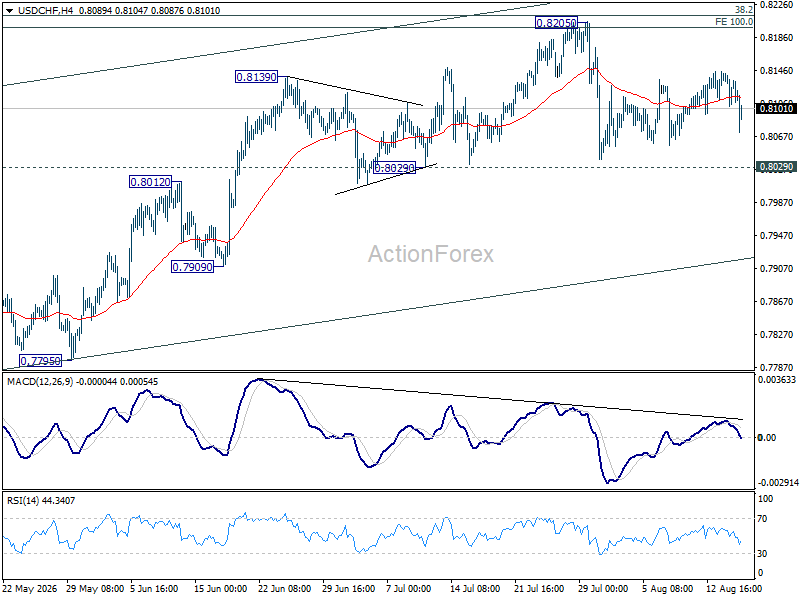
Range trading continues in USD/CHF and intraday bias stays neutral. With 0.8029 support intact, further rally is expected. On the upside, firm break of 0.8205 will extend the rise from 0.7603 to 161.8% projection 0.7603 to 0.8041 from 0.7600 at 0.8469. However, decisive break of 0.8029 will bring deeper fall to channel support (now at 0.7912).
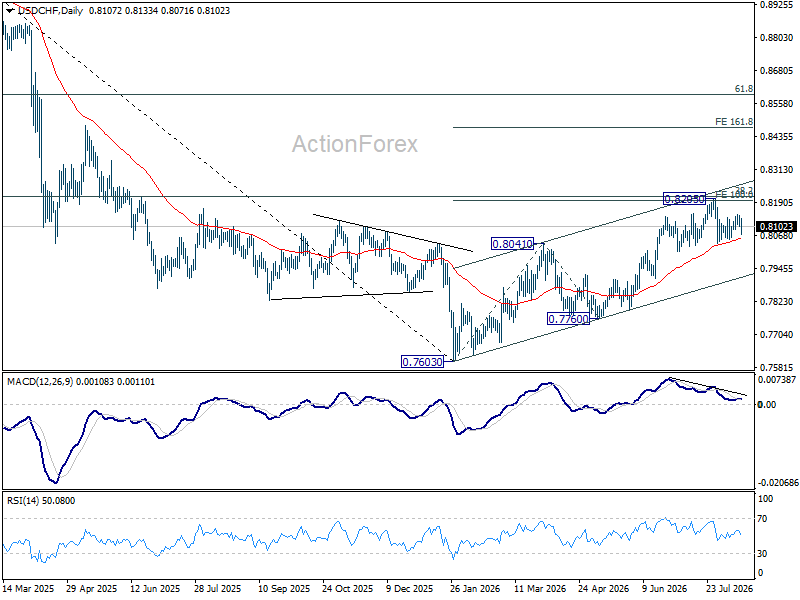
In the bigger picture, focus is now on 38.2% retracement of 0.9200 (2025 high) to 0.7603 at 0.8213. Decisive break will argue that USD/CHF is reversing the medium term trend, and turn focus to 0.8332 support turned resistance (2023 low) for confirmation. Nevertheless, rejection by 0.8213 will maintain medium term bearishness for another fall through 0.7603 at a later stage.
AUD/USD Daily Report
AUD/USD's rally from 0.6864 accelerated through 100% projection of 0.6864 to 0.7026 from 0.6921 at 0.7083. Intraday bias remains on the upside for 161.8% projection of 0.6864 to 0.7026 from 0.6921 at 0.7183. On the downside, below 0.7078 minor support will turn intraday bias neutral.
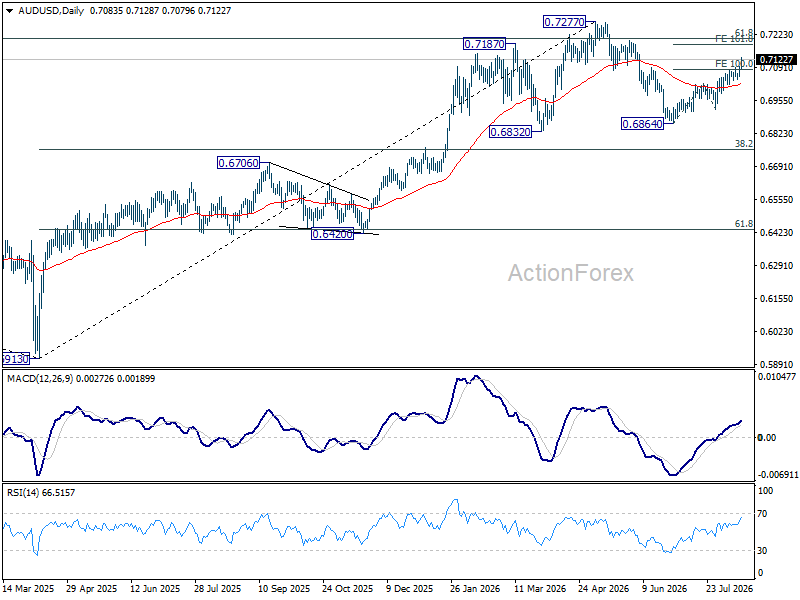
In the bigger picture, price action from 0.7277 medium term top is seen as developing into a correction to rise from 0.5913 only. While deeper decline cannot be ruled out, downside should be contained by 38.2% retracement of 0.5913 to 0.7277 at 0.6756 to bring rebound. Consolidations would continue below 0.7277 for a while, before an eventual upside breakout.
USD/CAD Daily Outlook
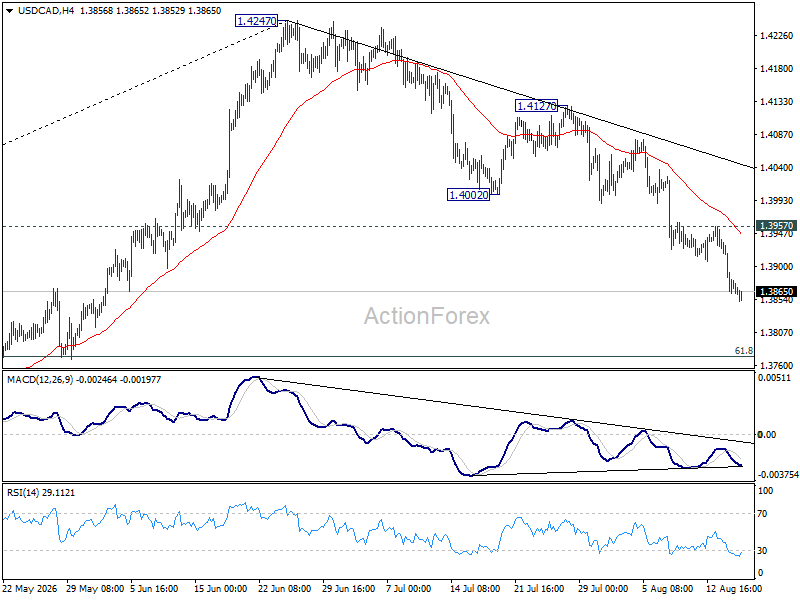
USD/CAD's fall from 1.4247 continues today and intraday bias stays on the downside for 61.8% retracement of 1.3480 to 1.4247 at 1.3773. Firm break there will target a retest on 1.3480 low. On the upside, above 1.3957 minor resistance will turn intraday bias neutral again first.
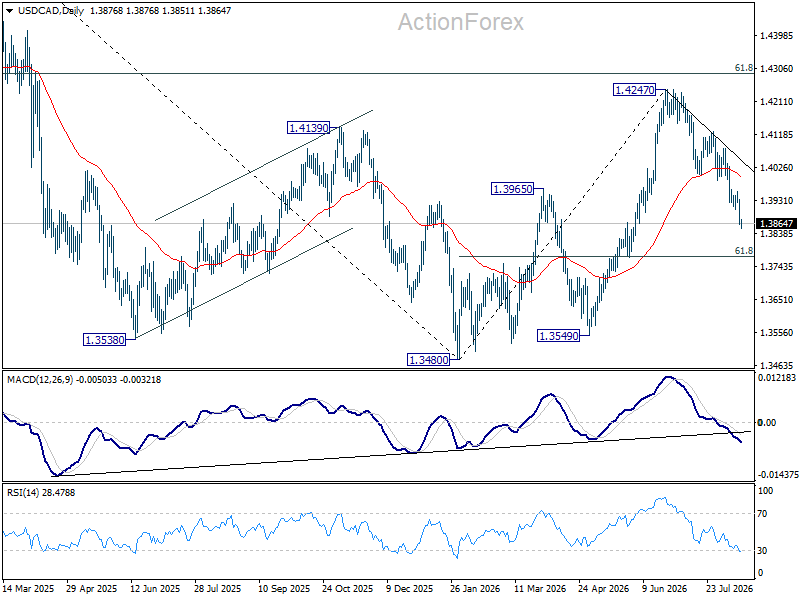
In the bigger picture, rejection below 61.8% retracement of 1.4791 to 1.3480 at 1.4290 suggests that the pattern from 1.4791 medium term is still extending. Firm break of 55 W EMA (now at 1.3882) will solidify this case, and bring deeper decline through 1.3480 low.
GBP/JPY Daily Outlook
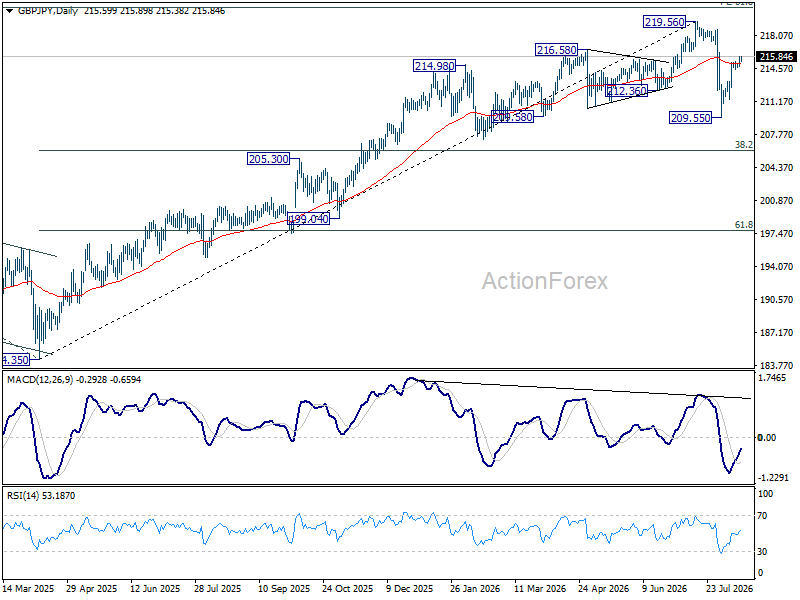
Intraday bias in GBP/JPY remains on the upside as rise from 209.55 continues today. Corrective fall from 219.56 should have already completed. Sustained break of 61.8% retracement of 219.56 to 209.55 at 215.73 will pave the way to retest 219.56 high. On the downside, below 214.51 minor support will turn bias neutral again first.
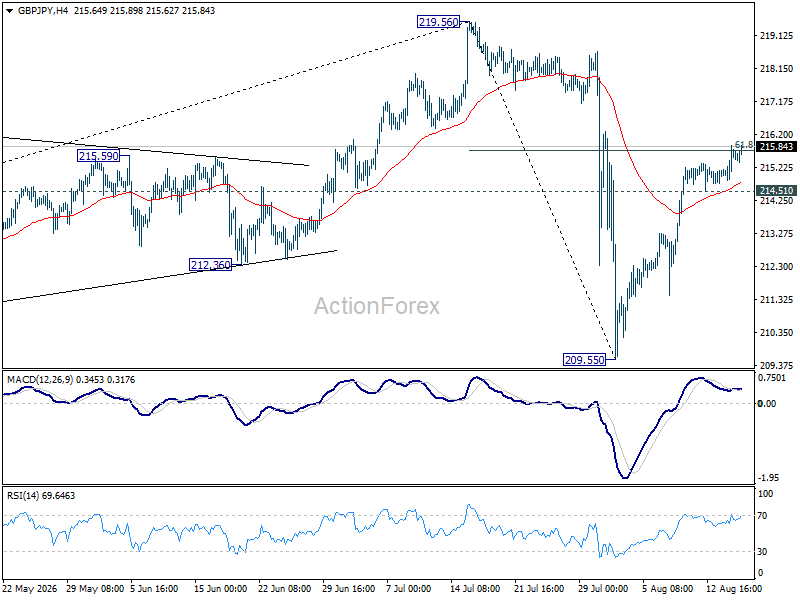
In the bigger picture, strong rebound above 55 W EMA (now at 208.91) keeps the up trend from 123.94 (2020 low) intact. Firm break of 209.55 should target 100% projection of 148.93 to 208.09 from 184.35 at 243.51. However, sustained break of 55 W EMA will argue that it's already in a medium term down trend to 184.35 support.