

Sample Category Title
Sunrise Market Commentary
Markets
US eco data grabbed a lot of attention last week with CPI & PPI inflation and retail sales suggesting that time remains on the Fed's side for now. The market implied probability of a September rate hike halved from around 50% to 25%. Several attempts from US Treasuries to rally were blocked and eventually morphed into a sell-off last Friday. Splitting hairs over the Fed's next move took attention away from where the action really unfolded: the (very) long end of global bond curves. Highest auction yields since respectively 2007 and 2001 for the US Treasury's 10-yr Note and 30-yr Bond sales are testament to the markets' real concerns: deteriorating public finances. Rating agency Fitch last week forecasted general government deficits of 7.4% of GDP in both 2026 and 2027 with government debt projected to rise from 117% of GDP last year towards 128% by 2030. Daily changes on the US curve ranged between +2.8 bps (2-yr) and +5.2 bps (20-yr) last Friday. The US 30-yr yield tested the recent high at 5.28% which is the highest level since July 2007. Higher real yields rather than higher inflation expectations are the driving force. Similar dynamics are at play in Europe, the UK and Japan. The German yield curve bear steepened with yields rising by 3 bps (2-yr) to 8.7 bps (30-yr). The 30-yr yield closed at its highest level since April 2011 (3.73%), the 10-yr yield tested the similar technical reference (3.2%). The Japanese 10-yr yield this morning reached its highest level since 1996. On FX markets, the dollar for a long time shrugged off weak and tame US eco releases. EUR/USD 1.16 resistance remained out of reach for most of last week up until last Friday. The greenback started underperforming global peers, pushing EUR/USD from 1.1528 to 1.1570. The US currency remains in the defensive this morning, eying an attempt at 1.16.
Today's eco calendar only contains the August Empire Manufacturing Survey and a speech by ECB chief economist Lane. We don't expect them to influence trading. Main US eco figures were released already last week and EMU money markets fully discount a September ECB rate hike. The bear steepening theme on core bond markets is the one to watch out for. The stalemate between the US and Iran remains a wildcard. Brent crude holds near the $90/b area with the European reference contract (Dutch TTF) holding close to highest levels since March (€62/MWh).
News & Views
Japan's economy grew 0.3% q/q (1.1% annualized) in Q2 of this year, decelerating from Q1's 0.5% and missing the consensus estimate (0.5%). Domestic demand was weak with private consumption flat for the quarter and business spending down by 1.2%. With imports contracting by 1.5% and exports rising 0.5%, net exports accounted for virtually all of Q2's growth. The disappointing GDP numbers have little impact on money market expectations for a rate hike come September. The implied probability stands at 77% compared to 80% on Friday. The Japanese yield curve bear steepens with changes varying between 2.4 and 4.8 bps in what is a catch-up move with the US end last week. USD/JPY shows marginal changes around the 159 big figure.
Credit rating agency Fitch affirmed the UK's AA- with a stable outlook last Friday. It said the new prime minister Burnham's more commanding position (than his predecessor) within the Labour party and higher public approval should support greater political stability. Fitch doesn't anticipate a significant near-term change to fiscal rules or macro policy, largely due to financial market constraints. It forecasts a narrowing deficit from 5.2% in 2025 to 4.2% in 2028, well above the AA median and the UK government's own target. Debt would rise to 106% of GDP by end-2028, from 102.4% at end-2025. The agency downgraded growth forecasts to 0.9% this year and 1.2% in 2027 due to the drag from high energy prices, tighter funding conditions and further labour market weakness. In 2028 growth should rise to just above the 1.4% trend. Inflation is seen quickening from 2.6% in June to 3.7% at year-end before falling to the 2% Bank of England target by end-2028. Fitch does not foresee any changes in monetary policy through 2026 with rate cuts starting from next year to 3% in 2028.
Sweden Inflation Expectations Take Focus Ahead of Riksbank
In focus today
In the US, regional manufacturing PMI from the NY Fed and the NAHB housing market index will be released for August. The releases will provide an early read on business sentiment and housing market conditions.
In Sweden, Origo inflation expectations will be published this morning ahead of the Riksbank rate decision on Thursday. 1-year expectations have risen somewhat but remain low, while 5-year expectations have been around or slightly above 2%.
For the remainder of the week, focus turns to UK July inflation and the FOMC minutes on Wednesday. On Thursday, the Riksbank rate decision will be in focus, alongside the ECB minutes. The week closes on Friday with preliminary August PMIs for the major economies and Japan nationwide CPI for July. The euro area PMIs will be particularly interesting after the strong July print.
Economic and market news
What happened overnight
In commodities, Brent crude traded above USD88/bbl Monday morning as Middle East tensions kept supply risks in focus. Israel struck Lebanon over the weekend, while the US is preparing new sanctions on Iran and the interim US-Iran ceasefire expires today. Talks to reopen the Strait of Hormuz show little progress, though reported crude shipments by producers in the Middle East continued through the waterway and Iran-Oman talks appear to be progressing without US participation.
In Japan, preliminary Q2 GDP growth came in weaker than expected at 0.3% q/q (cons.: 0.5%, prior: 0.5%), as private consumption was flat and capital expenditure declined, while external demand supported growth. The print is important for the Bank of Japan (BoJ), as continued solid growth remains a prerequisite for further rate hikes, while the weaker domestic demand details affect the assessment of underlying growth momentum.
In China, the National Bureau of Statistics delayed the release of July activity and house price data to 3.00pm local time from the usual morning release.
What happened over the weekend
In the US, July retail sales came in weak, both in headline and control group terms, with the latter falling 0.4% m/m (cons: 0.3%, prior: 0.4%). Lower gasoline prices as well as weak online shopping and car sales weighed on the print, while restaurants, clothing, furniture and general merchandise were steadier. Hence, the details were not as soft as the headline suggested.
Also in the US, consumer sentiment weakened in August, with the preliminary University of Michigan index declining to 51.0 from 55.2. 1-year inflation expectations edged higher to 4.3% from 4.2%, likely reflecting the modest rise in gasoline prices during the latter part of summer. 5-year inflation expectations remained steady at 3.3%, suggesting anchored longer-term views.
On the wires, Fed's Goolsbee said he was encouraged by recent CPI reports and supported keeping rates unchanged in July, though more data is needed. Goolsbee downplayed the weak retail sales print as one month of data but noted that persistent weakness in consumer spending or productivity would be concerning.
In the euro area, the second estimate confirmed the preliminary reading of strong Q2 GDP growth at 0.4% q/q and annual growth was confirmed at 1.0% y/y. The release also showed employment rising by 0.1% q/q in Q2, in line with Q1.
Equities: Equities took a breather on Friday after fresh all-time highs in Europe and US earlier in the week. S&P 500 and Stoxx 600 were both -0.2% lower on Friday, and underlying sector rotations also calmed. Tech stocks were mostly lower (both semis and software) along with health care, which have both outperformed the market over summer. It was not an outright risk off session either: Outside energy, traditional cyclicals like materials and industrials were both trading higher on Friday. Risk appetite is visible in Asian markets this morning, with Shanghai and Shenzhen up 1% and US futures also pointing slightly higher.
FI and FX: EUR/USD weakened slightly overnight, extending the move from Friday after the weaker-than-expected US retail sales figures. Expectations of Fed hikes are being reduced, with the market now pricing in only 32bp of rate hikes for the coming year, less than our call of 2x25bp. The Brent oil future is steady compared with Friday's close, just below USD89/bbl. Focus continues to be on the Middle East after Israel struck Lebanon over the weekend, while the US is preparing new sanctions on Iran and the interim US-Iran ceasefire expires today. The NOK is somewhat stronger overnight, while EUR/SEK lingers just above the 11.00 mark. The ECB's Lane will speak today and in terms of data the week's highlight will be the flash PMIs released on Friday.
AUD/USD Gets Its Breakout. Can Australia’s Jobs Data Keep It Going?
TL;DR: AUD/USD has broken out on external tailwinds — a weaker Dollar and rebounding risk appetite — but Thursday's jobs report lands in the middle of a genuine split between economists who think the RBA is done hiking and an RBA that keeps saying otherwise.
Aussie Has External Momentum — Now Australia Needs to Contribute
AUD/USD has already received almost everything it could ask for from outside Australia. The Dollar is weakening as markets scale the Fed path back toward only "one and a bit" additional hikes through mid-2027. Regional risk appetite has rebounded strongly, with the KOSPI more than 30% above its July trough and the Nikkei roughly 14% higher. Against that backdrop, AUD/USD extended its rally from 0.6864 and broke through its near-term channel ceiling, giving the first technical sign that the advance is accelerating.
The question now is whether domestic fundamentals can join the move. Thursday's July employment report arrives with consensus around just 12k jobs growth, a dramatic slowdown from June's 76.3k, while the unemployment rate is expected to hold at 4.4%. That would normally look like routine normalization after an outlier. This time, however, the labor data sit directly in the middle of an unresolved disagreement over whether the RBA's tightening cycle is finished.
Economists Say the RBA Is Done. The RBA Hasn't Said That.
All four major banks now have no further 2026 hike as their base case, with Westpac dropping its August tightening call after softer Q2 inflation data. But the RBA's own language remains conspicuously hawkish. The August SoMP retained a commitment to increase the cash rate further "if upside risks materialise." Governor Michele Bullock said at the July 28 Anika Foundation speech that the Board was "prepared to act as required." After the August hold, Assistant Governor Christopher Kent went further at the Reuters Next event on August 13, saying inflation risks "lean firmly to the upside" and the cash rate "could rise further" if those risks materialise.
That consistency before and after the decision matters. It suggests the hike bias is deliberate rather than a sentence left behind by inertia. At the same time, the rates market hasn't moved all the way toward bank economists' conviction: the SoMP cited pricing consistent with roughly a 50% chance of another hike by year-end. ANZ also continues to flag a November hike as a live risk despite its hold base case. In other words, economists are leaning heavily toward "done," but money markets remain genuinely divided.
One Jobs Report Already Proved It Can Change the Rate Story
This year's employment series has been unusually volatile: -18.6k in April, +43.9k in May, and +76.3k in June. The June surge, almost five times the expected increase, helped send year-end hike odds from around 78% to 97% before the August meeting. The RBA still chose to hold, and the current roughly 50% year-end probability reflects the reset since then. But the precedent is clear: one labor report has already moved RBA pricing materially this cycle.
That gives Thursday a genuine two-sided setup. Another large beat could challenge the hold-through-2026 consensus, revive hike pricing, and potentially add domestic rate support to AUD/USD's existing Dollar and risk-sentiment tailwinds. A result near or below consensus would instead strengthen the case that June was an outlier and pull market pricing closer to the Big Four view. Neither outcome should be read in isolation, however — jobs this week and CPI next week are better treated as a paired test: only a combination of resilient labor demand and renewed inflation pressure would make the September hike case substantially harder to dismiss.
ActionForex's Technical View on AUD/USD
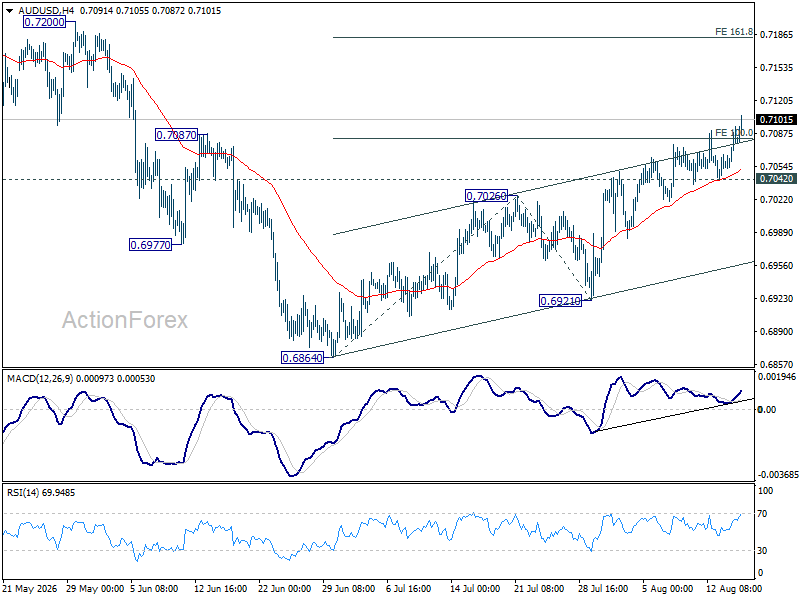
The chart setup already reflects rising optimism. AUD/USD's rally from 0.6864 has broken above its near-term channel ceiling, signaling upside acceleration. As long as 0.7042 minor support holds, the next objective sits at the 161.8% projection of 0.6864 to 0.7026 from 0.6921, at 0.7183.
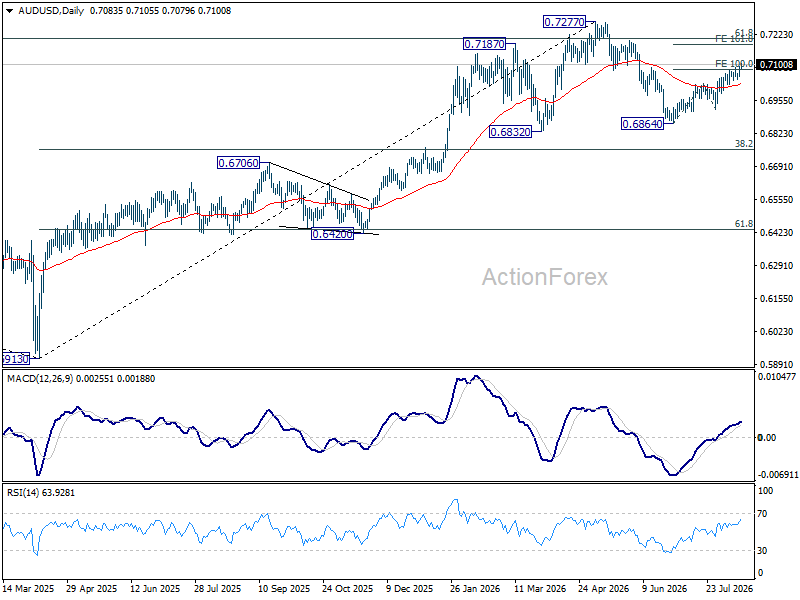
The larger trend remains bullish as well. AUD/USD continues to hold well above the 38.2% retracement of the 0.5913 to 0.7277 rise, at 0.6756, leaving the year-long advance from the 2025 low intact. Price action from 0.7277 is treated as corrective, though it's too early to rule out another down leg before the larger uptrend resumes.
For now, holding above the 55-day EMA near 0.7023 keeps a retest of 0.7277 favored. The Aussie has already broken higher on external support; Thursday will show whether Australia can supply the next reason to keep buying.
Key Takeaways
- AUD/USD's breakout has so far been driven entirely by external factors: fading Fed hike odds and a strong regional risk-appetite rebound.
- All four major Australian banks expect no further RBA hikes in 2026, but RBA officials, including Bullock and Kent, have kept using hawkish language even after the August hold.
- Rates markets remain split from bank economists, pricing roughly a 50% chance of another hike by year-end versus the Big Four's near-unanimous "done" call.
- June's 76.3k jobs surge already proved a single report can swing RBA pricing sharply, from 78% to 97% hike odds, showing Thursday's data carries real two-sided risk.
- AUD/USD holds above 0.7042 support with 0.7183 as the next objective; the broader uptrend from 2025 stays intact above the 0.6756 retracement level.
Related Reading
EUR/USD Rally Meets a Crucial Barrier with Bulls on Watch
Key Highlights
- EUR/USD regained traction and climbed toward the 1.1580 resistance.
- A bullish trend line is forming with support near 1.1535 on the 4-hour chart.
- Gold could start another increase and clear the $4,440 resistance.
- GBP/USD seems to be eyeing an upside break above the 1.3555 resistance.
EUR/USD Technical Analysis
The Euro remained supported above 1.1500 against the US Dollar. EUR/USD started another increase above the 1.1550 resistance zone.
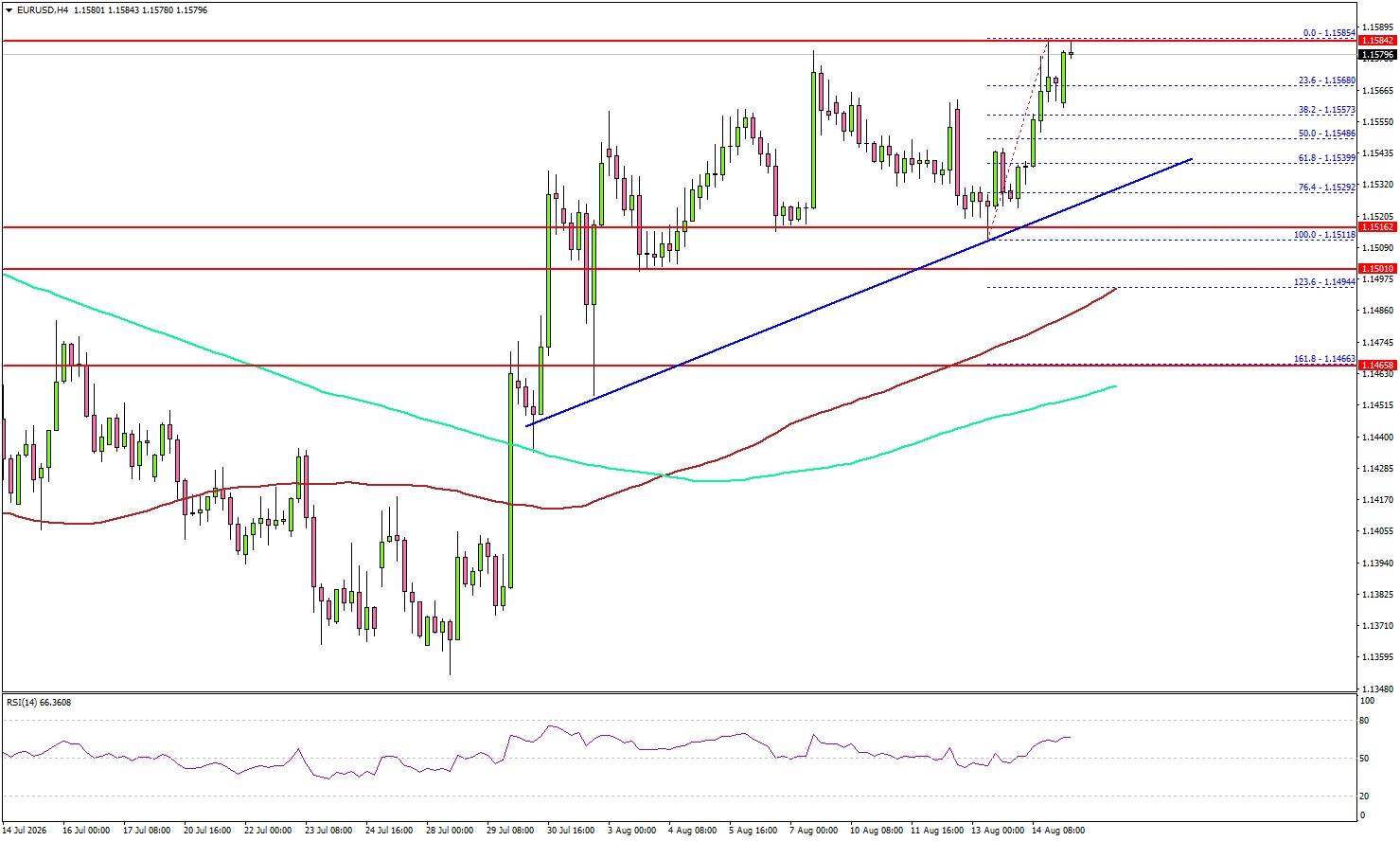
Looking at the 4-hour chart, the pair tested the 1.1580 resistance. It settled well above the 100 simple moving average (red, 4-hour) and the 200 simple moving average (green, 4-hour). On the upside, the pair is now facing a major hurdle at 1.1580.
The next major resistance might be 1.1620. A close above 1.1620 could start another steady increase. In the stated case, the bulls could aim for a move to 1.1685.
Any further gains might open the door for a test of 1.1750. If there is a fresh decline, the pair might find bids near 1.1535. There is also a bullish trend line forming with support at 1.1535. The next major support could be near 1.1500 and the 100 simple moving average (red, 4-hour).
The main support might be 1.1460 and the 200 simple moving average (green, 4-hour). A downside break and close below 1.1460 might send the pair toward 1.1420. Any more losses could open the door for a test of 1.1350.
Looking at Gold, the bulls are active again, and they could aim for a move above the $4,440 and $4,450 resistance levels.
Upcoming Key Economic Events:
- ECB's Lane speech.
- NY Empire State Manufacturing Index for August 2026 – Forecast 10.2, versus 15.6 previous.
Japan GDP Misses, but Export-Led Growth Keeps BoJ September Hike Alive
Japan’s economy expanded in Q2, but weaker domestic demand left growth well short of expectations. GDP rose 0.3% q/q, or 1.1% annualized, compared with 2.1% annualized growth in Q1 and consensus for around 2.0%. Result covers first full quarter incorporating impact of Iran war and higher energy costs, yet economy still avoided contraction.
Composition was considerably softer than headline growth suggested. Domestic demand fell -0.2% q/q, with private consumption essentially flat and capital expenditure dropping -1.2%, against expectations for an increase. Private residential investment also declined -0.5%. Weak consumption is particularly relevant for BoJ, which is watching whether wage gains are translating into sustained household demand and domestically generated inflation.
External sector did most of heavy lifting. Net exports added 0.5 percentage point to quarterly growth, as exports rose 0.5% while imports fell -1.5%. Solid US demand for Japanese hybrid vehicles and continued global AI investment supported shipments of semiconductor-related equipment and components. Government consumption also rose 1.6%, while some weakness in private consumption may have reflected one-off shifts toward public spending, including education-related measures.
Flat consumption and falling business investment argue against describing domestic economy as strongly accelerating, but positive headline growth and resilient exports leave BoJ normalization case intact if policymakers view Q2 drags as temporary. Bigger question is whether higher energy and import costs begin squeezing households more visibly in Q3, weakening demand just as BoJ considers faster pace toward tighter policy.
Data Summary
| Indicator | Actual | Expected | Previous |
|---|---|---|---|
| GDP q/q | 0.3% | 0.5% | 0.5% |
| GDP annualized | 1.1% | 2.0% | 1.9% |
| Domestic Demand q/q | -0.2% | — | 0.2% |
| Private Consumption q/q | -0.0% | 0.5% | 0.5% |
| Private Non-Residential Investment q/q | -1.2% | 0.4% | -1.0% |
| Private Residential Investment q/q | -0.5% | — | 0.9% |
| Government Consumption q/q | 1.6% | — | 0.4% |
| Exports q/q | 0.5% | — | 1.7% |
| Imports q/q | -1.5% | — | 0.3% |
| Net Exports Contribution | +0.5ppt | — | +0.3ppt |
Key Takeaways
- Japan GDP grew 0.3% q/q in Q2, equivalent to 1.1% annualized, undershooting expectations for 0.5% q/q and 2.0% annualized growth.
- Domestic demand contracted 0.2%, making composition notably weaker than positive headline GDP suggests.
- Private consumption stalled after 0.5% growth in Q1, an important weak point as BoJ looks for a durable wage-consumption-inflation cycle.
- Business investment fell 1.2%, substantially weaker than expectations for a 0.4% increase, while residential investment also declined.
- External demand kept economy growing, contributing 0.5 percentage point as exports rose 0.5% and imports fell 1.5%.
- Government consumption accelerated from 0.4% to 1.6%, providing another offset to weak private demand.
- Report complicates rather than overturns September BoJ hike case. Domestic momentum is soft, but positive growth and resilient exports leave normalization path intact if policymakers see Q2 drags as temporary.
- Q3 focus shifts to whether higher energy and import costs squeeze household spending, particularly as some Q2 durable-goods demand may have been temporarily boosted.
NZ PSI Recovery Holds, but Employment Still Refuses to Follow
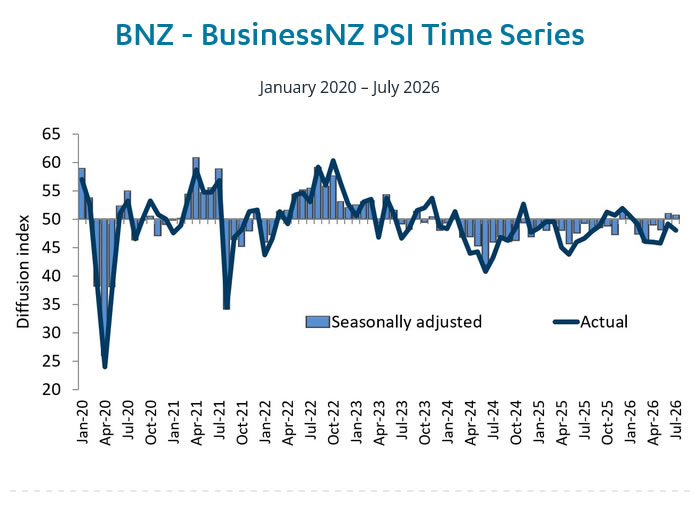
New Zealand’s services sector stayed in expansion in July, although momentum eased slightly. BNZ–BusinessNZ PSI slipped from 50.9 in June to 50.6 in July, marking a second consecutive month above 50 breakeven. Encouragingly, Activity/Sales improved from 49.7 to 50.5, moving into expansion for first time in six months, while Stocks/Inventories strengthened from 50.3 to 51.6.
Details nevertheless point to a recovery that remains narrow. New Orders/Business stayed strongest component despite easing from 53.3 to 52.6, while Employment slipped from 48.8 to 48.5 and Supplier Deliveries fell from 51.2 to 48.5. BusinessNZ said firms remain cautious about hiring, while respondent sentiment was notably weak, with 64% of comments negative amid concerns over living costs, fuel prices, interest rates and election uncertainty.
Overall, July PSI reinforces signs that New Zealand services activity is stabilizing rather than entering a strong rebound. Return of Activity/Sales above 50 is a meaningful improvement, but persistent employment contraction and subdued business sentiment argue against reading two months of headline expansion as broad recovery. For markets, mixed composition provides little reason by itself to overturn last week’s tension between RBNZ’s still-hawkish expected OCR path and sharply lower near-term inflation expectations.
Data Summary
| Component | Current | Previous | Trend |
|---|---|---|---|
| BNZ–BusinessNZ PSI | 50.6 | 50.9 | Expansion eased slightly |
| Activity/Sales | 50.5 | 49.7 | Returned to expansion |
| Employment | 48.5 | 48.8 | Contraction deepened slightly |
| New Orders/Business | 52.6 | 53.3 | Expansion moderated |
| Stocks/Inventories | 51.6 | 50.3 | Expansion strengthened |
| Supplier Deliveries | 48.5 | 51.2 | Fell into contraction |
Key Takeaways
- Services remained in expansion for second straight month, with PSI easing only slightly from 50.9 to 50.6.
- Activity/Sales provided strongest sign of improvement, rising from 49.7 to 50.5 and moving above 50 for first time in six months.
- Recovery remains narrow, as Employment stayed in contraction at 48.5 and Supplier Deliveries dropped sharply below 50.
- New Orders remained relatively firm at 52.6, suggesting demand has not rolled over despite cautious business sentiment.
- 64% of respondent comments were negative, with cost-of-living pressures, fuel prices, higher interest rates and election uncertainty weighing on confidence.
Softer U.S. Data Reduces Interest Rate Hike Expectations
It was a relatively quiet week for markets during the middle of the summer trading period. U.S. inflation was the main focus, with CPI in line with expectations and PPI slightly below expectations. The softer inflation data reduced expectations for higher U.S. interest rates, with markets pricing around a 32% chance of a Fed rate hike in September, down from around 52% earlier in the week.
U.S. consumer data was more concerning. Retail sales and consumer sentiment were both weaker than expected, with retail sales falling 0.6% in July, the biggest monthly decline since May 2025. USD/JPY moved higher early in the week as buyers returned and concerns about another Japanese intervention eased. U.S. stocks finished the week close to flat, while Japanese stocks continued to recover.
Speculation also increased that the Bank of Japan could raise interest rates as early as September. Meanwhile, WTI crude oil moved higher again as tensions in the Middle East continued, keeping concerns about possible supply disruptions through the Strait of Hormuz in focus.
Markets This Week
U.S. Stocks
The Dow had a quiet week, moving slightly lower as weaker-than-expected U.S. economic growth and consumer sentiment weighed on stocks. The weekly close below the 10-day moving average suggests the short-term trend has weakened, with further downside possible in the week ahead. Resistance levels are at 54,500, 55,000 and 56,000. Support is seen at 53,000, 52,500, 51,500, 51,000 and 50,000.
Japanese Stocks
A weaker yen and continued buying of AI-related stocks helped the Nikkei continue its recovery last week. The market looks slightly overbought in the short term, so traders may look for selling opportunities early this week. Medium-term traders could wait for a pullback to the 10-day moving average before looking to buy. Resistance is at 69,500, 70,000 and 71,000. Support is at 67,000, 66,000, 65,000, 64,000 and 63,000.
USD/JPY
USD/JPY continued its recent recovery, starting last week strongly as buyers became more active as WTI crude oil moved higher. However, slightly weaker-than-expected U.S. inflation data and growing expectations of a Japanese interest rate increase in September limited further gains. The 10-day moving average has now turned higher and is providing support, so buying on weakness may be the preferred strategy this week. Resistance is at 160.00, 161.00, 162.00, 164.00 and 165.00, while support is at 158.50, 158,00, 157.00, 156.00, 155.00 and 154.00.
Gold
Gold continued to move higher last week as expectations for a U.S. interest rate increase fell following weaker-than-expected economic data. The outlook for gold remains positive, but after the recent strong gains, both short- and medium-term traders may prefer to wait for a pullback toward the rising 10-day moving average before buying. Resistance is at $4,400, $4,450, $4,500 and $4,600, while support is at $4,200, $4,150, $4,050, $4,000 and $3,950.
Crude Oil
WTI crude oil started the week strongly as tensions between the U.S. and Iran increased over the weekend. Oil continued to rise through the week as Trump introduced new economic sanctions against Iran to pressure the country to end the war. With little progress in reducing tensions, sideways to higher oil prices look likely this week. Resistance is at $75, $80, $90, $95 and $100, while support is at $75, $67.50, $65 and $60.
Bitcoin
After failing again at the $65,000 resistance level early last week, Bitcoin remained under pressure and slowly moved toward the monthly lows. The market remains quiet as trading interest is low, so a large move may be unlikely this week. A range-trading strategy could be preferred, selling above $64,000 and buying around $62,000. Resistance is at $65,000, $75,000, $80,000, $85,000, and $90,000, while support is at $62,000, $60,000, $55,000 and $50,000.
This Week’s Focus
- Monday: Japan GDP and Industrial Production, China Industrial Production, Unemployment Rate and Retail Sales, U.S. NY Empire State Manufacturing Index
- Tuesday: U.K. Unemployment Rate, E.U. ZEW Economic Sentiment, U.S. Housing Starts and Industrial Production
- Wednesday: U.K. CPI, E.U. CPI, U.S. FOMC Meeting Minutes
- Thursday: Japan Trade Balance, Australia Unemployment Rate, U.S. Philadelphia Fed Manufacturing Index and US Leading Index
- Friday: Japan National Core CPI and S&P Global Services PMI, U.K. Retail Sales, E.U. HCOB Eurozone Manufacturing PMI, U.K. S&P Global Manufacturing PMI, U.S. S&P Global Manufacturing PMI
XAUUSD Elliott Wave: the Buying Zone That Triggered the Gold Rally
Hello, fellow traders. In this technical article, we’ll take a quick look at the Elliott Wave charts of Gold (XAUUSD), recently published in the members’ area of our website.
Recently, XAUUSD formed a 3-wave pullback after a rally, a textbook example of an Elliott Wave bullish sequence. Price completed a clear 3-wave move down from the peak and found support at the Equal Legs zone (buying area).In the following analysis, we explain the Elliott Wave pattern and the market outlook.
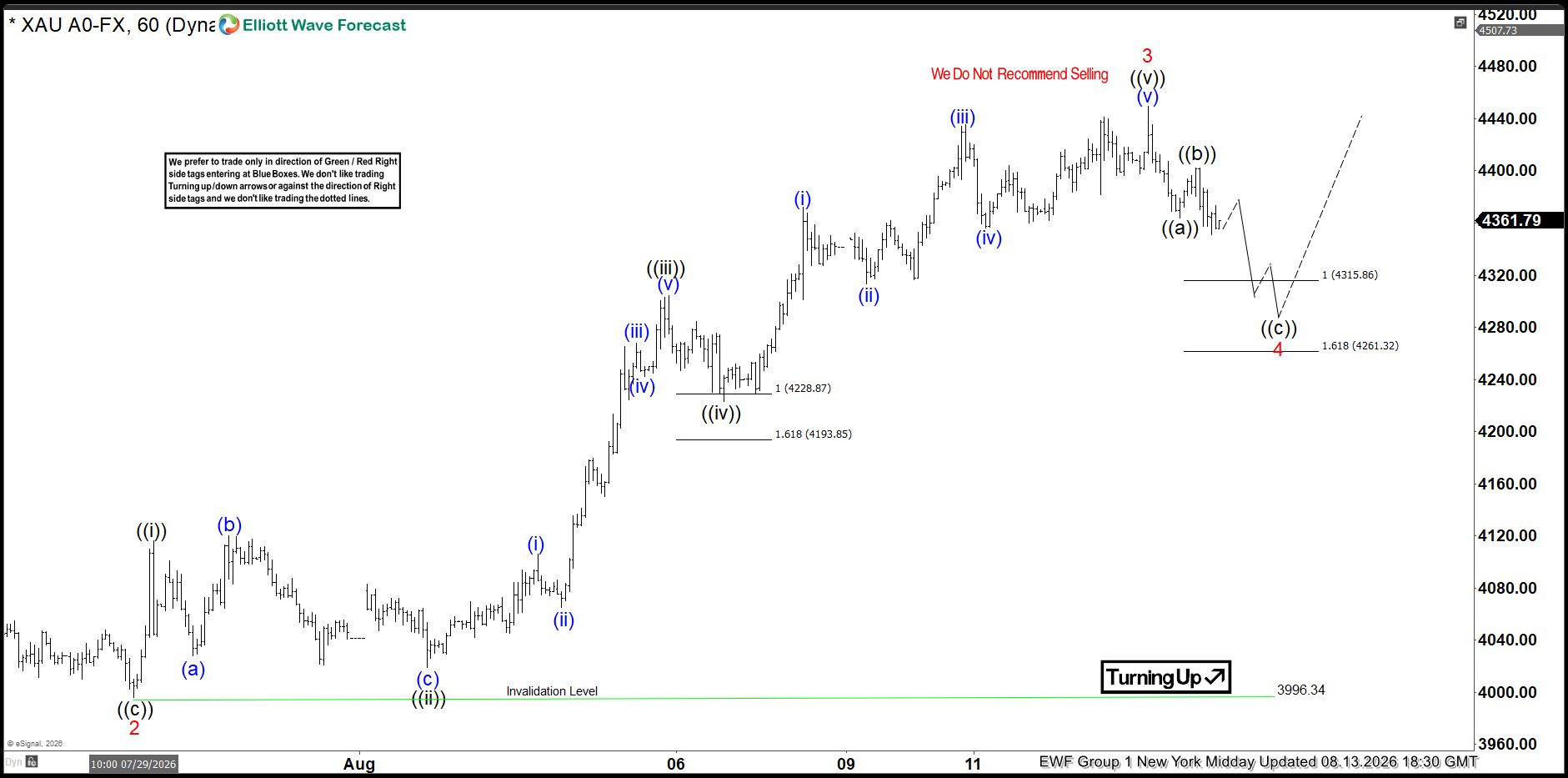
XAUUSD Elliott Wave 1 Hour Chart 08.13.2026
XAUUSD is forming a three-wave pullback from the recent highs. At the moment, the structure of the pullback looks incomplete, suggesting that more downside could be seen before the correction is completed. As our members know, the buying zone is identified by measuring the Equal Legs area using the Fibonacci extension tool. The ideal support area comes in at 4315.86–4261.32. From this zone, we expect buyers to step in and take control, pushing the price higher in at least a three-wave bounce, with the potential to extend toward new highs.
90% of traders fail because they don’t understand market patterns. Are you in the top 10%? Put your skills to the test with this advanced Elliott Wave challenge.
Reminder : Our member chat rooms are open 24/7 and provide ongoing expert guidance on market trends and Elliott Wave analysis. Members are encouraged to ask questions about market structure and technical setups at any time. You can learn more about Elliott Wave Patterns at our Free Elliott Wave Educational Web Page
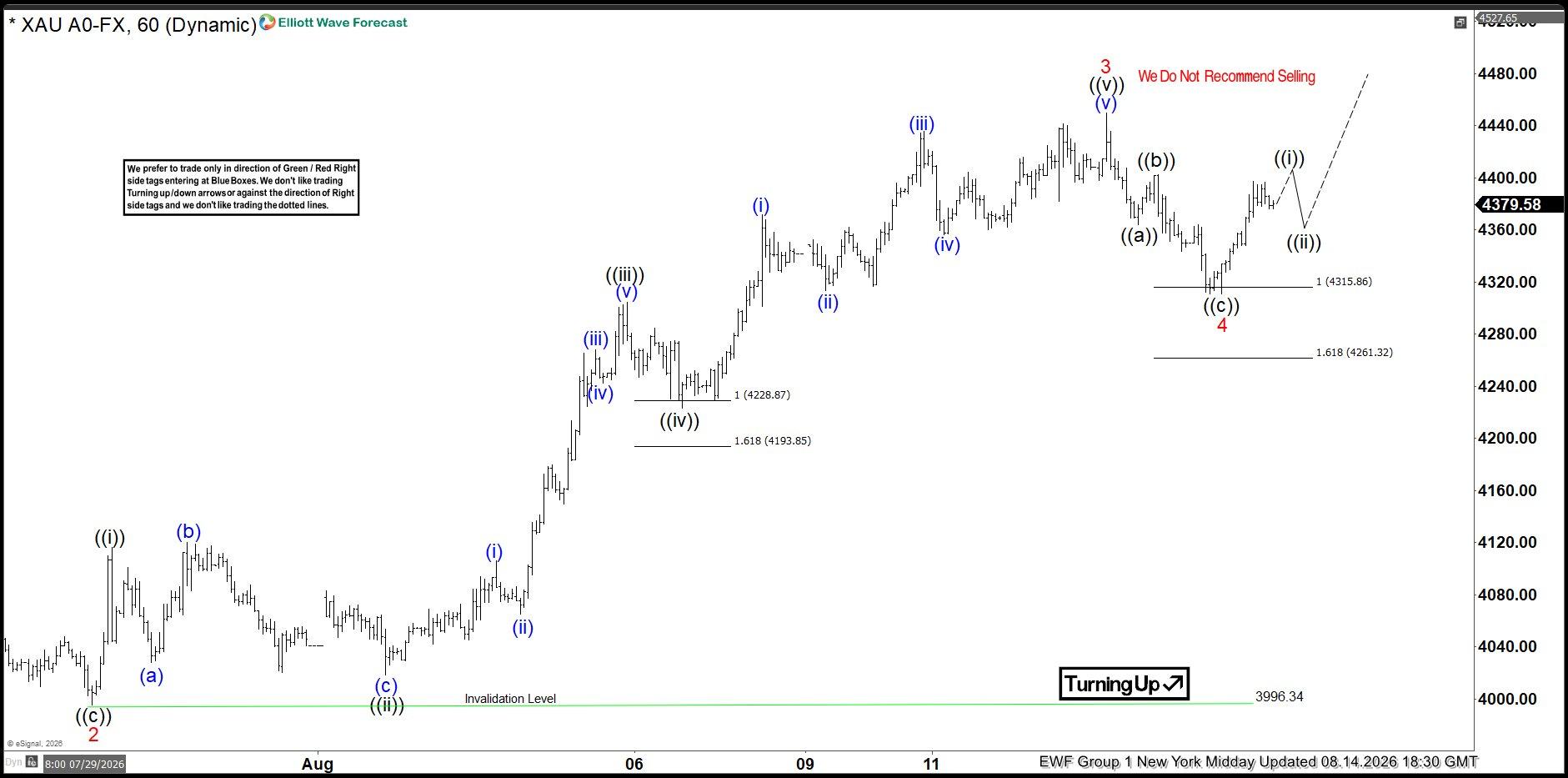
XAUUSD Elliott Wave 1 Hour Chart 08.14.2026
GOLD made decline as expected. The commodity found buyers right at the Equal Legs zone, producing a solid reaction from that area. As a result, long positions taken from the Equal Legs zone are now risk-free. We expect XAUUSD to continue trading higher, with a break above the 3 red peak (4450) needed to confirm that the next leg up is in progress.
Important note: Our analysis is not based on Elliott Wave in isolation. We perform detailed higher-time-frame cycle analysis, which shows an incomplete market structure. This is one of the key drivers of price action, along with correlation analysis and broader market context.
We also teach our members in live analysis sessions how to identify incomplete bullish and bearish sequences. Even a 14-day trial, is enough to noticeably improve your trading analysis and forecasting approach.
The Next Opportunity Is Already Forming.
Every trading session creates new opportunities. Some traders recognize them early. Others only see them after the move has already happened.
The difference isn’t luck. It’s preparation.
At Elliott Wave Forecast, our analysts monitor 78 global markets every day, identifying potential Elliott Wave setups and helping traders develop a more structured approach to the markets.
As a member, you’ll get more than daily analysis. You’ll gain a process designed to help you analyze opportunities, manage risk, and make decisions with greater confidence.
SPX Gains 20% +From Our Blue Box Buying Zone
Hello traders. We have remained long the S&P 500 since SPX reached our Blue Box buying zone in March, when the setup was first presented to members. Since then, the index has advanced approximately 20%. In this technical article, we revisit the Elliott Wave setup that identified the buying opportunity and examine the price structure behind the ongoing SPX rally.
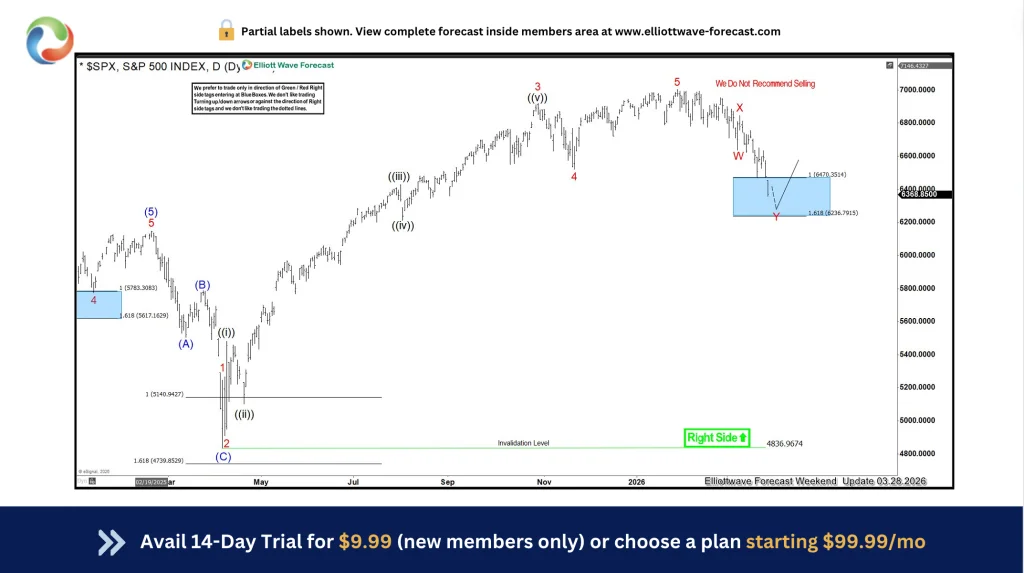
SPX Elliott Wave Daily Chart 03.28.2026
The chart below shows the SPX trading setup presented to our members. At the time, the index was developing a three-wave pullback in the form of an Elliott Wave Double Three pattern.
The decline from the main peak reached the 6,470.35–6,236.79 extreme area. We identified this region as our Blue Box buying zone and looked to enter long positions there.
The strategy was straightforward: enter within the equal-legs area, with the 1.618 Fibonacci extension at 6,236.79 serving as the invalidation level. Once SPX recovered 50% of the decline from the red X peak, we would move the stop to breakeven, making the position risk-free.
Official trading strategy on How to trade 3, 7, or 11 swing and equal leg is explained in details in Educational Video, available for members viewing inside the membership area.
Quick reminder on how to trade our charts :
Red bearish stamp+ blue box = Selling Setup
Green bullish stamp+ blue box = Buying Setup
Charts with Black stamps are not tradable.
[Image download failed: original image removed]
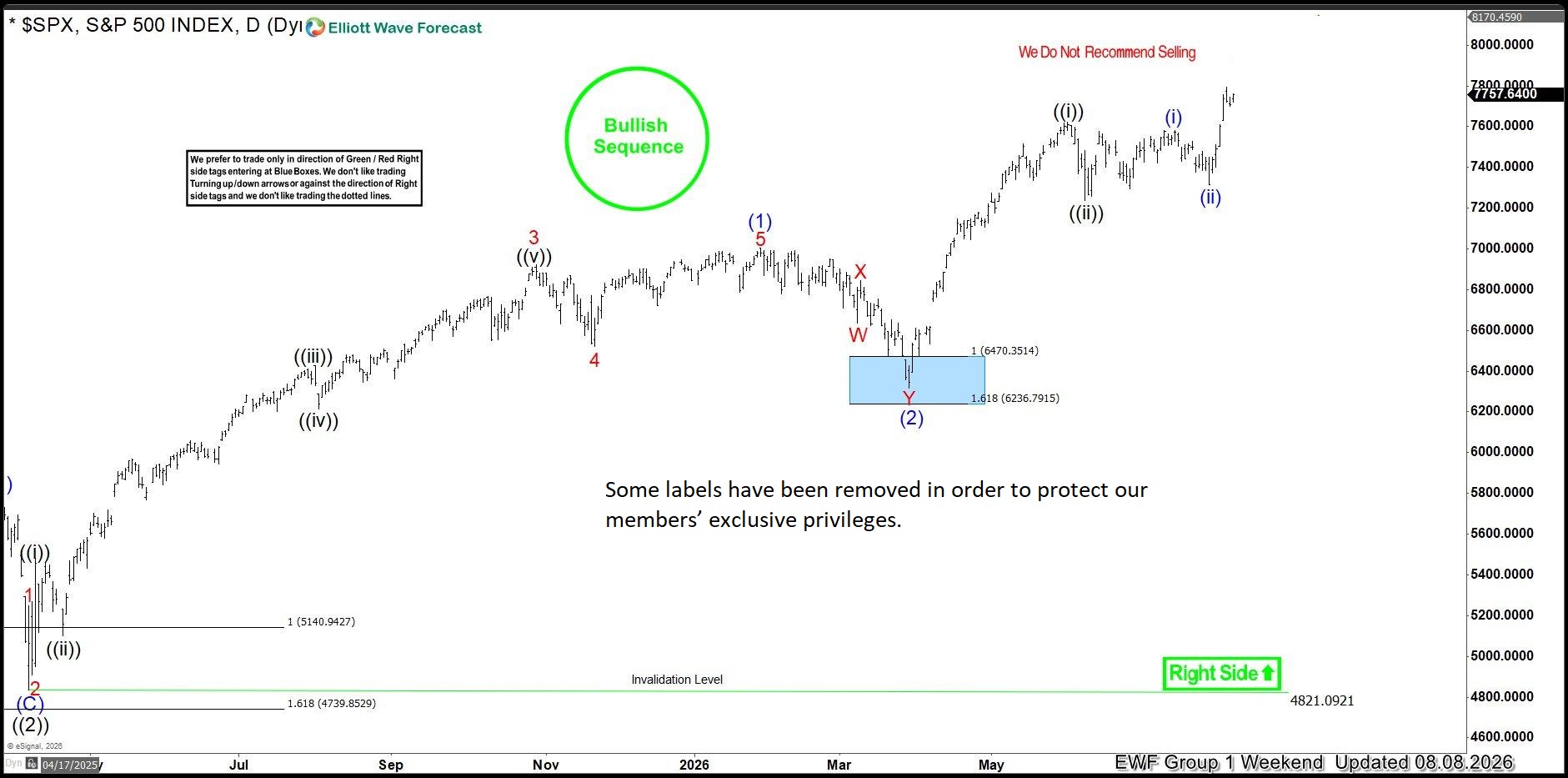
SPX Elliott Wave Daily Chart 08.09.2026
SPX completed the expected decline into our Blue Box buying zone, where buyers entered the market as anticipated. From our entry at 6,470, the index rallied strongly to new all-time highs. The move delivered a gain of approximately 20% in less than six months.
Note: Certain labels have been removed from the chart. Our members receive the complete version with all labels and additional details.
Our member chat rooms are open 24/7 and provide ongoing expert guidance on market trends and Elliott Wave analysis. Members are encouraged to ask questions about market structure and technical setups at any time.
The Next Opportunity Is Already Forming.
Every trading session creates new opportunities. Some traders recognize them early. Others only see them after the move has already happened.
The difference isn’t luck. It’s preparation.
At Elliott Wave Forecast, our analysts monitor 78 global markets every day, identifying potential Elliott Wave setups and helping traders develop a more structured approach to the markets.
As a member, you’ll get more than daily analysis. You’ll gain a process designed to help you analyze opportunities, manage risk, and make decisions with greater confidence.
Eco Data 8/17/26
| GMT | Ccy | Events | Act | Cons | Prev | Rev |
|---|---|---|---|---|---|---|
| 22:30 | NZD | BusinessNZ PSI Jul | 50.6 | 50.6 | 50.9 | |
| 23:50 | JPY | GDP Q/Q Q2 P | 0.30% | 0.50% | 0.50% | |
| 23:50 | JPY | GDP Deflator Y/Y Q2 P | 2.60% | 2.40% | 3.20% | |
| 04:30 | JPY | Tertiary Industry Index M/M Jun | -0.20% | -0.90% | 1.10% | 0.80% |
| 04:30 | JPY | Industrial Production M/M Jun F | 1.90% | 1.30% | 1.30% | |
| 07:00 | CNY | Industrial Production Y/Y Jul | 4.50% | 4.80% | 5.30% | |
| 07:00 | CNY | Retail Sales Y/Y Jul | 0.60% | 1.60% | 1.00% | |
| 07:00 | CNY | Fixed Asset Investment YTD Y/Y Jul | -6.70% | -6.00% | -5.70% | |
| 12:30 | CAD | CPI M/M Jul | 0.50% | 0.40% | -0.40% | |
| 12:30 | CAD | CPI Y/Y Jul | 3.00% | 2.90% | 2.80% | |
| 12:30 | CAD | CPI Median Y/Y Jul | 2.00% | 2.00% | 1.90% | |
| 12:30 | CAD | CPI Trimmed Y/Y Jul | 1.90% | 1.80% | 1.80% | |
| 12:30 | CAD | CPI Common Y/Y Jul | 2.70% | 2.50% | 2.60% | |
| 12:30 | USD | Empire State Manufacturing Aug | 20.6 | 10.2 | 15.6 | |
| 14:00 | USD | NAHB Housing Market Index Aug | 35 | 33 | 34 |
| 22:30 | NZD |
| BusinessNZ PSI Jul | |
| Actual | 50.6 |
| Consensus | |
| Previous | 50.6 |
| Revised | 50.9 |
| 23:50 | JPY |
| GDP Q/Q Q2 P | |
| Actual | 0.30% |
| Consensus | 0.50% |
| Previous | 0.50% |
| 23:50 | JPY |
| GDP Deflator Y/Y Q2 P | |
| Actual | 2.60% |
| Consensus | 2.40% |
| Previous | 3.20% |
| 04:30 | JPY |
| Tertiary Industry Index M/M Jun | |
| Actual | -0.20% |
| Consensus | -0.90% |
| Previous | 1.10% |
| Revised | 0.80% |
| 04:30 | JPY |
| Industrial Production M/M Jun F | |
| Actual | 1.90% |
| Consensus | 1.30% |
| Previous | 1.30% |
| 07:00 | CNY |
| Industrial Production Y/Y Jul | |
| Actual | 4.50% |
| Consensus | 4.80% |
| Previous | 5.30% |
| 07:00 | CNY |
| Retail Sales Y/Y Jul | |
| Actual | 0.60% |
| Consensus | 1.60% |
| Previous | 1.00% |
| 07:00 | CNY |
| Fixed Asset Investment YTD Y/Y Jul | |
| Actual | -6.70% |
| Consensus | -6.00% |
| Previous | -5.70% |
| 12:30 | CAD |
| CPI M/M Jul | |
| Actual | 0.50% |
| Consensus | 0.40% |
| Previous | -0.40% |
| 12:30 | CAD |
| CPI Y/Y Jul | |
| Actual | 3.00% |
| Consensus | 2.90% |
| Previous | 2.80% |
| 12:30 | CAD |
| CPI Median Y/Y Jul | |
| Actual | 2.00% |
| Consensus | 2.00% |
| Previous | 1.90% |
| 12:30 | CAD |
| CPI Trimmed Y/Y Jul | |
| Actual | 1.90% |
| Consensus | 1.80% |
| Previous | 1.80% |
| 12:30 | CAD |
| CPI Common Y/Y Jul | |
| Actual | 2.70% |
| Consensus | 2.50% |
| Previous | 2.60% |
| 12:30 | USD |
| Empire State Manufacturing Aug | |
| Actual | 20.6 |
| Consensus | 10.2 |
| Previous | 15.6 |
| 14:00 | USD |
| NAHB Housing Market Index Aug | |
| Actual | 35 |
| Consensus | 33 |
| Previous | 34 |