Sample Category Title
EUR/USD Outlook: Violation Of 1.1447/22 Support Zone Would Spark Further Weakness
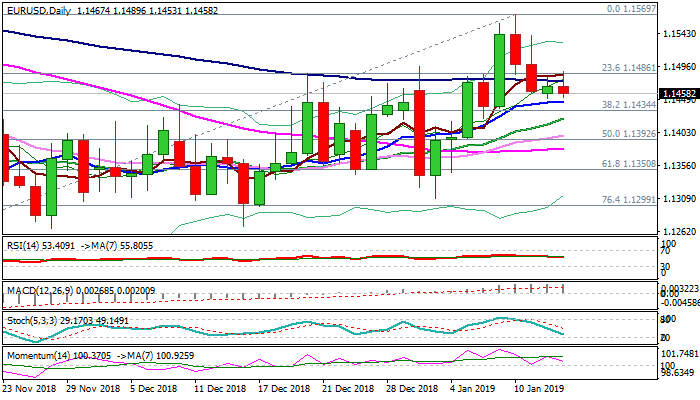
The Euro came under pressure in early European trading on Tuesday and eased from Asian high at 1.1489, shifting near-term risk lower, after Monday’s positive close signaled that strong two-day pullback may be over.
Solid supports at 1.1447 (10SMA), 1.1434 (Fibo 38.2% of 1.1215/1.1569) and 1.1422 (20SMA) underpin for now but the structure could weaken on break lower.
South-heading daily momentum and slow stochastic support negative scenario, as the single currency could be pressured further if sterling falls after Brexit vote.
Break below 1.1447/22 support zone would risk bearish extension towards 55SMA (1.1380) and Fibo 61.8% support at 1.1350.
Conversely break and close above daily cloud would sideline downside risk and shift focus higher.
Res: 1.1474, 1.1486, 1.1540, 1.1569
Sup: 1.1447, 1.1434, 1.1422, 1.1380
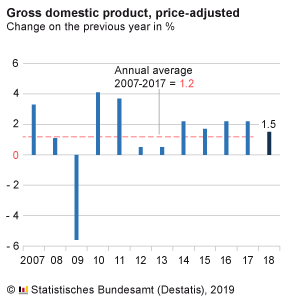
German economy grew 1.5% in 2018, slowest since 2013
The German Federal Statistical Office said the German economy grew 1.5% in 2018 as a whole. And that was above the 1.2% average growth rate of the last 10 years. It's the ninth year of growth in a row. But Destatis noted that "growth has lost momentum". German economy grew 2.2% in both 2017 and 2016, and 1.7% in 2015. And the pace was slowest since 2013.
Positive contributions came mainly from domestic demand. Household final consumption expenditure rose 1.0%. Government final consumption expenditure rose 1.1%. But both were notably slower than growth rate back in the past three years. Exports grew 2.7% while imports grew 3.4%. Full release here.
The Economy Ministry said the slowdown was due to weaker global economy, car industry's sales problem, outbreak of flu and strikes. It's optimistic that the economy will likely expand at the start of 2019. However, Euro drops notably today on worries that Germany was in a technical recession with contraction in last Q3 and Q4
FX 2019 – EUR’s Upside Limited by Growth Deceleration and Political Risks
GDP growth should have moderated in 4Q18 and would remain lukewarm 1H19. Although the Italian government eventually backed down in the budget plan, political risks in the region have not yet abated. European Parliament election scheduled in mid-May and ongoing uncertainty about Brexit would still cause the euro to trade with high volatility. Growth deceleration and soft inflation allow the ECB to keep interest rates lower for longer. We expect the central bank to leave the policy rates unchanged for the entire year.
Economic Outlook
Economic growth in the Eurozone has peaked in 2017 and the pace of slowdown in 2018 came in faster than expected. GDP growth moderated to the lowest in about four years in the third quarter. GDP growth decelerated to +0.16% q/q in 3Q18, slowest since 2Q14, weighed down by production loss in German car manufacturers. Contractions were seen in Germany and Italy. From a year ago, the economy expanded +1.7%, the lowest level since 4Q14.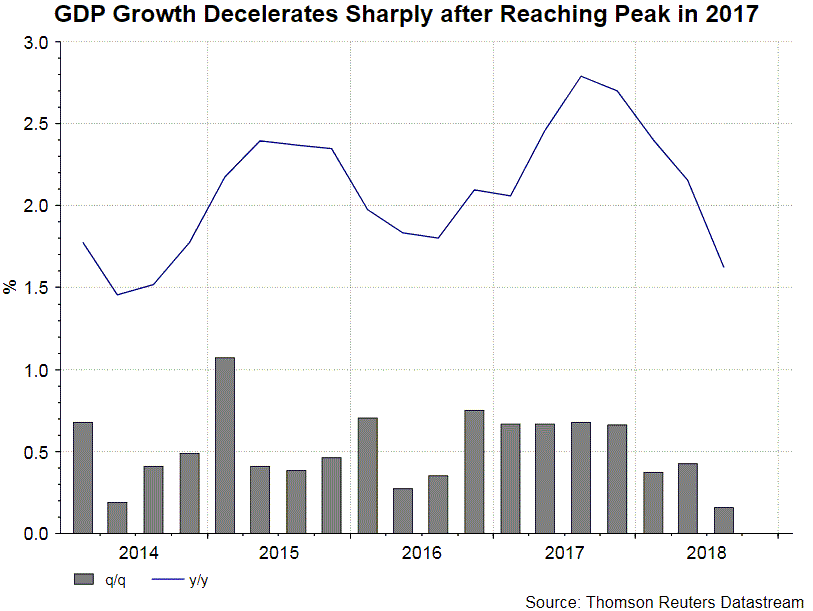
The Markit PMI shows that the region experienced the weakest growth in four years last month. the composite index fell -1.6 points to 51.1, the lowest in 4 years and revised from the initial reading of 51.3. although the slowdown was mainly due to the protest in France, the weakness was indeed across the board. Note that the reading for Germany, the largest economy in the bloc, plunged to the lowest level in 5.5 years. Markit suggested that the readings are consistent with GDP growth of “just under 0.3%” in 4Q18. Things are not getting better at the start of 2019. With expectations of output also falling to the lowest in 4 years, firms are not hopeful of recovery in demand any time soon.
Disappointing economic sentiment signals further weakness in 4Q18 and in 2019. European Commission’s economic sentiment indicator dropped to 107.3 in December 2018, from 109.5 in November. This was compared with consensus of 108.2. The top three economies in the region all showed significant decline, with the indices in France, Germany and Italy losing -2 points, -1.9 points and -1.4 points respectively. The consumer confidence index for the region also weakened. The market currently forecasts that GDP growth would be around +0.4% q/q in 4Q18 and 1H19.
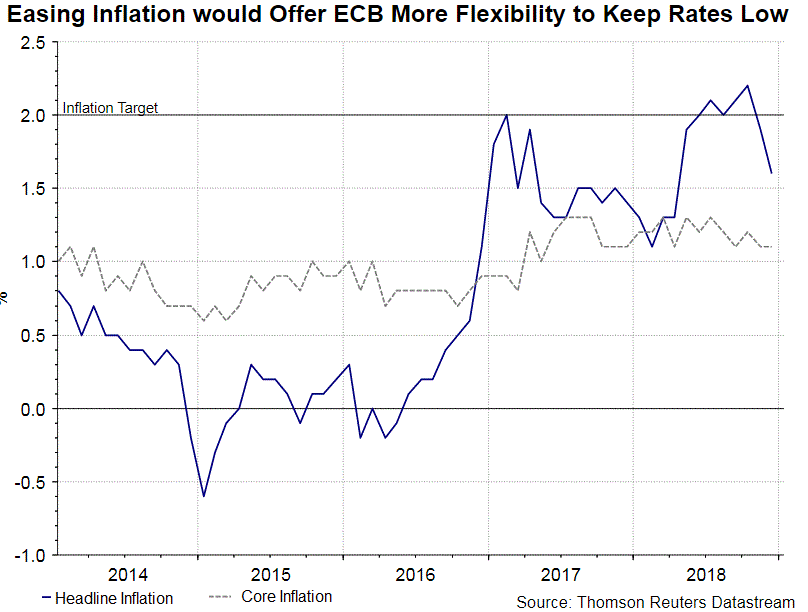
Headline inflation eased for two straight months, falling to 8-month low of +1.6% y/y in December. Core CPI steadied at +1% y/y during the month, due to weakness in energy prices. Moderation in the headline reading suggests that a tighter job market has not translated to higher consumption, hence substantiating benign price pressure.
Political Risk
Political risk has not yet abated although the Italian government eventually backed down on the budget plan. For the year ahead, European Parliament elections scheduled in mid-May and ongoing Brexit uncertainty would still result in market volatility. Meanwhile, deterioration in growth outlook the region would likely raise support to right- wing and/ or populist parties across the EU.
ECB Monetary Policy
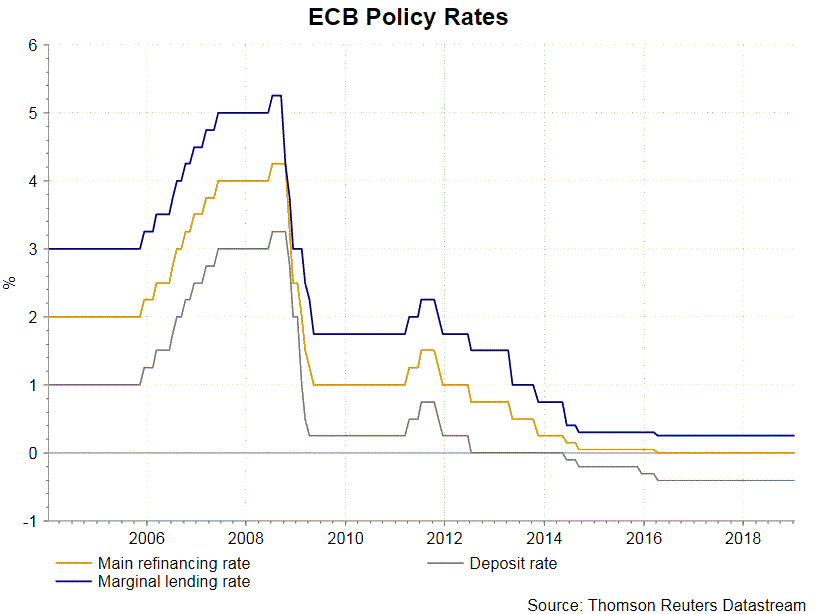
As indicated in December minutes, the members retained the judgment that risks to growth remained “broadly balanced”. However, it also revealed that some members noted that “a case could be made for assessing risks to activity as tilted to the downside”. The central bank suggested that “the situation remained fragile and fluid, as risks could quickly regain prominence or new uncertainties could emerge”. We see room for ECB to downgrade its growth forecasts. In December, ECB’s updated projections showed that GDP growth would moderate to +1.7% in 2019 (Sep: +1.8%) and stabilize at this level in 2020.
The forward guidance on interest rate reiterated no change in the policy rate “at least through the summer 2019”. The market has gradually pricing out any rate hike this year.
Policy Not Yet Converging to Fed’s
ECB has just ended its entire QE program last December and would begin reinvestment this year. Draghi has been affirming that reinvestment, a process to keep the central bank’s balance sheet as huge as it currently is, would continue “for an extended period of time past the date when it starts raising the key ECB interest rates, and in any case for as long as necessary”. Meanwhile, we expect ECB to announce a new round of targeted long-term refinancing operations (TLTROs) in January. The operations tentatively keep the liquidity ample in the market.
The December FOMC minutes revealed that that Fed has undeniably turned more dovish. Meanwhile, Fed Chair Jerome sent further dovish note last week, noting that he would “not hesitate” to adjust the size of reduction if it causes problems to the financial market. After all, the US and Eurozone are in different stages of the normalization cycle. Our base case remains that the Fed could deliver two rate hikes this year. Both would be implemented in the first half the year. ECB would at most deliver one rate hike in the final quarter of this year. Interest rate differential signals that US dollar should still strengthen against the euro in the first half of the year. Euro might recover in the second half of the year, as a result of the end of the USD bull market and rate hike by ECB.
What Currency Pair is the Most Difficult to Trade?
If you were to look into any Forex trading guide, you’d get a recommendation to trade on major currency pairs only — at least until you get comfortable with trading and see some profits. However, not many of them explain what is wrong with the more exotic currency pairs and why exactly you should never trade on them.
This guide is going to do exactly that — take each “undesirable” currency pair, explain what makes it so bad, and show the successful trading strategies for it, if there are any.
Exotic Pairs
Exotic currency pairs are characterized by having low liquidity and little interest of the traders outside of the countries involved. The central banks dominate those markets, and thus they are often extremely stable — which is not a good thing for trading.
EUR/CHF
The Euro (EUR) is a currency of the European Union; however, Switzerland does not utilize it. Instead, they have their own Swiss Franc (CHF), which used to act as a haven currency. However, when it comes to trading, it does not quite work.
The main problem with EUR/CHF is its long periods of stability followed by sudden jumps in value. Some EUR/CHF trades can last for months only to suddenly close with 2 000 pips of difference. Lately, the situation improved with EUR being involved in Brexit, which brought some much-needed volatility to the market.
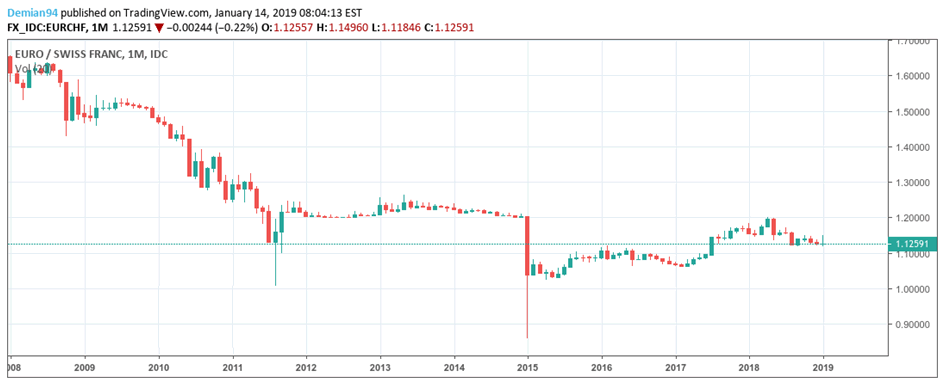
EUR/CHF monthly chart. As you can see, the long periods of relative stability are followed by sudden drops or increases in value.
Overall, EUR/CHF is not suited for scalping and other high-volatility short-term strategies. Price Action patterns aren’t truly applicable either since the patterns on the weekly and monthly timeframes are much less defined.
As of right now, there isn’t a single recommended way of trading on EUR/CHF. The most viable one so far is trend-trading — catching onto a new trend at its beginning and jumping off before it ends. It’s not a particularly profitable endeavor and does carry some risk, but if you want to trade EUR/CHF — it’s the only reliable solution.
EUR/TRY
The current Turkish government is far from competent, as evident by all the political scandals and populistic positions taken in the last two years. So it’s not a huge surprise that the Turkish lira is kind off all over the place. Up until January 2018, the currency pair was very much downward bound, but the weakening EUR helped TYR retake positions for a couple of months. And yet, from September onwards, the TYR has been correcting back down.
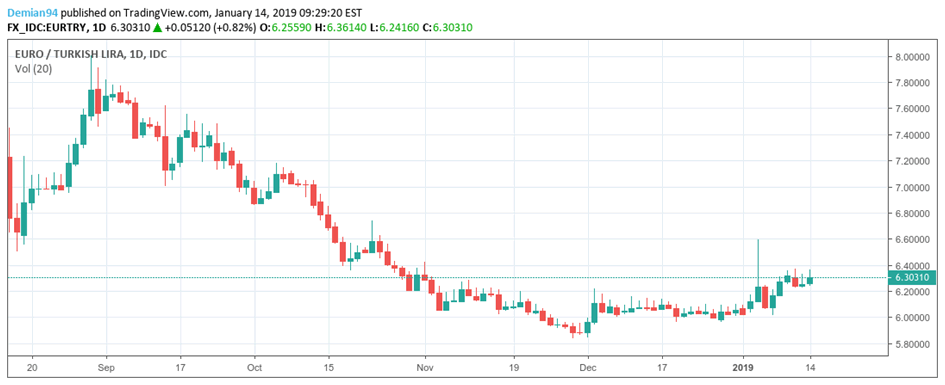
EUR/TRY looks relatively fine on larger timeframes, but on the smaller ones, you see a lot of erratic, unpredictable movement.
The biggest problem with EUR/TRY is the lack of central direction. The market does not correspond to the known patterns since any moment another piece of news may drop that will change the picture. This makes strategies based on Price Action practically unusable.
However, there are ways to trade on EUR/TRY. More straightforward scalping strategies, like “lazy river” are useful, and there are price movements suitable for trend-trading. However, the erratic nature of the market makes them very risky.
Derivative Pairs
EUR/USD and other major currencies are being exchanged directly — however, that is not always the case. There is a whole array of currency pairs that use an intermediary currency due to the lack of liquidity.
This makes the derivative pairs depend on two economics, but three. For example, when USD is being highly volatile, the GBP/JPY will become unstable too — even though, on the first glance, it is not directly affected. This gives derivative pairs a lot of unhealthy volatility and makes them very difficult to trade.
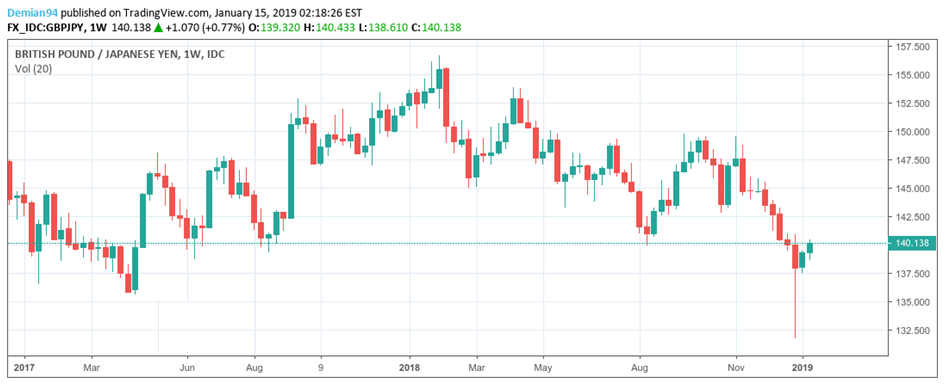
Despite JPY being a relatively stable currency over the last year, the GBP/JPY chart is somewhat incomprehensible.
There isn’t a good way to trade on the derivative pairs. You are bound to the whim of two different markets and often their price movements are completely unexplainable. Trend-trading is the most viable strategy, but considering the erratic market, the risk is not worth it.
Conclusion
The worst currency pairs are considered “the worst” for good reasons. While there are ways to trade them and not end up in a complete wash, the risks and efforts far outweigh the reward. Especially for newcomers, who should probably stick to the major currencies.
Moreover, some brokers make trading on exotic or derivative currencies practically impossible with high spreads. If you still want to try them — consider switching to something like JustForex ECN Zero account, which features no spreads at all. You will have to pay a fee for each transaction but your chances to close your order in the green will increase drastically.
Elliott Wave Analysis: Crude Oil Can Face Support And Bounce At 50.0 Level
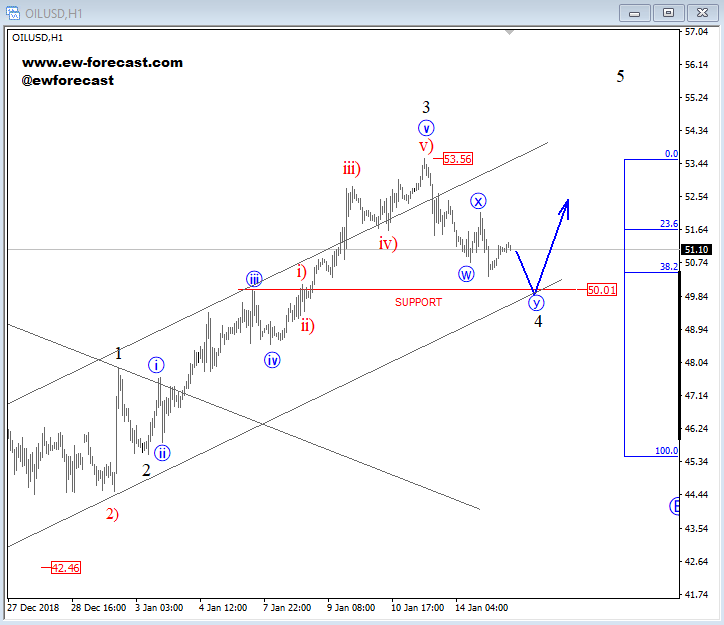
Crude oil is nicely approaching projected support within a double zig-zag w-x-y corrective pattern.
Ideal support would be here around 38,2% Fibo. retracement, where previous wave »iii« swing high is, where the channel support line is and of course, where psychological 50 level is, so be aware of a bullish turn for wave 5 soon. A rally in five minor waves from the mentioned region would indicate a completed wave 4 correction and wave 5 to be in play
Crude oil, 1h
The US Dollar Index Closed In The Red
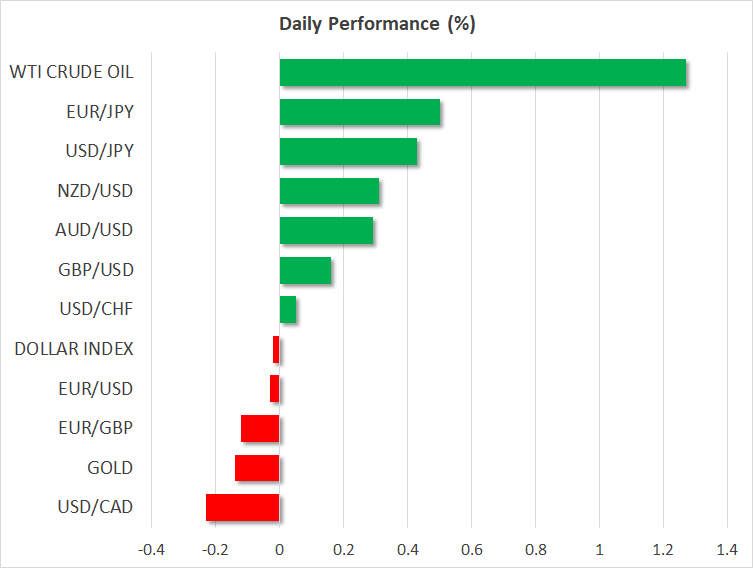
Yesterday, the US dollar slightly changed against a basket of major currencies. Financial market participants took a wait-and-see attitude. Important economic reports will be published today. The dollar index (#DX) closed yesterday in the negative zone (-0.07%).
The US government shutdown also puts pressure on the US currency. The government has not work from December 22 due to disagreements concerning the wall on the border with Mexico. The shutdown has been lasting 25 days and is the longest in the US history. Republican Senator Lindsey Graham tried to urge Donald Trump to at least partially restore work, but the President refused.
The euro weakened against the US dollar amid weak statistics from the Eurozone. Thus, the industrial production declined by 1.7% in November, while investors expected a drop of 1.5%. Previous data were also revised downward, the growth in October counted to 0.1%, not 0.2%. Today, the attention of financial market participants will be focused on the Brexit vote.
The "black gold" prices are consolidating. At the moment, futures for the WTI crude oil are testing the mark of $51.15 per barrel. At 23:30 (GMT+2:00), the API weekly crude oil stock will be published.
Market Indicators
- Yesterday, the bearish sentiment was observed in the US stock market: #SPY (-0.61%), #DIA (-0.39%), #QQQ (-0.88%).
- The 10-year US government bonds yield is at the level of 2.71-2.72%.
The news feed on 15.01.2019:
- Reports on the volume of exports and imports in the US at 15:30 (GMT+2:00);
- Producer price index in the US at 15:30 (GMT+2:00);
- UK Parliament vote on Brexit deal at 21:00 (GMT+2:00).
JPMorgan Stock Advances In Near Term, Indicators Signal Bearish Actions
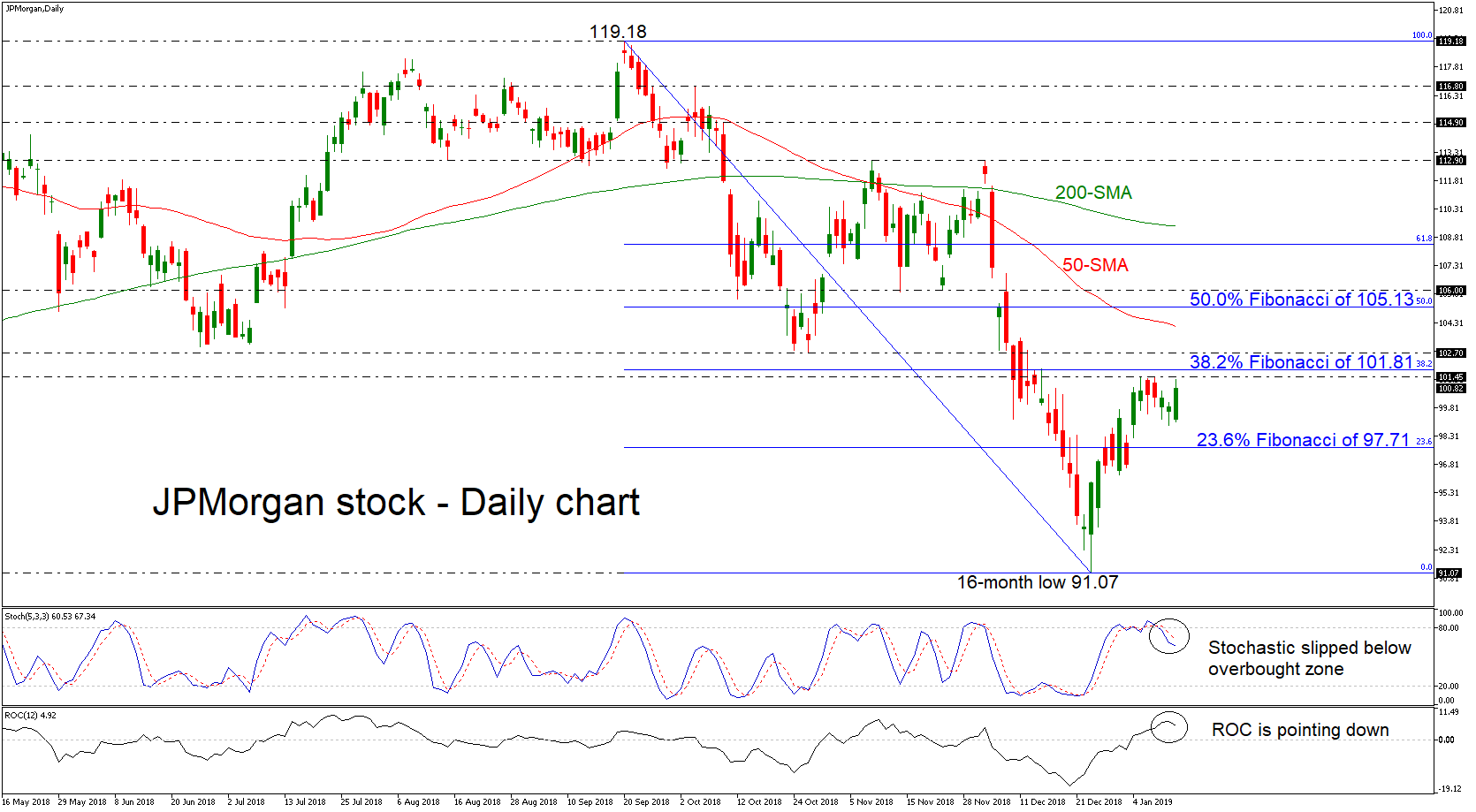
The JPMorgan stock price is continuing last month’s rebound on the 16-month low of 91.07, touching the 101.45 resistance level. However, looking at the technical indicators, they suggest bearish actions as the price opened with a gap down in the previous sessions. The stochastic oscillator is moving lower below the overbought level, while the ROC is pointing down above the zero line.
The 38.2% Fibonacci retracement level of the downleg from 119.18 to 91.07, around 101.81 could be a trigger point for steeper bullish actions. Further upside pressures could attract greater attention around the 102.70 resistance level before touching the 50-day simple moving average (SMA), near 104.06. Also, more buyers could be waiting to enter the market once the price hits the 50.0% Fibonacci of 105.13.
However, if the stock reverses back to the downside, investors could stop at the 23.6% Fibonacci region of 97.71. If the price continues to drop, support could next come somewhere around the 16-month low of 91.07.
In the medium-term picture, the bounce back has failed to turn the outlook from negative to bullish as the stock needs to climb above the 61.8% Fibonacci 108.45 for stronger advances.
UK Parliament Holds ‘Meaningful Vote’
- British lawmakers will vote on the Brexit deal today; outcome crucial for sterling
- In the broader market, risk aversion is abating as China outlined plans for fresh stimulus
- Some remarks by ECB President Draghi may also attract attention
Sterling turns its sights to the long-awaited parliamentary vote
The spotlight will fall on the UK today, where Parliament will vote on the government’s Brexit deal during the evening, between 1900-2100 GMT. The consensus overwhelmingly suggests a rejection and hence, the real question – which could also determine how the pound reacts – may instead be how heavy the defeat is, that is to say by what margin the accord is voted down.
A devastating rejection of say more than 100 lawmakers could hurt the pound, as any hopes that a revised version of this deal may pass later vanish, and the odds for early elections rise. However, if the motion is voted down only by a slim margin, the currency may gain on speculation that a revised version of the deal could pass in subsequent attempts. Of course, an approval would be an upset, and could see sterling skyrocket.
From a longer-term perspective, the risks surrounding the UK currency increasingly seem skewed to the upside. Although there are still some short-term threats including the uncertainty that early elections could bring, the biggest tail risk – a no-deal exit – seems to have abated somewhat lately as Parliament has seized control of the process. So long as a disorderly exit is avoided, practically every other scenario is likely positive for the pound in the bigger picture.
China’s stimulus hints turn market sentiment around
Risk appetite remained in 'risk-off' territory on Monday, following the disappointing trade data out of China, which reignited concerns that the world’s second-largest economy is slowing down amid a damaging trade dispute with the US. Accordingly, the Japanese yen that is viewed as a safe-haven asset outperformed, while US stock indices closed lower.
However, sentiment seems to have turned around today, following a chorus of market-supportive comments out of China overnight. Officials from both the People’s Bank of China (PBoC) and the government hinted that even more stimulus may be on the way to cushion the economy. As such, the defensive yen is lower today, while Asian equity markets were a sea of green, and futures tracking the major US benchmarks like the S&P 500 are pointing to a higher open.
Coming up: US PPI data and remarks from ECB’s Draghi
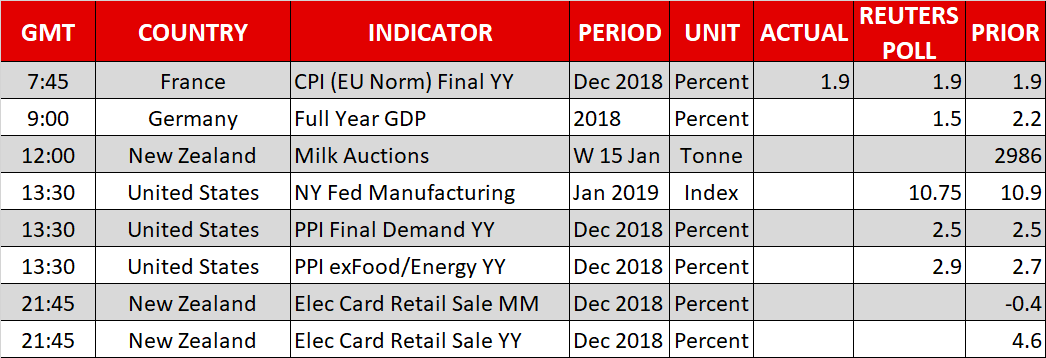
Outside of the UK, the economic calendar will be relatively light today. In the US, the producer prices for December are due out alongside the Empire State manufacturing PMI for January – the first regional survey for the new year. Although neither typically has much of a market impact, they are worth keeping an eye on in light of fears a recession may be drawing closer.
Staying in the US, regional Fed Presidents Kashkari (1630 GMT), Kaplan (1800 GMT), and George (1815 GMT) will all delivers remarks.
Meanwhile in Europe, ECB President Draghi will address the European Parliament at 1500 GMT. Keep in mind there’s been a slight shift in tone from some ECB members lately towards a more cautious direction amid slowing growth; it will be interesting to see if Draghi echoes such concerns.
Finally, in equity markets, the earnings season has kicked off. Notable names releasing their quarterly results today include JPMorgan Chase and Wells Fargo.
GBP/USD Outlook: Pound Holds Under Key Barriers Ahead Of Key Brexit Vote
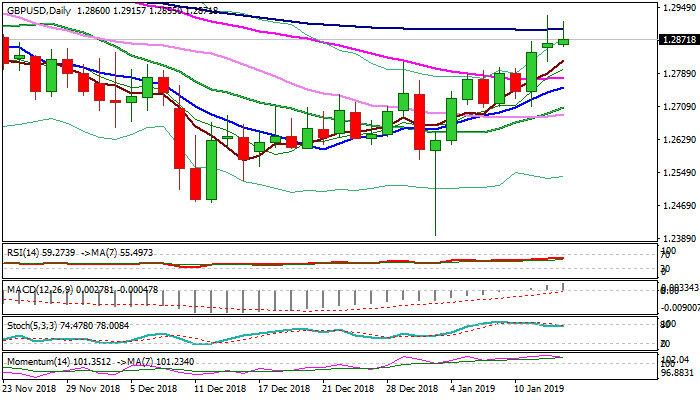
Cable holds firm tone in early Tuesday's trading, hours ahead of parliamentary vote on Brexit deal. Monday's Doji candle and failure to clearly break above pivotal barriers at 1.2877/1.2894 (Fibo 61.8% of 1.3174/1.2397/100SMA) signals that bulls might be running out of steam. South-turning 14-d momentum and converged daily Tenkan-sen/Kijun-sen in sideways mode add to negative signal. The UK parliament is widely expected to vote down PM May's plan today, suggesting that this should not be a big surprise for traders, however, markets are expected to focus at the grade of defeat that could be a major driver of sterling today. If May's plan loses more than a hundred votes, this would be additional negative signal for pound which could accelerate below 1.2600 support in post-vote knee-jerk reaction in highly volatile market. Alternative scenario requires sustained break above 100SMA / 30WMA and daily cloud top to generate strong bullish signal for extension through psychological 1.30 barrier at possible extension towards falling 200SMA (1.3120).
Res: 1.2894, 1.2933, 1.2958, 1.3000
Sup: 1.2855, 1.2804, 1.2776, 1.2726
Crude Oil Under Pressure
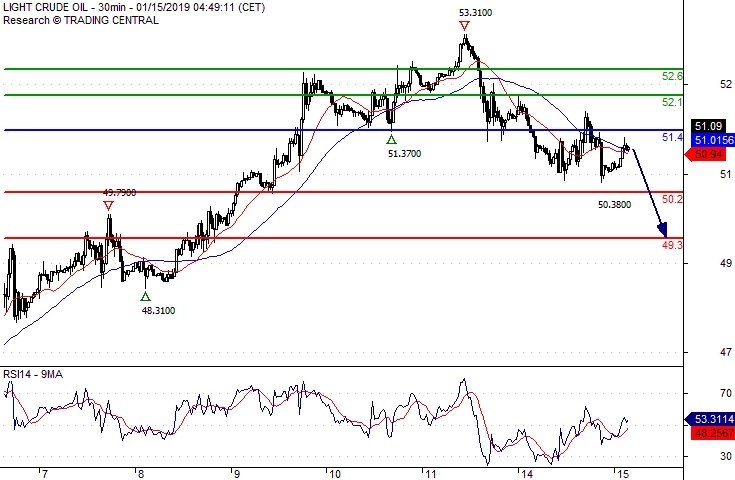
Pivot (invalidation): 51.40
Our preference Short positions below 51.40 with targets at 50.20 & 49.30 in extension.
Alternative scenario Above 51.40 look for further upside with 52.10 & 52.60 as targets.
Comment As Long as 51.40 is resistance, likely decline to 50.20.