Sample Category Title
(ECB) Account of the monetary policy meeting 12-13 December 2018
Account of the monetary policy meeting of the Governing Council of the European Central Bank, held in Frankfurt am Main on Wednesday and Thursday, 12-13 December 2018
1. Review of financial, economic and monetary developments and policy options
Financial market developments
Mr Cœuré reviewed the latest financial market developments. Since the Governing Council's previous monetary policy meeting on 24-25 October 2018, there were growing signs that investors were becoming more concerned about the global growth outlook, reflecting both the weakness in recent economic data in many jurisdictions and continuing geopolitical tensions. These concerns had added to market volatility and likely contributed to a marked drop in global stock prices. Corporate bond spreads, both in the United States and in the euro area, had widened too, in particular for bonds with lower credit quality.
In euro area government bond markets, yields on bonds of the highest credit quality had declined to levels seen early in 2018, reflecting both a demand for safety and a fall in inflation expectations. Part of the fall in inflation expectations likely echoed a measurable drop in oil prices in recent weeks, which were down by 30% on early October. A model-based decomposition of oil price movements indicated that factors of both supply and demand had likely contributed to the decline in oil prices.
Euro area sovereign bond spreads had eased somewhat from recent highs. However, yield spreads between the ten-year Italian government bond and its German equivalent remained at elevated levels of slightly below 300 basis points. Contagion from Italy to other euro area sovereign bond markets remained contained.
Turning to euro area equity markets, two broad factors were seen to have accounted for the recent correction: a rise in the equity risk premium, which was consistent with the growing demand for safe-haven assets in global bond markets, and a downward revision in earnings expectations. In the United States, by contrast, earnings expectations were seen to have continued to push stock prices higher, while the increase in the equity risk premium had pulled US stocks lower.
Finally, with regard to monetary policy expectations in the euro area, both survey results and market-based evidence were signalling a push-back in the expectations for the timing of a first rise in key ECB interest rates and in the subsequent expected future path of short-term interest rates. At longer tenors, market pricing had exhibited a more pronounced adjustment, which could have also reflected changes in risk premia.
The global environment and economic and monetary developments in the euro area
Mr Praet reviewed the global environment and recent economic and monetary developments in the euro area.
Regarding the external environment, global growth momentum was moderating and global trade growth stabilising. Global survey indicators pointed to a deceleration in economic activity in the second half of 2018. The global composite output Purchasing Managers' Index (PMI) had increased somewhat in November, but overall still pointed to a weakening of growth relative to the first half of 2018. The latest indicators on trade gave mixed signals while pointing overall towards broad stabilisation. The volume of goods imports had increased in September. However, the global PMI for new export orders in the manufacturing sector remained slightly below 50 in November.
Annual consumer price inflation in the OECD area had picked up in October. Excluding energy and food, inflation had remained largely stable. Wage dynamics appeared to have gained momentum since the turn of 2017-18, with annual growth in compensation per employee reaching 2.9% in the third quarter of 2018.
Brent crude oil prices had declined markedly since the 24-25 October meeting, as oil production had increased and growth in oil demand was expected to slow. Over the same period, aggregate non-oil commodity prices had decreased by 3%, while the euro exchange rate was broadly unchanged both against the US dollar and in nominal effective terms.
Turning to the euro area, growth in economic activity had slowed further on account of weaker external demand and also sector and country-specific factors. Eurostat's second release had put euro area real GDP growth in the third quarter of 2018 at 0.2% in quarter-on-quarter terms, down from 0.4% in each of the previous two quarters. Data that had become available since the Governing Council's previous monetary policy meeting had been weaker than expected.
At the same time, the fundamental factors supporting the economic expansion remained in place. In the medium term, private consumption was expected to remain resilient, reflecting mainly continued growth in compensation of employees, which – over time – was expected to be driven more by growth in compensation per employee and less by employment growth. Business investment was expected to continue growing at a solid pace, supported by favourable earnings expectations, resilient domestic demand and favourable financing conditions. However, the ongoing uncertainty surrounding global trade and tariffs was likely to be a factor weighing on business investment.
This assessment was broadly reflected in the December 2018 Eurosystem staff macroeconomic projections for the euro area. These projections foresaw annual real GDP increasing by 1.9% in 2018, 1.7% in 2019, 1.7% in 2020 and 1.5% in 2021. Compared with the September 2018 ECB staff macroeconomic projections, the outlook for real GDP growth had been revised slightly down for 2018 and 2019.
Turning to price developments, according to Eurostat's flash estimate, euro area annual HICP inflation had declined to 2.0% in November 2018, from 2.2% in October, reflecting mainly a decline in energy inflation. HICP inflation excluding energy and food was also lower, edging down to 1.0% in November from 1.1% in October, owing to a slowing in the services component. Meanwhile, a broader range of underlying inflation measures had continued to move sideways.
Incoming data pointed to building wage pressures, which were expected to support an upward adjustment in underlying inflation. Annual growth in compensation per employee was 2.5% in the third quarter of 2018, up from 2.2% in the second quarter. The increase had continued to be broad-based, both across sectors and across countries.
According to the December Eurosystem staff projections, HICP inflation was projected to decrease from 1.8% in 2018 to 1.6% in 2019, before gradually increasing to 1.7% in 2020 and 1.8% in 2021. This drawn-out V‑shaped pattern reflected two offsetting trends over time: a decline in the annual rate of growth of the energy component, as the impact of past increases in oil prices faded, and gradually rising underlying inflation, on account of an increasingly positive output gap in the context of rising supply constraints and tightening labour markets.
Compared with the September 2018 ECB staff projections, the outlook for HICP inflation had been revised up by 0.1 percentage point for 2018 and down by 0.1 percentage point for 2019, while it remained unchanged for 2020.
Market-based measures of inflation expectations had fallen somewhat since the 24-25 October monetary policy meeting, mostly in response to the steep decline in the price of oil. The five-year forward inflation-linked swap rate five years ahead stood at 1.6%, slightly lower than the level prevailing at the time of the October meeting.
Financial conditions continued to be accommodative, amid heightened market volatility. Meanwhile, the expected timing of "lift-off" in key ECB interest rates had shifted out to around the end of 2019. Euro area equity markets had declined due to lower earnings growth expectations and a higher equity risk premium. At the same time, the overall cost of financing for euro area firms had remained very favourable.
Turning to money and credit developments, the annual growth rate of broad money (M3) had continued on its slightly decelerating path, although the latest reading for October showed a rebound to 3.9%. Domestic sources of money creation had remained the main driver of M3 growth. The annual growth rate of loans to the private sector had been broadly stable in October, standing at 3.3%, after 3.4% in September. At the euro area level, lending rates had remained very favourable and close to their historical lows. Euro area banks' composite funding costs had remained accommodative, despite some limited increase in the yields on bank bonds.
As regards fiscal policy, the euro area general government deficit ratio was projected to increase over the period 2019-21, on account of a loosening fiscal stance – measured as the change in the cyclically adjusted primary balance – in both 2019 and 2020.
Monetary policy considerations and policy options
Summing up, Mr Praet observed that financial conditions had remained accommodative, in the context of heightened market volatility. Overall the ECB's monetary policy had contributed to dampening the impact of prevailing uncertainties on financial conditions. Credit conditions for households and firms had remained very supportive.
Incoming data on growth had been weaker than expected, reflecting softer external demand but also some country and sector-specific factors. While some of these factors were likely to unwind, the latest data could indicate a moderation in the growth momentum. At the same time, the fundamentals underpinning the euro area economic expansion remained in place. This was also consistent with the December 2018 Eurosystem staff projections, which pointed to a continued expansion at a pace closer to potential.
The risks surrounding the growth outlook could still be assessed as broadly balanced. However, the balance of risks was moving to the downside, owing to the persistent prominence of uncertainties related to geopolitical factors, the threat of protectionism, vulnerabilities in emerging markets and financial market volatility.
Measures of underlying inflation remained generally muted, but domestic cost pressures were continuing to strengthen amid high levels of capacity utilisation, tightening labour markets and rising wages. The December Eurosystem staff projections broadly confirmed the inflation outlook foreseen in both the June and September projection exercises.
This overall assessment continued to support confidence that the sustained convergence of inflation to levels below, but close to, 2% would proceed and be maintained even after the end of net purchases under the asset purchase programme (APP). At the same time, continued inflation convergence still required an ample degree of monetary accommodation.
On the basis of these considerations, Mr Praet proposed: (a) concluding APP net asset purchases at the end of December 2018, (b) keeping the ECB forward guidance on the key ECB interest rates unchanged, and (c) specifying the guidance on reinvestments by expressing the Governing Council's intention to continue to reinvest, in full, the principal payments from maturing securities purchased under the APP for an extended period of time past the date when the Governing Council started raising the key ECB interest rates, and in any case for as long as necessary to maintain favourable liquidity conditions and an ample degree of monetary accommodation.
Linking the reinvestment horizon to the interest rate "lift-off" signalled that the forward guidance on the key ECB interest rates was the Governing Council's primary tool for adjusting the monetary policy stance. This "chained guidance" would strengthen the impact of rate guidance on financial conditions because market expectations for the reinvestment horizon would evolve in line with expectations for the date of a first interest rate rise. It was furthermore important for communication to: (a) stress that the incoming information had been weaker than expected, but that the underlying strength of domestic demand continued to underpin the euro area expansion and gradually rising inflation pressures; (b) acknowledge that the risks surrounding the euro area growth outlook could still be assessed as broadly balanced, but that the balance of risks was moving to the downside owing to the persistent prominence of uncertainties related to geopolitical factors, the threat of protectionism, vulnerabilities in emerging markets and financial market volatility; (c) underline the Governing Council's confidence that the sustained convergence of inflation to its aim would continue in the period ahead, and would be maintained even after the end of net asset purchases under the APP; (d) reiterate that the forward guidance on the key ECB interest rates, reinforced by the reinvestments of the sizeable stock of acquired assets, continued to provide the necessary degree of monetary accommodation for the sustained convergence of inflation to the Governing Council's aim; (e) reconfirm that the Governing Council expected the key ECB interest rates to remain at their present levels at least through the summer of 2019, and in any case for as long as necessary to ensure the continued sustained convergence of inflation to levels below, but close to, 2% over the medium term; and (f) announce that the Governing Council intended to reinvest, in full, the principal payments from maturing securities purchased under the APP for an extended period of time past the date when it started raising the key ECB interest rates, and in any case for as long as necessary to maintain favourable liquidity conditions and an ample degree of monetary accommodation.
Turning to monetary policy implementation issues, Mr Cœuré recalled that, even though the key principles guiding the net asset purchase phase would also prevail during the reinvestment phase, some technical adjustments were required to the way the Eurosystem would conduct its reinvestments.
The first main element related to the operational target. During the reinvestment phase, the cumulative net asset purchases made under all four constituent APP programmes would be maintained at their end-December 2018 levels. Limited temporary deviations in the overall size and composition of the APP might occur for operational reasons. Within the public sector purchase programme (PSPP), the aim was also to keep the respective shares in the stock of purchases for EU supranational bonds, on the one hand, and for government and agency bonds, on the other hand, at their end-December 2018 levels.
The second main element related to the allocation of reinvestments under the PSPP across jurisdictions. This would continue to be guided, on a stock basis, by the respective national central banks' subscription to the ECB capital key, as amended over time. As a rule, therefore, redemptions would be reinvested in the jurisdiction in which principal repayments were made, but the portfolio allocation across jurisdictions would continue to be adjusted with a view to bringing the share of the PSPP portfolio into closer alignment with the respective national central banks' subscriptions to the ECB capital key. Any adjustment to the portfolio allocation across jurisdictions would be gradual and would be calibrated as appropriate to safeguard orderly market conditions.
During the reinvestment phase the Eurosystem would continue to adhere to the principle of market neutrality via smooth and flexible implementation. To this end, the reinvestment of principal redemptions would be distributed over the year to allow for a regular and balanced market presence. Within the PSPP, purchases of securities with a yield to maturity below the interest rate on the ECB's deposit facility would continue to be undertaken to the extent necessary.
The third main element related to the reinvestment modalities for the private sector programmes. Market capitalisation would continue to be the guiding principle for reinvestment purchases under these programmes, while an adequate degree of flexibility in implementation would be needed for a smooth implementation. Purchases of securities in primary markets would continue to be permitted as necessary. Finally, Mr Cœuré recalled that, at the start of the reinvestment phase, all covered bonds with a conditional pass-through structure would be excluded from further purchases under the third covered bond purchase programme.
2. Governing Council's discussion and monetary policy decisions
Economic and monetary analyses
With regard to the economic analysis, members broadly shared the assessment of the outlook for economic activity in the euro area provided by Mr Praet in his introduction, and they discussed the balance of risks. Incoming data on growth had been weaker than expected, reflecting softer external demand but also some country and sector-specific factors. While some of these factors were likely to unwind, the latest data could indicate a moderation in the growth momentum. At the same time, the fundamental factors underpinning the euro area economic expansion remained in place.
This outlook was broadly reflected in the December 2018 Eurosystem staff projections, which entailed a slight downward revision for real GDP growth in 2018 and 2019 compared with the September 2018 ECB staff projections and a gradual slowing of real GDP growth over the horizon, from 1.9% in 2018 to 1.5% in 2021, following downward revisions in the March and June exercises. In this context, it was underlined that, notwithstanding weaker data, the baseline could still be considered valid and that the economy was still expected to grow at a pace close to potential.
The factors underpinning economic activity were reflected in developments in the main demand components. Ongoing employment gains and rising wages continued to support private consumption. Favourable financing conditions and improving balance sheets underpinned business investment, and residential investment remained robust. In addition, the expansion in global activity was still expected to continue, although at a slower pace, and thus to support euro area exports.
The latest data, including the decline in real GDP growth from 0.4% to 0.2%, quarter on quarter, in the third quarter, had been weaker than expected. While some of the country and sector-specific factors behind this slowdown were likely to unwind, the point was made that a number of indicators had, of late, declined substantially compared with their levels in 2017, conveying the picture of a slowing economy. At the same time, it was recalled that 2017 had been a very positive year with upside surprises. The issue of whether the country and sector-specific factors in the recent weakening of growth would be transitory or longer-lasting had already been discussed at the Governing Council's previous monetary policy meeting and continued to warrant attention. Reference was again made to the impact of new emissions testing standards on car production and registration in the largest euro area economy.
Members discussed in greater detail the risks to the euro area growth outlook. Uncertainties and risks related to geopolitical factors, the threat of protectionism, vulnerabilities in emerging markets and financial volatility had remained prominent. It was widely considered that uncertainty persisted or had increased, with risks to activity moving to the downside. It was also argued that, even though certain downside risks – regarding trade tensions, emerging markets, US monetary policy and developments in sovereign bond markets in the euro area – had receded, the continually changing nature of risks would sustain – or even increase – general uncertainty.
In this context, it was underlined that the situation remained fragile and fluid, as risks could quickly regain prominence or new uncertainties could emerge. The situation in emerging markets was cited as an example, with vulnerability related to some countries becoming less of a concern (notably with Turkey and Argentina stabilising), while vulnerability related to others was already looming. Other examples were the frequently changing state of discussion on trade issues and the withdrawal of the United Kingdom from the European Union. Against this background, it was argued that the current environment could be described as one of "risk rotation" in a state of generally heightened uncertainty.
As regards the balance of risks, on the one hand, the view was expressed that a case could be made for assessing risks to activity as tilted to the downside. Prevailing uncertainty appeared to have affected confidence, although the latter was coming down from high levels. Reference was made to a recent deterioration in business confidence, with PMI survey data related to production and exports again disappointing. This was seen as affecting business investment and cautioned against being complacent about downside risks to growth. Regarding the Eurosystem staff macroeconomic projections, it was noted that there had now been three successive downward revisions to the short-term euro area baseline growth outlook over the past half-year. The latest revisions essentially reflected the incorporation of new data regarding the short term but had no bearing on the growth path for the remainder of the projection horizon. Therefore, it was argued that, unless all shocks affecting the latest figures were considered to be of a purely temporary nature, this should have moved the balance of risks to the downside.
On the other hand it was argued that, while there had recently been somewhat more negative news than positive news, this had been incorporated in the downward revision to the baseline Eurosystem staff projection, such that the balance of risks pertaining to this new projection could be maintained as fairly balanced. It was also remarked that the assessment of still balanced risks to growth was supported by the emergence of new upside risks, namely a further decline in oil prices since the cut-off date for the projections and the likelihood of more stimulus coming from fiscal measures. Against this background, caution was expressed against moving the balance of risks to the downside.
All in all, members concurred with the view that the risks to the euro area outlook could still be assessed as broadly balanced, but that the balance of risks was moving to the downside owing to the persistence of uncertainties related to geopolitical factors, the threat of protectionism, vulnerabilities in emerging markets and financial volatility. This assessment struck the necessary balance between confidence in the medium-term outlook and acknowledgment of the recent weakness in data and indicators.
With regard to price developments, there was broad agreement with the assessment presented by Mr Praet in his introduction. According to Eurostat's flash estimate, euro area annual HICP inflation had declined to 2.0% in November from 2.2% in October, reflecting mainly a decline in energy price inflation. On the basis of current futures prices for oil, headline inflation was likely to decrease over the coming months. Measures of underlying inflation remained generally muted, but domestic cost pressures were continuing to strengthen and broaden amid high levels of capacity utilisation and tightening labour markets, which were pushing up wage growth. Looking ahead, underlying inflation was expected to increase over the medium term, supported by the ECB's monetary policy measures, the ongoing economic expansion and rising wage growth.
This assessment was also broadly reflected in the December 2018 Eurosystem staff projections. Compared with the September 2018 ECB staff projections, the outlook for inflation had been revised slightly up for 2018 and down for 2019. HICP inflation excluding energy and food was projected to increase from 1.0% in 2018 to 1.8% in 2021. Compared with the September 2018 ECB staff projections, this implied a small downward revision of around 0.1 percentage point for each of the years between 2018 and 2020.
As regards risks to the inflation outlook, it was observed that the link between possible downside risks to the outlook for growth and corresponding risks for the outlook for inflation generally depended on the nature of shocks. A major downside risk to the inflation projections – but a probable upside risk to growth – related to oil prices, which were presently lower than they had been when the projections were finalised. However, it was argued that changes in oil prices could normally be expected to imply a risk mainly to the shorter-term outlook that diminished over the relevant medium-term policy horizon, while it was also remarked that geopolitical tensions could make the drop in oil prices more protracted.
Some reassurance regarding the outlook for underlying inflation was drawn from recent developments in wage growth. Growth in compensation per employee in the euro area as a whole had been 2.5% in the third quarter of 2018, continuing a steady increase seen since 2016. The pick-up in wage growth had also become broader-based across different euro area countries and sectors of the economy. Reference was made to the fact that wage developments were fairly dynamic in a number of euro area countries from a historical perspective.
Members widely shared the view that the pass-through of wages to prices, in particular in the services sector, was a key factor underpinning confidence in the outlook for underlying inflation. It was argued that the extent of the pass-through depended on the source of the shocks that were driving rising wage growth. Evidence suggested that the pass-through could be expected to be stronger if the source was a demand shock, but more moderate in the case of other shocks. The transmission of higher wages to consumer price inflation was subject to time lags, and it appeared that more time and patience were needed. The argument was reiterated that the pass-through should eventually occur, as rising wage growth with unchanged price inflation implied a squeeze in profit margins and mark-ups that could not continue indefinitely.
With regard to inflation expectations, market-based measures of longer-term expectations had fallen somewhat from their levels at the time of the Governing Council's previous monetary policy meeting. It was remarked that this could be due to the recent fall in oil prices since, as also observed elsewhere, there appeared to be a correlation between these two variables when oil prices were declining that was not observed symmetrically when oil prices were increasing. At the same time, it was recalled that the risk of negative inflation rates and deflation had long faded.
Regarding fiscal policies, the Governing Council reiterated the need for rebuilding fiscal buffers. This was particularly important in countries where government debt was high and for which full adherence to the Stability and Growth Pact was critical for safeguarding sound fiscal positions.
With regard to the monetary analysis, members widely shared the assessment provided by Mr Praet in his introduction. The annual growth rate of M3 had rebounded somewhat in October. The narrow monetary aggregate M1 continued to be the main contributor to broad money growth. The gradual shift in the driver of the growth momentum of M3, from the APP to a rising contribution from a sustained pick-up in private-sector credit, had continued.
The gradual recovery in the growth of MFI loans to the private sector, which had been observed since the beginning of 2014, was still proceeding. Credit creation was seen to enjoy continued support from the overall improvement in banks' balance sheets, which was also evidenced by the continued decline in the level of non-performing loans. Reference was made to the latest survey on the access to finance of enterprises (SAFE). According to the survey results, small and medium-sized enterprises had continued to assess the availability of bank credit between April and September 2018 as ample.
Euro area bank lending rates to households and non-financial corporations had remained very attractive and close to their historical lows. In this respect, reference was made to developments in one euro area jurisdiction, where sovereign bond yields remained at elevated levels. While lending rates had so far not increased to the same extent, if financial volatility continued, some upward pressure on bank lending rates could be expected in that jurisdiction over time.
Monetary policy stance and policy considerations
With regard to the monetary policy stance, members widely shared the assessment provided by Mr Praet in his introduction. While incoming information had been weaker than expected, the underlying strength of domestic demand continued to underpin the euro area expansion and gradually rising inflation pressures. This was seen to still support confidence that the sustained convergence of inflation to the Governing Council's aim would proceed and be maintained even after the end of the net asset purchases. At the same time, significant monetary policy stimulus was still needed to support the further build-up of domestic price pressures and headline inflation developments over the medium term. Increased caution was warranted in the light of the persistent uncertainties – related to geopolitical factors, the threat of protectionism, vulnerabilities in emerging markets and financial market volatility – which had remained prominent. Monetary policy needed to remain prudent, patient and persistent and to continue to be data-driven in the period ahead.
There was broad agreement that financial conditions remained accommodative and that credit conditions for households and firms were still very supportive. In this respect, the Governing Council's forward guidance had contributed to dampening the impact of prevailing uncertainties on financial conditions. Both the expected time period before a first increase in the key ECB interest rates and the expected reinvestment horizon had increased in response to the recent weaker than expected data. This appeared to be in line with the state-contingent elements of the Governing Council's forward guidance on both of these instruments and contributed to preserving the financial conditions necessary for sustained inflation convergence.
Against this background, all members agreed with the overall package of monetary policy proposals made by Mr Praet in his introduction. This involved concluding net asset purchases under the APP at the end of December, keeping the forward guidance on the path of the key ECB interest rates unchanged, and enhancing the forward guidance on reinvestment. Accordingly, the Governing Council would state its intention to reinvest, in full, the principal payments from maturing securities for an extended period of time past the date of a first rise in interest rates, and in any case for as long as necessary to maintain favourable liquidity conditions and an ample degree of monetary accommodation.
There was broad agreement among members that the overall monetary policy stance remained highly expansionary and would remain so even after net asset purchases ceased at the end of 2018. While the APP was transitioning into a phase of zero net asset purchases, the Eurosystem would continue to make purchases under the programme, in line with the Governing Council's enhanced forward guidance on reinvestments. Owing to the sizeable stock of acquired assets and the reinvestment of maturing principal, as well as the Governing Council's forward guidance on interest rates, ample monetary policy accommodation remained in place. The enhanced forward guidance on reinvestments would adequately convey the Governing Council's intention to continue to fully reinvest maturing principal repayments over an extended period of time past the date of a first rise in the key ECB interest rates.
There was broad agreement among members that expressing the time dimension of the reinvestment guidance in terms of an "extended period past the date when the Governing Council starts raising the key ECB interest rates" struck an appropriate balance between giving additional guidance on reinvestments and maintaining flexibility and optionality for the period ahead. Furthermore, linking the reinvestment horizon to the interest rate "lift-off" was seen as signalling that the Governing Council's policy rate guidance was the primary tool for adjusting the monetary policy stance in the period ahead. Moreover, the "chained guidance" would reinforce the impact of the Governing Council's interest rate guidance on financial conditions, by ensuring that market expectations for the reinvestment horizon would evolve in line with expectations for the date of the "lift-off". As a result, term premium effects implied by reinvestments – operating primarily at the long end of the yield curve – would be consistent with changes in expectations regarding short-term interest rates.
Members underlined that specifying the forward guidance on the Governing Council's policy instruments in terms of both a time-based and a state-contingent leg had served it well. Hence, there was broad agreement that the state-contingent leg of the reinvestment guidance should be maintained. Accordingly, the Governing Council should continue to reinvest, in full, maturing principal payments "in any case for as long as necessary to maintain favourable liquidity conditions and an ample degree of accommodation". At the same time, it was noted that liquidity conditions also depended on liquidity provision in credit operations, the fixed-rate full allotment policy and other factors.
Concerning the composition of the APP, there was broad agreement that all its constituent programmes should remain active during the reinvestment phase. Moreover, their relative shares would be maintained at the levels prevailing at the end of the net purchase phase. Regarding the corporate sector purchase programme (CSPP), a remark was made that the liquidity position of firms was comfortable and that the financial risks associated with the CSPP were somewhat more pronounced than those of the other programmes. At the same time, it was emphasised that the risk management framework in place had proven effective. Moreover, corporate bonds were inherently risky and it was recalled that the monetary policy objective of corporate bond purchases was paramount.
As regards the technical parameters for the reinvestment phase, the overall approach adopted was widely seen as being finely balanced and all members supported the proposals set out by Mr Cœuré in his introduction. Accordingly, for the PSPP, the allocation across eligible jurisdictions would continue to be guided, on a stock basis, by the respective national central banks' subscription to the ECB capital key, as amended over time. As a rule, therefore, redemptions would be reinvested in the jurisdiction in which principal repayments were made, but the portfolio allocation across jurisdictions would continue to be adjusted with a view to bringing the share of the PSPP portfolio into closer alignment with the respective national central banks' subscription to the ECB capital key. Furthermore, it was emphasised that any adjustment to the portfolio allocation across jurisdictions would be gradual and calibrated as appropriate to safeguard orderly market conditions.
Looking ahead, the suggestion was made to revisit the contribution of targeted longer-term refinancing operations to the monetary policy stance.
On communication, members widely concurred with the elements proposed by Mr Praet in his introduction. Accordingly, it was seen as appropriate to acknowledge that the incoming information had been weaker than expected but, at the same time, to stress that the underlying strength of domestic demand continued to underpin the euro area expansion and gradually rising inflation pressures. It was important to underline that the Governing Council continued to be confident that the sustained convergence of inflation towards its aim would continue in the period ahead and would be maintained even after the end of the net asset purchases. At the same time, it was deemed appropriate to convey that this confidence was accompanied by increased caution. While the risks surrounding the euro area growth outlook could still be assessed as broadly balanced, the balance of risks was moving to the downside.
It was seen as important to highlight that, while the APP was transitioning into a phase of zero net asset purchases, the forthcoming reinvestments meant that asset purchases under the APP would continue, in line with the Governing Council's enhanced forward guidance. It was hence seen as vital for communication to reiterate that the Governing Council's forward guidance on the key ECB interest rates, reinforced by the reinvestments of the sizeable stock of acquired assets, would continue to provide the necessary degree of monetary accommodation for the sustained convergence of inflation to the Governing Council's aim.
In this respect, communication should confirm that the Governing Council expected the key ECB interest rates to remain at their present levels at least through the summer of 2019, and in any case for as long as necessary to ensure the continued sustained convergence of inflation to levels below, but close to, 2% over the medium term, and should specify that the Governing Council intended to continue to reinvest, in full, the principal payments from maturing securities purchased under the APP for an extended period of time past the date of a first increase in the key ECB interest rates, and in any case for as long as necessary to maintain favourable liquidity conditions and an ample degree of monetary accommodation.
Finally, it was considered prudent to restate the Governing Council's readiness to adjust all of its instruments, as appropriate, to ensure that inflation continued to move towards the Governing Council's inflation aim in a sustained manner.
Monetary policy decisions and communication
Taking into account the foregoing discussion among the members, on a proposal from the President, the Governing Council decided that the interest rate on the main refinancing operations and the interest rates on the marginal lending facility and the deposit facility would remain unchanged at 0.00%, 0.25% and -0.40% respectively. The Governing Council expected the key ECB interest rates to remain at their present levels at least through the summer of 2019, and in any case for as long as necessary to ensure the continued sustained convergence of inflation to levels below, but close to, 2% over the medium term.
Regarding non-standard monetary policy measures, the net purchases under the APP would end in December 2018. At the same time, the Governing Council was enhancing its forward guidance on reinvestment. Accordingly, the Governing Council intended to continue reinvesting, in full, the principal payments from maturing securities purchased under the APP for an extended period of time past the date of a first rise in the key ECB interest rates, and in any case for as long as necessary to maintain favourable liquidity conditions and an ample degree of monetary accommodation.
As regards the technical parameters for the APP reinvestment phase, the Governing Council adopted the decisions as proposed, which would be communicated in a technical press release.
The members of the Governing Council subsequently finalised the introductory statement, which the President and the Vice-President would, as usual, deliver at the press conference following the end of the current Governing Council meeting.
Introductory statement
https://www.ecb.europa.eu/press/pressconf/2018/html/ecb.is181213.en.html
Press releases
https://www.ecb.europa.eu/press/pr/date/2018/html/ecb.mp181213.en.html
https://www.ecb.europa.eu/press/pr/date/2018/html/ecb.pr181213.en.html
Meeting of the ECB's Governing Council, 12-13 December 2018
Members
- Mr Draghi, President
- Mr de Guindos, Vice-President
- Mr Cœuré
- Mr Costa
- Ms Georghadji
- Mr Hansson
- Mr Hernández de Cos
- Mr Knot
- Mr Lane
- Ms Lautenschläger
- Mr Makúch
- Mr Mersch
- Mr Nowotny
- Mr Praet
- Mr Rehn
- Mr Reinesch*
- Mr Stournaras
- Mr Vasiliauskas*
- Mr Villeroy de Galhau
- Mr Visco*
- Mr Weidmann
* Members not holding a voting right in December 2018 under Article 10.2 of the ESCB Statute.
Other attendees
- Mr Centeno, President of the Eurogroup**
- Mr Teixeira, Secretary, Director General Secretariat
- Mr Smets, Secretary for monetary policy, Director General Economics
- Mr Winkler, Deputy Secretary for monetary policy, Senior Adviser, DG Economics
** In accordance with Article 284 of the Treaty on the Functioning of the European Union.
Accompanying persons
- Mr Aucremanne
- Mr Alves
- Mr Arce
- Mr Bradeško
- Ms Buch
- Mr Caruana
- Mr Demarco, Alternate to Mr Vella*
- Mr Dolenc
- Ms Donnery
- Mr Gaiotti
- Ms Goulard
- Mr Kaasik
- Mr Kuodis
- Mr Mooslechner
- Mr Ódor
- Ms Razmusa
- Mr Rutkaste
- Mr Schoder
- Mr Sinnott
- Mr Stavrou
- Mr Swank
- Mr Tavlas
- Mr Välimäki
- Mr Wunsch, Alternate to Mr Smets
Other ECB staff
- Ms Graeff, Director General Communications
- Mr Straub, Counsellor to the President
- Mr Bindseil, Director General Market Operations
- Mr Sousa, Deputy Director General Economics
- Mr Rostagno, Director General Monetary Policy
- Mr Klöckers, Director General International & European Relations
Release of the next monetary policy account foreseen on Thursday, 21 February 2019.
Into US session: Aussie and Yen strongest in mixed markets
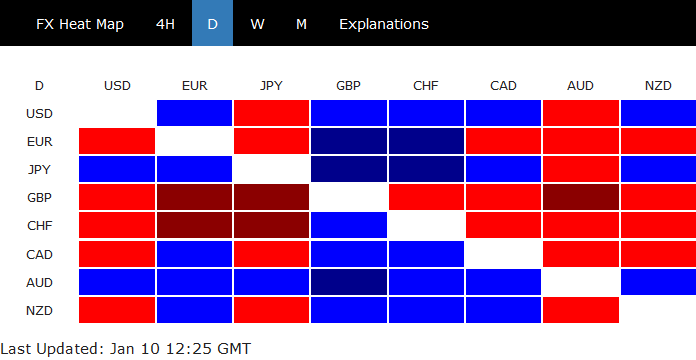
Entering US session, the forex markets are kind of mixed today. Australian Dollar is so far the strongest one, followed by Yen. Stock market rallies are starting to lose momentum but Aussie is paying little attention. Dollar is a close third as it's trying to recover some of yesterday's losses. The main driver of Dollar selling is Fed officials comment that patience is needed before making another rate move. Fed Powell, Bullard and Evans will speak again today and will likely reinforce the same message.
Sterling is the weakest ones over Brexit uncertainties. Prime Minister Theresa May's Brexit deal will have a meaningful vote next Tuesday. But as the day approaches, it looks increasingly unlikely to get the deal through the parliament. Both Brexiteers and Pro-EU camps look determined to vote it down no matter what. Swiss Franc is the second weakest, followed by Euro.
In Europe, at the time of writing:
- FTSE is down -0.03%
- DAX is down -0.27%
- CAC is down -0.69%
- German 10 year yield is down -0.024 at 0.198, back below 0.2 handle
Earlier in Asia:
- Nikkei dropped -1.29%
- Singapore Strait Times rose 0.81%
- Hong Kong HSI rose 0.22%
- China Shanghai SSE dropped 0.36%
- Japan 10 year JGB yield dropped -0.0061 to 0.025 but stays positive
UK 100 Index Finds Resistance Near 50-day SMA
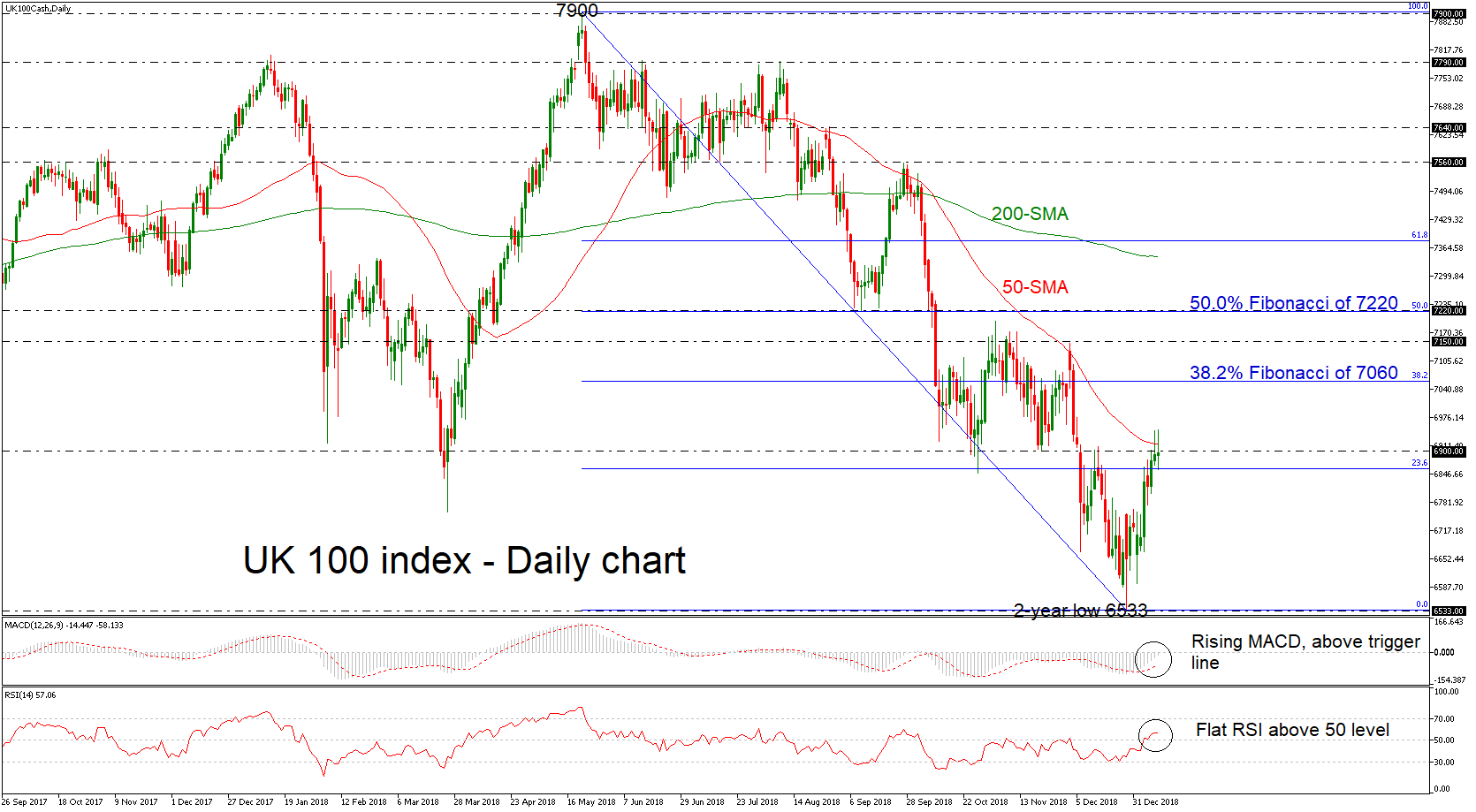
UK 100 stock index (FTSE 100) has rebounded somewhat after falling to a two-year low of 6533 on December 27, hitting the 50-day simple moving average (SMA). Momentum indicators now suggest that the market sentiment might get better as the RSI is moving in the positive territory. The MACD also looks to be changing direction, moving higher to meet its zero line in the negative zone.
If the price manages to continue bullish actions and surpass 6900, the 38.2% Fibonacci retracement level of the downleg from 7900 to 6533, around 7060 could come in focus. Further up, the index could rest around the 7150 level as it did in early December, while a violation of this point may shift attention towards the 7200 resistance, which overlaps with the 50.0% Fibonacci mark.
However, should bearish dynamics dominate, the market might revisit the two-year trough of 6533. Below that, the area around 6440, identified by the low on April 2016, could be another potential barrier for traders.
Overall, the downfall from 7900 is still active and hence the outlook remains negative despite the two consecutive green weeks. The 50-day simple moving average (SMA) has further increased distance below the 200-day SMA, hinting that the downward pattern might hold for longer.
UK Leadsom: Brexit plan B will be ready within days if the deal is voted down
In UK, Andrea Leadsom, the Leader of the House of Commons, said the government will set out its plan B should Prime Minister Theresa May's Brexit deal is voted down next week. She told the Parliament that "the prime minister has shown her willingness to always return to this House at the first possible opportunity if there is anything to report in terms of our Brexit deal and we will continue to do so."
Meanwhile, May's spokesman said she is still working on more assurances from the EU on the Brexit deal, in particular the Irish backstop. May still hope to convince MPs to vote for the agreement on January 15.
Opposition Labour leader Jeremy Corbyn said the party would vote against the deal. And after that it's voted down, "an election must be the priority. It is not only the most practical option, it is also the most democratic option." Though, he's open that "if a general election cannot be secured, then we will keep all options on the table, including the option of campaigning for a public vote."
Dollar Loses Its Luster, More To Come
Thursday January 10: Five things the markets are talking about
Global equities took a time-out overnight, ending a four-day rally as investor optimism over a possible easing in Sino-U.S trade tensions faded and concerns around global economic growth returned.
Capital markets were probably too optimistic that some concessions would be announced at the end of three-day trade talks this week between the world’s two largest economies – investors seem to prefer to wait for concrete details in the negotiations before mapping out the next leg of investments.
The dollar is steady, while crude oil prices have pulled back a tad after climbing above +$52 a barrel and entering a bull market. U.S Treasuries are leading a broad advance in sovereign bonds.
Aside from trade negotiations, investors will be watching closely as Fed Chair Powell gives a speech at the Economic Club of Washington this afternoon (12:45pm EST).
The market is looking for signs that the Fed will pause or significantly reduce its cycle of rate increases this year. Thus far, there are no signals of a Fed U-turn on interest rates, but market pressure is mounting. U.S policy makers to date have been less data dependent, and more agile in order to respond swiftly to changing conditions.
Note: Minutes from the Fed’s Dec.18-19 meeting revealed that several U.S policymakers were in favour of keeping rates steady this year.
Domestically, the ongoing partial U.S government shutdown is also weighing on market sentiment ahead of earnings season and coupled with China’s disappointing inflation data overnight, investors have a right to be worried about slowing growth in the world’s second-biggest economy.
On tap: The U.K Parliament resumes a debate on the Brexit withdrawal bill – a vote is set for the week of Jan. 14.
1. Stocks see ‘red’
In Japan, the Nikkei’s three-day winning streak came to an end overnight on profit taking as the yen (¥108.09) firmed. After rallying just over +4% in the last three-days, the Nikkei share average ended -1.3% lower, while the broader Topix dropped -0.9%.
Down-under, an afternoon rebound allowed the Aussie stock benchmark to finish higher, giving the S&P/ASX 200 its fourth-straight gain. The index rose +0.3% – digging deeper, commodities and utilities rallied +0.8%, while consumer staples lost -2%. In S. Korea, the Kospi edged down -0.7% ahead of Thursday’s expiration of options contracts.
In China, equities shed their earlier gains to end lower overnight on worries about sluggish domestic economic growth, while the enthusiasm over the Sino-U.S trade negotiations and policy support faded. At the close, the Shanghai Composite index fell -0.4%, while the blue-chip CSI300 index was down -0.2%.
An outlier was Hong Kong equities, stocks rallied for the fifth consecutive session, as a cautious Fed and a firmer yuan lifted market sentiment. At the close of trade, the Hang Seng index was up +0.2%, while the Hang Seng China Enterprises index rose +0.4%.
In Europe, regional bourses trade mostly lower on profit taking following on from weakness in Asia and lower U.S futures.
U.S stocks are set to open in the ‘red’ (-0.43%).
Indices: Stoxx600 -0.26% at 346.78, FTSE -0.17% at 6,894.75, DAX -0.36% at 10,854.07, CAC-40 -0.69% at 4,780.18, IBEX-35 +0.27% at 8,847.00, FTSE MIB +0.08% at 19,194.50, SMI +0.07% at 8,682.80, S&P 500 Futures -0.43%
2. Oil falls on U.S-China trade talks and U.S supply surge, gold higher
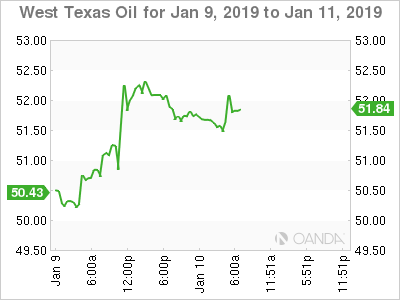
Oil prices fell more than -1% overnight due to the lack of clear guidance from the Sino-U.S trade talks and on data that again indicated an increase in fuel stocks stateside.
Brent crude futures are down -1.3%, or -79c, at +$60.65 per barrel, while U.S West Texas Intermediate (WTI) oil futures are at +$51.66 per barrel, down -70c, or -1.2%, from Wednesday’s close.
Note: Both benchmarks rallied +5% Tuesday, capping off a weeklong climb that marked oil’s longest non-stop rally since last summer.
A number of analysts have begun to cut their 2019 oil price forecasts by more than -10% this week, citing weaker economic growth expectations and rising oil supply, especially from the U.S. Consensus now expects Brent to average around +$61 a barrel this year, down from a previous estimate of +$69, and U.S crude to average +$54, against a previous forecast of +$60.
Note: The main source of new supply is the U.S – according to EIA data, crude oil production stateside remains at a record +11.7M bpd in the week ended Jan. 4 and is leading to record fuel inventories.
Crude oil prices have been receiving support from supply cuts that started at the end of last year by OPEC+. However, to balance the market would require OPEC discipline to continue well into next year.
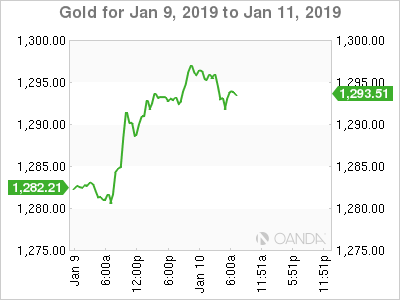
Ahead of the U.S open, gold prices have found support as growing expectations that the Fed will pause its rate tightening cycle this year and an impasse between President Trump and Democrats on funding for a border wall is weighing on the dollar. Spot gold is up +0.2% at +$1,295.83 per ounce, atop of last Friday’s peak of +$1,298.42. U.S gold futures have gained +0.4% to +$1,297.20 per ounce.
3. Europe takes down a record supply of product
Eurozone sovereign bond yields are a tad lower with the overall minor moves indicating that the market was able to take down this weeks record supply with some ease – syndicated supply came from Slovenia, Belgium, Portugal, Ireland.
The 10-year German Bund yield is trading at +0.20%, down -1 bps, while the French 10-year OAT yield is down -0.6 bps at +0.70%. Italy will round off this week’s record issuance tomorrow, Friday.
Yesterday’s FOMC December minutes highlighted that officials expressed less certainty about the “timing and size” of future rate increases.
Many Fed Members believed they could afford to be patient about further policy tightening given muted inflation pressures of last month meeting, with a few noting that they “should assess impact of risks that had become more pronounced in recent months.”
The yield on U.S 10-year Treasuries fell -3 bps to +2.68%, the largest fall in a week, while in the U.K, the 10-year Gilt yield fell -4 bps to +1.226%, the lowest in a week on the largest tumble in more than a week.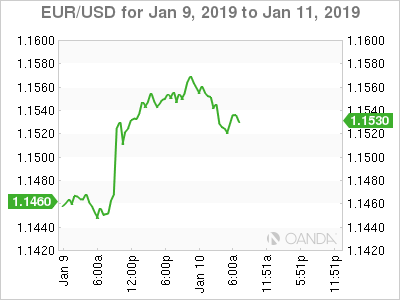
4. Dollar looking for consistency
The ‘mighty’ USD began this mornings E.U session on the softer side on rising bets that the Fed would soon implement a ‘pause’ in the current tightening cycle or significantly reduce its pace of rate increases this year. Investors continue to look for clarity – will Fed Chair Powell provide some color at today’s talks at the Economic Club in Washington (12:45 EST)?
EUR/USD (€1.1525) trades atop of its highest levels in a couple of months. Earlier in today’s session dealers witnessed a EUR ‘short squeeze’ to a nine-day high print of €1.1571. The longer the single unit stays above the psychological €1.15 handle, the techies seem more confident that they will a €1.1620 print in the short-term.
Overnight, China guided the yuan to its strongest level outright since late August. The People’s Bank of China (PBoC) fixed the midpoint for trading at ¥6.8160/dollar, compared with ¥6.8526 Wednesday. The USD ended ‘onshore’ Chinese trading yesterday at ¥6.8330.
GBP/USD is lower by -0.2% at £1.2760 area as PM May seeks EU assurances on the backstop provision. Last night, the UK government lost a second consecutive vote –an amendment to the withdrawal agreement which changed the time PM May has to come back with a plan B in the event of a defeat next week. Previously it was 21-days, it’s now 3 and had support from 20 Tory rebels again.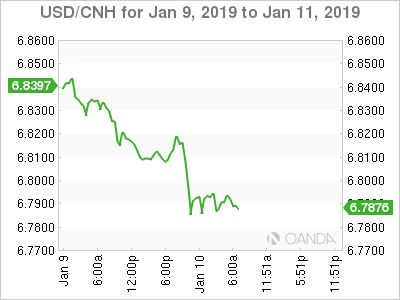
5. China’s sluggish prices raise deflation fears
Data overnight from China showed that both consumer and producer prices ‘decelerated’ sharply last month, making it even harder for authorities to improve a “sluggish demand in a deepening economic downturn.”
Consumer prices rose in December at their slowest pace in six-months, +1.9% y/y, while prices charged by producers increased by the lowest rate in 24-months, at +0.9%.
The disappointing headline prints have many raising the alarm about the rising risk of deflation in the Chinese economy. Other weaker recent data, such as factory orders, retail sales and exports, point to a slowing economy, which puts more pressure on Beijing to resolve their trade fight with the U.S sooner rather than later.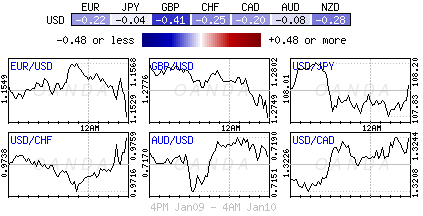
Cautious Tone In Session
Notes/Observations
- Cautious tone as US-China statement regarding recent trade talks lacked sufficient substance. US seeking ongoing verification and effective enforcement making any likelihood of such a comprehensive agreement being reached in the next 50 days as challenging
- French Nov production economic continued to paint a picture the Euro Zone was softening
Asia:
- China Commerce Ministry (MOFCOM) commented on recent talks with the US: China and US agreed to continue close communication on trade; had 'broad, deep, detailed' communication with the US
- China Dec CPI Y/Y: 1.9% v 2.1%e
Europe:
- PM May said to hold private meetings with Labour MPs to try and secure backing for her Brexit deal. PM said to be openly contemplating a Brexit plan B as a result of growing signs Parliament will reject her Brexit deal next week
- UK Labour Leader Corbyn (opposition) to call for UK election if PM May loses Brexit vote
- UK Dec BRC LFL Sales Y/Y: -0.7% v -0.3%e; Total sales growth for period was flat for its worst performance for the month since 2008
- UK Dec Barclaycard Consumer Spending Y/Y: 1.8% v 3.3% prior (slowest growth since March 2016)
Americas:
- The talks between President Trump and congressional Democrats aimed at ending the partial government shutdown collapsed in acrimony and disarray Wednesday, with the president walking out of the White House meeting and calling it "a total waste of time"
- FOMC Dec Minutes highlighted that officials expressed less certainty about the timing and size of future rate increases. Many Fed Members believed they could afford to be patient about further policy tightening given muted inflation pressures of Dec meeting with a few noting that should assess impact of risks that had become more pronounced in recent months
- Fed's Rosengren (moderate, voter): Fed could wait for clarity before next rate move; appropriate for now to have no bias toward higher or lower rates
Macro
- (CN) China: PPI fell sharply in December to hit it's lowest in 2 yearrs, bringing threat of factory deflation even closer. The breakdown showed metals and automobiles experienced deflation in PPI, which is alarming, and telecommunication-related industries also experienced very low inflation. Manynow believe that the government should take more aggressive steps to arrest sharp slowdown and interest rate cut should be put on the agenda as a result.
- (FR) France: Industrial production dropped -1.3% m/m in November, much more than expected and erasing completely the similar gain in October. The Yellow Vest protests against government policies are impacting the numbers leaving the risk of disappointing Q4 GDP print, which would further back the arguments of those at the ECB that don't want to discuss policy normalization.
- (EU) ECB: The minutes are likely to confirm growing unease and while there will have been broad support for the decision to phase out net asset purchases. Hansson's comments yesterday highlighted that the ECB's central scenario remains cautiously optimistic for now, which keeps a possible rate hike in the last quarter of the year on deck for the time being.
SPEAKERS/FIXED INCOME/FX/COMMODITIES/ERRATUM
Equities
- Indices [Stoxx600 -0.26% at 346.78, FTSE -0.17% at 6,894.75, DAX -0.36% at 10,854.07, CAC-40 -0.69% at 4,780.18, IBEX-35 +0.27% at 8,847.00, FTSE MIB +0.08% at 19,194.50, SMI +0.07% at 8,682.80, S&P 500 Futures -0.43%]
- Market Focal Points/Key Themes: European Indices trade mostly lower on profit taking after recent strength following on from weakness in Asia and lower US futures. On the corporate front UK Supermarket retail giant Tesco trades higher after the company reported better than expected Christmas trading figures, while Marks & Spencer also trades higher after affirming its outlook. Elsewhere UK retailers Halfords, Debenhams and Card Factory trades lower after trading updates; FNAC Darty trades lower on a profit warning blaming the yellow vest protests; Mitchell & Butlers on the otter hand trades higher following a 4.7% rise in Q1 comp sales,; while Suedzucker and Sodexo trade higher following earnings. In M&A news Scout24 trades lower on reports of a potential takeover by PE firms have stalled. Looking agreed notable earners include Emmis and FuelCell Energy.
- Consumer discretionary: Tesco [TSCO.UK] +2.5% (trading update), Marks & Spencer Group [MKS.UK] +1% (earnings), Halfords [HFD.UK] -16% (trading update), FNAC [FNAC.FR] -4.5% (estimates yellow vests protests losses), Card Factory [CARD.UK] -8.5% (trading update), Debenhams [DEB.UK] -7% (trading update)
- Energy: DNO International [DNO.NO] +2.5% (acquires additional stake in Faroe Petroleum)
- Financials: Danske Bank [DANSKE.DK] -2.5% (said to be sued in U.S.)
- Technology: OSRAM Licht [OSR.DE] -6% (CEO comments on Q4 performance)
- Telecom: Nokia [NOKIA.FI] -1%, Ericsson [ERICB.SE] -4.5% (Norway reportedly considering excluding Huawei from building 5G network; Ericsson updates on provisions), Proximus [PROX.BE] -1.5% (restructuring plan)
Speakers
- Spain Fin Min Calvino: To send budget to parliament during week of Jan 14th. 2018 GDP seen at 2.6% with 2-19 growth forecasted at 2.2%
- China Commerce Ministry (MOFCOM) Spokesman Gao reiterated thats trade talks with the US lasted 'long' because both sides were 'serious' and 'honest'. Declined to answer question on specifics of the trade talks but noted was in close contact with US over the next stage of talks (**Note: would not confirm if China Vice Premier Lui would travel to Washington). Structural issues (such as forced tech transfer, IP rights) have made progress during the talks
Currencies/Fixed Income
- USD began the EU session on some soft footing on rising bets that the Fed would soon implement a pause in the current tightening cycle or significantly reduce its pace of rate increases this year. Fed Chair Powell was due to speak again on Thursday at the Economic Club in Washington
- EUR/USD at highest level since Oct and holding above the 1.15 level. Dealers note that the currency seems to be defying gravity as the region's economic picture appears softening on the back of recent data. Focus turns to the ECB Dec minutes.
- Large January euro zone government bond supply being met with strong demand but the French bond auction saw the overall demand at the lower end of the range
Economic Data
- (DK) Denmark Dec CPI M/M: -0.3% v -0.2%e; Y/Y: 0.8% v 0.9%e
- (DK) Denmark Dec CPI EU Harmonized M/M: -0.4% v -0.2%e; Y/Y: 0.7% v 0.9%e
- (NO) Norway Dec CPI M/M: 0.0% v -0.1%e; Y/Y: 3.5% v 3.4%e
- (NO) Norway Dec CPI Underlying M/M: 0.0% v -0.1%e; Y/Y: 2.1% v 2.0%e
- (NO) Norway Dec PPI (including Oil) M/M: -3.5% v -3.2% prior; Y/Y: 7.8% v 14.9% prior
- (FI) Finland Nov Industrial Production M/M: +0.4% v -1.8% prior; Y/Y: 1.6% v 2.3% prior
- (FR) France Nov Industrial Production M/M: -1.3% v 0.0%e; Y/Y: -2.1% v -0.2%e
- (FR) France Nov Manufacturing Production M/M: -1.4% v +0.4%e; Y/Y: -2.2% v -1.1% prior
- (CZ) Czech Dec CPI M/M: 0.1% v 0.1%e; Y/Y: 2.0% v 2.1%e
- (SE) Sweden Nov Private Sector Production M/M: 0.0% v -0.5%e; Y/Y:2.2% v 1.5%e
- (SE) Sweden Nov Industrial Orders M/M: -2.7% v +1.0% prior; Y/Y: -2.4% v +4.0% prior
- (SE) Sweden Nov Industry Production Value Y/Y: 3.2% v 3.6% prior; Service Production Value Y/Y: 2.9% v 5.4% prior
- (IT) Italy Nov Retail Sales M/M: 0.7% v 0.2% prior; Y/Y: 1.6% v 1.5% prior
- (ZA) South Africa Dec SACCI Business Confidence: 95.2 v 95.5e
- (BR) Brazil Jan IGP-M Inflation (1st Preview): 0.0% v -0.1%e - (GR) Greece Oct Unemployment Rate: 18.6% v 18.6% prior
Fixed Income Issuance
- (FR) France Debt Agency (AFT) sold total €B vs. €8.0-9.0B indicated arnge in 2028, 2034 and 2048 bonds
- Sold €4.855B in 0.75% Nov 2028 Oat; Avg Yield: 0.68% v 0.82% prior; Bid-to-cover: 1.71x v 1.81x prior (Nov 8th 2018)
- Sold €1.88B in 1.25% May 2034 Oat; Avg Yield: 1.11% v 1.23% prior; Bid-to-cover: 1.72x v 1.59x prior (Oct 4th 2018)
- Solds €1.50B in 2.00% May 2048 Oat; Avg Yield: 1.60% v 1.70% prior, Bid-to-cover: 1.72x v 1.39x prior (Oct 4th 2018)
- (IT) Italy Debt Agency (Tesoro) sold €7.0B vs. €7.0B indicated in 12-month Bills; Avg Yield: 0.285% v 0.370% prior; Bid-to-cover: 1.54x v 1.62x prior
Looking Ahead
- 05:30 (HU) Hungary Debt Agency (AKK) to sell in 12-month Bills
- 05:30 (PL) Poland to sell PLN3.0-6.0B in bonds
- 06:00 (IE) Ireland Dec Live Register Monthly Change: No est v -3.1K prior; Live Register Level: No est v 207.2K prior
- 06:00 (ZA) South Africa Nov Manufacturing Production M/M: 0.3%e v 1.1% prior; Y/Y: 1.6%e v 3.0% prior
- 06:00 (BR) Brazil CONAB Corp Report
- 06:00 (RO) Romania to sell RON400M in 4.85% 2026 bonds
- 07:00 (CZ) Czech Central Bank to comment on CPI data
- 07:30 (EU) ECB Account of Dec Governing Council Meeting (Dec Minutes)
- 08:00 (RU) Russia Gold and Forex Reserve w/e Jan 4th: No est v $466.0B prior
- 08:00 (UK) Baltic Dry Bulk Index
- 08:30 (US) Initial Jobless Claims: 226Ke v 231K prior; Continuing Claims: 1.74Me v 1.740M prior
- 08:30 (CA) Canada Nov New Housing Price Index M/M: 0.0%e v 0.0% prior; Y/Y: 0.0%e v +0.1% prior
- 08:30 (CA) Canada Nov Building Permits M/M: -0.5%e v -0.2% prior
- 08:35 (US) Fed's Barkin (hawk, voter)
- 09:00 (MX) Mexico Dec Consumer Confidence Index: 101.8e v 100.9 prior
- 09:00 (MX) Mexico Nov Leading Indicators M/M: No est v -0.06 prior
- 09:00 (MX) Mexico Vehicle Production: No est v 345.0K prior; Vehicle Exports: No est v 273.8K prior
- 10:00 (US) Postponed: Nov Final Wholesale Inventories M/M: 0.5%e v 0.5% prelim; Wholesale Trade Sales M/M: No est v -0.2% prior
- 10:30 (US) Weekly EIA Natural Gas Inventories
- 11:30 (US) Treasury to sell 4-Week and 8-Week Bills
- 12:00 (US) Fed Chair Powell
- 12:30 (FR) ECB's Villeroy (France) at event
- 12:40 (US) Fed's Bullard (dove, voter)
- 13:00 (US) Fed's Evans (hawk, non-voter)
- 13:00 (US) Treasury to sell 30-year bonds
- 16:30 (AU) Australia Dec AiG Performance of Construction Index: No est v 44.5 prior
- 17:30 (US) Fed's Vice Chair Clarida (voter, moderate)
- 18:00 (PE) Peru Central Bank (BCRP) Interest Rate Decision: Expected to leave Reference Rate unchanged at 2.75%
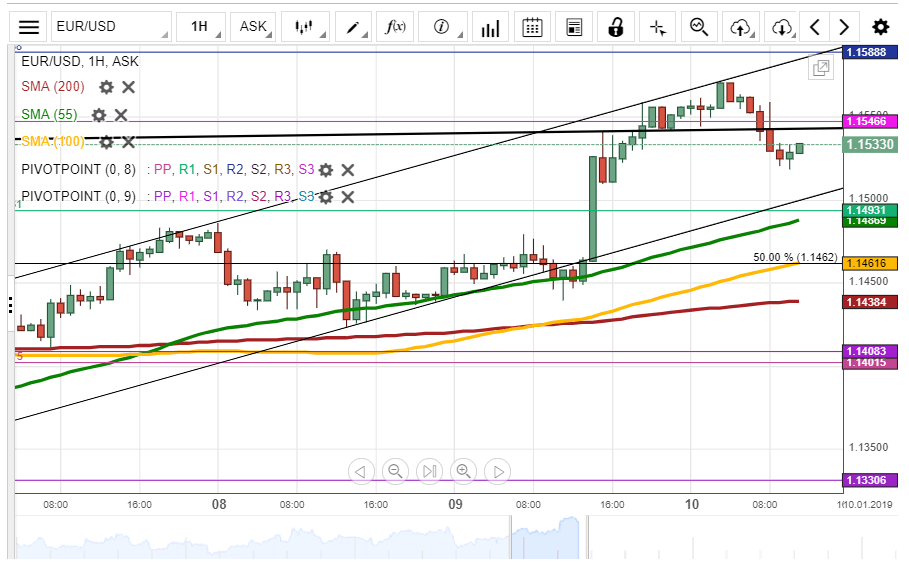
EUR/USD Trades Sideways
During the last trading session, the European Single Currency jumped by 62 pips or 0.54% to push the European Single Currency to break the resistance level of the weekly R1 at the 1.1546 mark.
In regards to the near-term future, most likely the currency exchange rate will trade sideways to stay between the weekly R1 at the 1.1546 mark and the weekly R2 at the 1.1588 mark. Meanwhile, the simple moving averages will try to catch up the rate during the trading session.
However, the European Single Currency might depreciate against the US Dollar to fall towards the weekly R1 at the 1.1496 mark.
GBP/USD Appreciates To 1.2850 Mark
During the previous trading session, the 55-hour simple moving average supported the rate to push it towards the 1.2800 level. On Thursday morning, the currency exchange rate was retraced by the bottom boundary of the ascending small pattern line at the 1.2757 mark.
Most likely, the British Pound will keep trying to appreciate against the US Dollar to the 1.2800 level. Besides, supports of the 100-hour and the 55-hour simple moving averages will give additional support for the British Pound during the session.

USD/JPY Trades Below S1 At 108.17
During the previous trading day, the 200-hour simple moving average resisted the US Dollar to push the rate to pass through the most of the technical indicators. The USD/JPY ended Wednesday's trading session at the 108.00 level.
In regards to the near-term future, most likely, the resistance levels of the simple moving averages together with the 38.20% at the 108.43 mark will retrace the rate to the 107.50 level.
However, the weekly pivot point at the 107.96 mark could support the rate to trade sideways at the 108.00 level during the day.

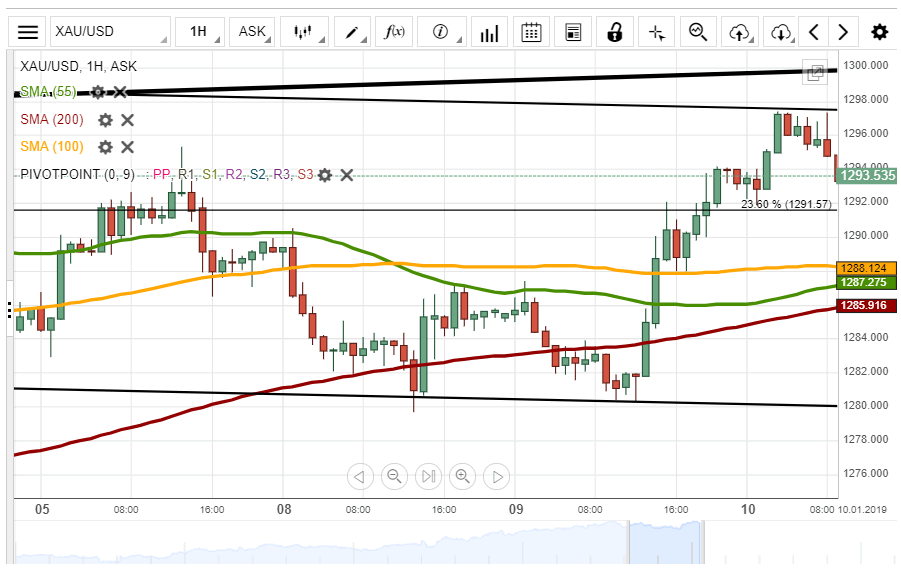
XAU/USD Breaks 23.60% Fibo At 1,291.57
During Wednesday's trading session, the gold broke most of the technical indicators to trade above the 23.60% Fibonacci retracement level at the 1,292.86 mark.
It is expected that the 23.60% Fibonacci retracement level at the 1,292.86 mark will give additional support for the gold to appreciate against the US Dollar. Most likely, the yellow metal will trade near the upper boundary of the ascending dominant pattern line at the 1,300.00 mark.
On the other hand, the yellow metal could depreciate against the US Dollar to pass through the support levels of the simple moving averages to trade near the bottom boundary of the ascending medium pattern line at the 1,284.00 mark.