

Sample Category Title
Powell: Fed will be waiting and watching patiently
Fed Chair Jerome Powell echoed other Fed officials' comments and said yesterday that policymakers can be patient on next rate move. And Fed will be "waiting and watching" in the coming months.
Powell said at the Economic Club of Washington that "Especially with inflation low and under control, we have the ability to be patient and watch patiently and carefully as we ... figure out which of these two narratives is going to be the story of 2019". He referred to the risks of overheating and slowdown. Though, he maintained that Fed will continue to shrink the balance sheet to a "substantially smaller" level.
Powell also emphasized that the federal funds rate projections are not plan. He said "there is no such plan" and "that was conditional on a very strong outlook for 2019". He added "there is no pre-set path for rates" and "we can flexibly and quickly move policy, and we can do so significantly if that's appropriate."
China VP Liu to visit Washington in January for top level trade talks
US-China trade negotiation is set to set up to top level talks later in January. US Treasury Secretary Steven Mnuchin said Chinese Vice Premier Liu He will most likely visit Washington later in the month.
He told reports that "The current intent is that the Vice Premier Liu He will most likely come and visit us later in the month and I would expect the government shutdown would have no impact," And, "we will continue with those meetings just as we sent a delegation to China."
Trump also said yesterday that "we're negotiating and having tremendous success with China." Also, "I think that China is actually much easier to deal with than the opposition party". Trump related to the deadlock he is having with the Democrat on the border wall.
USD/JPY Facing Significant Hurdles Near 108.80
Key Highlights
- The US Dollar recovered recently and moved above 107.20 against the Japanese Yen.
- There is a crucial bearish trend line formed with resistance at 108.45 on the 4-hours chart of USD/JPY.
- The US Initial Jobless Claims for the week ending Jan 05, 2018 declined from 233K (revised) to 216K.
- The US Consumer Price Index for Dec 2018 will be released today, which could increase 0.1% (MoM).
USDJPY Technical Analysis
After a sharp decline below 105.00, the US Dollar recovered and moved above 107.20 against the Japanese Yen. The USD/JPY pair is now facing key resistances near 108.50, 108.80 and 109.20.
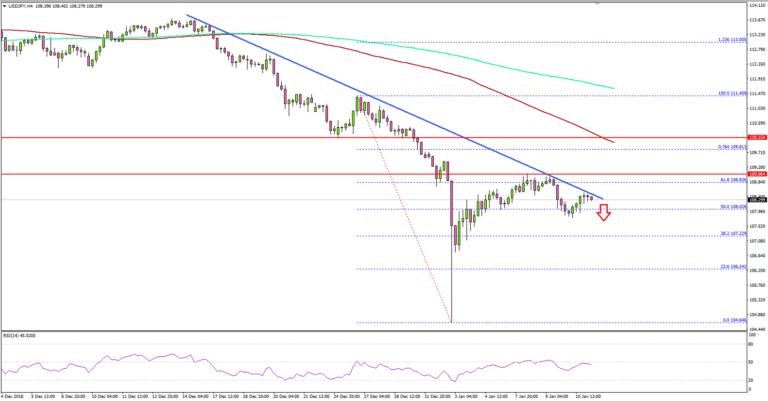
Looking at the 4-hours chart, the pair traded as low as 104.64 and later bounced back above 105.00, 105.80, 106.80 and 107.20. The pair even cleared the 50% Fib retracement level of the last drop from the 111.40 high to 104.64 low.
However, the pair faced a strong resistance near the 109.00-109.10 zone. Besides, there is a crucial bearish trend line formed with resistance at 108.45 on the same chart. Finally, the 61.8% Fib retracement level of the last drop from the 111.40 high to 104.64 low is near 108.85 to act as a solid hurdle.
To recover further, the pair must break the trend line and settle above 109.00 in the near term. If not, there is a risk of a fresh decline below the 107.50 and 107.20 support levels.
Fundamentally, the US Initial Jobless Claims figure for the week ending Jan 05, 2018 was by the US Department of Labor. The market was looking for a decline from 231K to 225K.
However, the result was better than the forecast since the US Initial Jobless Claims declined to 216K. On the other hand, the last reading was revised up from 231K to 233K.
Overall, the US Dollar may struggle to gain traction above 109.00 against the Japanese Yen. Besides, both EUR/USD and GBP/USD are traded with a positive bias this week.
Economic Releases to Watch Today
- UK Industrial Production for Nov 2018 (MoM) – Forecast +0.2%, versus -0.6% previous.
- UK Manufacturing Production for Nov 2018 (MoM) – Forecast +0.3%, versus -0.9% previous.
- US Consumer Price Index Dec 2018 (MoM) – Forecast -0.1%, versus 0% previous.
- US Consumer Price Index Dec 2018 (YoY) – Forecast +2.2%, versus +2.2% previous.
- US Consumer Price Index Ex Food & Energy Dec 2018 (YoY) – Forecast +2.2%, versus +2.2% previous.
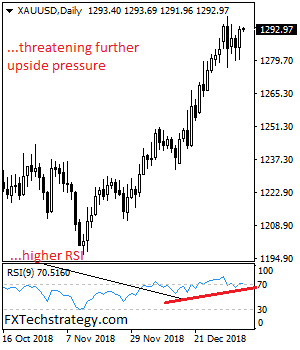
GOLD Bullish, Remains Biased To The Upside
GOLD remains biased to the upside as it looks to resume its broader upside pressure as it closed higher on Wednesday. On the downside, support comes in at the 1,280.00 level where a break will turn attention to the 1,270.00 level. Further down, a cut through here will open the door for a move lower towards the 1,260.00 level. Below here if seen could trigger further downside pressure targeting the 1,250.00 level. Conversely, resistance resides at the 1,300.00 level where a break will aim at the 1,310.00 level. A turn above there will expose the 1,320.00 level. Further out, resistance stands at the 1,330.00 level. All in all, GOLD looks to move further higher.
Steady As She Goes
Markets
The NY session saw a decent rebound in risk and a slight recovery in the USD, leaving USDJPY sitting near 108.40 as we open the book for the final trading session of the week in Asia.
The main two stories the market has been following, the Fed and the US/China trade played a helping hand buttressing investor risk sentiment overnight as US equities rose for the fifth straight session weathering a bout of negativity from weaker holiday sales while some of the shine initially faded from the US-China trade talks. But indeed, the ability for the market to rally in the face of bearish news is a sure hallmark that normalcy is returning to the markets which suggest current momentum can be sustained.
However, Federal Reserve Chairman Jerome Powell took the spotlight amid a Fedspeak frenzy echoing his recent comments from last week that the central bank’s commitment was to proceed with caution on the monetary policy, which of course equity markets interpreted as deliciously dovish. While positive signs on the trade war front continue to resonate favourably with investors, all of which suggest Asia stocks are ready for gains.
Event-wise today the calendar is light so that investors will place much more weight on US CPI print.
Oil markets
Oil markets have gone from the outhouse to the penthouse after extending its best winning streak in nearly a decade. Both the S &P and OIl markets have found solid footing from a thaw in US-China trade tensions, and Fed Powell stressing his patience all added to the positive buzz as energy markets continue to extend its recent period of close correlation with equity markets.
Yesterday, I thought the recent move was a bit overdone given the larger-than-expected increase in US product inventories. But I’m glad I stopped overthinking as clearly the market sentiment continues to run uninterrupted, and indeed the ability for the market to rally in the face of bearish news is a sure hallmark that the bulls are back in the game.
Trust me when it comes to trading in cross-asset markets, overthinking is much more dangerous than not thinking at all!!
Gold Markets
Gold prices moved lower as the dollar showed some Moxy, particularly against the EUR and JPY as US yields firmed overnight. But we’re currently carving out an impressive structural range above solid support at $ 1280 as on the Fed policy front; everything is lining up for a weaker USD and an eventual breakthrough $1300 in convincing fashion.
Currency markets
Euro: Finally breaking through the 1.1500 is enormous, and if I’m reading this one correctly, G10 traders will put greater emphasis on the dovish Fed vs the already baked in downside risk for the EUR which suggest the EUR move higher to test the 1.1629 (200-day MA) on it’s the way to 1.1800
AUD: I expect the AUD to move higher as we move closer to an eventual trade truce but chatting with my AUD trader colleagues most have reached near enough to the .7200 target that they are in profit-taking mode. So, until more definitive trade detent or at least sings of one, further Aud gains could be a grind into the weekend.
Ringgit: Bonds Bonds Bonds !! MYR bonds are in demand as the currency broker the key 4.10 as traders were scurrying for MYR bonds to get Ringgit exposure. In the absence of an NDF market, investors access MYR bonds to gain currency exposure. Indeed, the stars are aligned for the Ringgit with risk on, a dovish Fed a weaker USD, lower USD bond yields and rising oil prices all suggesting the local unit could extend gains to the next critical support level around 4.0750,
The “risk on” signs are compelling with the Fed signalling the Greenlight for risk which should benefit commodity and oil-linked currencies.
And this should be a sure-fire bet the MYR will trade favourably as there is nothing better for EM Asia risk than a sturdy local currency basket
But with the Fed pausing it walks back a lot of long USD positions that were built around the Fed policy normalisation vs BNM neutral stance, and if we get shot in the arm from a definitive Trade war truce, we could see the MYR extend gains to USDMYR 4.05 in a heartbeat.
Eco Data 1/11/19
[php_everywhere instance="1"]
Dollar to Take a Special Look at US CPI
Since it is uncertain how long the impasse over funding Trump’s wall will keep parts of public services closed in the US including the Bureau of Economic Analysis, which is responsible to update the core PCE index, the core CPI figure will attract extra attention this week. Should the measure beat forecasts, suggesting that inflation is well anchored, investors may turn more positive that the Fed may not abandon its rate hiking plans this year.
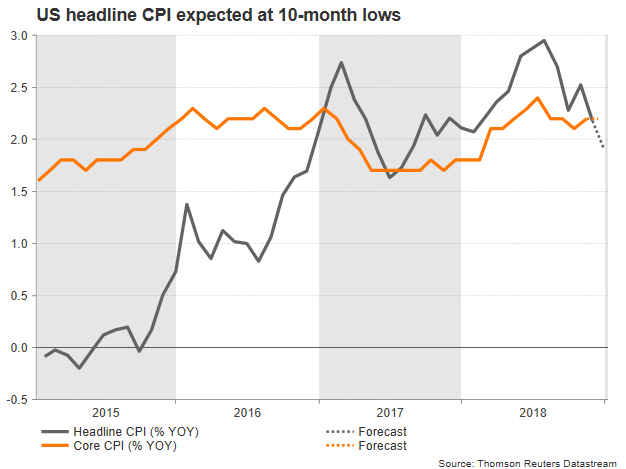
On Friday at 1330 GMT, the US Department of Labor Statistics is expected to show that the headline CPI contracted by 0.1% in December on a monthly basis for the first time after eight months, sending the yearly gauge down by 0.3 percentage points to 1.9% (a 10-month low). Undoubtedly the recent crash in oil prices could be the main catalyst behind the weakness as gasoline prices declined for 12 weeks in a row, with the Energy Information Administration saying that demand in the US was down at almost two-year lows in the week ending December 28 despite holidays travelling.
Indeed, the core CPI figure could prove that the lost momentum in inflation is a product of temporary volatility and not of persisting consumption-negative pressures, if the measure holds steady at 0.2% m/m and 2.2% y/y as analysts forecast. Still, the Conference Board Consumer Confidence index which registered its second monthly decline in December after hitting a decade-high in October, could be a warning sign that households are turning more careful with their overall spending.
The Federal Open Market Committee (FOMC) finished 2018 with another rate hike in December, marking four in total for the year but the minutes from the gathering released yesterday revealed that a few policymakers were hesitant about their decision due to the low-inflationary backdrop. For the same reason and acknowledging the risks from escalating trade frictions and a slowing global economy, the Committee downgraded its rate projections from three to two. Yet the cautious language used in the minutes coupled with Powell’s latest dovish remarks and a row of discouraging data creates doubts about whether the Fed could push tightening even further this year, while the scenario of a rate cut has already started to grow in investors’minds.
With the Fed turning more data-sensitive and the already three-week-old government shutdown threatening the on-time issuance of the core PCE index, which the Bank relies on to adjust policy, the spotlight will shift to Friday’s CPI readings which consequently may bring a higher-than-usual-volatility to the dollar.
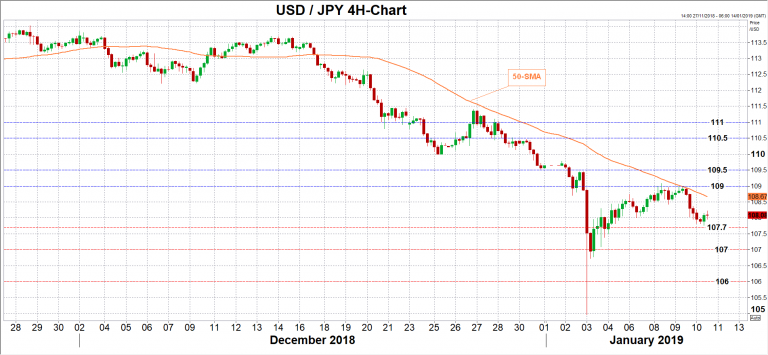
An upward surprise in the numbers could restore investors optimism for further monetary tightening in coming months, scrapping chances for rate cut as well. In this case, dollar/yen could potentially visit the 50-period simple moving average on the 4-hour chart (108.67) which recently acted as a barrier to upside movements. Above that line, the bulls may move between 109.50 and 110.50, while higher 111 and 111.50 may be the next targets.
If the data disappoint, clouding prospects for higher inflation and thus additional rate hikes, the pair could move south to meet support near 107.70. Falling lower, the door could open for the 107 round level, while if this fails to hold too, bearish action may stop near 106.
Powerful Reversal Pattern on USD/JPY Points Towards 108.4 Area – Elliott Wave Analysis
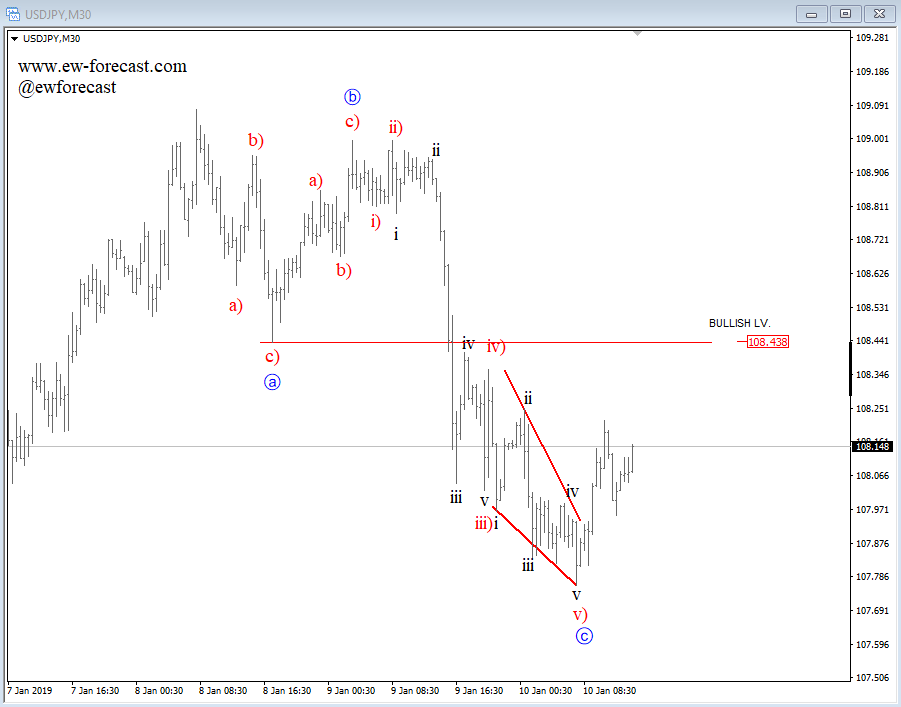
USDJPY is showing us a three-wave corrective decline called a flat correction, because of only three legs within the first wave »a« and the second wave »b«. We see this correction as completed, especially after that sharp bounce out of an ending diagonal which was located in wave c. In such we expect to see more upside on the pair, ideally in five waves from the lows with a break above the 108.44 level. That said, be aware of a temporary pullback during the uptrend.
An ending diagonal is a special type of pattern that occurs at times when the preceding move has gone too far too fast, as Elliott put it. Once completed it tends to push price into a sharp reversal into the opposite direction. USDJPY, 30Min
Stocks Appear Poised to Snap Five-Day Rally
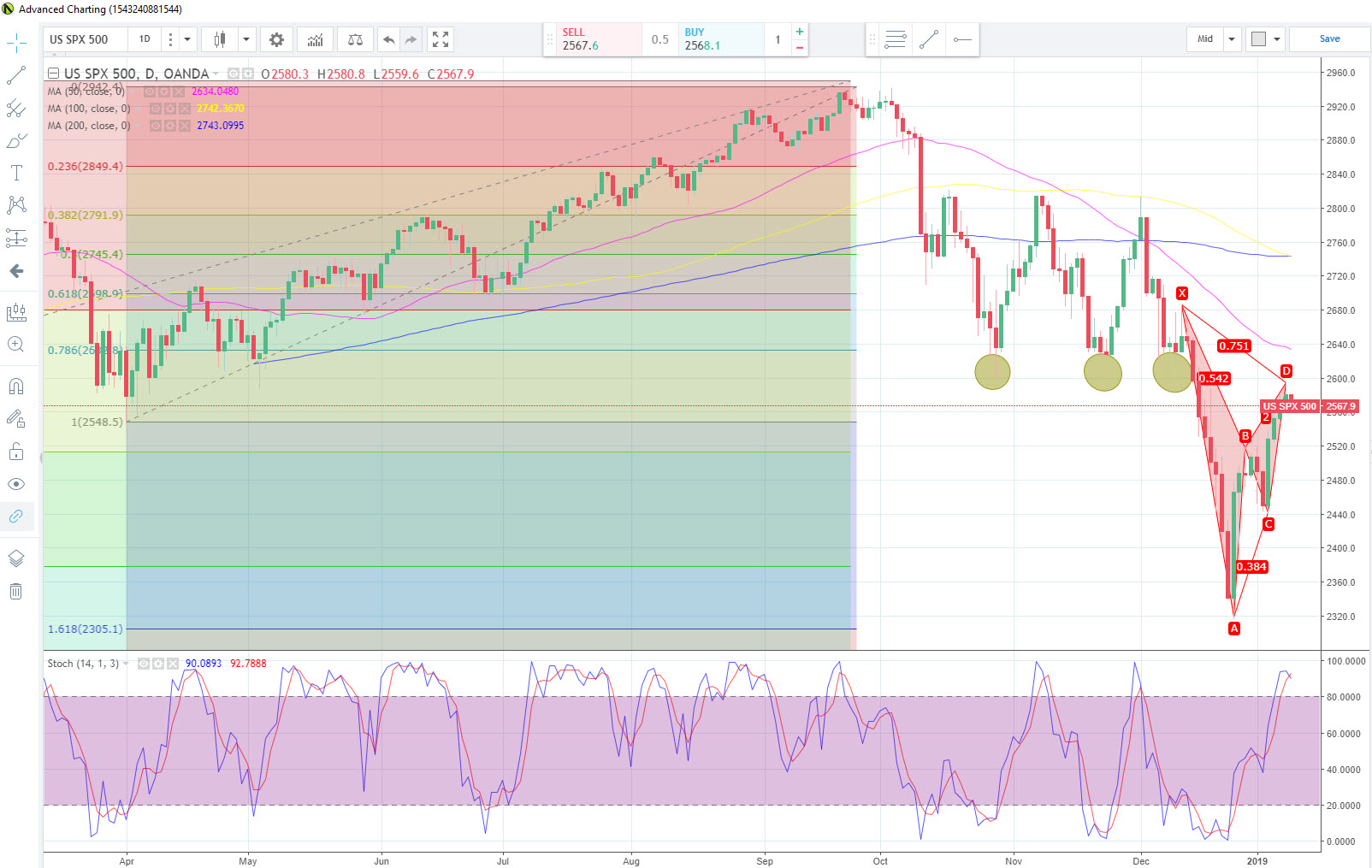
The stock market rally could be ripe for a pullback after recovering almost one-third of slump we saw in the fourth quarter. Today’s weakness is being attributed to poor holiday sales from Macy’s and concern over what will be the next step in the latest round of US-China trade discussions. The Dow Jones Industrial Average opened lower by 0.5%, while the dollar traded mixed against its major trading partners.
With 50 days left until the March 1st deadline of the next round of tariff increases from the US, market participant skepticism is growing that the US and China will not be able to layout a structural framework agreement for a long term trade deal. Both the US and China issued statements following three days of talks, with the US providing a long list of outstanding issues. China’s Commerce Ministry spokesman Gao Feng noted that that progress had been made during the talks on structural issues including forced tech transfers and the protection of intellectual property rights. If the US confirms, that would be huge progress in talks, as rectifying the forced technology transfer issue is a major goal from the Trump administration.
Yesterday the FOMC Dec Minutes stated that officials expressed less certainty about the timing and size of future rate increases. Many Fed Members believed they could afford to be patient about further policy tightening given muted inflation pressures of December meeting with a few noting that they should assess impact of risks that had become more pronounced in recent months. Today will be busy with Fed speak. We already heard from Fed’s Barkin, he is a hawk and a non-voter. His comments were pretty much in line with the Fed statement and Minutes. He sees slower growth in 2019 compared to 2018. He noted that the Fed normalizing rates is not aimed at restraining the economy. Later today we will hear from Fed Chair Powell, Bullard, Evans, Kashkari and Clarida. Kashkari, is a dove and a non-voters this year.
Sunset Market Commentary
Markets
Global core bonds rebounded with German Bunds outperforming US Treasuries. The recent uptick in risk sentiment came to a halt as recent good news is starting to be priced in asset prices. The economic data wee of second tier significance. Asian markets reflected the change in market sentiment this morning, as Asian equity indices printed mixed to negative. European equities opened lower, providing some support for core bonds. However, German Bunds proved resilient as the move remained rather limited. The release of the minutes of the December ECB meeting after lunch hadn’t much influence. The German yield curve edged lower with changes varying between ‑0.7 bps (2-yr) and -3 bps (10-yr). Similar story in the US, with only the weekly jobless claims attracting some investor interest.. The claims printed at 216k, slightly better than expected. US Treasuries had little to work with and remained near opening levels throughout the day. With US investors joining the dealings, US Treasuries edged little higher. The US yield curve is moving both ways as changes varied between -1.5 bps (5-yr) to +0.1 bp (30-yr).
The dollar dropped below some significant technical levels yesterday, including EUR/USD breaking out of the 1.12/1.15 trading range. The move was mainly driven by indications from the Fed that policy normalization will likely slow as uncertainty on the economic outlook is growing and as inflation doesn’t pose an immediate risk. The repositioning out of the US dollar slowed today. This slowdown coincided with a pause in risk rebound. There were no eco data to guide FX trading. Interest rate differentials widened slightly in favour of the dollar. This widening was no big issue, but maybe it was a good excuse to prevent further aggressive USD selling at this stage. Several Fed governors, including Chairman Powell are still scheduled to speak later today, but the change in the Fed approach was already well documented of late. EUR/USD is changing hands in the 1.1525 area. USD/JPY stabilizes in the low 108 area.
The Brexit sage clearly entered a new phase yesterday. Amendments in Parliament yesterday illustrated that the government of PM May is losing control on the Brexit process in case PM May’s deal is rejected next week, which remains the most likely scenario. After that, all options are open including general elections, a new referendum or a delay of Brexit in one way or another. In first stage, the process will result in a highly unstable political context. This remains a good reason for investors to avoid all kind of sterling exposure, in particular sterling longs. EUR/GBP after yesterday’s vote jumped above 0.90. The 0.91 resistance is on the radar. Cable (1.2760 area) held up fairly well as the dollar was in the defensive overall.
News Headlines
UK Labour leader Jeremy Corbyn advocated a new general election as a solution to break the deadlock on Brexit. In this scenario, a renegotiation of the of the Brexit deal would probably lead to an extension to Article 50. In the meantime, Jaguar Land Rover said it intends to cut some 4500 jobs mainly in the UK, partly caused by Brexit worries.
The ECB meeting minutes of the December meeting showed that ECB officials considered to downgrade the economic outlook for the euro-area. As president Draghi was set to officially announce the decision to halt bond buying after four years, the downgrade didn’t happen. The ECB agreed that cutting their 2019 growth projections was in itself acknowledging that risks to the outlook had increased.
The Norwegian consumer headline inflation stabilized in December at 3.5% (Y/Y) and 0.0% (M/M) while markets expected a small decrease. Core inflation also declined less than expected. So, the scenario of a March Norges Bank rate hike is still on the table.