Sample Category Title
Currencies: Will USD Suffer Further Losses From CPI?
- Rates: US CPI and Italian supply in focus
US Treasuries underperformed during yesterday’s US session as stock markets recovered from opening weakness and after a soft 30-yr bond sale. Soft US CPI readings and cautiousness about President Trump’s reaction function in the border funding debate might cause outperformance of US T’s today. First Italian supply of the year is expected to be well digested. - Currencies: Will USD suffer further losses from CPI?
The USD decline slowed yesterday, at least temporarily. Still, EUR/USD sustained north of 1.15 as Fed speakers confirmed a wait-and-see approach. Today, the focus is on the US December CPI. A slowdown in headline inflation might comfort markets to continue recent repositioning away from the dollar.
The Sunrise Headlines
- US equity markets gained modest ground yesterday, recovering from opening weakness. The first HY bond deal in 40 days supported sentiment. Asian equities trade mixed this morning with Japanese and Chinese indices all reaping profits.
- US President Trump cancelled his trip to the World Economic Forum later this month in Davos (Switzerland), as the partial government shutdown keeps US politics in deadlock. The shutdown enters its 21th day.
- US Fed chairman Powell reiterated that the central bank can apply a more flexible approach while it’s assessing the impact of economic conditions. VP Clarida added it might alter its balance sheet normalization process if necessary.
- Steven Mnuchin, US Treasury secretary, told that Liu He, Chinese VP, is most likely to visit Washington later this month to continue US-Sino trade talks after three days of negotiations concluded on Wednesday.
- The Chinese renminbi advanced 1.7% so far this week against the US dollar, its best week since 2005, when China left its currency peg and changed to a floating exchange rate regime. USD/CNY currently trades below 6.78.
- Australian retail sales rose 0.4% (M/M) in November, more than the month before (0.3%) and market expectations (0.3%). The Australian dollar gained this morning, but partially on overall US dollar softness.
- Today’s economic calendar is very meagre, with in the US only CPI data for December lining up. The UK publishes some second-tier data, while the Italian government taps the bond market for the first time this year
Currencies: Will USD Suffer Further Losses From CPI?
Soft US inflation to inspire further USD decline?
The USD decline slowed yesterday, at least temporarily. The risk rebound, which was at least partially correlated with a weaker dollar, also shifted into a lower gear. Fed governors, including Chairman Powell reiterated that the Fed can be patient and monitor the data in order to see whether it is still appropriate to raise rates further. The comments had little direct impact on US yields or on the dollar. Both continued a technical intraday rebound. Sentiment on risk improved again later in US dealings. EUR/USD closed exactly at 1.1500 (from 1.1543). USD/JPY also gained modestly (108.43 vs 108.17). This morning, most Asian equity markets are again in positive territory. The pace of the CNY rebound (USD/CNY 6.75 area) is catching the eye. The yuan profits from an overall softer dollar and is supported by investor hopes on easing trade tensions between the US and China. Australian equities underperform as the Aussie dollar strengthens (AUD/USD > 0.72). The US dollar remains in the defensive overall. EUR/USD is trading in the 1.1530 area. USD/JPY (108.20) is also under slight pressure even as risk sentiment remains constructive. The December US CPI takes centre stage today. A soft inflation context currently justifies the Fed’s softer wait-and-see approach. Consensus expects headline inflation to ease from 1.9%. Core inflation is expected unchanged at 2.2%. The risks headline inflation are probably to the downside (oil prices). A figure in line or softer than expected will comfort markets on the softer Fed approach and might be inspire further USD selling. This is our preferred scenario. On the other hand, an upward surprise of (core) inflation, might wrong-foot (FX) markets. Since end last week, the dollar lost momentum and EUR/USD clearing a first technical barrier (1.15). We had a cautious bias on the US dollar as it became clear that the USD will get little interest rate support in the foreseeable future. For now, we see no reason to row against the USD negative momentum. EUR/USD 1.1621 (mid-Oct top) is next reference.
EUR/GBP hovered the 0.90 big figure yesterday. The UK currency remains hostage to the ever growing political uncertainty in the run-up to Tuesday’s ‘meaningful vote’. At some point, this process might lead to a Brexit delay or another scenario that might be considered more favourable for sterling. However, short term, visibility on the next Brexit steps remains close to non-existent. This might continue to weigh on sterling. EUR/GBP 0.91 is the next technical reference.
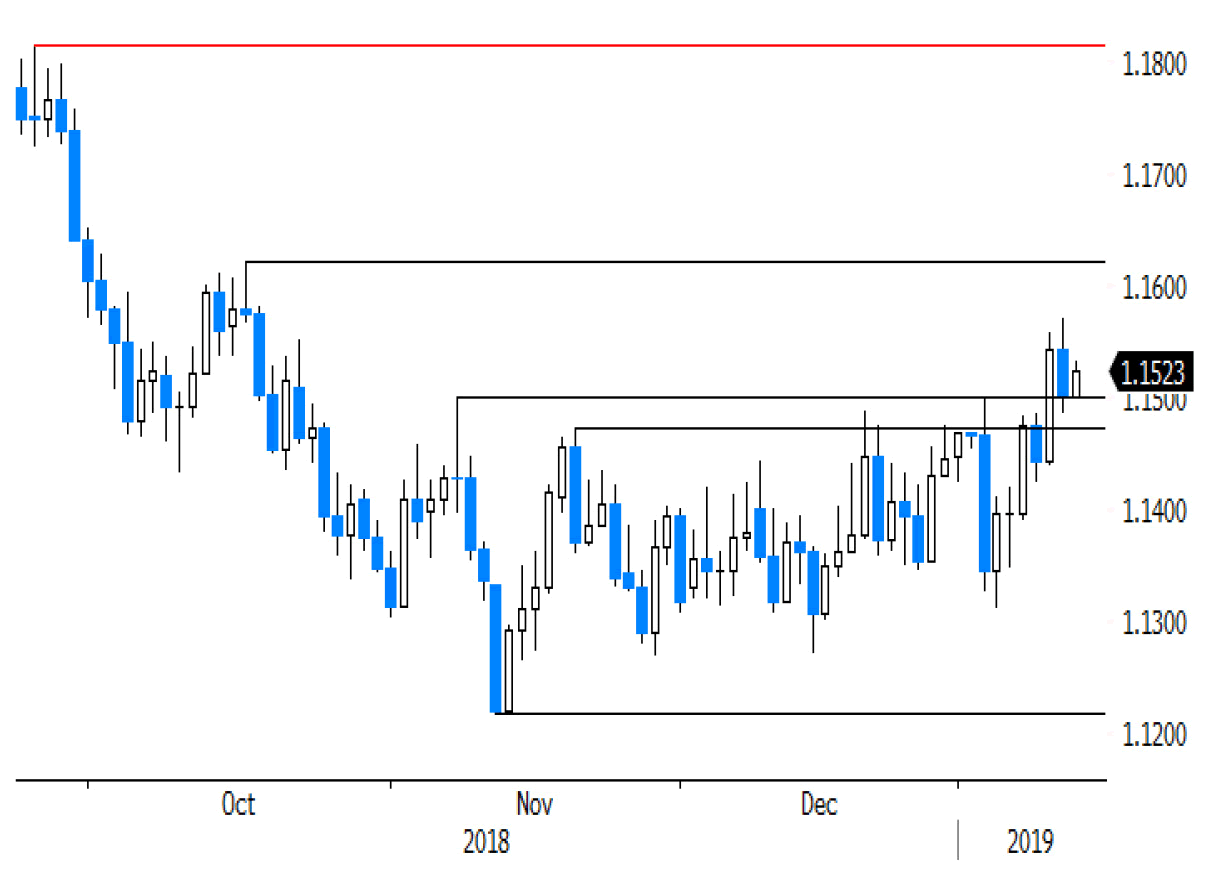
EUR/USD holding north of 1.15 as Fed confirms wait-and-see approach
Patient Central Banks
Market movers today
The main economic release today is the US core inflation number. We estimate the CPI core index rose +0.2% m/m in December, implying an unchanged core inflation rate at 2.2% y/y.
In the UK, the monthly GDP estimate for November is due to be released. Given the weak PMIs, do not expect a strong number and estimate another 0.1% m/m (0.3% 3M/3M) increase.
In Sweden, average house prices for December are due out.
In Denmark, industrial production data for November is due to be released.
Selected market news
Headlines overnight were dominated by several interesting central bank headlines. Fed Chair Jerome Powell spoke yesterday. He emphasised that the Fed is now in a place where it has room to be patient and flexible in terms of further adjustments in monetary policy. On the balance sheet, his message was that it will be substantially smaller than now, but bigger than before the crisis. Fed Vice Chair Richard Clarida followed up on Powell's message, stressing that the Fed should be forward looking as it would not be prudent to wait until a slowdown before acting. On the balance sheet discussion, he said it will be consistent with the Fed's goals for monetary policy.
Francois Villeroy expressed caution from the side of the ECB in terms of the next step following the halt of the bond purchase programme in December. He stressed that the ECB wants to be predictable but not recommitted and was keeping its options open amid risks to the outlook for the eurozone economy. While ECB and Fed officials are sounding patient, the Bank of Canada's Stephen Poloz yesterday conveyed that the base case for the BoC is still that the expected slowdown in economic growth following the slump in oil prices would be only temporary, which means that further interest hikes could still be on the cards.
There was also news on the trade front. Chinese Vice Premier Liu He is scheduled to meet US Trade Representative Lighthizer and Treasury Secretary Steven Mnuchin on 30-31 January to continue talks on a trade deal.
EURUSD Dip Buyers Retain Control
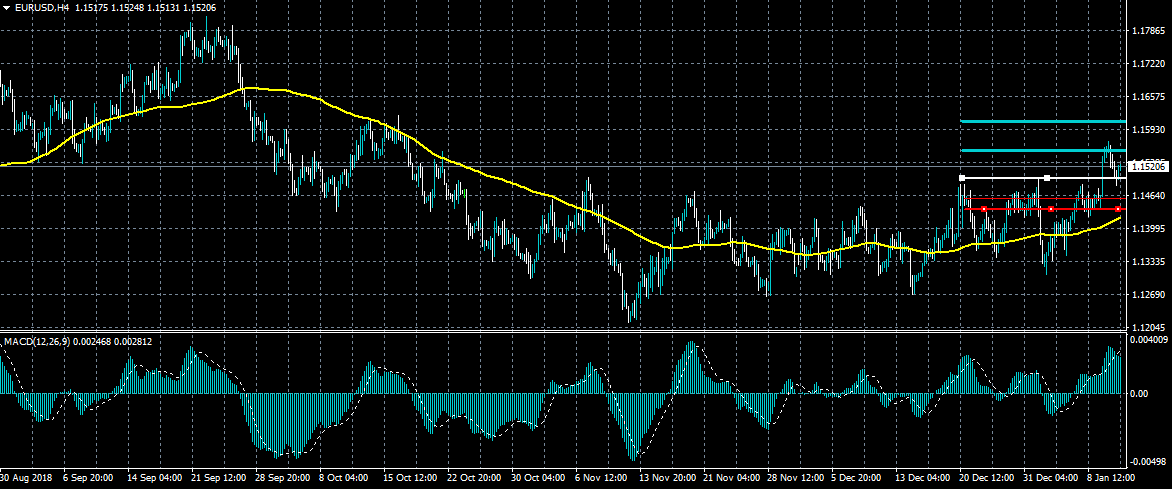
The euro currency is starting to recover short-term bullish momentum against the US dollar, following a brief test of buying demand below the key 1.1490 level. The intraday sentiment surrounding the EURUSD pair remains bullish while price trades above the 1.1490. It is also worth noting that the EURUSD has performed two consecutive daily price closes above its one-hundred day moving average.
The EURUSD pair is intraday bullish while trading above the 1.1490 level, key technical resistance remains at the 1.1550 and 1.1600 levels.
If the EURUSD pair moves below the 1.1490 level, sellers may test towards the 1.1460 and 1.1430 support levels.
GBPUSD Traders Awaiting Important Data
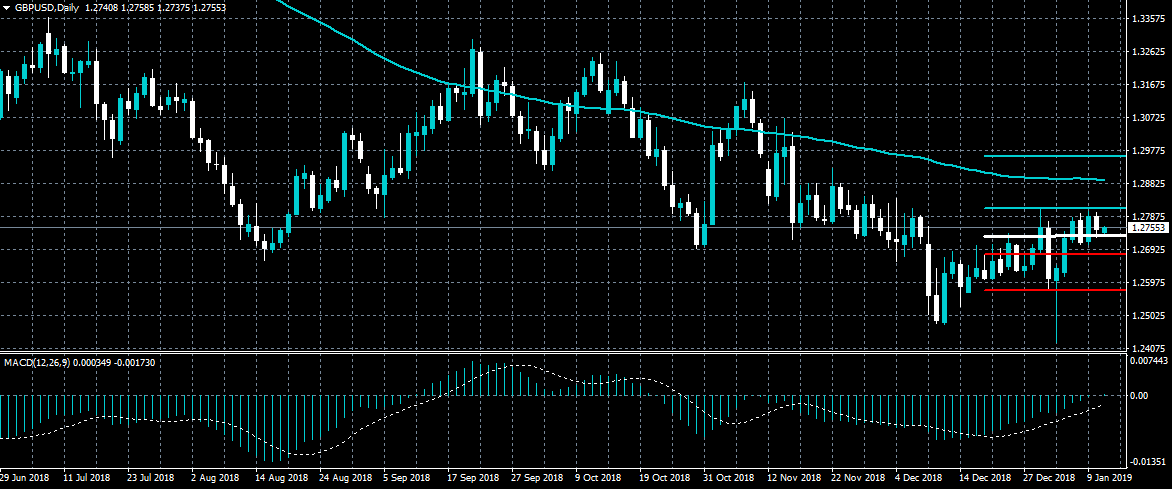
The British pound remains largely unchanged against the US dollar, as traders await the release of important macroeconomic data from the United Kingdom economy this morning. A clear break from the 1.2700 to 1.2800 price range is currently needed to provide the impetus for the next directional move. Short-term technical indicators remain largely neutral for the GBPUSD pair, it is also worth noting that sterling traders remain cautious ahead of next weeks crucial Brexit vote in UK Parliament.
The GBPUSD pair only intraday bullish while trading above the 1.2800 level, key technical resistance is found at the 1.2820 and 1.2890 levels.
If the GBPUSD pair trades under the 1.2700 level, sellers are likely to test towards the 1.2660 and 1.2600 levels.
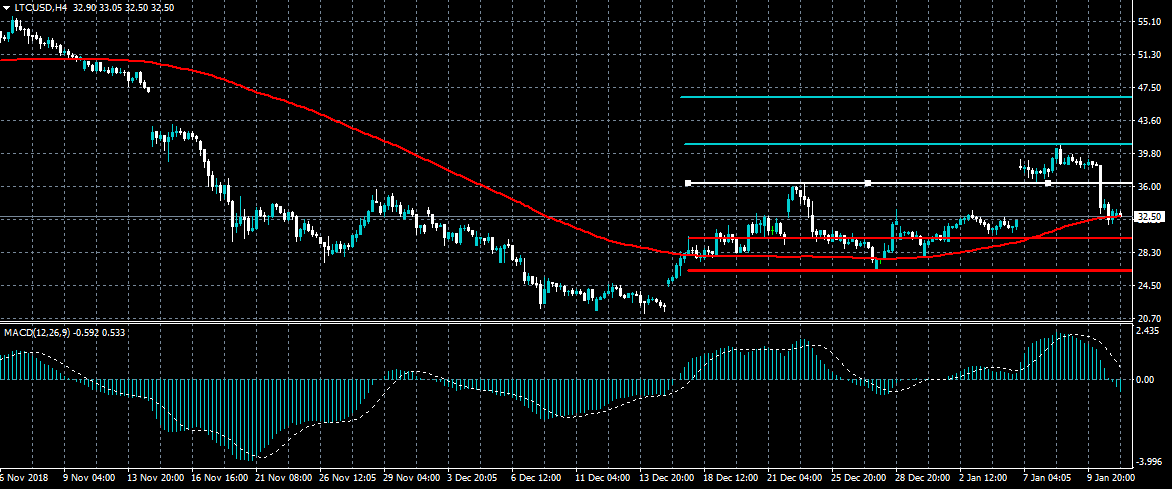
LTCUSD $31.50 Now Key Support
The LTCUSD pair has come under heavy selling pressure, after a brief period of stability in the broader cryptocurrency market. The decline has so far found support from the $31.50 level, a further move below the $30.00 level will likely increase technical selling. It is also worth noting that LTCUSD bulls may use the pullback as a chance to buy the pair at a more attractive price and the drop has helped closed to close the gap on the charts.
The LTCUSD pair is bearish while trading below the $36.60 level, key support is found at the $30.00 and the $26.00 levels.
If the LTCUSD pair holds above the $31.50, buyers may test the $36.60 and $40.00 resistance levels.
US Stocks Extend Weekly Gains As Retail Sector Lags
US stocks ended the day higher yesterday as investors cheered the progress of US and China talks. They also appreciated Jerome Powell’s statement that the Fed was prepared to wait and see before making any more changes to interest rates. The biggest underperformer were retail stocks, which were weighed down by reports of weaker retail sales. In total, the biggest retailers lost more than $34 billion of value. Macy’s was the biggest loser, shedding more than 18% of value.
Today, traders will focus on key data from the United Kingdom and the United States. The UK will release key economic numbers. The monthly GDP change is expected to remain at 0.1%. The industrial production is expected to shrink by 0.7% while the manufacturing production is expected to shrink by 0.7%. On a MoM basis, the manufacturing production is expected to rise by 0.4%, which will be better than the 0.9% in the previous month. Traders will also focus on key Brexit developments.
From the United States, investors will receive key inflation numbers. The headline CPI for December is expected to fall to 1.9% after rising by 2.2% in November. On a MoM basis, the CPI is expected to contract by 0.1%. The core CPI, which excludes the volatile food and energy products is expected to remain unchanged at 2.2%. Real earnings are expected to increase by 0.3% in December after contracting by 0.1% in November.
EUR/USD
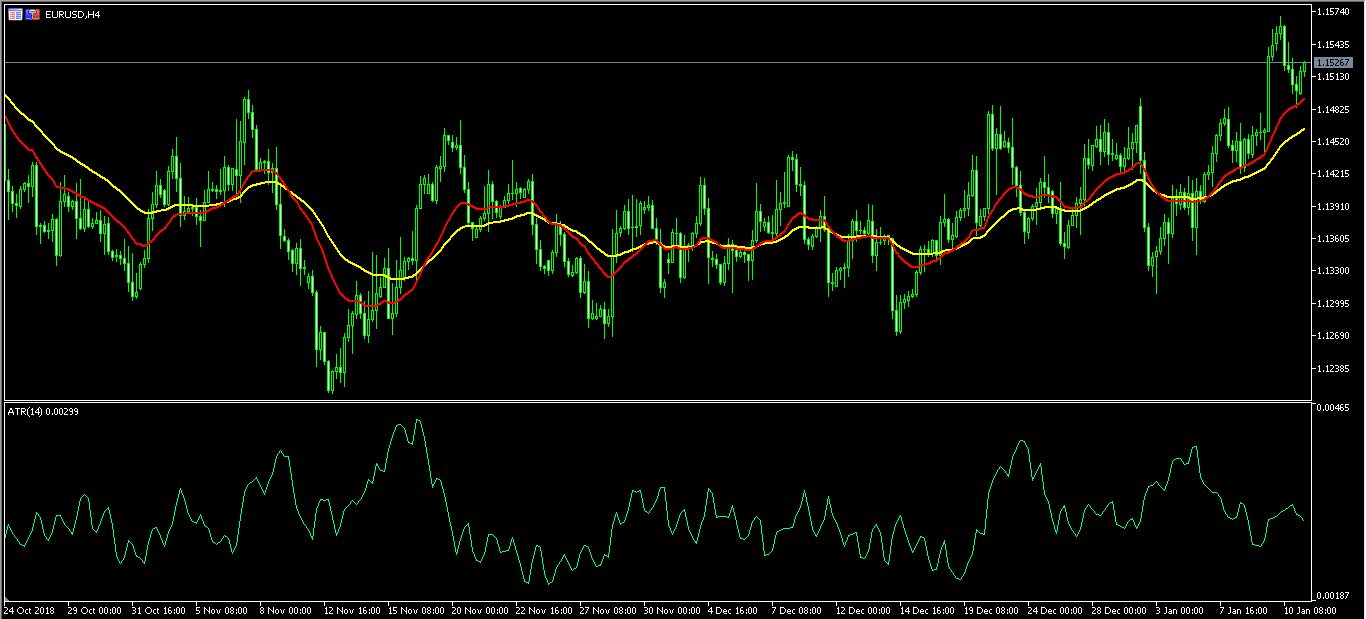
The EUR/USD pair rose today after declining sharply during the American session. The pair reached a high of 1.1530. As shown in the four-hour chart below, the pair has been making big upward and downward moves in the past few weeks. The current price is above the 21-day and 42-day EMAs as the Average True Range indicator declines. There is a likelihood that the pair will continue with the upward trend as investors expect the Fed to halt rate hikes.
GBP/USD
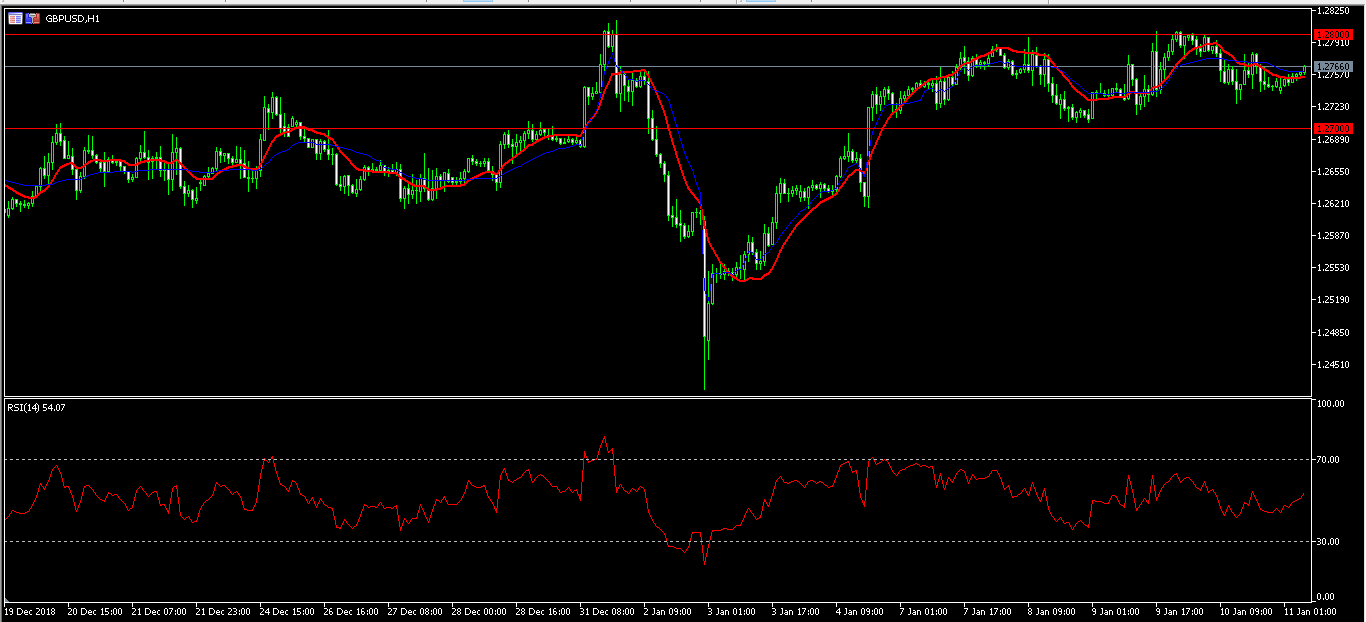
The GBP/USD pair was little moved in the Asian session as traders waited for key economic data from the UK. The pair is trading at 1.2765, which is where it ended the day at yesterday. The level is also along the key moving averages as the RSI remains at a neutral level of 50. The pair will likely react to the economic data from the UK and move in either direction today. The key levels to watch will be 1.2700 and 1.2800.
USD/CAD
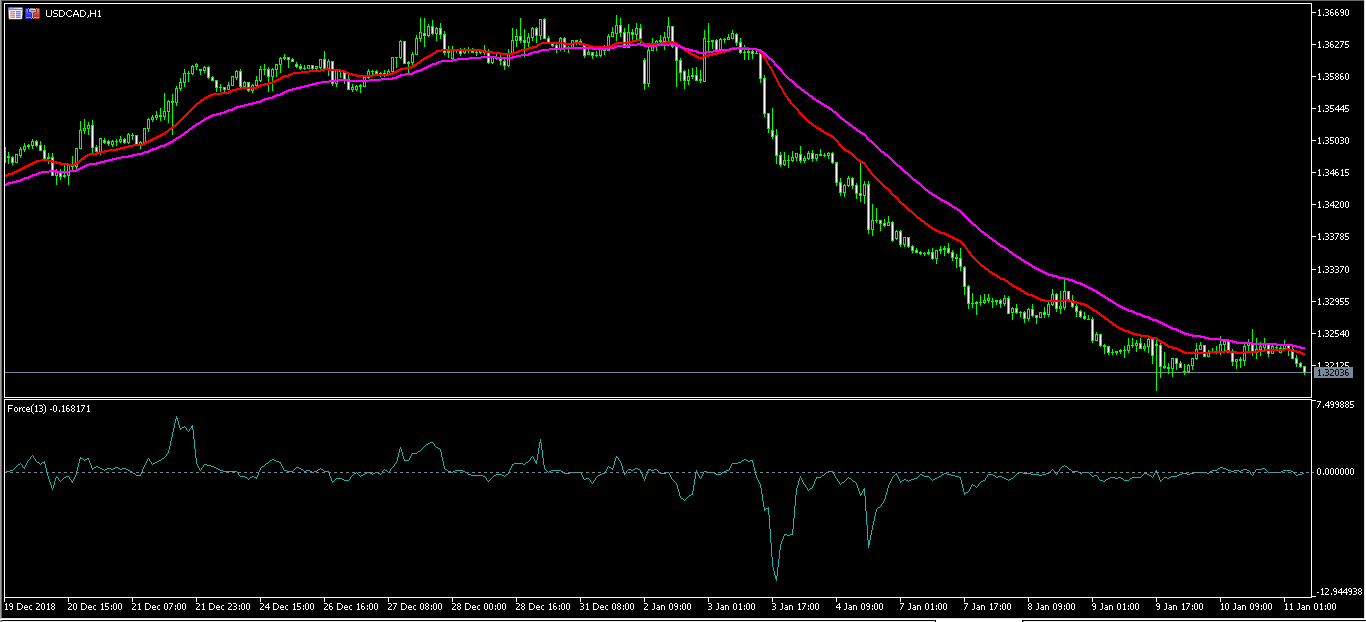
The USD/CAD pair declined in overnight trading as it attempted to continue with the previous downward trend. It is now trading at 1.3200, which is lower than the 21-day and 42-day EMAs. The Force index remains along the neutral level. Today, traders will focus on news from the United States. If inflation weakens, the pair will likely continue to move lower.
China Vice Premier May Visit The US For Trade Talks
General Trend:
- Shanghai trades flat during morning session: Telecoms outperform, property index declines
- Resources and Financials indices weigh on shares in Australia
- Nikkei rises, Fast Retailing gains over 5% post earnings
- Hitachi rises on speculation it may halt UK nuclear project
- Hong Kong listed Kingsoft considering business collaboration with JD.com
- Error related to unemployment benefits may impact Japan’s budget (officials)
- US dollar trades generally weaker after Fed comments
- Fed Vice Chair Clarida said can afford to be ‘patient’; Won't hesitate to change balance sheet runoff if necessary
- Partial US government shutdown enters 21st day as of Friday, tying the record
- Trump continues to leave national emergency option on the table
- China Dec Trade Balance data said to be due on Jan 14th (Monday)
Headlines/Economic Data
Australia/New Zealand
- ASX 200 opened flat
- (AU) AUSTRALIA NOV RETAIL SALES M/M: 0.4% V 0.3%E
- (AU) Australia Dec AiG Performance of Construction Index: 42.6 v 44.5 prior
- (NZ) New Zealand Nov Building Permits M/M: -2.0% v 1.4% prior
China/Hong Kong
- Shanghai Composite opened +0.2%, Hang Seng +0.6%
- (US) US Treasury Sec Mnuchin: China Vice Premier Liu He will most likely visit Washington later in Jan for trade talks
- (US) There are concerns that US partial government shutdown could delay the Jan trip of China Vice Premier Liu He to Washington; the trip is expected on Jan 30-31 - US financial press
- (CN) China to reportedly to set lower 2019 GDP growth target of 6.0-6.5% - press
- (CN) CHINA PBOC SETS YUAN REFERENCE RATE: 6.7909 V 6.8160 PRIOR (strongest yuan fix since late July 2018)
- (CN) China PBoC Open Market (OMO): Skips OMO for 4th consecutive session ; Net: CNY110B drain v CNY40B drain prior
- (CN) China said to tighten oversight of research reports by brokerage firms - Chinese Press
- (CN) China Industry Min Miao Wei: Sees more room for tax cuts in manufacturing sector
- (CN) China Agriculture Ministry: Raises 2018/19 Soybean output 16MT (prior 15.8MT)
Japan
- Nikkei 225 opened +0.7%
- (JP) Nikkei 225 Jan Options said to settle at ~20,291
- Nissan [7201.JP]: Japan prosecutors indict former Chairman Carlos Ghosn for aggravated breach of trust; Ghosn, Kelly and Nissan itself indicted on new charge of breaking financial law -
- Japanese press
- Reportedly Japan government owes billions of yen in unemployment benefits - Nikkei
- (JP) Japan Labor Minister Nemoto: Polling discrepancies caused regular pay to be understated from 2004 to 2017; Estimates the benefit shortfalls total ¥53.6B
- (JP) Japan Fin Min Aso: Confirms the Labor Ministry is conducting research into wage data, highly likely that the wages data and FY19/20 budget will be revised
- (JP) Japan Chief Cabinet Spokesman Suga: Government will check all economic data, following revelations of flaws in wage data; will alter next FY budget as needed to repay benefits
- (JP) Reportedly to delay release 2018 stock section of national accounts
- (JP) JAPAN NOV PRELIMINARY CURRENT ACCOUNT: ¥757.2B V ¥560.2BE; TRADE BALANCE -¥559.1B V -¥614.3BE
- (JP) Japan Nov Household Spending Y/Y: -0.6% v -0.3% prior
- (JP) Japan Dec Bank Lending Ex-Trusts Y/Y: 2.5% v 2.2% prior; Bank Lending Incl Trusts Y/Y: 2.4% v 2.1% prior
- (JP) Japan investors purchased net ¥561.8B in foreign bonds in Dec
- (JP) JAPAN DEC ECO WATCHERS SURVEY CURRENT: 48.0 V 50.7E; OUTLOOK: 48.5 V 51.4E
Korea
- Kospi opened +0.3%
- (KR) Second summit between US President Trump and North Korea Leader Kim could be held during the second week of Feb - South Korean Press
Other
- (PH) Philippines Financials Stock index declines over 2.8%
- (PH) 5 banks in the Philippines are said to have over $400M in total exposure to the Philippines unit of Hanjin Heavy Industries [097230.KR], according to a Philippines press report
- (MY) Malaysia Nov Industrial Production Y/Y: 2.5% v 2.3%e
- (SG) Singapore Nov Retail Sales M/M: 0.2% v 0.6%e: Y/Y: -3.0% v -2.4%e
- (TW) Taiwan Premier Lai formally resigns at cabinet meeting (as expected)
North America
- (US) US President Trump: Most likely will declare emergency if no border deal; should be able to do deal with Congress
- (US) Pres Trump has been reportedly briefed on plan to use Army Corps of Engineers funding for construction of border wall - NBC News
- (US) Sen Collins (R-ME) says a deal for bipartisan immigration deal to end the govt shutdown is all but dead - Wash Post
- (US) Fed Chair Powell: We have ability to be patient, flexible, and watch patiently at this time; Fed balance sheet will end up "substantially smaller" - comments in Washington
- (US) Fed Vice Chair Clarida (moderate, voter): If economic crosswinds are sustained, Fed policy should respond to offset them - comments in NYC
- (US) Fed's Evans (dove, voter in 2019): Fed can easily look at data for six months before hiking rates
Levels as of 01:00ET
- Nikkei 225, +1%, ASX 200 -0.4%, Hang Seng +0.3%; Shanghai Composite +0.5%; Kospi +0.5%
- Equity Futures: S&P500 -0.1%; Nasdaq100 -0.2%, Dax -0.3%; FTSE100 -0.1%
- EUR 1.1530-1.1496 ; JPY 108.52-108.22 ; AUD 0.7215-0.7175 ;NZD 0.6818-0.6777
- Feb Gold +0.4% at $1,292/oz; Feb Crude Oil -0.2% at $52.50/brl; Feb Copper +0.8% at $2.656/lb
Brexit Monitor: May Is Losing Control Over The Brexit Process But No Credible Alternative Has Emerged Yet
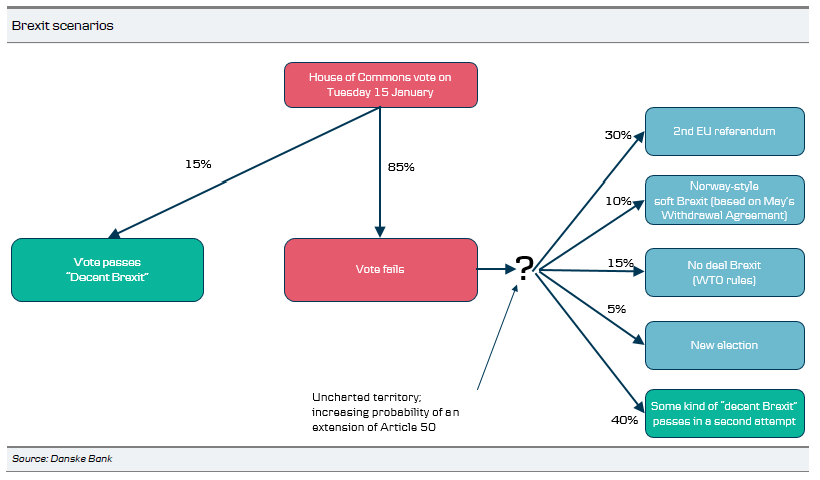
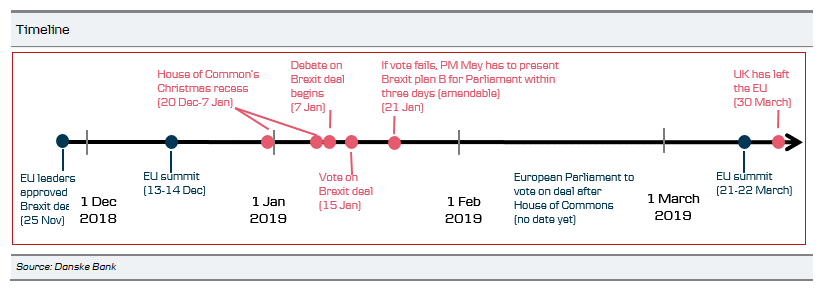
The House of Commons went back to business this week and the first thing on the agenda for 2019 was the debate and vote on PM Theresa May's Brexit deal, which began on Wednesday. The vote is due to take place on Tuesday, 15 January. Nothing seems to have changed since the MPs went on Christmas holiday and the most likely outcome is still that the deal will be voted down next week (we now estimate an 85% probability up from 75% given the development this week, more on that below). PM May's strategy was to get "further assurances" from the EU, but it has not been sufficient to win MPs over. The EU has very clearly said that it will not renegotiate the withdrawal agreement, but has expressed it is not in the EU's interest to keep the UK in the backstop indefinitely. The EU would probably like to be more helpful, but has not been able to help May, as she has not told the EU leaders what she needs to get support for her deal.
What happens if the deal is voted down? A defeat seems widely expected, so markets will not react to the defeat itself but to the size of the defeat. A narrow defeat means that she might be able to get it through at a later stage when we are closer to the 29 March deadline, but a big defeat means we are in uncharted territory (and we cannot rule out that Theresa May will resign). Based on her defeat on the so-called "what next" amendment on Wednesday this week, May will be forced to present a Brexit plan B within three days if she loses the vote on Tuesday, which seems very likely. Remember that a previous amendment means that the MPs can debate and amend her plan B. Both mean that the House of Commons has taken more control over the Brexit process, but the problem remains that there is no credible alternative with backing from a majority of the House (also the EU negotiates with government and officials, not parliaments). It also means that PM Theresa May is not able to run down the clock in order to get support for her deal.
We still think some outcomes are more likely than others (see our game tree on page 4). The default option is a no deal Brexit, but it would only happen "by accident". While some hardcore Brexiteers are advocating a no deal Brexit, there is not a majority for it in parliament and the government's defeats on several amendments support this view. The problem is that it will happen nonetheless by default unless the centrist MPs from different parties find a common way forward and so far they have failed to do so. We attach a 15% probability of a no deal Brexit (assuming the deal is voted down next week).
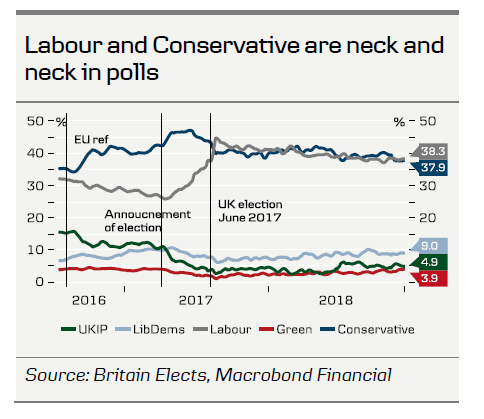
We continue to believe the probabilities of a soft Norway-style Brexit and snap election are low (10% and 5%, respectively, assuming the deal is voted down next week). In the soft Norway-style Brexit, there would not be any economic consequences, but the political damage would be significant, as the UK would be subject to all EU laws (including EU contributions and accepting free movement of people) without representation in institutions, agencies, etc. In that case, it would make more sense to just stay in the EU. We think the probability of a snap election is very low. The Prime Minister cannot call for a snap election anymore and this could only occur if (1) the Commons voted for no confidence in the government and no new government was formed within two weeks, or (2) the Commons dissolved itself by a two-thirds majority. It is difficult to see the Conservative MPs having the incentive to support a snap election, as they risk losing their seats (Labour and the Conservatives are neck and neck in the opinion polls).
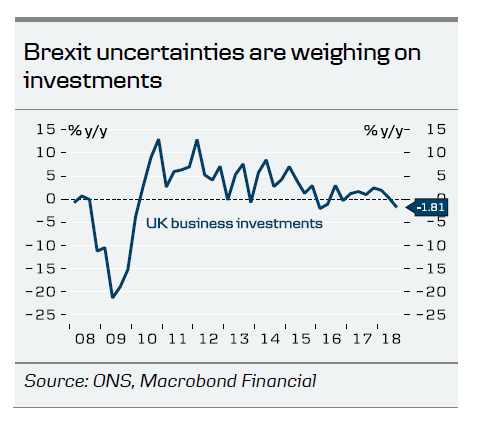
This leaves us with two possible outcome: either PM Theresa May’s deal (or something very similar) passes the House of Commons at a later stage in a second attempt when we get closer to the deadline, or the politicians agree to call for a second EU referendum. As something needs to settle for the politicians to choose one of the options, we think it is difficult to predict which one is most likely, but at the moment we attach a slightly higher probability of the former than the latter (40% and 30%, respectively, assuming the deal is voted down next week). While it is from an economic perspective positive that PM Theresa May’s deal is probably the hardest realistic version of the Brexit on the table right now, uncertainty is high and the probability is increasing that the UK must ask for an extension of the Article 50 deadline. According to The Telegraph (paywall, 8 January), British officials are “putting out feelers” with the EU for an extension of Article 50. If the Article 50 deadline is extended, the UK may need to hold European Parliament elections, for which there is time enough to call from a legal perspective, but may be very chaotic from a political perspective in the current situation.
What is the argument for the deal passing the House of Commons at a later stage? The main argument is the passing of time. While companies, investors and analysts all seem exhausted from the Brexit uncertainty and think the deadline is very fast approaching, the deadline is still “far away” from a political perspective. As time goes by and 29 March draws closer, the pressure on the politicians increases, which is an argument we have highlighted many times. Soft Brexiteers within the Conservative Party would then be inclined to vote in favour of the deal despite it not delivering the perfect Brexit in their view, as they would fear the alternative would be a majority for a second referendum (something the moderate Conservatives have already threatened). Moderate Labour MPs may support the deal when they find out that a snap election is unlikely. This scenario requires enough politicians willing to compromise eventually.
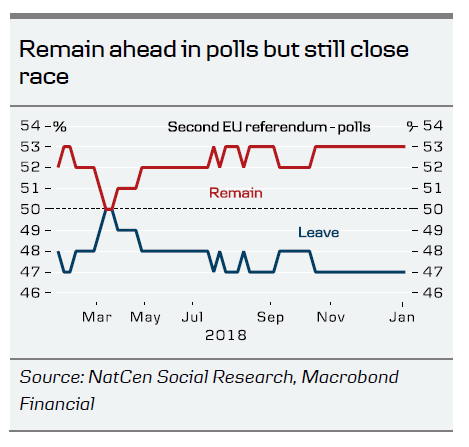
UK politicians may call for a second EU referendum either if they find out they cannot find a way forward themselves or if moderate MPs start backing staying inside the EU. A second referendum would require an extension of the Article 50 deadline, as it would require at least 4-6 months to organise the referendum. As the UK is on summer holiday in July-August, a second EU referendum would most likely be held in September (perhaps late June at the very earliest but it seems optimistic in our view), meaning that the UK would probably need a nine months extension of Article 50. Staying inside the EU has been made easier as the European Court of Justice has ruled that the UK can unilaterally revoke the Article 50 notification without changes to the existing member terms. Looking at the opinion polls, the share of the voters regretting the Brexit decision is increasing and the remain camp is currently ahead in polls (53% on average versus 47%). Overall, we still see this as very close.
Another way forward could be to ask the EU for a long extension of 9-12 months in order to make time for negotiations on the future relationship. The two main issues for UK politicians have been the Irish backstop and not knowing details of what the future relationship looks like. Looking back at the past two years, the UK and the EU27 were actually supposed to start negotiating the future relationship in 2018 after the first phase of the negotiations was concluded late 2017. Due to internal disputes in the UK, especially over the Irish backstop, this did not happen. By extending the deadline, there will be more time to make the negotiations on the future relationship, without reopening the Withdrawal Agreement, which would probably make it easier for Theresa May to get her deal through parliament. The question is whether the EU would accept such an idea.
FX outlook: key risk to our bullish GBP view is that Brexit clarifications are dragged out
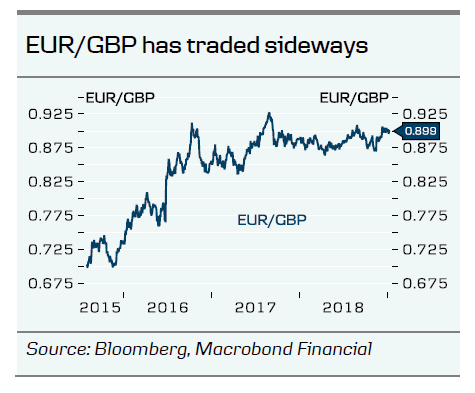
As argued above, it appears likely that PM Theresa May will lose the Brexit vote next week, but markets might react to the size of the defeat. Unless we see a big defeat, we think EUR/GBP is likely to stay boxed in the current 0.88-0.9060 range near term. As the 29 March deadline approaches, upside risks to EUR/GBP may dominate unless we get further clarifications. We thus raise our 1M EUR/GBP forecast from 0.88 to 0.90.
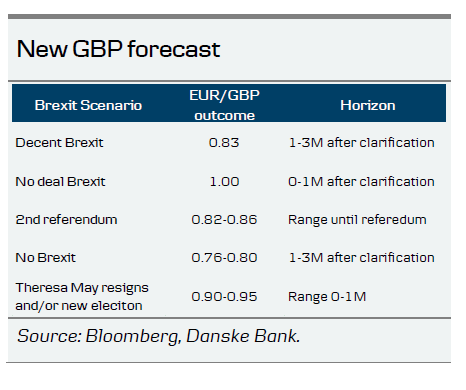
Longer term, our EUR/GBP FX forecast is based on our main scenario that May’s Brexit plan eventually will be approved by parliament. We expect this to pave the way for a significant decline in EUR/GBP. We target 0.84 in 3M, and 0.83 in 6-12M. However, it is a close call and all options are still on the table, meaning the post Brexit outcome space for EUR/GBP remains extremely wide, which will keep volatility high.
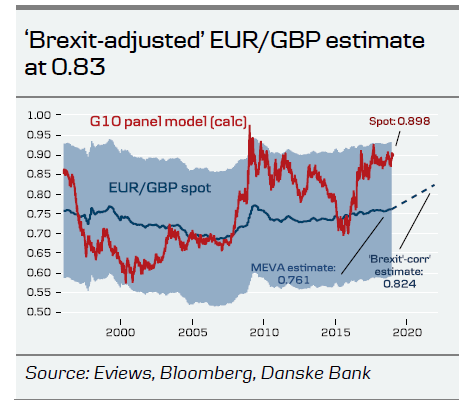
That said, we still attribute the highest probabilities to either a decent Brexit (Theresa May’s Brexit plan in some form) or a new referendum and both are positive for GBP in our view. Especially, if a second referendum is called, we expect GBP to appreciate as the probability distribution is likely to shift substantially in favour of ‘NO Brexit’ and ‘Decent Brexit’. We expect EUR/GBP to settle in the 0.82-0.86 range until the referendum (most likely in September) in this scenario.
Hence, a key risk to our bullish GBP view is that Brexit clarifications are dragged out – even beyond 30 March if Article 50 is extended, and the GBP appreciation consequently will be much more moderate and materialise later than our forecast (main scenario) implies. In a scenario where the EU and UK agree to extend Article 50 in order to further negotiations about the future relationship, this would be moderately positive for GBP as it increases the probability that the UK parliament eventually will support the deal.
FX strategy: Short EUR/GBP via options
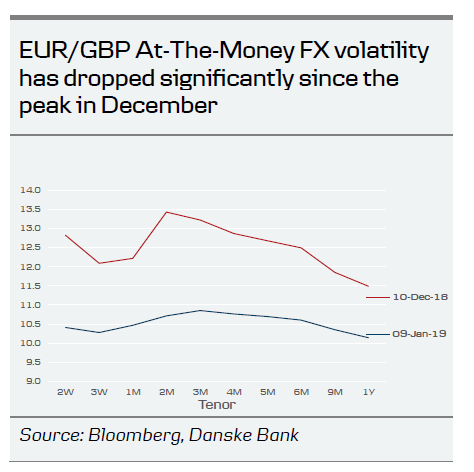
Timing a possible break lower in EUR/GBP is very difficult and given the high degree of uncertainty related to Brexit, we prefer to position for GBP appreciation via FX options. We are short EUR/GBP via 1M-4M put calendar spread as one of our FX Top Trades for 2019 (the sold 1M put has expired in our FX Top Trades). Risk premiums (EUR/GBP volatility) is much lower compared to the peak in December, and we still like to position for a lower EUR/GBP by selling 1M puts and buying 3-6M puts.
Hedging GBP income/asset
We generally recommend hedging GBP income/assets by buying EUR/GBP call options. In our view, volatility (option price) is fair given the risk of a bounce in EUR/GBP and not least given the downside potential in our main scenario and other GBP positive scenarios such as a new referendum or ‘no Brexit’.
Corporate clients should consider to hedge the entire 2019 flow via 4-6M call options. Hedges can then subsequently be swapped out to the actual pay dates when Brexit is clarified. The risk to this strategy is that Brexit remains unresolved when the bought options expire, which then would require one to buy another period of protection. Hedging GBP expenses
We are approaching the end of the Brexit path, and we recommend clients hedging GBP payables to use bounces in the spot to increase hedge ratios and hedge horizons via FX forwards. Given the risk of a prolonged period of uncertainty clients could consider hedging via risk reversals (1-3M).
Elliott Wave View: Indian Rupee (USD/INR) Should Turn Lower
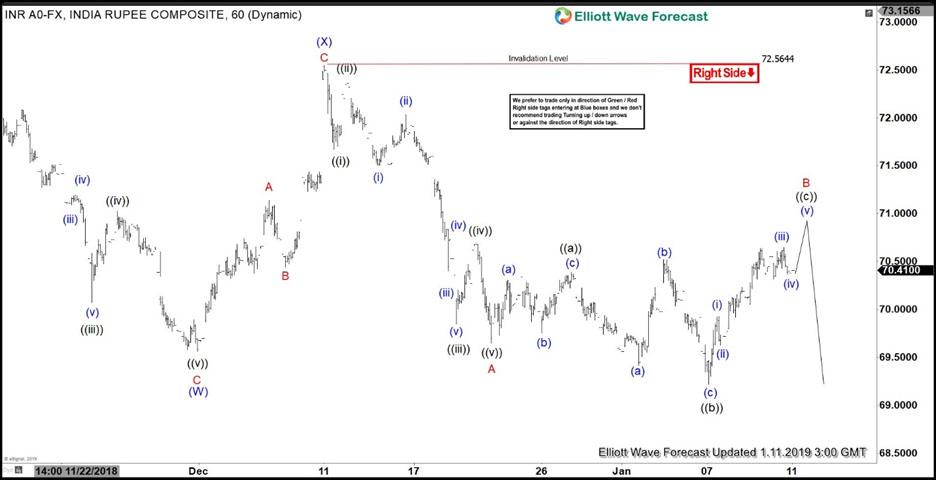
Short term Elliott Wave view in USDINR suggests that the decline to 69.56 low ended wave (W) and bounce to 72.56 high ended wave (X). Internal of wave (X) unfolded as a zigzag Elliott Wave structure. Wave A ended at 71.14, wave B ended at 70.44 and wave C ended at 72.55. Pair has resumed lower with the break below wave (W) at 69.56 and now shows a bearish sequence from 10.11.2018 peak.
Wave (Y) lower is unfolding as a zigzag where wave A ended at 69.65. Subdivision of wave A is in 5 waves impulsive Elliott Wave structure. Down from 72.56, Wave ((i)) ended at 71.67, wave ((ii)) ended at 72.36, wave ((iii)) ended at 69.847, wave ((iv)) ended at 70.68, and wave ((v)) of A ended at 69.65.
Wave B is currently in progress as an Expanded Flat Elliott Wave structure. Up from 69.65, wave ((a)) ended at 70.39 and wave ((b)) ended at 69.22. Wave ((c)) of B is expected to end below 72.56 and pair should then resume lower again. Potential area to end wave B is towards 70.89 – 71.77 (50 – 76.4 Fibonacci retracement) of the decline from 72.56. As far as pivot at 72.56 high is holding, expect pair to eventually resume lower again.
Indian Rupee (USDINR) 1 Hour Elliott Wave Chart
Euro Reverses Its Losses In The Asian Session
For the 24 hours to 23:00 GMT, the EUR declined 0.51% against the USD and closed at 1.1499.
In the US, data revealed that the US number of Americans filing applications for fresh jobless benefits dropped to a one-month low level of 216.0K in the week ended 05 January 2019, signalling a strong labour market. In the prior week, initial jobless claims had registered a revised level of 233.0K, while market participants had expected initial claims to fall to a level of 226.0K.
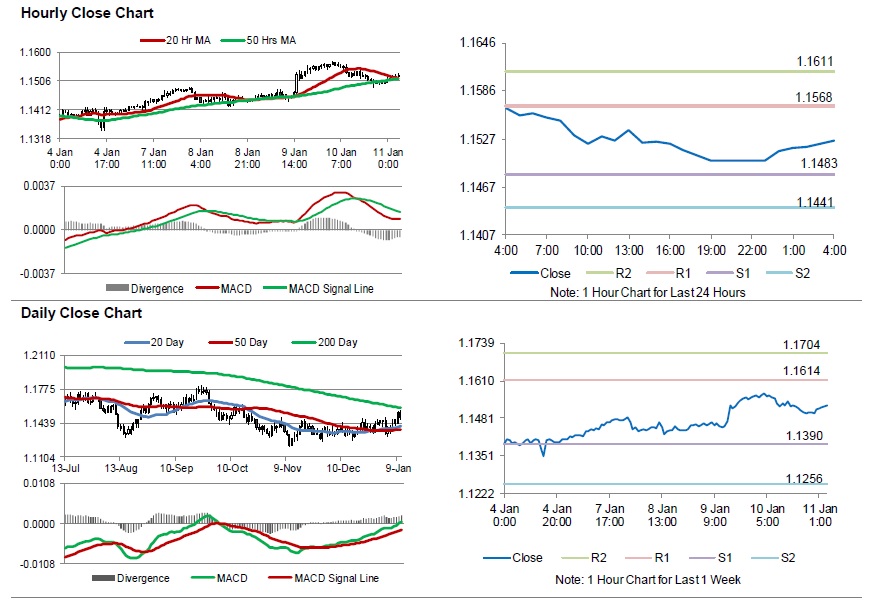
In the Asian session, at GMT0400, the pair is trading at 1.1524, with the EUR trading 0.22% higher against the USD from yesterday’s close.
The pair is expected to find support at 1.1483, and a fall through could take it to the next support level of 1.1441. The pair is expected to find its first resistance at 1.1568, and a rise through could take it to the next resistance level of 1.1611.
In absence of key economic releases in the Euro-zone today, investors would closely monitor the US trade balance data for November followed by the consumer price index, average hourly earnings and monthly budget statement, all for December, set to release later in the day.
The currency pair is showing convergence with its 20 Hr and 50 Hr moving averages.