Sample Category Title
Forex Technical Analysis: EUR/USD, USD/JPY, GBP/USD
EUR/USD
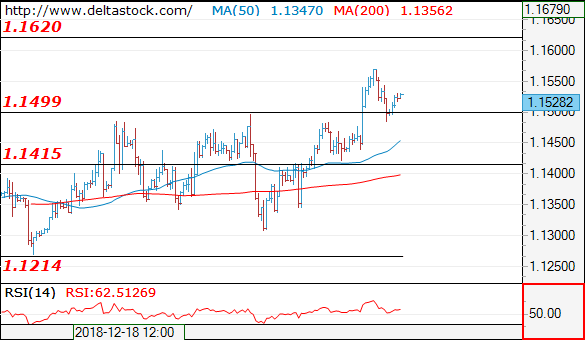
Current level - 1.1528
The support at 1.1500 is still intact, but I favor a break lower to target 1.1410 area. Major resistance lies at 1.1620.
| Resistance | Support | ||
| intraday | intraweek | intraday | intraweek |
| 1.1630 | 1.1630 | 1.1500 | 1.1214 |
| 1.1630 | 1.1820 | 1.1410 | 1.1100 |
USD/JPY
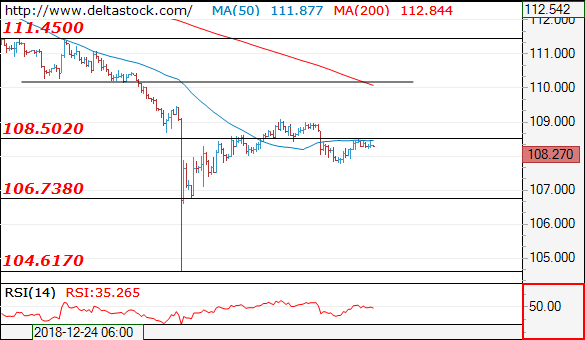
Current level - 108.27
The rebound after 107.70 is capped at 108.50 resistance and I favor another downswing, towards 106.70 zone.
| Resistance | Support | ||
| intraday | intraweek | intraday | intraweek |
| 108.50 | 111.45 | 106.70 | 106.70 |
| 109.10 | 112.20 | 106.70 | 104.60 |
GBP/USD
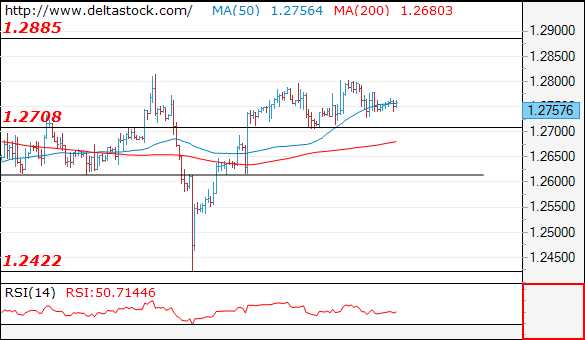
Current level - 1.2757
My outlook here is bearish, for a test of 1.2710, en route to 1.2620 area.
| Resistance | Support | ||
| intraday | intraweek | intraday | intraweek |
| 1.2810 | 1.2885 | 1.2710 | 1.2420 |
| 1.2885 | 1.3250 | 1.2615 | 1.2340 |
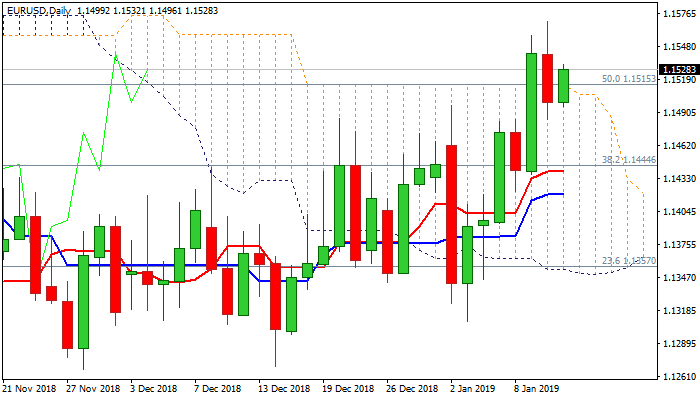
EUR/USD Outlook: Friday’s Close Above Daily Cloud Would Provide Bullish Signal But Risk Of Stall Exists
The Euro regained traction and returned above daily cloud in early Friday's trading, following strong upside rejection and bearish close on Thursday.
Overall bullish bias keep bulls in play for further advance, as Wednesday's long bullish daily candle (the biggest one-day gains since Sep 2018) continues to underpin.
Bullishly aligned daily studies are supportive, but bulls need Friday's close above daily cloud to confirm bullish stance for extension towards target at 1.1586 (Fibo 61.8% of 1.1815/1.1215 bear-leg).
Daily cloud top marks initial support at 1.1506, followed by broken 100SMA (1.1477) which is expected to contain stronger dips.
Caution on daily cloud top support which will significantly descend next week and thin daily cloud.
US CPI data due later today, will be also in focus for fresh signals.
Res: 1.1569, 1.1586, 1.1632, 1.1673
Sup: 1.1506, 1.1496, 1.1477, 1.1450
GBP/USD Outlook: Cable Stands At The Back Foot Ahead Of Release Of UK Data
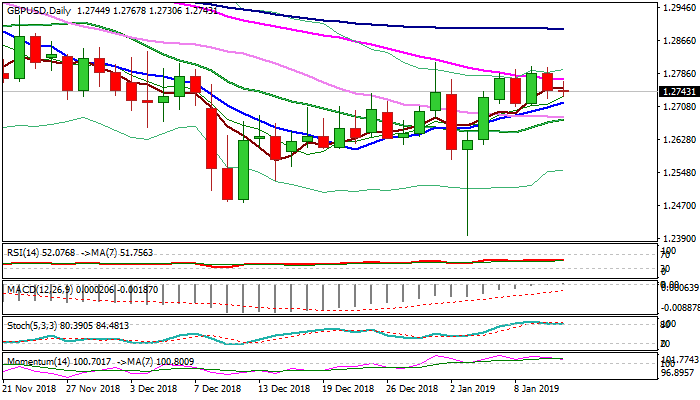
Cable holds within narrow range on Friday ahead of release of a series of UK data.
Bearish close on Thursday after repeated failure to clearly break above falling 55SMA (currently at 1.2772) and Fibo barrier at 1.2786 (50% retracement of 1.3174/1.2397) keeps the pair at the back foot, as multiple upside rejections could spark stronger bearish acceleration.
South-heading momentum and slow stochastic in attempt to reverse from overbought territory, are negative signals, with UK data expected to give more clues about near-term direction, as markets await next week’s Brexit plan vote, the key event for British pound.
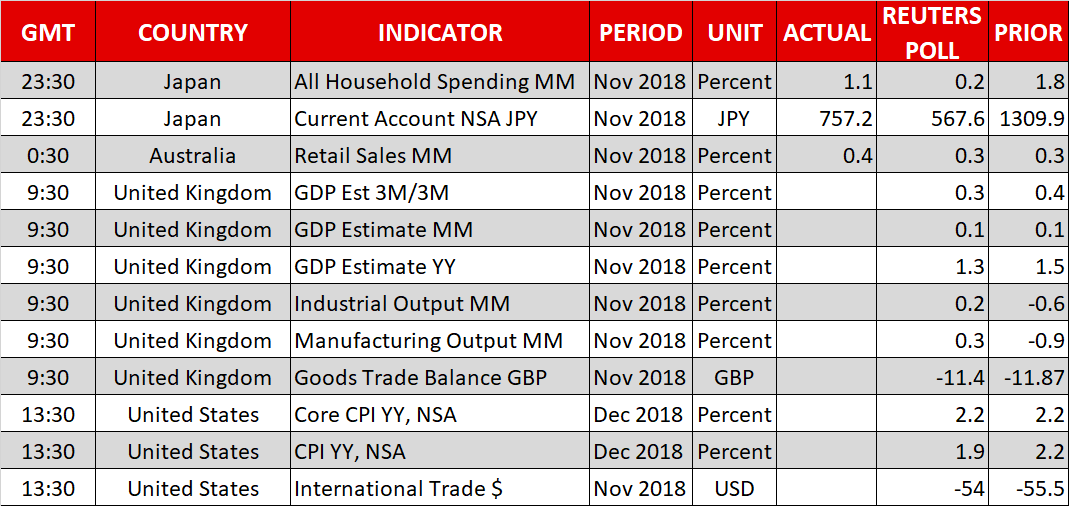
UK GDP is expected to remain unchanged at 0.1% while positive forecast are seen on Industrial and Manufacturing production, as well as slight narrowing in UK trade gap.
Overall positive results would boost pound for eventual break above 55SMA, with weekly close above needed to confirm signal and shift focus towards daily cloud base (1.2854).
Weaker than expected figure, on the other side, would risk test of support zone between 1.2715 and 1.2675 (10/20/30SMA’s) close below which would generate bearish signal.
Res: 1.2772, 1.2786, 1.2803, 1.2854
Sup: 1.2715, 1.2675, 1.2648, 1.2600
USD/JPY Outlook: Bearish Bias Below Daily Kijun-Sen, US CPI Data Eyed For Fresh Signals
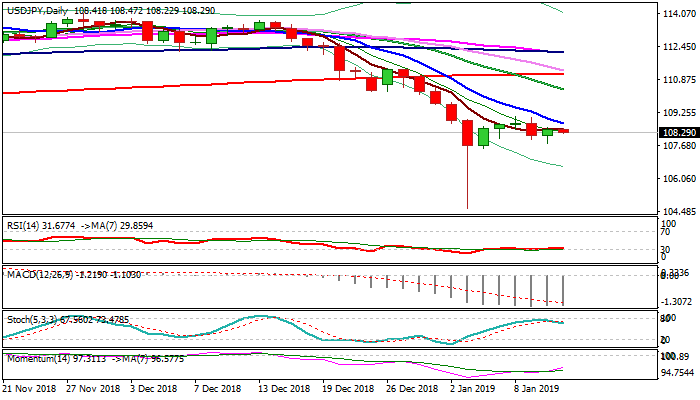
The pair holds within week-long congestion between daily Kijun-sen and Tenkan-sen but near-term bias remains on the downside on signals that corrective phase of larger downtrend from 113.70, which spiked to 104.59 on last week’s flash crash, might be over.
Daily Tenkan-sen turned south, while falling 10SMA (currently at 108.72) continues to cap and maintain bearish pressure.
Daily MA’s in full bearish setup and reversal of slow stochastic from overbought zone’s border add to negative signals, while strengthening momentum limits the downside attempts for now.
Close below broken Fibo support at 108.07 (38.2% of 113.70/104.59) which acted as solid support in past few sessions, would generate bearish signal and increase downside risk.
Alternative scenario requires Friday’s close above 10SMA and daily Kijun-sen to ease bearish pressure.
US CPI data are eyed for fresh signals.
Res: 108.51, 108.72, 109.15, 109.72
Sup: 108.07, 107.76, 107.37, 107.00
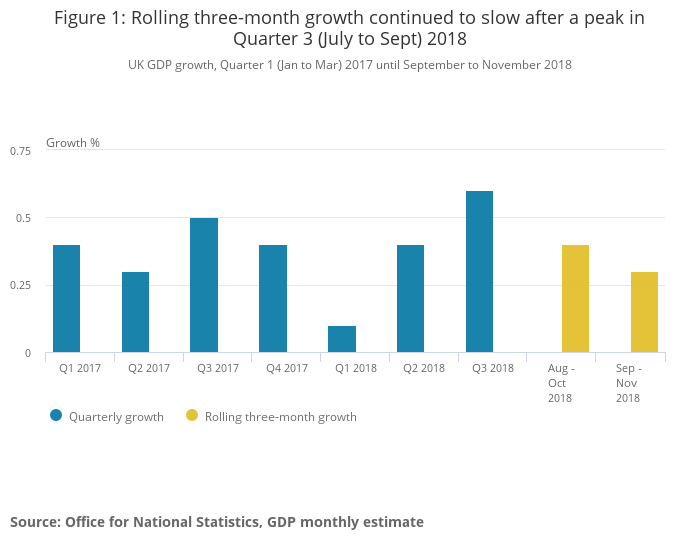
UK GDP growth slowed to 0.3% in three months to November, production dragged
UK GDP grew 0.2% mom in November, above expectation of 0.1% mom. For the three months to November, GDP growth slowed to 0.3% 3mo3m.
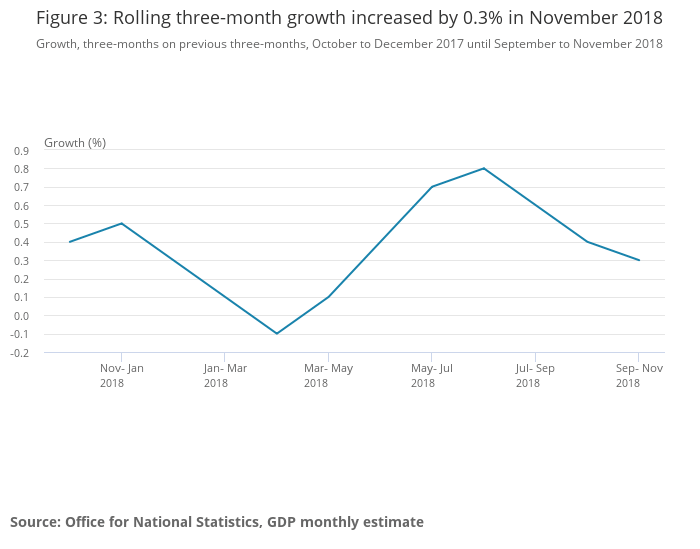
Commenting on today's GDP figures Head of National Accounts Rob Kent-Smith said:
"Growth in the UK economy continued to slow in the three months to November 2018 after performing more strongly through the middle of the year. Accountancy and housebuilding again grew but a number of other areas were sluggish. Manufacturing saw a steep decline, with car production and the often-erratic pharmaceutical industry both performing poorly."
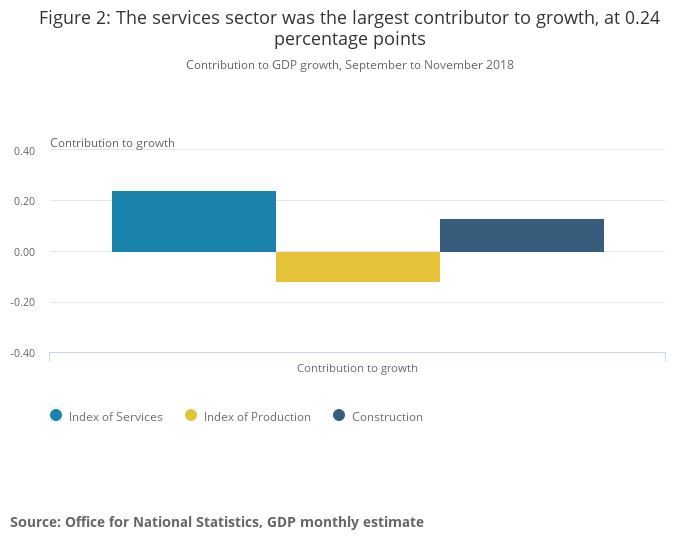
Over the three months from September to November, services contributed to 0.24% GDP growth, construction contributed 0.13%. But production was a drag and contributed to -0.12% contraction.
Also from UK, industrial production dropped -0.4% mom, -1.5% yoy in November, well below expectation of 0.2% mom, -0.5% yoy.
Manufacturing production dropped -0.3% mom, -1.1% yoy, also well below expectation of 0.4% mom, -1.y% yoy.
Visible trade deficit widened to GBP -12.0B in November.
US Inflation Data In The Spotlight
- Dollar briefly inches up after Powell; US CPI data today will be crucial
- Swiss franc drops, with SNB likely behind the move
- US-China trade optimism boosts aussie and kiwi
- Brexit uncertainty lingers ahead of next week’s Parliamentary vote
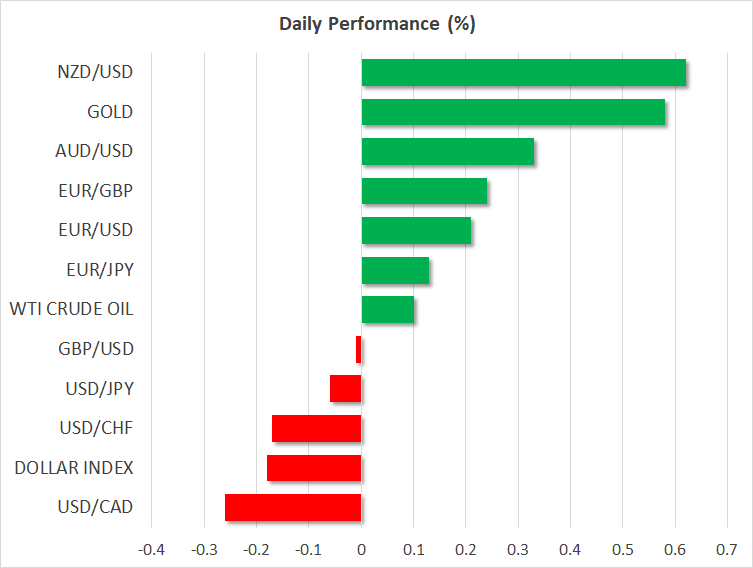
Powell helps dollar to rebound briefly, but mind the upcoming inflation data
Fed Chair Powell mostly “stuck to the script” yesterday, reiterating the recent shift in the Fed’s reaction function. He said his central bank can afford to be patient with further policy adjustments given the muted inflationary backdrop. Yet, he also noted the Fed still intends to “substantially” shrink its balance sheet, to an extent keeping more policy tightening on the table. That seemingly caught some investors off guard, boosting the dollar a little. However, Vice Chair Clarida was more dovish, indicating the Fed doesn’t have to wait for the economy to slow before responding, dragging the greenback back down early on Thursday.
Today, all eyes will turn to the US CPI data for December; remember that as long as the partial government shutdown continues the core PCE data won’t be released, so the CPIs are the only inflation data “in town” for now. Forecasts point to a drop in the headline CPI rate in yearly terms, something likely owed to falling energy prices, as the core rate is expected unchanged at 2.2%. As for the dollar, given the Fed’s dovish shift, it may stand to lose more from a disappointing CPI data set than it stands to gain from a robust report; the bar for markets to re-price in rate hikes is probably quite high at this point.
Swiss franc crumbles: SNB to blame?
A major mover yesterday was the Swiss franc, which fell sharply, in the absence of any major catalyst. Yes, risk sentiment was for the most part in positive territory throughout the day, with the defensive yen pulling back and US stock markets managing to post some gains, but the magnitude of those moves was nowhere near the one in the franc.
Hence, this sell-off seems to have the SNB’s fingerprints all over it, with the Bank potentially intervening to weaken the safe-haven currency, which had been appreciating overall in this fragile risk environment as of late. Overall, this serves as a reminder that although less frequently, the SNB still probably meddles in the market, and will fight off any sustained franc strength if risk aversion continues to push it higher.
Mnuchin stokes trade optimism, but stocks don’t buy it
US Treasury Secretary Mnuchin was on the wires overnight, stating that China’s Vice Premier Liu He will visit the US for trade talks later this month, fueling hopes that a deal may be inching closer – or at least that progress is being made. The headlines propelled higher trade-sensitive currencies such as the kiwi and the aussie, though interestingly enough, futures tracking the major US stock indices are pointing to a marginally lower open today.
Brexit uncertainties rumble on
In the UK, the dominant theme is the Parliamentary vote on PM May’s Brexit deal, scheduled for Tuesday. The consensus remains that May will lose the vote, perhaps by a wide margin. A heavy defeat for the government could even see the opposition Labour party attempt to trigger early elections. The political landscape is thus unlikely to clear anytime soon.
Note though, that lots of “doom and gloom” is probably priced into sterling already. Hence, any development that suggests May could ultimately push her deal through (for instance a very narrow loss in Parliament), or that makes a second EU referendum more likely, could be met with an explosive rebound in the UK currency. Today, UK GDP data for November are due out, but with Brexit at such a crucial stage, economics may continue playing second fiddle to politics.
The Upcoming Brexit Parliament Vote
A weaker currency usually makes the country’s export more attractive and we have seen this story playing really well over in Europe when the European Central Bank deliberately tried to push the currency lower.
However, in the UK, the Bank of England didn’t have to take such measures because the chaos of Britain’s divorce has done the job. The sterling-dollar pair dropped near the 1.18 mark from its previous high of 1.71 (back in mid-June 2014) after the Brexit vote and only once it has crossed the level of 1.40 and that was during the month of April in 2018. It is trading near the 1.27 mark against the dollar. This weakness in sterling has helped the country’s export to an extent and there is no doubt that it has a meaningful impact on Germany’s export industry. However, this isn’t going to have the same impact in the coming days.
A hard Brexit will only make the matters worse and the only good thing which will come out of that will be a huge devaluation in the currency. But such kind of devaluation may not have a direct impact on the country’s export as Britain would have to strike separate agreements with each country.
The deadline for Brexit is getting closer (March 29) and the upcoming next week’s Parliament vote on Jan 15 is the most important one. It will determine if the UK is going to have orderly Brexit or just going to crash out of Europe.
On January 15th, Theresa May is going to put the vote in parliament and she is hopeful that the parliament will support her deal. Although the chances of such are slim. We do think that there are chances that the final result may be very close and if that is the case then it is highly that Theresa May will push the vote again in the parliament and actually get things done.
So just how things can go next week and their effect, here is what we think
Scenario 1
The current deal goes to the parliament and if by any miracle parliament passes the vote then we move to the transition stage. The final outcome could be one of the followings
Canadian style: Free trade agreement and if this happens we expect the UK’s GDP would shrink more than 4% in the coming 10 years while the European economies will enjoy the benefit of free trade and continue to grow their economies. The sterling could go all the 1.05 (against the dollar) mark and the parity calls may become stronger.
Customs agreement: This is something which is on the cards more than anything and under such a scenario, the impact may not be that much devastating but the UK’s economy would shrink by over 3% while the European economies would do much better than the UK. Sterling is likely to drop its Brexit vote low of 1.18 against the dollar.
Scenario 2
The outcome of the vote is close and Theresa May pulls what she does the best, avoid all the odds and puts the vote back to the parliament and get it across the line. Then we move on the transition period and after that, we have the same three options which are mentioned above in Scenario one.
Scenario 3
Finally an interesting outcome and Theresa May losses the vote. Under those circumstances, Britain faces its worst fear.
If she stays in power, then “No Deal”, WTO arrangement becomes a reality. This will be no short of Armageddon, the country’s economy will plunge and Britain will see the darkest days in its history. The UK’s economy will shrink in excess of 7%. The Sterling may drop even below parity against the dollar.
However, two more things can also happen
General Election: The impact of this on sterling may not be that strong in fact, it is likely that investors start to push the currency higher and the clouds of uncertainty start to fade away.
Second Referendum: This will be the best option and under this scenario, we could see the reverse of what happened back in June 2016 for sterling. Sterling could jump well above the 1.70 mark against the pound.
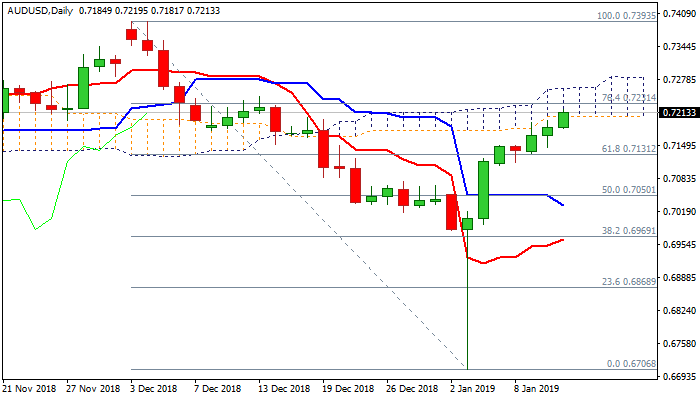
AUD/USD Outlook: Bulls Penetrate Daily Cloud, Boosted By Strong Data And Weaker Greenback
The Australian dollar advanced further in early Friday’s trading, boosted by Australian retail sales data (Nov 0.4% vs 0.3% f/c).
Weaker US dollar on repeatedly dovish tone from Fed chief Powell, which made investors more confident that US central bank’s rate hike cycle would stay on hold in 2019.
Also, optimism about agreement between the US and China over trading dispute, despite talks in past three days ended without deal, continues to fuel risk appetite and underpin the Aussie dollar.
Fresh bulls broke above converged 55/100SMA’s and penetrated daily cloud (spanned between 0.7207 and 0.7260).
Immediate target at 0.7231 (Fibo 76.4% of 0.7393/0.6706) is under pressure, with extension above daily cloud, expected to generate fresh bullish signal and unmask 200SMA (0.7334).
Strengthening bullish momentum and daily MA’s turning to positive setup continue to underpin, with the pair being on track for the second straight bullish weekly close.
On the other side, strongly overbought slow stochastic require caution.
Broken 55/100SMA’s mark initial support at 0.7180, with deeper dips expected to find ground above broken Fibo 61.8% barrier at 0.7131 to keep bulls intact.
Res: 0.7231, 0.7246, 0.7260, 0.7334
Sup: 0.7180, 0.7160, 0.7131, 0.7109
Crude Oil: Retains Its Bullish Offensive Short Term
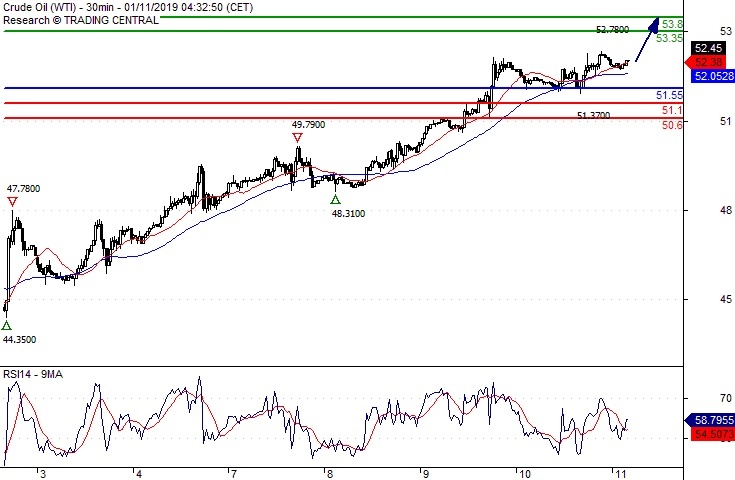
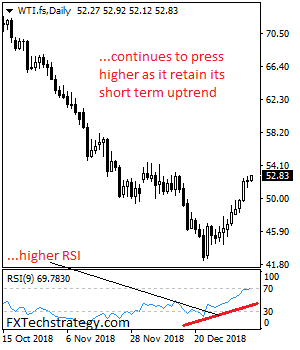
CRUDE OIL retains its bullish offensive short term as it looks for more strength. Support lies at the 52.00 level where a break will expose the 51.50 level. A cut through here will set the stage for a run at the 51.00 level. Further down, support comes in at the 50.50 level. On the upside, resistance resides at the 53.00 level. Further out, resistance comes in at the 53.50 level. A break above here will aim at the 54.00 level and then the 54.50 level followed by the 55.00 level. Its daily RSI is bullish and pointing higher suggesting further strength. All in all, CRUDE OIL remains biased to the upside in the short term.
Crude Oil Further Advance
Pivot (invalidation): 51.55
Our preference Long positions above 51.55 with targets at 53.35 & 53.80 in extension.
Alternative scenario Below 51.55 look for further downside with 51.10 & 50.60 as targets.
Comment The RSI advocates for further upside.