

Sample Category Title
EUR/USD Mid-Day Outlook
Daily Pivots: (S1) 1.1467; (P) 1.1519; (R1) 1.1552; More.....
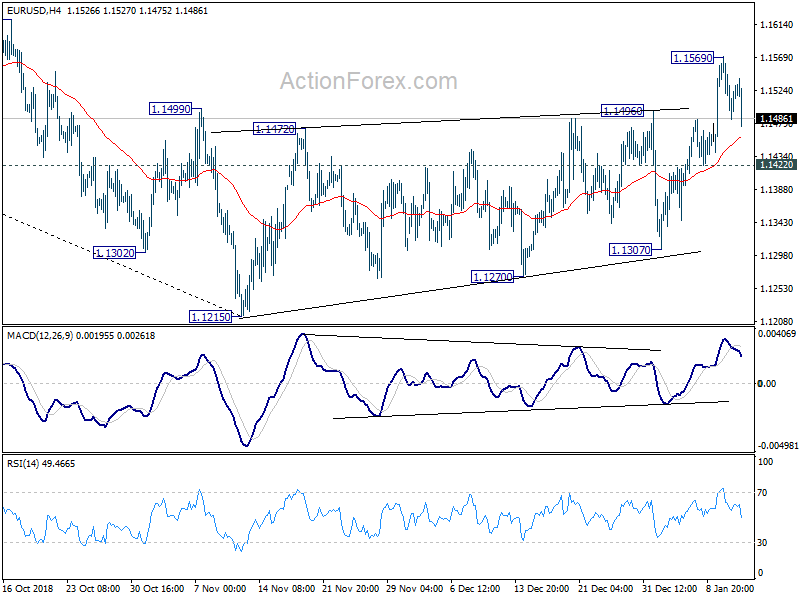
Intraday bias in EUR/USD remains neutral for consolidation below 1.1569 temporary top. As long as 1.1422 minor support holds, another rise remains in favor. Price actions from 1.1215 low is seen as correcting whole decline from 1.2555, if not reversing the down trend. On the upside, above 1.1569 will target 1.1621 resistance first. Break will target 38.2% retracement of 1.2555 to 1.1215 at 1.1727 next. On the downside, break of 1.1422 support will bring retest of 1.1214 low instead.
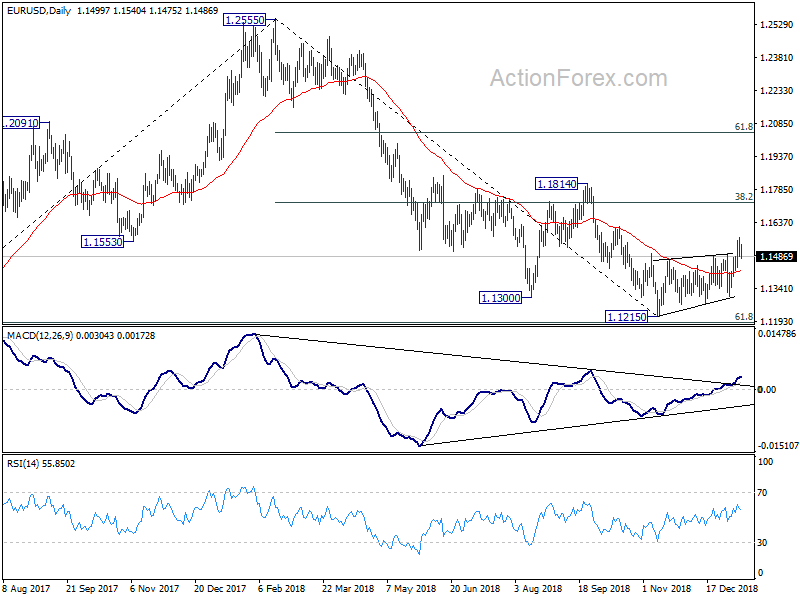
In the bigger picture, as long as 1.1814 resistance holds, down trend down trend from 1.2555 medium term top is still in progress and should target 61.8% retracement of 1.0339 (2017 low) to 1.2555 at 1.1186 next. Sustained break there will pave the way to retest 1.0339. However, break of 1.1814 will confirm completion of such down trend and turn medium term outlook bullish.
U.S. December CPI Drops Lower
Highlights:
- The all items CPI declined an expected 0.1% in the month following no change in November. Declining energy prices over the past two months have put downward pressure on overall consumer inflation.
- Food prices rose a more robust 0.4% with core prices up 0.2% for the third consecutive month.
- The CPI annual rate dropped to slightly below the Fed’s 2% inflation objective at 1.9% though the core measure remained slightly above this mark at 2.2%.
Our Take:
December consumer prices dropped 0.1% in the month. The decline had been widely expected given earlier indications that weakening oil prices were putting attendant downward pressure on gasoline prices. Outside of energy prices, food prices rose 0.4% after a 0.2% gain in November while core, or ex food and energy, prices rose 0.2% for the third consecutive month. The weakness in energy prices has put the annual increase in overall consumer prices at a slightly ‘below objective’ 1.9% with the core measure is showing greater price pressure rising 2.2%. The headline year-over-year rate has been relatively volatile over the past couple of years largely reflecting the swings in energy prices. In contrast. the annual increase in core inflation has been steadily rising from a recent low of 1.7% recorded November 2017 to the current rate slightly above the Fed’s 2.0% objective. This upward trend matches a similar steady rise in wage gains increasing 3.2% in December up from the 2.7% recorded the year prior. Though the current rate of increase in both measures is not worrisome, it is the upward trajectory that needs to be watched given that the economy is operating beyond capacity. Activity is expected to slow going forward as fiscal stimulus starts to wane and earlier Fed tightening kicks in which should help to limit the upward trajectory in prices going forward. But the current fed funds range of 2.25% to 2.50% still implies modestly stimulative conditions. Our expectation is that policy will be tightened modestly further to eliminate this remaining stimulus with the fed funds range eventually rising to 2.75% to 3.00% later this year.
Sterling Jumps on Brexit Delay Talks, Dollar Steady after CPI
Sterling surges broadly today on rumor that there will be delay in the Brexit date. Even though the government came out quickly denying intention for Article 50 extension, the Pound stays firm. As next Tuesday's Brexit meaningful vote looms, it's just getting less and less likely for the Brexit bill to get through the Parliament. Prime Minister Theresa May will have to table a Plan B within days. And no matter what path May would seek, referendum or election or something else, a delay of Brexit is inevitable. So the rumor is actually not so much a piece of news.
Anyway, the Pound is the second strongest one for today, following New Zealand Dollar and followed by Australian Dollar. Dollar remains the weakest one for today and the week after CPI release provides little inspiration. Canadian Dollar is the second weakest as WTI crude oil seems to be losing upside momentum. Euro is the third weakest.
Technically, GBP/USD's break of 1.2814 resistance is taken another an early sign of trend reversal. And that could add to the case of Dollar bearish trend reversal too. We'll how things develop ahead. The more immediate focus just before weekly close is 51.59 in WTI oil and 1.3259 minor resistance in USD/CAD. Break of these levels would suggests short term topping in WTI and CAD.
In other markets, US futures are pointing to a slightly lower open as US government shutdown ties record. Major European indices are generally lower. FTSE is down 0.47%, DAX is down -0.69%, CAC is down -0.85%. German 10 year yield is up 0.0369 at 0.236. Earlier in Asia, Nikkei rose 0.97%, Hong Kong HSI rose 0.55%, Shanghai SSE rose 0.74%, Singapore Strait Times rose 0.48%. Japan 10 year JGB yield stayed positive at 0.013.
US CPI slowed to 1.9%, core unchanged at 2.2%
US headline CPI slowed to 1.9% yoy in December, down from 2.2% and matched expectations. Core CPI was unchanged at 2.2% yoy, matched expectations too. Dollar release the weakest one for today and the week as Fed officials emphasized "patience" before the next rate move. In particular, as Fed Chair Jerome Powell said yesterday, "especially with inflation low and under control, we have the ability to be patient and watch patiently and carefully as we". Today's CPI readings don't express any objection to Powell's line of logic.
Pound spikes higher on Brexit delay rumor
Sterling spiked higher earlier today after the Evening Standard reported that it's increasingly likely that Brexit will be delayed beyond March 29. Unnamed senior minister was quoted saying "the legislative timetable is now very very tight indeed… certainly, if there was defeat on Tuesday and it took some time before it got resolved, it's hard to see how we can get all the legislation through by March 29."
However, Prime Minister Theresa May's office was quite to come out to deny the rumor. Her spokesman Alison Donnelly said May has ruled out extending Article 40. And, "it's government policy that this is not something we are going to do."
UK GDP growth slowed to 0.3% in three months to November, production dragged
UK GDP grew 0.2% mom in November, above expectation of 0.1% mom. For the three months to November, GDP growth slowed to 0.3% 3mo3m. Over the three months from September to November, services contributed to 0.24% GDP growth, construction contributed 0.13%. But production was a drag and contributed to -0.12% contraction.
Commenting on today's GDP figures Head of National Accounts Rob Kent-Smith said, "Growth in the UK economy continued to slow in the three months to November 2018 after performing more strongly through the middle of the year. Accountancy and housebuilding again grew but a number of other areas were sluggish. Manufacturing saw a steep decline, with car production and the often-erratic pharmaceutical industry both performing poorly."
Also from UK, industrial production dropped -0.4% mom, -1.5% yoy in November, well below expectation of 0.2% mom, -0.5% yoy. Manufacturing production dropped -0.3% mom, -1.1% yoy, also well below expectation of 0.4% mom, -1.y% yoy. Visible trade deficit widened to GBP -12.0B in November.
UK CBI: No-deal Brexit could cause 8% GDP decline, it's not manageable
UK CBI Director-General Carolyn Fairbairn is going to want the government that no-deal Brexit could cause -8% decline in GDP, in a speech today.
In an article at CBI's website, Fairbairn talked about the "dangers" of no-deal Brexit. She warned that "The economic consequences would be profound, widespread and lasting. GDP would decline by up to 8%, meaning less money for our public services and those who rely on them."
There would be "new costs and tariffs" and ports would be "disrupted". Trade deals with countries like Japan, South Korea and Turkey would be "lost". Services sector would be "at a sharp disadvantage".
In short, She said "no-deal cannot be managed". On next week's vote in the parliament, she said "And next week, they face a test. If they meet it with yet more brinkmanship, the whole country could face a no-deal, disorderly Brexit.
Canada PM Trudeau to pressure Trump to drop steel tariffs
Canadian Prime Minister Justin Trudeau said in a televised Q&A that he's working on pressuring Trump to drop steel and aluminum tariffs. The measures were imposed last May using national security as excuse. And it stays in place despite the signing of the so called US-Mexico-Canada (USMCA) trade agreement in November.
Trudeau said "We have already been working with members of Congress, with governors, with business interests who are being affected negatively by these tariffs … to put pressure on the President that in the process of ratification, they should remove those steel and aluminum tariffs".
Asked why he still signed the USMCA with steel tariffs in place, Trudeau defended and said securing the deal "at a time of unpredictability and protectionism in the United States was a massive priority for all Canadians".
Released earlier today
Australia retail sales rose 0.4% mom in November, matched expectations. New Zealand building permits dropped -2.0% mom in November. Japan household spending dropped -0.6% yoy in November. Current account surplus widened to JPY 1.44T in November.
GBP/USD Mid-Day Outlook
Daily Pivots: (S1) 1.2715; (P) 1.2763; (R1) 1.2797; More....
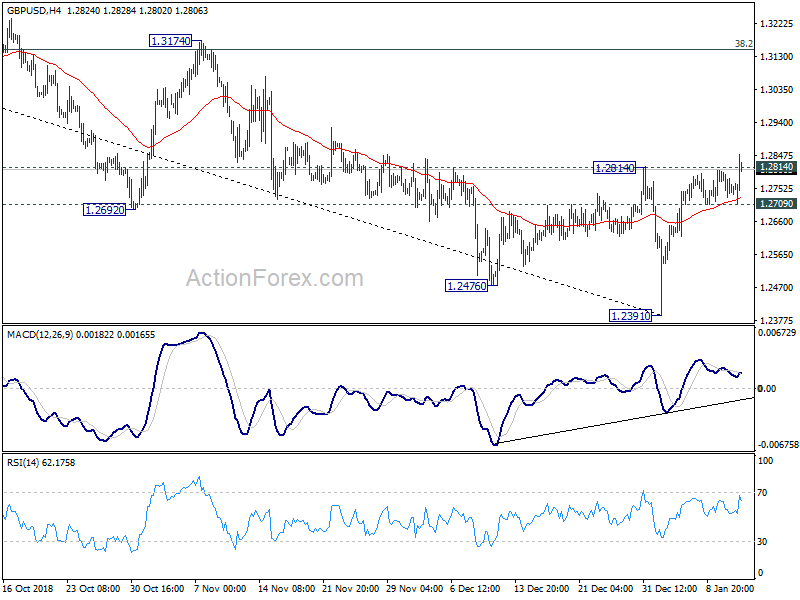
GBP/USD's rise and breach of 1.2814 resistance today argues that a medium term bottom might be in place at 1.2391, on bullish convergence condition in daily MACD. Intraday bias is back on the upside for further rebound to 1.3174 resistance, which is close to 38.2% retracement of 1.4376 to 1.2391. For now, such rebound from 1.2391 is seen as a corrective move. Hence, we'd expect strong resistance from 1.3174 to limit upside. On the downside, below 1.2709 minor support will turn bias to the downside for retesting 1.2391 low instead.
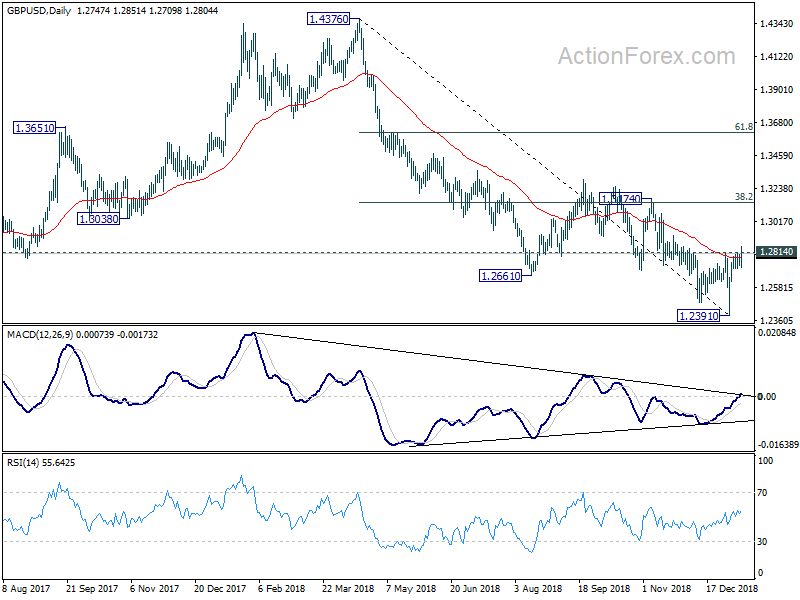
In the bigger picture, whole medium term rebound from 1.1946 (2016 low) should have completed at 1.4376 already, after rejection from 55 month EMA. The structure and momentum of the fall from 1.4376 argues that it's resuming long term down trend from 2.1161 (2007 high). And this will now remain the preferred case as long as 1.3174 structural resistance holds. GBP/USD should target a test on 1.1946 first. Decisive break there will confirm our bearish view.
Economic Indicators Update
| GMT | Ccy | Events | Actual | Forecast | Previous | Revised |
|---|---|---|---|---|---|---|
| 21:45 | NZD | Building Permits M/M Nov | -2.00% | 1.50% | 1.40% | |
| 23:30 | JPY | Household Spending Y/Y Nov | -0.60% | 0.20% | -0.30% | |
| 23:50 | JPY | Current Account (JPY) Nov P | 1.44T | 1.10T | 1.21T | |
| 00:30 | AUD | Retail Sales M/M Nov | 0.40% | 0.40% | 0.30% | |
| 05:00 | JPY | Eco Watchers Survey Current Dec | 48 | 50.3 | 51 | |
| 09:30 | GBP | Visible Trade Balance (GBP) Nov | -12.0B | -11.4B | -11.9B | |
| 09:30 | GBP | Industrial Production M/M Nov | -0.40% | 0.20% | -0.60% | -0.50% |
| 09:30 | GBP | Industrial Production Y/Y Nov | -1.50% | -0.60% | -0.80% | -0.90% |
| 09:30 | GBP | Manufacturing Production M/M Nov | -0.30% | 0.40% | -0.90% | -0.60% |
| 09:30 | GBP | Manufacturing Production Y/Y Nov | -1.10% | -0.70% | -1.00% | -0.70% |
| 09:30 | GBP | Construction Output M/M Nov | 0.60% | 0.20% | -0.20% | |
| 09:30 | GBP | GDP M/M Nov | 0.20% | 0.10% | 0.10% | |
| 13:30 | USD | CPI M/M Dec | -0.10% | -0.10% | 0.00% | |
| 13:30 | USD | CPI Y/Y Dec | 1.90% | 1.90% | 2.20% | |
| 13:30 | USD | CPI Core M/M Dec | 0.20% | 0.20% | 0.20% | |
| 13:30 | USD | CPI Core Y/Y Dec | 2.20% | 2.20% | 2.20% |
US CPI slowed to 1.9%, core unchanged at 2.2%, Dollar steady
US headline CPI slowed to 1.9% yoy in December, down from 2.2% and matched expectations. Core CPI was unchanged at 2.2% yoy, matched expectations too. Full release here.
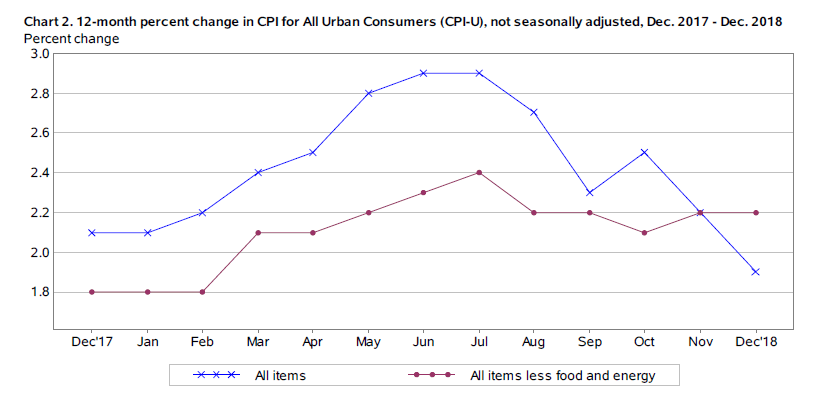
Dollar release the weakest one for today and the week as Fed officials emphasized "patience" before the next rate move. In particular, as Fed Chair Jerome Powell said yesterday, "especially with inflation low and under control, we have the ability to be patient and watch patiently and carefully as we". Today's CPI readings don't express any objection to Powell's line of logic.
Canadian Dollar Tests 1.32, US Consumer Inflation Next
It’s been an excellent week for the Canadian dollar, and the currency has posted slight gains on Friday. In the North American session, the pair is trading at 1.3215, down 0.16% on the day. On the release front, there are no Canadian events. Investors are bracing for weak inflation numbers out of the United States. CPI is expected to drop to -0.1%, while Core CPI is forecast to remain steady at 0.1%.
The Federal Reserve is sounding much more dovish of late, after a hawkish rate statement in December sent equity markets plunging in late December. The minutes from that meeting noted that low inflation levels meant that the Fed could “afford to be patient about further policy firming”. Even more striking, the minutes revealed that at the December meeting, some policymakers opposed a rate hike, arguing that inflation was too low to warrant higher rates. The U.S. dollar responded to the minutes with broad losses on Wednesday. On Thursday, Fed Chair Jerome Powell said he was “very worried” about the massive U.S. debt and reiterated that the Fed would remain patient on monetary policy. Given that further interest rate hikes would hurt the debt burden of corporate borrowers, Powell’s remarks on the debt could be a sign that the Fed will take a pause on rate hikes in the near future, and perhaps even entertain a rate cut this year.
The Bank of Canada held the benchmark rate at 1.75% on Wednesday, which is unchanged since October. The bank policy statement was somewhat on the dovish side, as policymakers highlighted their concerns for the economy. These included low oil prices, an overpriced housing market and the global trade war. The Canadian economy is highly dependent on exports, and a weaker global economy has put a crimp in the export sector. The Canadian dollar had a dismal 2018, falling 8.4%. However, it’s been a stellar January for the currency, which has jumped 3.0%, recovering the losses seen in December. The loonie is sensitive to the movement in equity markets, and higher risk appetite has boosted the currency. The BoC remains cautious, and is likely to hold off on interest rate hikes until the current turmoil in the equity markets eases.
Pound Roars Back to Life on Brexit Delay Reports
Pound bulls were injected with a renewed sense of inspiration on Friday after a newspaper report revealed that the official Brexit date in March could be delayed.
According to London’s Evening Standard newspaper, cabinet ministers believed a delay was possible, thanks to “a backlog of at least six essential Bills that must be passed” before the UK departs from the EU.
Sterling’s aggressive appreciation following the report continues to highlight how the currency remains extremely sensitive and highly reactive to Brexit headlines. It is fair to say that the outlook of the Pound hangs on the outcome of the meaningful vote on January 15. While it remains quite uncertain over what to expect next week in Parliament, the outcome will certainly have a lasting impact on the British Pound.
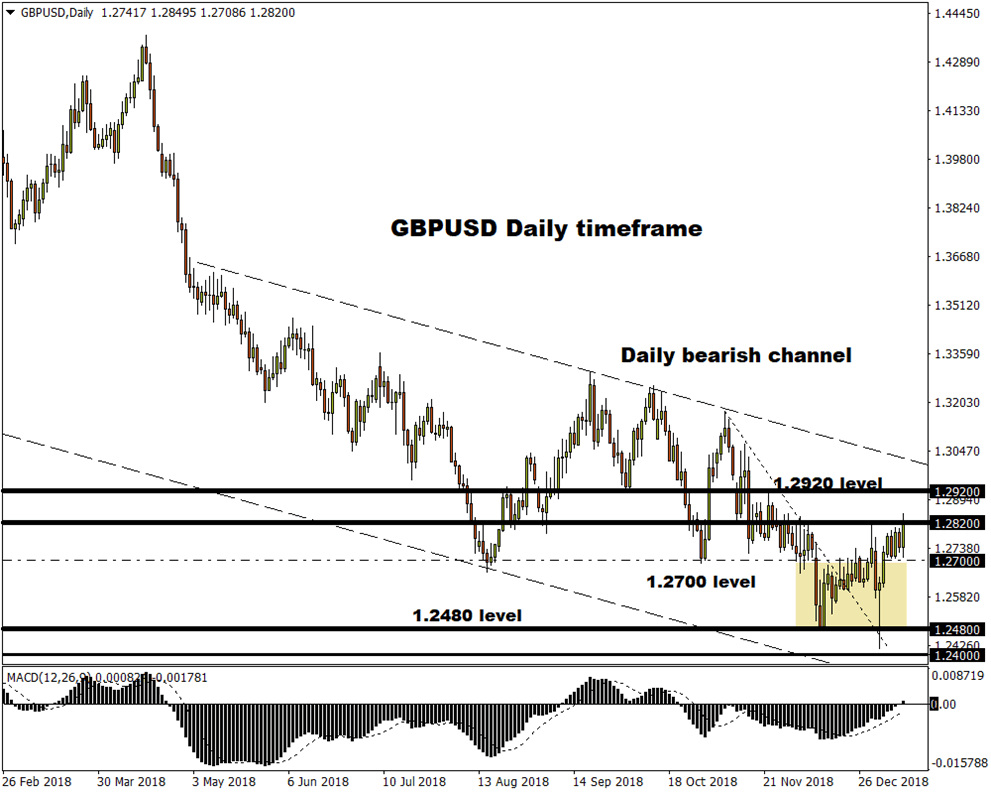
Focusing on the technical outlook, the GBPUSD has rallied over 100 pips today with prices jumping above 1.2810. However, the currency pair still remains on a very wide range on the daily charts with resistance at 1.2820 and support around 1.2480. A decisive breakout and daily close above 1.2820 is seen opening a path towards 1.2920. Alternatively, if 1.2820 proves to be a reliable resistance level then bears are seen exploiting the correction to push prices towards 1.2700.
Global stocks buoyed by cautious Fed and trade optimism
Global equity markets traded cautiously higher today as dovish comments from Federal Reserve Chair Jerome Powell and a modest outcome to US-China trade talks helped improve risk appetite.
Asian stocks closed broadly higher after extended trade negotiations between the United States and China concluded with a good “foundation” to iron out differences. In Europe, shares were steady amid the improving market mood with Wall Street expected to open positive amid growing speculation over the Fed taking a pause on rates this year.
While trade optimism has the ability to push equity markets higher, investors should not overlook the geopolitical risks brewing in the background. Brexit turmoil, political uncertainty in the United States and China growth fears are major market themes seen fueling risk aversion down the road. Although investors remain optimistic over the United States and China engaging in more higher-level negotiations to resolve trade differences, the clock is ticking towards the 90-day deadline. If no breakthrough is reached before the deadline and the US ends up imposing more tariffs on China, risk aversion will most likely return with a vengeance – ultimately exposing stock markets to downside shocks.
Commodity spotlight – WTI Oil
It has been a positive trading week for Oil prices thanks to Dollar weakness and improving market mood.
While the commodity has the potential to venture higher in the short term, gains are likely to be capped by supply and demand dynamics. Concerns over excessive supply in the markets coupled with fears over falling demand are likely to create obstacles for Oil bulls in the medium to longer term.
The combination of geopolitical risk, global growth fears, China’s economy and the Dollar’s trajectory remain themes seen influencing Oil prices. Although a weaker Dollar has the potential to offer Oil prices some support, robust production from US Shale and further signs of China experiencing a slowdown will translate to downside losses for Oil.
Focusing on the technical picture, WTI Crude has scope to venture towards $54 in the near term.
Pound spikes higher on Brexit delay rumor
Sterling spiked higher earlier today after the Evening Standard reported that it's increasingly likely that Brexit will be delayed beyond March 29. Unnamed senior minister was quoted saying "the legislative timetable is now very very tight indeed... certainly, if there was defeat on Tuesday and it took some time before it got resolved, it's hard to see how we can get all the legislation through by March 29."
However, Prime Minister Theresa May's office was quite to come out to deny the rumor. Her spokesman Alison Donnelly said May has ruled out extending Article 40. And, "it's government policy that this is not something we are going to do."
The pound pared back some gains but remains generally firm against Dollar, Euro and Yen.
GBPCAD Struggles in Upward Sloping Channel in Medium Term
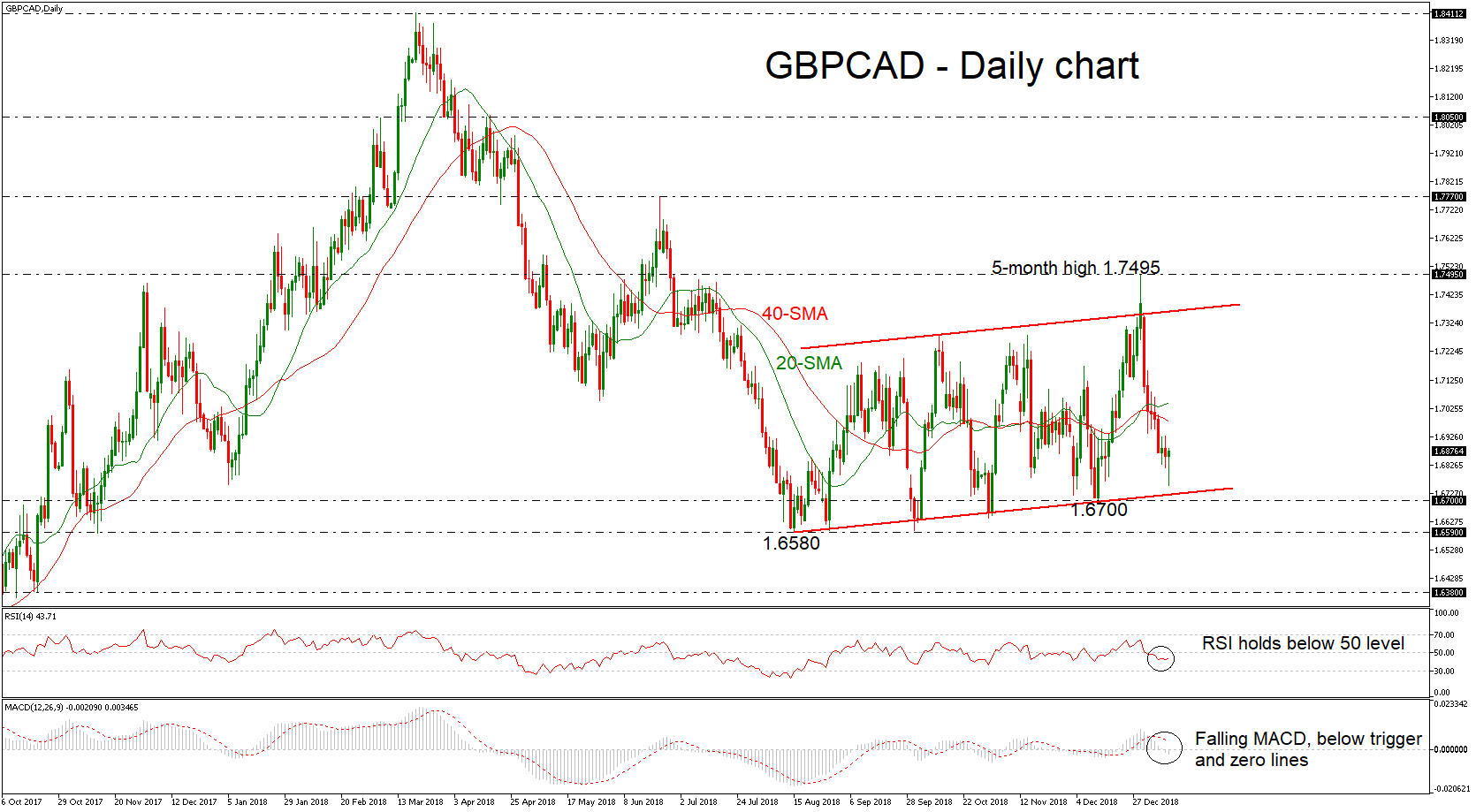
GBPCAD slipped below the 20- and 40-simple moving averages (SMAs) in the daily timeframe, following the bounce off the five-month high of 1.7495 resistance level reached on 1.7495. The pair has been trading within an ascending sloping channel over the last five months, despite the upside spike towards 1.7495. The RSI indicator keeps moving slightly down, below the 50 level, while the MACD is strengthening its momentum to the downside.
Further declines may meet support around the lower channel line, which stands near the 1.6700 strong psychological level. More losses could endorse the long-term bearish view and drive the price until the 1.6590 support level, while even lower, the pair could hit the October 2017 low of 1.6380.
On the upside, resistance could occur around the 40- and then at the 20- SMAs at 1.6980 and 1.7040 respectively. Higher still, the next resistance could come from the upper band of the channel around 1.7400.
The medium-term picture continues to look predominantly bullish with trading activity remaining within the upside canal.
DAX Pauses after Gains
The DAX index has edged lower in the Friday session. Currently, the index is at 10,891, down 0.27% since the close on Thursday. On the release front, Italian industrial production declined by 1.6%, well short of the estimate of -0.3%.
The global trade war has led to less demand for European exports, which in turn has weighed heavily on the manufacturing industry. Industrial production in Italy fell by 1.6% in November and in France the drop was 1.3%. The biggest worry is over Germany, where industrial production has slipped for three straight months. With the three largest economies in the eurozone in trouble, conditions may not warrant any rate increases in the foreseeable future. The ECB winded up its stimulus program last month, and had expressed plans to raise rates later this year.
After weeks of turmoil in the equity markets, risk appetite has returned and steadied the markets. The Fed has made a sharp U-turn since the December rate hike and is sounding much more cautious about future rate hikes. The minutes noted low inflation meant that the Fed can “afford to be patient about further policy firming”. Even more striking, the minutes revealed that at the December meeting, some policymakers opposed a rate hike, arguing that inflation was too low to warrant higher rates. The new dovish stance from the Fed has relieved investors and helped stabilize the stock markets, with 2018 being the worst year in a decade.
Asian Shares Marking Weekly Gains As Trade Talks Will Continue
Asian markets have been closing in positive territory as US and Chinese mid-level officials closed a three-day session in Beijing in good, progressing ways. Investors gained confidence as trade talks are expected to extend, with the advent of China Vice Premier Liu He in Washington in January.
Indeed, the de-escalation of trade tensions bodes well for the stock market, which is set for new weekly gains. Hong Kong Hang Seng (+3.18% year-to-date) is closing a sixth trading session in positive territory amid a confirmed pause of Fed interest-rate increases and a stronger Renminbi against dollar while US equities are set for a similar path, with currently 5 consecutive day gains. However, the prospects of a continued government shutdown, which could become the longest if maintained through the weekend and the risk of policy dispute between Republicans and Democrats in the scenario of a national emergency policy should weigh on US equities and have a negative impact on US data, closely monitored by market participants. US CPI data published today for the month of December are expected to slowdown, with headline y/y and m/m metrics given at 1.90% (prior: 2.20%) and -0.10% (prior: 0%).
The recent reaction in USD/CNY (-1.84% week-to-date) suggests that the currency pair is an interesting indicator to gauge the US – China trade situation. Currently trading at 6.7428, largely below today’s PBoC fixing rate of 6.7909, we expect the pair to continue its downward trend short-term.