

Sample Category Title
AUD/USD Weekly Outlook
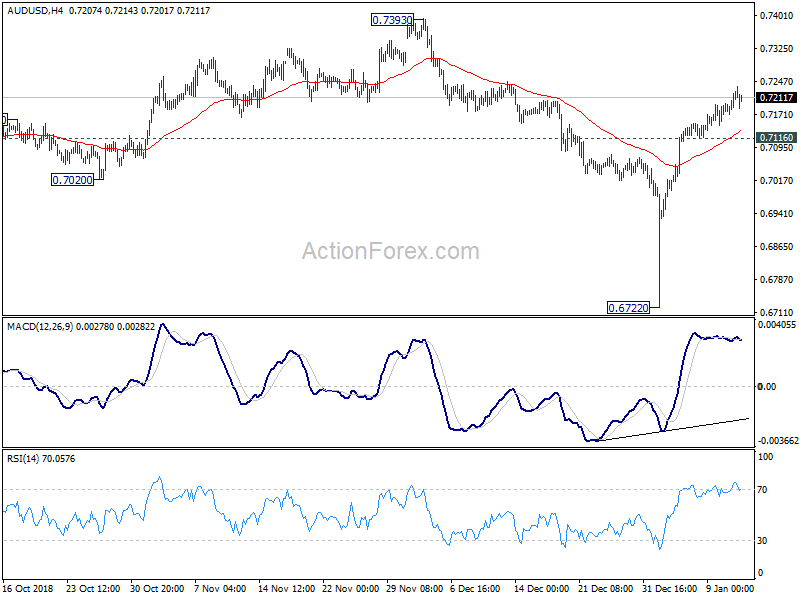
AUD/USD's rebound from 0.6722 short term bottom extended higher last week. And despite loss of upside momentum as seen in 4 hour MACD, there is no sign of topping yet. Initial bias remains mildly on the upside for further rally. But upside should be limited by 0.7393 resistance to bring reversal. On the downside, break of 0.7116 minor support will turn bias back to the downside for retesting 0.6722 low.
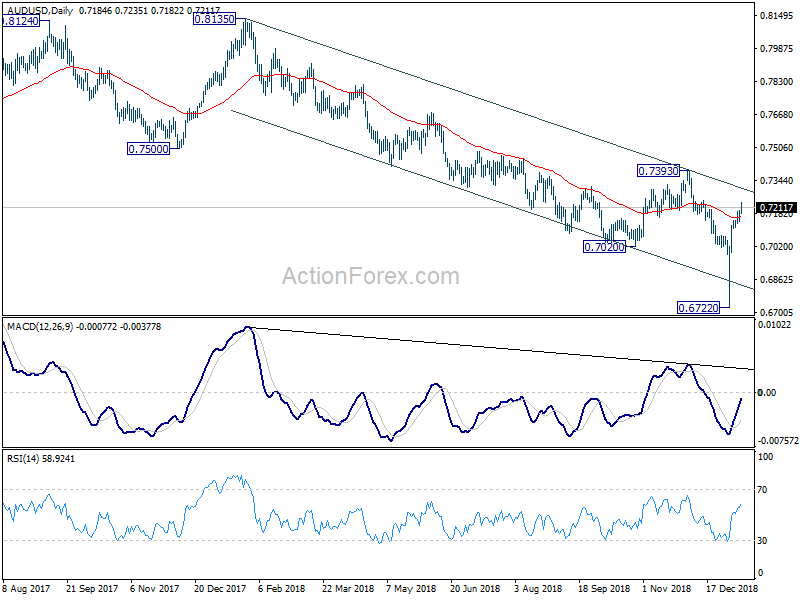
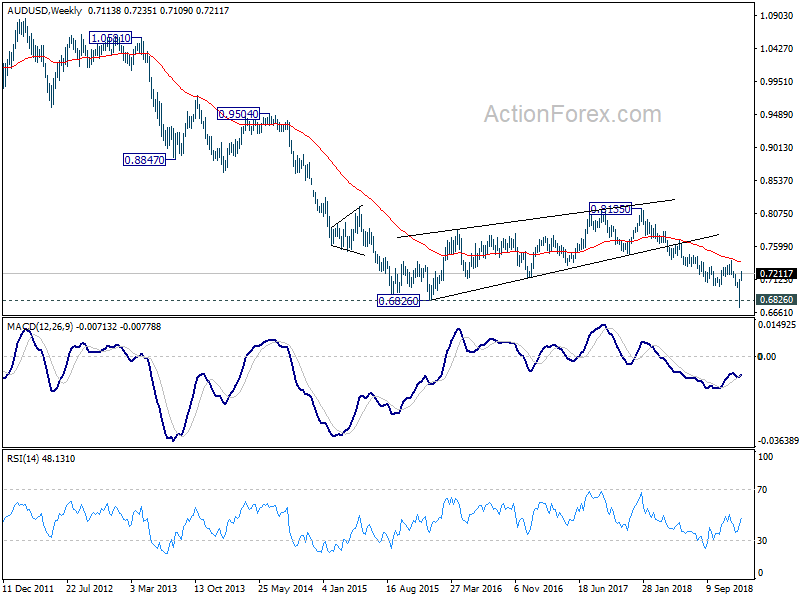
In the bigger picture, the failure to sustain below 0.6826 (2016 low) suggests that the long term down trend is not ready to resume yet. But prior rejection by 55 week EMA indicates underlying medium term bearishness in the pair. Outlook will also stay bearish as long as 0.7393 resistance holds. On the downside, sustained break of 0.6826 will target 0.6008 (2008 low).
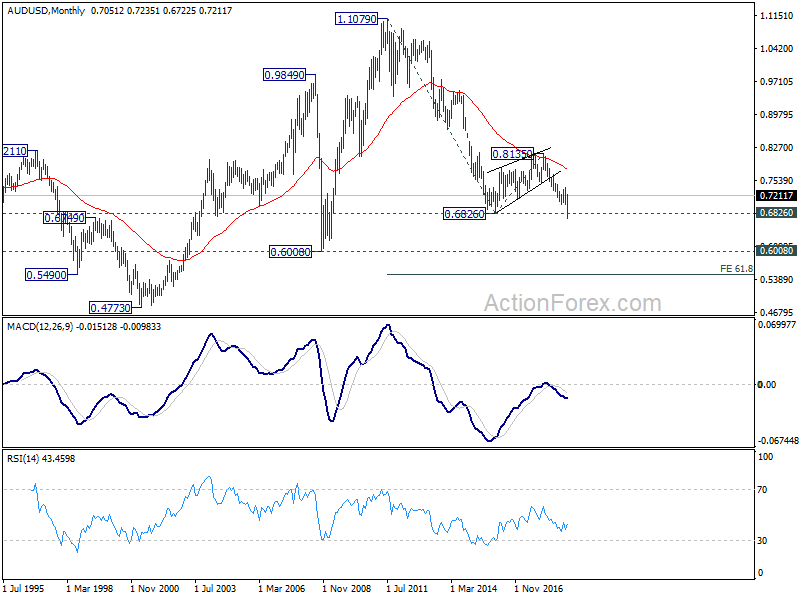
In the longer term picture, prior rejection by 55 month EMA maintained long term bearishness in AUD/USD. That is, down trend from 1.1079 (2011 high) is still in progress. Sustained break of 0.6826 will target 0.6008 low and then 61.8% projection of 1.1079 to 0.6826 from 0.8135 at 0.5507.
USD/CAD Weekly Outlook
USD/CAD's fall from 1.3664 accelerate through 55 day EMA last week and reached as low as 1.3180. A temporary low is in place and initial bias is neutral this week work. But further decline is expected as long as 1.3323 minor resistance holds. Break of 1.3180 will target 61.8% retracement of 1.2781 to 1.3664 at 1.3118. We'll start look for bottoming sign below there. On the upside, above 1.3323 will suggest short term bottoming and turn bias back to the upside for stronger rebound.
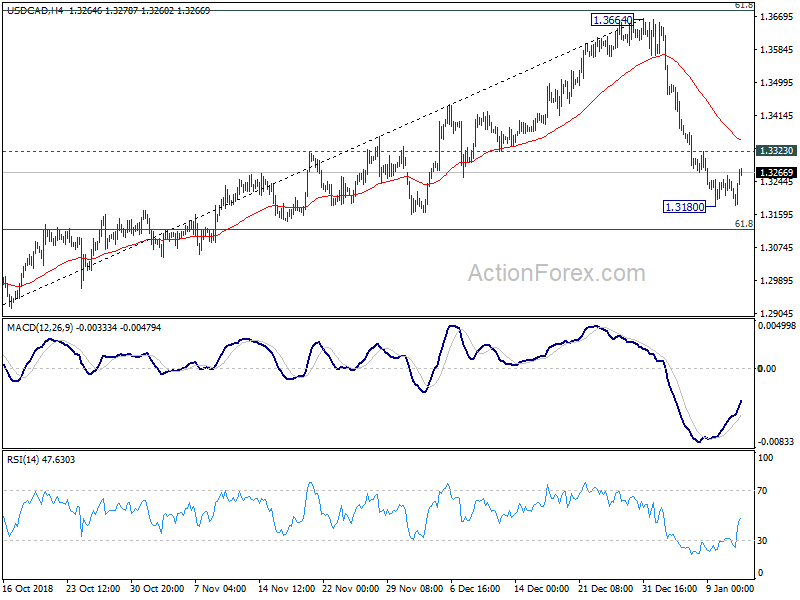
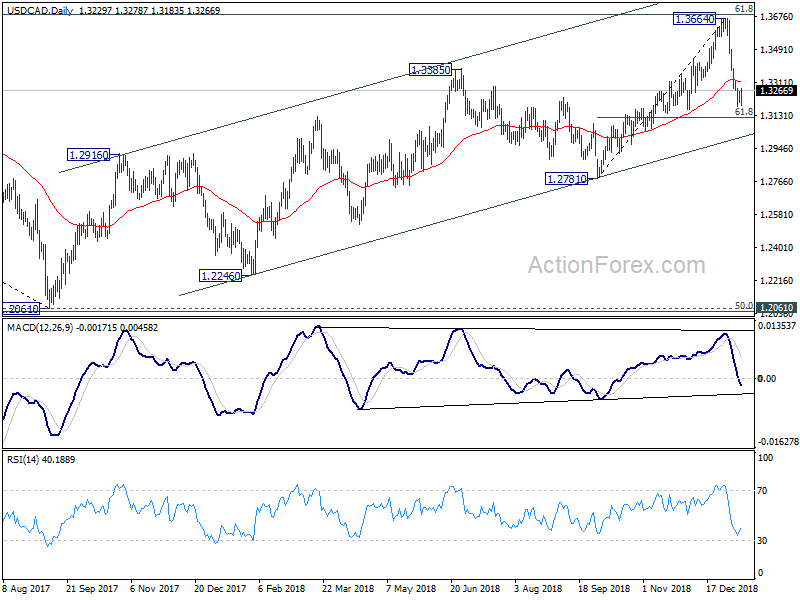
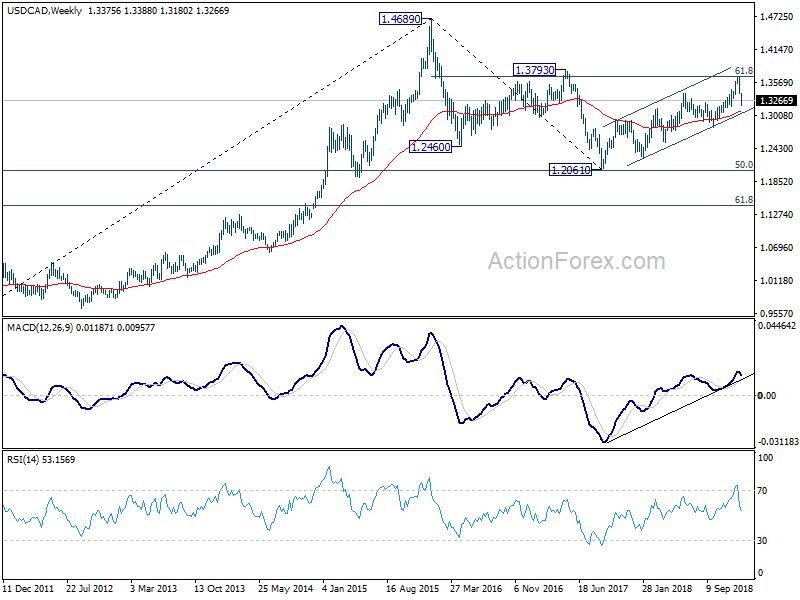
In the bigger picture, the medium term rise from 1.2061 (2017 low) might continue further. But the structure of such rise is not clearly impulsive so far. Hence, we'd stay cautious on strong resistance from 61.8% retracement of 1.4689 (2016 high) to 1.2061 at 1.3685 and 1.3793 resistance to limit upside, and bring medium term topping. But in any case, medium term outlook will stay bullish as long as channel support (now at 1.3016) holds. Sustained break of 1.3793 will pave the way to retest 1.4689 (2015 high).
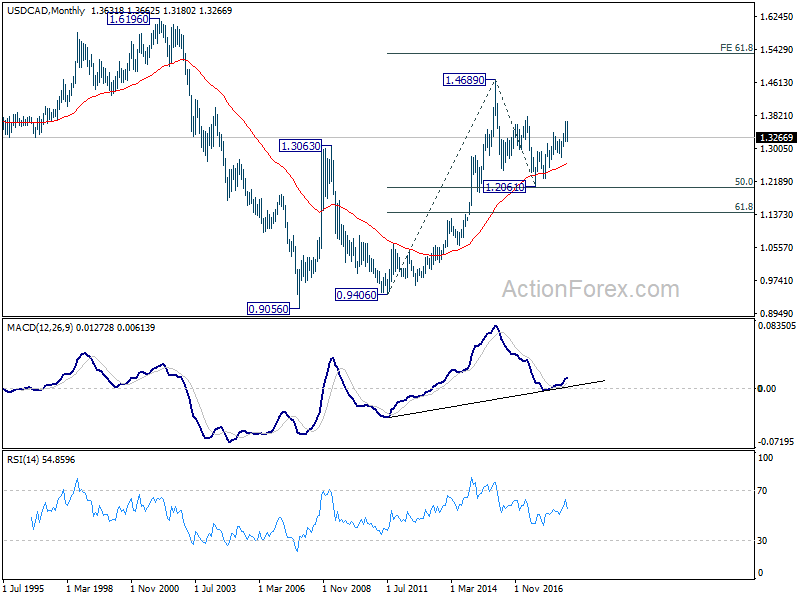
In the longer term picture, corrective fall from 1.4689 (2015 high) should have completed with three waves down to 1.2061, just ahead of 50% retracement of 0.9406 (2011 low) to 1.4689 (2015 high) at 1.2048. The development keeps long term up trend from 0.9406 and that from 0.9056 (2007 low) intact. For now, there is prospect of extending the long term up trend to 61.8% projection of 0.9406 to 1.4689 from 1.2061 at 1.5326 in medium to long term.
GBP/JPY Weekly Outlook
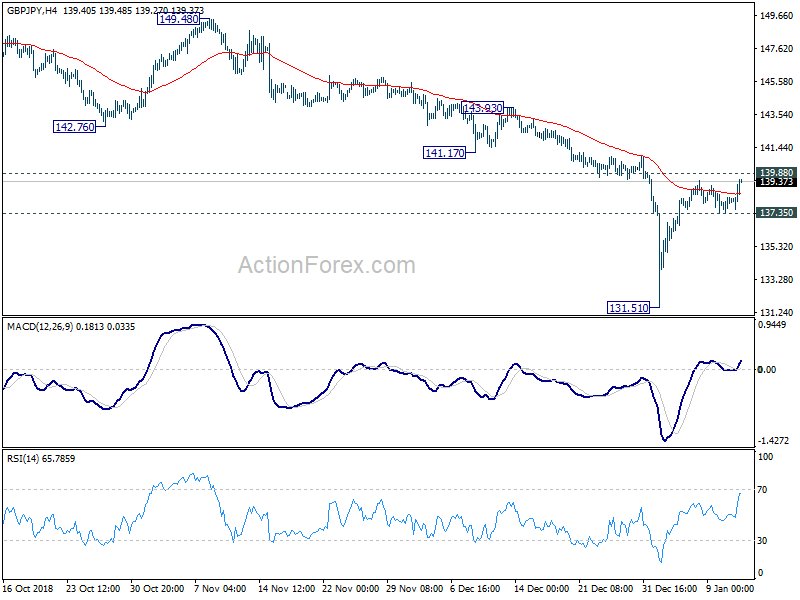
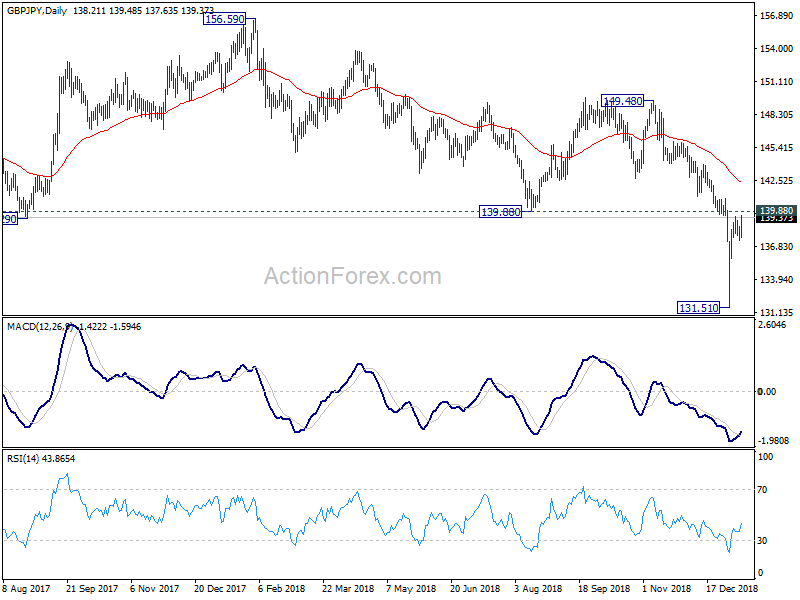
GBP/JPY's rebound from 131.51 tried to extend last week after brief retreat. But it's limited below 139.88 key resistance so far. Initial bias remains neutral this week first. For now, we'd still expect strong resistance from 139.88 to limit upside. On the downside, break of 137.35 minor will turn bias to the downside for retesting 131.51 low. However, firm break of 139.88 will extend the rebound to 143.93 resistance next.
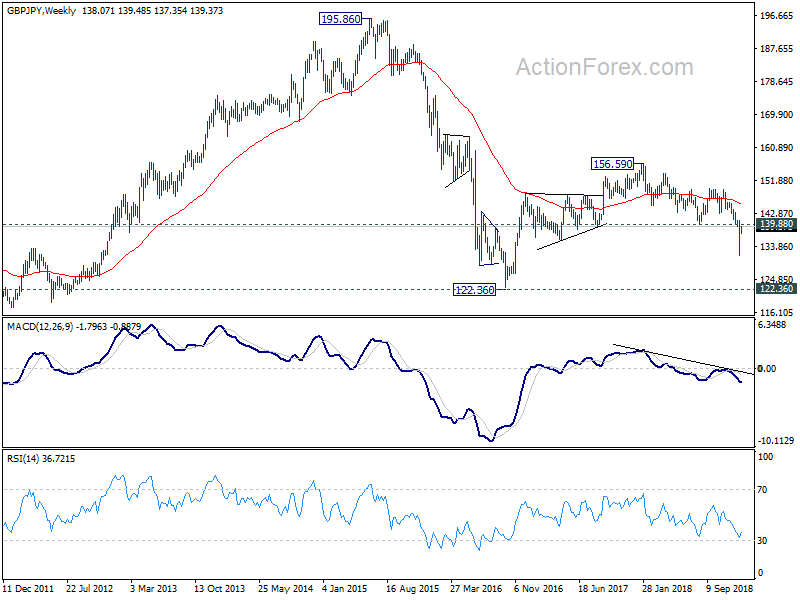
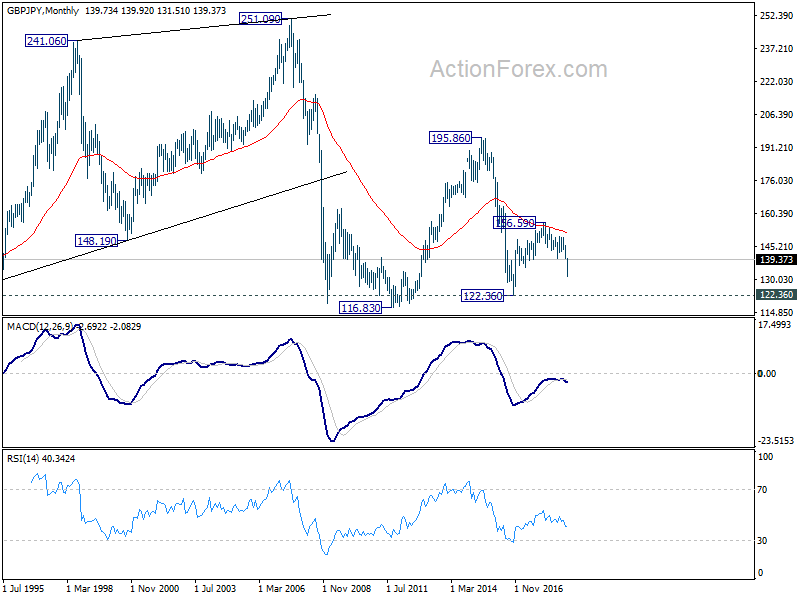
In the bigger picture, corrective medium term rise from 122.36 (2016 low) has completed at 156.69 already. That came after failing to break through 55 month EMA. Fall from 156.59 (2018 high) is seen as resuming the long term down trend from 195.86 (2015 high). Below 131.51 will target 122.36 low first. And this will now remain the preferred case as long as 139.88 support turned resistance holds. Sustained break of 139.88 will mix up the outlook and we'll reassess on the final structure of the rebound from 131.51.
In the longer term picture, rejection by 55 month EMA is seen as a bearish signal. And fall from 195.86 (2015 high) should still be in progress. Break of 122.26 should confirm this bearish case and send GBP/JPY through 116.83 low.
EUR/JPY Weekly Outlook
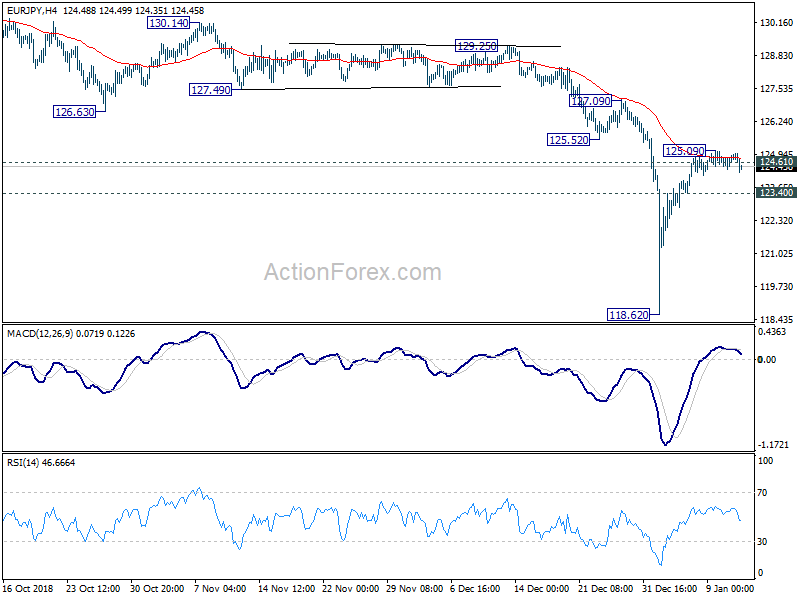
EUR/JPY edged higher to 125.09 last week but failed to sustain above 124.61 resistance, as well as 4 hour 55 EMA. With 4 hour MACD staying below signal line, initial bias remains neutral this week first. We'd still expect upside to be limited around 124.61 resistance to complete the rebound from 118.62. On the downside, break of 123.40 minor support will turn bias back to the downside for retesting 118.62 low first. However, sustained break of 124.61 will extend the rebound to 127.09 resistance next.
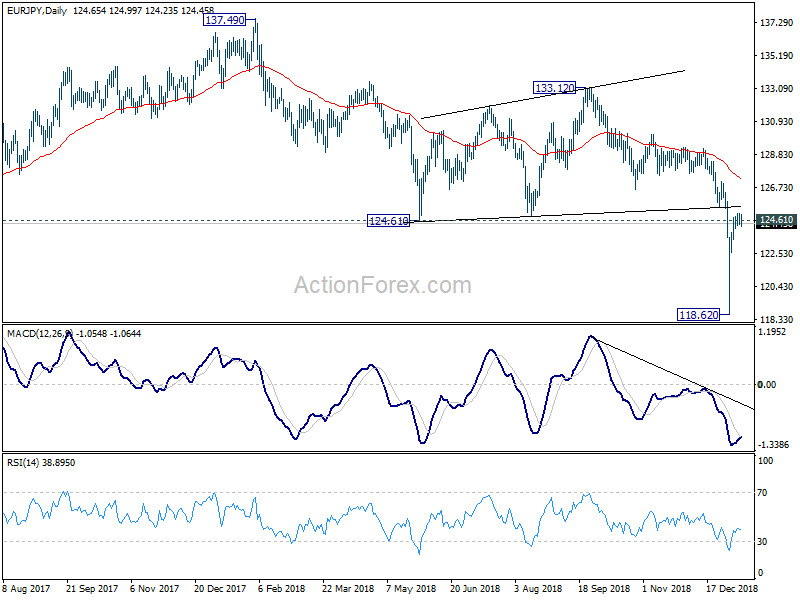
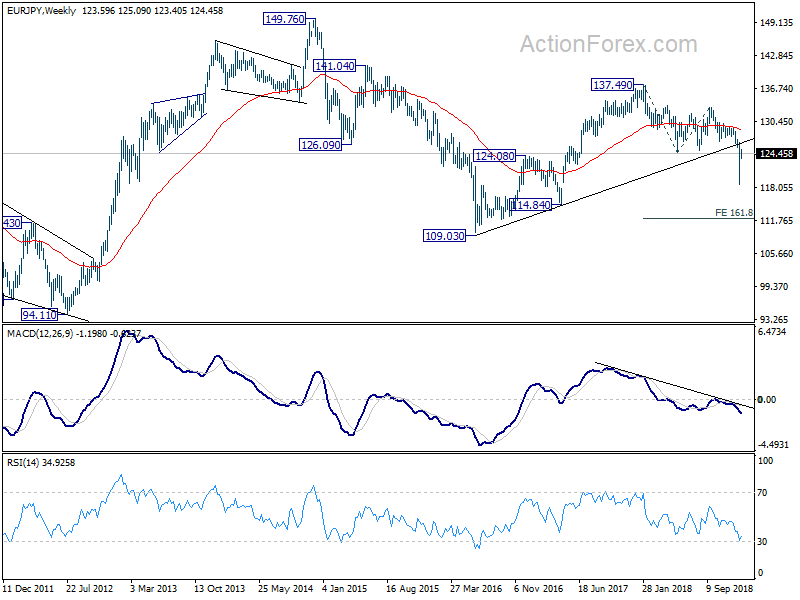
In the bigger picture, medium term rebound from 109.03 (2016 low) has completed at 137.49 already, with corrective structure. Fall from 137.39 is seen as a medium term fall, resuming the decline from 149.76 (2014 high). Such decline should break through 109.03 low next. This will remain the preferred case as long as 124.61 support turned resistance holds. Sustained break of 124.61 will mix up the outlook and we'll reassess on the final structure of the rebound from 118.62.
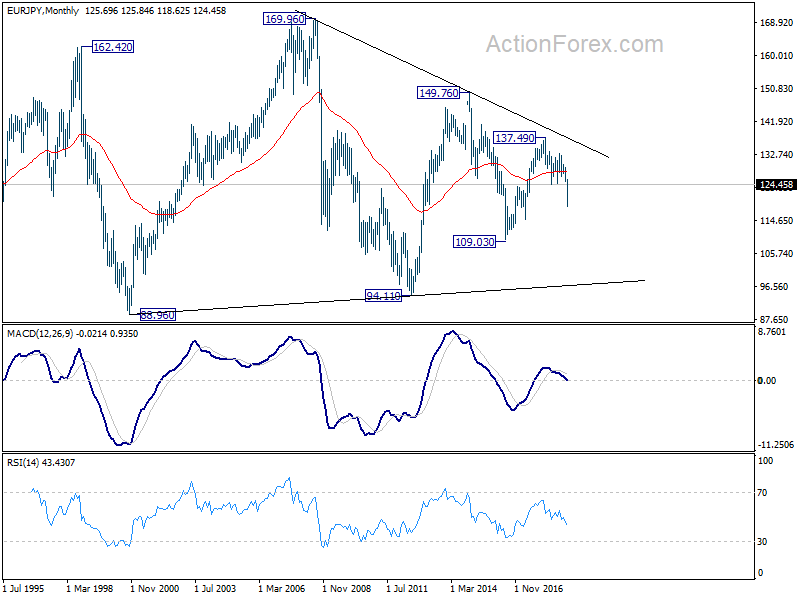
In the long term picture, EUR/JPY is staying in long term sideway pattern, established since 2000. Fall from 137.49 is seen as a falling leg inside the pattern. It could extend through 109.03 to resume the decline from 149.76 But in that case, we'd expect strong support around 94.11 (2012 low) to bring reversal.
EUR/GBP Weekly Outlook
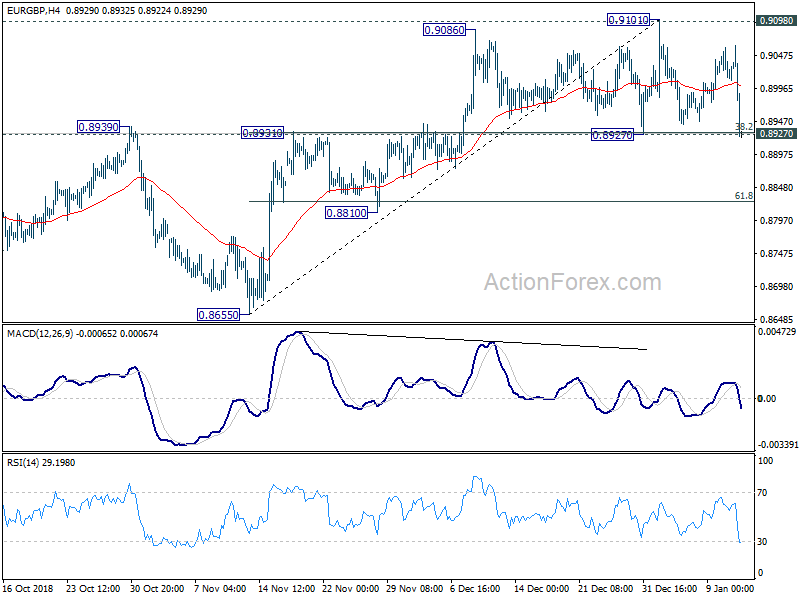
Last week's sharp decline argues that rebound from 0.8655 has completed at 0.9101, after failing to sustain above 0.9098 resistance. Initial bias is mildly on the downside this week with focus on 0.8927 support. Break will confirm near term reversal and target 61.8% retracement of 0.8655 to 0.9101 at 0.8825 and below. On the upside, break of 0.9101 resistance is needed to confirm rise resumption. Otherwise, risk will now stays on the downside in case of recovery.
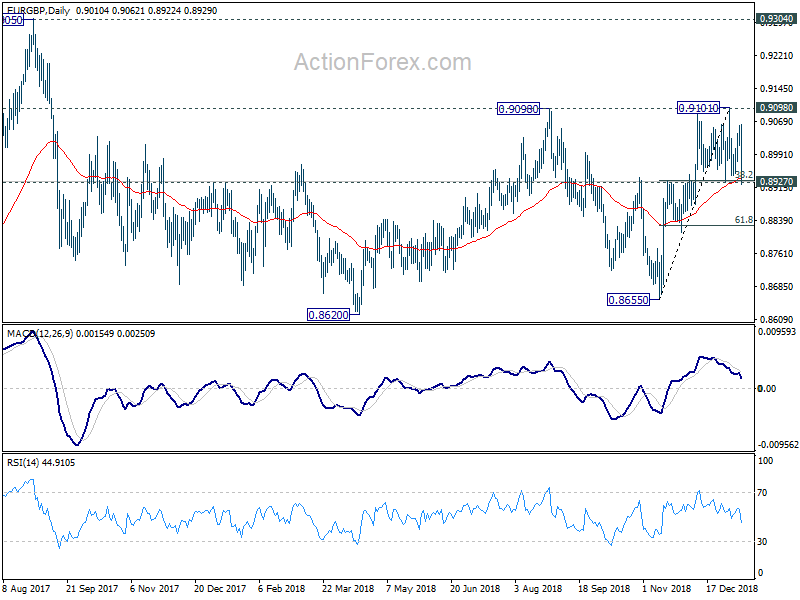
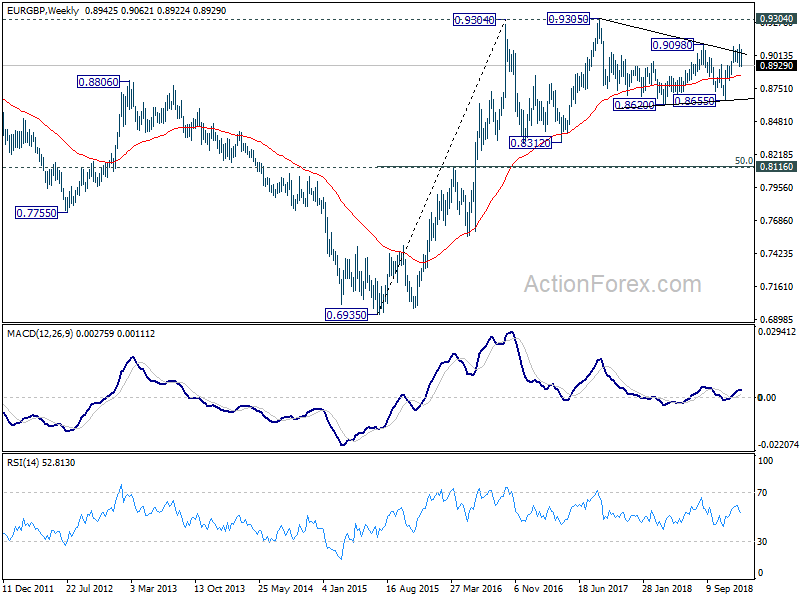
In the bigger picture, EUR/GBP is seen as staying in long term range pattern started at 0.9304 (2016 high). The medium term range is set between 0.8620 and 0.9101. Downside break out of 0.9620 will pave the way back to 0.8302/12 support zone. Break of 0.9101 will bring retest of 0.9304/5 resistance.
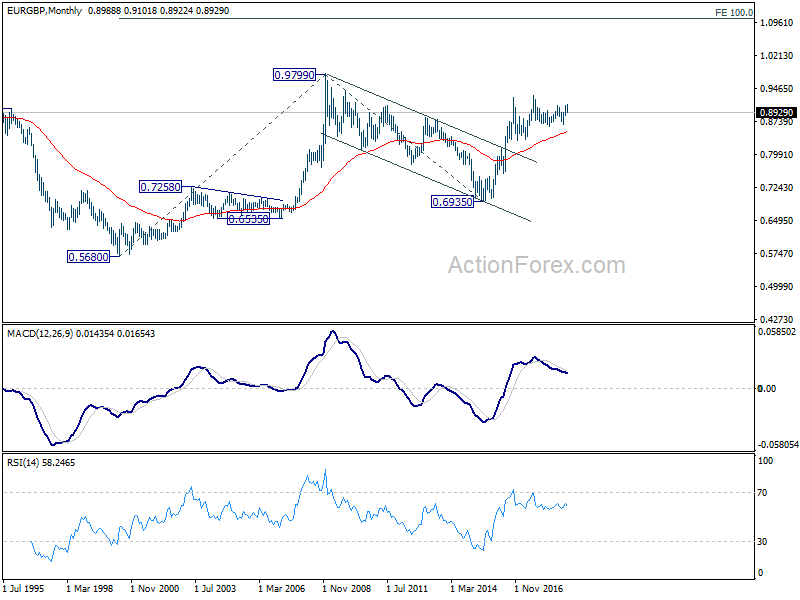
In the long term picture, we're holding on to the view that rise from 0.6935 (2015 low) is resuming the up trend from 0.5680 (2000 low). Hence, after the consolidation from 0.9304 completes, we'd expect another medium term up trend through 0.9799 to 100% projection of 0.5680 to 0.9799 from 0.6935 at 1.1054.
EUR/AUD Weekly Outlook
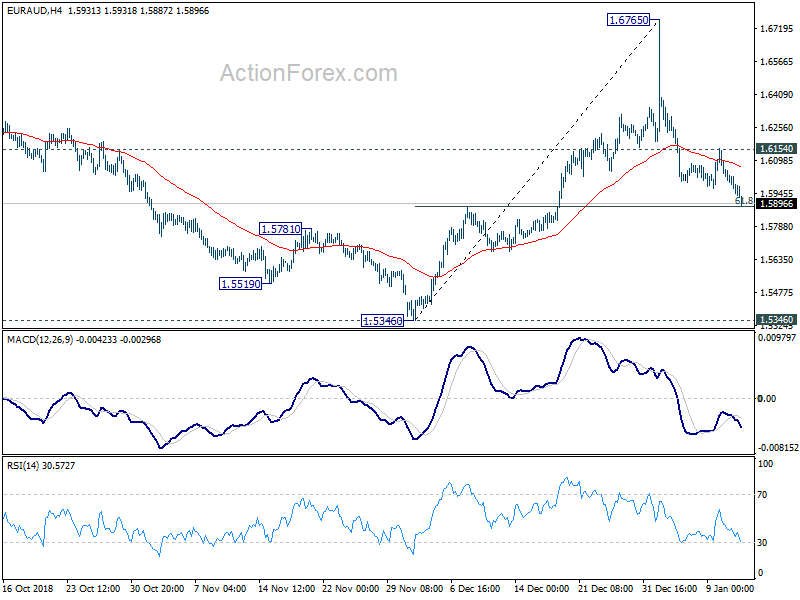
EUR/AUD's fall from 1.6765 extended to as low as 1.5887 after brief interim recovery. Initial bias remains on the downside this week. Sustained break of 61.8% retracement of 1.5346 to 1.6765 at 1.5888 will pave the way to 1.5346 key support level. On the upside, break of 1.6154 resistance is needed to indicate completion of the decline from 1.6765. Otherwise, further fall will remain in favor even in case of recovery.
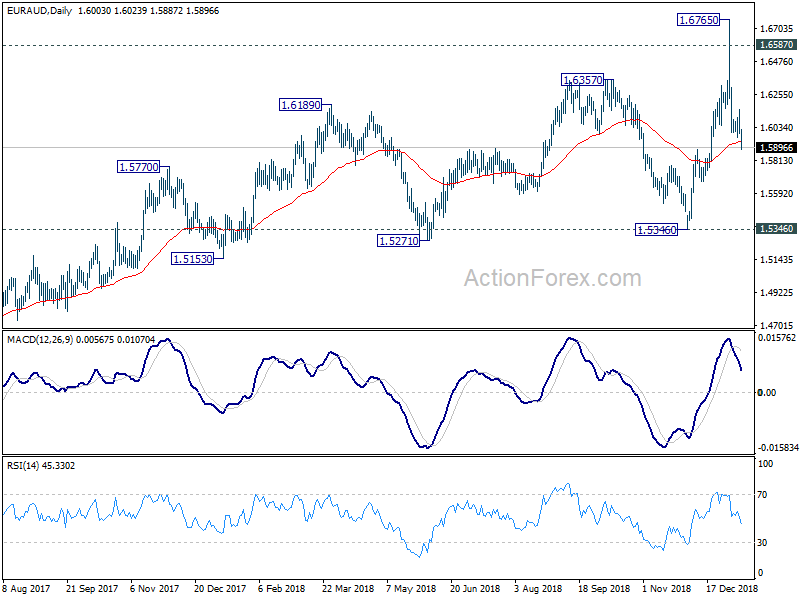
In the bigger picture, the failure to sustain above 1.6587 key resistance (2015 high), argues that up trend from 1.1602 (2012 low), is not ready to resume yet. But still, as long as 1.5346 support holds, outlook will remain bullish. Break of 1.6765 will target 61.8% retracement of 2.1127 (2008 high) to 1.1602 at 1.7488 next. However, firm break of 1.5346 key support will indicate trend reversal, with bearish divergence condition in weekly MACD, and turn outlook bearish.
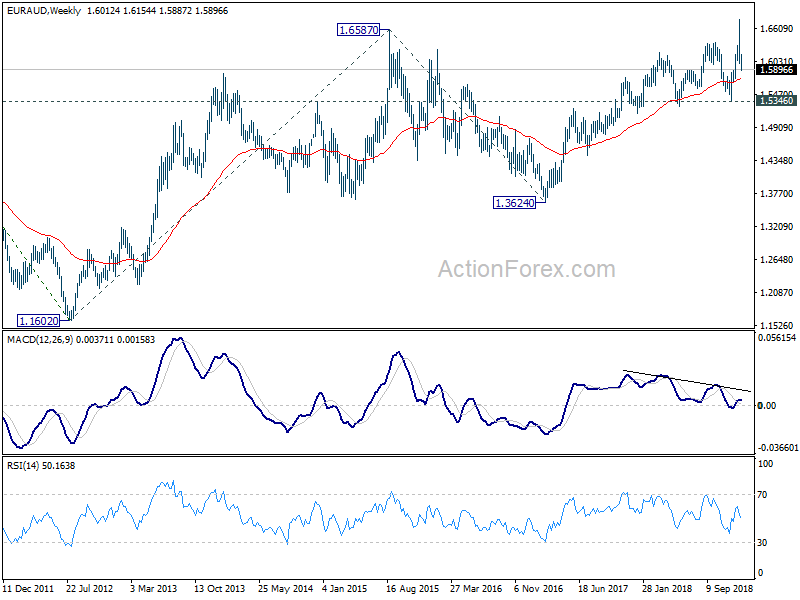
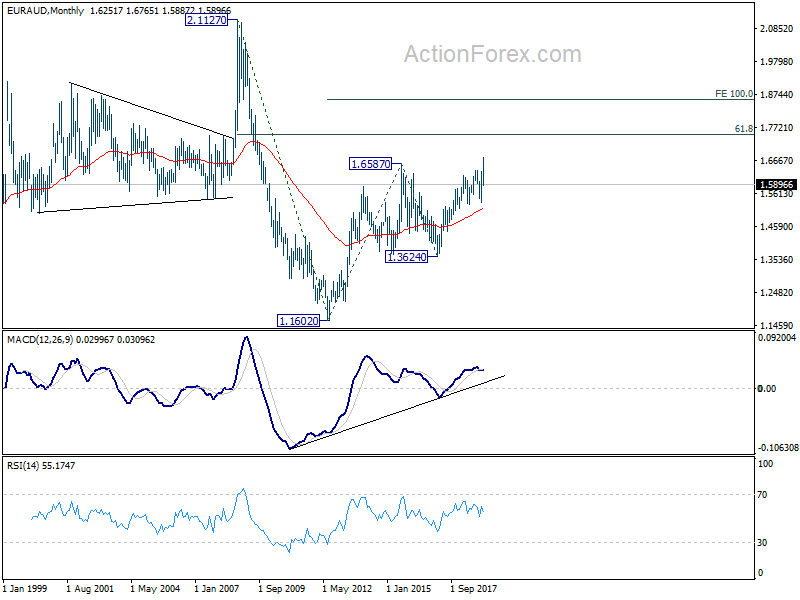
In the longer term picture, the rise from 1.1602 long term bottom (2012 low) is still in progress. Break of 61.8% retracement of 2.1127 to 1.1602 at 1.7488 will pave the way to 100% projection of 1.1602 to 1.6587 from 1.3624 at 1.8069. And this will remain the favored case as long as 1.5346 remains intact.
EUR/CHF Weekly Outlook
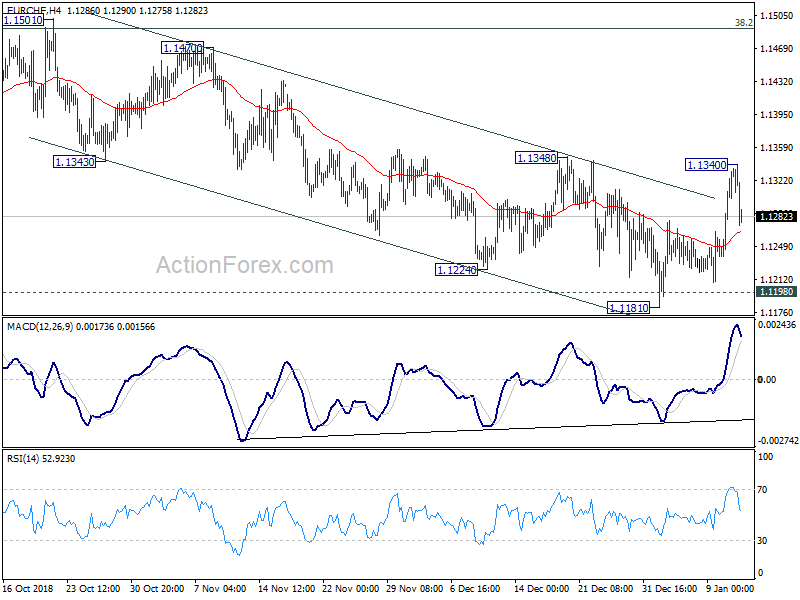
EUR/CHF rebounded strongly to 1.1340 last week and the break of near term falling channel suggests bullish reversal. But it retreated ahead of 1.1348 resistance. Thus, initial bias is neutral this week first. On the upside, break of 1.1348 will confirm this bullish case and turn bias to the upside for retesting 1.1501 next. On the downside, in case of another fall, we'd expect strong support from 1.1154/98 support zone to contain downside to bring rebound.
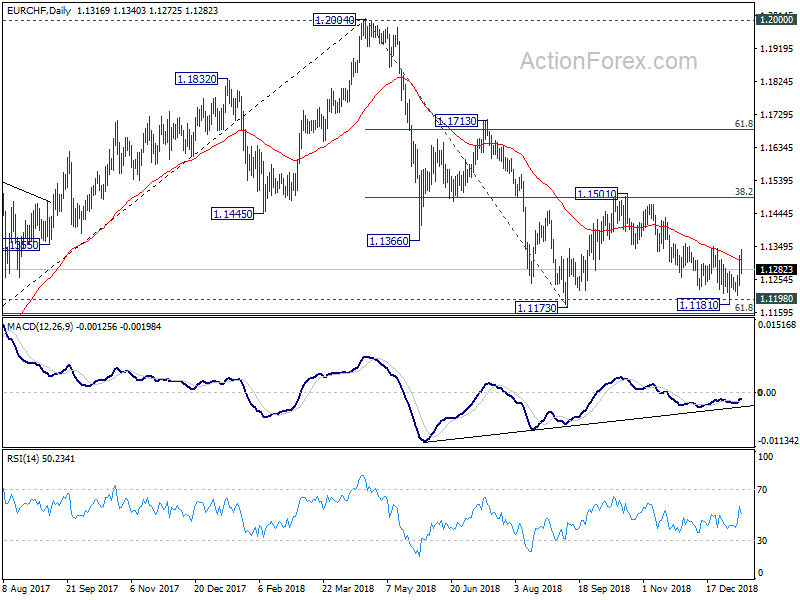
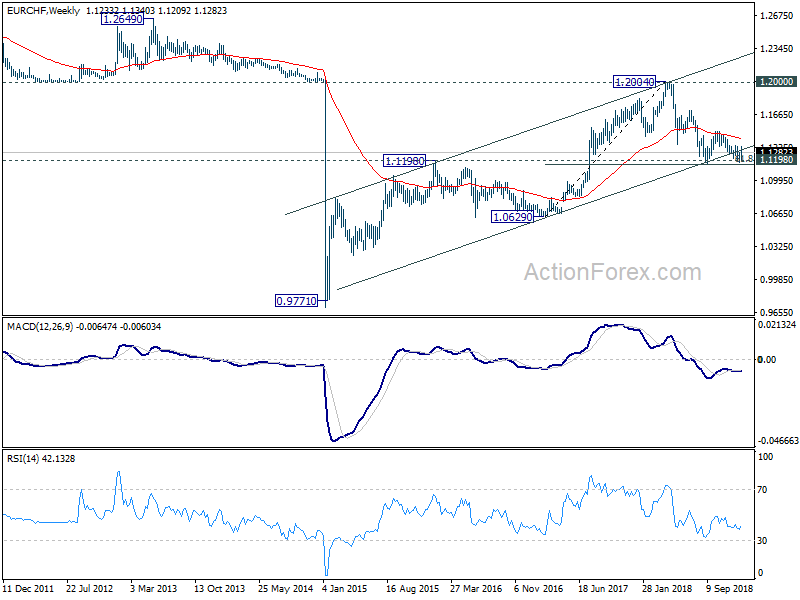
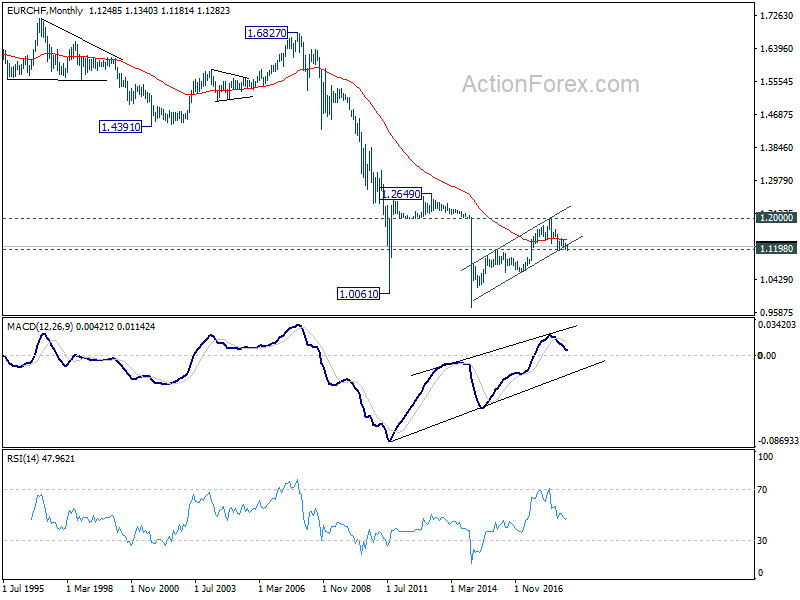
In the bigger picture, price actions from 1.2004 medium term top is seen as a correction only. Downside should be contained by support zone of 1.1198 (2016 high) and 61.8% retracement of 1.0629 to 1.2004 at 1.1154 to complete it and bring rebound. A break of 1.2 key resistance is still expected in the medium term long term. However, sustained break of the mentioned support zone will mark reversal of the long term trend. In that case, 1.0629 key support will be back into focus.
Brexit to Take the Spotlight from Fed, Trade War and US Government Shutdown
Risk sentiments continued to recover last week as Fed officials indicated they would be patient before making the next rate move. Positive developments of US-China trade talks also helped. One notable development was the rebound in US treasury yields as 10-year yield reclaimed 2.7 while 30-year yield is back above 3.0. Japan 10-year JGB yield also turned positive These are signs of stabilization in the financial markets. The recording setting government shutdown in the US is so far having little impact on the markets too.
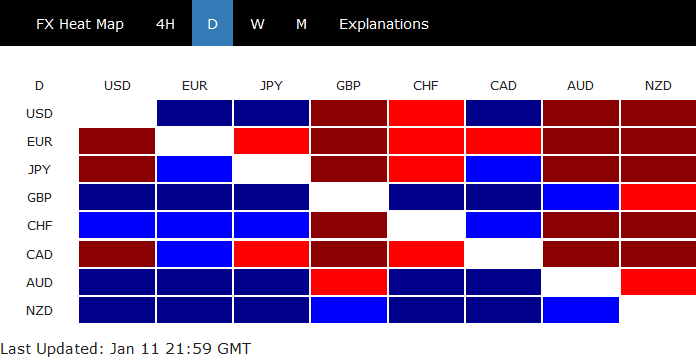
As a result, Yen ended as the weakest one for the week, followed by Dollar, and then Swiss Franc. New Zealand Dollar was the strongest, followed by Australian Dollar. This is a rather reasonable result of return of risk appetite. Sterling ended as the third strongest as the Brexit parliamentary vote is approaching and the chance of no-Brexit is rising. Canadian Dollar was also strong, but it suffered some setback as oil prices pullback quite notably on Friday. Brexit is set to be the major focus this week.
Government shutdown sets new record, no emergency, no end in sight
As of Saturday, the US government shutdown has stretched into its 22nd consecutive days, surpassing the 21-day record set in 1995-96. Trump stormed out of a meeting with Congressional leaders as his request for funding for the border wall of any form was rejected bluntly by Democrats. On Friday, Trump said "the easy solution is for me to call a national emergency... I have the absolute right to do it." But he added "I'm not going to do it so fast. Because this is something Congress should do."
The is no end in sight for the shutdown. Some 800k government employees missed their first paycheck on Friday. Around 380k workers have been furloughed. And should there is no breakthrough next week, the furloughed workers could be counted as unemployed. The would result in a big contraction of employment to be shown in the January non-farm payroll report, with a surge in unemployment rate, probably back above 4%.
For now, there is little impact on the financial markets. But investors might start to feeling something as it extends into uncharted territory.
DOW's rebound continues, setting sight on 55 day EMA
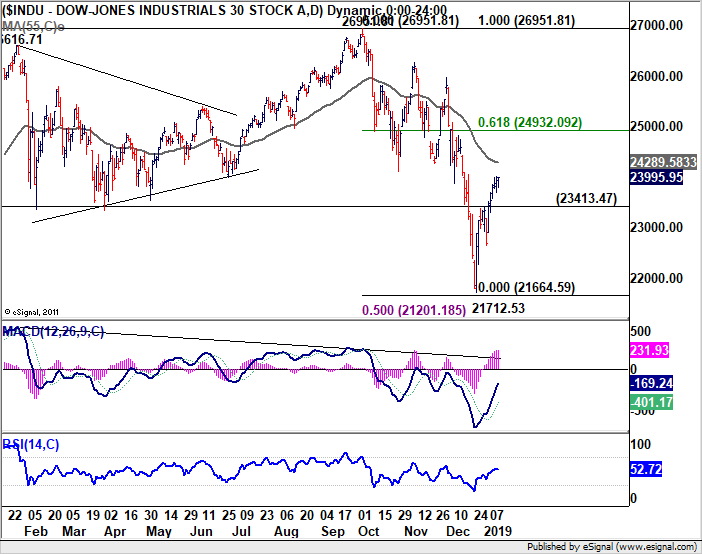
US stocks extended the post-Christmas rebound last week. DOW reached as high as 24014.78 and broke 38.2% retracement of 26951.81 to 21712.53 at 23864.30. The slightly stronger than expected rebound is now raising the chance that price action from 26951.81 are merely developing into a sideway pattern, rather than a deeper correction.
The next hurdle will be 55 day EMA (now at 24289.58). Sustained break will affirm this case and target 61.8% retracement at 24943.09. However, rejection from there, followed by break of 23413.48 support will turn focus back to 21712.53 low instead.
Futures suggest Fed to stand pat for 2019, but less pessimistic after "patient" fedspeaks
The messages from Fed officials as well as the FOMC minutes were very clear last week. With inflation low and under control, Fed has the room to be patient to wait-and-see the developments in the economy before raising interest rate again. Officials including Chair Jerome Powell want that patience too.
The December FOMC minutes also noted that "many participants" preferred to be "patient about further policy firming", amidst "muted inflation pressures". And, "participants expressed that recent developments, including the volatility in financial markets and the increased concerns about global growth, made the appropriate extent and timing of future policy firming less clear than earlier". More in FOMC Minutes Reveal Dovish Notes Which Were Hidden in December.
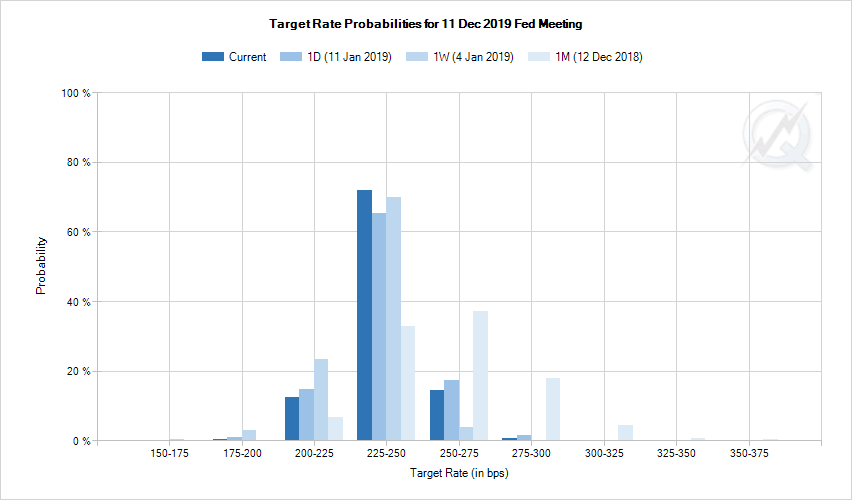
For December 2019 meeting, fed funds futures are pricing in 71.8% chance of interesting rate being unchanged at 2.25-2.50%. It's slightly higher than last week's 69.7%. Chance of a rate cut dropped notably to around 12.5%, down from last week's 26%. It's also now lower than chance of a hike, at 14.5%, up from less than 4% a week ago. That is, investors are now slightly less pessimistic on the rate path.
Dollar index in medium term correction towards 93.81/94.09
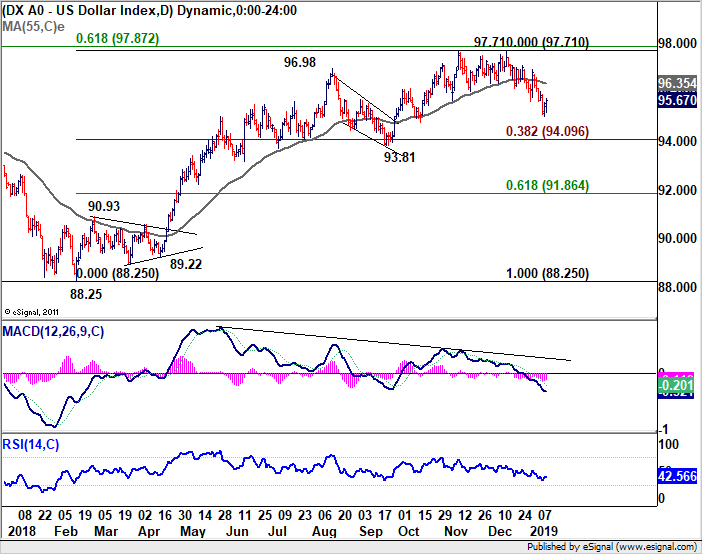
Dollar index's choppy decline from 97.71 extended to as low as 95.02 last week. The development suggests that 97.71 is a medium term, on bearish divergence condition in daily MACD, after rejection by 61.8% retracement of 103.82 to 88.25 at 97.87. Fall from 97.71 is corrective the five-wave sequence from 88.25. Deeper decline would likely be seen to 93.81 support, which is closed to 38.2% retracement of 88.25 to 97.71 at 94.09. Though, we'd expect strong support from there to bring rebound. Rise from 88.25 is in still in favor to resume at a later stage.
Chinese Yuan rebounded remarkably after trade talks with US in Beijing
The vice ministerial level US-China trade talks ended in Beijing with one-day extension. The extension itself was seen as a positive sign. Chinese MOFCOM later said there "extensive, in-depth and meticulous exchanges on trade issues and structural issues of common concern, which enhanced mutual understanding and laid the foundation for resolving mutual concerns." USTR's statement was more neutral and just described what were being discussed.
Nevertheless, the US team raised the "need for any agreement to provide for complete implementation subject to ongoing verification and effective enforcement". This is a legitimate concern based on China's history of failing promising. China Vice Premier Liu He is planning a visit to Washington later this month. And we'll see if Liu would bring something promising.
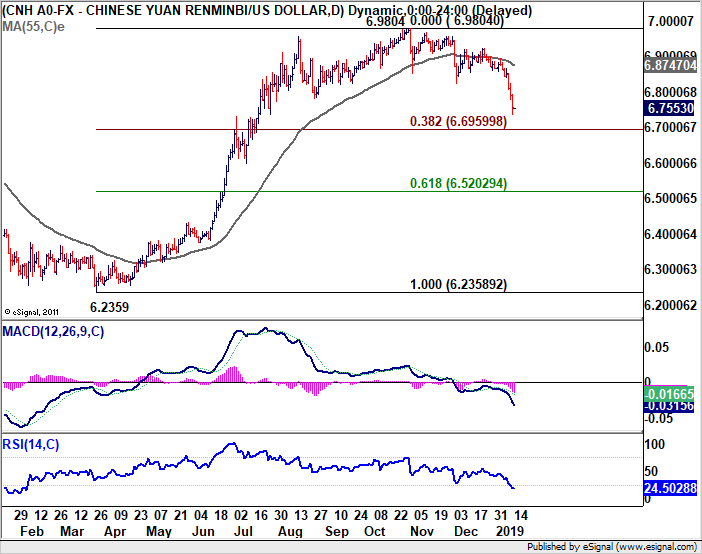
The Chinese Yuan staged a remarkable come back last week. And that's the most concrete indication of positive development in trade negotiations. Current development suggests medium topping at 6.9804 in USD/CNH (offshore Yuan), on bearish divergence condition in daily MACD. 7 handle was also safely defended. There For now, USD/CNH should drop to 38.2% retracement of 6.2359 to 6.9804 at 6.6959. Firm break there will pave the way to 6.5202.
Sterling lifted as chance of no-Brexit rises
UK will definitely be the center of focus ahead as the meaningful vote of Prime Minister Theresa May's Brexit deal looms. While May might still be spending her last effort to secure approval of the Commons, it's just remotely likely for it to happen. As the deal is voted down, the government should have a plan B ready within days. May's office was quite to deny reports regarding Article 50 extension. But no matter what route the plan B paves, it's unlikely to match the March 29 deadline. And Brexit would be delayed.
There are basically three options: Just leave without a deal; general election; or a second referendum. There should be enough opposition to no-deal Brexit in the parliament. And there is no sign of campaigning for no-deal seen. So this route is rather unlikely. Labour leader Jeremy Corbyn is pushing for a general election. But we can't see how a change in leadership would prompt EU to re-open negotiation. Though, it's still possible.
Pro-EU groups are pushing for second referendum. In the Roadmap to a People's Vote, the group is pushing for a binary referendum: either the Government's deal vs staying in the EU; or an alternative, deliverable form of Brexit vs staying in. But they do not entirely rule out a referendum with three options, including no-deal Brexit.
There are a lot of uncertainties ahead and chance of no-Brexit at all is rising. That, together with the inevitable delay in Brexit, has pushed up the Pound last week. For now, we're seeing a second referendum as the most likely outcome. But the result could be highly dependent on how it's structured. If it's a binary referendum, more Britons may opt for respecting the result of the 2016 referendum and choose May's deal. However, if there are three options, votes maybe piled towards no-Brexit, just for the sake of avoiding a hard-Brexit. It's not quite predictable for now.
Position trading strategy
Our strategy to buy USD/CHF on break of 0.9965 last week was not filled. EUR/CHF did stage a strong rebound as anticipated. And Swiss Franc was the third weakest over the week. However, Dollar was even weaker after Fed officials' comments. USD/CHF, thus, went the other direction. The development now suggests USD/CHF's choppy fall from 1.0128 is a correction of larger degree. That is prospect of further decline to 0.9541 support before bottoming. We'll cancel the order first.
On new strategy, Sterling long is rather tempting but we'd prefer to continue to avoid it due to Brexit uncertainties. Stocks and Yen crosses seemed to be losing momentum towards the end of the week but there is no clear indication of topping yet. Similar, WTI crude oil also looks like it's topping ahead of 54.61 resistance but there is no confirmation. Dollar's decline looks set to extend but it's seen as in a correction that could end any time. In particular, fortune of Dollar and Yen could have a turn should stocks and oil top soon.
Overall, we don't see any compelling trading opportunity for now. We'll stand aside first and wait-and-see "patiently".
GBP/USD Weekly Outlook
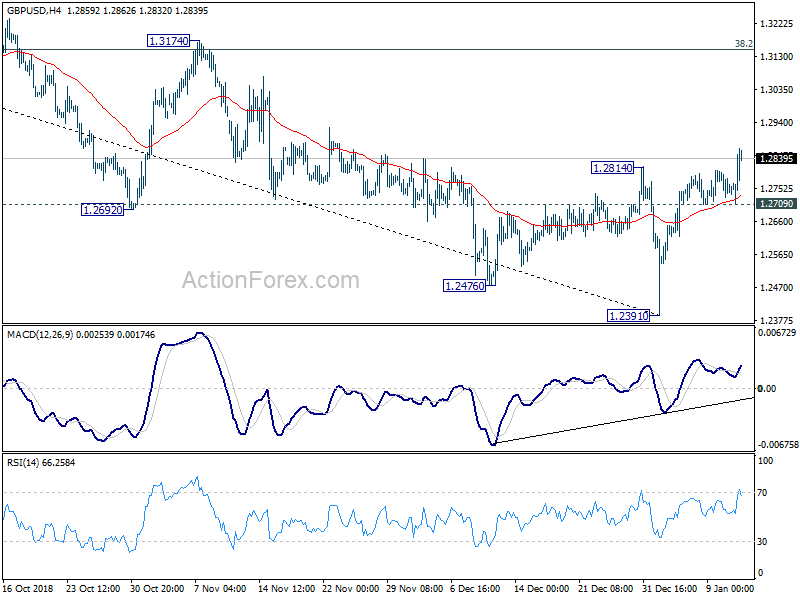
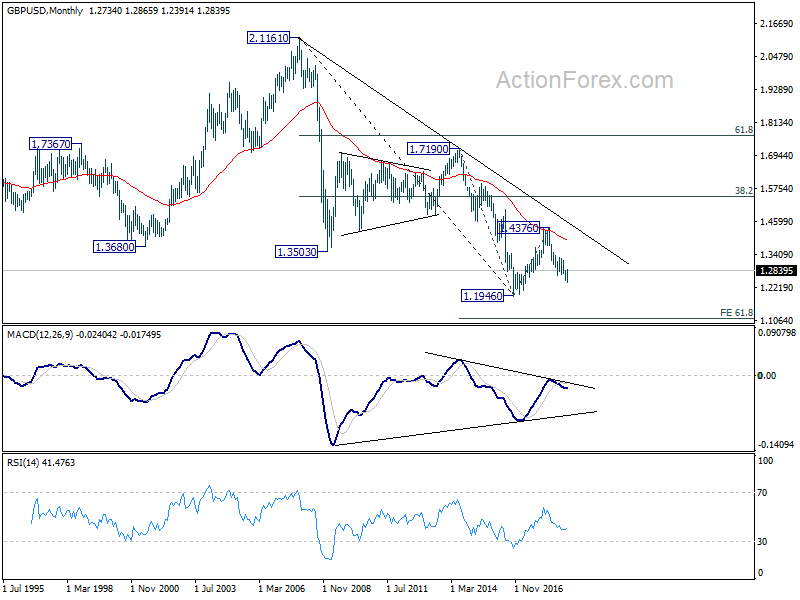
GBP/USD's rebound from 1.2391 extended to as high as 1.2865 last week and broke a.2814 resistance. The development now suggests that such rebound is correcting whole down trend from 1.4376. Initial bias remains on the upside this week for 1.3174 resistance, which is close to 38.2% retracement of 1.4376 to 1.2391 at 1.3149. We'd expect strong resistance from there to limit upside, at least on first attempt. On the downside, break of 1.2709 minor support will argue that such rebound is completed and turn bias back to the downside for retesting 1.2391 low.
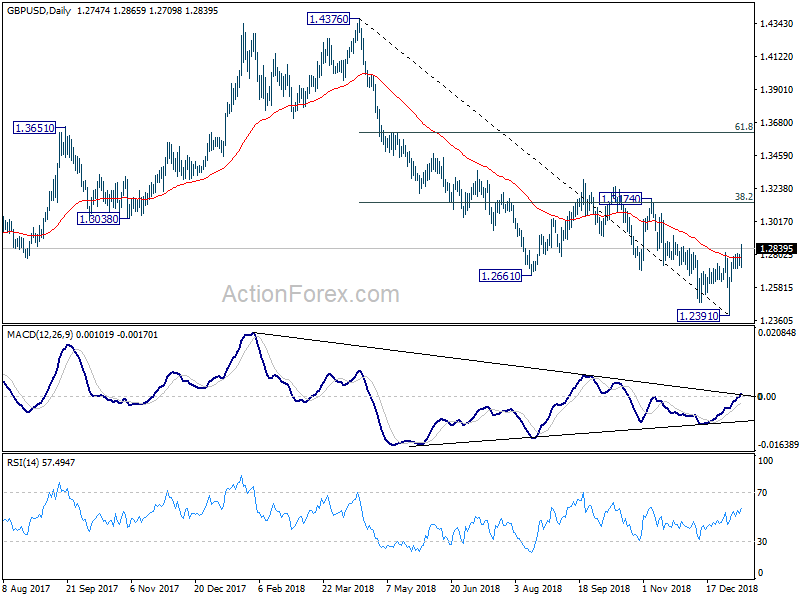
In the bigger picture, whole medium term rebound from 1.1946 (2016 low) should have completed at 1.4376 already, after rejection from 55 month EMA. The structure and momentum of the fall from 1.4376 argues that it's resuming long term down trend from 2.1161 (2007 high). And this will now remain the preferred case as long as 1.3174 structural resistance holds. GBP/USD should target a test on 1.1946 first. Decisive break there will confirm our bearish view. However, sustained break of 1.3174 will invalidate this case and turn outlook bullish.
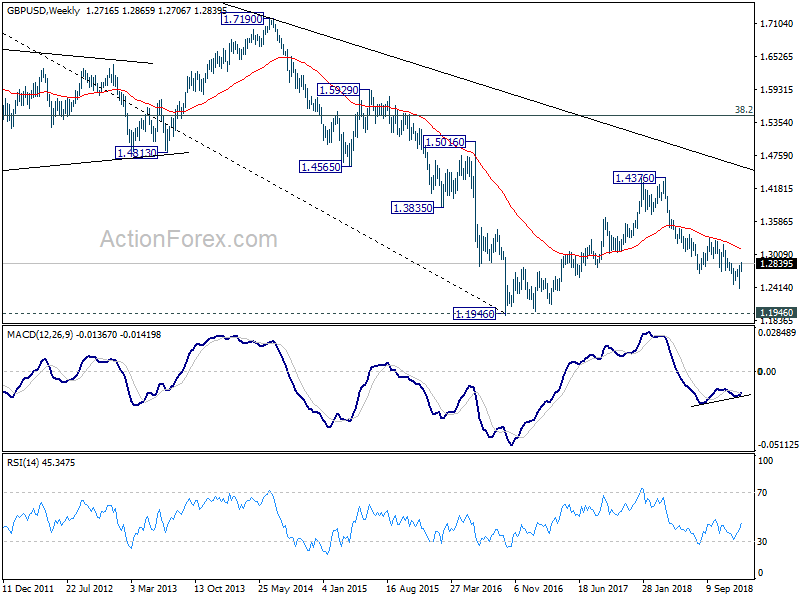
In the longer term picture, outlook in GBP/USD remains bearish. Rebound from 1.1946 was rejected solidly by falling 55 month EMA. The pair was limited well below 38.2% retracement of 2.1161 (2007 high) to 1.1946, as well as the decade long falling trend line. On break of 1.1946, next target will be 61.8% projection of 1.7190 to 1.1946 from 1.4376 at 1.1135.
Summary 1/14 – 1/18
Monday, Jan 14, 2019
[php_everywhere instance="1"]
Tuesday, Jan 15, 2019
[php_everywhere instance="2"]
Wednesday, Jan 16 2019
[php_everywhere instance="3"]
Thursday, Jan 17, 2019
[php_everywhere instance="4"]
Friday, Jan 18, 2019
[php_everywhere instance="5"]
China Weekly Letter – Big Jump in CNY on Trade Optimism and Weaker USD
- Big move higher in CNY - the tide has turned for the Chinese currency.
- Trade talks on track - Liu He set to go to Washington later this month.
- Stimulus is coming for consumers and small businesses.
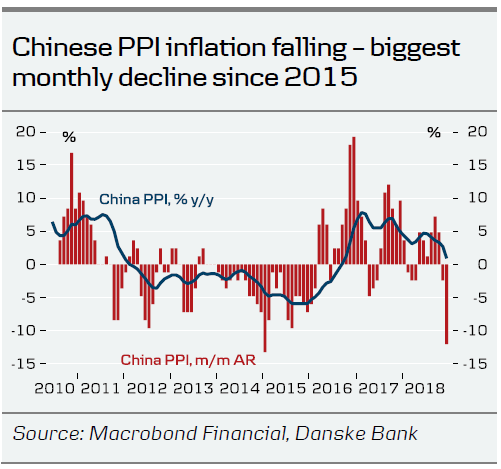
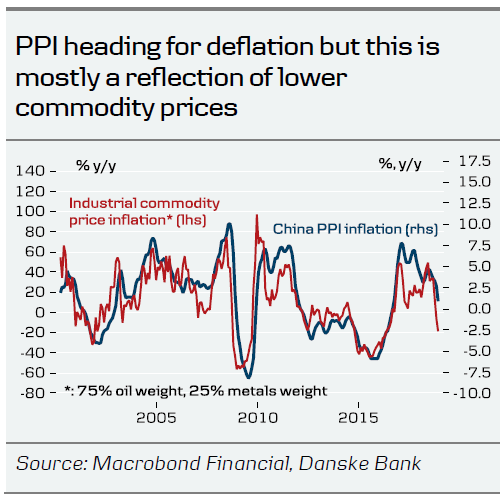
- Producer price inflation is heading for deflation territory.
Big move lower in USD/CNY - the tide has turned
USD/CNY moved sharply lower this week to 6.74, after flirting with the 7-level only two months ago. We see two main drivers behind the stronger CNY: (1) rising optimism about a trade deal with the US and (2) an overall weakening of the USD on the back of more dovish speeches by Federal Reserve members that suggest it will be on hold for a while.
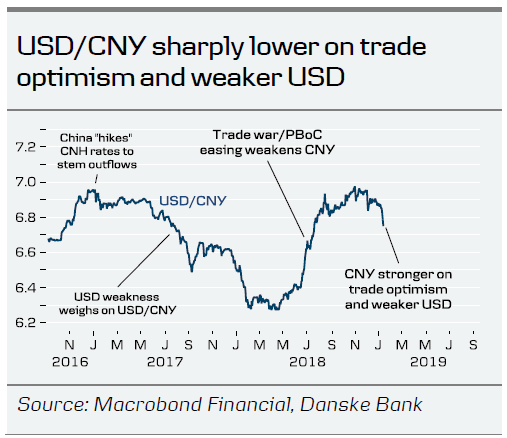
Comment : We believe the tide has turned for the CNY and the significant depreciation pressure is turning into a moderate strengthening trend. A halt to the weakening of the CNY is also likely to be part of a trade deal with the US. If we are right that they strike a trade deal and the Chinese economy recovers gradually from Q2, then the CNY should see more tailwind ahead. We plan to publish our latest forecasts in FX Forecast Update - January 2019 on Monday.
Trade talks on track - top-level negotiations later this month
The US and China wrapped up another round of trade negotiations in Beijing this week, with the mid-level talks being extended by one day. The extension is seen as a sign of a commitment on both sides to push forward as needed to reach a deal. Donald Trump tweeted during the talks that 'Talks with China are going very well!'. China stated that the meetings were 'extensive, in-depth and detailed' and laid the foundation for a resolution of the conflict (see Bloomberg , 9 January).
The talks seemed to be mostly on technical issues such as Chinese purchases of US products within agriculture, energy and some manufacturing products, while the bigger hurdles are left for higher level officials. China's head of the negotiations, economic tsar and vice-President Liu He, is scheduled to meet with US Trade Representative Robert Lighthizer in Washington later in January. Some reports suggest 30-31 January (see The Straits Times , 11 January). Surprisingly, Liu He showed up shortly at the negotiations in Beijing, which added to the sentiment that talks were constructive, as there was no official at the same level from the US delegation.
North Korea's leader Kim Jong-Un visited China this week on his birthday. It was seen by some as putting pressure on Trump to make a deal (see New York Times , 8 January). Kim Jong-Un and Xi Jinping discussed a summit between Kim and Trump expected to take place soon (see Reuters , 8 January). According to state media in North Korea, Xi Jinping accepted an invitation to visit the country (see SCMP , 10 January).
China gave the long-awaited approval of US exports of five genetically modified crops this week (see Reuters, 8 January). This was seen as a further sign of goodwill from the Chinese side to accommodate the negotiation atmosphere. On a similar note, Citigroup is on track to set up a majority-owned securities joint venture after China has opened up further for investments in the financial area (see Reuters, 8 January).
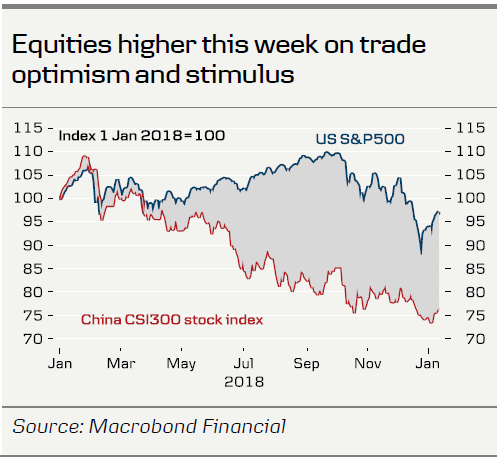
Comment: We continue to look for a trade deal within three to six months. It should be positive for equities and pave the way for a gradual Chinese economic recovery. So far, talks do not seem to have met any big bumps in the road. There are still some hurdles to be sorted out when it comes to Chinese subsidies and industrial policy, which could delay a deal beyond the ceasefire deadline of 1 March. However, both Trump and Xi seem keen on getting a deal and ending the trade war and we believe they can reach a compromise on the thorny issues. Trump is set to get important 'gifts' for key voters in several swing states, as China is set to buy more agriculture products and keep the lower 15% tariff rate on cars.
Stimulus to support consumers and small businesses
China plans to introduce policies that will boost consumer spending on autos and home appliances this year (see SCMP, 10 January). It has also announced further measures to support small and micro businesses. China plans to reduce the tax burden for these companies by USD29bn per year for the next three years (see Bloomberg, 9 January). One of the measures is a reduction in corporate income tax to 5% for income up to CNY1m and 10% for income from CNY1m to CNY3m.
That China is putting more focus on the quality of growth is evident from the news this week that it has reduced the growth target for 2019 to 6.0-6.5% from the target in 2018 of 'around 6.5%' (see SCMP, 11 January).
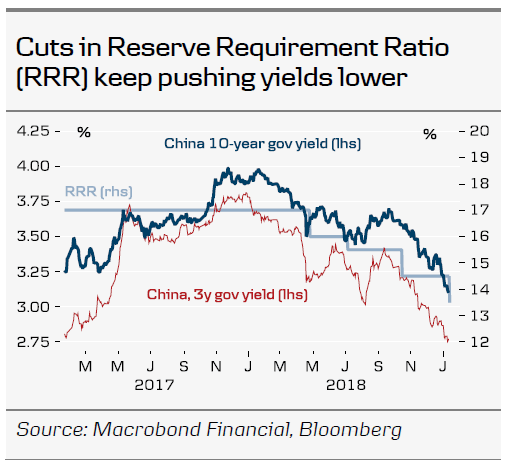
Comment: China is progressing with its piecemeal fiscal stimulus to underpin the private economy, as consumers and private sector companies have reduced spending due to higher uncertainty and tight credit availability. We are not likely to see a big fiscal stimulus plan as in 2008/09 but more measures on a step-by-step basis. We are still awaiting an announcement on tax cuts for consumers. The monetary easing has fuelled a big decline in bond yields (see chart on previous page). We look for growth bottoming in Q1 and recovering gradually from Q2 (see China Leading Indicators – Darkest before dawn, 3 January).
Other China news
Producer price inflation (PPI) decreased more than expected in December, falling to 0.9% y/y (consensus 1.6% y/y) from 2.7% y/y in November. The monthly decline was the biggest since 2015 (see middle chart on the right). We expect the annual rate to dip into deflation territory in coming months due to the fall in commodity prices (see bottom chart).
Xi Jinping may be readying for a long-awaited plenum meeting of the Central Committee of the Communist Party this month (see Bloomberg, 9 January). There has been speculation that the delay may be due to disagreements at the top of the Party. However, it may also have been to keep flexibility on trade talks with the US in December.
Huawei has unveiled cutting-edge 'big data' chip, as China pushes for reduced reliance on technology imports (see SCMP, 7 January).
The head of China's tech ministry has called for enterprises to support core technology (see Technode, 7 January). Although China has made some changes to the Made in China 2025 strategy, there is no doubt in our minds that technology and innovation will continue to take centre stage in China's development for years to come.