Sample Category Title
Oil Rises Due To USD Correction
After being sold for about a month and a half, the oil is being slightly corrected. It’s still too early to say that it has completely recovered, but little by little investors are starting to buy the asset that has lowered in price quite a lot recently.
On one hand, these long positions, apart from quite attractive prices, are based on the USD weakness. As long as the American currency is under pressure, investors have reasons to buy. On the other hand, fundamental background remains “bearish” and the positive momentum in the oil may quickly disappear at the first signs of strong USD.
The US numbers on the Gas Storage and Crude Oil Inventories have been growing for 8 consecutive weeks. The Oil Refinery Plant Utilization is also improving (90.1%, according to the latest data) as well as the Oil Extraction Volume (11.7M barrels per day – all-time high). At the same time, there is information about the oil extraction increase in Russia, although Saudi Arabia is trying to balance the offered market by itself and take steps to decrease the daily extraction volume.
In the meantime, the global demand for the oil is not growing as fast as it was expected, further still, it is expected to slow down even more in the weeks to come. This factor may also have some negative influence on the oil prices.
It might be really interesting to watch the OPEC+ creating a new document regulating the oil extraction for the countries that joined the agreement earlier. Previous regulations outlived themselves, new ones haven’t been created yet, while the oil market does require some restrictions. There is an opinion that the OPEC+ may start working on a new agreement in the nearest future and present it to the world by the end of the first quarter 2019.
Brent is still trading inside the long-term downtrend. Of course, many investors may already be bored of such monotonous decline, but there are hardly any signals for a significant correction so far. As we can see in the H1 chart, after breaking the support line of the previous channel, Brent hasn’t been able to reach the target support line of the projected channel and right now is forming a short-term correctional trend. The instrument is back into the previous channel and currently testing its support line again. In case the line is broken, the price may fall towards the target at 61.10. However, one should realize that the test may result in a rebound. In this case, Brent may continue the correction towards the resistance line at 70.00.
Into US session: Swiss Franc overwhelmingly strong, Euro follows
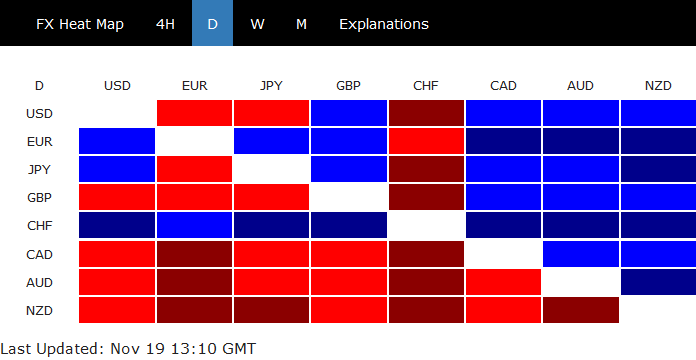
Entering into US session, Swiss Franc is overwhelmingly the strongest one for today. The reason is so far unknown as we won't see notable weakness in emerging market currentices. Nor is European stock market in risk aversion mode. Euro is following as the second strongest indeed, and then Yen and Dollar. Commodity currencies are generally softer as last week's rebound lost steam. Sterling is mixed as there is no more significant development in the UK regarding leadership challenge, nor Brexit agreement.
In other markets, European indices are trading in positive territory at the time of writing:
- FTSE is up 0.71%
- DAX reversed earlier gains and is now up only 0.01%
- CAC also reversed earlier gains and is now up 0.08%.
- German 10 year yield is up 0.0-149 at 0.385, still below 0.4%
- Italian 10 year yield is up 0.025 at 3.514. German-Italian spread is above 310.
Earlier in Asia, all major indices closed up, except Singapore:
- Nikkei rose 0.65% to 21821.16
- Hong Kong HSI rose 0.72% to 26372.00
- China Shanghai SSE rose 0.91% to 2703.51
- Singapore Strait Times dropped -0.60% to 3065.07
- Japan 10 year yield dropped -0.0112 to 0.095. Back below 0.1%, suggesting some safe-have demand in Japan.
DAX Pauses after Dismal Week
The DAX index is unchanged in the Monday session. Currently, the DAX is trading at 11,336, down 0.04% on the day. On the release front, there are no major indicators on the schedule. The eurozone’s current surplus dropped sharply to EUR 16.9 billion, short of the forecast of EUR 24.2 billion. This was the smallest surplus since July 2014. On Tuesday, the eurozone releases PPI.
The DAX is coming off a dismal week, recording losses of 2.16 percent. Investor risk appetite soured after Germany reported that GDP in the third quarter had declined 0.2%, marking the first contraction in GDP since 2015. Another alarm signal is weak investor confidence. German ZEW Economic Sentiment posted a second straight soft release for November, with a reading of -24.1 points. This points to deep pessimism on the part of institutional investors and analysts. The ZEW added that investors did not expect a rapid recovery from the current weakness, and if is the prevailing sentiment among investors, more headwinds could be in store for European equity markets.
The ECB remains on track to wind up its stimulus package in December, but policymakers may have to reassess this stance, based on recent eurozone growth numbers, which are the weakest since 2014. Germany, the locomotive of the eurozone, has hit some headwinds, after posting a decline in GDP in the third quarter. The simmering trade dispute between the U.S. and China shows no signs of being resolved anytime soon, which will continue to take a bite out of German and eurozone exports. If the eurozone economy continues to soften, there could be calls on the ECB to continue stimulus into 2019.
Eurogroup Centeno hails Franco-German proposal of Eurozone budget a breakthrough
Eurogroup President Mario Centeno hailed that the Franco-German proposal of a Eurozone budget is "breakthrough" on reforms to be discussed among finance ministers in December. Centeno said "the contribution of France and Germany on the euro zone budget is an important topic for today's discussion," and, "it can be a sort of a breakthrough toward December".
Under the joint proposal, the objective of the Eurozone budget is to foster convergence and support reforms "in particular by co-financing growth-enhancing public expenditures such as investments, research and development, innovation and human capital". The pool of funds from dedicated taxes and indiviual state contributions would be put under a system of shared management. Members would then be allowed to used the fund for short-term investment plans with approvals from the European Commission. However, the budget would only be available to member states which abide by EUR rules, including deficit and debt.
Italy appears to be unhappy with the proposal as Deputy Prime Minister Matt eo Slovenia warned that "If, as it seems, it (the plan) damages Italy, it will never have our support."
Bundesbank: German economy to see fairly strong growth again in Q4
Bundesbank said in its monthly report that the -0.2% contraction in Q3 GDP in Germany was due to "a strong temporary one- off effect in the automotive sector." Meanwhile, "private consumption was temporarily absent as a driving force of the economy".
However, after that "setback" the German economy is "expected to see fairly strong growth again in the final quarter of 2018". Bundesbank said output and exports of motor vehicles are "expected to return to normal before the year is out". And, "manufacturing sector as a whole likewise looks set for marked growth." "Private consumption is expected to re- assume its role as a major economic driver". And, "the still outstanding income and labour market prospects are expected to again provide a boost."
USDCHF Momentum Heads South With Pair At 2-Week Low, Medium-Term Outlook Still Bullish
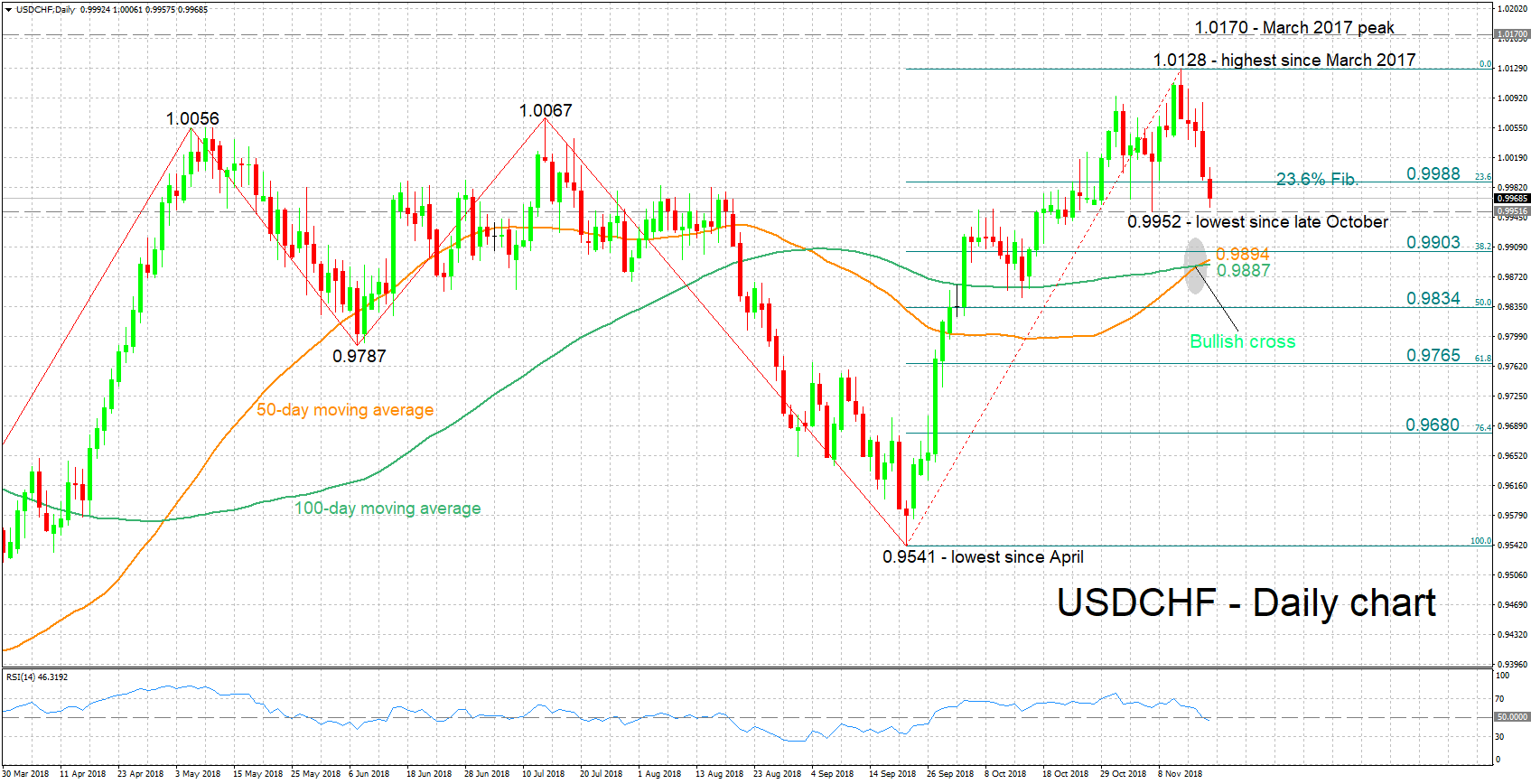
USDCHF recorded considerable losses after touching its highest since March 2017 of 1.0128 last Tuesday. Additionally, the pair hit a near two-week low of 0.9958 earlier on Monday and looks set to record its fifth straight day of declines.
The short-term momentum turned to the downside as evidenced by the downward sloping RSI which entered bearish territory below 50.
Immediate support to declines may be coming around 0.9952, the pair’s lowest since late October. Notice that the area around this was congested between mid-June and late August. Further below, support could emerge around 0.9903, the 38.2% Fibonacci retracement level of the upleg from 0.9541 to 1.0128; the current levels of the 50- and 100-day moving average lines at 0.9894 and 0.9887 correspondingly are also part of the zone around this Fibonacci point. Even lower, the 50% Fibonacci mark at 0.9834 would be eyed.
On the upside, resistance could take place around the 23.6% Fibonacci mark of 0.9988, with the region around it also capturing the parity level (1.00) that may hold psychological importance. The focus would turn to the 1.0056 and 1.0067 peaks in the event of more bullish movement, while higher still, Tuesday’s top of 1.0128 would again come within scope.
Despite the recent decline, the medium-term outlook continues to look mostly positive, with trading activity taking place above both the 50- and 100-day moving average lines. It is also of note that the two MAs have recently posted a bullish cross.
To conclude, the short-term momentum looks negative at the moment, while the medium-term picture continues to look predominantly bullish.
USDTRY Outlook: Lira Maintains Bullish Near-Term Tone And Eyes 200SMA Support At 5.1067
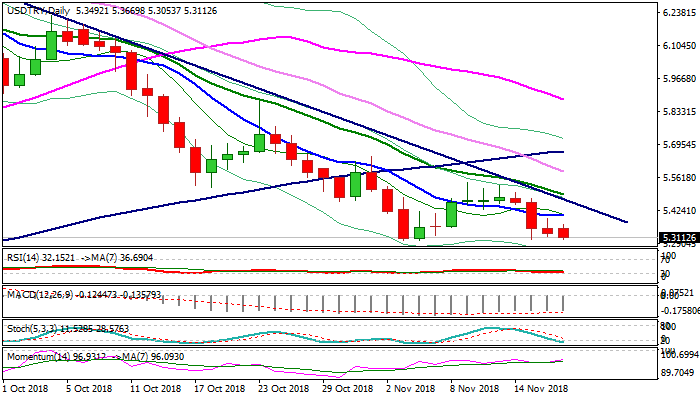
The USDTRY pair holds in red for the fourth straight day on Monday and is on track to fully retrace 5.3015/5.5412 correction after bulls were trapped at important 5.50 resistance zone.
Turkish lira maintains firm tone despite last week's weak jobs and industrial data (unemployment rose to 11.1% in three months to Sep from previous 10.6 result while IP fell 2.7% in Sep).
The pair is expected to continue to channel lower on firm break below 5.30 handle, which would open way towards 5.1246 (Fibo 76.4% of 4.5121/7.1074) and 5.1067 (200SMA).
Improved sentiment and bearish daily/weekly techs maintain lira's bullish stance, with weaker US dollar on concerns over Dec rate hike, adding to positive near-term outlook for lira.
Res: 5.4078, 5.4918, 5.5412, 5.5849
Sup: 5.3015, 5.2450, 5.2100, 5.1534
UK PM May: The Brexit deal takes back control over borders, money and laws
UK Prime Minister Theresa May said in the CBI annual conference that her Brexit agreement is " a good one for the UK" as it "fulfils the wishes of the British people as expressed in the 2016 referendum". And she emphasized the outcomes" she wanted to deliver.
Those include "Control over our borders, by bringing an end to free movement, once and for all"; "Control of our money, so we can decide for ourselves how to spend it, and can do so on priorities like our NHS"; "Control of our laws, by ending the jurisdiction of the European Court of Justice in the United Kingdom and ensuring that our laws are made and enforced here in this country."
CBI Fairbairn: Westminster living in own narrow world, extreme positions allowed to dominate
UK CBI President John Allan said in the group's annual conference that even though Prime Minister Theresa May's Brexit deal is "not perfect", it "opens a route to a long-term trade arrangement, it unlocks the transition period – the very least that companies need to prepare for Brexit". And more importantly, he emphasized that " it avoids the nightmare scenarios a no-deal departure, which would be a wrecking ball for our economy."
The group's Direct General Carolyn Fairbairn complained that "Westminster seems to be living in its own narrow world, in which extreme positions are being allowed to dominate." And, "the result is a high-stakes game of risk, where the outcome could be an accidental no-deal." She also acknowledged that May's deal is "not perfect" but a "compromise", a "hard-won progress". She urged that "this is not a time to go backward".
WTI OIL Outlook: Recovery Runs Out Of Steam As Signals Of Global Production Cut Need Confirmation
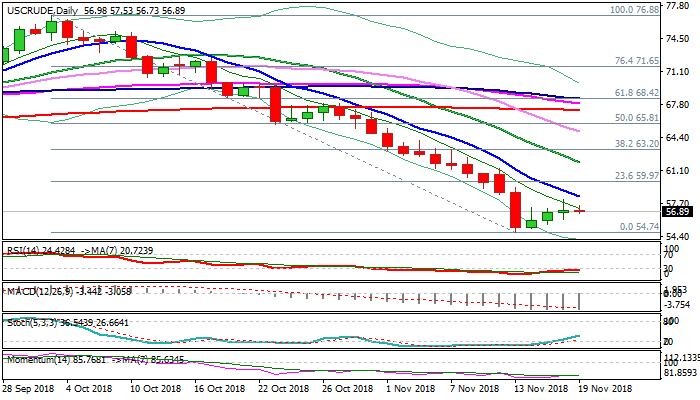
WTI oil price stands at the back foot on Monday and eased below $57 in European session after Friday's Doji candle signaled that three-day recovery might be running out of steam.
Oil prices regained ground after being down 25% in past one and a half month, on comments that main oil producers from OPEC and Russia may reduce the output towards the end of the year, in order to stabilize oil market.
Saudi Arabia initiated plan of reducing production and Russia generally agreed, but markets await OPEC meeting on 06 Dec to get further information.
On the other side, oil prices were under strong pressure on fears of global oversupply, with additional negative signals on the impact from US sanctions on Iran, which proved to be not as strong as expected, as the US granted waivers to some of Iran's customers to extend oil imports after sanctions were imposed.
Also, persisting trade conflict between the US and China which threatens to lower global demand if the conflict escalates, continues to weigh.
Current move so far looks like correction on strongly overextended daily techs and partial profit-taking, which so far holds below pivotal falling 10SMA barrier ($58.46) and keeps the downside vulnerable. Sustained break above 10SMA is seen as initial requirement for firmer recovery signal, with extension through next pivots at $61.93 (falling 20SMA) and $63.20 (Fibo 38.2% of $76.88/$54.74) needed to confirm reversal and signal stronger correction of $76.88/$54.74 fall.
Res: 57.53,58.14,58.46,59.33
Sup: 56.73,56.11,55.57,55.35