

Sample Category Title
Price Action Is Swirling Around This Week’s Key Drivers. Dovish Fed, Brexit And Trade War
Markets
Overnight price action is swirling around this week's key drivers. Dovish Fed, Brexit and Trade War
USDJPY remains lower EURUSD higher following soft US housing data – all speaking again to the market's sensitivity to weaker US data given the Fed dovish U-turn.
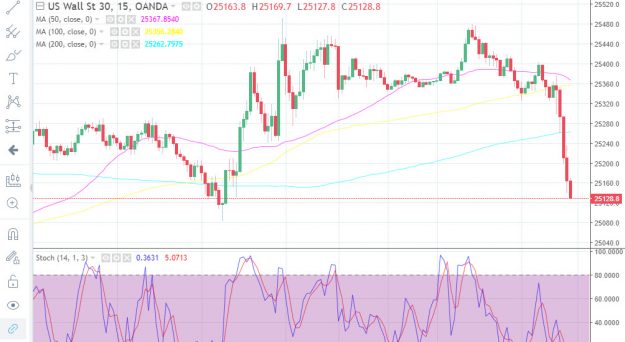
US Stocks moved aggressively lower, led by technology, as trade talks sour beyond APEC disarray after inside sources told the South China Morning Post SCMP that Liu He, China's chief trade negotiator, and Steven Mnuchin, Treasury Secretary, have rescheduled their talks for Buenos Aires instead of Washington
On the Trump- Xi G-20, we should expect more freeze than thaw on this outcome if the APEC disarray was any sign of things to come.
Oil Markets
Oil traded with heavy tone most of the NY morning dominated by the trade war, equity noise and negative macro factors which were compounded by OPEC + uncertainty after comments from Russian Energy Minister Alexander Novak suggest that an OPEC production cut is not set in stone.
Although the latest COT, which has been a decent indicator of future price action on oil markets, signals bear. However, prices recovered in US afternoon trade suggesting markets are starting to discount demand uncertainties and rising supplies into the forward assessment which tempers the risk of another meltdown. But amid declining Iranian production and a possible supportive OPEC+Russia decision at the December 6 summit, we could see a gradual recovery in prices.
But of course, the Khashoggi factor is impossible to ignore as it's uncertain that Saudi Arabia plays with fire cutting production when the President continues to support MBS. Or are they so annoyed about getting double-crossed by the breadth of US Iran waiver that the could throw all caution to the wind?
Gold Markets
The Feds have changed the landscape to a more dovish terrain suggesting that they too are turning a little bit risk-averse. Great signal for gold prices which should see the dollar struggle into year-end why gold will continue to feed off Brexit and trade war risk. With trade war unlikely to thaw, equity markets could sputter into year-end adding another kicker for gold prices.
US equities
It was a very intense session on the S&P tech sector woes continue as non-stop stream of negative headlines is showing few signs of abating. While Apple order cuts were expected, “chip gate” was back in the headlines after China alleges ‘massive' evidence of chipmaker violations. Meanwhile, scrutiny is back on the social media industry as without question new regulations are coming.
Currency Markets
The Feds have changed the playing field and are preparing the markets for a monetary policy response to any wobble in tier one data. All of which tells me to err on the side of forwarding policy despite little evidence in a US economic wobble, as we could see a very aggressive response (USD sell off) to any Tier one economic data miss. But when you factor in sagging equity markets and Brexit to the mix, it makes for challenging markets which suggest to me that traders do not have a lot of skin in the game this shortened holiday week as there is far too much noise amid dwindling liquidity.
Japanese Yen
With few reasons for USDJPY rally, the path of least resistance remains skewed lower.
The Pound
Its all quiet on the Westminster front. May is hanging tough, more than up for the battle and making a believer out of some as GBPUSD firms overnight.
Antipodean
Bad news on the Trade war front is bad news for both the Australian and New Zealand dollar. RBA minutes, as usual, will be a non-event as the Antipodeans are being viewed as a proxy trade for China risk. Not to mention there is no chance of any policy shift given the Feds are adopting a more defensive tack.
The Malaysian Ringgit
Its been very quiet with the markets trading in a sideways fashion. Oil prices are basing while and US Bond yields are softer. Both factors are positives for the Ringgit. However, the overhang from the APEC disarray is keeping investor guarded.
Eco Data 11/20/18
[php_everywhere instance="1"]
British Pound Edges Higher, Investors Eye Inflation Report Hearings
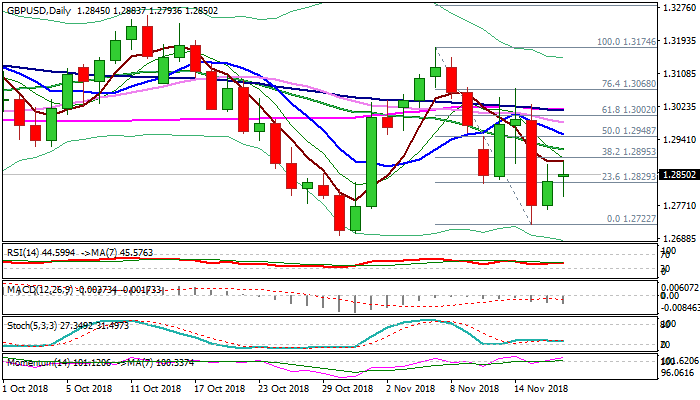
GBP/USD has edged lower in the Monday session. In North American trade, the pair is trading at 1.2844, up 0.11% on the day. On the release front, British Rightmove HPI posted a sharp decline of -1.7%. In the U.S., there are no major events on the schedule. On Tuesday, the U.S. releases building permits and housing starts.
Brexit jitters hit full force on Thursday, and the pound responded with sharp losses. The currency plunged 1.65% on Thursday after Brexit Secretary Dominic Raab resigned in protest of the draft Brexit agreement between the U.K and the European Union. It promises to be an uphill battle for May, as many Conservative MPs are against the agreement, particularly over the proposed customs agreement with the EU. On Thursday, there were calls from some Conservative MPs for a no-confidence vote against May, and it’s unclear if May will survive the latest crisis. With Labor vowing to shoot down the agreement, May will have a tough time getting a majority in parliament for the agreement. The EU announced that a special summit on Brexit on November 25, but the markets remained concerned that a ‘no-deal’ scenario is a real possibility. GBP/USD posted its sharpest one-day loss of 2018 on Thursday, and further tensions over Brexit could push the pound lower.
Overshadowed by the political drama in Westminster was a dismal reading from British retail sales on Thursday. The indicator came in at -0.5%, its second straight decline. Consumers are nervous about Brexit and are holding tighter to their purse strings. As well, the mild autumn weather has put a damper on sales of winter clothes. The dismal retail sales release could dampen consumer and investor confidence, which could push the wobbly pound even lower.
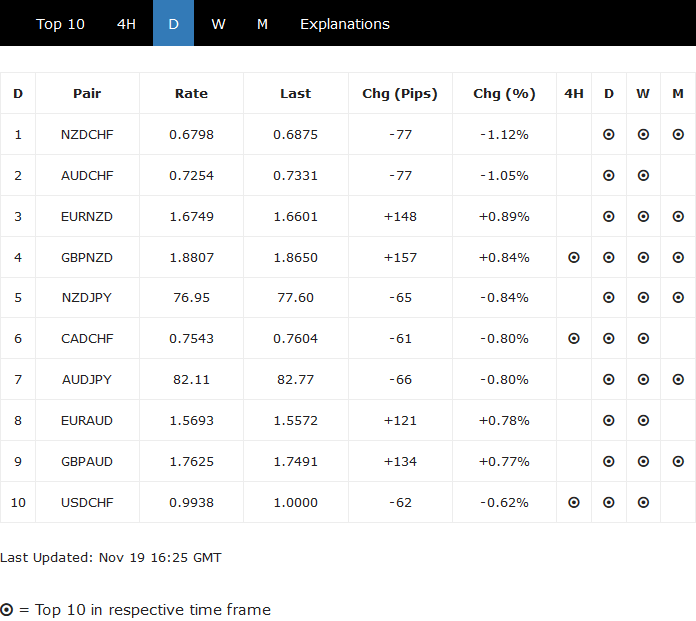
Today’s top mover: NZD/CHF just correcting a medium term impulsive rise
NZD/CHF is so far the top mover today. On the one hand commodity are under broad selling pressure. Kiwi and Aussie are paring some of last week's gain. Meanwhile, the Swiss Franc is surprisingly the strongest one for today. In particular, USD/CHF's selling accelerates through 0.9952 support after weaker than expected US housing data.
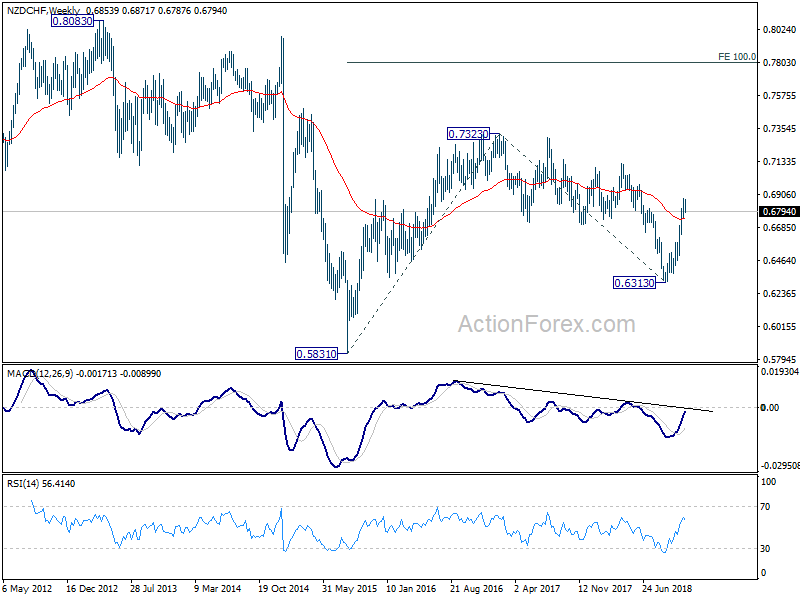
To assess the outlook of NZD/CHF, we'd like to have a look at the bigger picture in the weekly chart first. Powerful rise from 2018 low at 0.6313 appears to be a medium term impulsive wave. The corrective fall from 0.7323 (2017 high) should have completed at 0.6313. Hence, rise from 0.6313 is possibly resuming the long term rise from 0.5831 (2015 low).
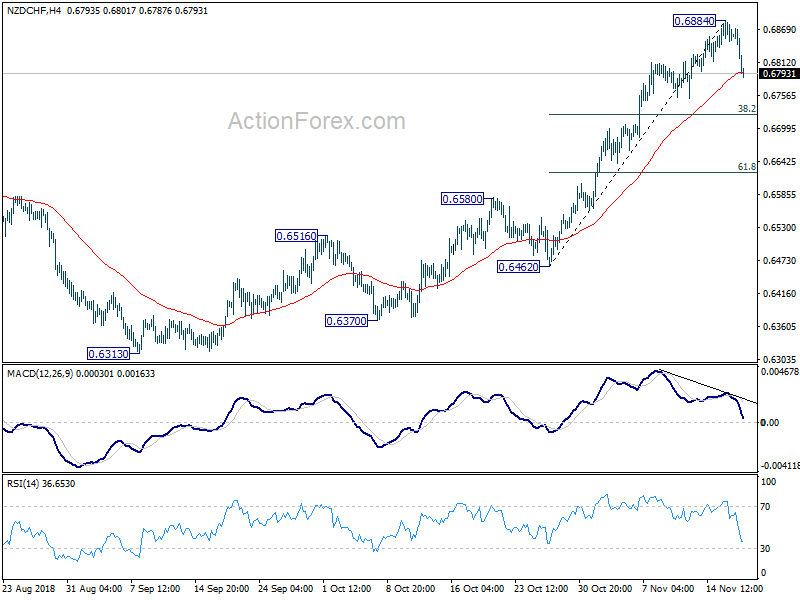
With that in mind, the current fall from 0.6884 short term top (on bearish divergence condition in 4 hour MACD), is likely just a corrective pull back. We're currently viewing it as correcting the rise from 0.6462 only. Hence, while further decline is likely, downside should be contained by 38.2% retracement of 0.6462 to 0.6884 at 0.6723 to bring rebound. Break of 0.6884 will target 0.7210 resistance next.
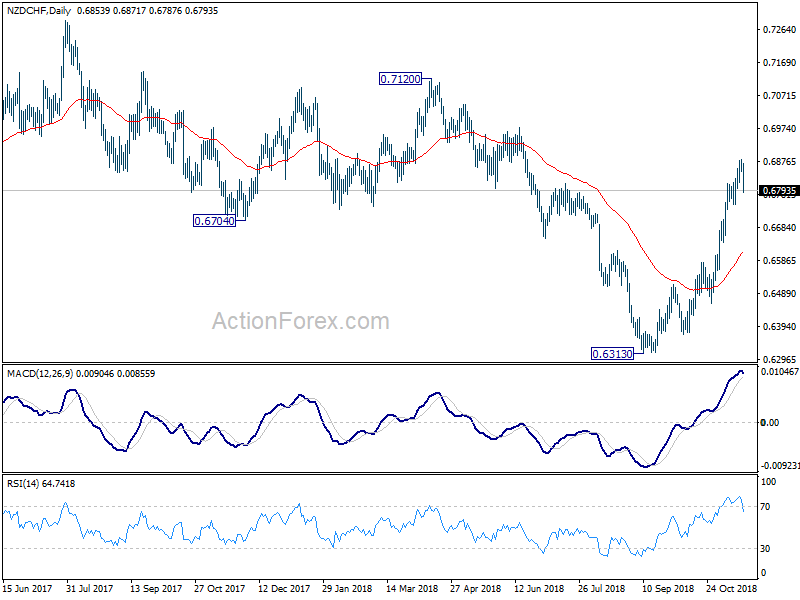
Nevertheless, firm break of 0.6723 will argue that NZD/CHF is correcting whole rise from 0.6313. IN that case, deeper pull back could be seen towards 55 day EMA (now at 0.6607).
Dollar dives as NAHB said rising interest rates weigh on housing market
Dollar appears to be rather troubled by disappointment in housing data. Selloff accelerates against Euro, Swiss Franc and Yen. Though, the greenback is still in black against commodity currencies so far today.
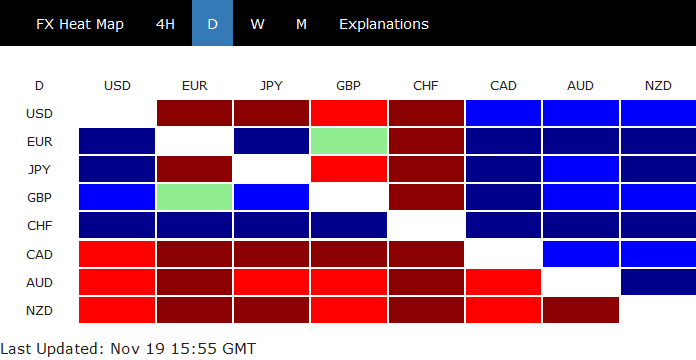
The NAHB housing market index dropped to 60 in November, down from 68 and missed expectation of 67. That's also the biggest drop in more than four years. We believe that the key, as seen by the markets, is comments in by NAHB Chairman Randy Noel. He noted that "customers are taking a pause due to concerns over rising interest rates and home prices."
NAHB Chief Economist Robert Dietz. also complained that "recent policy statements on economic conditions have lacked commentary on housing, even as housing affordability has hit a 10-year low." And, "given that housing leads the economy, policymakers need to focus more on residential market conditions."
This is another factor that argues Fed should think twice in its rate path.
EURJPY Threatens Further Bullishness On Recovery Higher
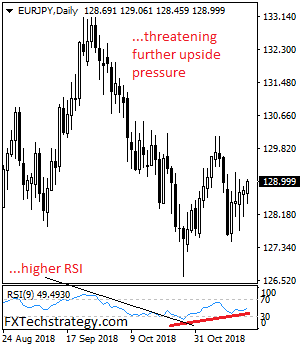
EURJPY threatens further bullishness on recovery higher. This is coming on the back of its flat close the past week. Support comes in at the 128.50 level where a break if seen will aim at the 128.00 level. A cut through here will turn focus to the 127.50 level and possibly lower towards the 127.00 level. On the upside, resistance resides at the 129.50 level. Further out, we envisage a possible move towards the 130.00 level. Further out, resistance resides at the 130.50 level with a turn above here aiming at the 131.00 level. On the whole, EURJPY faces further upside threats towards key resistance.
Sunset Market Commentary
Markets
Global core bonds lost ground today. German Bunds immediately edged lower at the opening bell as European equities opened in green, continuing the modest improved risk sentiment on Asian bourses. Risk appetite was today’s main driver in absence of economic data to steer trading. Calm returned to financial markets after last week’s Brexit rollercoaster. PM May is not backing down and is pushing through with her Brexit deal, despite the Eurosceptic Tories collecting the support for a vote of confidence. UK media reports 42 votes are locked, six short of the threshold of 48 votes. EU negotiator Barnier signaled the EU was willing to extend the transition period to the end of 2022, instead of 2020, while May was seeking support of UK businesses. In the meantime, Spain stated that it seeks more assurance on Gibraltar before it could back the Brexit deal, proving EU countries will not blindly accept the deal on the table. UST’s moved on Friday in the direction of some technical support levels (10-yr, 3.06%) on several Fed members signaling a more cautious outlook. A break didn’t occur as there was no news to trade on today, leading US Treasuries gradually lower and pushing US yields higher across the curve. Changes range from +2.1 bps (5-yr) to +2.7 bps (30-yr). German yield curve steepens with changes from +1.1 bps(2-yr) to +2.7 bps (30-yr).
At the end of last week, the dollar lost substantial ground. Several Fed speakers indicated that slower global growth could become a factor of significance for Fed policy going forward. The jury is still out whether/when the Fed will indeed slow its path of policy normalization. Even so, the US dollar lost interest rate support and declined off recent peak levels. Today, core US and European yields rebounded a few basis points even as sentiment on risk remained fragile. Especially US equity futures are facing headwinds. Again, this tentative risk-off context didn’t help the dollar much. The US currency also didn’t profit from its usual invers correlation with oil as crude oil futures resumed their decline. The trade-weighted dollar hovers in the 96.40 area. EUR/USD even gains a few ticks. There were few eco data. Spain made some reservations on approving the Brexit deal due to uncertainty on Gibraltar. However, the euro maintains the benefit of the doubt. EUR/USD trades currently in the 1.1430 area. USD/JPY shows directionless trading in a tight sideways range. The pair is currently trading in the 112.80 area.
The moves in sterling were much more moderate today compared to the end of last week. If anything, the UK currency lost marginal further ground. UK PM May continued her efforts to ‘sell’ her Brexit deal to Parliament but also tries to get support from the public on her approach. For now, there is no indication that she is making any progress in solving the Brexit stalemate. In technical trading, EUR/GBP touched a new ST correction top. The pair is trading in the 0.89 area. Cable is little changed in the mid 1.28 area.
News Headlines
The Belgian debt agency raised €3.38bn by tapping 4 OLO’s today (€0.7bn 0.5% Oct2024; €1.61bn 0.8% Jun2028; €0.48bn 3% Jun2034; €0.59bn 2.25% Jun2057). The auction bid cover was 1.84. It was the final auction of the year. Belgium raised €33.81bn in OLO funding this year, which is more than the €31bn targeted at the start of the year.
French ECB policy maker Villeroy de Galhau said that the ECB could consider a fresh round of TLTRO’s next year. On a more hawkish note, he suggested that the central bank should reduce the pace of reinvestments only after the first rate increase. Market consensus currently doesn’t expect a slowdown of reinvestments in the policy horizon.
The German Bundesbank expects a fairly strong German growth in the final quarter of this year, following the negative GDP figure in Q3. Output and exports in the auto sector are forecast to return to normal after the introduction of the new emissions-measurement standards. Outstanding income and labor market prospects are expected to give a new boost to consumption.
Brent Comes Under Renewed Pressure on Oversupply Fears and Fading Hopes about Production Cut
Brent oil dipped to session low at $65.26 on Monday, as fresh weakness following three-day recovery stall retraced the largest part of $64.63/$68.35 recovery rally.
With fading support on expectations that OPEC and Russia would cut output in attempts to stabilize oil market, concerns over persisting US/China trade conflict, which so far shows no signs of end; continuation of imports from Iran from big Asian consumers and fears of further rise in oil output from the US, keep oil prices under strong pressure.
Brent started week in negative mode after being in red for six consecutive weeks and down over 22%, risk of further fall of oil prices remains high. Fresh bears probe below cracked Fibo support at $65.54 (50% of $44.35/$86.73) firm break of which would generate fresh bearish signal and expose target at $62.42 (base of rising weekly cloud.
Falling 10SMA ($68.35) which tracks the downtrend for five weeks, marks pivotal barrier, violation of which would ease immediate bearish pressure.
Res: 67.62; 68.35; 70.00; 71.76
Sup: 65.01; 64.63; 64.04; 63.41
US Home Builder Sentiment Plummets in November
The National Association of Home Builders (NAHB) housing market index had its largest decline in four years as housing affordability concerns rise. The November reading of builder confidence in the market of new single-family homes came in at 60, well below the October reading of 68 and economists estimate of 67. A print of above the 50 level shows that builders believe business are good. The NAHB noted that despite the sharp drop, builder sentiment still remains in positive territory. Builders report that they continue to see signs of consumer demand for new homes but that customers are taking a pause due to concerns over rising interest rates and home prices.
US Equities extended losses following the miss. Tomorrow, Tuesday November 20th the Commerce Department is expected to release Building Permits and Housing Starts, economists are expecting slight improvements in both readings.
Yen at 3-Week High as Dollar Sputters
The Japanese yen has posted slight losses in the Monday session. In North American trade, USD/JPY is trading at 112.48, down 0.32% on the day. On the release front, Japan’s trade surplus rose to JPY 0.30 trillion, lower than the estimate of JPY 0.48 trillion. There are no major U.S. events on the schedule. On Tuesday, the U.S. releases building permits and housing starts.
The Bank of Japan has no plans to alter its ultra-accommodative monetary policy, as inflation remains well below the BoJ target of around 2 percent. However, there have been negative side effects to this stance, primarily the toll on bank profits, which has raised concerns that banks might take excessive risks in order to recoup lost profits. BoJ Governor Haruhiko Kuroda addressed this issue on Monday, warning that risk management steps were needed in order to maintain the stability of the financial system and ensure that borrowing costs did not climb sharply.
In the U.S., consumer inflation and spending numbers were strong in October. On Thursday, the U.S released retail sales reports. Retail sales rebounded with a strong gain of 0.7% in October, after a decline of -0.1% a month earlier. Core retail sales jumped 0.8%, after a gain of 0.1% in September. There was good news from the inflation front on Wednesday, as U.S consumer inflation numbers beat their estimates for October. The consumer price index posted a gain of 0.3%, its strongest gain since January. Core CPI, which excludes food and energy prices edged higher to 0.2%, marking a 3-month high. Both releases were in line with forecasts. Core CPI was 2.1% higher than a year ago. The solid consumer data means that the Fed remains on track to continue raising interest rates. The Federal Reserve holds its next policy meeting in December, with the odds of a December rate hike at 69%, slightly lower compared to last week.