Sample Category Title
EUR/JPY About To Break Downtrend At 131.50
Key Highlights
- The Euro is in a major downtrend with a key resistance at 131.50 against the Japanese Yen.
- There are two important bearish trend lines forming with resistance near 131.30-50 on the 4-hours chart of EUR/JPY.
- The Euro Zone Services PMI for Feb 2018 posted a decline from the last reading of 56.7 to 56.2.
- The US Factory orders figure for Jan 2018 will be released today, which is forecasted to decline by 1.3% (MoM).
EURJPY Technical Analysis
The Euro declined heavily during the past few days and moved below the 132.00 support against the Japanese Yen. The EUR/JPY pair is currently attempting a recovery, and it must break 131.50 to move into a positive zone.
The pair recently traded as low as 129.35 and is currently correcting higher. It already corrected higher substantially, but it is facing sellers on the upside near the 131.40 and 131.50 levels.
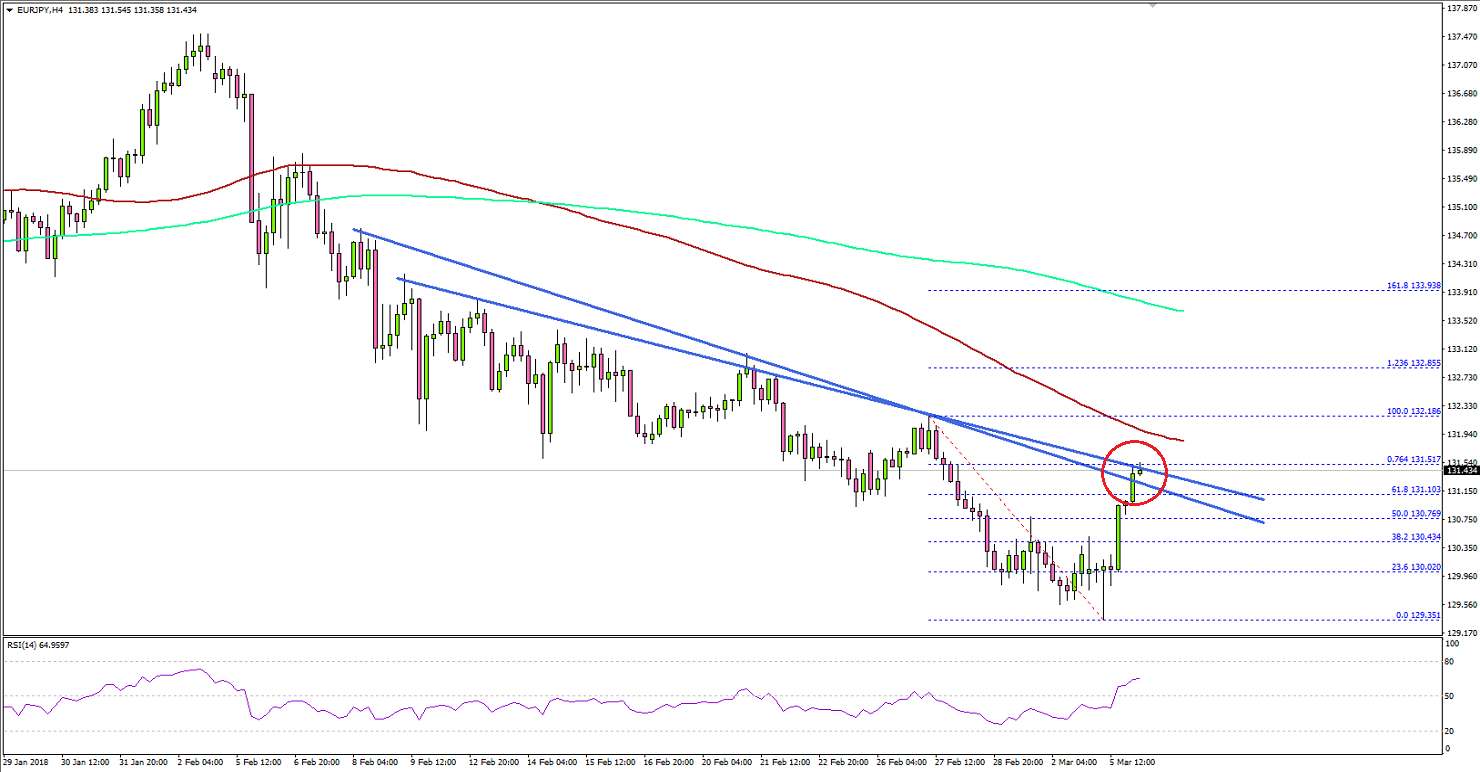
Looking at the 4-hours chart, there is a clear downtrend in place from the 137.00 swing high. The pair broke a couple of important support levels such as 135.00 and 132.00.
On the upside, there are two important bearish trend lines forming with resistance near 131.30-50 on the 4-hours chart. Moreover, the pair is well below the 100 simple moving average (red, 4-hour) and 132.00.
There can be an upside correction, but the pair may face resistance near the trend lines and the 76.4% Fib retracement level of the last decline from the 132.18 high to 129.35 low. Once there is a close above 131.50, the pair may move into a bullish zone.
On the downside, a break below the recent low of 129.35 could ignite further declines toward the 128.50 level.
Recently, the Euro Zone saw the release of the Services PMI for Feb 2018. The market was looking for no change in the PMI from 56.7. However, there was a minor decline from the last reading of 56.7 to 56.2.
Commenting on the report, the Chief Business Economist at IHS Markit, Chris Williamson, stated:
The eurozone economy looks to have hit a speed bump in February after a stellar start to the year. It’s too early to read too much into the February fall in the PMI, and some pull-back from January’s high was always on the cards.
It seems like the recent gains in the Japanese Yen may continue to weigh on EUR/JPY. Only a close above the 131.50 resistance could clear the path for a recovery.
I Won’t Back Down
While the markets get distracted by Central Bank discourse and Friday’s crucial NFP report, the tariff story continues to linger over the market like the foul smell of rotten eggs as the day of reckoning nears for the release of the official tariff details. Given the overwhelmingly negative response from industry leaders, international financial markets and even the furious backlash from loyal members of Trumps administration, there is growing optimism that perhaps significant exemptions will be forthcoming. The ink has not dried on the tariff bill, so investors remain guardedly optimistic.
US equity market rose Monday as investors apprehension about the impending global trade war has tempered hoping for a diplomatic solution, and at the minimum, a process would be in place for businesses to get exemptions from the White House. However, expecting for cooler heads to prevail, might be far too optimistic given that President Trump promoted reforms of U.S. trade policies as a cornerstone of his election campaign, and it’s challenging to envision him back down.
With traders eyeing NAFTA headlines and extrapolating possibility of steel tariff, the latest round of talks made little progress and negotiations remain fractured as political headwinds build.
Oil Markets
Oil prices moved the significantly higher overnight following reports of a drop in crude inventories at the prominent US Cushing Oklahoma storage facility with WTI chalking up its most significant days since Feb 14.
Also, lingering optimism that the CERAWeek by IHS Market conference could generate some production consensus, but with the trade war rhetoric filling the air suggesting little compliance from the Shale elements, the risk will be a two-way street subject to the outcome of the meeting.
Still, the upswing in US Shale production estimates continues to soar as the International Energy Agency suggested that the U.S. would become the world’s top crude producer by 2023 with production hitting a record of 12.1 million barrels a day.
Gold Market
Gold market continues to run hot and cold on the back of fast money.
With higher headline risk comes waves of fast short-term money plays that can leave a sizable imprint on the daily charts. Again, price momentum becomes headline challenged at the principal $ 1330 level as investors reduce risk hedges as global trade ware rhetoric tempers. Price action will remain choppy within near-term ranges until the prospect of higher US inflation receives increased attention. But even in the near term, given the unpredictable nature of current market sentiment, investors will continue to buy gold on dips to hedge the growing tail risk from Trump’s controversial policies.
Currency Markets
The Euro
The Euro has traded positively in the wake of the Italian election aftermath despite the growing wave of anti-establishment populism.
But the Euro has a convincing history story of reversing EU political negatives. And with the main political risk for Germany behind us, with compelling headlines, the Euro could punch higher. But the sentiment is predictably muted ahead of the ECB given the recent soft run of data as traders are erring on the side of caution. But even if the ECB play their cards close to their chest, it’s as sure of a bet as one can get in FX markets that the ECB will continue to march towards policy normalisation and the EUR will move higher in this weak US dollar environment.
The Japanese Yen
The risk was a bit overextend, and traders found themselves far to stretched heading into the Tariff announcement while simultaneously positioning for a possible upgraded inflation expectation ahead of this week’s NFP’s wage data.
US yields moved higher overnight, and USDJPY caught a bit of a tailwind, helping USDJPY move towards crucial resistance levels ( 106.35-50 )
But looking at a broader class of riks assets they too are trading more favourably this morning assisting USDJPY sentiment. But given this could be little more than a short-term reprieve , the market will continue to look lower for USDJPY from both a short-term risk perspective and longer-term BoJ policy implications.
The Malaysian Ringgit
For now, the downside surprise in Jan’s headline inflation and tepid core give MPC ample room to hold policy steady on Wednesday, with the BNM preference for a stronger MYR to act as the cantilever for tightening monetary conditions as the Malaysian economy will continue to overperform through 2018
The BNM well telegraphed January’s rate hike intention so traders will be looking for forwarding guidance, mainly the BNM’s in inflation outlook, to gauge if they could move the dial one more time in 2018. AS such traders will keep a close watch for any hawkish nuances. Overall the statement should be very favourable for the local economy and will be supportive of the local bond markets. However, given the current currency malaise in the regional market, it could be less favourable in that regards.
In the meantime, OPEC compliance continues to support oil prices which play favourably for the Ringgit fortunes. And as far as the regional basket is concerned the MYR should remain in favour given is a strong external position, the lack of dependency on US trade and improving current account balance.
Pound Continues To Gains Ground
The British pound has posted gains to start off the week. In Monday’s North American trade, GBP/USD is trading at 1.3852, up 0.37% on the day. In economic news, British Services PMI improved to 54.5, above the estimate of 53.3 points. In the US, the ISM Non-Manufacturing PMI slowed to 59.5, but managed to beat the estimate of 58.9 points.
The pound has started the week with gains, despite growing concerns over tensions between London and Brussels over Brexit. On Friday, Prime Minister May outlined her vision of relations between the EU and Britain after Brexit. May sought to lower the recent sharp rhetoric surrounding Brexit, saying that both sides needed to show flexibility in order to reach an agreement. May said that she was seeking a free trade agreement with the EU that included financial services. The response from Brussels has been lukewarm, with some policymakers saying that Britain continues to operate under the illusion that it can leave the club but still enjoy the benefits. Last week, there were sharp exchanges between the two sides after the EU releases a draft of the legal framework of the Brexit agreement.
The US dollar was broadly lower last week, after President Trump sent shock waves through the markets when he announced stiff tariffs on steel and aluminum, in order to protect domestic producers. Under the new scheme, foreign steel will be taxed at 25% and aluminum at 10%. The response to the move was overwhelmingly negative, both abroad and in the US. China and the EU immediately denounced the move. US auto makers and oil and gas producers also condemned the tariffs, saying they could get caught in the middle of a nasty trade war if other countries retaliate. In imposing the tariffs, Trump relied on a provision which allows such measures for national security, but clearly, US trading partners will not quietly accept these protectionist measures.
Trade Risks Crystalize
White House comments to start the week tied tariffs to NAFTA and were seen as a sign that the President has a strategy. The pound was the top performer while the Canadian dollar lagged. The RBA decision is up next.
Global stock markets bounced and the yen slipped on Monday as rhetoric shifted on steel tariffs. What looked like a hasty decision to put on global tariffs may have been part of a strategy to leverage a better NAFTA deal. Trump and US NAFTA negotiator Lighthizer both said Canada and Mexico would win exemptions from the tariffs if they made a NAFTA agreement.
It's entirely unclear what kind of agreement Trump wants or if US NAFTA partners can accept it but for now, markets were comforted by signs of a plan.
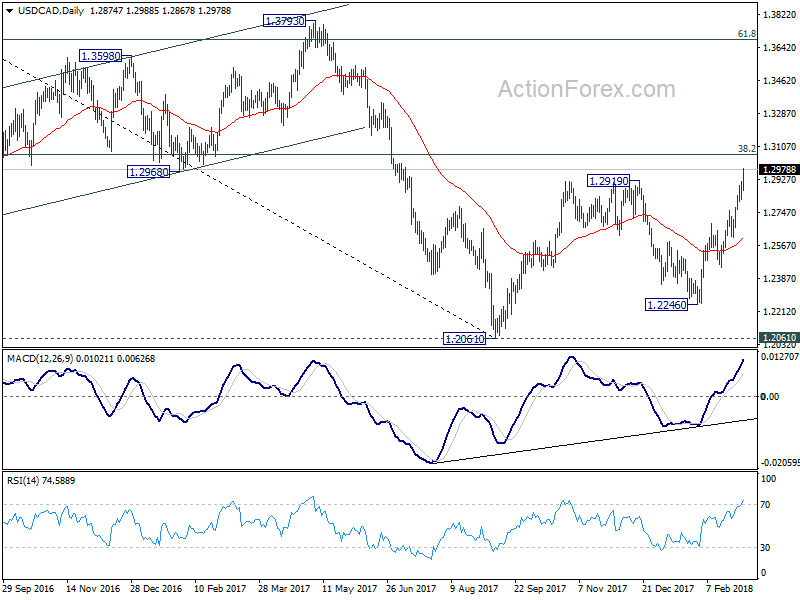
One pocket of weakness was the Canadian dollar as mounting risks pushed USD/CAD above the technically-critical 1.2920 level to the highest since June. That fear ties into Wednesday's BOC decision and a growing likelihood of a more-neutral stance because of greater trade and economic risks.
Yet, it remains unclear if Trump has a bigger plan for tariffs outside of NAFTA. Many leaders want to see the text of what Trump is proposing before taking a step towards retaliation.
Looking ahead, it's a big day for AUD traders with current account and retail sales at 0030 GMT followed by the RBA decision three hours later. Retail sales are forecast to rise 0.4% after a 0.5% decline in December. It's been volatile time for the numbers but consumer confidence has been rising.Trade, meanwhile is expected to show next exports pulling GDP 0.6 pp lower and the current accounts in a deficit of A$12.2B.
Whatever the numbers, the market will be reluctant to make a move before the RBA weighs in. Lowe has been more optimistic lately and expects GDP to accelerate to 3.25% y/y by the end of 2018 but recent wage numbers have been soft.
Eco Data 3/6/18
[php_everywhere instance="1"]
Elliott wave Analysis: USD Index Update
USD Index is trading impulsively lower from the high, suggesting that a bigger corrective wave 4 had ended. If so, then we now expect price to unfold a five-wave drop, with red wave i) being already completed. Current minor rally can be wave ii), which can see limited upside near the 90.45/90.50 area.
USD Index, 1H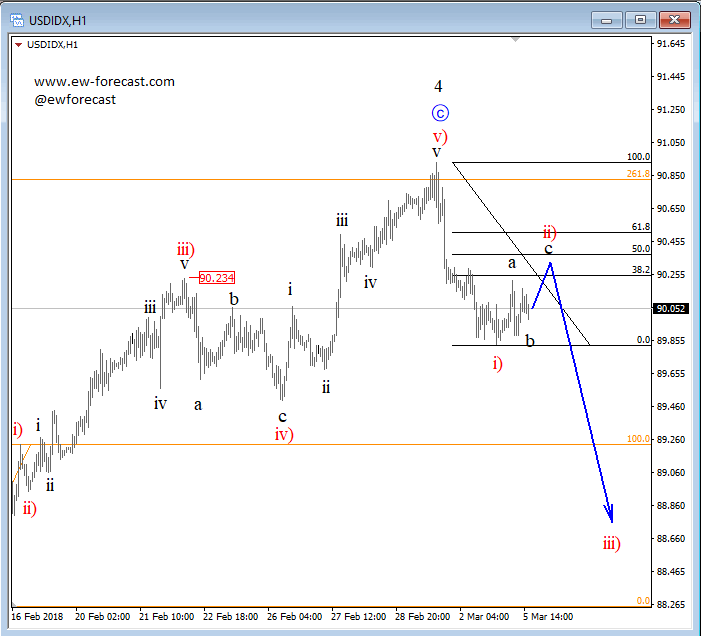
RBA to hold. AUD/JPY drawing support from 81.48.
RBA up next in Asian session. OCR is widely expected to be kept unchanged at 1.50%. RBA will also maintain a neutral stance. Movements in Aussie is more likely tied to risk appetite/aversion than RBA. Australia will also release current account and retail sales.
More on RBA
- RBA Expected to Stand Pat; Other Key Data Out of Australia on the Agenda
- Australia & New Zealand Weekly: RBA on Hold, AUD to Weaken through 2018 and 2019
AUD/JPY is a pair that's worth watching. It's pressing key long term cluster level at 81.48, close to 50% retracement of 72.39 to 90.29. Return of risk appetite could trigger a rebound through 83.17 resistance. And that would in turn trigger a near term reversal.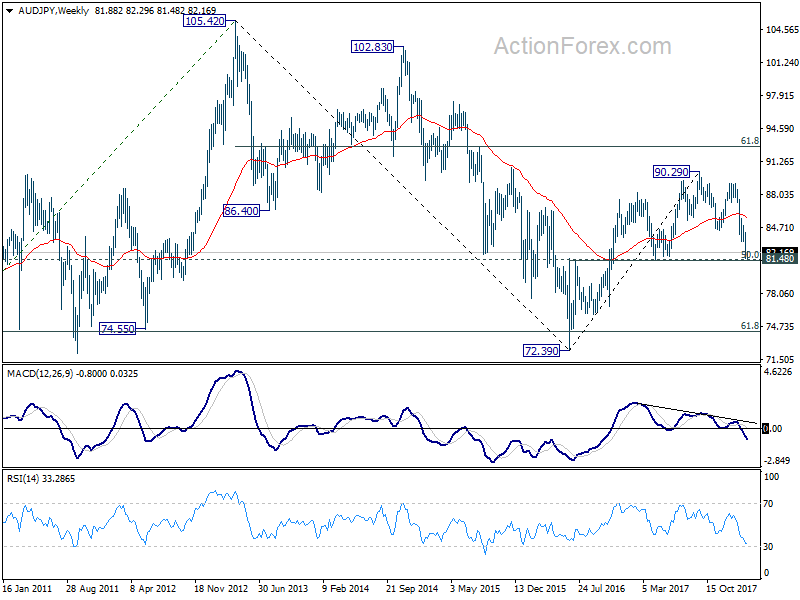
Japanese Yen Pauses After Strong Week
The Japanese yen has edged lower in the Monday session. In North American trade, USD/JPY is trading at 105.96, up 0.20% on the day. On the release front, the sole Japanese event is the 30-year bond yield. In the US, the ISM Non-Manufacturing PMI slowed to 59.5, but managed to beat the estimate of 58.9 points.
It was a good week for the Japanese yen, which improved 1.3% on the week. The currency received a boost after Bank of Japan governor Haruhiko Kuroda said that the BoJ would consider exiting from its ultra-accommodative monetary policy if its inflation target of around 2020 was reached in early 2020. Kuroda’s remarks were unusual in that they mentioned a possible “exit” from its stimulus program, and this caught the markets off guard. The BoJ has been lagging behind the Fed and other central banks in winding up stimulus, but Kuroda added that the Bank would normalize policy if “economic conditions become favorable and our price target is achieved”. Although inflation remains well below target, any further hints at normalization could strengthen the yen.
The US dollar was broadly lower last week, after President Trump sent shock waves through the markets when he announced stiff tariffs on steel and aluminum, in order to protect domestic producers. Under the new scheme, foreign steel will be taxed at 25% and aluminum at 10%. The response to the move was overwhelmingly negative, both abroad and in the US. China and the EU immediately denounced the move. US auto makers and oil and gas producers also condemned the tariffs, saying they could get caught in the middle of a nasty trade war if other countries retaliate. In imposing the tariffs, Trump relied on a provision which allows such measures for national security, but clearly, US trading partners will not quietly accept these protectionist measures.
DOW correcting fall from 25800
DOW sees some solid buying today, up 200 pts at the time of writing. But it's more like a recovery that corrects the fall from 25800.35 to 24217.47. For now, the recovery could extend to 55 H EMA an or above. but strong resistance is likely between 25000/25200. Another fall to 23360.29 is still in favor for the near term.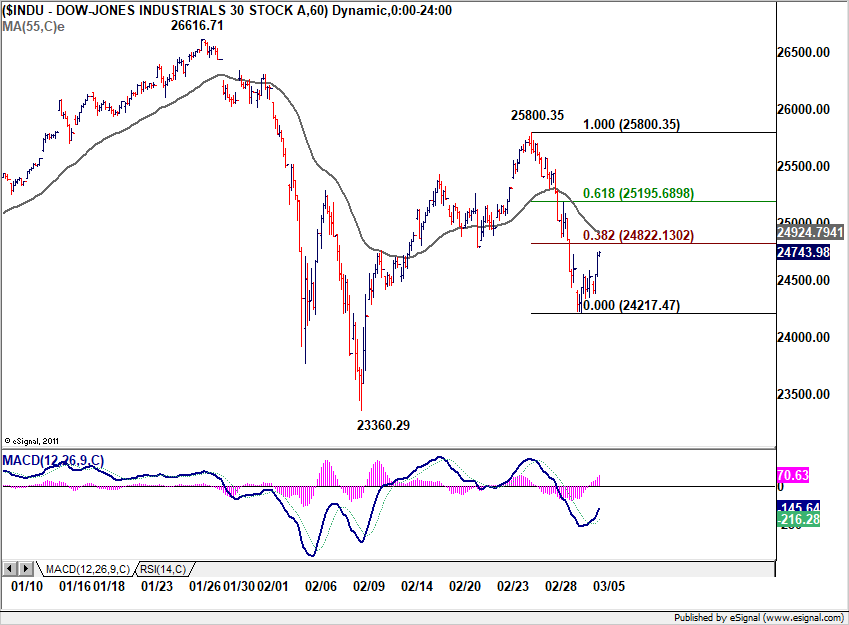
CAD worst performing, threatened by Trump
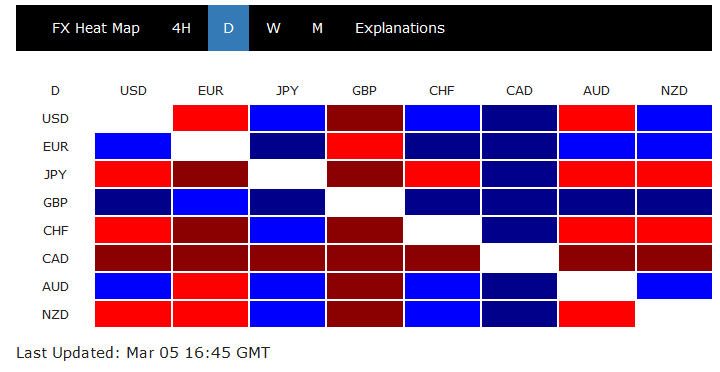 CAD is clearly the worst performing one today threatened by Trump. He tweeted:
- "NAFTA, which is under renegotiation right now, has been a bad deal for U.S.A. Massive relocation of companies & jobs,"
- "Tariffs on Steel and Aluminum will only come off if new & fair NAFTA agreement is signed."
A recap on top steel importers to the US in 2017
- Canada (16%)
- Brazil (13%)
- South Korea (10%)
- Mexico (9%)
- Russia (9%)
- Turkey (7%)
- Japan (5%)
- Taiwan (4%)
- Germany (3%)
- India (2%)
USD/CAD now heading to 1.3065 fibonacci level.