Investor sentiment cooled overnight as markets reassessed the US–EU trade agreement more critically. While initially welcomed for averting harsher tariff scenarios, the deal is now being viewed by many as a near-term drag on European growth. What once seemed like a “good deal” in absolute terms is now being interpreted as a relative setback for the EU economy.
Political backlash within Europe has intensified. French Prime Minister Francois Bayrou called the framework a “dark day” for Europe, accusing the bloc of capitulating to US demands. German Chancellor Friedrich Merz also warned that the tariffs embedded in the deal would inflict “significant” damage on Germany’s export-driven economy.
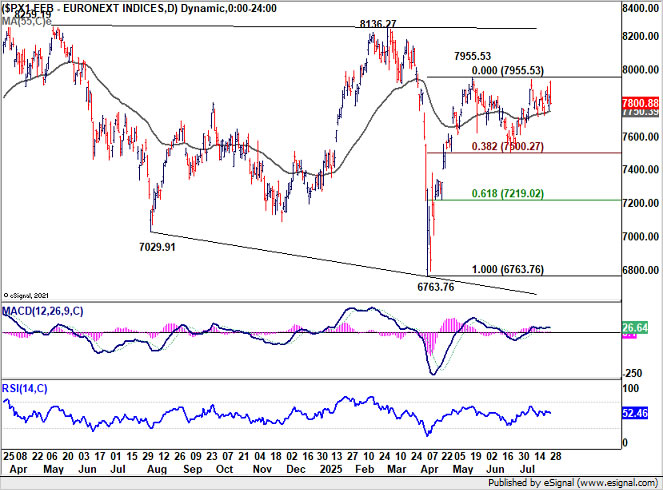
Despite the rhetoric, equity market reactions remained contained. Germany’s DAX lost -1.02% and France’s CAC fell -0.43%, but both indexes remain within tight sideways trading ranges. In the US, DOW dipped slightly by -0.14% while S&P 500 eked out a small gain of 0.02%, signaling that investors don’t see the agreement as overwhelmingly skewed toward American interests either.
EUR/USD came under strong selling pressure yesterday. However, the move is seen as part of the corrective pattern from 1.1829 short term top. Larger up trend is still expected to resume later. This view will hold as long as 55 D EMA (now at 1.1538) holds.

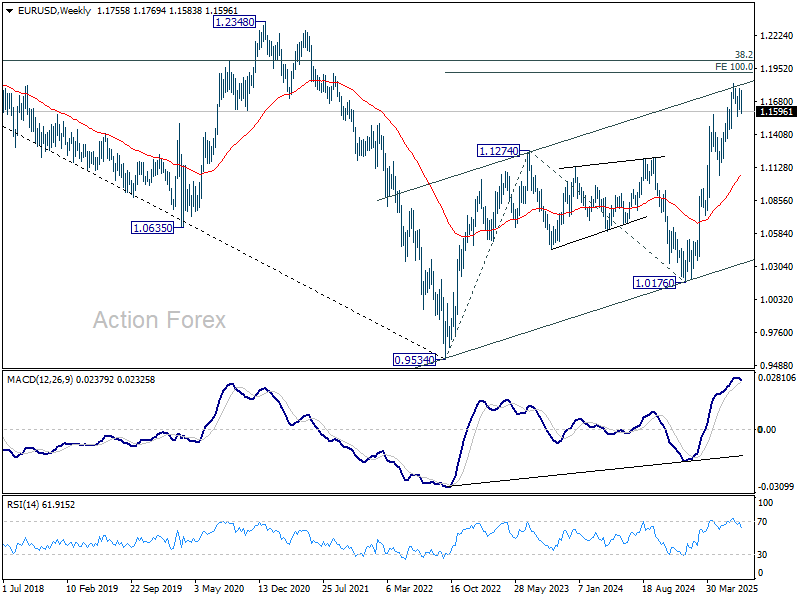
That said, technical headwinds are clearly building. The pair already touching the long term rising channel resistance, and nearing a long-term Fibonacci projection level at 1.1916, 100% projection of 0.9534 to 1.1274 from 1.0176 at 1.1916. Bearish divergence on D MACD suggests fading momentum, recent up trend is clearly running out of steam. Sustained break of 55 D EMA will argue that it’s already in a larger scale correction after rejection by 1.1916.