


The Non-Farm Payrolls (NFP) report, which comes out on December 16, 2025, is the first full look at the US job market since September, and it will be a crucial factor in determining the Federal Reserve’s (Fed) strategy for interest rates throughout 2026.
This jobs data will either prove that the Fed was right to implement the controversial rate cuts of 75 basis points since September, or it will suggest that the central bank was too aggressive in cutting rates.
The report is complicated because it includes both October and November job numbers and is slightly skewed by issues like the recent government shutdown and delayed resignations of federal workers.
For this reason, experts suggest ignoring the main unemployment rate and focusing instead on the number of new jobs added in November and the changes in Average Hourly Earnings (AHE), which track how much wages are rising.
Significant market swings are expected because market participants are betting on much deeper rate cuts in 2026 than the Fed has officially planned. This creates a unique situation where Gold could rise strongly regardless of the outcome, while the currently low US Dollar has a greater potential to suddenly jump in value.
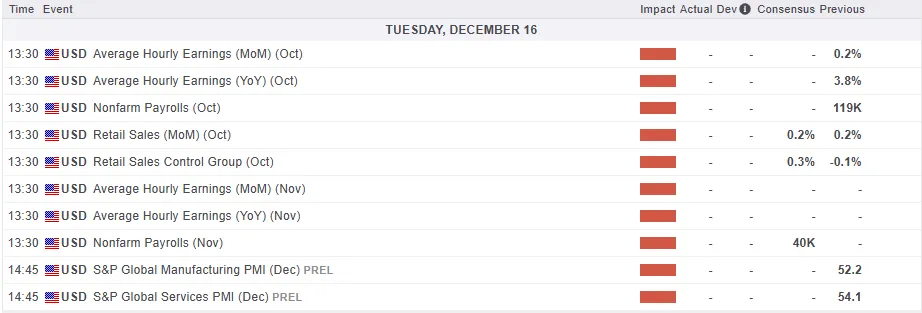
For all market-moving economic releases and events, see the MarketPulse Economic Calendar. (click to enlarge)
Complex Expectations: Analyzing the Dual-Month Release and Distortion
The upcoming NFP report will release two months of jobs data simultaneously, though the most important figure is for November. The jobs number for October is expected to be a loss of about 10,000 jobs, but this is largely ignored because it’s due to a technical issue: many federal workers who resigned had their departure dates delayed, resulting in a temporary, one-time drop in the count.
The crucial expectation for November NFP is a modest recovery, adding about 50,000 jobs, which is a major slowdown from the 119,000 jobs gained in September. This expected number is uncertain, with forecasts ranging widely, and the risk is tilted toward a lower number, especially after a separate report (the ADP) unexpectedly showed a loss of 32,000 private sector jobs.
A key concern for the Fed is inflation, which they measure through Average Hourly Earnings (AHE), or wage growth. This is expected to rise by 0.3% from the previous month, translating to an annual growth of 3.7%. Since the main unemployment rate is unreliable right now, AHE is the clearest signal the Fed has to judge how tight the job market is and how high the risk of inflation is.
Finally, the official Unemployment Rate for October will not be released at all because the government shutdown prevented the necessary data from being collected. The rate for November is expected to suddenly spike to around 4.5% to 4.7%.
However, this sharp increase is not considered a true sign of economic weakness but rather a temporary glitch: federal employees who were temporarily sent home (furloughed) during the reference week of the government shutdown will be mistakenly counted as unemployed. Because of this issue, the market is expected to largely ignore the high unemployment rate and focus primarily on the raw payrolls number and the wage inflation figures.
Policy Crossroads: The Federal Reserve’s 2026 Rate Path Divergence
The market currently has a very different view from the Fed on interest rates for 2026, which is expected to create high market volatility. Traders are betting that the Fed will cut rates two more times by September 2026. However, the Fed’s own latest forecast (Dot Plot) suggests they only expect one cut for the entire year of 2026.
If the November jobs report is stronger than expected, the market will be forced to quickly reduce its bets on those extra rate cuts and move closer to the Fed’s more cautious projection. This would strengthen the argument from some Fed members who believed the central bank was in a “comfortable position to wait” before cutting rates.
This risk of the market having to “reprice” its expectations is why the NFP report is considered the single most important event for setting the tone of monetary policy in the first part of 2026.
Potential implications for the US Dollar Index (DXY) & Gold
The market’s reaction to the NFP report will not be uniform, but rather dependent on the deviation from consensus forecasts. These are the potential reactions we could see depending on how the data comes out and is received.

Source: Table Created by Zain Vawda
US Dollar (DXY) Strategy: Asymmetric Upside Risk
The US Dollar Index (DXY) is currently in a near-term downtrend and is technically oversold due to aggressive market pricing of future rate cuts. This technical positioning creates an asymmetric risk profile:
- Weak Data Scenario: A weak NFP print (e.g., net job losses) validates the dovish market stance. Downside momentum would accelerate, targeting the “measured move” objective near prior support at 97.60.
- Strong Data Scenario: A stronger-than-expected November payrolls report (e.g., above 75k) would trigger a rapid unwinding of dovish expectations. This necessitates a violent short-covering bounce for the USD, potentially driving DXY back toward the 200-day Simple Moving Average (SMA) at 99.30.
US Dollar Index (DXY) Daily Chart, December 15, 2025
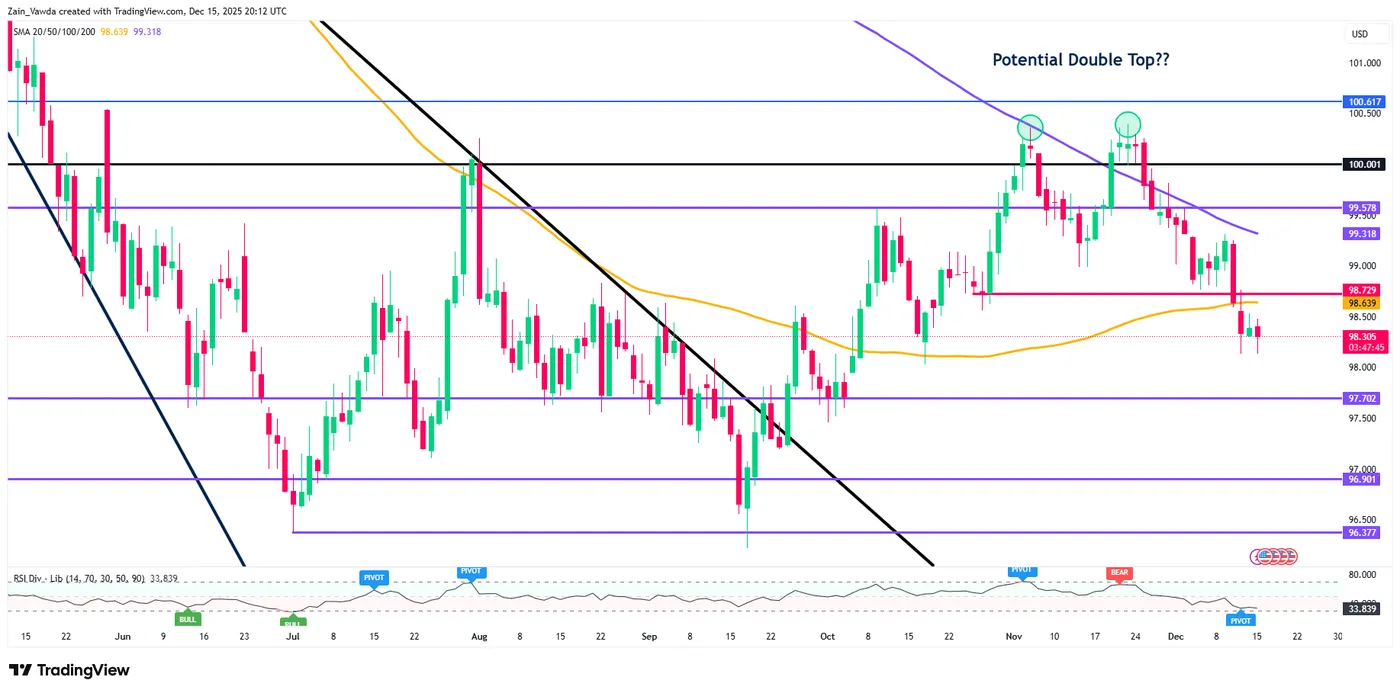
Source: TradingView (click to enlarge)
Gold (XAU/USD) Strategy: The Dual Bullish Catalyst
Gold exhibits the potential for a rally regardless of the NFP outcome due to the unique policy environment. A strong Dollar traditionally controls Gold prices, while a weaker Dollar pushes them up. However, the current political and policy uncertainty provides two avenues for gains:
- Dovish Catalyst (Weak NFP): Weak employment figures lead to lower interest rates and a weaker dollar, diminishing the opportunity cost of holding the non-yielding metal.
- Policy Error Catalyst (Strong NFP): If the data is surprisingly strong, it suggests the Fed may have cut rates “too far too fast”. This shift in narrative from a controlled slowdown to policy error ignites fears of future inflationary acceleration. Gold then trades as an inflation hedge and an asset favored when confidence in financial assets or prudent policymaking declines, which could boost prices toward October’s record high. This structural bid under Gold suggests continuation toward resistance zones (e.g., 4380)
Gold Four-Hour Chart, December 15, 2025
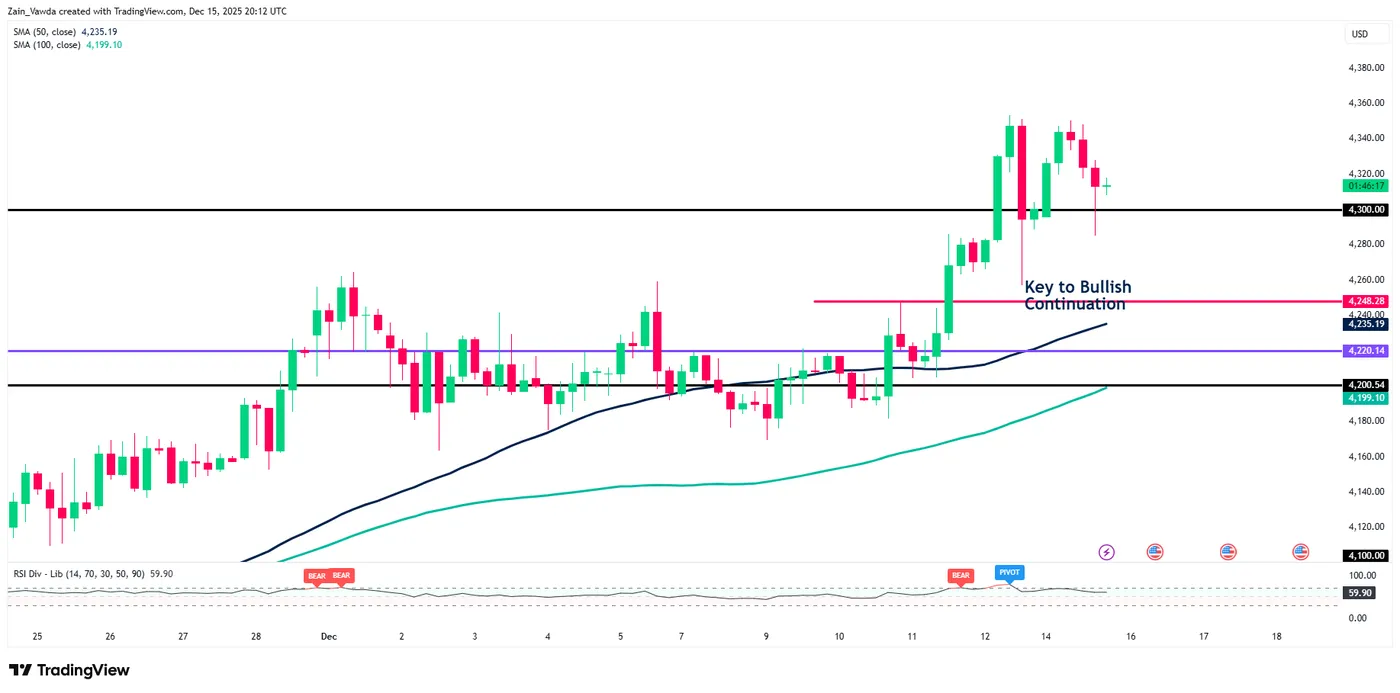
Source: TradingView (click to enlarge)





 report, which comes out on December 16, 2025, is the first full look at the US job market since September, and it will be a crucial factor in determining the Federal Reserve's (Fed) strategy for interest rates throughout 2026.)