- Trump goes all out to gain control of Danish territory of Greenland.
- NATO ties become strained as Trump uses tariffs to ‘blackmail’ allies.
- But would Trump use force to seize Greenland and how would markets react?
Trump’s ‘large real estate deal’
It’s no secret that Donald Trump has had his eye on Greenland – an autonomous territory of Denmark – for some time. The President first expressed a desire to buy the giant glacier-covered island back in 2019 during his first term at the White House. Trump said the US acquisition would be like a “large real estate deal”. Unsurprisingly, the response from the islanders was that they are not for sale. Luckily for them at the time, Greenland was “not No1 on the burner” for Trump. But it is now.
Hot on the heels of Washington’s intervention in Venezuela whereby President Maduro was dramatically captured and flown out of the country, Trump seems hungry to flex America’s muscles even further. So why all the interest in Greenland?
The Arctic’s growing strategic importance
Trump is claiming that the territory is crucial for US and world security, as its location in the Arctic Circle would hand Washington control over vital northern shipping routes that Russia and China are also trying to mark as their own.
The President does have a point. The melting of Arctic ice due to climate change is making these shipping lanes more accessible, and with Russia and China becoming increasingly active in the region, even carrying out joint patrols, Trump is right to be worried.
A reduced military presence
Certainly, Denmark and its European partners haven’t done enough in recent years to shore up Greenland’s defences and boost their military presence in the Arctic. But the US is just as much to blame. There used to be 10,000 military personnel housed on the island at the height of the cold war, most of them at the Pituffik Space Base on the northwestern coast. But that figure has fallen to just 150 now.
This then raises the question of why Trump feels the need to take over Greenland. If the US already has a military base there, then surely increasing its troop numbers and agreeing with other NATO countries to do the same would solve the security issue?
Greenland’s hidden riches
Most likely, Trump’s strong interest in the island has a lot to do with the fact that Greenland is rich in rare earth minerals. There’s currently a global race by countries to get their hands on these critical minerals, as demand has surged due to their use in a vast array of technology products such as mobile phones, electric cars and solar panels.
With about 70% of the world’s rare earth supply being mined in China, having control over Greenland’s natural resources would give the US a much-needed advantage. The Trump administration is already not happy about the leverage that China holds in trade negotiations by limiting the export of these highly sought minerals.
Tariffs back on the table
But is it right for Trump to pick a fight with his closest allies just so to achieve his objective at any cost? Eight European countries, including Denmark, the United Kingdom, Germany and France, were threatened with additional US tariffs of 10% as of February 1, rising to 25% from June 1, because they are opposed to the idea of the US acquiring Greenland against the will of its people.
Trump later climbed down on those threats after progress was made in talks with NATO towards a framework deal. But there can be no doubt this was just another negotiating tactic, betting that these countries will cave in before long. However, it’s unlikely that the key European powers will ever agree to a complete handover of Greenland to the United States. Hence, there’s a very real risk of a major NATO rift forming that could possibly lead to the eventual breakup of the North American and European military alliance.
This would leave Europe extremely vulnerable against adversaries such as Russia and China, while a full-blown trade war with America could cripple its economies. Yet, investors’ immediate concern was about what such action by Trump would mean for the American economy.
‘Sell America’ is back on
The return of tariff headlines has revived the ‘sell America’ trade, which first became a phenomenon in April 2025 when the imposition of levies against almost every nation by Trump triggered a loss of confidence in US assets, with investors dumping Treasuries, Wall Street stocks and the dollar.
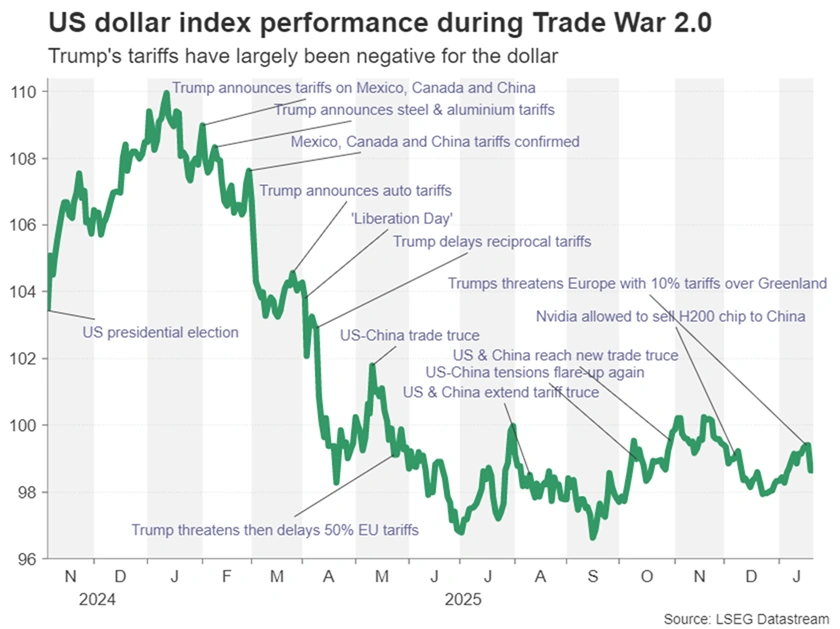
Trump’s very aggressive rhetoric and non-negotiable stance towards America’s long-time friends and allies have once again led investors to question the soundness of the President’s policies, sending the dollar into a spin. In contrast, European currencies such as the euro, pound as well as the Danish krone gained against the greenback during the initial reaction.
New risks for the global economy
US stocks also took a tumble, but so did European shares, as a fresh tariff salvo risks clouding the otherwise mostly positive outlook for 2026.
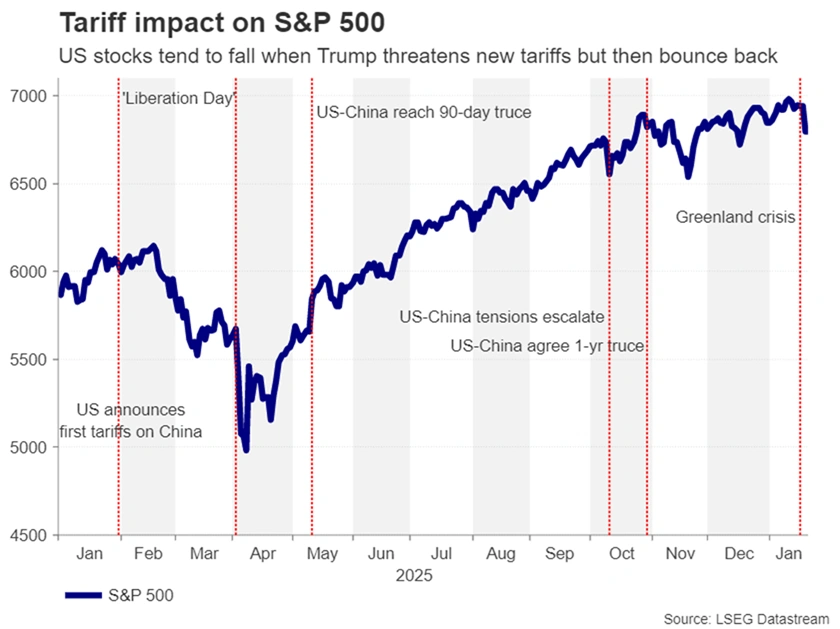
Although the UK has opted to reason with Trump quietly behind the scenes, the European Union isn’t taking any chances and is preparing retaliatory measures and counter tariffs as a contingency plan, signalling a readiness to escalate the row. Regardless of this, in the event that Trump does not back down on his demands and starts a new round of cross-Atlantic trade war, this would almost definitely shave some percentage points off GDP growth in both regions.
Winners and losers
This suggests that the ‘sell America’ impact on the dollar would probably be short-lived and currencies like the euro would soon start to feel the heat from any deterioration in Eurozone economies.
But the dollar is still vulnerable as Trump’s attempt to reshape the world order could accelerate the de-dollarization trend and push investors and central banks even more towards gold and other precious metals.
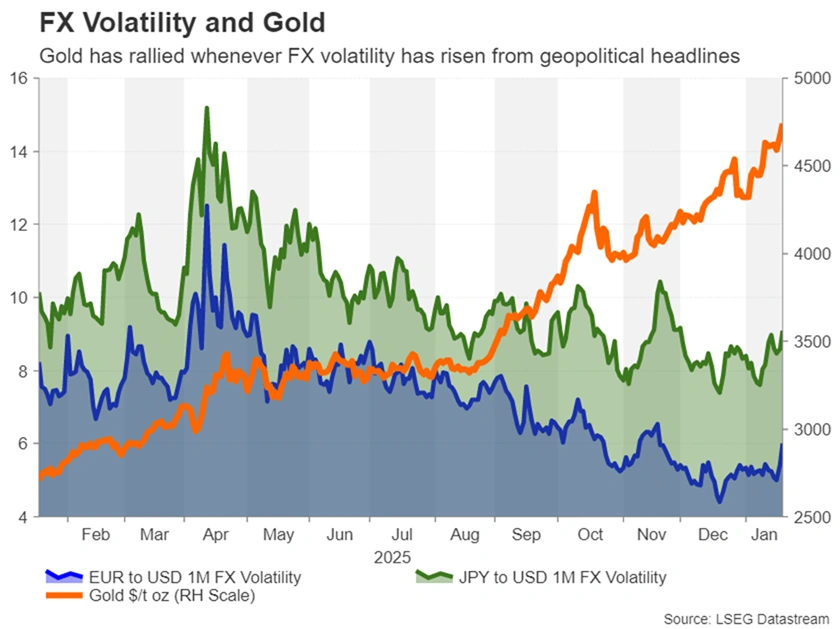
For corporate America, the AI boom and Wall Street’s global dominance in the sector would likely be enough to keep the bullish momentum alive, and in the worst-case scenario of military intervention, prevent a too heavy bloodbath. The latter case would also boost defence stocks and potentially mining stocks too.
Is Canada next on Trump’s conquest list?
The danger for the markets and the world is that the US taking Greenland by force isn’t actually the worst-case scenario, as Trump is unlikely to stop there were he to succeed. The President has often joked that Canada should become the United States’ 51st state and so, as unlikely as it sounds, an invasion is not something that’s completely out of the realm of possibility.
Trump seems intent on controlling the entire Arctic region in his own backyard and the next few weeks will be important in understanding how far he’s willing to go to get his wish. But is Europe powerless to stop him?
Europe in a bind
European investors hold more than $10 trillion in US assets, including $3.6 trillion in US Treasuries. Weaponizing these assets by selling US government bonds, for example, could inflict significant damage by pushing up Treasury yields, making it more difficult for the Trump administration to borrow money.
Such action would probably cause havoc in global financial markets, not just in bond markets, and it’s not certain if it would even deter Trump from seizing Greenland.
For now, the base case is that Trump wants to make a deal to acquire Greenland, or at the very least, to gain significant access to the island, including its rare earths, and will stop at nothing to achieve this. Europe may have no choice but to negotiate.