Dollar is consolidating within a narrow range today, reflecting a temporary balance between supportive near-term developments and persistent longer-term headwinds. Volatility has subsided, but price action lacks the conviction typical of a durable turnaround.
A sharp pullback in precious metals has played a key role in easing pressure on the greenback. Gold has retreated below 5,200 after printing fresh record highs above 5,500, with traders locking in gains after a steep and extended rally. That said, the broader trend in Gold remains intact. The correction appears technical in nature, offering relief to Dollar without undermining the longer-term appeal of hard assets as hedges against policy uncertainty. Equity markets also contributed to a slightly more cautious tone. Asian stocks traded lower following a brief US selloff, led by a sharp decline in Microsoft shares. However, broader US indexes stabilized quickly, preventing risk aversion from escalating.
Another notable source of support came from US political developments. President Donald Trump said he would announce his pick for the next Fed chair on Friday, adding that the choice is “somebody that could have been there a few years ago.” The remark was widely read as a strong hint toward former Fed Governor Kevin Warsh. Warsh is viewed by many investors as a stabilizing choice, combining deep Fed experience with credibility as an orthodox central banker. His potential nomination is seen as reducing tail risks around overt political interference in monetary policy, even if pressure on the Fed is unlikely to disappear entirely.
At the same time, lawmakers moved to defuse a looming fiscal cliff. Senators reached agreement on a spending package designed to avert a partial government shutdown, easing a risk that had been weighing on sentiment. Trump endorsed the bipartisan deal publicly, signaling White House backing and reducing the likelihood of last-minute disruption, even as procedural hurdles remain in the House.
These factors collectively explain why the Dollar has managed to steady. The easing of near-term political and fiscal tail risks has encouraged traders to pause rather than press bearish bets aggressively. Yet the underlying narrative has not materially changed. Persistent uncertainty around US trade relations, foreign policy, and political interference continues to motivate diversification away from the Dollar into real assets and alternative currencies. In that sense, Dollar’s current recovery looks tactical rather than structural. The broader trend toward Dollar erosion remains in place, with today’s consolidation best viewed as a breather within a larger adjustment.
Performance tables reinforce that view. For the week so far, Dollar sits firmly at the bottom, followed by Euro and Sterling. Kiwi leads, with Swiss Franc next, while Aussie, Yen, and Loonie are clustered in the middle of the performance table.
Swiss KOF falls to 102.5, but outlook remains above average
Switzerland’s KOF Swiss Economic Institute Economic Barometer eased from 103.6 to 102.5 in January, undershooting expectations of 103.2. Despite the pullback, the index remains comfortably above its medium-term average, suggesting the outlook has softened but is far from weak.
The decline was driven mainly by deterioration in hospitality and construction, where confidence faded at the start of the year. By contrast, sentiment improved in manufacturing as well as financial and insurance services, helping to cushion the overall slowdown.
Within the producing sector, signals were mixed. Employment prospects, profit expectations, exports, and assessments of production constraints came under pressure. However, brighter readings for order backlogs, general business conditions, and competitive positioning point to underlying resilience, reinforcing the view of moderation rather than a sharp downturn.
Tokyo CPI slows to 2% on fuel subsidies, BoJ normalization path intact
Japan’s January Tokyo core CPI (excluding fresh food) eased from 2.3% to 2.0% yoy, undershooting expectations of 2.2% and marking a 15-month low. Core-core CPI (excluding fresh food and energy) also eased from 2.3% to 2.0% yoy. Headline inflation slowed more sharply from 2.0% to 1.5%.
The slowdown was driven largely by one-off factors. Food inflation excluding fresh food decelerated for a fifth straight month, while energy prices fell -4.2% yoy after gasoline subsidies and the abolition of a provisional fuel tax surcharge. Gasoline prices dropped -14.8%, with electricity and city gas bills also declining. Base effects from last year’s food price surge further weighed on the data.
Despite the softer print, the figures are unlikely to derail the BoJ’s normalization. While fuel subsidies may push core inflation below target in coming months, policymakers are expected to focus on whether firms continue to pass through higher import costs from a weak yen—an outcome that would keep underlying inflation pressures alive.
Japan’s industrial production fall -0.1% mom in December, consumption falters
Japan’s industrial production edged down -0.1% mom in December, a milder decline than expected -0.4% mom and consistent with a sector struggling for direction rather than deteriorating sharply. The Ministry of Economy, Trade and Industry maintained its assessment that output “fluctuates indecisively,” reflecting uneven momentum across industries.
Forward-looking guidance from manufacturers remains volatile. Firms surveyed expect output to jump 9.3% in January, followed by a 4.3% decline in February, highlighting stop-start dynamics rather than a clear recovery trend.
Sector performance was split, with declines in production machinery, chemicals, and paper products offset by gains in general machinery, electronics, and motor vehicles. Supply-side indicators pointed to some imbalance. Industrial shipments fell -1.7%, while inventories rose 1.0%, suggesting demand has not kept pace with production and raising the risk of further output adjustments if sales do not improve.
That concern was reinforced by a sharp disappointment in consumption. Retail sales fell -0.9% yoy in December, far below expectations for a 0.7% increase.
AUD/USD Daily Report
Daily Pivots: (S1) 0.6981; (P) 0.7038; (R1) 0.7106; More...
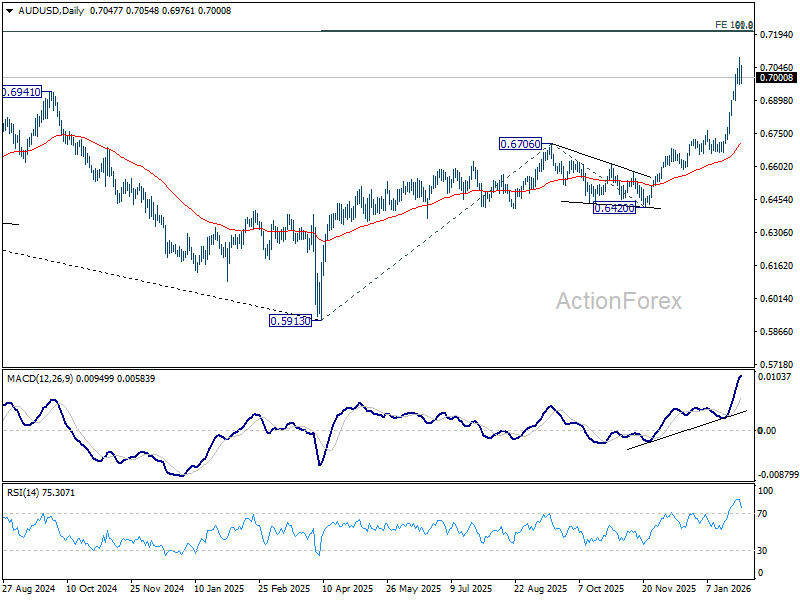
A temporary top is firmed at 0.7093 in AUD/USD with current retreat. Some consolidations would be seen but risk will stay on the upside as long as 55 4H EMA (now at 0.6905) holds. Above 0.7093 will extend larger up trend to 100% projection of 0.5913 to 0.6706 from 0.6420 at 0.7213 next. Nevertheless, break of 55 4H EMA will confirm short term topping, and bring lengthier consolidations before rally resumption.
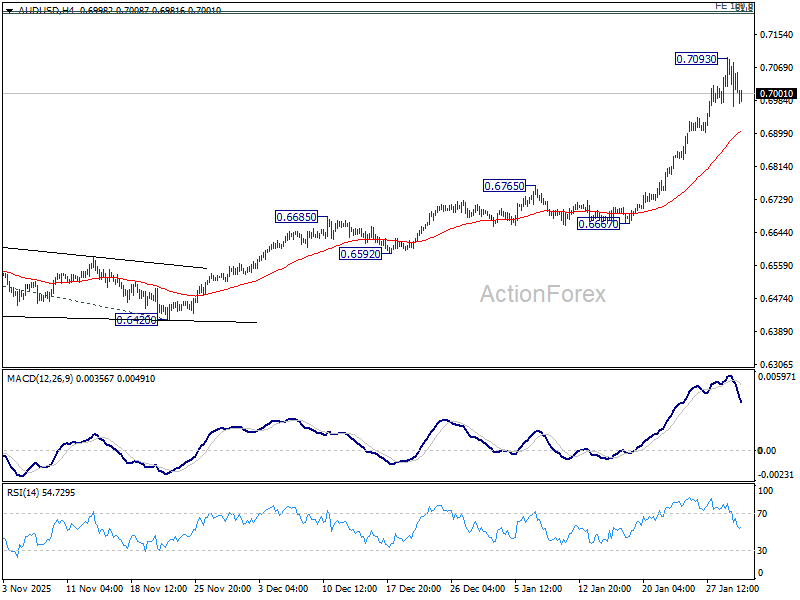
In the bigger picture, current development argues that rise from 0.5913 (2024 low) is reversing whole down trend from 0.8006 (2021 high). Further rally should be seen to 61.8% retracement of 0.8006 to 0.5913 at 0.7206. This will remain the favored case as long as 0.6706 resistance turned support holds, even in case of deep pullback.