The latest 10-day extension of the Iran strike pause by US President Donald Trump might act as a “relief valve”, preventing a freefall in stocks. But it has also created a “slow-boil” inflation trap that is forcing a dramatic global monetary policy reversal. Contrary to providing a sentiment boost, Trump’s extension is paralyzing equity markets—preventing both a final capitulation and a meaningful recovery. This fundamental deadlock is keeping Dollar firmly at the top of the weekly performance table.
The “nightmare scenario” currently haunting global central banks is the transition from first-round to second-round inflationary effects. Typically, policymakers “look through” volatile energy spikes, but oil hovering at $105 for weeks is a different beast. It is high enough to infiltrate every layer of the economy—from plastics and transport to fertilizer—but not “explosive” enough to cause the immediate demand collapse that would naturally cool the market. This “slow boil” is exactly what leads manufacturers and logistics firms to stop absorbing costs and start passing them on to the final consumer.
The shift in rhetoric from the world’s most influential central banks has been swift. Bundesbank President Joachim Nagel, a noted hawk, has pivoted from discussing potential rate cuts to a 25bps “insurance hike” in April to protect the ECB’s 2% target. Similarly, the Fed’s trajectory has undergone a massive reversal; after starting the year with expectations for multiple cuts, the market now assigns a near 50% chance of a rate hike in 2026.
As long as the Iran war drags on, the likelihood of inflation becoming entrenched grows, leaving central banks with no choice but to tighten.
Ultimately, Trump’s 10-day “relief valve” is a double-edged sword for investors. While it prevents a total market capitulation today, it also kills any appetite for “dip buying.” Professional investors remain on the sidelines, paralyzed by the uncertainty of whether April 7 brings a diplomatic resolution or a regional energy war. This will keep the risk markets pressured, at least in the short term.
In the currency markets, this has solidified a clear hierarchy: Dollar and Sterling are the dominant beneficiaries, while growth-sensitive currencies like the Australian and New Zealand Dollars remain at the bottom of the pile.
In Asia, at the time of writing, Nikkei is down -0.12%. Hong Kong HSI is up 0.68%. China Shanghai SSE is up 0.70%. Singapore Strait Times is up 0.64%. Japan 10-year JGB yield is up 0.099 at 2.373. Overnight, DOW fell -1.01%. S&P 500 fell -1.74%. NASDAQ fell -2.38%. 10-year yield rose 0.088 to 4.416.
Stagflation Trap Could Tie RBA’s Hawkish Hand, and Send AUD/JPY to 103
AUD/JPY is under pressure as rising geopolitical risks and surging energy and fertilizer costs create a stagflation threat for Australia. While markets still price a May RBA hike, growing concerns over a growth slowdown are raising doubts about further tightening. As expectations shift, the cross is at risk of a deeper correction toward the 103 level. Read More.
Fed Shifts Focus Back to Inflation as Officials See Labor Market in Balance
Federal Reserve officials are shifting focus back to inflation as the labor market is increasingly seen as balanced. Jefferson, Barr, and Cook warn that rising energy prices could push inflation higher and risk becoming entrenched if sustained. With policymakers prioritizing inflation risks over growth concerns, expectations for rate cuts are being pushed back, reinforcing a higher-for-longer outlook. Read More.
Oil Not a Simple Boost as BoC Rogers Flags Inflation and Growth Risks
Oil is no longer a clear tailwind for the Canadian Dollar, as Bank of Canada’s Carolyn Rogers warns that the latest energy surge is lifting inflation while weighing on growth. While higher oil prices support export income, rising costs are squeezing households and businesses, raising concerns about demand and investment. Read More.
USD/CHF Daily Outlook
Daily Pivots: (S1) 0.7924; (P) 0.7942; (R1) 0.7972; More….
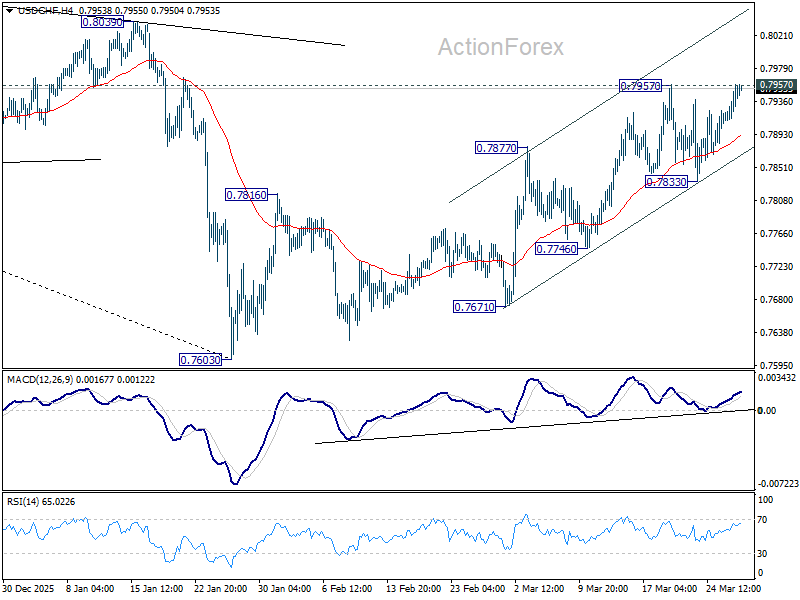
Immediate focus is now on 0.7957 resistance in USD/CHF as rebound from 0.7833 extends. Firm break there will resume the rise from 0.7603, as correction to the downtrend from 0.9200, and target 38.2% retracement of 0.9200 to 0.7603 at 0.8213. For now, further rise is expected as long as 0.7833 support holds, in case of another retreat.
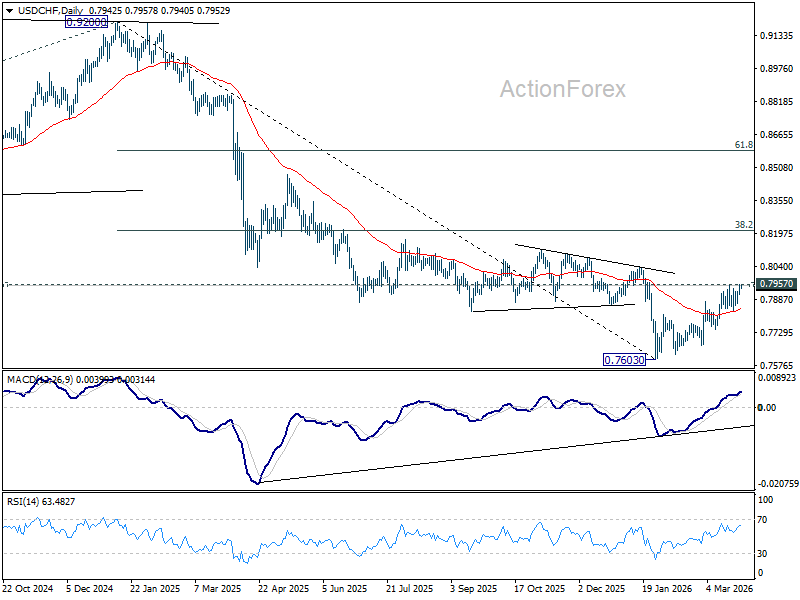
In the bigger picture, a medium term bottom should be in place at 0.7603 on bullish convergence condition in D MACD. Rebound from there is seen as correcting the fall from 0.9200 only. However, decisive break of 55 W EMA (now at 0.8085) will suggest that it’s probably correcting the larger scale down trend from 1.0146 (2022 high). On the other hand, rejection by the 55 W EMA will setup down trend resumption to 100% projection of 1.0146 (2022 high) to 0.8332 from 0.9200 at 0.7382 at a later stage.