Markets struggled to settle on a single narrative today as investors weighed conflicting geopolitical headlines alongside a range of regional developments. Reports that mediators had proposed a 10-day ceasefire between Washington and Tehran initially offered hope that last month’s Memorandum of Understanding could be revived. Those hopes were tempered, however, by market chatter that US President Donald Trump may reject the proposal, leaving traders reluctant to make large directional bets.
That uncertainty was enough to lift Brent crude back above $91 a barrel, helping Dollar edge higher alongside a modest rise in US Treasury yields. Still, the broader market reaction remained restrained. Without confirmation from either side, investors were unwilling to fully embrace either a de-escalation or renewed escalation scenario, leaving most major asset classes confined to relatively narrow ranges.
The stronger oil price nevertheless carries broader implications for foreign exchange. Rising energy costs risk feeding inflation expectations and keeping upward pressure on Treasury yields, a combination that has historically supported Dollar against Yen. With the US 10-year yield back above 4.6%, USD/JPY is once again approaching levels associated with the Yen’s weakest point in 40 years.
The timing is notable. Japanese authorities did not intervene during Monday’s holiday, despite the combination of closed domestic markets and thinner-than-usual liquidity providing an opportunity to catch speculative positioning off guard. With that window now behind them, market participants may increasingly test Tokyo’s tolerance for further Yen weakness if oil prices continue to rise and Treasury yields extend their advance.
Away from geopolitics, Sterling was under pressure as investors continued to digest Prime Minister Andy Burnham’s decision to name John Healey as Chancellor. Opinions were divided over the implications. Supporters argue the appointment signals a commitment to fiscal discipline and respect for bond markets, while critics believe it undermines assumptions that a fiscally conservative figure would restrain the government’s broader agenda. Until greater policy clarity emerges, confidence in UK assets may take time to recover.
Trade policy also stayed on the radar as US and Mexican officials prepared to begin a third round of bilateral talks aimed at revising the USMCA, following Washington’s decision earlier this month not to renew the regional trade agreement while simultaneously imposing fresh duties on Canada. Although the negotiations are unlikely to generate immediate market moves, they reinforce that North American trade policy remains an evolving source of uncertainty.
For the day so far, Australian Dollar outperformed major peers, followed by Euro and New Zealand Dollar. Sterling lagged behind all other major currencies, with Yen and Swiss Franc also weaker, while Dollar and Canadian Dollar traded in the middle of the performance table.
AUD/USD Breaks Higher, but Jobs Data Will Decide Whether Rally Lasts
AUD/USD climbed to a four-week high as broad US Dollar weakness, improving risk sentiment and a rally in copper prices combined to lift the Australian Dollar. However, the move has so far been driven largely by external factors rather than domestic fundamentals. Attention is now firmly on Australia’s June employment report, which is expected to play a decisive role in shaping expectations for an August RBA rate hike and determining whether the breakout can develop into a sustained rally. Read More.
USD/CAD Climbs as Trump Expands Tariffs Beyond USMCA Protections
USD/CAD advanced after the Trump administration announced a new round of 50% tariffs on selected Canadian imports, but the market reaction reflected more than the immediate trade impact. Investors viewed the measures as further evidence that Washington is increasingly willing to bypass USMCA protections by invoking alternative legal authorities, reinforcing the perception that US-Canada trade tensions are becoming structural. While Canada’s response has so far remained measured, the risk of reciprocal tariffs could deepen the economic headwind for Canada and keep pressure on the Canadian Dollar. Read More.
German ZEW Sentiment Jumps to One-Year High as Recovery Hopes Strengthen
German investor confidence strengthened sharply in July, with the ZEW Economic Sentiment Index climbing to its highest level in five months as optimism over exports, domestic demand and economic reforms continued to build. While assessments of current conditions remain weak, they also improved modestly, suggesting the recovery is gradually broadening. The survey also showed confidence improving across the Eurozone, although ZEW warned that the Iran conflict and elevated oil prices remain significant risks to the region’s economic outlook. Read More.
UK Wage Growth Holds Steady as Payroll Employment Continues to Weaken
The latest UK labour market report reinforced the picture of a gradual cooling rather than a sharp slowdown. Payroll employment continued to soften, while wage growth remained stable at its weakest pace since 2020. Although the unemployment rate held steady and claimant growth came in well below expectations, moderating earnings should provide further reassurance to the Bank of England that domestic inflation pressures are easing. Read More.
New Zealand CPI Hits 4.1% as Fuel Costs Reinforce RBNZ Challenge
New Zealand’s annual inflation accelerated to 4.1% in the second quarter as higher petrol and fuel prices drove the strongest increase in consumer prices. While the headline reading came in slightly above the RBNZ’s own forecast, the details showed imported inflation remained the primary driver, with tradeable inflation reaching 4.9% compared with 3.4% for non-tradeable inflation. The report keeps pressure on the RBNZ to remain vigilant, but policymakers will be focused on whether higher energy costs begin spilling over into broader domestic inflation before deciding whether further tightening is needed. Read More.
USD/JPY Daily Outlook
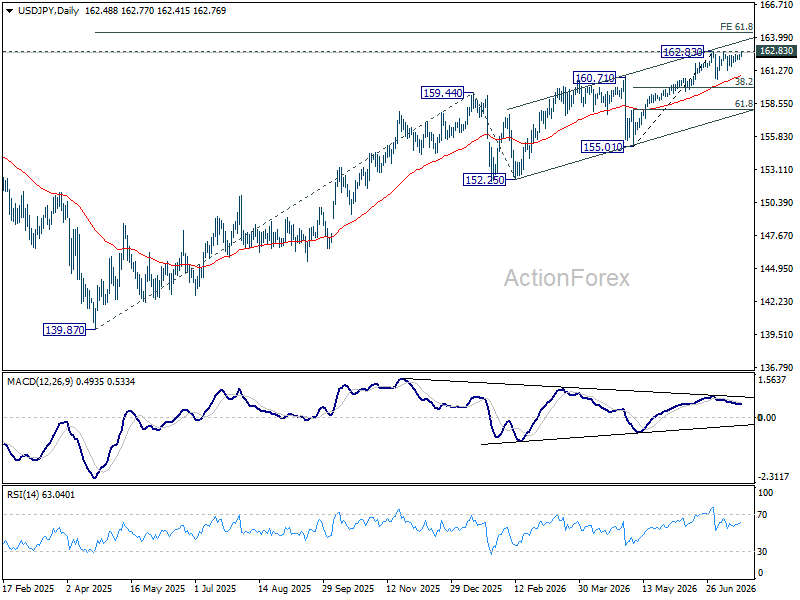
USD/JPY is still staying below 162.83 despite today’s rally. Intraday bias remains neutral. Consolidations from 162.83 could extend with another fall. But in that case, but downside should be contained by 38.2% retracement of 155.01 to 162.83 at 159.84. On the upside, firm break of 162.83 will extend the larger up trend to 164.34 projection level.
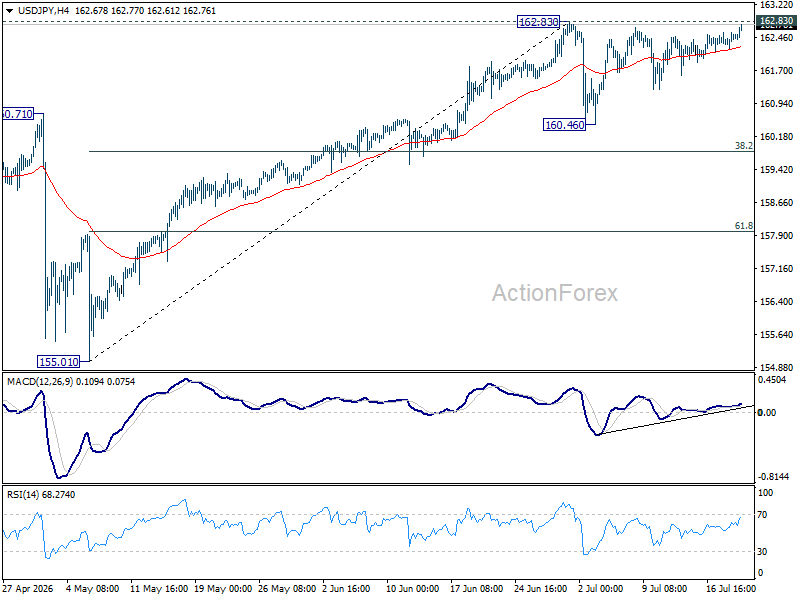
In the bigger picture, rise from 139.87 (2025 low) is seen as another rising leg of the long term up trend. Next target is 61.8% projection of 139.87 to 159.44 from 152.25 at 164.34. For now, outlook will remain bullish as long as 155.01 support holds, even in case of deep pullback.