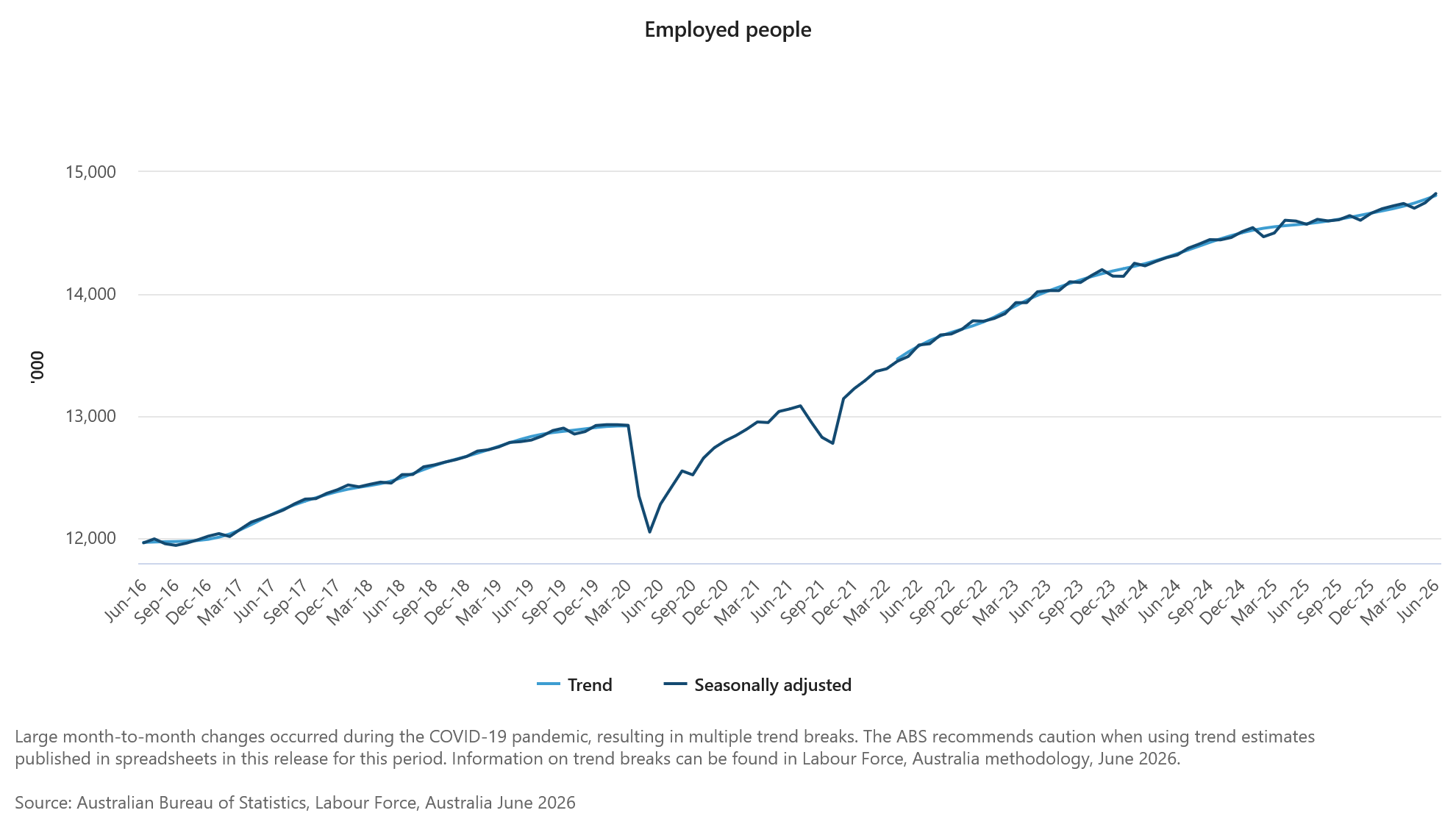
Australia’s labour market delivered a much stronger-than-expected performance in June, with employment jumping by 76.3k, far exceeding expectations of 15.0k and accelerating from May’s 40.3k gain. Despite the surge in hiring, the unemployment rate held steady at 4.4%, as forecast, with the participation rate climbing from 66.7% to a record-equalling 67.0%. The data point to continued resilience in labour demand while also highlighting a growing supply of workers entering the labour force.
According to the Australian Bureau of Statistics, much of June’s employment gain was driven by a 47k increase in part-time employment, with some of the strength reflecting people who had been waiting to start jobs in May. The ABS also noted that elevated job retention continued to support employment growth. At the same time, the number of unemployed people rose by 12.7k, while the underemployment rate edged up from 6.3% to 6.5%, suggesting that although hiring remained robust, spare capacity in the labour market has yet to disappear completely. Total hours worked increased 0.2% on the month, led by a 1.2% rise in part-time hours, while full-time hours were unchanged.
The stronger-than-expected employment gain reinforces the economy’s underlying resilience, but the combination of a steady unemployment rate, higher participation and rising underemployment points to a labour market that is expanding without generating a fresh wave of wage pressures. Attention will now turn to inflation data to determine whether the RBA sees sufficient evidence that price pressures are easing before considering any adjustment to policy.
Economic Data
| Indicator | Actual | Expected | Previous |
|---|---|---|---|
| Employment Change | +76.3k | +15.0k | +40.3k |
| Unemployment Rate | 4.4% | 4.4% | 4.4% |
| Participation Rate | 67.0% | — | 66.7% |
| Underemployment Rate | 6.5% | — | 6.3% |
| Employment-to-Population Ratio | 64.0% | — | 63.8% |
Key Takeaways
- Employment rose by a much stronger-than-expected 76.3k, led primarily by part-time hiring (+47k).
- Unemployment held steady at 4.4% as a higher participation rate (67.0%) brought more people into the labour force.
- Underemployment increased to 6.5%, indicating some spare capacity remains despite robust hiring.
- Total hours worked rose 0.2% m/m, driven by higher part-time hours while full-time hours were unchanged.
- The report reinforces labour market resilience but is unlikely, by itself, to materially alter the RBA’s policy outlook. Inflation data remain the more important policy driver.