


Canadian Highlights
- Markets are ready for a Bank of Canada hike next week after Governor Macklem’s comments on higher inflation last weekend.
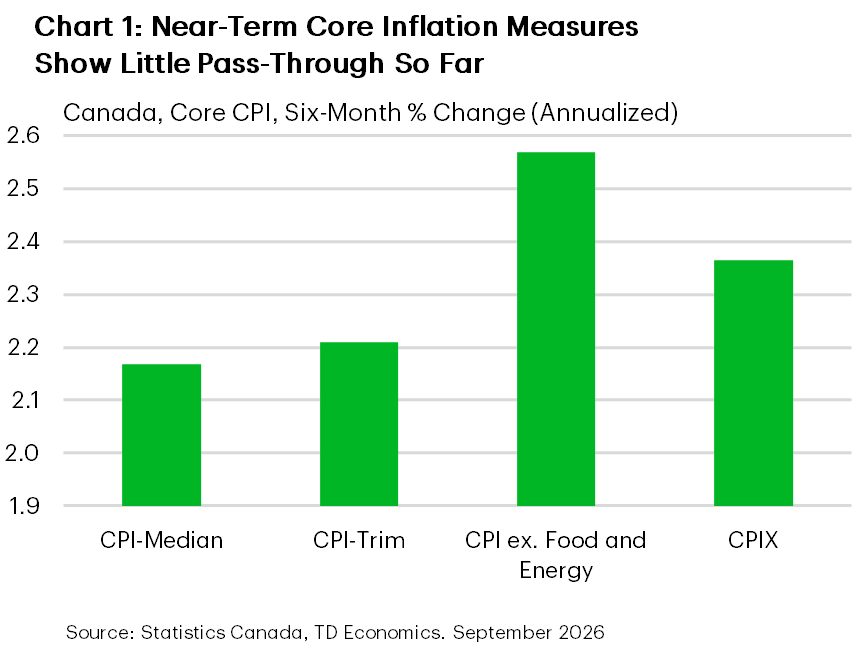
- The actual inflation data have yet to show that higher energy costs have filtered through to broader consumer prices seven months after the initial rise in energy prices.
- We think that the deterioration in the trade environment and a softening labour market provide a counterweight to the inflation pressures from energy, and that an interest rate hike at this point is premature.
U.S. Highlights
- Falling Treasury yields brought relief, but this was paired with weakening sentiment and a sell-off in tech stocks.
- Housing remains caught between punishing borrowing costs and a severe affordability squeeze.
- Firm growth and stubborn inflation strengthen the case for another Fed hike this year.
Canada – Angling for a Hike
Governor Macklem made a stir on Monday, as his comments to media over the weekend led markets to raise the odds of an interest rate hike on Oct. 28th from only 36% on Friday to over 80% now. The focus has been on the inflationary pressures that are coming down the pipe due to persistently elevated oil prices. Particularly given, as Governor Macklem noted, that in contrast to when the BoC last published forecasts in July, “[t]here’s no resolution in sight for the conflict in the Middle East”, suggesting businesses won’t be able to absorb higher costs indefinitely, and will need to increasingly pass them along to consumers in the months ahead.
Markets are likely thinking that the Bank of Canada is now in the world of the high oil price scenario laid out in its April Monetary Policy Report (MPR). In it, oil prices remain at $100 per barrel for the entire forecast horizon, lifting both inflation and GDP. Notably, CPI inflation reaches 3% year-on-year (y/y) in 26Q4 and 3.1% y/y in 27Q1, basically in line with the current tracking. In this scenario the BoC stated “tighter monetary policy is required, resulting in consecutive increases to the policy interest rate.” Friday’s retail sales report suggests there may be some more room for consumer spending to continue growing into Q3 despite a soft labour market, which also supports a bit more inflation pressure from domestic demand.
The issue is that this isn’t happening in a vacuum. For all the worries about the pass-through of energy prices to core inflation, the inflation data have shown it to be notably subdued. Oil prices rocketed higher in March, and yet September’s inflation report (seven months later) shows most measures of core inflation still relatively close to the BoC’s target (Chart 1). And while the breadth of inflation is slightly higher than in the two years prior to the pandemic, it’s nowhere near the levels recorded in the 2021-2022 inflation shock.
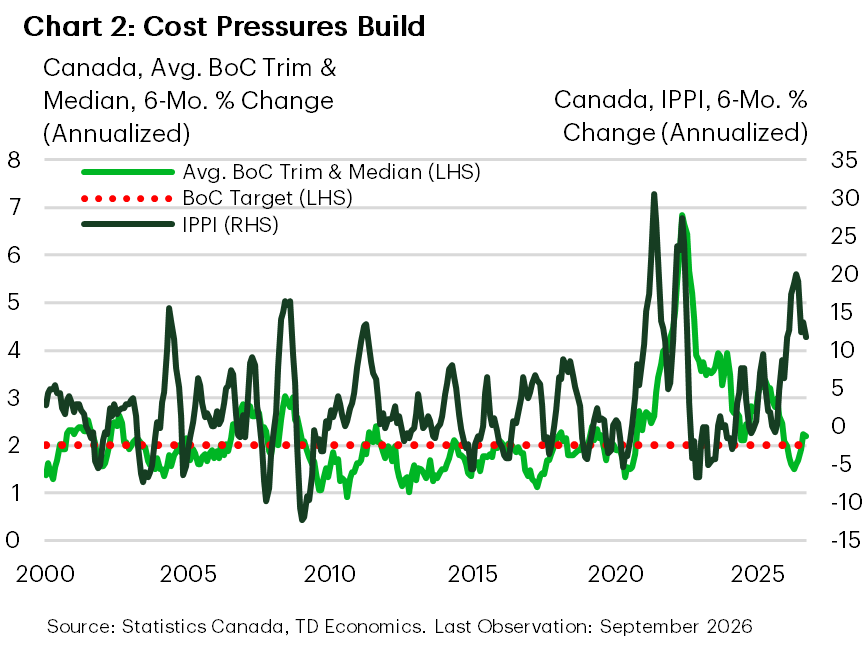
To justify an interest rate hike now, the BoC must believe that since the energy shock appears to be more long-lasting, businesses that have been hesitant to pass on cost increases so far will start to do so. In fact, in the third quarter Business Outlook Survey nearly half of firms say they will pass on the additional costs, versus a quarter that said they already have. Of course, if a quarter of firms have already passed on the costs, pricing power must be very weak elsewhere for core inflation to still be at target. Nonetheless, industrial producer prices are up sharply and should eventually translate to higher consumer prices (Chart 2).
Raising the policy rate, by our assessment, is premature, given the prospect of new auto tariffs come January, weak wage growth, limited employment growth and inflation that has yet to definitively start to break higher. However, the BoC seems to have signalled that it is in the world of its high oil price scenario and higher interest rates are required from a risk management perspective to ensure inflation remains on target in the months ahead. If the BoC surprises markets by holding interest rates steady, Governor Macklem will have some explaining to do on what he intended to signal with his Saturday remarks.
U.S. – Yields Fall as Tech Stocks Sell Off
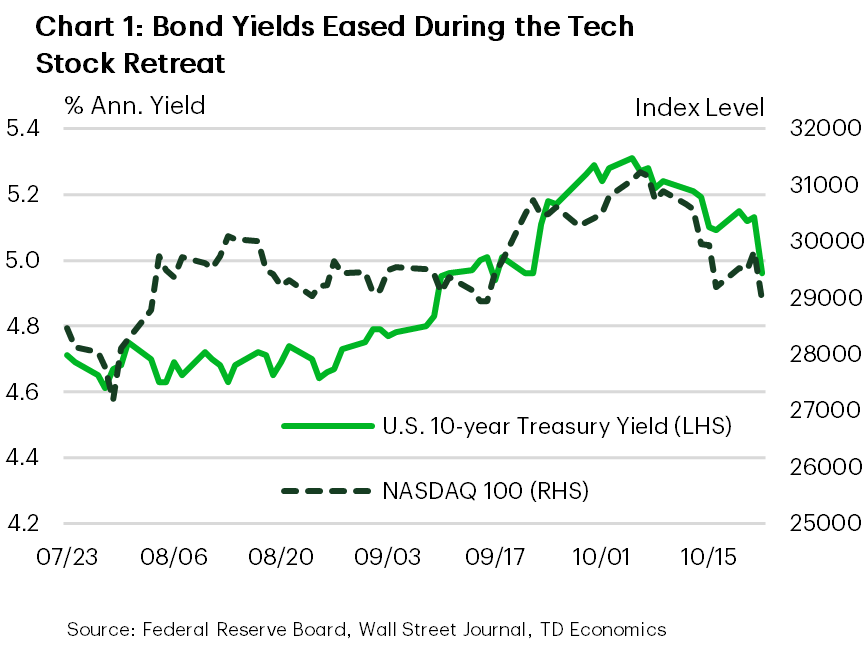
Wall Street found refuge in bonds this week, but little comfort elsewhere. The 10-year Treasury yield briefly slipped below 5% as investors sought safety, offering rate-sensitive sectors some reprieve. Yet the rally was not solely due to good news, as it seems Treasuries were only playing their old role of safe haven amid weakening sentiment. The technology-led equity selloff deepened as investors again questioned the financing and eventual payoff of the AI investment boom—hardly the first bout of doubt this year, and unlikely the last (Chart 1). Higher oil prices and renewed geopolitical tensions added to the unease. Lower borrowing costs bought at the expense of confidence in the economy’s growth engine are somewhat of a pyrrhic victory for the country’s borrowers.
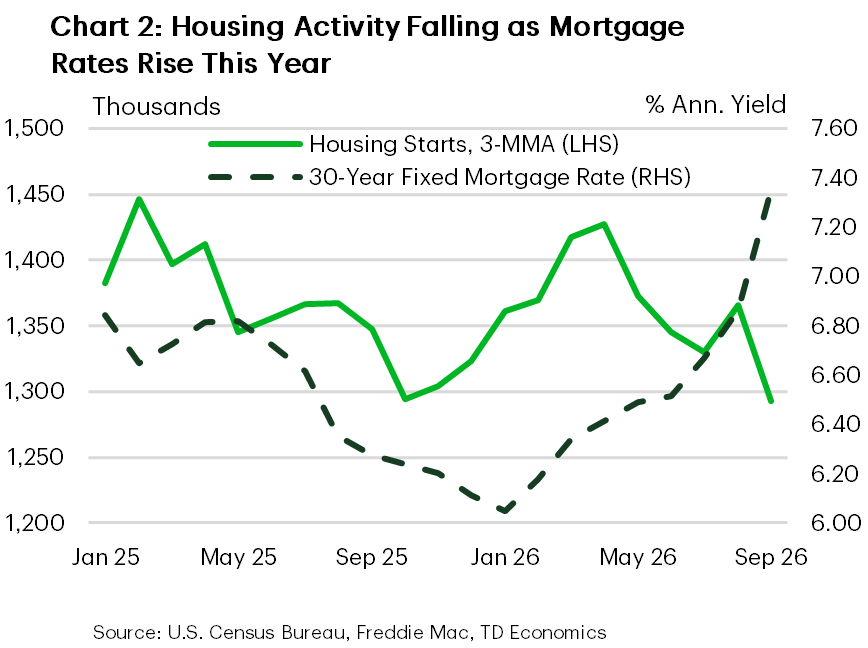
The data calendar was sparse, but housing delivered a blunt reminder of how higher rates are squeezing households (Chart 2). Single-family starts fell 4.6% in September, while permits dropped 4.0% to a three-and-a-half-year low. Pending home sales sank 7.3% in September and 11.3% from a year earlier, reaching a record low as mortgage rates climbed. The average 30-year fixed rate eased to 7.32% this week from 7.40%, but monthly payments remain out of reach for many buyers. Lower Treasury yields could help, though unusually wide spreads mean mortgage rates may be slow to follow.
Housing affordability has also reached the White House. President Trump’s October 22 executive order aims to lower borrowing and refinancing costs by, among other steps, ending mortgage insurance sooner for qualifying borrowers and promoting cheaper manufactured housing. The measures may take some sting out of homeownership, but they cannot cure the deeper problem: lofty prices, scarce supply and expensive credit.
Beyond housing, the economy still has plenty of fuel in the tank. The Atlanta Fed’s GDPNow model is tracking annualized third-quarter growth of 3.5%, close to our 3.6% estimate. Add that strength to stubborn, above-target inflation and scant evidence of cooling in last week’s data, and the case for further tightening grows harder to dismiss. For the Fed, the real tension is timing: press harder on inflation now or allow September’s hike and tighter financial conditions more time to bite.
Above-target inflation which shows few signs of cooling and firm third-quarter growth point toward a second interest rate hike. The case for pausing next week rests not on softer data, but on prudence: policymakers may want to see how September’s increase and tighter markets ripple through the economy. On Thursday the advance GDP report for the third quarter and personal income and outlays for September are released. GDP will reveal whether domestic demand kept its spring momentum, while core PCE will provide the Fed’s preferred read on underlying inflation. Together, the reports will provide critical evidence for the path for interest rates into 2027.





. Higher oil prices and renewed geopolitical tensions added to the unease. Lower borrowing costs bought at the expense of confidence in the economy’s growth engine are somewhat of a pyrrhic victory for the country’s borrowers.)