


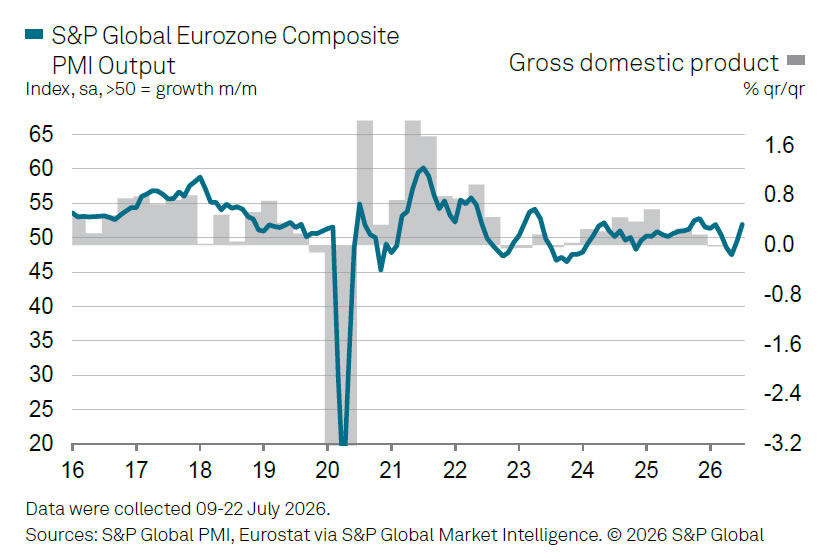
Eurozone business activity returned to expansion in July, with the Flash Composite PMI rising to 51.9 from 50.0, its highest level in five months and signaling the first increase in private-sector output in four months. The improvement was broad-based, driven by a rebound in services and a further acceleration in manufacturing, suggesting the economy has entered the third quarter on firmer footing after stagnating through much of Q2.
Manufacturing was the standout performer. The Manufacturing PMI rose to 52.0 from 51.4, while the Manufacturing Output Index climbed to 53.0 from 51.7, marking the strongest production growth since March 2022. Services also returned to expansion, with the Services PMI Business Activity Index rising to 51.6 from 49.4 after three consecutive months of contraction. According to S&P Global, stronger demand lifted activity across sectors and was accompanied by the first increase in employment this year, while business confidence improved to its highest level since February.
Regional performance also became more encouraging. Germany returned to growth for the first time in four months, with its Composite PMI rising to 51.2 from 49.5, supported by a surge in manufacturing where the output index jumped to 54.7, the highest in more than four years. France remained the weakest of the major economies, but its Composite PMI improved to 49.6 from 47.2, indicating that the downturn moderated considerably. Meanwhile, the rest of the Eurozone recorded its strongest expansion in eight months, pointing to a broader improvement beyond the region’s two largest economies.
The survey also offered encouraging news on inflation. Input cost pressures eased to their lowest level since the outbreak of the Middle East conflict, helping moderate selling price inflation across both manufacturing and services. That should reduce immediate pressure on ECB to tighten policy further. Nevertheless, the outlook remains closely tied to developments in the Middle East. Renewed increases in oil prices and rising shipping disruptions could quickly revive inflationary pressures and disrupt supply chains, threatening what is still a fragile recovery.
Economic Data
Eurozone Flash PMI (July)
| Component | Current | Previous | Trend |
|---|---|---|---|
| Composite PMI Output | 51.9 | 50.0 | ▲ 5-month high |
| Services PMI Business Activity | 51.6 | 49.4 | ▲ 5-month high |
| Manufacturing Output Index | 53.0 | 51.7 | ▲ 52-month high |
| Manufacturing PMI | 52.0 | 51.4 | ▲ 3-month high |
Germany Flash PMI (July)
| Component | Current | Previous | Trend |
|---|---|---|---|
| Composite PMI Output | 51.2 | 49.5 | ▲ 4-month high |
| Services PMI Business Activity | 49.6 | 48.6 | ▲ 4-month high |
| Manufacturing Output Index | 54.7 | 51.6 | ▲ 53-month high |
| Manufacturing PMI | 52.2 | 50.3 | ▲ 4-month high |
France Flash PMI (July)
| Component | Current | Previous | Trend |
|---|---|---|---|
| Composite PMI Output | 49.6 | 47.2 | ▲ 5-month high |
| Services PMI Business Activity | 49.8 | 46.8 | ▲ 7-month high |
| Manufacturing Output Index | 48.8 | 49.1 | ▼ 2-month low |
| Manufacturing PMI | 50.0 | 51.2 | ▼ 2-month low |
Key Takeaways
- Eurozone Composite PMI rose from 50.0 to 51.9, the highest in five months, signaling the first expansion in business activity in four months.
- Manufacturing remained the main growth engine, with the Manufacturing Output Index climbing to 53.0, the strongest reading since March 2022.
- Services also returned to expansion, with the Business Activity Index rising from 49.4 to 51.6 after three months of contraction.
- Germany returned to expansion for the first time in four months, driven by a sharp acceleration in manufacturing output to a 53-month high.
- France remained just below the 50 threshold, but the pace of contraction eased significantly as services stabilized.
- The broader euro area outside Germany and France recorded its strongest expansion in eight months, suggesting the recovery is becoming more widespread.
- Firms reported the first increase in employment this year, supported by stronger demand and improved business confidence.
- Input cost inflation eased to its lowest level since the Middle East conflict began, helping moderate selling price inflation and reducing immediate pressure on the ECB to tighten policy further.
- Rising oil prices and shipping disruptions linked to Middle East tensions remain the principal downside risk to the recovery, with renewed energy inflation capable of derailing the nascent rebound.





