Why USD/JPY’s plunge from 163.70 to below 160 has traders asking whether Japan intervened, not just whether the BoJ will hike in October
Why it matters: The size and timing of the move have shifted the question from “when will the BoJ hike” to “did Japan just intervene.” A weak Dollar backdrop made this an unusually efficient window for authorities to act, since less official buying would be needed to generate a large decline in USD/JPY, but the move is just as explainable by an aggressive unwind of short Yen positioning alone.
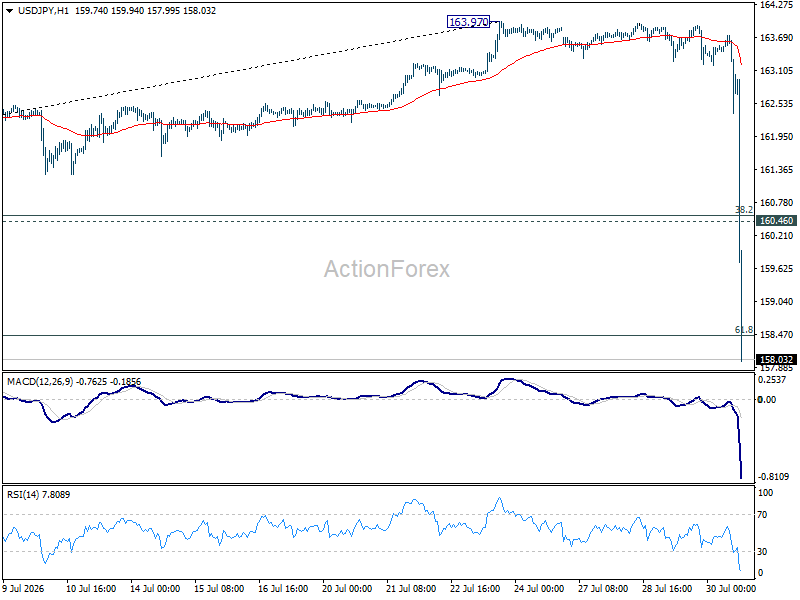
USD/JPY Plunges From 163.70 to below 160 as Intervention Speculation Builds
Today’s sharp fall in USD/JPY has shifted attention from the Bank of Japan meeting itself to a more immediate question: did Japanese authorities take advantage of the perfect market conditions to intervene?
The Japanese Yen extended its rally sharply during early US trading, sending USD/JPY below 160.00 from a day high at 163.70. Earlier in the European session, the Yen had already strengthened broadly, gaining around 100 pips against Dollar as investors unwound short positions ahead of Friday’s Bank of Japan policy decision. But the renewed acceleration lower during US hours came as the Dollar weakened across the board following softer-than-expected US GDP and June PCE inflation data, creating an ideal window for intervention.
The Two-Stage Yen Move
| Session | USD/JPY Move | Likely Driver |
|---|---|---|
| European session | Roughly 100 pips lower | Short-covering ahead of Friday’s BoJ decision |
| US session | Accelerated from a 163.70 day high to below 160.00 | Broad Dollar weakness (soft GDP/PCE) combined with possible official intervention |
Why This Was the Ideal Window for Intervention
The opportunity was unusually attractive. Dollar sentiment had already deteriorated after Wednesday’s FOMC meeting, where investors concluded that although the Federal Reserve remains concerned about inflation, Chair Kevin Warsh’s communication pointed to patience rather than urgency. Thursday’s softer US data reinforced that view. Second-quarter GDP expanded by just 1.5%, below expectations, while June core PCE inflation slowed to 3.3%, extending the broader disinflation trend. Together, the data kept broad pressure on the Dollar, providing an ideal backdrop for any official Yen-buying operation by reducing the amount of intervention needed to generate a meaningful decline in USD/JPY.
Key US Data
- Q2 GDP: expanded just 1.5% annualized, below expectations
- Real final sales to private domestic purchasers: accelerated to 3.9%, pointing to resilient underlying household and business demand despite the headline miss
- June core PCE inflation: slowed to 3.3%, extending the broader disinflation trend
- Three Fed officials dissented in favor of an immediate rate hike, yet September hike odds fell from around 76% to 65%
- 30-year Treasury yield: climbed to its highest level since 2007, even as near-term hike odds fell
ActionForex analysis shows that divergence, in which near-term Fed odds fall while long-term borrowing costs rise, points to markets growing less concerned about the next meeting but more concerned about persistent inflation, reduced policy guidance, and geopolitical supply shocks feeding into the compensation investors demand to hold long-term government debt.
The Yen’s Fundamentals Were Already Improving
Even without intervention, the Yen had fundamental support. Investors had already begun covering short Yen positions before Friday’s BoJ decision amid expectations that policymakers could strengthen guidance toward another rate hike in October. Interest-rate markets already assign better than an 80% probability to such a move, yet the Yen has lagged well behind Japanese bond yields in reflecting that outlook.
Whether Thursday’s late selloff ultimately proves to have been official intervention or simply an aggressive extension of market positioning, the combination of broad Dollar weakness and growing confidence in further BoJ normalization has finally given the Yen the momentum it had lacked for much of the past month.
Euro and Sterling Diverge on Central Bank Paths
Euro extended its weekly gains as stronger-than-expected Eurozone GDP and Brent crude’s rebound revived expectations for another ECB insurance hike in September.
Sterling edged modestly higher after Bank of England held rates at 3.75% in a slightly more hawkish-than-expected 6-3 vote, with Catherine Mann joining Megan Greene and Huw Pill in calling for another increase. Governor Andrew Bailey acknowledged higher energy prices would lift inflation over coming months but stressed there was still little evidence of inflation becoming embedded domestically, limiting Sterling’s follow-through gains.
Geopolitical Risk Still Simmering in the Background
Beyond central banks, geopolitical risks continued to simmer in the background. Iran’s Revolutionary Guard threatened further retaliation following another wave of US strikes, while an apparent drone attack near Egypt’s Damietta port raised concerns that disruptions could increasingly spread toward the Suez Canal as well as the Strait of Hormuz. Brent crude edged back toward the $90 mark but again struggled to establish a decisive break higher, suggesting markets remain cautious about pricing a prolonged disruption to global energy supplies even as regional tensions broaden.
Currency Performance This Week
Overall for the week so far, Dollar, Aussie, and Loonie are among the worst performers. Euro, Swiss Franc and Kiwi are the better performers. Sterling and Yen are positioning in the middle.
Related Coverage
Central Bank Deep Dives
- Read why the BoE’s 6-3 hold is more hawkish than the headline suggests, and why future policy now hinges on wages and services inflation rather than oil prices alone: BoE Split Widens as Policymakers Debate When, Not Whether, to Fight Inflation.
- See why EUR/USD’s rebound reflects genuine ECB repricing rather than just Dollar softness, and what’s driving the case for a September hike: EUR/USD Rebound Reflects ECB Repricing as Oil Revives September Hike Bets.
- Read why the bond market is sending a different signal than the Fed itself, with the 30-year yield at its highest since 2007 even as September hike odds fall: Bond Market Sends Different Message Than Fed as 30-Year Yield Hits Highest Since 2007.
US Data Deep Dives
- See why Q2 GDP’s headline miss masks a stronger underlying picture, including a jump in real final sales to private domestic purchasers: US Q2 GDP Growth Cools to 1.5%, Well Below Expectations.
- Read the full June core PCE breakdown supporting the Fed’s wait-and-see stance, and what policymakers are watching next: US Core PCE Inflation Eases to 3.3% in June, Supporting Fed’s Wait-and-See Stance.
Global Data Roundup
- See how the Eurozone economy regained momentum in Q2, with growth accelerating well beyond expectations: Eurozone Economy Rebounds in Q2 as GDP Growth Accelerates to 0.4%.
- Read why Switzerland’s KOF Barometer points to above-trend growth in the months ahead: Swiss KOF Barometer Rises to 103.5, Reinforcing Recovery Outlook.
- See how the Hormuz closure is already showing up in Australia’s import prices, with petroleum costs up a record 47.1%: Australia Import Prices Surge Most Since 2021 as Hormuz Closure Drives Oil Shock.
- Read why New Zealand business confidence is climbing even as firms flag geopolitical risk as a wildcard: ANZ: New Zealand Business Confidence Jumps as Firms Look Beyond Geopolitical Risks.
Frequently Asked Questions
Q: Did Japan actually intervene to drive USD/JPY from 163.70 to below 160.00?
A: It’s not confirmed either way. The move split into two distinct phases: a roughly 100-pip decline during the European session tied to short-covering ahead of Friday’s BoJ decision, then a sharper acceleration during US trading hours that coincided with broad Dollar weakness following soft GDP and PCE data. That combination makes the US-session move just as explainable as an aggressive extension of existing positioning as it is an actual Yen-buying operation.
Q: Why was this considered an “ideal window” for intervention?
A: Dollar sentiment had already deteriorated after Wednesday’s FOMC meeting and Thursday’s soft GDP and PCE data, meaning the Dollar was falling broadly on its own. That backdrop would let any official Yen-buying reinforce a move already in motion, reducing how much intervention would be needed to generate a meaningful decline in USD/JPY.
Q: Does it matter whether this was intervention or just positioning, for Friday’s BoJ decision?
A: Not fundamentally. Investors were already covering short Yen positions ahead of Friday’s meeting on expectations that the BoJ could strengthen guidance toward an October hike, a move rate markets already assign better than 80% odds to. Whether or not officials intervened, the Yen has now closed some of the gap it had been lagging behind Japanese bond yields.
Key Takeaways
- USD/JPY plunged from a 163.70 day high to below 160.00: One of the Yen’s sharpest moves in weeks, split between pre-BoJ short-covering in the European session and an accelerated US-session decline tied to broad Dollar weakness.
- Whether Thursday’s US-session move was official intervention remains unconfirmed: The backdrop of a broadly weaker Dollar made it an unusually efficient window either way, since less official buying would be needed to move USD/JPY meaningfully.
- Soft US data reinforced Dollar weakness: Q2 GDP grew just 1.5% and core PCE eased to 3.3%, extending the disinflation trend and reinforcing Chair Warsh’s patience-over-urgency tone from Wednesday’s FOMC.
- Euro and Sterling remain this week’s hawkish outliers: Stronger Eurozone GDP and rebounding oil revived ECB September hike bets, while the BoE’s 6-3 hold came with an unexpectedly hawkish vote split.
- Geopolitical risk keeps broadening without yet moving oil decisively: Iran’s Revolutionary Guard threatened retaliation and a drone attack hit near Egypt’s Damietta port, but Brent’s push toward $90 has stalled, suggesting markets remain cautious about pricing a prolonged supply disruption.
What to Watch Next
Friday’s BoJ decision now carries double significance: it’s the week’s key test for whether the Yen’s fundamentals catch up to hawkish rate pricing, and it may prompt officials to confirm or deny Thursday’s move if they choose to comment at all. Japanese authorities have historically stayed quiet on intervention for days or weeks, so confirmation may not come immediately. On the US side, markets will keep watching whether rising energy prices show up in the next round of inflation data, which is what’s kept the Fed, and the long end of the Treasury curve, on alert even as near-term hike odds ease.