


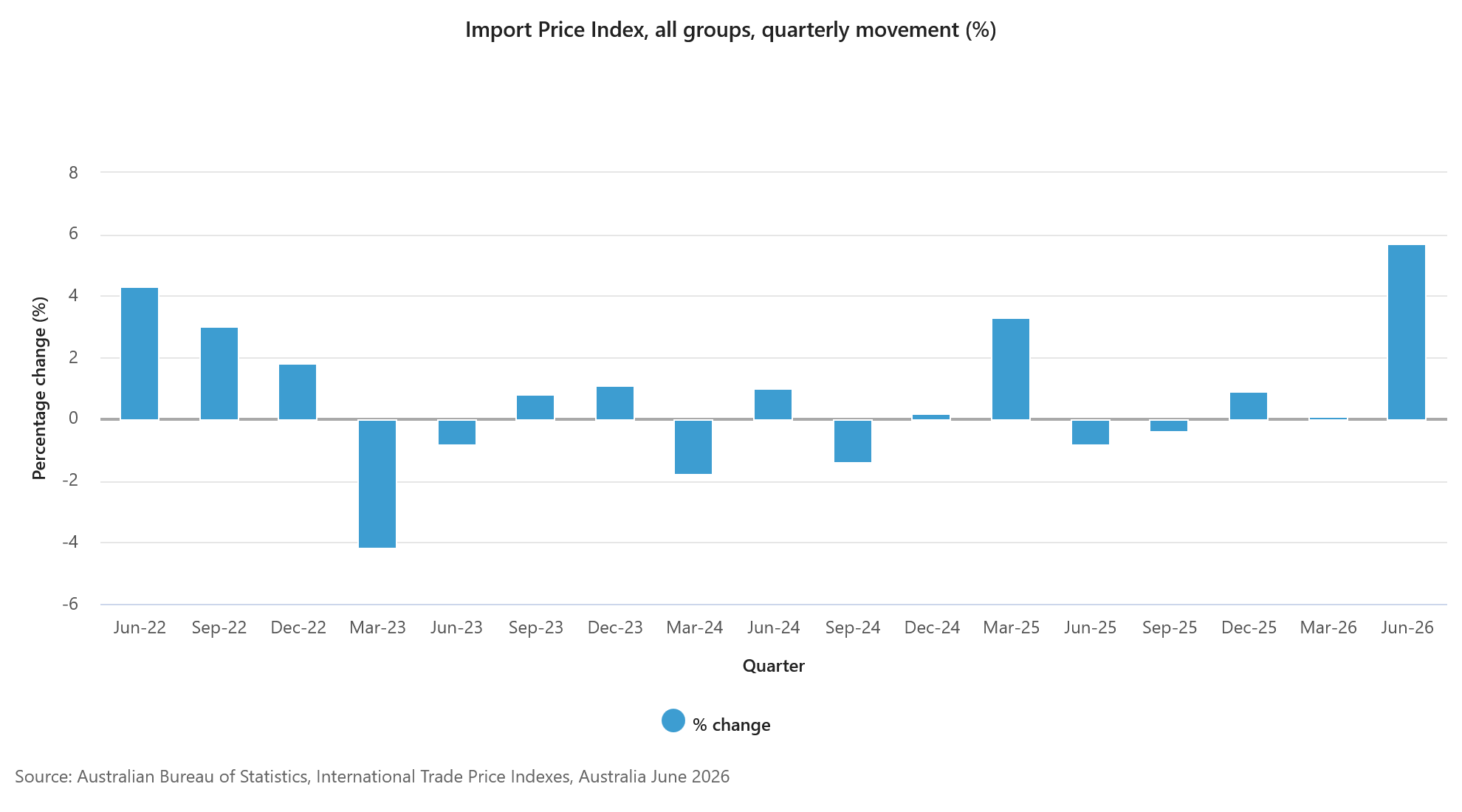
Australia’s import prices surged 5.7% qoq in the second quarter, far exceeding expectations of a flat reading and marking the largest quarterly increase since the December 2021 quarter. The sharp acceleration underscores the extent to which the Strait of Hormuz closure has rippled through global supply chains, driving up the cost of key imported commodities despite broader signs that domestic inflation pressures have been easing.
According to the Australian Bureau of Statistics, the jump was led by a record 47.1% increase in petroleum and related products—the largest quarterly rise since the Import Price Index began in 1983. Fertilisers rose 25.1%, while plastics in primary forms gained 26.3%, reflecting widespread supply disruptions caused by the Middle East conflict.
ABS head of prices statistics Rachael McCririck said the closure of the Strait of Hormuz disrupted global supplies of oil, fertiliser and plastics, leading to broad-based increases in import costs. The only major offset came from non-monetary gold, which fell -9.1% as higher energy prices lifted inflation expectations, strengthened the US Dollar and reduced demand for non-yielding assets.
Export prices also increased, rising 1.1% qoq and 3.9% from a year earlier. Coal prices climbed 5.4% as concerns over global gas supplies boosted demand for thermal coal, while petroleum products and crude fertilisers rose 22.7% and 20.9%, respectively.
Although the data primarily reflect a global supply shock rather than stronger domestic demand, the sharp rise in import costs highlights the inflationary risks posed by prolonged disruptions in Middle East energy routes, a development the RBA will continue to monitor despite the recent moderation in consumer inflation.
Economic Data
| Indicator | Q2 2026 | Q1 2026 |
|---|---|---|
| Import Price Index (q/q) | 5.7% | 0.1% |
| Export Price Index (q/q) | 1.1% | — |
| Export Price Index (y/y) | 3.9% | — |
Major Import Price Components
| Component | Q2 Change |
|---|---|
| Petroleum & Related Products | 47.1% |
| Fertilisers (excluding crude) | 25.1% |
| Plastics in Primary Forms | 26.3% |
| Non-monetary Gold | -9.1% |
Major Export Price Components
| Component | Q2 Change |
|---|---|
| Petroleum & Related Products | 22.7% |
| Crude Fertilisers | 20.9% |
| Coal, Coke & Briquettes | 5.4% |
| Non-monetary Gold | -8.8% |
Key Takeaways
- Australia’s Import Price Index surged 5.7% qoq, the strongest quarterly increase since Q4 2021 and far above expectations for no change.
- The increase was overwhelmingly driven by the Strait of Hormuz closure, which disrupted supplies of oil, fertilisers and plastics.
- Petroleum prices soared 47.1%, the largest quarterly increase since the Import Price Index began in 1983, highlighting the severity of the energy shock.
- Export prices also rose 1.1% qoq, supported by stronger prices for coal, petroleum products and fertilisers as global buyers sought alternative energy supplies.
- Falling non-monetary gold prices partially offset both import and export price gains, reflecting higher US interest rate expectations and a stronger US Dollar.
- The report illustrates how geopolitical supply shocks can rapidly feed into Australia’s import costs, posing upside risks to inflation even as domestic price pressures have recently moderated.
Full Australia International Trade Price Indexes release here.





