


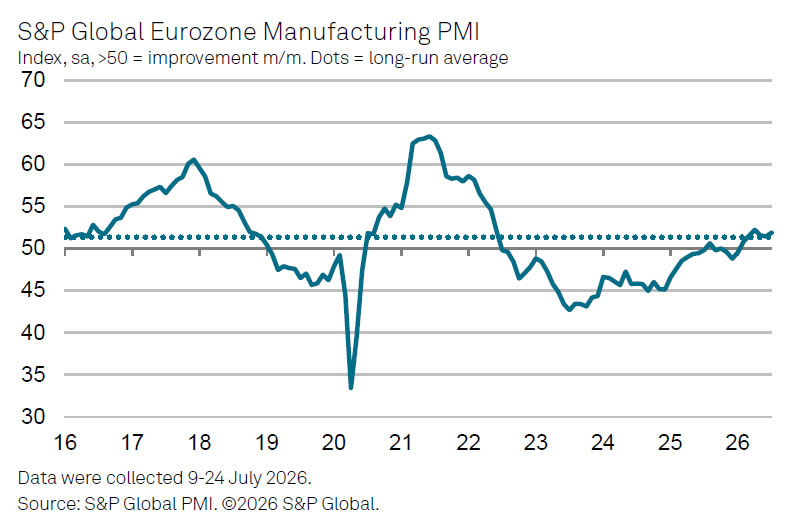
Eurozone manufacturing extended its recovery in July, with the final S&P Global Manufacturing PMI rising to 51.9 from 51.4 in June, marking a three-month high and the strongest improvement in factory conditions since April. Factory output was an even brighter spot, with the Output Index jumping to 52.9 from 51.7, its highest level in 52 months, suggesting production continued to accelerate at the start of the third quarter.
Beneath the headline strength, however, the survey painted a less convincing picture of demand. Output growth was supported largely by manufacturers working through existing order backlogs rather than a meaningful pickup in new business. While new orders continued to increase, the pace remained sluggish, prompting firms to rely on orders secured in previous months to keep production lines running. At the same time, manufacturers continued to trim headcounts, reflecting concerns that current demand may not be sufficient to sustain production once existing backlogs are exhausted.
The recovery also remained highly uneven across the region. Germany led the way with one of its strongest PMI readings in more than four years, while Italy stayed in expansion despite losing some momentum. By contrast, manufacturing activity in France and Spain was broadly stagnant, underscoring the uneven nature of the region’s industrial recovery. According to S&P Global’s Chris Williamson, several economies continue to struggle with weak demand, elevated prices and lingering supply constraints despite recent improvements.
The survey also suggested that geopolitical risks remain an important headwind. Although supply bottlenecks and energy-related cost pressures eased somewhat in July, tensions in the Middle East continued to keep supply chains under strain and energy prices elevated. With new orders still growing only modestly, the durability of the current recovery will depend on whether demand strengthens enough to replace the backlog-driven boost to production. Until then, the impressive rise in output may prove stronger than the underlying health of the manufacturing sector.
Economic Data
| Indicator | Actual | Previous |
|---|---|---|
| Eurozone Manufacturing PMI | 51.9 | 51.4 |
| Eurozone Output Index | 52.9 | 51.7 |
Market Takeaways
- Eurozone Manufacturing PMI rose from 51.4 to 51.9, reaching a three-month high and signalling the strongest improvement in factory conditions since April.
- The Output Index jumped from 51.7 to 52.9, its highest level in 52 months, pointing to a sharp acceleration in manufacturing production.
- Production growth continued to outpace demand, with manufacturers relying on existing order backlogs as new orders increased only modestly.
- Germany remained the region’s manufacturing leader, while Italy stayed in expansion despite slowing. France and Spain were broadly stagnant, highlighting an uneven regional recovery.
- Manufacturers continued to reduce employment, reflecting concerns that current production may not be sustainable without a stronger pickup in new business.
- Although supply bottlenecks and energy-related cost pressures eased slightly, Middle East tensions continued to keep supply chains under strain and inflationary pressures elevated, posing risks to the durability of the recovery.





