


TL;DR: AUD/USD has broken out on external tailwinds — a weaker Dollar and rebounding risk appetite — but Thursday’s jobs report lands in the middle of a genuine split between economists who think the RBA is done hiking and an RBA that keeps saying otherwise.
Aussie Has External Momentum — Now Australia Needs to Contribute
AUD/USD has already received almost everything it could ask for from outside Australia. The Dollar is weakening as markets scale the Fed path back toward only “one and a bit” additional hikes through mid-2027. Regional risk appetite has rebounded strongly, with the KOSPI more than 30% above its July trough and the Nikkei roughly 14% higher. Against that backdrop, AUD/USD extended its rally from 0.6864 and broke through its near-term channel ceiling, giving the first technical sign that the advance is accelerating.
The question now is whether domestic fundamentals can join the move. Thursday’s July employment report arrives with consensus around just 12k jobs growth, a dramatic slowdown from June’s 76.3k, while the unemployment rate is expected to hold at 4.4%. That would normally look like routine normalization after an outlier. This time, however, the labor data sit directly in the middle of an unresolved disagreement over whether the RBA’s tightening cycle is finished.
Economists Say the RBA Is Done. The RBA Hasn’t Said That.
All four major banks now have no further 2026 hike as their base case, with Westpac dropping its August tightening call after softer Q2 inflation data. But the RBA’s own language remains conspicuously hawkish. The August SoMP retained a commitment to increase the cash rate further “if upside risks materialise.” Governor Michele Bullock said at the July 28 Anika Foundation speech that the Board was “prepared to act as required.” After the August hold, Assistant Governor Christopher Kent went further at the Reuters Next event on August 13, saying inflation risks “lean firmly to the upside” and the cash rate “could rise further” if those risks materialise.
That consistency before and after the decision matters. It suggests the hike bias is deliberate rather than a sentence left behind by inertia. At the same time, the rates market hasn’t moved all the way toward bank economists’ conviction: the SoMP cited pricing consistent with roughly a 50% chance of another hike by year-end. ANZ also continues to flag a November hike as a live risk despite its hold base case. In other words, economists are leaning heavily toward “done,” but money markets remain genuinely divided.
One Jobs Report Already Proved It Can Change the Rate Story
This year’s employment series has been unusually volatile: -18.6k in April, +43.9k in May, and +76.3k in June. The June surge, almost five times the expected increase, helped send year-end hike odds from around 78% to 97% before the August meeting. The RBA still chose to hold, and the current roughly 50% year-end probability reflects the reset since then. But the precedent is clear: one labor report has already moved RBA pricing materially this cycle.
That gives Thursday a genuine two-sided setup. Another large beat could challenge the hold-through-2026 consensus, revive hike pricing, and potentially add domestic rate support to AUD/USD’s existing Dollar and risk-sentiment tailwinds. A result near or below consensus would instead strengthen the case that June was an outlier and pull market pricing closer to the Big Four view. Neither outcome should be read in isolation, however — jobs this week and CPI next week are better treated as a paired test: only a combination of resilient labor demand and renewed inflation pressure would make the September hike case substantially harder to dismiss.
ActionForex’s Technical View on AUD/USD
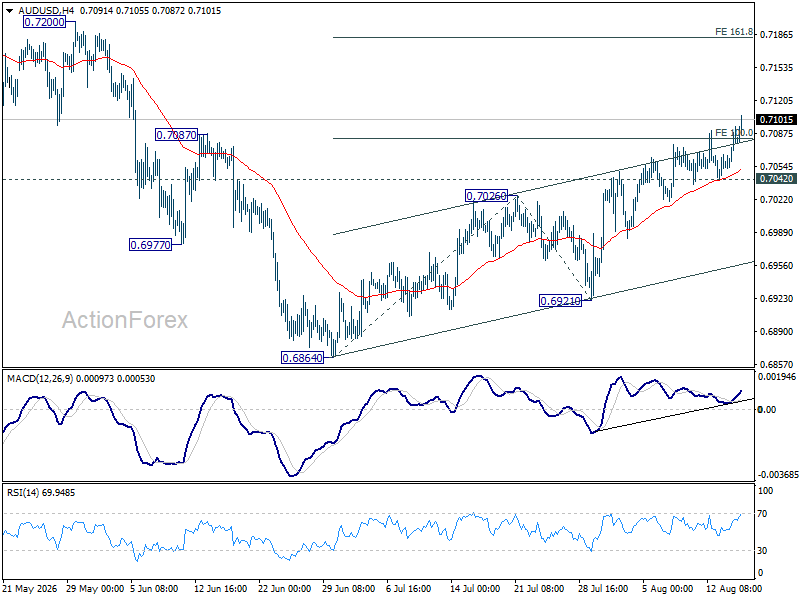
The chart setup already reflects rising optimism. AUD/USD’s rally from 0.6864 has broken above its near-term channel ceiling, signaling upside acceleration. As long as 0.7042 minor support holds, the next objective sits at the 161.8% projection of 0.6864 to 0.7026 from 0.6921, at 0.7183.
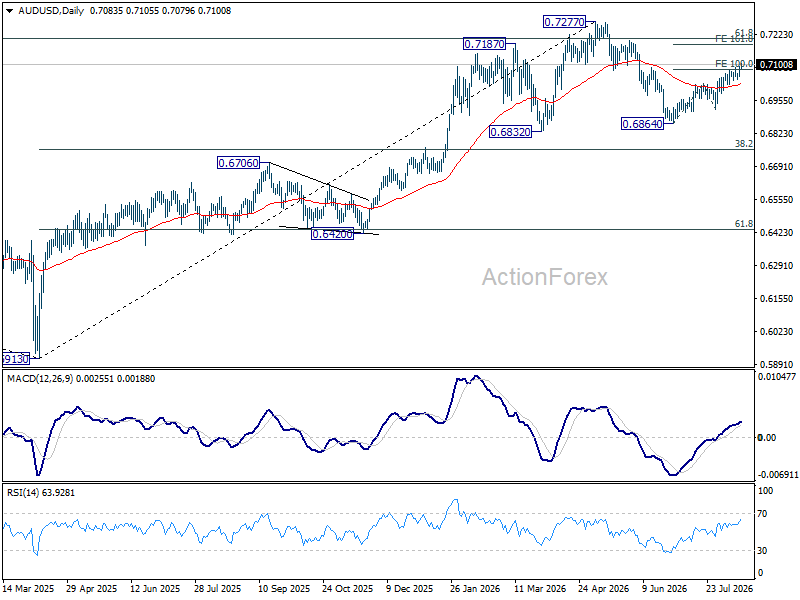
The larger trend remains bullish as well. AUD/USD continues to hold well above the 38.2% retracement of the 0.5913 to 0.7277 rise, at 0.6756, leaving the year-long advance from the 2025 low intact. Price action from 0.7277 is treated as corrective, though it’s too early to rule out another down leg before the larger uptrend resumes.
For now, holding above the 55-day EMA near 0.7023 keeps a retest of 0.7277 favored. The Aussie has already broken higher on external support; Thursday will show whether Australia can supply the next reason to keep buying.
Key Takeaways
- AUD/USD’s breakout has so far been driven entirely by external factors: fading Fed hike odds and a strong regional risk-appetite rebound.
- All four major Australian banks expect no further RBA hikes in 2026, but RBA officials, including Bullock and Kent, have kept using hawkish language even after the August hold.
- Rates markets remain split from bank economists, pricing roughly a 50% chance of another hike by year-end versus the Big Four’s near-unanimous “done” call.
- June’s 76.3k jobs surge already proved a single report can swing RBA pricing sharply, from 78% to 97% hike odds, showing Thursday’s data carries real two-sided risk.
- AUD/USD holds above 0.7042 support with 0.7183 as the next objective; the broader uptrend from 2025 stays intact above the 0.6756 retracement level.





