


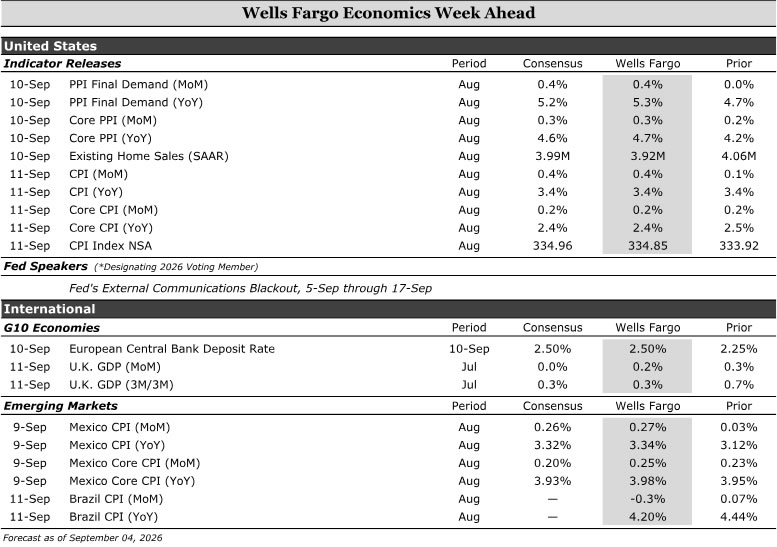
Next week, we expect U.S. inflation to show a modest pickup in headline prices due to higher energy costs, while underlying inflation pressures remain relatively contained. Existing home sales likely weakened further as elevated mortgage rates continue to weigh on affordability and demand.
Abroad, the ECB is expected to deliver a 25 bps rate hike while assessing whether energy and food inflation spreads more broadly. In the U.K., growth likely moderated in July, largely reflecting payback from June’s strong rebound. Mexico’s inflation likely edged higher, supporting an extended pause from Banxico, while Brazil’s inflation likely eased further, supporting another rate cut from the central bank.
United States:
- Existing Home Sales (Thursday), CPI (Friday)
Advanced Economies:
- European Central Bank Monetary Policy Meeting (Thursday), U.K. Monthly GDP (Friday)
Emerging Markets:
- Mexico CPI (Wednesday), Brazil CPI (Friday)
Source: Bloomberg Finance L.P. and Wells Fargo Economics
U.S. Week Ahead
Existing Home Sales • Thursday
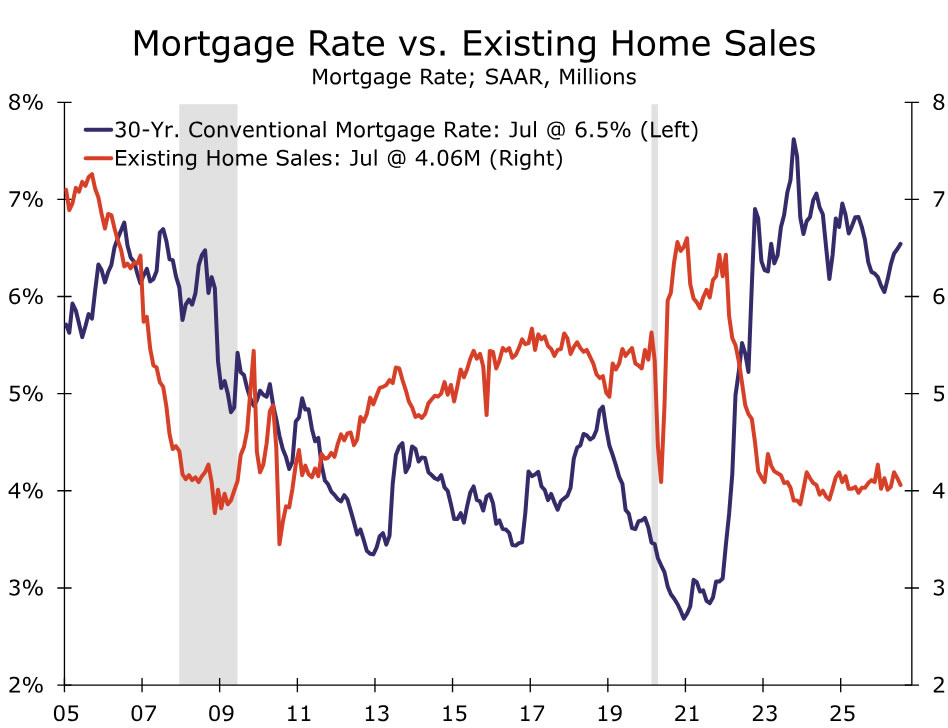
Housing market conditions remain highly unfavorable. Mortgage rates are the primary headwind, and they have climbed even higher alongside the rise in longer-term yields. At the same time, low supply is preventing a broad correction in home prices, leaving prospective buyers squeezed on two fronts.
We expect that existing home sales slid 3.4% in August to an annualized rate of 3.92 million. Behind this forecast is ongoing weakness in mortgage applications and a recent bounce in mortgage rates, which rose from 6.43% at the beginning of July to 6.66% by month-end.
We do not expect affordability conditions to meaningfully improve in the near term. Supply is likely to remain constrained while high mortgage rates discourage mobility. And mortgage rates are apt to remain elevated amid firm economic growth expectations and heavy government and corporate debt issuance.
Source: NAR, Freddie Mac and Wells Fargo Economics
CPI • Friday
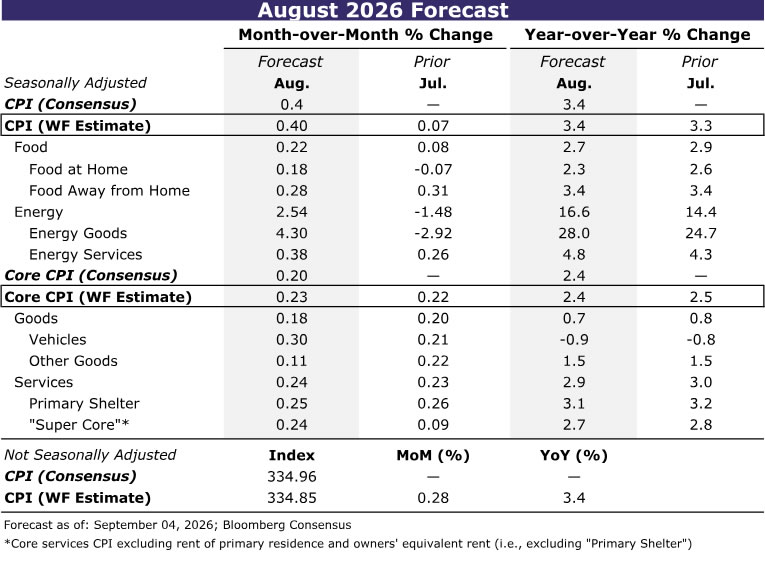
Headline inflation looks to have picked up last month. We estimate the CPI rose 0.40% in August, with gasoline prices increasing a little over 4% as renewed tensions in the Middle East pushed oil higher. Grocery prices also likely rebounded after modestly declining in July.
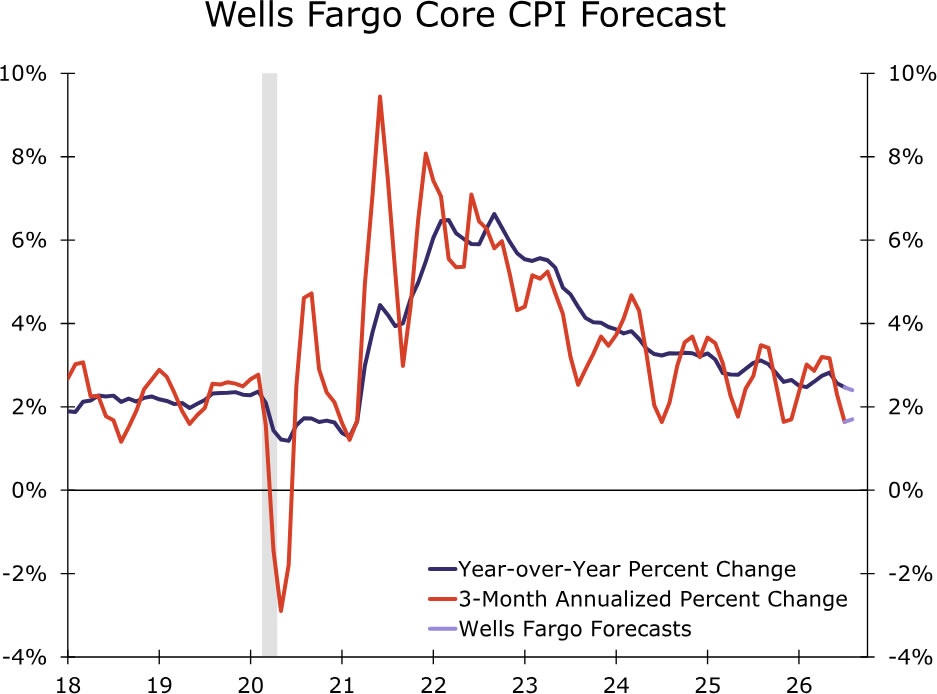
Outside of food and energy, price pressures appear little changed. We expect the core CPI to rise 0.23%, essentially matching July’s pace. Core goods inflation should remain firm, led by another solid increase in used vehicle prices as consumer prices continue to catch up to the trend indicated at wholesale auctions. Meantime, household furnishings and other tariff-sensitive categories appear to be stabilizing after declining earlier this year.
Core services inflation should be little changed with another 0.2% monthly increase. But underneath the surface, we expect a modest pickup in travel (led by lodging away from home) to offset slightly cooler medical care and housing cost growth.
All told, we expect the report to show that while headline inflation remains influenced by the ebbs and flows of the conflict in the Middle East, core inflation remains contained. Should our forecast prove correct, core CPI will ease to 2.4% year-over-year, in line with its 6-month annualized rate but above the more recent 3-month annualized pace of 1.7%.
Source: U.S. Department of Labor and Wells Fargo Economics
Source: U.S. Department of Labor, Bloomberg Finance L.P. and Wells Fargo Economics
G10 Week Ahead
European Central Bank Monetary Policy Meeting • Thursday
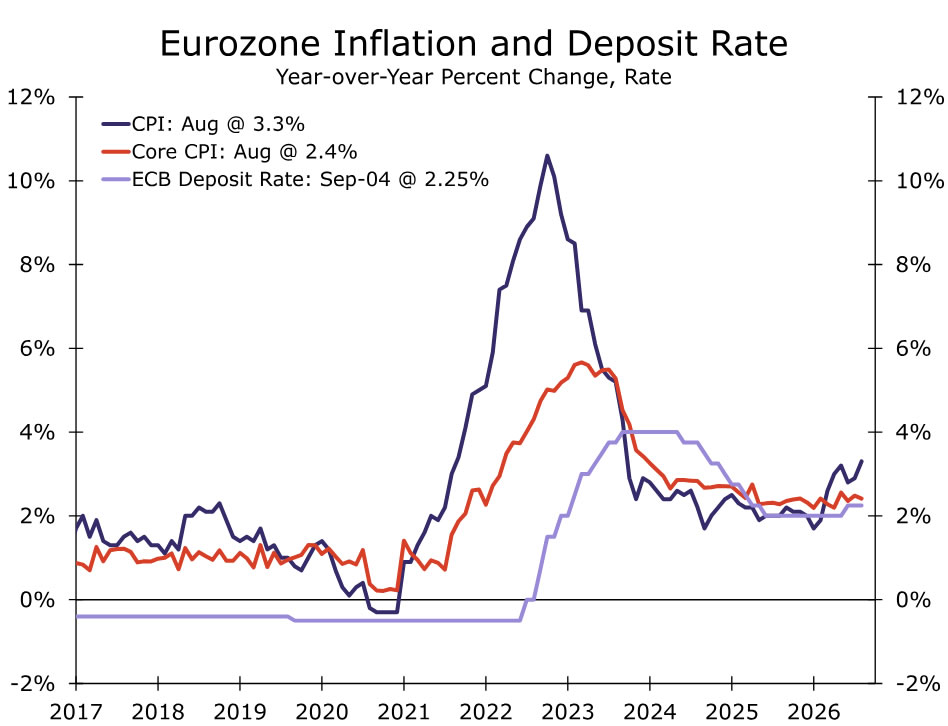
We expect the European Central Bank (ECB) to raise the Deposit Rate by 25 bps to 2.50% next week. August headline inflation remained elevated at 3.3% year-over-year, though softer core and services inflation suggest underlying pressures continue to moderate. Still, the more hawkish tone of the July minutes and renewed rise in energy prices should keep policymakers cautious.
The recent escalation in the Middle East has pushed fuel prices at the pump close to their 2022 peaks, while natural gas storage remains below historical levels, leaving the Eurozone vulnerable to further energy price increases. The ECB is unlikely to respond aggressively if the shock remains confined to energy given the downside risks to growth. However, a broader rise in food inflation linked to El Niño would be more concerning, as highly visible prices could lift inflation expectations and generate second-round effects.
For now, resilient Q3 activity, elevated headline inflation and contained wage growth support one final hike. The ECB will likely retain and emphasize its scenario-based outlook in the updated staff projections given continued uncertainty around the conflict and energy prices. The policy path beyond September will depend on whether energy and food pressures persist and begin to spread, which could leave room for further tightening.
Source: Bloomberg Finance L.P. and Wells Fargo Economics
U.K. Monthly GDP • Friday
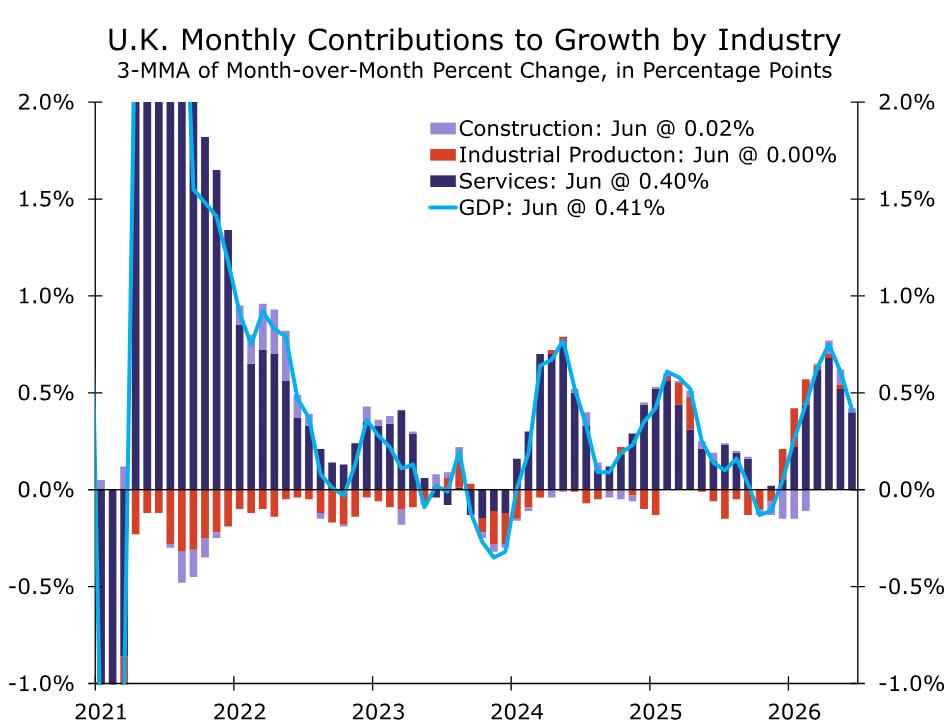
We expect UK GDP to rise 0.2% month-over-month in July, with growth of 0.3% on a three-month-over-three-month basis. Activity likely moderated after June’s strong rebound, though services remained supportive as the July services PMI rose to 52.1. Retail sales volumes fell 0.5% month-over-month, while softer manufacturing activity likely reflected some reversal of earlier precautionary stockbuilding.
The moderation appears more consistent with payback from June than a broader deterioration in momentum. August PMIs remain consistent with Q3 GDP growth of around 0.3% quarter-over-quarter. Still, the renewed escalation in the Middle East and associated rise in gas and energy prices adds upside risk to inflation and could weigh on household demand. Against this backdrop and with Bank of England hawks continuing to emphasize the need for tighter policy, we expect the BoE to remain cautious and continue to look for a rate hike in Q4.
Source: Bloomberg Finance L.P. and Wells Fargo Economics
EM Week Ahead
Mexico CPI • Wednesday
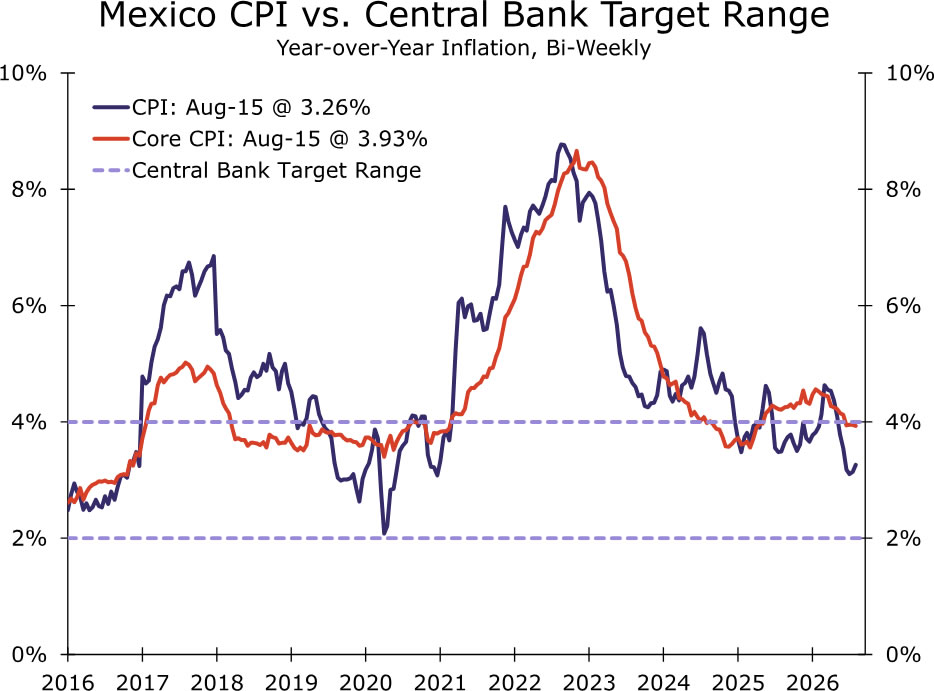
We expect Mexico’s August inflation rate to edge higher, with headline CPI rising to 3.34% year-over-year (0.27% month-over-month) from 3.26% year-over-year in early August. Part of the pickup likely reflects less favorable base effects and a smaller disinflationary contribution from food prices. While agricultural prices continued to help restrain inflation in mid-August, the drag was notably less pronounced than in July. Core inflation should remain elevated at 3.98% year-over-year (0.25% month-over-month).
While inflation remains within Banxico’s midpoint 3% target, persistent core and services inflation suggest convergence toward the midpoint of the target could prove gradual. For now, we continue to expect Banxico to keep rates on hold, with the policy rate remaining at 6.50% through the rest of 2026 and into early 2027 as policymakers await clearer evidence that underlying inflation pressures are easing sustainably. While rate cuts remain a possibility in 2027, the current inflation backdrop argues for patience in the near term.
Source: Bloomberg Finance L.P. and Wells Fargo Economics
Brazil CPI • Friday
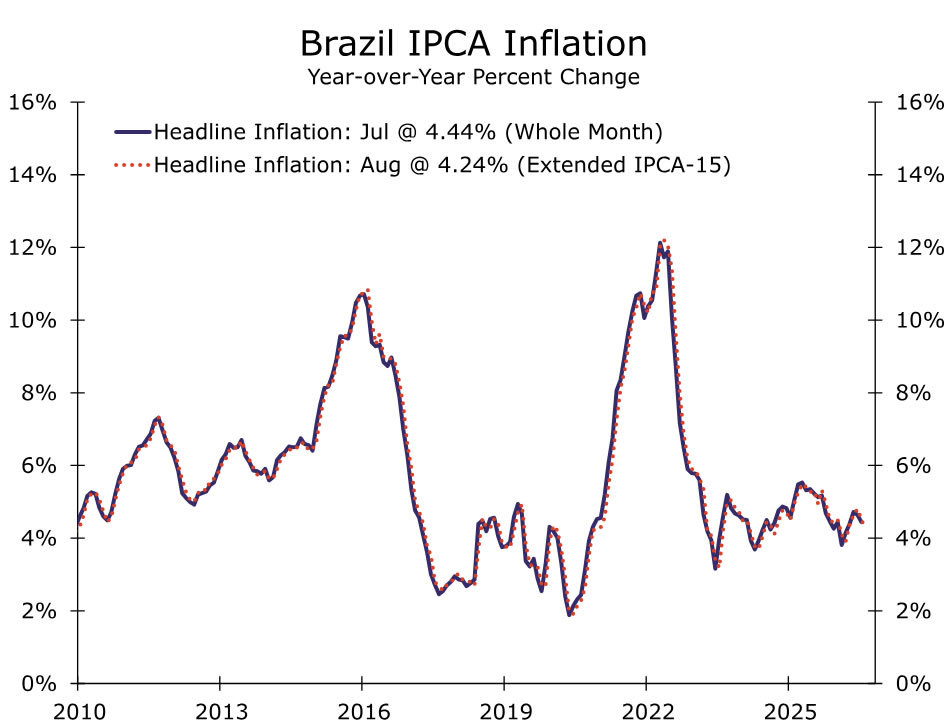
We expect Brazil’s August inflation rate to slow to 4.20% year-over-year, helped by lower electricity, food and fuel prices. The main driver should be a temporary reduction in residential electricity bills stemming from a one-off credit, while recent data already point to a notable easing in price pressures. Mid-August CPI came in weaker than expected, with inflation falling to 4.24% year-over-year amid declines in electricity, food, fuel and airfare prices. Beyond these temporary factors, restrictive monetary policy continues to weigh on economic activity, as evidenced by the recent slowdown in Q2 GDP growth. However, underlying inflation risks remain. A still-tight labor market and government measures aimed at supporting consumption could keep services inflation sticky, making progress toward the 3.0% inflation target more gradual.
Overall, the inflation outlook remains consistent with additional policy easing. We expect COPOM to deliver a 25 bps rate cut in September, bringing the Selic Rate to 13.75%. Beyond September, policymakers are likely to proceed cautiously as they assess incoming inflation data and the impact of the election cycle on inflation expectations. Our base case remains for a pause after September, with additional easing more likely in 2027.
Source: Bloomberg Finance L.P. and Wells Fargo Economics





