


- The BoE kept Bank Rate unchanged at 3.75%, as widely expected.
- Inflation and labour market data released ahead of the meeting indicate no imminent need for rate hikes.
- We maintain our call for unchanged Bank Rate this year and a rate cut in June. The risk is however increasingly skewed towards a hike in Q4.
The Bank of England (BoE) kept Bank Rate unchanged at 3.75% as expected. In a rerun of the July decision, the vote split was 6-3 in favour of hold, as we had also expected.
The decision on QT was also close to expectations as “remaining stock is unwound at an annual average pace of £46 billion by the end of 2034”.
Fresh inflation and labour market data were released in the days ahead of the meeting. The fear of energy prices spreading to core inflation has still not materialised as core inflation was unchanged at 2.6% in August. Food inflation has been mentioned as a key focus point for spillover effects and there are no signs of that with food inflation at a modest 1.1%.
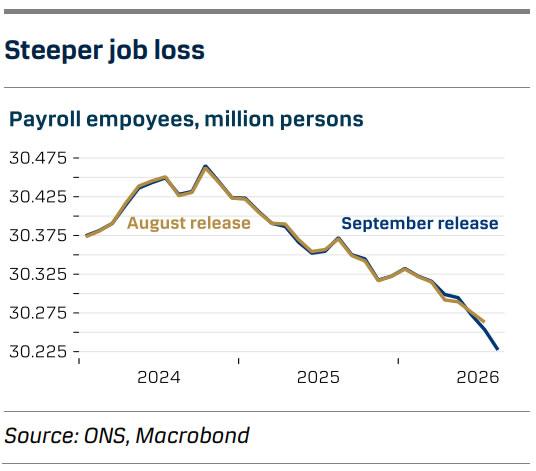
The labour market remains on a cooling trend, with job losses accelerating in August and the previous months’ declines revised lower. The unemployment rate declined to 4.9%, though, keeping alarm systems from going off. Wage growth continues to trend lower.
Being the swing voter of the MPC, we continue to think Governor Bailey is the key member to watch. He has become increasingly worried, stating “if the conflict in the Middle East persists for an extended period, as appears to be the case, and the risk of second-round effects emerging increases, it is likely that policy may have to tighten.” This highlights how the risk of a hike is significant. However, we also see a clear risk that the economy will lose momentum as real wage growth has turned negative for many in H2 and spillover effects on inflation do not seem imminent.
BoE call. Our base case remains for an unchanged Bank Rate until June 2027, when the BoE can resume the cutting cycle and deliver another 25bp rate cut. Bank Rate of 3.75% is already restrictive, and we are more sceptical about the growth outlook for the remainder of 2026. If energy markets do not improve and the economy continues to look resilient, we would then expect a rate hike, even in the absence of spillovers to broader price-setting. The cost of an “insurance hike” has declined in recent months, and this risk has clearly increased compared with July.
Market reaction. GBP weakened on the decision and gilt yields traded lower, as markets were priced for more hawkish central bank rhetoric after listening in to both Fed and ECB hawks recently.





 kept Bank Rate unchanged at 3.75% as expected. In a rerun of the July decision, the vote split was 6-3 in favour of hold, as we had also expected.)