The sell-off in global bond markets is causing headaches around the world. Higher benchmark interest rates mean higher borrowing costs for governments, companies and households alike. A bond market rout is therefore dicey territory for politicians and carries important risks for the real economy. Higher borrowing costs can kill both private consumption and investment and make it more costly for governments to step in with counter-cyclical fiscal stimulus. A major slide in the bond market can also cause broader volatility in financial markets and eventually lead to a correction in equity markets. It’s therefore no surprise policymakers and investors are fretting about how far and fast this sell-off will go. At the same time, one major economy’s bond market is resisting the trend. China’s 10-year government bond yield remains near multi-decade lows. And though some might be tempted to eye the Chinese bond market with envy, the driving factors behind China’s low interest rates and their knock-on implications serve as a stark reminder that the flip side of a weak bond market isn’t necessarily worry free.
Bond market drivers
Though it may be folly to try to ascribe normative value judgments like ‘good’ or ‘bad’ to the state of the bond market, it’s still important to distinguish the driving factors behind changes in the market. For most economies right now, several factors are working in confluence to send yields ratchetting higher. First, many major economies have sizable debt to GDP burdens with no credible plans in sight to meaningfully reduce deficits (see KBC Economics Research Report: A worrying look at Belgium’s public finances). While this is not a new development by any means, current pressures in bond markets, together with increased spending needs on defense and climate infrastructure, draw attention to it. But while the term-premium (an estimated measure of the compensation demanded by investors for holding longer-term debt and a proxy for the inherent riskiness of a bond) increased in both Germany and the US between 2022 and 2025, reflecting in Germany’s case a turn away from rigidly balanced budgets, and for both, central bank quantitative tightening, the term-premium has been relatively stable in both countries this year. This suggests markets are not suddenly reassessing the risk of holding US or German longer-term sovereign debt. Rather, they are reassessing the price to be gained given higher demand for capital from both governments and AI hyperscalers. However, it should be noted that the rise in the spread between the debt of several European economies and the benchmark German yield is representative of a higher country risk premium.
Second, there is the rise in inflation triggered by the war in Iran and the resulting supply shock to oil, gas, and refined products. Higher near-term inflation and inflation expectations can send the short end of the yield curve up as markets anticipate central banks will increase policy rates as a response, which we’ve indeed seen with the Fed, ECB and other major central banks this year. At the longer end of the curve, higher inflation erodes the future value of debt repayments, sending yields higher as investors demand a higher payment in return. Notably, this latter mechanism does not appear to be in play in the current bond market sell-off. The US 10-year breakeven inflation rate, derived from the difference between the yield on a regular 10-year Treasury and a 10-year inflation-linked Treasury has remained stable this year (and for the past four years) around 2.3% (figure 1). This implies no expectation of a long-term de-anchoring of inflation.
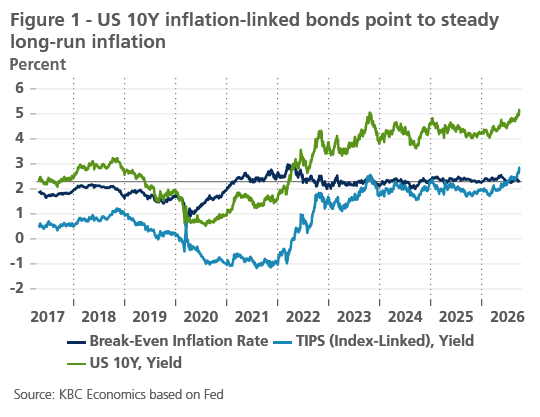
Indeed, the sharp rise in not only nominal yields, but also real yields, suggests stronger economic growth, which then leads to both higher demand for investment and higher inflation, is at play. Growth in both Europe and the US has proved rather resilient to the energy supply shock in 2026. Linked to this, particularly in the US, is the activity stemming from AI and the AI buildout. The government spending mentioned above also lends support to growth (though the multiplier from defense spending tends to be modest).1 Hence, while an aggressive bond market sell off can rattle markets and cause a headache for politicians drawing up budgets, small businesses taking out loans, or a family securing a mortgage, higher rates by themselves don’t necessarily signal doom and gloom.
China as a counterpoint
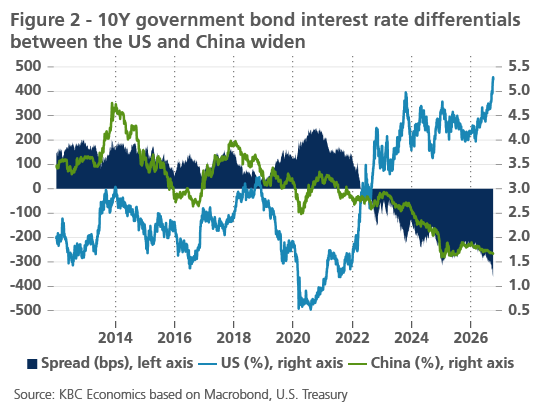
China’s bond market proves a perfect counterpoint. Government bond yields in China have been on a downward trajectory since 2014 despite high and growing government debt levels made worse by opaque off-budget, quasi-government debt held by state-owned enterprises and local government financing vehicles. Still, demand for government debt remains high due to a lack of strong alternatives amid sluggish growth fueled by weak domestic demand and a years-long downturn in the property market. Simply put, China is in the middle of a balance sheet recession; following a long period of debt accumulation fueled primarily by mortgages, households are deleveraging and saving more, and the lack of consumer demand means private businesses have little incentive to invest and borrow (state-owned investment has also been contracting this year amid efforts to address overcapacity concerns).
Low credit demand and declining interest rates have important implications for policymakers and the financial sector. Monetary easing has been extremely moderate in recent years, despite clear signs of slack in the economy. Though the central bank (PBoC) cut the rate on its Pledged Supplementary Lending facility last week by 25 bps, it has kept its other key policy rates steady since May 2025, with only 80 bps of cumulative cuts to the 7-day Reverse Repo rate since 2021, when the real estate crisis began. There are several reasons the PBoC is hesitant to add further fuel to the Chinese bond market rally. First, during a balance sheet recession, credit demand responds less to monetary easing. Second, aggressive easing would put more strain on the financial sector, where bank net interest margins have declined to historic lows, and profit growth has stagnated. Finally, the persistently low and declining sovereign bond yields in China raise the risk of a disorderly repricing, which could have important repercussions for the regional banks that have heavily bought up the debt, and therefore lead to wider financial stability concerns. This concern is exacerbated by global trends, as the growing interest rate differential with the US could eventually trigger sharp capital outflows (figure 2).
The Chinese bond market therefore serves as an important reminder. Although concern over the current stress in global bond markets is valid given the important implications for financial markets and the real economy, higher bond yields on their own are not a sign of impending problems or market disfunction. Low bond yields come with their fair share of concerns too. Understanding the core drivers of any bond market is therefore key to assessing the outlook and underlying risks.
Disclaimer:
Any opinion expressed in this KBC Economic Opinions represents the personal opinion by the author(s). Neither the degree to which the hypotheses, risks and forecasts contained in this report reflect market expectations, nor their effective chances of realisation can be guaranteed. Any forecasts are indicative. The information contained in this publication is general in nature and for information purposes only. It may not be considered as investment advice. Sustainability is part of the overall business strategy of KBC Group NV (see https://www.kbc.com/en/corporate-sustainability.html). We take this strategy into account when choosing topics for our publications, but a thorough analysis of economic and financial developments requires discussing a wider variety of topics. This publication cannot be considered as ‘investment research’ as described in the law and regulations concerning the markets for financial instruments. Any transfer, distribution or reproduction in any form or means of information is prohibited without the express prior written consent of KBC Group NV. KBC cannot be held responsible for the accuracy or completeness of this information.