Australia’s private-sector activity returned to contraction in October, with PMI Composite falling from 51.3 to 47.7, its lowest level since March and the first decline in five months. The deterioration was driven primarily by PMI Services, which dropped from 51.9 to 47.8, marking its first contraction since May. PMI Manufacturing edged up from 49.6 to 49.7 but remained below the expansion threshold, while its output index improved slightly from 46.2 to 46.5. Overall new business growth slowed to near stagnation, reflecting a sharper decline in manufacturing orders and weaker growth in services demand.
Price pressures intensified despite the downturn in activity. Input cost inflation accelerated to its fastest pace since May, with manufacturers experiencing greater pressure than service providers. Companies reported rising energy, shipping, commodity and wage costs, while worsening supplier delivery times added to manufacturing cost pressures. Businesses increasingly passed these costs on to customers, pushing selling price inflation higher for a second consecutive month. The broadening price pressures suggest that weakening demand has yet to translate into meaningful relief on the inflation front.
Employment nevertheless increased, supported by services hiring to address outstanding workloads, while backlogs accumulated at their fastest pace in approximately 18 months. However, business confidence fell to its lowest since June, reflecting concerns about the economic outlook and increasingly challenging operating conditions. Overall, the October survey presents an uncomfortable combination of contracting output, weakening demand and accelerating price pressures. While continued hiring provides some resilience, the divergence between activity and inflation suggests a difficult start to the fourth quarter.
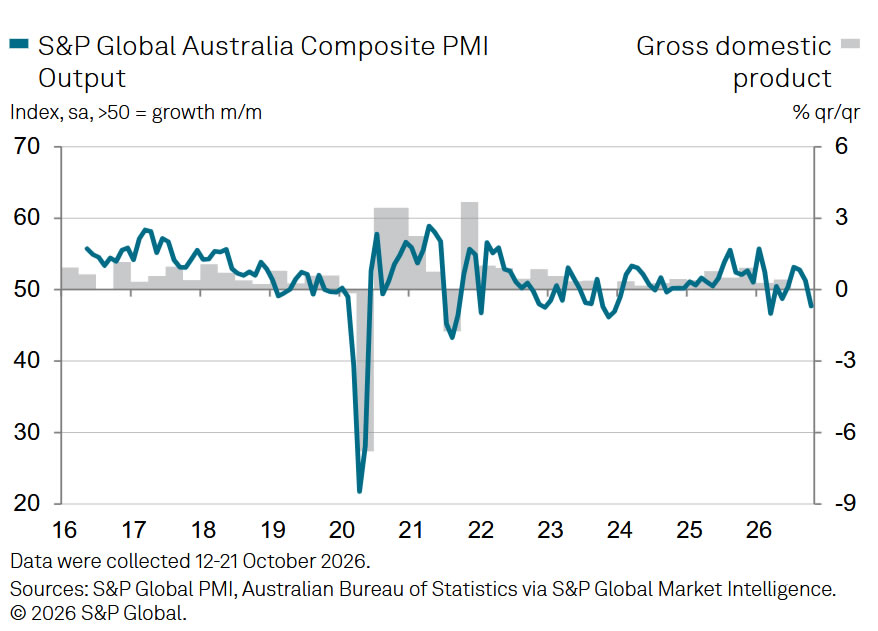
Data Summary — Australia Flash PMI (October 2026)
Headline PMI Data
| Indicator | Previous | Current |
|---|---|---|
| PMI Composite | 51.3 | 47.7 |
| PMI Services | 51.9 | 47.8 |
| PMI Manufacturing | 49.6 | 49.7 |
| PMI Manufacturing Output | 46.2 | 46.5 |
Readings above 50 indicate expansion, while readings below 50 indicate contraction. Survey responses were collected October 12–21.
Additional Survey Details
| Indicator | October Development |
|---|---|
| Private-Sector Output | First contraction in five months; lowest PMI Composite since March |
| Services Activity | First contraction since May |
| Manufacturing New Orders | Decline deepened |
| Services New Business | Growth slowed |
| Export Demand | Broadly unchanged |
| Employment | Increased, driven by services |
| Backlogs of Work | Fastest accumulation in approximately 18 months |
| Input Cost Inflation | Fastest since May |
| Selling Price Inflation | Accelerated for second consecutive month |
| Business Confidence | Lowest since June, but remained positive |
Key Takeaways
- Private-sector activity returns to contraction: PMI Composite fell from 51.3 to 47.7, its lowest since March, signaling a difficult start to the fourth quarter.
- Services drive the deterioration: PMI Services dropped from 51.9 to 47.8, recording its first contraction since May. PMI Manufacturing edged higher from 49.6 to 49.7 but remained below 50, while manufacturing output continued declining at a slightly slower pace.
- Demand momentum weakens: Overall new business growth slowed to near stagnation, reflecting a deeper decline in manufacturing orders and slower services new business growth. Companies cited rising borrowing costs, inflation and uncertainty as constraints on demand.
- Inflation pressures intensify despite weaker activity: Input cost inflation accelerated to its fastest pace since May, with higher energy, shipping, commodity and wage costs contributing. Selling price inflation also accelerated for a second consecutive month as firms passed on higher costs.
- Employment remains resilient: Businesses continued hiring, supported by services firms addressing outstanding workloads. Backlogs increased at their fastest pace in approximately 18 months, although this does not necessarily indicate stronger new demand.
- Business confidence deteriorates: Sentiment fell to its lowest since June, reflecting concerns about economic uncertainty and increasingly challenging operating conditions, although expectations for future output remained positive.
- Growth-inflation divergence raises concern: The combination of contracting output, softer demand and accelerating price pressures suggests that weaker economic activity has yet to produce meaningful relief from business inflation.