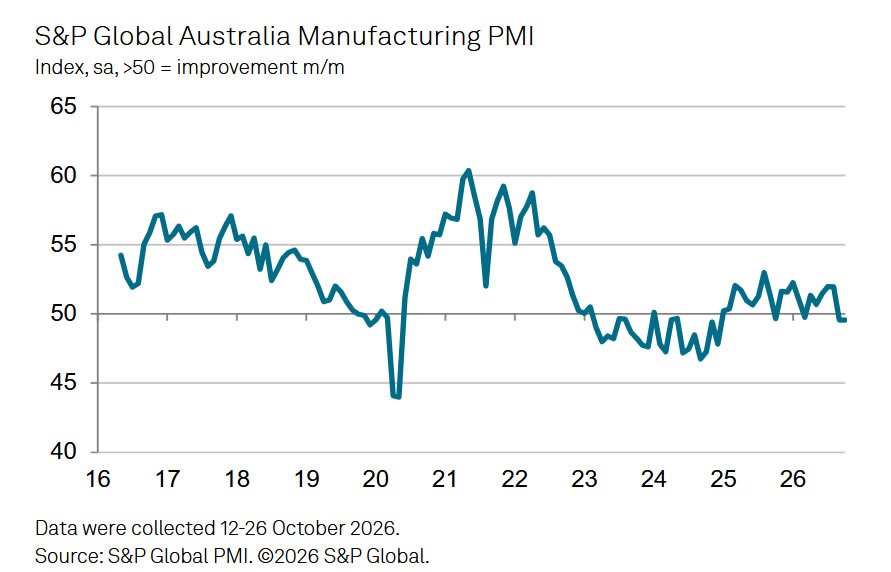
Australia’s manufacturing sector contracted for a second consecutive month in October, with S&P Global PMI Manufacturing unchanged at 49.6, matching its lowest reading since December 2024. Beneath the steady headline, demand conditions deteriorated further, with new orders falling at their fastest pace since December 2024. Production consequently registered another solid contraction, while manufacturers reduced employment for a second month, at the fastest rate in seven months.
Supply constraints added to the sector’s difficulties, with supplier delivery times lengthening at one of the sharpest rates since mid-2022. Survey respondents attributed disruptions partly to shipment delays linked to the Middle East conflict and port congestion. Higher raw material, supplier, fuel and shipping costs pushed input inflation to its fastest pace since June. Manufacturers also raised selling prices more quickly for the first time in five months, with the rate of increase exceeding its historical average.
The October survey highlights a difficult combination of weakening demand and intensifying price pressures. Manufacturers cut purchasing activity and inventories as new business declined, while supply disruptions continued to raise operating costs. Business confidence improved slightly from September but stayed below its long-run average, suggesting that expectations have become somewhat less pessimistic without pointing to a convincing recovery in manufacturing activity.
Data Summary
| Indicator | Sep | Oct |
|---|---|---|
| PMI Manufacturing | 49.6 | 49.6 |
Components
| Component | October Trend |
|---|---|
| New Orders | Fastest decline since Dec 2024 |
| Output | Solid contraction, pace unchanged |
| Export Orders | Second monthly decline, marginal |
| Employment | Fastest decline in seven months |
| Purchasing Activity | Contracted |
| Supplier Delivery Times | Among sharpest extensions since mid-2022 |
| Input Prices | Fastest inflation since Jun |
| Output Prices | Inflation accelerated, above average |
| Business Confidence | Improved, still below long-run average |
Key Takeaways
- Manufacturing contraction persisted: PMI Manufacturing held at 49.6, its joint-lowest reading since December 2024, masking further deterioration in underlying demand conditions.
- Demand weakness deepened: New orders declined at their fastest pace in almost two years, driving another solid contraction in production and further reductions in employment, purchasing and inventories.
- Supply disruptions intensified: Shipping delays and port congestion, partly associated with the Middle East conflict, contributed to one of the sharpest extensions of supplier delivery times since mid-2022.
- Cost pressures strengthened despite weak demand: Input inflation accelerated to its fastest since June, while manufacturers raised selling prices more quickly, at an above-average rate.
- Confidence improved modestly: Business optimism recovered from September’s low but stayed below its historical average, offering limited evidence of an improvement in manufacturing prospects.