TL;DR: A narrow centre-right lead after Saturday’s New Zealand election reduces the immediate risk of a more dovish RBNZ mandate, giving the New Zealand Dollar mild support. But the one-seat majority is fragile with special votes outstanding until November 27, and neither AUD/NZD nor NZD/USD has confirmed a technical reversal.
Why Is the New Zealand Election Giving NZD Only Mild Support?
The New Zealand Dollar opened the week on a firmer footing after Saturday’s general election left the incumbent centre-right bloc narrowly ahead, reducing the immediate prospect of a change in the RBNZ’s monetary-policy mandate. However, the political advantage is fragile, with a one-seat majority and substantial special votes still outstanding. The currency’s reaction has also been relatively restrained. NZD/USD rose around 0.6% from Monday’s open to 0.5591, and AUD/NZD slipped 0.13% to around 1.2315. The modest movement in the cross suggests that the election has provided limited NZD-specific support, while broader market sentiment has contributed to the currency’s gains. More importantly, neither AUD/NZD nor NZD/USD has confirmed a reversal, leaving an interesting divergence between the mildly favorable political outlook and the still-vulnerable technical picture.
Centre-Right Leads, but Special Votes Could Change the Outcome
The preliminary election results gave National 42 seats, ACT 13 and New Zealand First 12, providing the centre-right bloc with 67 seats in the enlarged 131-seat parliament. That is just one above the 66-seat majority threshold. Labour secured 36 seats, the Greens 16 and Te Pāti Māori five, while the Opportunity Party won seven seats and could become influential in coalition negotiations.
- Centre-right bloc: National 42, ACT 13, New Zealand First 12, a total of 67 seats, one above the 66-seat majority threshold.
- Opposition and others: Labour 36, Greens 16, Te Pāti Māori 5, Opportunity Party 7.
The parliamentary arithmetic remains uncertain because approximately 400,000 special votes, representing around 14% of the eventual total, have yet to be counted. Official results are not due until November 27. Westpac noted that special votes have historically reduced the centre-right’s election-night advantage, although National’s electorate overhang complicates the usual relationship between changes in party votes and parliamentary seats.
One particularly important contest is Wairarapa, where National leads Labour by just 139 votes. According to Westpac’s assessment, a Labour victory there could reduce the centre-right bloc to 66 seats in a 130-seat parliament, leaving it vulnerable to even a small shift in party-list allocations.
Westpac considers another centre-right government the more likely outcome, potentially requiring support from Opportunity. Nevertheless, the narrow majority and unsettled seat allocation suggest that coalition negotiations could be complicated, with either political bloc facing constraints on major policy initiatives.
Follow the New Zealand election count and the Kiwi on the ActionForex Telegram channel.
RBNZ Mandate Offers Modest Support, but Policy Uncertainty Persists
The clearest potential implication for NZD concerns the RBNZ’s monetary-policy mandate. A centre-right government would be expected to retain the existing framework, while a centre-left administration would be more likely to restore the dual mandate covering both inflation and employment.
Such a change could be relatively dovish by giving employment conditions an explicit role alongside price stability in monetary-policy decisions. Consequently, the provisional centre-right advantage is mildly supportive for NZD compared with the alternative of a left-led government.
However, the distinction should not be overstated. Westpac expects any incoming government to have relatively weak parliamentary support, potentially limiting the scope for significant fiscal or regulatory changes. The Opportunity Party’s policy preferences also lean closer to the centre-left on some issues, complicating the outlook if its support becomes necessary.
Meanwhile, the RBNZ faces its own economic uncertainties regardless of the election outcome. Westpac’s assessment following weaker-than-expected third-quarter labour-market data maintained that a December rate hike was more likely than not, but anticipated a debate between policymakers favoring further tightening and those concerned about deteriorating employment conditions.
The bank suggested that labour-market weakness could delay the pace of tightening without necessarily changing the eventual peak in the Official Cash Rate. A slower convergence of New Zealand interest rates toward global levels would limit the support NZD could derive from monetary-policy expectations.
NZD Strength Reflects More Than the Election
Monday’s currency movements offer limited evidence that investors have substantially repriced New Zealand’s political outlook.
NZD/USD advanced around 0.6% from its weekly open, while AUD/NZD declined only 0.13%. The cross briefly reached 1.2295 before recovering, leaving it comfortably above the technically important 1.2266/83 support zone.
The broader market environment also favored risk-sensitive currencies. NZD ranked strongest among the major currencies in the early-session heat map, with AUD second and USD weakest. Asian equities rebounded, led by gains of 3.44% in the Nikkei and 1.56% in Kospi, suggesting that improving sentiment outside New Zealand contributed to the currency’s advance.
The contrast between NZD/USD and AUD/NZD is therefore significant. While the election may have given NZD a modest relative advantage, the limited movement against AUD indicates that the political result has not triggered a decisive reassessment of the currency.
Attention will also turn to Tuesday’s US CPI report, which could influence the Dollar through changes in Fed tightening expectations. With a December Fed rate hike already assigned an 80.5% probability in the latest available CME FedWatch reading, stronger-than-expected inflation could reinforce support for the Dollar and challenge NZD/USD’s recovery.
ActionForex’s Technical View: AUD/NZD, Uptrend Still Favored Despite Pullback
Daily Chart — 1.2266/83 Support Holds the Key
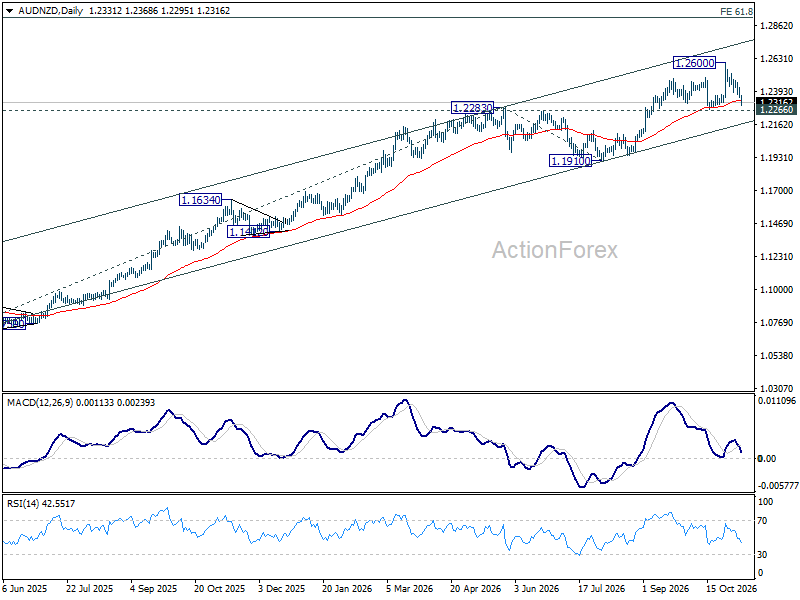 AUD/NZD’s pullback from the 1.2600 short-term top extended lower on Monday, but the cross continues to hold above the 1.2266/83 support zone.
The favored interpretation is that price action from 1.2600 is developing into a near-term consolidation pattern, rather than a reversal of the larger uptrend from 1.0649, the 2025 low.
As long as 1.2266/83 support holds, the broader bullish outlook remains intact. A break above 1.2600 is expected based on the current technical structure, which would pave the way toward the 61.8% projection of 1.0649 to 1.2283 from 1.1910 at 1.2920 in the medium term.
However, a sustained break below 1.2266/83 would suggest that 1.2600 might already be a medium-term top. That would weaken the bullish interpretation and open the way for a deeper decline toward 1.1910 structural support.
Weekly Chart — Broader Bullish Structure Remains Intact
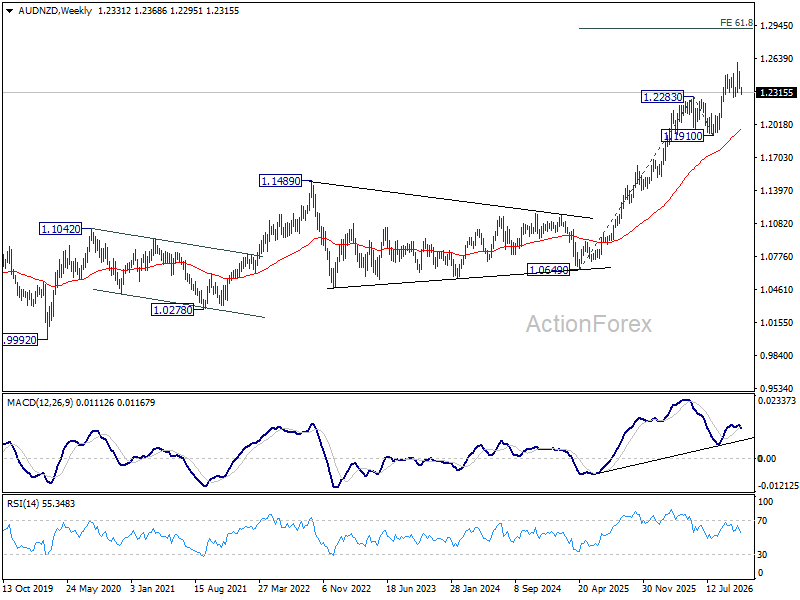
The weekly chart supports the view that the rise from 1.0649 is not yet complete. Despite the retreat from 1.2600, the larger sequence of higher highs and higher lows remains intact, with price holding above the rising weekly moving average.
The technical implication is that Monday’s NZD outperformance has not yet challenged AUD/NZD’s medium-term bullish structure. A sustained break below 1.2266/83 would therefore be important evidence that the election-related improvement in NZD sentiment, or other relative currency influences, is developing into a more durable shift.
ActionForex’s Technical View: NZD/USD, Downside Risks Remain Significant
Daily Chart — Bottoming Requires Break Above 0.5709
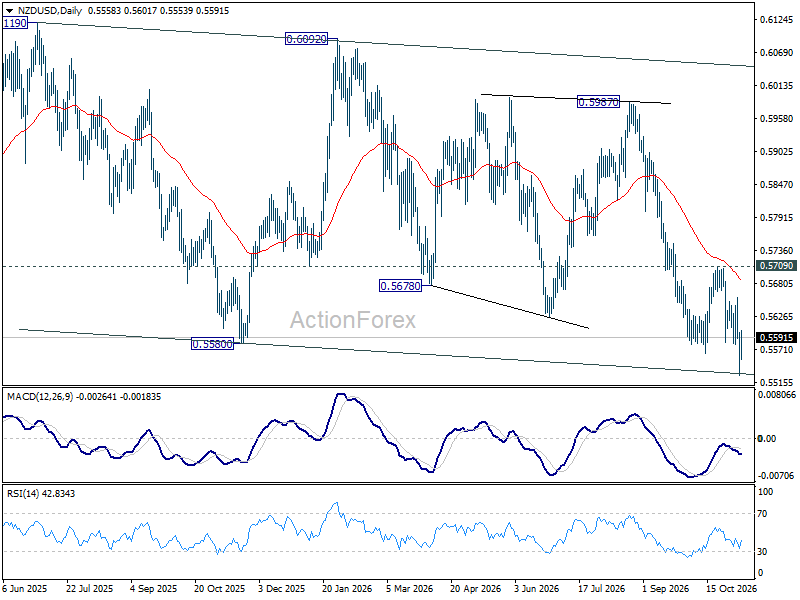
NZD/USD’s decline from 0.6092 has brought the pair back toward the lower boundary of its broader falling structure.
Price action from 0.6119 could still be interpreted as a three-wave corrective pattern, with the decline from 0.6092 representing its third leg. If this interpretation is correct, strong support should emerge above 0.5484, the 2025 low, and eventually bring a reversal.
However, a break above 0.5709 resistance is needed to indicate short-term bottoming. Without that confirmation, downside risks remain heavily tilted toward another test of support.
The distinction is important because Monday’s advance, while encouraging, has not yet altered the established sequence of lower highs or provided sufficient technical evidence of a sustained recovery.
Weekly Chart — 0.5484 Is the Critical Longer-Term Support
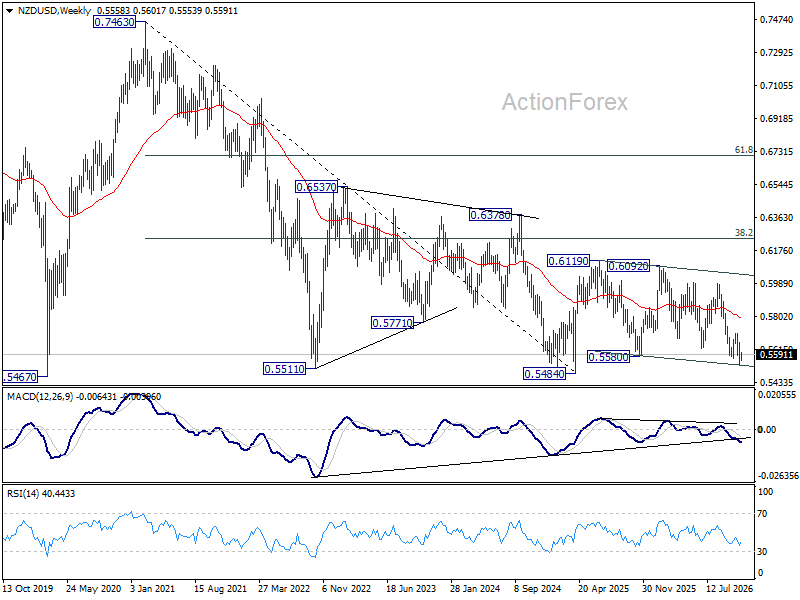
The weekly chart presents a more vulnerable structure. NZD/USD continues to trade within the larger downtrend from 0.7463, the 2021 high, with recent weakness bringing price back toward the important 0.5484 support level.
A firm break below 0.5484 would resume that long-term downtrend and invalidate the more constructive interpretation that the decline from 0.6119 is merely corrective.
Conversely, holding above 0.5484 would preserve the possibility of a three-wave correction, although a recovery through 0.5709 would still be required to establish a short-term bottom.
The political and technical outlooks therefore remain at odds. The provisional election outcome offers NZD some support by reducing the immediate risk of a more dovish RBNZ mandate, but the currency has yet to demonstrate a convincing technical response. Until AUD/NZD breaks below 1.2266/83 or NZD/USD clears 0.5709, the election result is better viewed as a modest improvement in the political backdrop than confirmation of a lasting Kiwi turnaround. Tuesday’s US CPI, subsequent RBNZ commentary and the November 27 final election count will provide further tests of that assessment.
Key Takeaways
- The centre-right bloc leads with 67 seats against a 66-seat majority threshold, but about 400,000 special votes (around 14% of the total) are still to be counted, with official results due November 27.
- A centre-right government would be expected to retain the RBNZ’s current mandate, which is mildly supportive for NZD compared with a left-led government restoring the dual mandate.
- NZD/USD rose about 0.6% to 0.5591 while AUD/NZD slipped just 0.13% to around 1.2315, pointing to broader risk sentiment more than an election-specific repricing.
- AUD/NZD holds above 1.2266/83 support within a larger uptrend from 1.0649, and a sustained break below would suggest 1.2600 is a medium-term top.
- NZD/USD needs a break above 0.5709 to signal a short-term bottom, while a break below 0.5484 would resume the long-term downtrend.
Stay ahead of the New Zealand election count and the RBNZ’s next signals for the Kiwi—join the ActionForex Telegram channel for regular market updates and analysis.