


TL;DR: Australian Dollar sank even after a hotter-than-expected CPI, because the renewed global risk selloff outweighed the data while RBA expectations barely moved. AUD/USD’s decline now targets 0.6510, with the 0.6420–0.6434 support cluster deciding whether this becomes a larger bearish reversal.
Why Did Aussie Sink Despite a Hotter-Than-Expected CPI?
Australian Dollar extended its sharp decline on Wednesday despite a stronger-than-expected domestic inflation report, as renewed weakness in technology stocks, Asian equities and industrial metals weighed on risk sentiment. AUD/USD fell around 1% even as Australia’s headline CPI accelerated to 4.9% and trimmed mean inflation rose to 3.8%. Crucially, RBA interest rate expectations changed little following the release, suggesting that the currency’s weakness was driven more by deteriorating global risk appetite than by a fresh reassessment of domestic monetary policy.
The contrast is particularly striking because AUD initially strengthened mildly after the inflation figures before reversing sharply lower. Meanwhile, NZD and CAD also weakened, although Australian Dollar suffered substantially larger losses. The move highlights AUD’s vulnerability to shifts in broader market sentiment, even when domestic economic data would ordinarily be expected to provide support.
Follow AUD/USD and the global risk selloff on the ActionForex Telegram channel.
Hotter CPI Fails to Shift RBA Expectations
Australia’s October headline CPI accelerated from 4.3% to 4.9% yoy, while trimmed mean inflation increased from 3.6% to 3.8%. The underlying measure also rose 0.5% mom, following September’s 0.3% increase, confirming that price pressures extended beyond volatile energy components.
- Headline CPI: 4.3% to 4.9% yoy
- Trimmed mean: 3.6% to 3.8% yoy; +0.5% mom after +0.3% in September
Electricity inflation accelerated sharply as earlier government rebates dropped out of the annual comparison, while higher automotive fuel prices added to the headline increase. Nevertheless, stronger trimmed mean inflation indicated that underlying price pressures remained persistent.
The figures reinforced concerns about inflation returning sustainably toward RBA’s target, but financial markets showed little lasting change in their expectations for the policy path.
OIS data showed that markets were pricing approximately 42bps of easing over the following 12 months immediately before the release. That briefly declined to around 38bps after CPI, but subsequently returned to approximately 43bps.
December easing expectations also remained negligible, with only around half a basis point of cuts priced for the upcoming meeting.
- 12-month easing priced: about 42bps before CPI, about 38bps briefly after, back to about 43bps
- December: only about 0.5bp of cuts priced
The absence of a sustained shift in interest rate pricing is important. Although the inflation report reduced the immediate scope for a more dovish interpretation of the economy, it did not fundamentally alter expectations for eventual monetary easing.
Westpac similarly viewed the October figures as broadly consistent with inflation approaching a peak, while maintaining that RBA could still consider another increase before eventually moving toward cuts.
The evidence therefore offers limited support for explaining AUD’s sharp decline through a fresh deterioration in Australian interest rate expectations.
Risk Sentiment Provides the Stronger Explanation
The more convincing immediate explanation lies in the renewed selloff across global risk-sensitive markets.
Tuesday’s Wall Street session saw Nvidia fall 5.9%, while Nasdaq declined around 1.5%, undermining the recovery that followed Monday’s powerful technology-led rebound.
The weakness extended into Asian trading on Wednesday, with South Korea’s KOSPI falling more than 6% and Japan’s Nikkei declining nearly 3%. Industrial metals also declined, with Copper losing approximately 2%, while Gold weakened alongside the broader commodities complex.
AUD/USD fell around 1.05% to approximately 0.6570 during the Asian session, compared with a decline of around 0.54% in NZD/USD. Dollar Index, meanwhile, strengthened only modestly.
- Tuesday: Nvidia −5.9%, Nasdaq about −1.5%
- Wednesday (Asia): KOSPI more than −6%, Nikkei nearly −3%, Copper about −2%
- AUD/USD about −1.05% to around 0.6570; NZD/USD about −0.54%
The combination of weaker equities, declining metals and relatively limited broad Dollar strength points toward a risk-driven selloff, with AUD acting as a higher-beta expression of deteriorating sentiment.
However, AUD’s underperformance against NZD and CAD suggests that global risk aversion may not explain the entire move.
One possible additional influence is the divergence in monetary policy expectations. Markets are pricing substantial December tightening for both RBNZ and BoC, while the RBA outlook still incorporates eventual rate cuts.
That relative interest rate disadvantage may be amplifying AUD weakness, although the available evidence does not establish its precise contribution.
For now, the broader pattern remains more consistent with weakening risk appetite than with a significant repricing of the Australian policy outlook.
The next immediate catalysts are Wednesday’s US October core PCE inflation, personal income and revised third-quarter GDP releases. These could influence AUD/USD through changes in US interest rate expectations and broader market sentiment.
The RBA’s December 8 decision will provide a more direct test of domestic monetary policy expectations.
ActionForex’s Technical View: AUD/USD, Decline Targets 0.6510
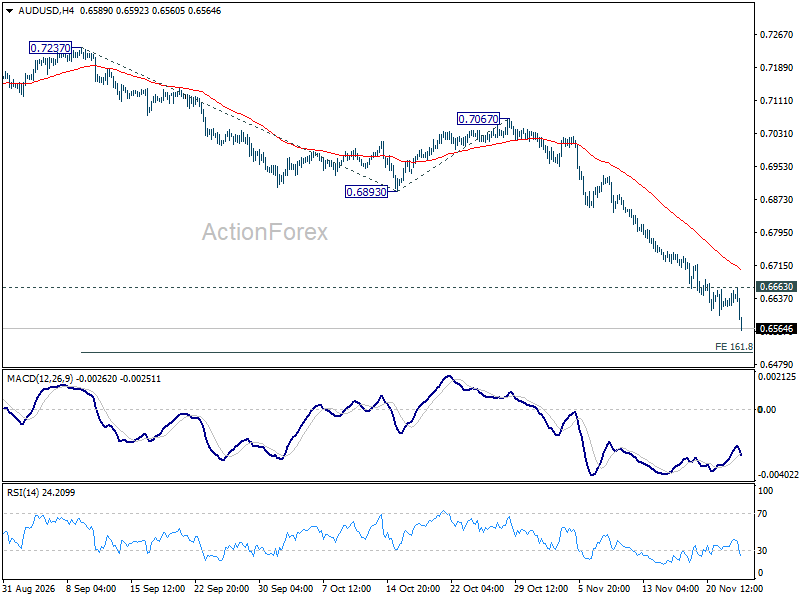
AUD/USD’s decline continues and remains on track toward the 161.8% projection of 0.7237 to 0.6893 from 0.7067 at 0.6510.
Oversold conditions in both 4-hour and daily RSI could help pause the selloff around the projection level. A break above 0.6663 minor resistance would indicate some near-term stabilization and bring consolidation first.
However, the near-term outlook will remain bearish as long as 0.6893 support-turned-resistance holds, even in the event of a stronger rebound.
The immediate technical picture therefore favors further downside, although stretched momentum increases the possibility of a temporary recovery before the decline extends.
Larger Downtrend May Be Resuming
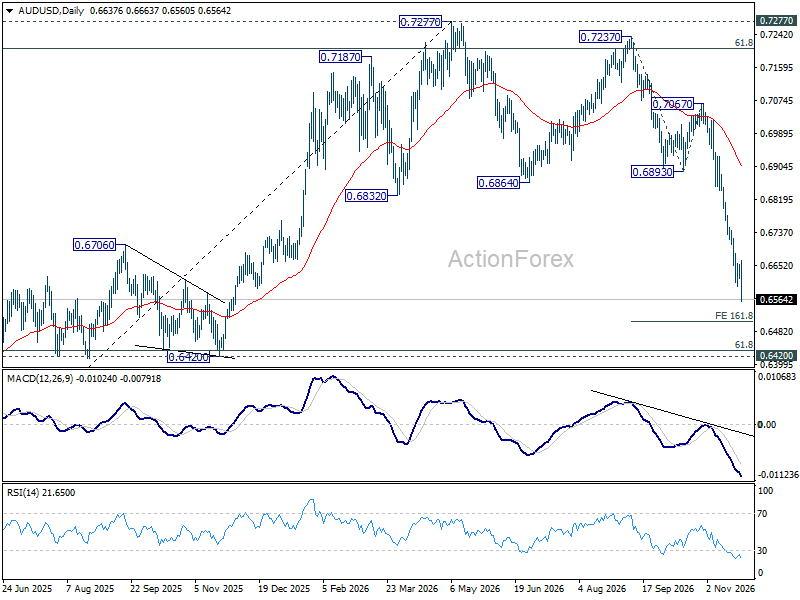
More importantly, both the decline from 0.7237 and the broader fall from 0.7277 are beginning to develop impulsive characteristics.
This brings the 0.6420 support cluster into focus, including the 61.8% retracement of the advance from 0.5913 to 0.7277 at 0.6434.
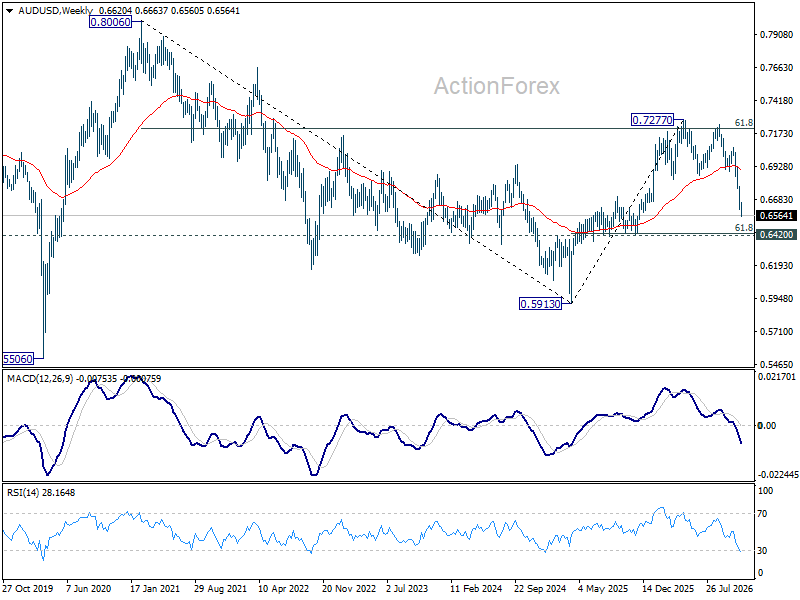
A decisive break of this support area would carry significance beyond the immediate selloff. It would raise the possibility that the decline from 0.7277 is resuming the broader downtrend originating from 0.8006, the 2021 high.
Under that scenario, at least a retest of the 0.5913 low from 2025 would become a medium-term objective.
However, the larger bearish interpretation remains conditional on a sustained break through the support cluster. Until then, the decline could still encounter substantial buying interest as oversold conditions deepen.
AUD/USD’s immediate direction remains vulnerable to further risk aversion, while the 0.6420–0.6434 area represents the more consequential test of whether the current decline is developing into a larger bearish reversal.
Key Takeaways
- AUD/USD fell about 1.05% to around 0.6570 even as Australia’s October headline CPI rose to 4.9% and trimmed mean to 3.8% (+0.5% mom).
- RBA pricing barely moved: about 42bps of 12-month easing before the release, a brief dip to 38bps, then back to about 43bps, with only about 0.5bp priced for December.
- The selloff looks risk-driven, with Nvidia −5.9%, KOSPI down more than 6%, Nikkei nearly −3% and Copper about −2%, though AUD’s larger losses against NZD and CAD hint at a relative-rates effect.
- AUD/USD targets the 161.8% projection at 0.6510 and stays bearish below 0.6893, with 0.6663 as minor resistance.
- The 0.6420–0.6434 support cluster is the key test of a larger reversal, with US core PCE and GDP data and the RBA’s December 8 decision as the next catalysts.
Stay ahead of AUD/USD and the RBA’s December 8 decision—join the ActionForex Telegram channel for regular market updates and analysis.