Stronger-than-expected US PPI data has unsettled financial markets, shifting sentiment toward a more defensive footing. The persistence of upstream inflation pressures reinforces the view that the Fed will remain cautious and resist calls for rapid rate cuts. Although US President Donald Trump and senior White House officials have continued to advocate for lower rates, the data argue for restraint. Inflation at the producer level suggests cost pressures from tariffs have not fully dissipated, making premature easing a risk.
Equity markets reacted swiftly. DOW futures slid more than -500 points after the release, signaling a weaker open. The move reflects renewed anxiety that monetary policy may stay restrictive for longer than previously hoped. At the same time, Treasury markets rallied. 10-year yield fell below the 4% psychological level on safe-haven flows, signaling that bond investors are increasingly concerned about growth risks even as inflation remains elevated. Gold and Silver rallied strongly alongside falling yields, reflecting demand for protection against both macro uncertainty and policy volatility.
For the Dollar, the picture is mixed. On one hand, risk-off sentiment should be supportive. On the other, falling yields weigh on rate differentials. As a result, Dollar gains remain tentative, with the opposing forces largely offsetting each other.
Elsewhere, Sterling remains under broad-based pressure for a different reason. The Green Party delivered a landmark victory in the Gorton and Denton by-election, taking a seat long considered safe for Labour. The outcome represents a significant political setback for Prime Minister Keir Starmer. The defeat intensifies scrutiny over Starmer’s leadership and could complicate the government’s fiscal and economic agenda.
Yen has staged a mild recovery, aided by comments from Japan’s Finance Minister Satsuki Katayama. She emphasized that authorities are closely monitoring currency developments and signaled urgency over recent weakness. Still, verbal intervention can only go so far without concrete policy action. Markets remain cautious, and follow-through buying has been limited.
For the week, Yen remains the worst performer despite today’s bounce. Sterling and Kiwi follow behind. Swiss Franc stands out as the strongest currency, with Aussie and Euro also firm. Dollar and Loonie are positioned mid-table.
In Europe, at the time of writing, FTSE is up 0.38%. DAX is down -0.10%. CAC is down -0.43%. UK 10-year yield is down -0.03 at 4.246. Germany 10-year yield is down -0.017 at 2.682. Earlier in Asia, Nikkei rose 0.16%. Hong Kong HSI rose 0.95%. China Shanghai SSE rose 0.39%. Singapore Strait Times rose 0.62%. Japan 10-year JGB yield fell -0.045 to 2.112.
US PPI rises 0.5% mom in January as services drive monthly jump
US producer prices rose more than expected in January, with headline PPI climbing 0.5% mom against forecasts of 0.3%. The increase was largely driven by a sharp 0.8% gain in final demand services, while prices for final demand goods declined -0.3%.
On an annual basis, PPI eased slightly from 3.0% yoy to 2.9% yoy, but above expectations of 2.6%. The moderation in the yearly rate does little to offset the firm monthly momentum, particularly as underlying measures continue to trend higher.
Core PPI excluding foods, energy, and trade services rose 0.3% mom, marking the ninth consecutive monthly increase. Over the past 12 months, this core gauge advanced 3.4%, suggesting persistent pipeline price pressures.
Canada GDP beats in December with 0.2% mom growth, but fragile start to 2026,
Canada’s economy closed 2025 on a slightly firmer note, with GDP rising 0.2% mom in December, above expectations of 0.1%. The expansion was driven by gains in both services-producing and goods-producing industries, suggesting a modest rebound in activity toward year-end.
Services industries led the monthly increase, rising 0.2%, supported by wholesale trade, the public sector, and transportation and warehousing. Meanwhile, goods-producing sectors also expanded 0.2%, partially reversing back-to-back declines in October and November, with manufacturing and utilities contributing to the recovery. In total, 11 of 20 industrial sectors recorded growth in December.
Advance estimates suggest real GDP was essentially unchanged in January, pointing to a fragile start to 2026.
The quarterly picture was less encouraging. GDP by industry edged down -0.1% in Q4 following a solid 0.6% expansion in Q3. Manufacturing was the main drag, contracting -1.5% in the quarter—its third decline of 2025 and fourth in the past five quarters—highlighting persistent weakness in the sector.
Swiss GDP returns to modest 0.1% qoq growth, domestic demand stabilizes Q4
Switzerland’s economy returned to modest growth in Q4, with GDP expanding 0.1% qoq. While slightly below expectations of 0.2%, the reading marks a rebound from the -0.4% contraction recorded in Q3. According to the State Secretariat for Economic Affairs, performance varied across sectors, with domestic demand providing the main source of support.
The chemical and pharmaceutical industry, a key pillar of the Swiss economy, grew 1.9% after a sharp decline in the previous quarter, aided by pickup in exports. However, the rest of manufacturing contracted by -1.3% amid subdued sales and weaker export performance. Overall, industrial value added stagnated, though goods exports edged up 0.6% following two quarters of decline.
Domestic final demand rose 0.5% and helped stabilize the broader economy. Private consumption expanded 0.4%, while construction investment increased 1.0% on stronger building activity. Retail activity surged 2.0%, supporting a 1.7% rise in trade value added.
Swiss KOF barometer strengthens to 104.2, demand outlook improves
Switzerland’s economic outlook brightened in February as the KOF Economic Barometer rose from 103.3 to 104.2, beating expectations of 103.1. The increase resumes the upward trend seen in recent months after a brief dip in January and leaves the gauge comfortably above its medium-term average of 100.
According to KOF, the improvement reinforces a positive outlook for the Swiss economy, with strength concentrated on the demand side. Indicator bundles linked to consumption and foreign demand both point to favorable momentum.
However, the production side presents a more “mixed” picture. While some sectors remain stable, manufacturing is experiencing a setback, signaling that industrial momentum has yet to fully align with the broader demand recovery.
Subsidy effect pulls Tokyo core CPI down to 1.8%, but underlying inflation firms
Inflation in Tokyo eased further in February, with core CPI (ex-fresh food) falling to 1.8% yoy from 2.0% yoy. While slightly above market expectations of 1.7% yoy, the reading marks the third straight monthly slowdown and the lowest level since October 2024, slipping back under the BoJ’s 2% target.
The primary driver was a sharp drop in energy prices, which declined -9.2% yoy as the government’s temporary utility subsidies began to take effect. The program has mechanically dampened readings and was broadly expected to weigh on inflation for several months.
Beneath the surface, however, price dynamics remain more persistent. Core-core inflation (excluding fresh food and energy) rose to 2.5% yoy from 2.4% yoy, suggesting domestic demand conditions and wage-driven pricing remain intact. Headline CPI also ticked up modestly from 1.5% yoy to 1.6% yoy.
Japan’s industrial production rose 2.2% mom on auto strength, but forward signals soft
Japan’s industrial production rose 2.2% mom in January, marking the first increase in three months, though falling well short of expectations for a 5.5%. .
Production expanded in 13 of 15 sectors, with automakers posting a notable 9.1% gain amid solid demand for passenger vehicles both domestically and overseas. However, weakness persisted in production machinery, where output declined on softer demand for semiconductor-manufacturing equipment.
The Ministry of Economy, Trade and Industry maintained its assessment that industrial production “fluctuates indecisively”. Officials noted that companies remain wary of US tariff policy developments and the Chinese growth outlook, even if no direct impact was evident in the latest data.
Looking ahead, manufacturers expect output to dip -0.5% in February and -2.6% in March.
In contrast, retail sales surprised to the upside, rising 1.8% yoy against expectations of just 0.2%.
GBP/USD Mid-Day Outlook
Daily Pivots: (S1) 1.3426; (P) 1.3501; (R1) 1.3556; More…
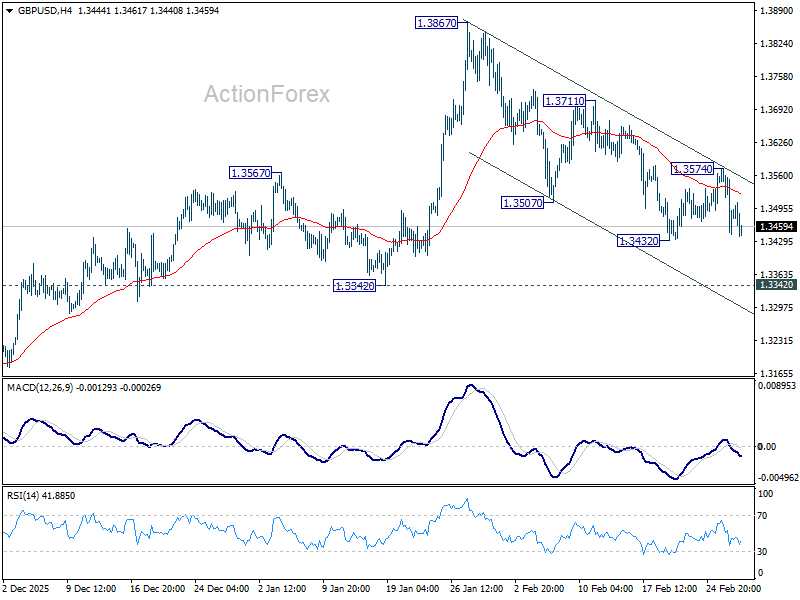
GBP/USD is still holding above 1.3432 support and intraday bias remains neutral for the moment. On the downside, below 1.3432 will resume the fall from 1.3867 to 1.3342 support. Firm break there should confirm that it’s already correcting the whole rise from 1.2099. However, break of 1.3574 resistance will argue that the decline has completed as a near term correction, and turn bias back to the upside for retesting 1.3867.
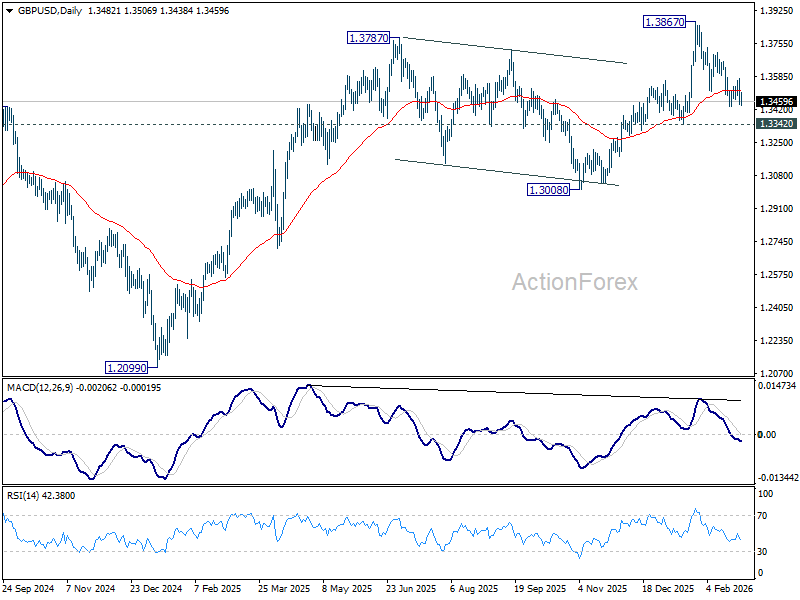
In the bigger picture, as long as 1.3008 support holds, rise from 1.3051 (2022 low) should still be in progress for 1.4284 key resistance (2021 high). Decisive break there will add to the case of long term bullish trend reversal. However, firm break of 1.3008 will raise the chance of medium term bearish reversal and target 1.2099 support next.