


TL;DR: July’s shockingly weak NFP report flipped September Fed odds toward a hold, but with Brent still above $80 and the Strait of Hormuz crisis unresolved, Treasury yields, the Dollar, and equities all stopped short of a full dovish repricing.
An Incomplete Post-NFP Reaction
US markets ended the week caught in an increasingly uncomfortable tug-of-war. July’s employment report revealed a much sharper deterioration in the labor market than previously understood, strengthening the case for the Fed to stay on hold in September. Yet the Middle East crisis remains unresolved, with Brent holding above $80 and keeping inflation risks elevated.
The result was an unusually incomplete post-NFP reaction: Fed expectations flipped, but Treasury yields refused to break lower, the Dollar held major technical support, and Wall Street offered only a restrained celebration.
Payrolls provided plenty of reason for a larger response. Nonfarm employment unexpectedly contracted -23K in July, while substantial downward revisions to May and June showed weakness had been developing more clearly than previously reported. Coming after a disappointing Q2 GDP print, the report raised a more serious question over whether the US economy is losing momentum faster than investors and the Fed had assumed.
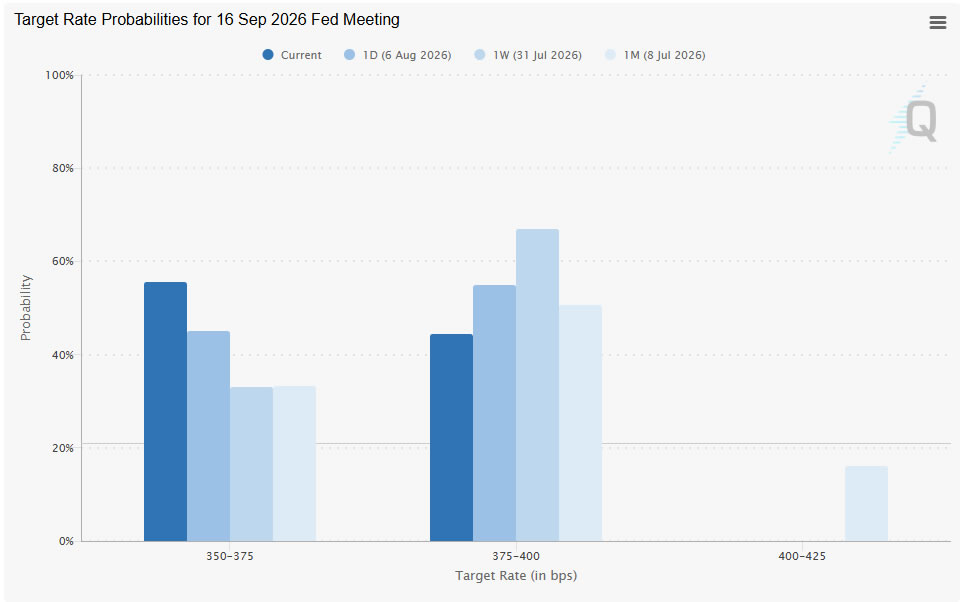
Markets nevertheless stopped well short of embracing a full dovish trade. September pricing shifted from a slight preference for another Fed hike to a slight preference for a hold, but remained close to a coin flip. The 10-year Treasury yield held around the critical 4.60 area, while the Dollar Index stopped its post-NFP slide around key 99.41 support. At the same time, the Dow and S&P 500 had little enthusiasm for rallying strongly on lower rate expectations, despite both reaching records earlier in the week.
That divergence captures the central tension heading into next week. Labor deterioration is making another Fed hike harder to justify, but unresolved oil-driven inflation risk is preventing markets from confidently ruling one out. Meanwhile, weaker growth is limiting how enthusiastically equities can celebrate a more dovish Fed outlook.
Weak NFP Flips the Fed Debate, but Doesn’t Settle It
Friday’s jobs report significantly raised the hurdle for another Fed hike. More important than July’s 23K payroll decline was evidence that weakness had been building beneath the surface for months. May and June employment gains were revised down by -103K combined, while wage growth slowed sharply. Falling unemployment to 4.1% offered some reassurance, but lower labor force participation diluted that signal.
Markets reflected that change without reaching a firm conclusion. September pricing flipped from roughly 55% probability of a hike and 45% for a hold before NFP, to around 55% for a hold and 45% for a hike afterward. That’s a meaningful reversal, but still remarkably close given the severity of the employment disappointment.
The reason is that payrolls answer only one side of the Fed’s problem. The labor market is weakening, but inflation risk hasn’t disappeared. NFP has made another hike considerably harder to justify; it hasn’t yet given the Fed confidence that tightening is no longer necessary. For that, markets may need a clearer signal from oil — and ultimately from the Strait of Hormuz.
Hormuz and $80 Oil Explain Why the Fed Repricing Stopped Short
Oil provides much of the explanation for why such a weak jobs report failed to produce a more decisive Fed repricing. Optimism built during the week that the US could soon reach an understanding with Iran to reopen the Strait of Hormuz, helping push Brent down to $78.11. But the expected agreement never arrived, and Brent reversed to close the week at $82.37 — still well above July’s $70.14 low.
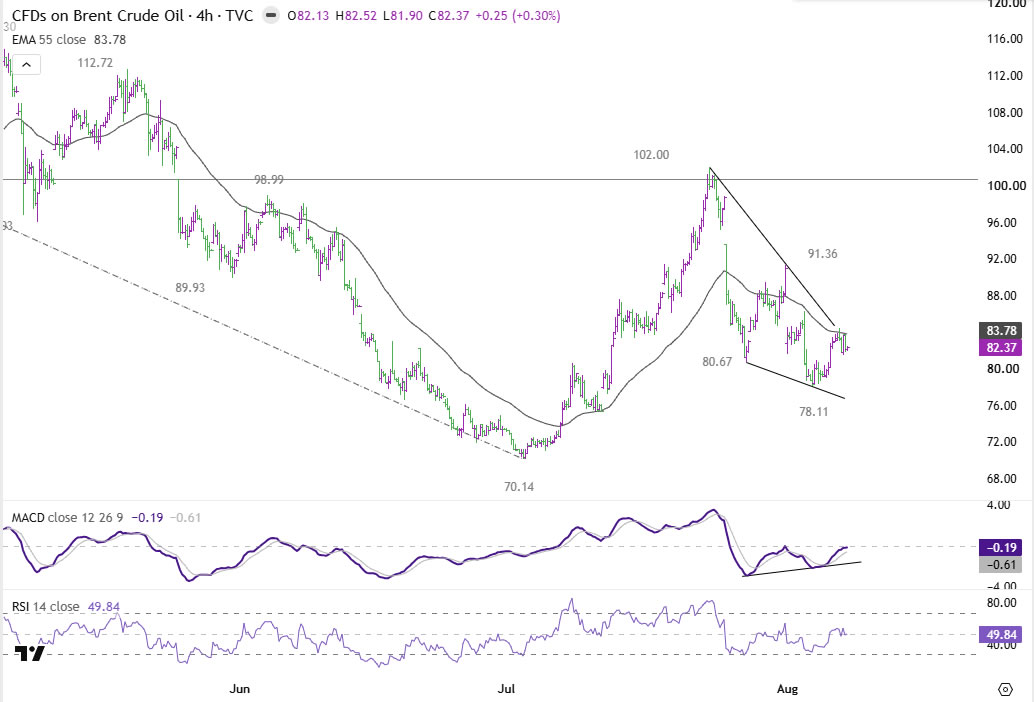
Price action suggests oil traders were willing to price a greater probability of an agreement, but not resolution of the crisis itself. Iran and Oman have made progress on a proposed shipping arrangement, yet important questions remain over how transit would operate, which vessels would be permitted through the Strait, and whether any initial arrangement would provide more than temporary relief. Meanwhile, broader regional military risks have hardly disappeared.
That distinction matters enormously for the Fed. A durable reopening of Hormuz accompanied by a sustained fall in oil would remove an important source of inflation pressure at precisely the moment the US labor market is weakening. Instead, Brent remaining above $80 leaves policymakers confronting both sides of the dual mandate at once: deteriorating employment argues against another hike, while elevated energy prices and continuing supply risks argue against declaring the inflation threat contained.
Treasury Yields Become the Confirmation Test
The Treasury market now provides one of the clearest tests of whether the post-NFP dovish shift has further to run. Given the scale of the payroll disappointment and downward revisions, the 10-year yield might ordinarily have been expected to break decisively lower. Instead, it recovered to close around 4.66%, suggesting investors aren’t yet prepared to dismiss persistent inflation risk.
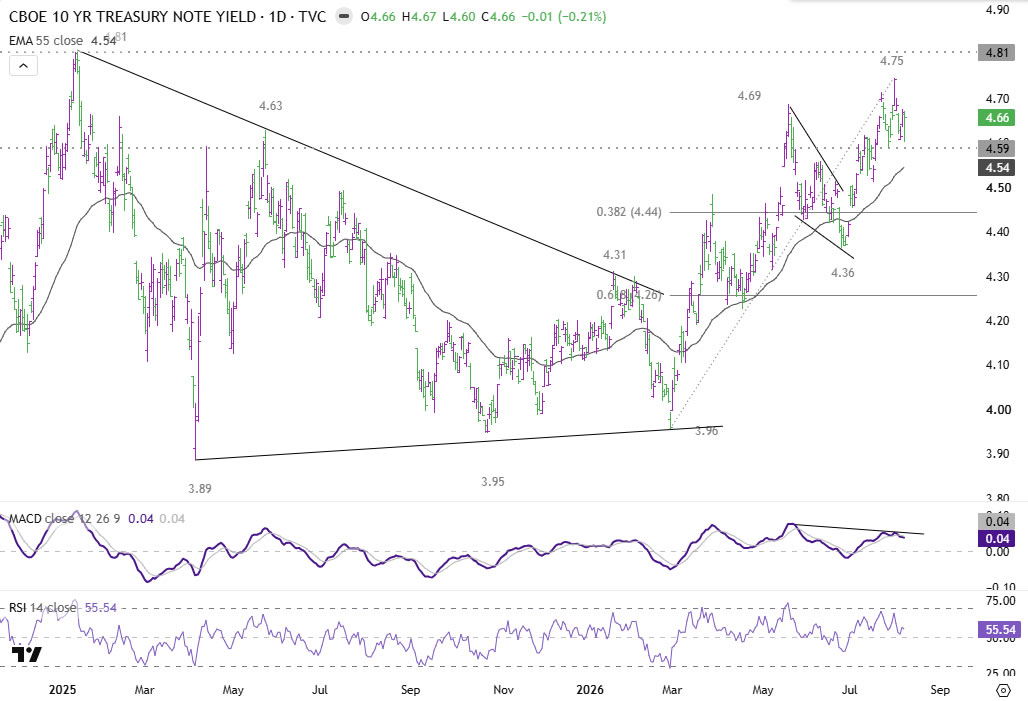
Technically, price action from 4.75 can still be treated as consolidation within the rally from 4.36. The 10-year yield continues to hold around the 4.59–4.61 support zone, which also contains the 55 4H EMA. As long as this area holds, near-term structure remains consistent with another attempt at 4.75 at a later stage, while the broader rise from 3.96 stays intact.
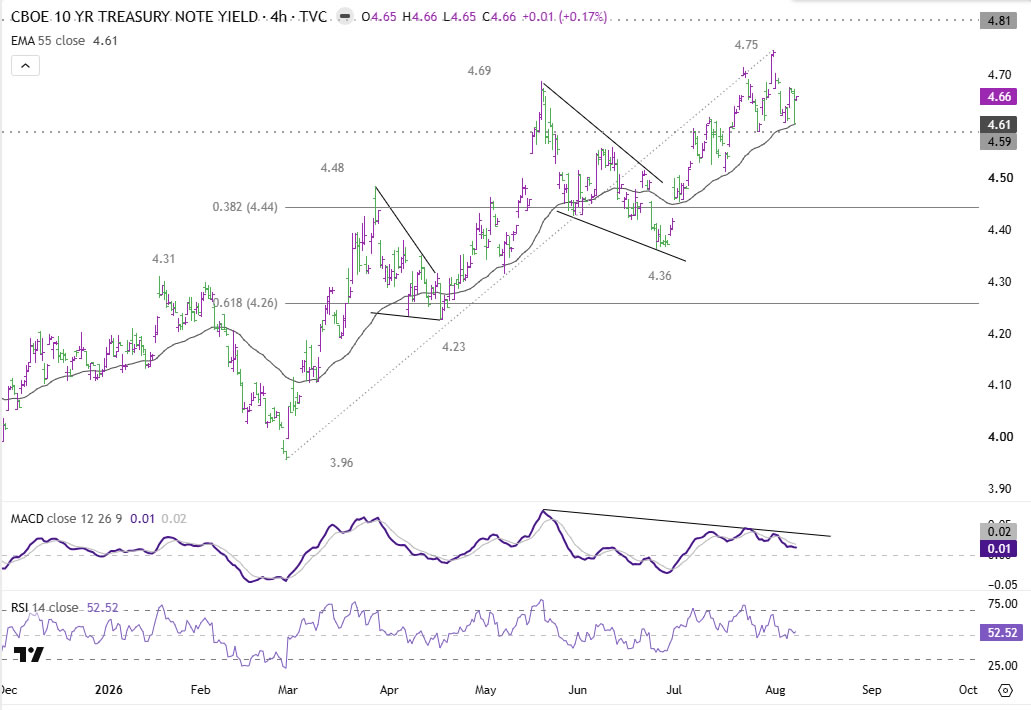
A decisive break below 4.59–4.61 would change that picture. It would argue the decline from 4.75 is developing into a correction of the broader rise from 3.96, bringing 4.44 — the 38.2% retracement of 3.96 to 4.75 — into focus. Bearish divergence in momentum indicators adds weight to that downside risk, but price confirmation is still missing.
Dollar Index Tests Key Support as Yields Refuse to Break
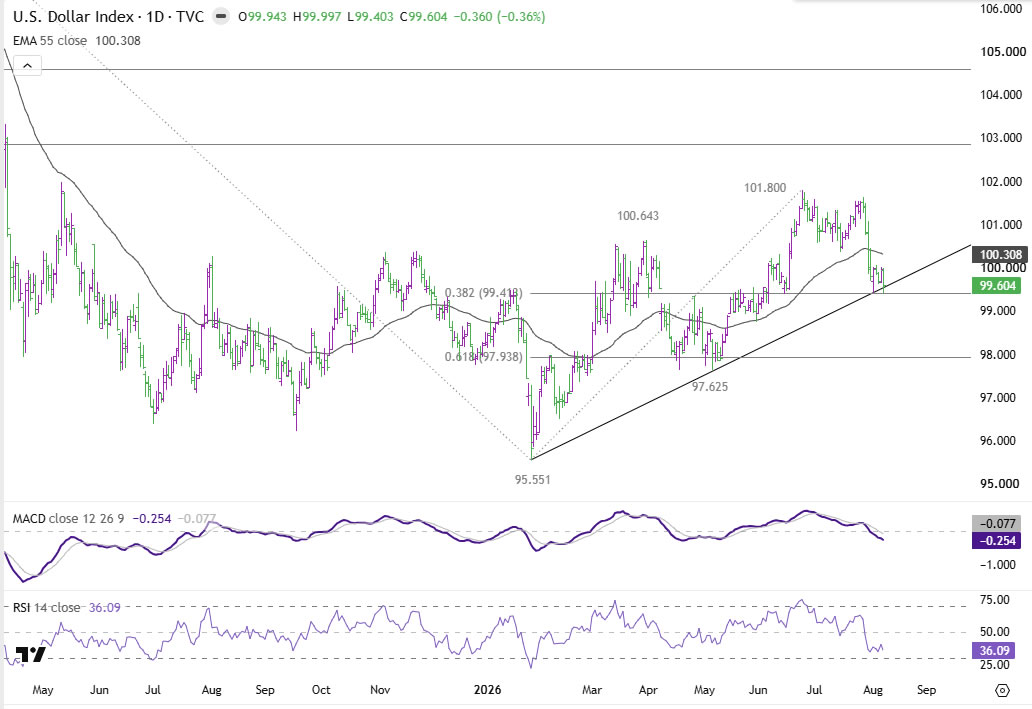
The Dollar’s post-NFP weakness is another expression of the same tug-of-war rather than a separate market story. Softer employment data pushed Fed expectations toward a hold, but with Treasury yields refusing to break lower, the Dollar selloff also stopped short of confirming a larger bearish reversal. The Dollar Index ended the week around 99.60, close to an important technical crossroads.
The DXY is currently defending both rising trendline support and 99.41, the 38.2% retracement of the rise from 95.55 to 101.80. A strong rebound from the current area, followed by a break of 100.05 resistance, would keep the near-term bullish outlook intact, leaving room for another challenge of 101.80 and, eventually, resumption of the whole rise from 95.55.
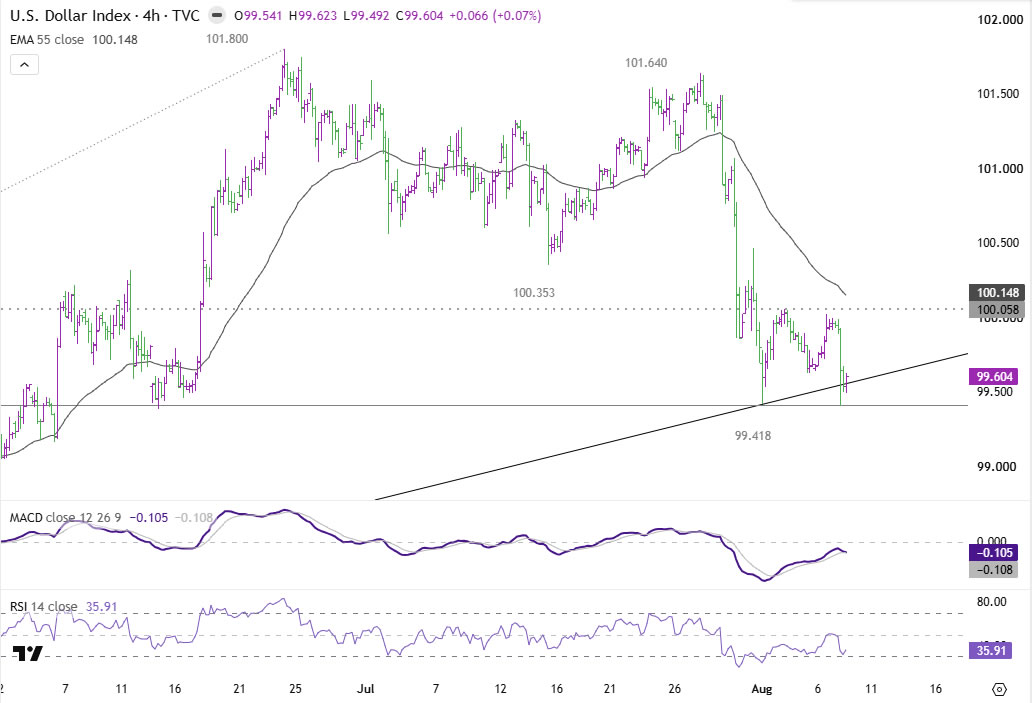
But a decisive break of 99.41 would carry much more bearish implications. It would strengthen the case that the rebound from 95.55 completed at 101.80 as a three-wave corrective move, exposing 97.38, the 61.8% retracement, next. Such a break would also fit with Treasury yields finally giving way below their own support zone.
Why Didn’t Wall Street Celebrate Weak NFP?
Equities exposed the other side of the market’s tug-of-war. Lower Fed hike expectations would normally provide a strong tailwind for stocks, particularly after such a large downside surprise in employment. Yet Friday’s response was restrained: the Dow gained just 0.28%, while the S&P 500 rose 0.62%. The Nasdaq performed better with a 1.30% advance, but remained well below its record high.
That suggests investors didn’t interpret NFP as benign Goldilocks weakness. A modest cooling in employment could have been welcomed as exactly what the Fed needs to keep rates unchanged without threatening growth. Instead, outright payroll contraction accompanied by substantial downward revisions raised a different concern: the labor market may be deteriorating faster than previously understood. Lower rate expectations therefore came with a less favorable reason behind them.
This distinction becomes more important while inflation risks remain elevated. A resilient economy operating with above-target inflation and restrictive Fed policy is something equity investors have largely learned to tolerate. More problematic would be weakening growth before inflation has fallen sufficiently to give the Fed freedom to respond — a combination that would push markets closer to a stagflationary scenario, where lower growth doesn’t automatically translate into meaningful monetary support.
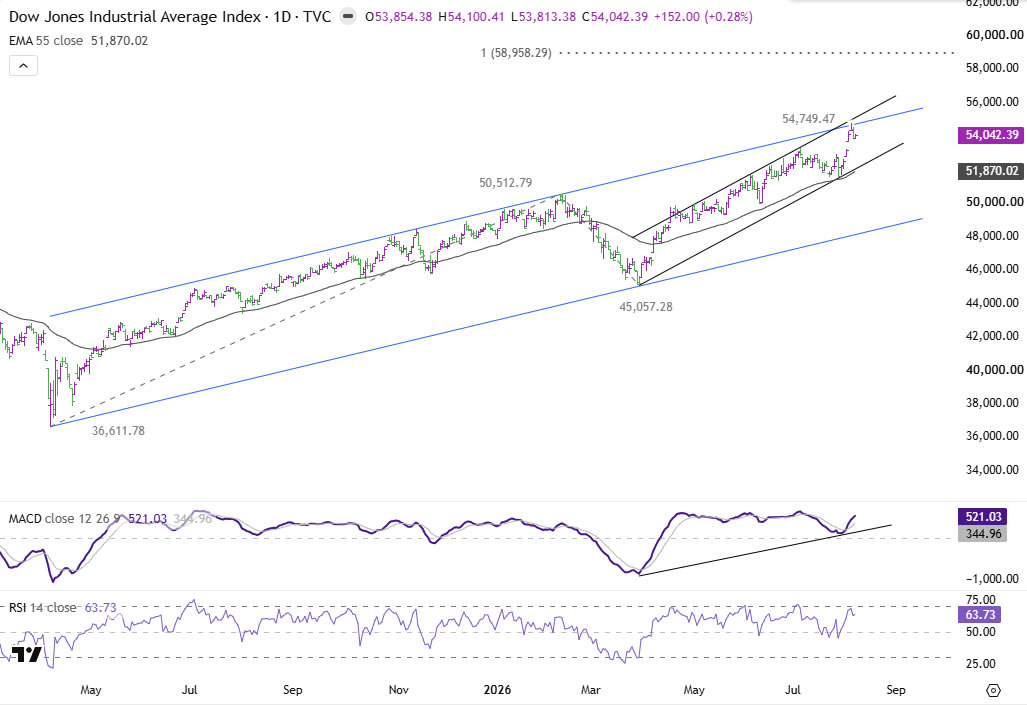
The Dow’s technical position reflects that hesitation. The index reached a fresh record at 54,749.47 during the week but is now confronting resistance from both the channel defining the rise from 45,057 and the larger channel governing the uptrend from 36,612. Some consolidation below the record would therefore be unsurprising; the underlying outlook remains bullish as long as the near-term channel floor, currently around 52,000, holds.
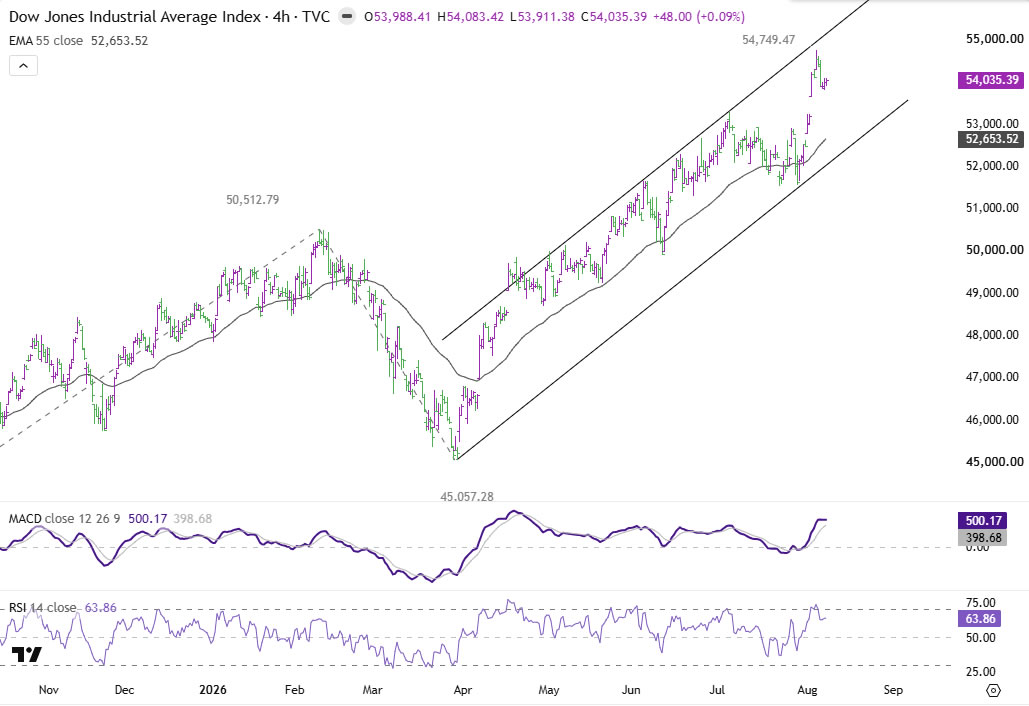
A decisive break through 54,749 would likely require a stronger catalyst than lower Fed hike odds alone. A credible resolution of the Hormuz crisis could provide one: lower oil would ease inflation risk, reinforce Fed hold expectations, and reduce a major geopolitical drag on confidence at the same time. Such a breakout would open the way toward 58,958, based on the 100% projection from 36,612.
What Could Break the Tug-of-War
Markets are entering next week without a clear winner between weakening growth and persistent inflation risk. NFP has established that the US labor market is softer than previously believed, but it hasn’t established that the Fed is free to respond. Much could depend on whether Middle East developments finally deliver sustained relief in oil prices:
- Weak employment combined with falling oil is the cleanest scenario. A credible and durable reopening of the Strait of Hormuz that pushes Brent materially lower would ease one of the Fed’s most immediate inflation concerns just as labor conditions deteriorate. September hike expectations could then fade much more decisively, putting the 10-year yield’s 4.59–4.61% support and the Dollar Index’s 99.41 level under renewed pressure, while equities would receive both lower-rate and lower-energy-cost tailwinds.
- US data stabilizing while oil remains elevated would restore some credibility to Fed hawks’ argument that the economy can withstand additional tightening. Treasury yields could challenge 4.75% again, the Dollar could rebound from current support, and equities would have to absorb the prospect of restrictive policy lasting longer.
- Further US growth deterioration while oil remains above $80 or rises again is the most difficult combination. The Fed would face weakening employment without corresponding relief on inflation, increasing the risk of a stagflationary environment in which policymakers have little room to support the economy — also challenging current equity resilience, since bad economic news would no longer come with a straightforward promise of easier monetary policy.
Friday’s NFP told investors something important: the US labor market is weaker than they thought. What it hasn’t answered is whether the Fed can safely respond. As long as Brent remains elevated and the Hormuz crisis unresolved, that question increasingly depends on developments outside the US economic calendar.
Key Takeaways
- July NFP contracted -23K with -103K in combined downward revisions to May and June, flipping September Fed odds from 55% hike/45% hold to roughly 45% hike/55% hold.
- Brent’s reversal from $78.11 back to $82.37 after a failed Hormuz agreement kept oil-driven inflation risk alive, preventing a fuller dovish Fed repricing.
- The 10-year Treasury yield held its 4.59-4.61% support and the Dollar Index defended 99.41, both signaling markets aren’t yet ready to fully dismiss inflation risk.
- Wall Street’s muted reaction (Dow +0.28%, S&P +0.62%) suggests investors read the NFP miss as a growth warning, not benign Goldilocks weakness.
- The cleanest dovish path requires both weak US data and falling oil from a durable Hormuz resolution; oil staying elevated or growth weakening further would instead risk a stagflationary setup.





