

Live Comments
US Consumer Confidence Falls to 90.8 in July, Expectations Remain Below Recession Threshold
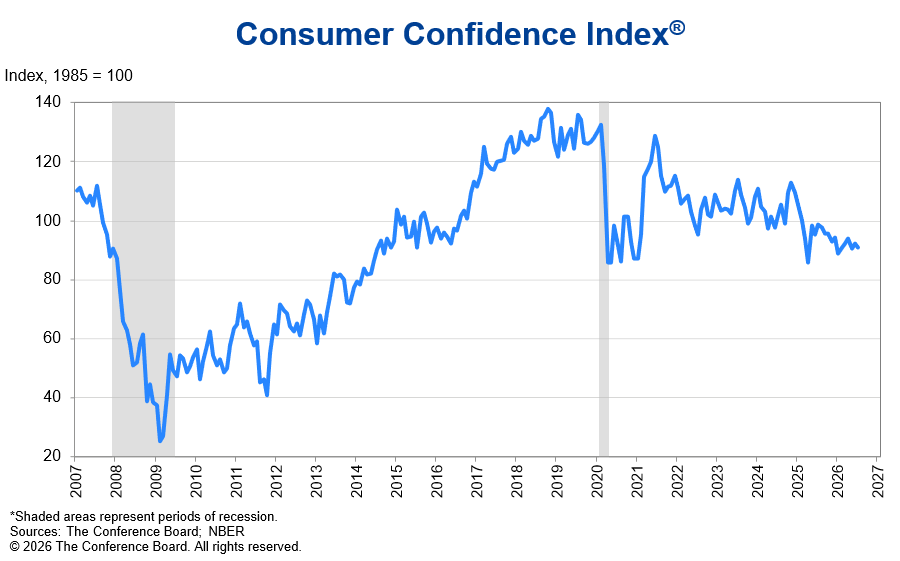
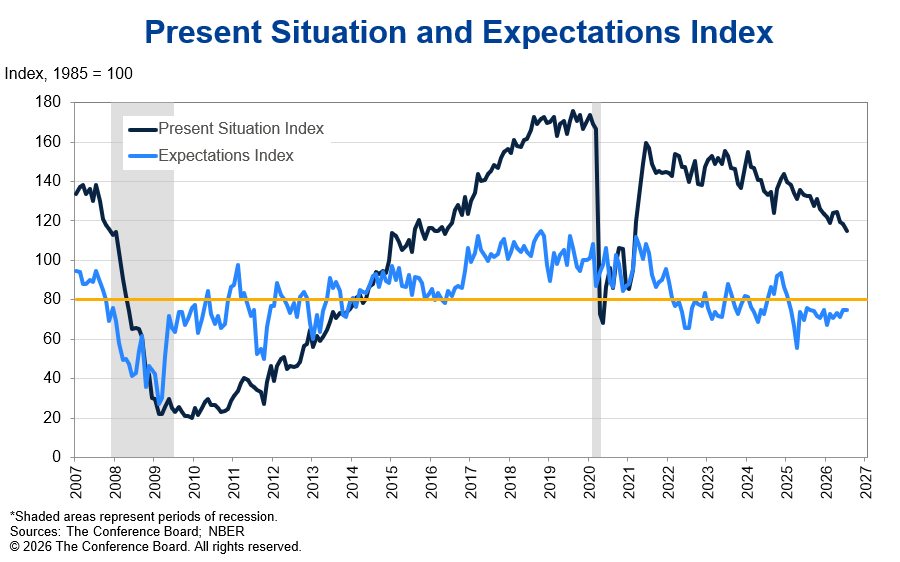
US consumer confidence weakened further in July as households grew less upbeat about current business conditions and the labor market, although easing inflation expectations offered a modest offset. The Conference Board's Consumer Confidence Index slipped -1.4 points to 90.8 from an upwardly revised 92.2 in June. The Present Situation Index fell -3.6 points to 114.9, marking its third consecutive monthly decline, while the Expectations Index held steady at 74.7—well below the 80 level that has historically been associated with recession risks.
The latest survey suggests consumers remain unconvinced that economic conditions will improve meaningfully in the months ahead. According to Dana M. Peterson, Chief Economist at The Conference Board, confidence has continued its gradual downtrend since late 2021 as assessments of current business conditions and, to a lesser extent, the labor market deteriorated further. While expectations for future employment became slightly less pessimistic, consumers continued to anticipate little improvement in overall business conditions over the next six months. Household income expectations also moderated, although they remained positive overall.
There were, however, some encouraging signs beneath the headline figures. Both average and median 12-month inflation expectations eased in July, suggesting consumers are becoming somewhat less concerned about future price pressures. Even after recent market volatility, households continued to expect stock prices to rise over the coming year. Meanwhile, 61.3% of respondents still anticipated higher interest rates over the next 12 months, unchanged from June, indicating consumers remain prepared for monetary policy to stay restrictive even as confidence gradually softens.
Economic Data
| Indicator | Actual | Previous |
|---|---|---|
| Consumer Confidence Index | 90.8 | 92.2 |
| Present Situation Index | 114.9 | 118.5 |
| Expectations Index | 74.7 | 74.7 |
| Average 12-mth Inflation Expectations | Lower | Higher |
| Median 12-mth Inflation Expectations | Lower | Higher |
Key Takeaways
- Consumer confidence fell for a second straight month, extending the gradual downtrend that has been in place since late 2021.
- The decline was driven by weaker assessments of current business conditions and the labor market, with the Present Situation Index falling for a third consecutive month.
- The Expectations Index remained at 74.7, below the 80 threshold that has historically been associated with recession risks, suggesting consumers remain cautious about the economic outlook.
- Consumers expect little improvement in business conditions over the next six months, although labor market expectations became slightly less pessimistic.
- Inflation expectations eased further, indicating households are becoming less concerned about future price pressures.
- Despite recent equity market volatility, consumers continued to expect stock prices to rise over the next year.
- A majority (61.3%) still expect interest rates to move higher over the coming 12 months, highlighting expectations that monetary policy will remain restrictive.
Full US Conference Board consumer confidence release here.
RBA’s Bullock Keeps Rate Hike Option Alive Despite Policy Lags
Speaking in Sydney today, Reserve Bank of Australia Governor Michele Bullock reaffirmed that the Board remains firmly focused on restoring price stability while leaving the door open to further monetary tightening if inflation proves more persistent than expected. Although she acknowledged that "the global environment has changed and the outlook is uncertain," Bullock stressed that the RBA's objectives "haven't changed," with the Board remaining committed to delivering both price stability and full employment. She also emphasized that the full effects of the cash rate increases delivered earlier this year "will take time to materialize," making it too early to judge whether existing policy settings are sufficiently restrictive.
Bullock warned that even if the latest disruption to global oil supplies proves temporary, inflation risks have not disappeared. She noted that "underlying inflation is still expected to be higher as fuel price rises flow through to other prices," while reminding markets that "inflation and capacity pressures in the domestic economy were already too high prior to the recent shock." Although there is evidence that domestic demand and labor market conditions have been easing, she argued that the economy continues to face significant capacity constraints and that the Board remains focused on "preventing elevated cost pressures from entrenching inflation."
While acknowledging that further moderation in demand may still be required, Bullock stopped short of signaling an imminent policy move, instead framing the coming months as a test of whether earlier tightening will be sufficient. She reiterated that monetary policy cannot solve Australia's weak productivity growth, but can make its greatest contribution by maintaining "low and stable inflation" alongside sustainable full employment. The speech nevertheless preserved the RBA's tightening bias, with Bullock concluding that the Board "is prepared to act as required to achieve its mandate, including by increasing the cash rate further if needed."
Key Takeaways
- Policy stance: RBA retains a conditional tightening bias and remains prepared to raise the cash rate again if inflation proves persistent.
- Policy lags: Bullock emphasized it is too early to judge whether the earlier rate hikes have been sufficiently restrictive, as their full effects are still working through the economy.
- Inflation: Even if oil supply disruptions ease quickly, higher fuel prices are expected to lift underlying inflation through broader cost pass-through.
- Domestic economy: Demand and labour market conditions are cooling, but capacity pressures remain elevated and inflation was already too high before the latest oil shock.
- Long-term challenge: Weak productivity continues to constrain Australia's non-inflationary growth potential, a problem monetary policy cannot solve.
- Market implication: The speech pushes back against expectations of an early policy pivot and reinforces the RBA's data-dependent tightening bias.
US Durable Goods Orders Rise 0.3%, But Growth Misses Expectations
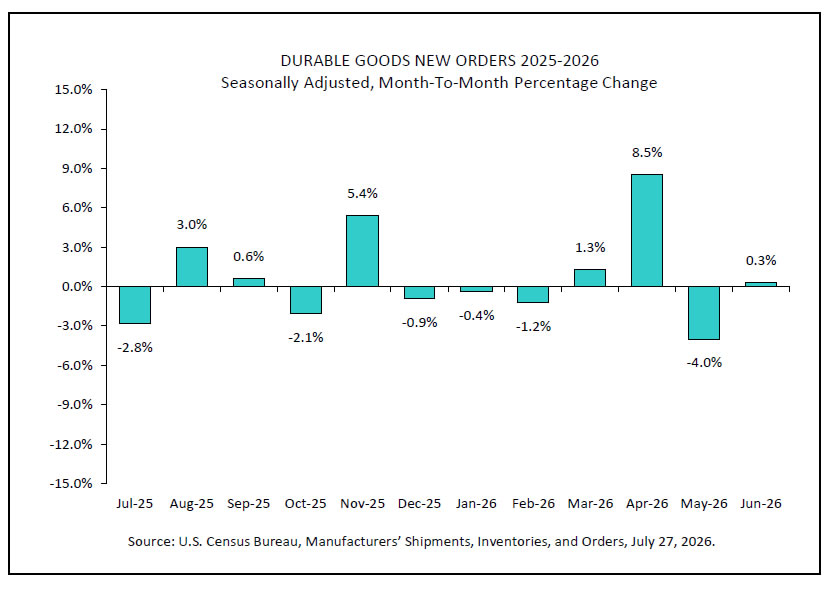
New orders for U.S. manufactured durable goods rose 0.3% mom in June, returning to positive territory after May's revised -4.0% decline but falling short of expectations for a 1.6% increase. Excluding transportation, orders increased 0.6%, also below the 0.9% consensus, while orders excluding defense edged up 0.3%. Although the headline figures disappointed, the report showed business investment remained on a positive footing rather than slipping back into contraction.
The underlying details were broadly constructive. Durable goods orders have now increased in three of the past four months, suggesting May's sharp decline was more of a setback than the start of a sustained downturn. Technology-related demand continued to stand out, with computers and electronic products rising 3.1%, marking gains in nine of the past ten months. The sector's strength highlights continued investment in digital infrastructure and advanced manufacturing, helping offset softer performance elsewhere.
Overall, the report points to moderating rather than weakening manufacturing activity. The slowdown from April's surge and May's sharp correction suggests order growth is normalizing, while positive readings in both headline and core measures indicate business spending remains resilient.
Economic Data Summary
| Indicator | Actual | Expected | Previous |
|---|---|---|---|
| Durable Goods Orders (Jun) | 0.3% m/m | 1.6% | -4.0% |
| Durable Goods Orders ex Transportation | 0.6% m/m | 0.9% | 1.4% |
| Durable Goods Orders ex Defense | 0.3% m/m | — | -4.3% |
Key Takeaways
- US durable goods orders returned to growth in June, rising 0.3% m/m after May's revised 4.0% decline, although the rebound fell well short of market expectations.
- Underlying business investment remained resilient. Orders excluding transportation increased 0.6%, while orders excluding defense also posted a 0.3% gain, indicating manufacturing demand continued to expand despite a slower pace.
- Technology remained a bright spot. Orders for computers and electronic products rose 3.1%, extending gains to nine of the past ten months and highlighting continued investment in digital infrastructure and advanced manufacturing.
- The report suggests normalization rather than deterioration. Durable goods orders have now increased in three of the last four months, implying May's sharp decline was more of a correction following April's surge than the start of a sustained downturn.