

Live Comments
Germany ZEW Sentiment Strengthens to 34.2 as Current Conditions Improve
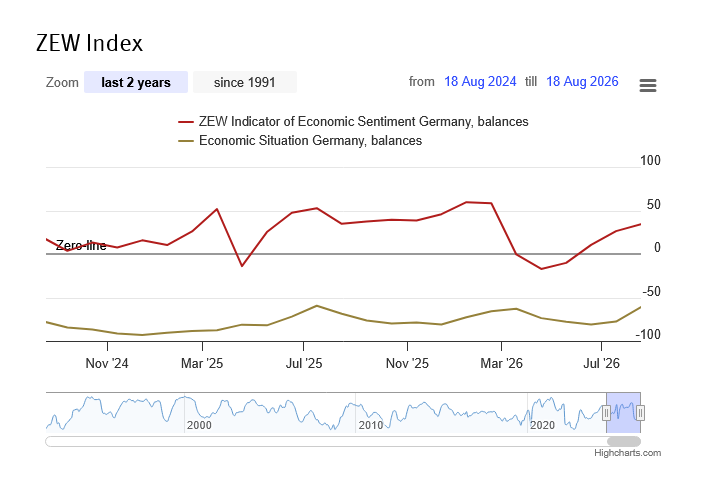
German investor sentiment improved further in August, with ZEW Economic Sentiment rising from 26.3 to 34.2, above 30.1 consensus. Current Situation Index also strengthened sharply from -77.6 to -61.1, much better than -68.8 expected. ZEW attributed improvement to solid quarterly corporate results, strong recent exports and support from federal infrastructure programs, although current-condition reading remains deeply negative.
The improvement was broad across sectors. Vehicle-industry expectations jumped by 22.2 points, though balance stayed below zero, while chemical and pharmaceutical, mechanical engineering and metals industries also recorded strong gains. Private-consumption expectations improved by 9.0 points to -6.2, while construction expectations edged up to +2.1. ZEW nevertheless flagged record-low Rhine water levels as an acute risk to activity.
Eurozone sentiment followed same direction. Economic Sentiment rose from 23.4 to 31.4, beating 25.0 forecast, while Current Situation assessment improved by 16.2 points to -21.5. Overall, August survey points to a more convincing improvement in expectations across Germany and wider Eurozone, though still-weak current-condition readings show recovery in confidence is running ahead of the underlying economy.
Data Summary
| Component | Current | Previous | Trend |
|---|---|---|---|
| Germany ZEW Economic Sentiment | 34.2 | 26.3 | Improved strongly |
| Germany ZEW Current Situation | -61.1 | -77.6 | Less negative |
| Eurozone ZEW Economic Sentiment | 31.4 | 23.4 | Improved strongly |
| Eurozone ZEW Current Situation | -21.5 | -37.7 | Less negative |
| Germany Private Consumption Expectations | -6.2 | -15.2 | Improved |
| Germany Construction Expectations | 2.1 | 0.7 | Improved |
Key Takeaways
- Germany ZEW Economic Sentiment rose from 26.3 to 34.2, comfortably above 30.1 consensus.
- Current Situation Index improved sharply from -77.6 to -61.1, also beating -68.8 expected.
- Improvement was broad across industries, led by a 22.2-point rise in vehicle-sector expectations.
- Private-consumption expectations strengthened from -15.2 to -6.2, while construction expectations improved from 0.7 to 2.1.
- ZEW linked stronger outlook to solid corporate results, recent export strength and federal infrastructure programs.
- Record-low Rhine water levels were highlighted as an acute downside risk to activity.
- Eurozone sentiment also strengthened, with Economic Sentiment rising from 23.4 to 31.4, above 25.0 consensus.
- Eurozone Current Situation improved from -37.7 to -21.5, though it remained in negative territory.
- Overall, August survey shows confidence improving faster than actual conditions, with expectations increasingly positive while current assessments remain weak.
UK Payroll Employment Falls as Unemployment Holds at 4.9%
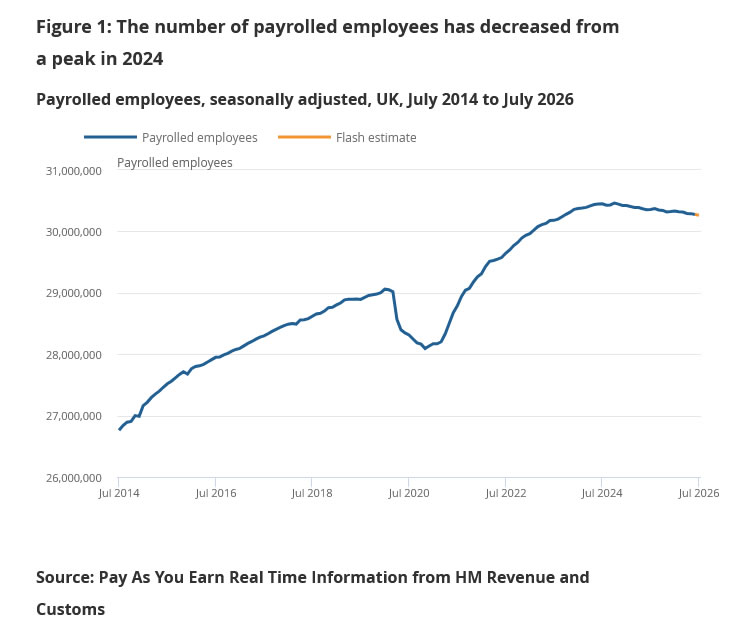
UK labor market continued to soften in July, with early payroll estimates showing employee numbers falling by -13,000 from June and by -94,000 from a year earlier. June’s monthly decline was also revised from -4,000 to -13,000, reinforcing gradual downtrend from 2024 peak.
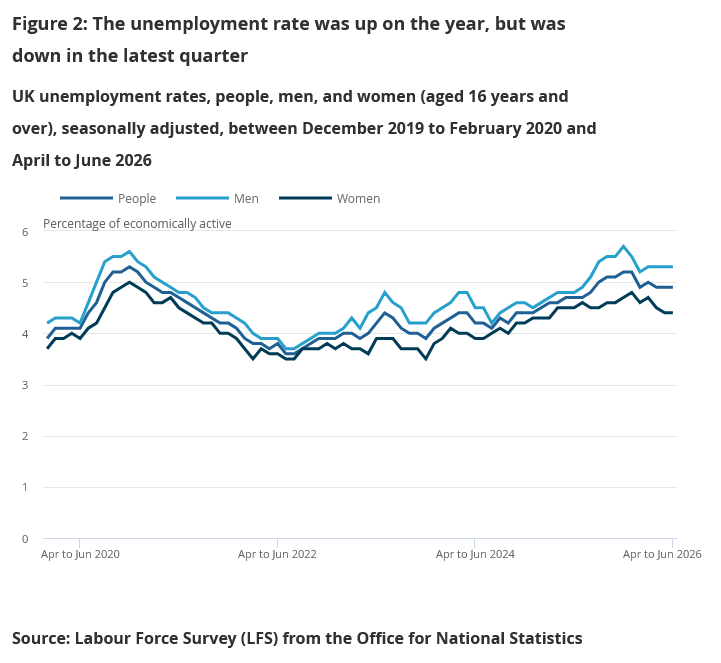
ILO unemployment rate held at 4.9% in three months to June, slightly above 4.8% expected, although claimant count moved in opposite direction with an -11,000 decline versus expectations for a 16,500 increase.
Wage data were mixed. Regular earnings growth edged up from 3.4% to 3.5% y/y in April-June, above 3.4% consensus Total earnings growth slowed from 4.3% to 4.1%, matching expectations.
More timely payroll-based median pay growth also eased from 4.5% to 4.2% y/y in July, suggesting underlying wage momentum is gradually cooling despite firmness in regular pay.
Overall, employment conditions are weakening more clearly than wages. Payrolls continue to drift lower and unemployment remains elevated, but pay growth is proving slower to soften.
Data Summary
| Indicator | Actual | Expected | Previous |
|---|---|---|---|
| Payrolled Employees m/m, Jul | -13K | — | -13K* |
| Payrolled Employees y/y, Jul | -94K | — | — |
| Payrolled Employees y/y, Jul | -0.3% | — | — |
| Payrolled Employees Level, Jul | 30.3M | — | — |
| ILO Unemployment Rate, 3M to Jun | 4.9% | 4.8% | 4.9% |
| Claimant Count Change, Jul | -11.0K | +16.5K | +6.7K |
| Average Earnings ex Bonus, 3M y/y Jun | 3.5% | 3.4% | 3.4% |
| Average Earnings incl Bonus, 3M y/y Jun | 4.1% | 4.1% | 4.3% |
| Median Monthly Pay y/y, Jul | 4.2% | — | 4.5% |
*June payroll decline was revised from -4K to -13K.
Key Takeaways
- UK payrolled employment fell another 13K in July, while June was revised to show the same decline, reinforcing gradual weakening from 2024 peak.
- Payrolls were 94K lower than a year earlier, equivalent to a 0.3% annual decline.
- ILO unemployment rate held at 4.9%, slightly above 4.8% consensus.
- Claimant count provided main positive surprise, falling 11K instead of expected 16.5K increase.
- Wage signals were mixed. Regular earnings growth firmed from 3.4% to 3.5%, while total earnings slowed from 4.3% to 4.1%.
- More timely median payroll pay growth eased from 4.5% to 4.2% in July.
- Overall picture is one of employment weakening faster than wages, with payrolls drifting lower but pay growth cooling only gradually.
Australia Westpac Consumer Sentiment Rebounds After RBA Hold, but Pessimism Persists
Australian consumer sentiment improved in August, with Westpac–Melbourne Institute Consumer Sentiment Index rising 83.9 to 88.9, a 6.0% monthly gain. Improvement was concentrated among mortgage holders and emerged almost entirely after RBA’s August 11 decision to keep rates unchanged. Current financial assessments led rebound, with family finances versus a year ago jumping 71.1 to 80.0, while time to buy a dwelling rose 85.4 to 95.7. Even so, headline index remains below neutral 100 and 9.7% weaker than a year earlier.
Forward-looking measures were less convincing. Family finances over next 12 months edged up 96.5 to 98.2, while expectations for economic conditions over next year rose 78.3 to 82.8. Unemployment Expectations Index deteriorated 129.9 to 135.7, moving above its long-run average, while House Price Expectations fell 118.0 to 110.8. Consumers also continue to anticipate tighter borrowing conditions: 59% expect mortgage rates to rise further, although RBA hold reduced uncertainty and lifted share expecting rates to stay unchanged or fall.
For RBA, survey shows August hold provided immediate relief without restoring confidence. Household pessimism, rising unemployment concerns and relatively subdued forward expectations suggest three hikes this year are still working through economy. Westpac argues Board is unlikely to have enough new evidence by September 28–29 meeting to conclude upside inflation risks have materialised, particularly with only one monthly inflation print ahead and labor market easing more than RBA had previously forecast. That keeps September tilted toward another hold even as Board retains explicit option to hike again.
Data Summary
| Component | Current | Previous | Trend |
|---|---|---|---|
| Consumer Sentiment Index | 88.9 | 83.9 | Improved 6.0% m/m |
| Family finances vs a year ago | 80.0 | 71.1 | Strong improvement |
| Family finances next 12 months | 98.2 | 96.5 | Modest improvement |
| Economic conditions next 12 months | 82.8 | 78.3 | Improved |
| Economic conditions next 5 years | 89.8 | 87.1 | Improved |
| Time to buy a major household item | 93.8 | 86.8 | Improved strongly |
| Time to buy a dwelling | 95.7 | 85.4 | Improved strongly |
| Unemployment Expectations Index | 135.7 | 129.9 | Job concerns increased |
| House Price Expectations Index | 110.8 | 118.0 | Weakened |
| Interest Rate Expectations Index | 158.8 | 162.6 | Eased slightly |
Key Takeaways
- Australian consumer sentiment rebounded 6.0% in August, with headline index rising from 83.9 to 88.9.
- Improvement was concentrated among mortgage holders and emerged almost entirely after RBA’s August 11 hold decision.
- Despite rebound, sentiment remains firmly pessimistic, below neutral 100 and 9.7% lower than a year ago.
- Current financial conditions improved more sharply than forward-looking expectations, suggesting consumers felt immediate relief without becoming substantially more confident about outlook.
- Family finances versus a year ago jumped from 71.1 to 80.0, while time to buy a dwelling rose from 85.4 to 95.7.
- Labor-market anxiety increased, with Unemployment Expectations Index rising from 129.9 to 135.7, above its long-run average.
- House Price Expectations Index fell from 118.0 to 110.8, pointing to weaker housing-market confidence.
- 59% of respondents still expect mortgage rates to rise further, although RBA hold reduced uncertainty and increased share expecting rates to stay unchanged or decline.
- Survey supports case for RBA patience in September: households are responding to restrictive policy, while rising unemployment concerns argue against assuming economy can absorb another hike easily.