


- European gas prices stay near 30–32 euro per MWh despite the upcoming heating season.
- High storage levels and strong LNG inflows from the U.S. keep the market stable.
- China’s weaker LNG demand reduces global price pressure.
- Risks ahead include Norwegian production outages and possible winter cold pushing prices toward 40 euro per MWh.
Despite the approaching heating season, natural gas prices in Europe remain near a yearly low — around 30–32 euros per megawatt-hour (MWh). The persistence of such low levels results primarily from high storage inventories and strong inflows of liquefied natural gas (LNG) from the United States. In addition, lower demand for LNG in China — offset by an increase in pipeline gas deliveries from Russia — has reduced competition and thus eased price pressure on the European market.
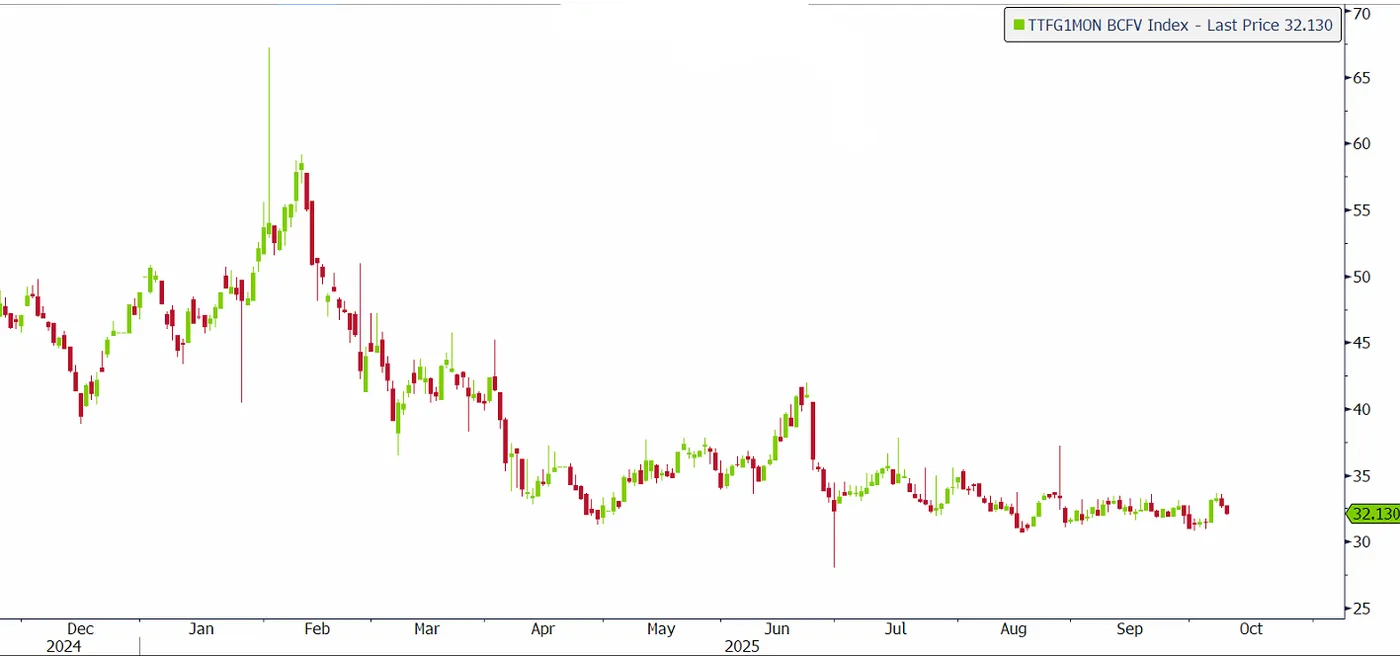
Chart of the European TTF natural gas futures contract, daily data, source: Bloomberg
High storage levels and steady prices
Since the end of June, the benchmark TTF price has remained around 30–32 euros per MWh, even as the heating season approaches. In the spring, the situation was much more “tense.” After a cold winter, European gas storage facilities were filled to only 33 percent, it means 25 percentage points lower than the year before. However, thanks to increased LNG imports in the second quarter, storage levels rose to about 80–82 percent, significantly reducing the risk of shortage.
U.S. LNG exports play a key role
The United States has played a key role in stabilizing the market. After the launch of new export terminals, American LNG exports increased by nearly 20 percent in the first half of the year compared to the same period last year. For the full year, growth is expected to reach as much as 25 percent. Rising supply from the U.S. is helping the European Union gradually move away from Russian gas, whose imports are now planned to end completely by 2027 — one year earlier than previously projected.
China’s weaker LNG demand eases global pressure
At the same time, Chinese LNG imports fell by 17 percent in the first eight months of the year, and in September they may decline by another 20 percent year-on-year. This results from weaker domestic demand and increased pipeline gas supplies, mainly from Russia, which is redirecting part of its exports from Europe to Asia.
Risks ahead: Norway and the weather factor
Despite the current stability, it is likely that European gas prices will start rising again in the coming months. Although storage levels are high, they remain slightly below the multi-year average, and another risk factor is the ongoing production outages in Norway, particularly at the Troll field.
Outlook: prices may climb by year-end
If temperatures in Europe start to drop rapidly and industrial gas demand continues to recover, the market balance could shift. In such a scenario, TTF contract prices could rise — possibly reaching 40 euros per MWh by the end of the year.





. The persistence of such low levels results primarily from high storage inventories and strong inflows of liquefied natural gas (LNG) from the United States. In addition, lower demand for LNG in China — offset by an increase in pipeline gas deliveries from Russia — has reduced competition and thus eased price pressure on the European market.)