- BoJ expected to keep rates unchanged at 1.00% on July 31.
- Inflation overshoot warning likely to remain.
- Markets seek clues on the timing of the next hike.
- Can a hawkish tone assist the ailing yen?
Pause likely, spotlight on next hike and Takaichi’s doves
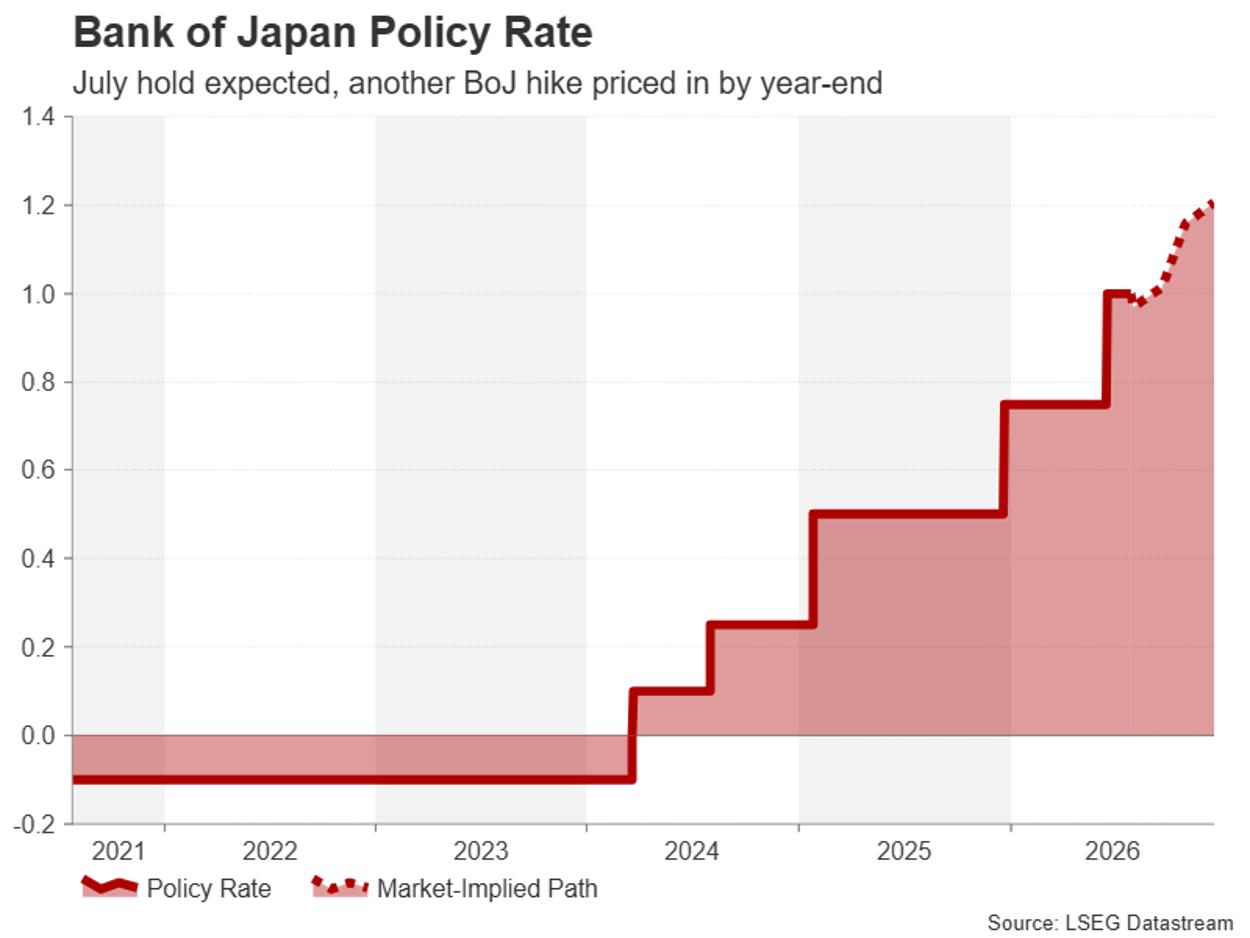
Having delivered a 25bp rate hike in June, lifting borrowing costs to a 31-year high, the Bank of Japan is widely expected to leave its policy rate unchanged at 1.00% on Friday. With no policy change anticipated, attention will shift to Governor Kazuo Ueda’s guidance, the quarterly Outlook Report and any signals on the timing of the next rate hike.
While policymakers are likely to maintain a tightening bias, a broadly balanced message, even alongside a renewed warning about inflation overshooting the central bank’s 2% target, would suggest policy continuity rather than a hawkish shift, potentially limiting the immediate market reaction. Nevertheless, inflation pressures linked to yen weakness, elevated energy costs and rising wage growth suggest the BoJ is unlikely to abandon its cautious normalization path.
December remains the market’s base case for the next hike, which would lift rates to 1.25% by year-end. However, September or October could emerge as live meetings if inflation proves more persistent or the yen resumes its decline.
For Ueda, the challenge will be balancing support for the yen through hawkish communication while avoiding friction with a government wary of higher interest rates. Friday’s meeting will also mark the first appearance of board member Ayano Sato, the second appointee of dovish PM Sanae Takaichi, adding to scrutiny over the balance of views within the policy board and what that could mean for the pace of the BoJ’s normalization process.
BoJ to retain warning of inflation overshoot risk
The BoJ’s quarterly Outlook Report is expected to show a somewhat stronger growth backdrop than projected in April, as concerns over a severe economic impact from Middle East tensions have eased.
At the same time, inflation forecasts may be revised slightly lower due to government subsidies and softer oil prices relative to earlier assumptions. Any downgrade is expected to be modest, however, as renewed energy-market volatility and rising import costs from a weak yen continue to pose upside risks.
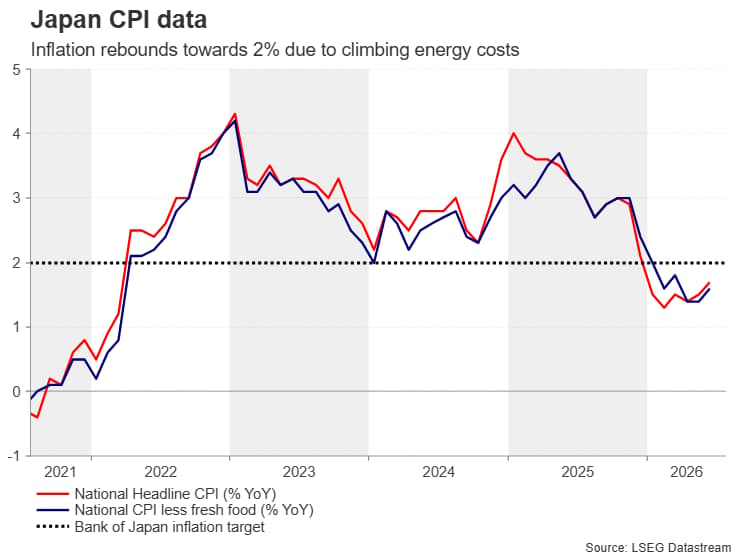
Recent inflation data has highlighted this balancing act. Japan’s core CPI rose to 1.6% year-on-year in June from 1.4% previously, although it has remained below the BoJ’s 2% target for several months. Policymakers nevertheless expect import costs, producer prices and currency weakness to support inflation later this year.
Importantly, the BoJ is expected to retain its warning that inflation could overshoot the 2% target, even as fears of an oil-driven price shock have moderated somewhat. With the BoJ having projected fiscal 2026 growth of 0.5% and core inflation of 2.8% in April, this week’s forecast revisions could prove important for future rate expectations.
Rising JGB yields reinforce the hawkish case
Recent developments continue to support the case for further rate increases. The BoJ’s latest Tankan survey showed corporate inflation expectations reaching record highs, while regional reports suggest many firms are preparing additional price increases in response to higher costs. Persistent yen weakness is also contributing to imported inflation pressures.
Meanwhile, more hawkish policymakers have argued that interest rates remain below neutral levels and may need to rise further. Japanese government bond yields also remain elevated, near multi-decade highs, reflecting expectations that policy normalization still has room to run.
Can the BoJ support the Yen?
Despite higher Japanese bond yields and expectations for additional tightening, the yen has struggled to gain traction. Investors remain unconvinced that the BoJ can turn significantly more hawkish, particularly given political sensitivities around higher borrowing costs. Markets are already pricing another rate hike by year-end, meaning policymakers may need to hint at a possible Autumn rather than late-year move to generate a more sustained yen recovery.
A cautious message from Ueda may keep pressure on the yen, while stronger warnings about inflation risks and a clearer commitment to further tightening could provide support.
USD/JPY remains pinned near multi-decade highs
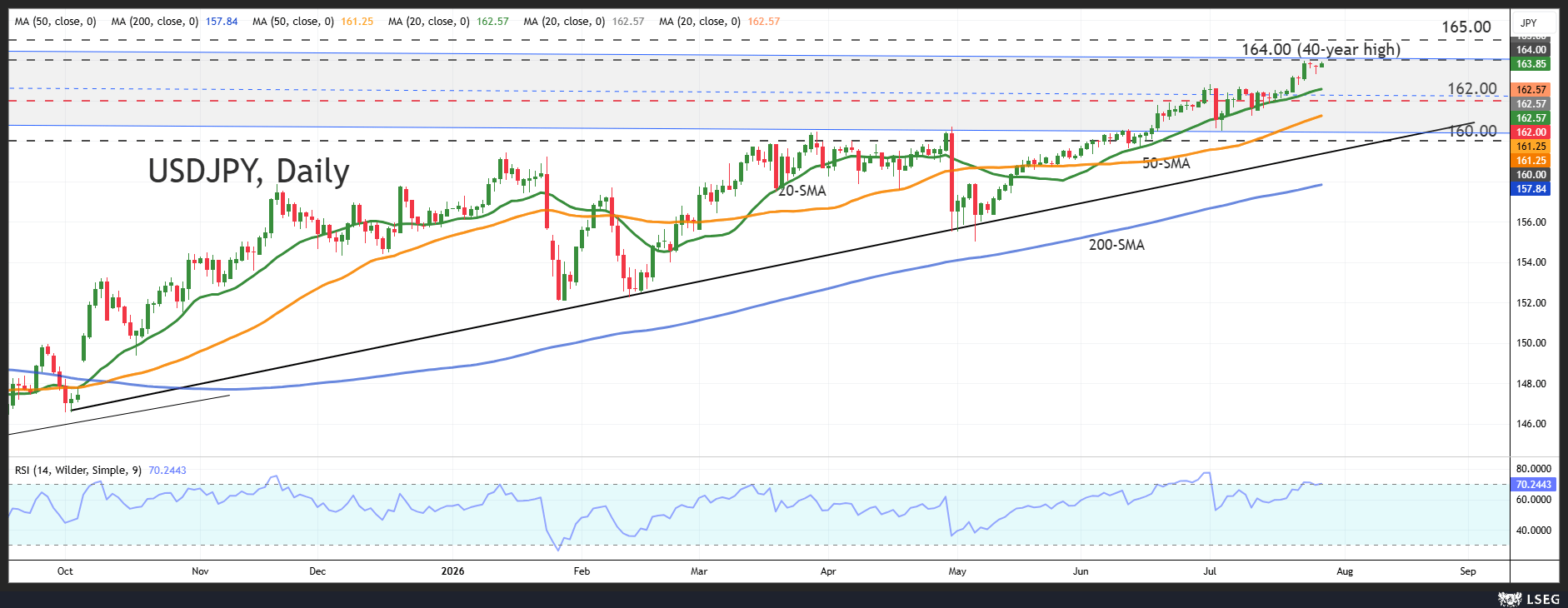
USD/JPY recently climbed to fresh 40-year highs near 164 before easing toward 163.50 levels on Tuesday, supported by the wide US-Japan yield gap and expectations that the Fed may keep policy restrictive for longer, leaving the broader bullish trend intact. Assuming that Japanese authorities don’t intervene at 164, the next key resistance is seen around the 165.00 region, with a break potentially opening the door for fresh highs.
On the downside, a hawkish shift in BoJ communication, particularly if it revives intervention concerns from Tokyo, could trigger a pullback toward 162.00, with stronger support emerging around the 160.00 area.