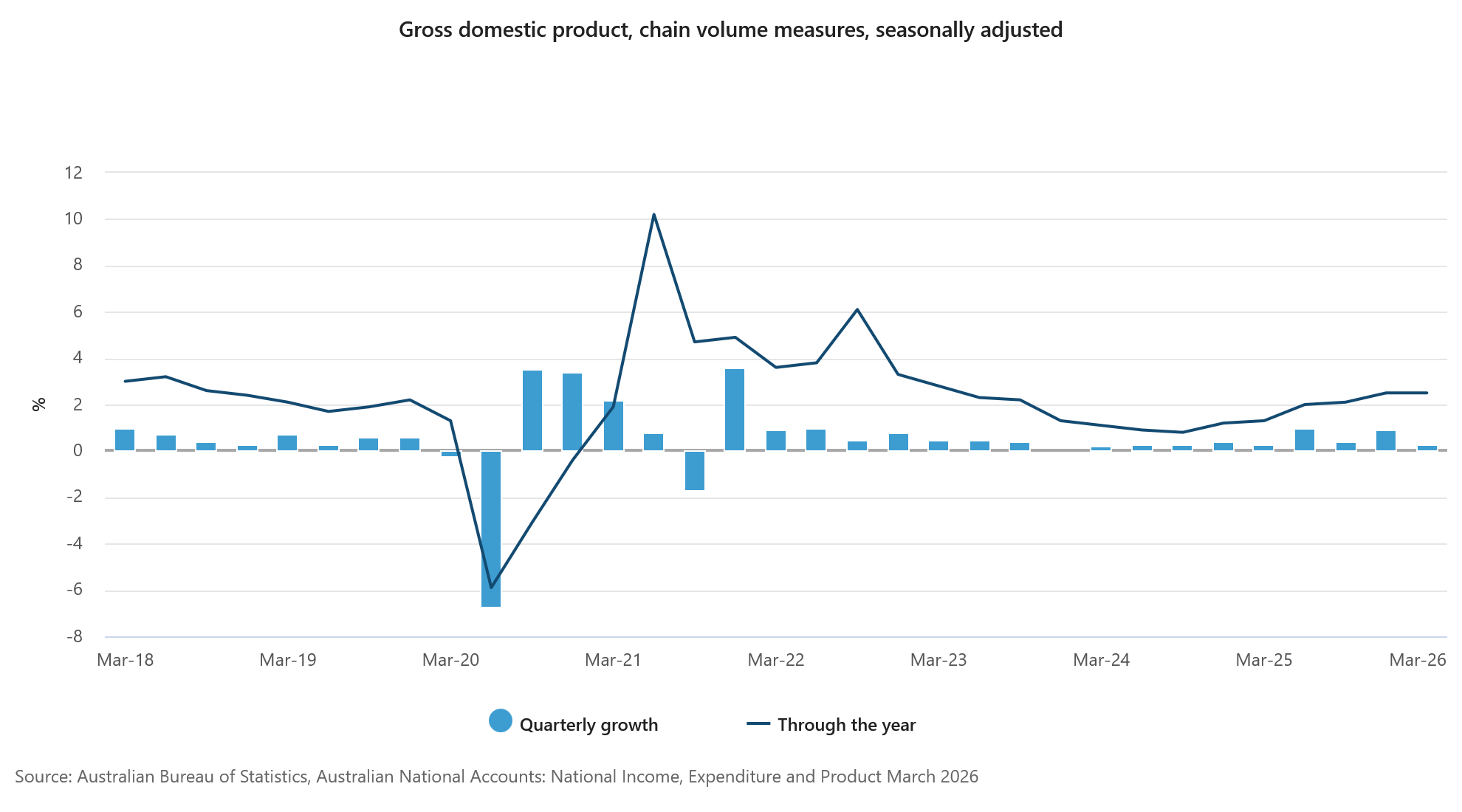
Australia’s economy grew by just 0.3% qoq in the first quarter, missing expectations of 0.5% qoq and signaling a loss of momentum at the start of 2026. Annual growth held at 2.5%. According to the Australian Bureau of Statistics, weaker household spending, softer public expenditure and weather-related disruptions all contributed to the slowdown.
ABS Head of National Accounts Grace Kim said, “Economic growth slowed in the March quarter, with modest household and public sector expenditure as well as cyclone disruptions to mining and export activities.”
A key drag came from the external sector. Exports fell -1.1%, the largest quarterly decline in two years, led by a -6.8% drop in coal exports and a -1.3% decline in mineral ores. Mining production fell -1.5%, while transport, postal and warehousing activity declined -1.3% as severe weather disrupted export-dependent industries. Combined with a 2.1% rise in imports, net trade subtracted a substantial -0.8 percentage points from GDP growth.
The brighter spot was business investment. Private investment rose 6.0%, driven by a remarkable 16.3% surge in machinery and equipment spending. Kim noted that investment in data centres across New South Wales and Victoria helped generate the largest increase in machinery and equipment investment in 30 years. However, much of the equipment was imported, limiting the positive impact on GDP.
| Indicator | Q4 2025 | Q1 2026 | Expectation |
|---|---|---|---|
| GDP Q/Q | 0.2% | 0.3% | 0.5% |
| GDP Y/Y | 2.6% | 2.5% | 2.7% |
| Component | Q1 2026 | Contribution / Comment |
|---|---|---|
| Household Spending | +0.5% | Supported by higher utility spending |
| Government Consumption | -0.2% | Weakest growth since Q3 2022 |
| Private Business Investment | +6.0% | Strongest area of the economy |
| Machinery & Equipment Investment | +16.3% | Largest increase in 30 years |
| Mining Production | -1.5% | Hit by cyclone disruptions |
| Transport, Postal & Warehousing | -1.3% | Impacted by weaker export activity |