US initial jobless claims remained near historically low levels in the latest week, reinforcing the view that layoffs continue to be limited despite signs of slower hiring elsewhere in the labor market. Initial claims rose by just 1,000 to 199,000 in the week ended August 1, slightly below market expectations of 203,000. The previous week’s figure was revised up modestly to 198,000, while the four-week moving average declined to 198,750, suggesting underlying labor market conditions remain broadly stable.
Continuing claims painted a slightly softer picture, rising 24,000 to 1.801 million in the week ended July 25, although the insured unemployment rate held steady at 1.2%. The increase suggests unemployed workers may be taking slightly longer to find new jobs, but the overall level remains consistent with a labor market that is cooling gradually rather than weakening abruptly.
The latest figures fit with other recent labor market indicators showing a “low-hire, low-fire” environment. While ADP employment and the ISM Services Employment Index pointed to softer hiring momentum, weekly claims continue to show employers are reluctant to shed workers.
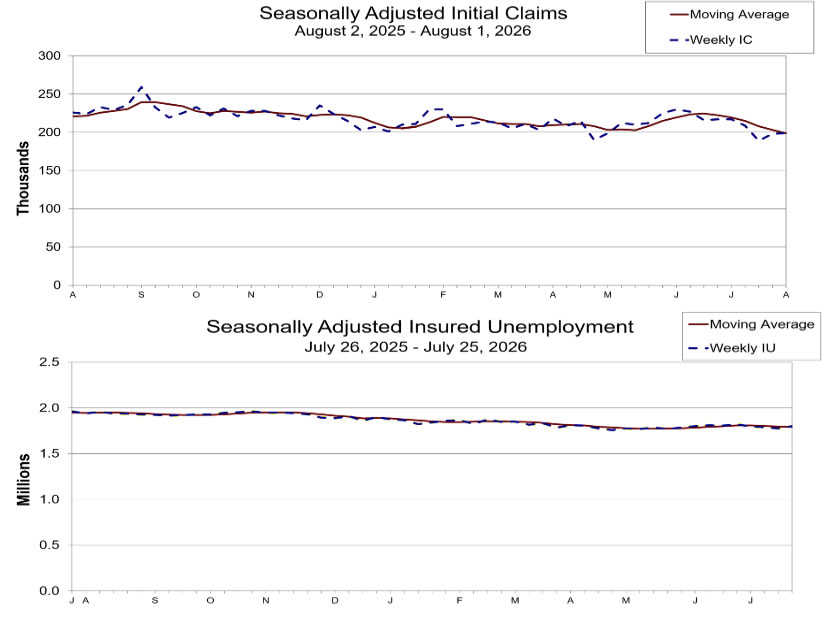
Data Summary
| Indicator | Latest | Previous |
|---|---|---|
| Initial Jobless Claims | 199K | 198K |
| Market Expectation | 203K | — |
| 4-Week Average | 198.8K | 203.3K |
| Continuing Claims | 1.801M | 1.777M |
| 4-Week Avg. Continuing Claims | 1.791M | 1.796M |
| Insured Unemployment Rate | 1.2% | 1.2% |
Key Takeaways
- Initial jobless claims edged up to 199K, remaining below the 200K mark and beating expectations of 203K, indicating layoffs remain historically low.
- The four-week moving average fell to 198.8K, suggesting there has been no meaningful deterioration in underlying labor market conditions.
- Continuing claims rose by 24K to 1.801 million, hinting that unemployed workers may be taking slightly longer to secure new jobs.
- The insured unemployment rate held steady at 1.2%, reinforcing the picture of a labor market that remains fundamentally resilient.
- The report supports the recent “low-hire, low-fire” narrative emerging from JOLTS, ADP and Fed officials—hiring has slowed, but employers are generally reluctant to lay off workers.