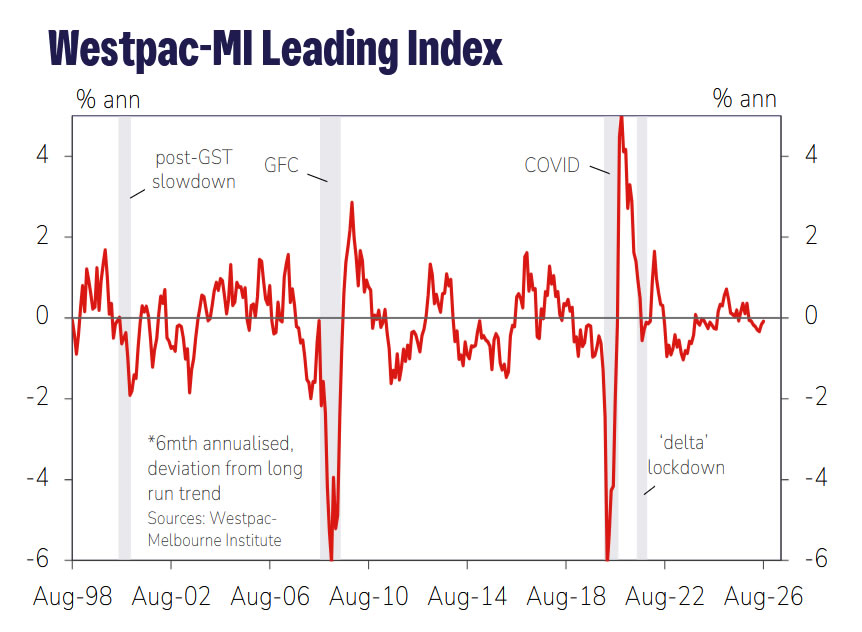
Australia’s forward growth momentum improved in August but remained slightly below trend. The six-month annualized growth rate in the Westpac–Melbourne Institute Leading Index rose from -0.17% in July to -0.09%, pointing to the likely pace of activity relative to trend over the next three to nine months. Westpac Head of Australian Macro-Forecasting Matthew Hassan said the economy appeared to be stabilizing at a slow pace rather than stalling, supported by resilient households and a strong increase in data-centre investment. Westpac raised its forecast for annual growth at the end of 2026 from 1.0% to 1.5%.
The composition was less convincing than the headline improvement. Over the six months since February, labour markets, financial markets, commodity prices and consumer sentiment collectively subtracted 0.42 percentage points from index growth. That drag was largely offset by dwelling approvals, which contributed 0.32 percentage points, and firmer US industrial production, which added 0.08 percentage points. Westpac warned that rising fuel prices, expectations of further interest-rate increases and the downturn in established housing markets could weigh more heavily on consumers and spread to other components, leaving the improved growth signal vulnerable to reversal.
That combination supports a hawkish rather than dovish policy interpretation. Westpac expects the Reserve Bank Monetary Policy Board to leave rates unchanged at its September 28–29 meeting but deliver a “very hawkish hold.” Growth is still below trend, yet its soft rather than weak pace is expected to extend through the second half of 2026 and into early 2027. Westpac believes this resilience is adding to the Board’s concern that inflation remains sticky, and still expects another rate increase after the next comprehensive quarterly inflation report is released on October 28.
Data Summary
| Indicator | August | July |
|---|---|---|
| Westpac–MI Leading Index growth rate | -0.09% | -0.17% |
Forecast Revision
| Forecast | Current | Previous |
|---|---|---|
| Year-end annual GDP growth | 1.5% | 1.0% |
Six-Month Component Contributions
| Component | Contribution |
|---|---|
| Dwelling approvals | 0.32ppts |
| US industrial production | 0.08ppts |
| Labour markets, financial markets, commodity prices and consumer sentiment | -0.42ppts |
Key Takeaways
- The Leading Index growth rate improved from -0.17% to -0.09%, moving closer to trend but remaining slightly negative.
- The index measures the likely pace of economic activity relative to trend over the next three to nine months.
- Westpac sees growth stabilizing at a slow pace rather than stalling, supported by resilient households and data-centre investment.
- Westpac upgraded its year-end growth forecast from 1.0% to 1.5%.
- The improvement was narrowly based, with dwelling approvals and US industrial production offsetting weakness across several domestic components.
- Rising fuel prices, expectations of further rate increases and the housing downturn could intensify pressure on consumer sentiment.
- Westpac expects the RBA to leave rates unchanged on September 28–29 but deliver a “very hawkish hold.”
- Another rate increase is still expected, although Westpac believes the RBA will wait for the October 28 quarterly inflation report.