


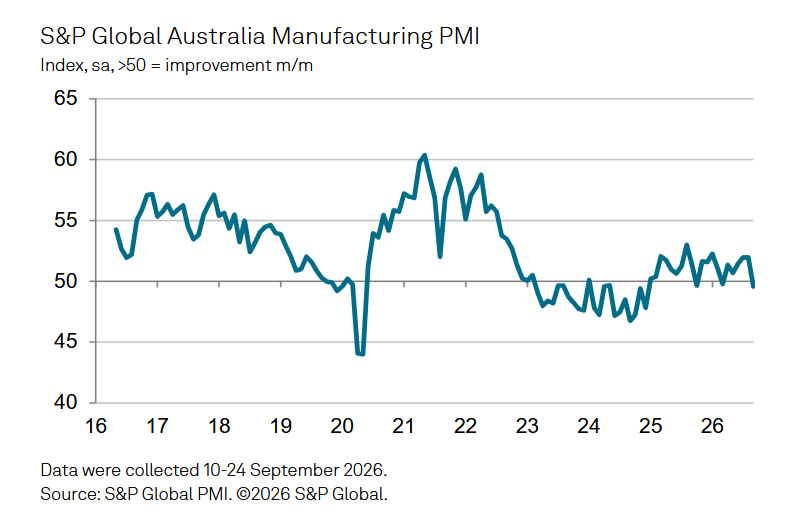
Australia’s PMI Manufacturing fell from 52.0 to 49.6 in September, slipping back below the 50.0 no-change mark and signalling the sharpest deterioration in manufacturing conditions for 21 months. The setback was led by a renewed decline in demand, with total new orders falling for the first time since June as respondents cited intense competition, rising prices and weaker underlying demand. Export orders also contracted after rising in August.
Weaker order inflows fed directly into production and employment. Output contracted for a second consecutive month, with the pace of decline the sharpest since December 2024, while manufacturing headcounts fell for the first time in five months. Backlogs declined for a seventeenth straight month, pointing to continued spare capacity, while purchasing activity was also scaled back at the fastest pace in four months. S&P Global said the latest downturn showed demand “has yet to stabilise” after improving earlier in the quarter.
Cost pressures remained elevated as Middle East shipping disruptions and severe weather around North Asia pushed up raw-material, oil and transport costs, though input-price inflation eased slightly from August. More importantly, weaker demand limited manufacturers’ ability to pass those costs on, with output-price inflation slowing to its weakest pace in seven months amid heightened competition. That leaves the sector facing an uncomfortable combination of softening demand and still-elevated costs, while business confidence also slipped to a four-month low.
Data Summary
| Indicator | Current month | Previous month | Trend |
|---|---|---|---|
| PMI Manufacturing | 49.6 | 52.0 | Fell into contraction |
Australia’s PMI Manufacturing fell from 52.0 to 49.6 in September, dropping below the 50.0 no-change mark and recording the sharpest deterioration in overall manufacturing conditions in 21 months.
Components
| Component | Trend |
|---|---|
| New Orders | Fell for the first time since June |
| Export Orders | Returned to contraction |
| Output | Fell for a second month; sharpest decline since December 2024 |
| Employment | Fell for the first time in five months |
| Backlogs | Declined for a 17th consecutive month |
| Purchasing Activity | Fell at the fastest pace in four months |
| Input Prices | Remained elevated, but inflation eased slightly |
| Output Prices | Rose at the slowest pace in seven months |
| Supplier Delivery Times | Lengthened further |
| Business Confidence | Fell to a four-month low |
The survey showed weakness spreading from demand into production, employment and purchasing, while supply disruptions kept cost pressures elevated even as firms’ ability to raise selling prices weakened.
Key Takeaways
- PMI Manufacturing fell from 52.0 to 49.6, returning the sector to contraction and marking the weakest overall conditions in 21 months.
- New orders declined for the first time since June, while export demand also deteriorated.
- Output contracted for a second consecutive month and at the sharpest pace since December 2024.
- Manufacturing employment fell for the first time in five months, while backlogs declined for a 17th straight month.
- Manufacturers cut purchasing activity as weaker orders and output reduced input requirements.
- Supply conditions worsened as Middle East shipping disruptions and severe weather around North Asia extended delivery times.
- Raw-material, oil and transport costs remained elevated, although input-price inflation eased slightly.
- Firms had less pricing power amid weaker demand and competition, with output-price inflation slowing to a seven-month low.
- Business confidence remained positive but slipped to a four-month low, reinforcing the loss of momentum at the end of Q3.





