Sample Category Title
US NFP: Expect The Unexpected
The September job report would be a good gauge to measure the output impairment
The Bureau of Labour Statistics has already issued a number of warnings about the US NFP data
The Fed is betting on higher GDP growth as we march towards the end of this year
Traders are eagerly awaiting for the US NFP payroll data and the volume in the market is going to remain low ahead of this number (due later today). This is your usual and typical Non-Farm Payroll trade. What is quite interesting is the price of the S&P and Dow Jones indices, the volatility has dropped massively in the past few days and the daily chart shows that the price is in a holding pattern (despite positive closes). Gold on the other hand is trading in a downtrend and the downward channel on a daily chart confirms this. However, the average true range has dropped massively (suggesting there is very little volatility) and the price is consistently touching the upper line of the downward channel, it suggest that the price could break to the upside.
The September job report would be a good gauge to measure the output impairment. Traders are not going to plug this number to asses the Fed stance in relation to their monetary policy decision. There is simply too much distortion in this number- not to mention the Fed is more likely to increase the interest rate in December and they would have three more reports to look at before they make any decision.
Therefore, let's just say that this would be more of a damage report due the hurricanes. The average hourly earnings and the length of the work week would provide us a good starting point to start assessing the damage impact. Usually, these two elements are used to measure the strength of the job market which is one of the pillar of the Fed monetary policy. The greater the household income, which is dependent on the above two components, the higher the consumer spending. An increase in the consumer spending provides a true colour about the consumer sentiment and it also boosts the GDP growth.
The Fed is betting on higher GDP growth as we march towards the end of this year and for that to happen, we need the consumer spending number to remain healthy.
The Bureau of Labour Statistics has already issued a number of warnings that the US non-farm data would be impacted by the hurricanes. What the smart money would be doing is to keep in mind that there would be several revisions of this number, so the investors are going to take this number with a pinch of salt. Such strategy would enable them to strike with a vengeance when the best opportunity would present itself.
Having said all this, the market participants are widely expecting a downward surprise, but a real surprise could be if the number actually isn't as bad as the consensus. The possibility of such an event taking place is likely because the employment component of the services ISM increased this week. The employment component of the manufacturing ISM also printed much better number. Finally, the challenger report confirmed 27% drop in lay offs. The ISM manufacturing number was also a blow out number. The biggest surprise is when the something happens when it is least expected.
Technical Outlook: GBPUSD – Bears Firmly In Play On Political Uncertainty
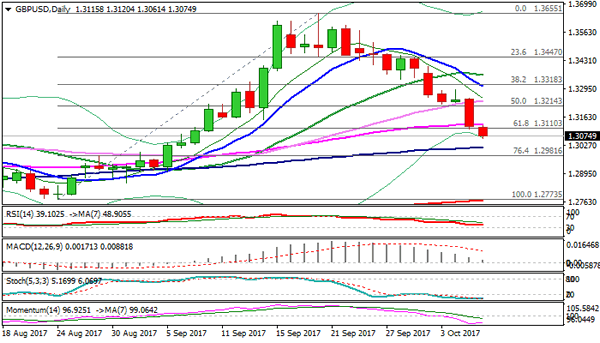
Cable remains in red on Friday and extends strong fall from the previous day, as rising political uncertainty over PM May’s future continue to heavily weigh on sterling.
Fresh bears on Friday broke below 1.3110 (Fibo 61.8% of 1.2773/1.3655 rally), generating bearish signal which could drive the pair towards 1.3015 (100SMA) and psychological 1.3000 support.
Bearish techs and rising negative sentiment are supportive for further losses, which could be additionally boosted if US jobs data surprise at the upside.
Meanwhile, bears may take a breather on oversold studies but no firmer signals seen for now as slow stochastic continues to head south in deeply oversold territory.
Broken Fibo 61.8% support and 55SMA now act as solid resistances at 1.3110/1.3128, as the latter is so far capping today’s action.
Only firm break here would sideline immediate bearish threats.
Res: 1.3128, 1.3200, 1.3220, 1.3250
Sup: 1.3061, 1.3015, 1.3000, 1.2981
Technical Outlook: EURUSD Is In Red And Near Seven-Week Low Ahead Of US Jobs Data
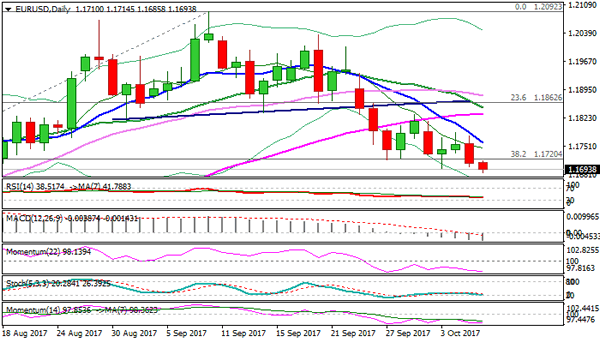
The Euro hit new seven-week low at 1.1685 in late Asian trading on Friday, pressured by fresh strength of the US dollar ahead of key event – US jobs report, due later today.
The EURUSD pair eventually broke and closed below strong support at 1.1720 (Fibo 38.2% retracement of 1.1118/1.2092 rally) which kept bears limited during the past week.
Strong bearish acceleration on Thursday commenced after falling 10SMA repeatedly capped recovery attempts and left long bearish daily candle which weighs on near-term action.
Close below 1.1720 pivot was bearish signal for attack at initial support at 1.1662 (17 Aug trough) and extension towards next targets at 1.1604 (daily cloud base) and 1.1594 (rising 100SMA).
Falling 10SMA / daily Tenkan-sen (currently at 1.1761/73) mark strong barriers which are expected to keep the upside protected, while close above would generate initial reversal signal.
Overall picture of US jobs sector in September will define near-term direction of the dollar and its major counterparts.
Forecast for NFP for only 90K new jobs created in September is seen affected by hurricanes that hit US states on the south, but wages are expected to rise, according to the forecast for September at 0.3% vs 0.1% in August.
Better than expected numbers on today’s release would additionally support the greenback and send the single currency further down.
Alternative scenario sees dollar under pressure on NFP report’s miss.
Res: 1.1720, 1.1762, 1.1773, 1.1832
Sup: 1.1685, 1.1662, 1.1604, 1.1594
World Economy In A Sweet Spot
Global economic momentum remains strong...
The global economy is enjoying fairly strong momentum. The expansion is synchronised across different regions: euro area real GDP, for example, grew at its fastest pace since 2011; in the US, uncertainty about the policy outlook has so far not undermined investor and consumer sentiment, which remains at multi-year highs. Even in China, economic growth has held up surprisingly well, despite signs of a slowdown earlier this year amid a tightening of credit standards in the real estate sector. Large commodity-producing emerging markets such as Russia and Brazil, which were badly hit by the fall in commodity prices, are getting back on their feet. Private consumption is currently the main driver of the global recovery following a sharp reduction in unemployment rates and higher real wage growth in many countries. There are also signs that private investment is picking up, aided by increasing capacity constraints, low global interest rates and a solid global economic outlook. The solid momentum in the world economy is boosting global trade.
...as a result, we raise our forecast for the global economy
In light of the stronger-than-expected momentum in the world economy, over the past couple of months we have raised our global growth forecasts. We now expect the world economy to expand by 3.6% in 2017 and 2018 (almost half a percentage point higher than in June). While we are slightly more positive on US growth in 2018, the main upward revisions stem from the euro area, Japan and, to some degree, China:
The momentum in the euro area economy is particularly strong due to strong domestic and external demand. The somewhat slower growth in 2018 is a combination of moderation in private consumption and weaker contribution from net exports due to EUR strength and slowing growth in key export market China.
In the US, we have revised up our forecast for 2018 due to strong underlying growth. We are still sceptical about a fiscal boost from tax reform or infrastructure spending given the divisions in the Republican Party (see our flash comment on the tax reform: Still a long way to go for tax reform, 28 September 2017). The approval of tax reform would, therefore, offer upside to our forecast. We do not expect the weaker USD to have a material impact on net exports given the fairly closed nature of the US economy and a large part of the US trade being quoted in USD.
In China, we have lifted our real GDP forecasts for both 2017 and 2018 (by about 0.3pp compared with our June forecast). However, we still see slower growth next year as we expect the housing market to cool, spilling over to weaker construction growth. However, we do not expect a hard landing, as housing inventories are fairly low (in contrast to 2014) and the export sector should experience robust growth as the US and euro area recovery looks set to continue.
In Japan, we expect growth to continue through fiscal year 2017 raising the annual real GDP growth estimate to 1.7% (vs. 1.2% in June), supported by a strong labour market, the global economic recovery and extremely accommodative policies. As fiscal stimulus wanes next year, we would expect growth rates to fall closer to potential with real GDP growing about 1.4%.
Inflation pressures to remain modest...
Despite the solid economic growth and low unemployment rates in many countries, global inflation pressures remain muted. After rising sharply in 2016, inflation generally fell back in the first half of 2017. Oil prices drive most of the swings in inflation, and with prices no longer moving much higher from here, we expect the impact on inflation to ease. The outlook for underlying inflation is still muted; we expect core inflation to remain below 2% in the US and (particularly) the euro area until at least 2018. One of the reasons is continuing low wage pressures even in countries where little slack is left in the economy, such as the US and Germany; probably as inflation expectations have come down over the past few years. Another reason is easing inflation in emerging markets, where it is at the lowest level ever. A possible slowdown in China could weigh on global inflation through weaker commodity prices
...preventing central banks from pulling the emergency brake for the time being
With the modest inflation outlook, we expect the major central banks to only gradually remove the massive monetary stimulus put in place since the financial crisis. The Fed has raised rates three times so far and we expect it to raise rates another three times over the next year, with the next rate hike expected in December. Still this marks a relatively gradual hiking cycle compared with the past. Furthermore, the Fed is set to start a modest reduction of its balance sheet in October 2017, gathering pace in 2018, while the ECB is set to continue its QE purchases going into next year, albeit at a reduced pace of EUR40bn per month, keeping policy rates unchanged at least until 2019. Meanwhile, we expect the BOJ to continue its highly accommodative policies for a considerable time as inflation pressures remain muted compared with the central bank's target. In light of the modest scaling back of central bank balance sheets, global liquidity is likely to remain ample for some time.
Base scenario supportive for equities and bearish for bonds
In light of the strong macroeconomic momentum, we remain positive on equities. We increase our overweight in developed market equities to 10%, as under the current positive macro conditions companies should be able to increase earnings through increasing sales growth. New investments should, at the same time, support cost cutting/efficiency gains, and thereby pave the way for continuous delivery of stronger earnings growth rates than in recent years. Naturally, strong global economic momentum tends to be bearish for fixed income. In addition, we expect somewhat higher yields in 2018. However, the muted inflation outlook, combined with modest tightening by the central banks, should keep a lid on the upward move.
Risk factors to watch
The risks to our growth forecasts are seen as broadly balanced. On the downside, the main risks to growth come from an unexpected sharp rise in inflation, triggering an abrupt tightening of monetary policies, a stronger-than-expected slowdown in China, a potential trade war and a military conflict with North Korea (which we see as a low probability-high impact event). On the upside, there is a possibility of a more upbeat investment outlook than we forecast due to pent-up demand in Europe after many years of weak corporate spending and the approval of significant tax reform in the US raising the economy's potential growth rate.
EURUSD Analysis: Rebounds From 200-Hour SMA
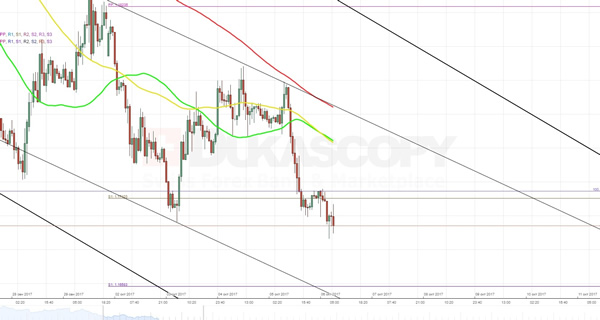
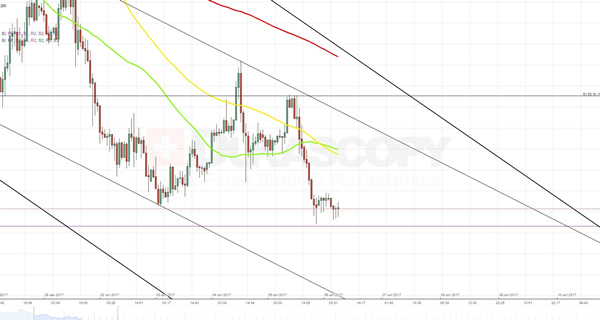
In result of the previous trading session, the currency exchange rate made a rebound from a combined resistance set up by the 200-hour SMA and the upper edge of a junior descending channel. In addition to that, the pair managed to break through the 100% Fibonacci retracement level and the weekly S1 again. On the one hand, this plunge shows that movement of the rate is still guided by a downtrend formed approximately a month ago. On the other hand, a daily chart indicates that the pair is about to reach the lower support line of a dominant falling wedge pattern. There is a need to take into account that this boundary is additionally secured by the monthly S1 at 1.15658 plus the pair is moving within the long-term uptrend. Hence, the further surge is likely to follow.
GBPUSD Analysis: Falls From Descending Channel
In line with expectations, traders used the 55-hour SMA as a benchmark to push the rate in the southern direction. The main role in the yesterday’s downfall played a release of better than expected US employment data as well as Govern Powell’s and the BOE MPC Members’ McCafferty and Haldane speeches. Because of a quite sharp depreciation of the Pound against the Dollar, the pair not only fell from a descending channel, but also crossed the 38.2% retracement level at 1.3145. The fact that the average market sentiment remains 59% bullish and the fact that 55% of traders are willing to purchase the Sterling suggests that the pair is likely to make a rebound either from the weekly S3 at 1.3078 or from an area near the psychological 1.30 level.
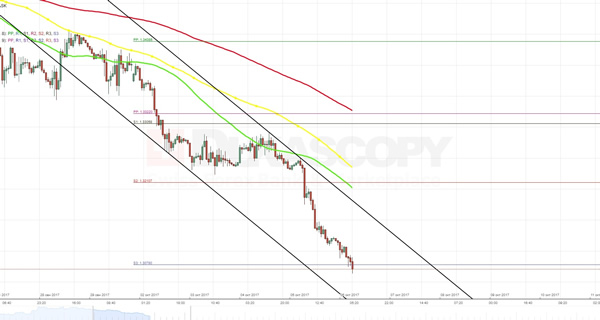
USDJPY Analysis: Heads Towards 113.21
In first half of the day the pair continued to move, as expected. However, a speech delivered by Governor Powell created a favourable impulse for the buck and elevated it against the Yen by 0.36% just in couple of hours. The fact that the pair did fall below the 112.40 level and made a rebound additionally confirms that it is moving in a medium-term ascending triangle. As the pair faces no barriers on its way, it is likely to surge to the upper resistance line of this pattern, which is located at the 113.21 level. Although a fourth rebound seems a more plausible scenario, there is a need to take into account an effect from a release of information about the US labour market later this day, which might lead to premature breakout.
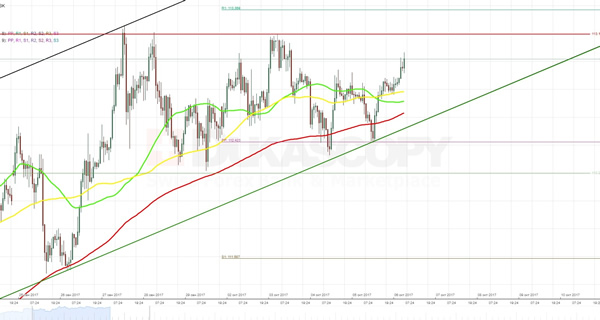
XAUUSD Analysis: Fails To Break Below 1,273.20 Again
In accordance with expectations, the yellow metal managed to restore some lost positions against the buck yesterday. However, this surge lasted only until the pair hit the 61.8% Fibonacci retracement level, which matched with beginning of Governor Powell’s speech. In result of the downfall, the pair approached the weekly S1, which is located at the 1,266.63 level. Although the first attempt to break to the bottom was not successful, eventually the pair is expected to bypass this barrier. Not only because the northern path is now secured by a combination of the 55-hour and 100-day SMAs, but also because the rate is moving in a medium-term downtrend, which should lead it to the bottom trend-line of a dominant, long-term ascending channel.
USD/CAD: Canadian Trade Balance
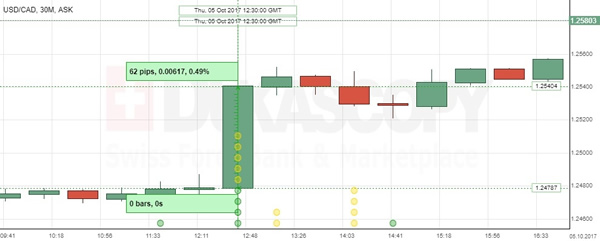
The Canadian Dollar weakened significantly against the US Dollar on account of data showing unexpectedly widened Canadian trade deficit. Following the report, the USD/CAD jumped by 62 base points or 0.49% to 1.2540, the strongest rate since August 31.
Statistics Canada revealed that the country's trade deficit widened more than anticipated to the 3.4B in the month of August, missing forecasts for a lower deficit of 2.6B. Weak report raised hopes that the Bank of Canada is unlikely to raise key interest rates one more time this year. Meanwhile, a separate report on the US trade balance revealed a 42.4B deficit versus 42.7B expected in the same period, providing additional support for the Greenback.
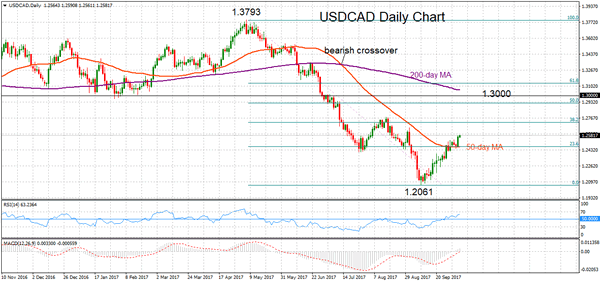
USDCAD Short-Term Bullish Above 50-Day MA, Underlying Trend Remains Bearish
USDCAD is in a bullish phase in the short term after rebounding from its lowest level since May 2015. The pair broke above the 50-day moving average this week, giving a bullish signal. RSI has crossed above 50 into bullish territory. The market structure on the daily chart is still bearish, with lower highs and lower lows since the May 5 high of 1.3793. The crossover of the 50-day MA below the 200-day MA highlights the bearish picture.
The pair has reached the upper 1.25-area after rising from 1.2061 and is now finding support at the 50-day MA at 1.2463. This support level is considered to be strong since it is the 23.6% Fibonacci retracement level of the May to September downleg. Momentum signals are bullish, giving scope for further upside in the market to target the 1.27 handle, with important resistance levels at 1.2718 (38.2% Fibonacci) and 1.2777 (August 15 high). USDCAD would need to reclaim the key 1.3000 area to indicate that the broader bearish trend has ended.
Falling below the 50-day MA would increase downside pressure and turn focus back to the 1.2061 low. From this point, additional losses are expected towards the next low at 1.1919. An extension below this point would strengthen the underlying bearish bias.
The short-term bullish bias has room to run as long as USDCAD can remain above the 50-day MA and momentum signals continue to rise. Near-term risk is tilted to the upside but it cannot be said there is a reversal in the underlying downtrend.